
LEAD ANALYST
Utkarsh Khirodkar is a Lead Market Research Analyst at MetaStat Insight, specializing in market intelligence, technology sector assessments, and competitive strategy.

Stationary Pyrometer and Infrared Cameras Market Size, Share, By Type (Stationary Pyrometer and Stationary Infrared Cameras), By End Users (Metal, Glass, Cement, Lime, Power Generation, Waste-to-Energy Utilities, Oil, Gas, Petrochemical, Chemicals, Pulp, Paper Producers, and Others), Industry Analysis, Growth, Trends, and Forecast, 2026-2033
Report ID
MSI-4546
Published
February, 2026
Pages
300 Pages
Format
Report Details
Choose Your License
Stationary Pyrometer and Infrared Cameras Market
The global Stationary Pyrometer and Infrared Cameras market size is valued at USD 2,886.6 million in 2025.
The market is projected to grow from USD 3,129.6 million in 2026 to USD 5,179.7 million by 2033, exhibiting a CAGR of 7.5% during the forecast period.
Global Stationary Pyrometer and Infrared Cameras market valued at USD 2,886.6 million in 2025, growing at a CAGR of around 7.5% through 2033, with potential to exceed USD 5179.7 million.
North America holds 30.8% share in 2025, with the United States leading the region.
Stationary Pyrometer segment accounted for around 9.5% share in 2025, supported by broad deployment in high-temperature process monitoring.
Key trends driving growth: Tightened quality, safety, and energy-efficiency requirements across metals, glass, cement, chemicals, and power support continuous, non-contact temperature control.
Opportunities include IIoT-ready, Al-assisted analytics that fuse thermal data with process variables to enable autonomous control loops, digital twins, and remote service.
Key insight: The increasing demand for accurate, non-contact temperature measurement in industrial processes is shaping the growth path of the global stationary pyrometer and infrared camera market.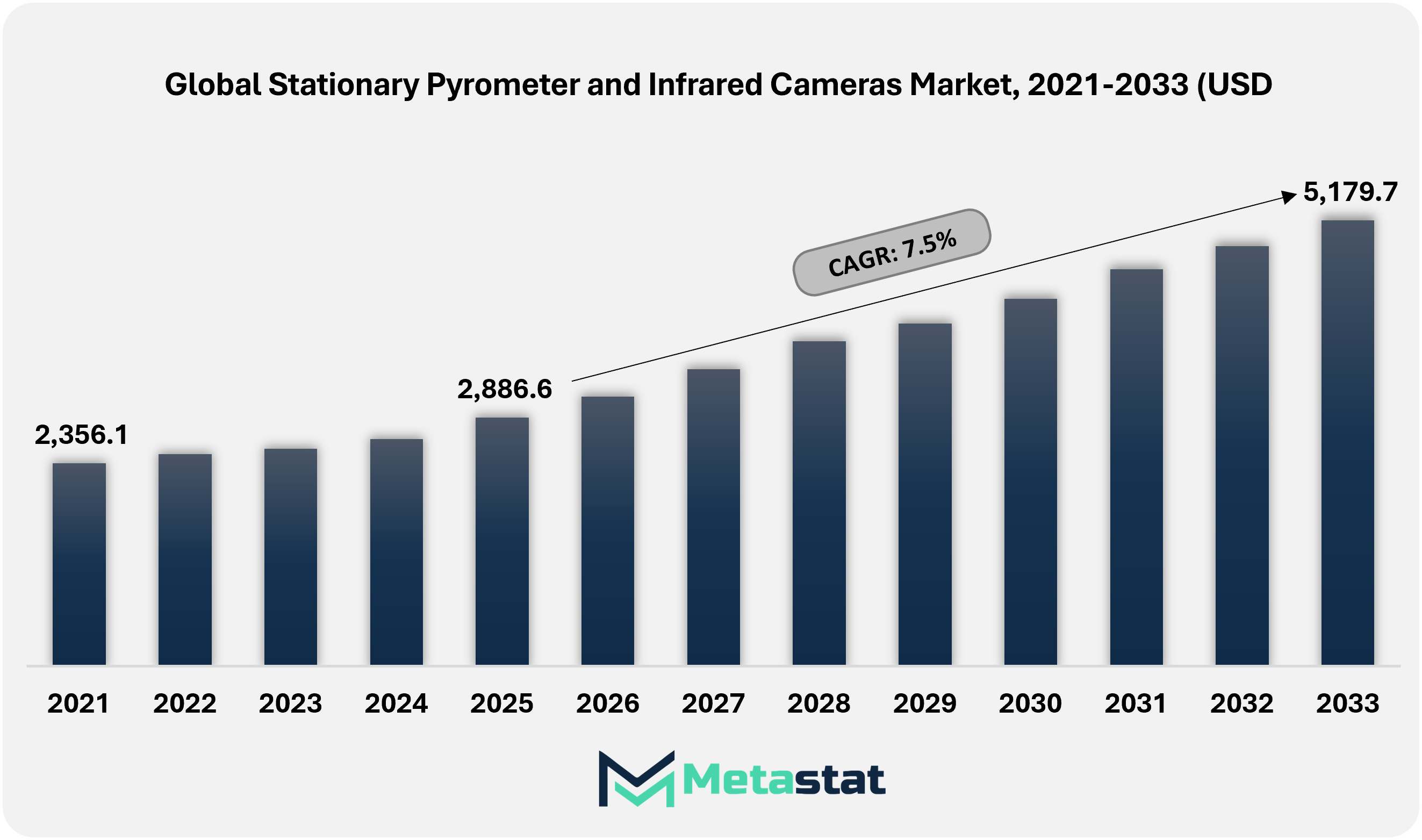
Stationary pyrometers and infrared cameras within industrial sensing and thermal imaging will move beyond traditional measurement boundaries and increasingly shape how industries interpret heat as strategic data rather than a control variable. Instead of being limited to temperature verification at fixed points, these technologies will be embedded in intelligent production ecosystems where thermal behaviour will predict material fatigue, process drift and operational anomalies long before visible failures emerge.
In advanced manufacturing environments, stationary pyrometers and infrared cameras will be designed to interact with digital twins, allowing virtual process simulations to be automatically adjusted based on live thermal feedback. The change will transform heat monitoring into a decision-support layer that will impact scheduling, maintenance planning, and energy allocation without human intervention. The value will lie not just in measurement accuracy, but in contextual interpretation of thermal patterns across time.
The worldwide market for fixed pyrometers and infrared cameras is expected to expand due to the increasing adoption of stringent quality, safety, and energy efficiency standards in metalworking, glass production, cement production, chemicals, and power plant applications. Continuous and non-contact temperature measurement promotes a stable process, conserves resources, and thus represents a factor for sustainable development. Future production will use effective thermal control management.
The international market for stationary pyrometers and infrared cameras will receive a boost from the application of Industry 4.0 technology, based on real-time monitoring and predictive maintenance for automated production lines to achieve better decision-making through thermal sensing. Manufacturing environments will increasingly rely on connected systems that align temperature data with smart automation goals.
The global stationary pyrometer and infrared camera market will face dust, steam, flames, and glare, along with emissivity and reflectivity uncertainty that impact measurement accuracy. Specific configuration and efficient calibration remain necessary. Challenging industrial conditions will continue to demand technical expertise to maintain reliable performance.
The global stationary pyrometer and infrared camera market will see slower adoption in cost-sensitive sites, linked to high upfront and lifecycle costs. Rugged equipment, protective enclosures, cooling systems, calibration requirements, and integration efforts increase ownership costs. Budget-focused operations will weigh these factors against simpler contact-based options.
The global stationary pyrometer and infrared camera market will expand through IIoT-ready and AI-supported analytics that connect thermal data with process variables. Autonomous control loops, digital twins and remote service models will gain momentum. Future industrial systems will prefer intelligent thermal solutions that support self-adaptation and remotely managed operations.
The global Stationary Pyrometer and Infrared Cameras market is mainly classified based on Type, and End Users.
Stationary Pyrometer segment was valued at USD 296.2 Million in 2026 and is projected to reach USD 406.6 Million by 2033, at a CAGR of 4.6% during the forecast period.
Stationary pyrometers will gain widespread acceptance due to the demand for continuous, non-contact temperature measurements in high-temperature operations. Industrial facilities will rely on these systems for stable readings, less downtime, and better-quality control. Integration with digital control platforms will support faster decision-making and consistent process outcomes.
Stationary Infrared Cameras segment was valued at USD 2,833.4 Million in 2026 and is projected to reach USD 4,773.1 Million by 2033, at a CAGR of 7.7% during the forecast period.
Stationary infrared cameras will support advanced thermal imaging requirements in automated plants. Continuous visual temperature mapping will help identify heat loss, equipment stress, and operational risks. Future deployments will focus on real-time analytics, remote monitoring, improved resolution, proactive maintenance strategies, and supporting safe working conditions.
Metals & Primary Metals Producers segment is projected to reach USD 1,930.9 Million by 2033, at a CAGR of 7.5% during the forecast period.
Metals and primary metals producers will depend on thermal monitoring to manage furnaces, casting lines, and rolling operations. Accurate temperature visibility will improve product consistency and energy efficiency. Future production environments will prioritize connected thermal systems that support automation goals and reduce material waste during high temperature processing.
Glass Manufacturers segment is projected to reach USD 969.8 Million by 2033, at a CAGR of 7.8% during the forecast period.
Glass manufacturers will use thermal solutions to maintain precise control over melting, forming, and annealing processes. Stable temperature management will support uniform product quality and reduced defects. Forward-looking facilities will integrate thermal data with process controls to support sustainability targets and lower fuel consumption.
Cement and Lime Producers segment is projected to reach USD 719.5 Million by 2033, at a CAGR of 6.8% during the forecast period.
Cement and lime producers will adopt thermal monitoring to manage kilns and optimize combustion efficiency. Continuous temperature feedback will support consistent output quality and emission control. Future operations will focus on energy optimization and regulatory compliance through advanced thermal measurement technologies.
Power Generation & Waste-to-Energy Utilities segment is projected to reach USD 622.2 Million by 2033, at a CAGR of 7.5% during the forecast period.
Power generation and waste-to-energy utilities will continue to use thermal systems to monitor boilers, turbines, and combustion zones. Precise heat tracking will enhance the reliability and lifespan of their operations. Digital integration will enable predictive maintenance, along with ensuring continued energy supply as facilities become even more automated.
Oil & Gas & Petrochemical Operators segment is projected to reach USD 530.7 Million by 2033, at a CAGR of 8.2% during the forecast period.
Thermal monitoring will be deployed by operators of oil, gas, and petrochemicals to ensure increased safety and stability of processes. It facilitates the early detection of anomalies in reactors, pipelines, and storage units through continuous temperature observations. Future investments will favor intelligent systems that reduce exposure to risk and support continuous production cycles.
Chemicals, Pulp and Paper Producers segment is projected to reach USD 271.5 Million by 2033, at a CAGR of 6.6% during the forecast period.
Producers of chemicals and pulp and paper will apply thermal solutions to maintain controlled reactions and drying processes. Reliable temperature data will improve efficiency and product consistency. Future plants will integrate thermal monitoring with centralized systems to support cost control and environmental performance.
Others segment is projected to reach USD 135 Million by 2033, at a CAGR of 6.5% during the forecast period.
The automation continues to spread into various applications; other industrial sectors will increasingly adopt thermal monitoring. Flexible and scalable solutions that provide quality assurance and equipment protection will be in greater demand.
Based on geography, the global Stationary Pyrometer and Infrared Cameras market is divided into North America, Europe, Asia-Pacific, South America, Middle East, and Africa.
North America Stationary Pyrometer and Infrared Cameras Market is set to expand at a CAGR of 7.5% during the forecast period, reaching a market size of USD 1466.8 million by 2033.
Adoption of automation and smart manufacturing systems will drive more dependence on non-contact temperature measurement solutions in the North American market.
Quality control and safety regulations across aerospace, automotive, and energy operations in North America will support adoption of advanced infrared and pyrometer systems.
The Asia-Pacific development of large-scale production units in China, the Indian subcontinent, and Southeast Asia will give rise to new applications of fixed thermal monitoring systems.
There are expected to be increased expenditures in semiconductor fabrication, steel production, and renewable energy to provide long-term opportunities for enhanced IR imaging.
Across the Middle East, Africa, and South America, uneven yet steady industrialization across energy, mining, and infrastructure sectors is driving gradual adoption of infrared temperature technologies for process control, efficiency improvement, and long-term asset protection despite near-term budget constraints.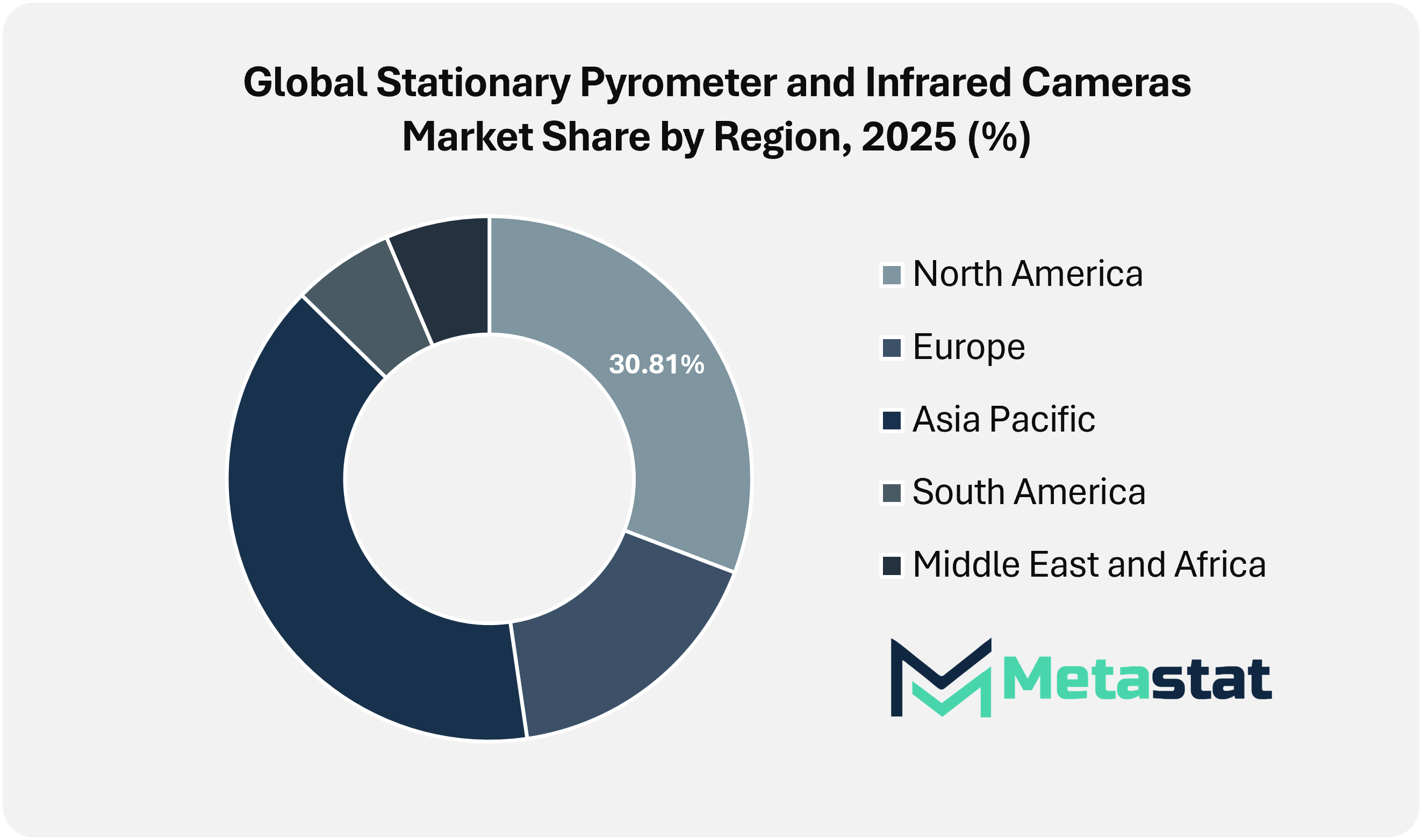
The Global Stationary Pyrometer and Infrared Cameras Market is driven by a broad range of manufacturers engaged in precise temperature measurement. These manufacturers will continue to support various industries such as metals, glass, energy, electronics, and manufacturing. In fact, stable heat control is critical for all such industries. In turn, the demand for global market revenue will be driven by the increasing use of infrared cameras for thermal imaging purposes. These cameras are extensively used for numerous industrial thermal imaging applications.
The well-established companies, including Teledyne FLIR LLC, Fluke Corporation through its Fluke Process Instruments, and AMETEK through its Land Instruments International Ltd, have positioned themselves as key market players through the supply of reliable and accurate instruments, supported by quality services and the ability to reach out into the international market. The other companies, such as Optris GmbH, Advanced Energy Industries, Inc., CHINO Corporation, and Williamson Corporation, have positioned themselves through the supply of solutions to cater to specific industrial requirements, such as fast measurement and the monitoring of temperature without contact.
European manufacturers, including Sensortherm GmbH, Heitronics Infrarot Messtechnik GmbH, Keller HCW GmbH, Calex Electronics Ltd., DIAS Infrared GmbH, Micro-Epsilon, Infratech GmbH, Workswell s.r.o., Axis Communications AB, and Mobotix AG contribute strongly to innovation in infrared sensing and imaging. The key companies often emphasize accuracy, durability, and integration with existing systems, making their products suitable for complex industrial environments. Also, Omega Engineering Inc. and companies like Keyence Corporation continue to expand their portfolio with user-friendly designs that simplify installation and daily use.
Other significant contributors, such as Hangzhou MicroImage Software Co., Ltd. (HickMicro), Seek Thermal, Inc., Telops Inc., and Banner Engineering Corp. bring new perspectives through advanced imaging software, compact camera designs, and smart sensing technologies. Their presence adds healthy competition and encourages rapid growth across the market. Together, these industry players will play a central role in shaping how stationary pyrometers and infrared cameras are used to improve efficiency, safety, and decision-making in industrial operations worldwide.
Market size is forecast to rise from USD 2886.6 million in 2025 to over USD 5179.7 million by 2033.
The global stationary pyrometers and infrared cameras market will also redefine compliance and quality verification by enabling continuous, non-contact verification in sealed or hazardous areas. Rather than inspection after the process, thermal assurance will be provided during execution, reducing reliance on destructive testing. With the industry prioritizing precision, consistency, and predictive intelligence, these systems will evolve into silent observers that turn heat into foresight, expanding their role beyond traditional monitoring expectations.
This research report categorizes the Stationary Pyrometer and Infrared Cameras market based on key segments and regions, forecasts revenue growth, and analyzes trends in each submarket. The report analyses the key growth drivers, opportunities, and challenges influencing the Stationary Pyrometer and Infrared Cameras market. Recent market developments and competitive strategies such as expansion, product launch, development, partnership, merger, and acquisition have been included to draw the competitive landscape in the market.
The report strategically identifies and profiles the key market players and analyses their core competencies in each sub-segment of the Stationary Pyrometer and Infrared Cameras market.
|
Report Attributes |
Details |
|
Study Period |
2021-2033 |
|
Base Year |
2025 |
|
Estimated Year |
2026 |
|
Forecast Period |
2026-2033 |
|
Historical Period |
2021-2025 |
|
Growth Rate |
CAGR 7.5% from 2026 to 2033 |
|
Revenue Unit |
USD Million |
|
Sales Volume Unit |
Thousand Units/ K Units |
|
Segmentation |
By Type, End Users, and Region |
|
By Region |
North America (By Type, End Users, and Country)
|
|
|
Europe (By Type, End Users, and Country)
|
|
|
Asia Pacific (By Type, End Users, and Country)
|
|
|
South America (By Type, End Users, and Country)
|
|
|
Middle East and Africa (By Type, End Users, and Country)
|
Find answers to common questions about this report
The Metastat Insight study shows that the global Stationary Pyrometer and Infrared Cameras market size was USD 2886.6 million in 2025.
The global Stationary Pyrometer and Infrared Cameras market is likely to grow at a CAGR of 7.5% over the forecast period (2026-2033).
The Metastat Insights analysis shows that the North America Stationary Pyrometer and Infrared Cameras market size is estimated to be USD 1466.8 million by 2033.
The Stationary Infrared Cameras segment is the leading type of segment in the global market.
Tightened quality, safety, and energy-efficiency requirements in metals, glass, cement, chemicals, and power drive continuous, non-contact temperature control and Industry 4.0 adoption-real-time monitoring, predictive maintenance, and edge analytics-pulls through pyrometers and thermal imagers into automated lines are key driving factors, boosting the market.
North America region dominates the market.
Emissivity/reflectivity uncertainty and environmental interference (dust, steam, flames, glare) can degrade accuracy and demand expert setup will hamper the market growth within the forecast period.
Global Stationary Pyrometer and Infrared Cameras market is estimated to reach USD 5179.7 million by 2033.
Top players operating in the Stationary Pyrometer and Infrared Cameras industry include Teledyne FLIR LLC, Fluke Corporation (Fluke Process Instruments), AMETEK (Land Instruments International Ltd), Optris GmbH, Advanced Energy Industries, Inc., CHINO Corporation, Williamson Corporation, and Sensortherm GmbH.
The analysts below cover Machinery & Equipment research at Metastat Insights.
LEAD ANALYST
Utkarsh Khirodkar is a Lead Market Research Analyst at MetaStat Insight, specializing in market intelligence, technology sector assessments, and competitive strategy.

INDUSTRY CONSULTANT - CHEMICALS & ADVANCED MATERIALS
Chemicals and Materials · Machinery & Equipment · Packaging
Amit Gadhekar Consultant for Chemicals and Materials at MetaStat Insight, directing sector-specific intelligence, research, and strategic consulting across global chemical and processing markets.

PRINCIPAL CONSULTANT - QUALITY SYSTEMS & COMPLIANCE
Electronics and Semiconductor · Machinery & Equipment · Professional Services
Omkar Phadtare is an Industry Consultant at MetaStat Insight, specializing in quality systems, regulatory compliance, and standards benchmarking to drive data-driven market intelligence and strategic industry research.

ENERGY & INFRASTRUCTURE INDUSTRY CONSULTANT
Automotive and Transportation · Electronics and Semiconductor · Energy and Power · Machinery & Equipment
Saurabh Vasant Ganvir consults for Energy & Infrastructure Industry at MetaStat Insight, specializing in renewable energy, solar EPC, and electric vehicle (EV) infrastructure markets.

LEAD CONSULTANT - COMMUNICATION, TELECOM, AND IT
Electronics and Semiconductor · Information & Technology · Machinery & Equipment · Professional Services
Ravindra Sathe Consultants for Communication, Telecom, and IT at MetaStat Insight. He leads the firm's industry research initiatives across telecommunications infrastructure, digital connectivity, enterprise networking, and emerging information technology domains.
Assessing 200mm wafer transition schedules and substrate supply bottlenecks requires precise technical intelligence. MetaStat Insight supplied an actionable breakdown comparing planar and trench MOSFET architectures across automotive and industrial drive markets. The regional capacity estimates for Asia-Pacific foundries helped clarify lead-time uncertainties during our strategic planning session. When we needed additional clarification on high-purity raw material sourcing, their analyst team responded with helpful context within twenty-four hours.
Tracking maintenance cycle demand for secondary flight display units and terrain collision avoidance systems across regional jet fleets involves complex aftermarket dynamics. MetaStat Insight provided practical analysis separating airline retrofit programs from OEM forward-fit production schedules in North America and Southeast Asia. The supplier matrix highlighted component obsolescence timelines without resorting to vague generalizations. The dataset served as a dependable reference during our annual program review meetings.
Evaluating secondary resin quality across post-consumer packaging streams requires reliable technical segmentation. MetaStat Insight delivered an objective assessment that distinguished between extrusion-grade flake pricing and optical sorting throughput limitations across Western Europe. The competitive positioning breakdown for licensed depolymerization technology providers answered several questions during our feedstock feasibility audit. Their team clarified regional trade restrictions on mixed plastic scrap quickly when our team submitted follow-up requests.
Explore related market intelligence reports worth reading alongside this one.
Starting from
$2950