
LEAD ANALYST
Utkarsh Khirodkar is a Lead Market Research Analyst at MetaStat Insight, specializing in market intelligence, technology sector assessments, and competitive strategy.

Train Brake System Market By Type (Brake shoe Brake System, Disc Brake System, Electromagnetic Brake System, Dynamic Brake System), By Component (Brake Pads, Rotors, Cylinders, Valves, Controllers), By Technology (Hydraulic Brake Systems, Pneumatic Brake Systems, Vacuum Brake Systems, Electromechanical Brake Systems, Magnetic Brake System), By Train Type (Metros, Monorail, Passenger Train, Light Rail/Trams, Freight Train), Industry Analysis, Size, Share, Growth, Trends, and Forecasts 2025-2032
Report ID
MSI-4179
Published
September, 2025
Pages
255 Pages
Format
Report Details
Choose Your License
Train Brake System Market
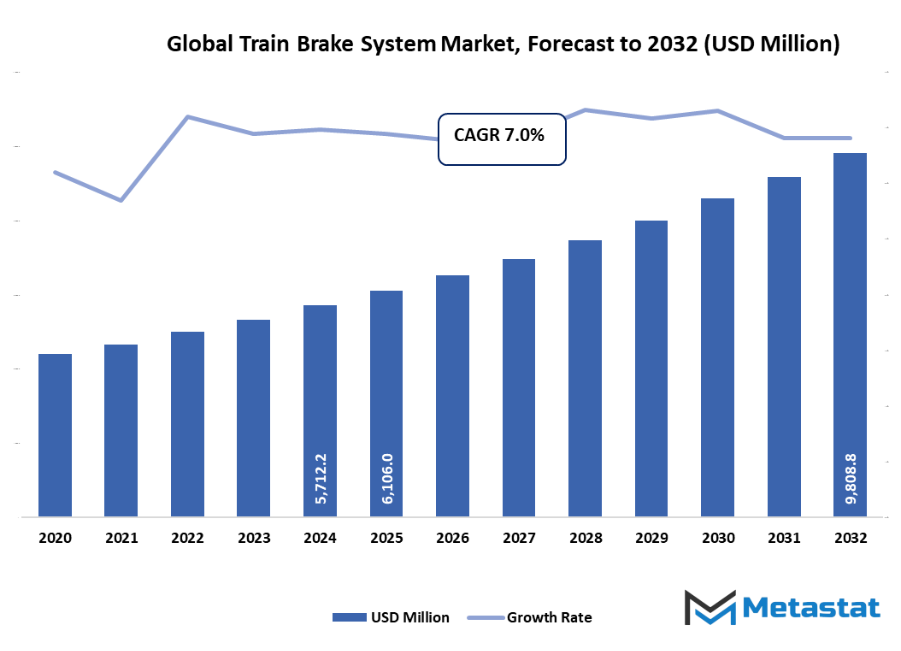
The global train brake system market will be a unique segment that specializes in the rail and transportation equipment industry, with a focus on the creation, production, and implementation of the braking systems that are designed specifically for passenger, freight, and high-speed trains. This market is expected to go beyond the standard brake technology using advanced mechanical, pneumatic, and electronic systems to provide the accurate control, safety, and operational efficiency of the wide variety of rail networks. In the case of reliability, quick reaction, and longevity, manufacturers will give priority to these parameters to be able to solve the different train speeds, loads, and environmental conditions in an effective way.
The smart braking technologies like the electronically controlled pneumatic brakes, regenerative systems, and automated monitoring solutions are some of the key features that are going to bring changes in the industry. The process of deceleration of the train will be optimized by these systems, the parts that come into contact during this process will not have a great wear, and energy efficiency will be improved, besides this, predictive maintenance and operational safety would also be facilitated. Customization of the braking systems will become of greater importance for the market players, as they must adapt to the local regulatory standards, conditions of the tracks, and train configurations so that there is a smooth transition from the modern to the legacy rail networks.
The global train brake system market is mainly classified based on Type, Component, Technology, Train Type.
|
Forecast Period |
2025-2032 |
|
Market Size in 2025 |
$6106 Million |
|
Market Size by 2032 |
$9808.8 Million |
|
Growth Rate from 2025 to 2032 |
7.0% |
|
Base Year |
2024 |
|
Regions Covered |
North America, Europe, Asia-Pacific, South America, Middle East & Africa |
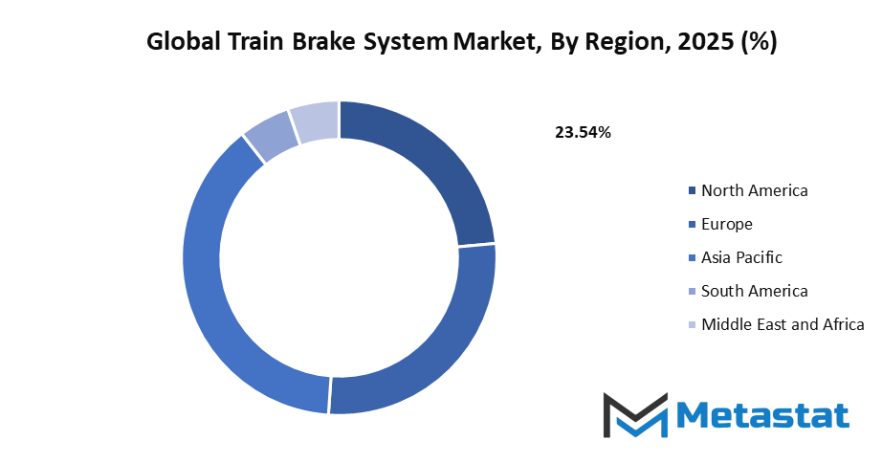
Infrastructure development, railway modernization programs, and regulatory standards will be the principal factors leading to varied regional dynamics in the global train brake system market. For instance, the North America area that includes the U.S., Canada, and Mexico will be one of the most important regions owing to the diverse projects of high-speed rail, freight network expansion, and urban transit systems. Besides safety improvements, several other aspects like energy saving, and operational reliability will be the focal points of manufacturers while developing technology in passenger as well as freight applications.
Among the EU countries (such as the UK, Germany, France, Italy), precision-engineered braking systems will be the major selling point of the new train brake system market. The solution providers and operators will be eager to get the product that is compatible with modern signaling and train control technologies. They will also seek to renew the aging rail networks with smart engineering to get better performance and to have less maintenance work.
On one hand, Asia-Pacific, including India, China, Japan, South Korea, and other neighbouring countries, the need for modern train brake technologies will be very high as a result of the extending railway network, the building of the high-speed rail, and urban transit development. On the other hand, the South America, fortified by Brazil and Argentina, will turn to the global train brake system market for solutions that will provide strong and stable rail freight and passenger operations. On top of that, the MENA region, consisting of GCC countries, Egypt, and South Africa, will need cutting-edge brake systems in order to deliver the high quality of rail transport required as a result of the severe weather in the area and rapid demand. Altogether, these regions will get the market to move forward with rail transportation by integrating technology, meeting regulations, and tailoring solutions that assure the safety and reliability of rail transportation while saving energy.
Rising investments in railway infrastructure and high-speed trains: The highest investments in railway infrastructure and high-speed trains are the main factors responsible for the rise of the global train brake system market. The opening of urban transit networks, the renewal of intercity rail, and the installation of high-speed lines create a great need for the use of trusted braking solutions that assure safety, save the energy, and give out the expected performance to the already varying conditions of operations.
Growing emphasis on passenger safety and accident prevention: The global train brake system market registered a growth due to the safety measures taken by the organizers who are increasingly relying on the latest technologies in accident prevention. As a result of the growing risk aversion mentality, advanced braking technologies, real-time monitoring, and predictive maintenance systems are introduced in the train braking system worldwide for safety reasons, which consequently bring the train braking systems to the status of global innovation and upgrade sectors.
High installation and maintenance costs restrict adoption: The global train brake system market faces limited use of high installation and maintenance costs that are prohibitive. The cost of advanced braking parts, the integration of the train system, and the ongoing maintenance may be a deployment limitation, particularly in the areas with budget restrictions, which in turn creates a problem for manufacturers and operators who are in quest of cost-effective and reliable solutions.
Complex integration with modern signaling systems poses challenges: Hidden intricacies in the relationship between old and new signaling systems are the difficulties faced by the global train brake system market. Achieving compatibility with digital controls, communication networks, and automated train management systems necessitates exact engineering, software support, and testing, which may lead to longer implementation periods and higher technical difficulties for the staff of older train fleets they are upgrading.
Adoption of advanced electronic braking and automation offers growth opportunities: The global train braking system market will rise through the use of cutting-edge electronic braking and automation. The implementation of these types of innovation including the use of electromechanical systems, smart controllers and regenerative braking, will by far be able to both decrease wear on the hardware and stabilize safety thereby giving the rail operators the opportunity to both upgrade their fleets and cater to the increasing demand of the rapid and urban transit networks.
The global train brake system market will see the coexistence of both the top-tier multinational companies and the up-and-coming local players who will influence such a competitive landscape where the main factors that would drive competition would be technological innovation, reliability, and safety. Wabtec, Knorr-Bremse, Akebono, and Amsted Rail, along with other leading companies in the industry, will not only be able to lead the market through their sophisticated braking solutions but also through their vast research capabilities and global service networks. It is expected that these corporate giants will be actively engaged in the task of using electronic, pneumatic, and regenerative brake technology for a better performance of the train and operational safety.
Surrounded by Regional Players, the group consisting of Escorts Limited, NYAB Products, European Braking Systems, CLEARSY SYSTEMS ENGINEERING, Shanghai Suyu Railway Material, DAKO-CZ, CRRC, and Hyundai Rotem Company, will cover the market demand for solutions tailored to specific rail networks, environmental conditions, and regulatory frameworks. These companies will aim to develop braking systems that are cost-effective, long-lasting, and are customizable as per the unique operational requirements of passenger and freight trains.
Improvements in the company's internal processes will be successful only through creativity, precision engineering, and the use of smart monitoring systems. To increase reliability and safety and, at the same time, reduce maintenance downtime, companies will apply predictive maintenance technologies, automated diagnostics, and data-driven performance analysis. As a result of the cooperation between the global leaders and local innovators, a market for the Global Train Brake System will be in continuous transformation to provide advanced, reliable, and efficient braking solutions to support the expansion and modernization of rail networks globally.
Market size is forecast to rise from USD 6106 million in 2025 to over USD 9808.8 million by 2032. Train Brake System will maintain dominance but face growing competition from emerging formats.
The global train brake system market is the aspect which looks to the future as it should; it thus becomes the backbone of safe and efficient rail transport systems worldwide. Research, innovation, and quality upkeep will continue to be the main goals of producers in order to cater to the demands of passenger as well as freight operators which are expanding at a large scale. The sector is ultimately going to be the one to reap all the benefits by being able to provide reliable and safe transport that is efficiency, along with high-performance, durable, and advanced technology brake solutions, thus, developing the global train brake system market as one of the main characters in the transfer of rail mobility.
This research report categorizes the Train Brake System market based on various segments and regions, forecasts revenue growth, and analyzes trends in each submarket. The report analyses the key growth drivers, opportunities, and challenges influencing the Train Brake System market. Recent market developments and competitive strategies such as expansion, type launch, development, partnership, merger, and acquisition have been included to draw the competitive landscape in the market. The report strategically identifies and profiles the key market players and analyses their core competencies in each sub-segment of the Train Brake System market.
Find answers to common questions about this report
Global Train Brake System market is valued at $6106 million in 2025.
Global Train Brake System market is estimated to grow with a CAGR of 7.0% from 2025 to 2032.
Global Train Brake System market is estimated to reach $9808.8 million by 2032.
Top players operating in the Train Brake System industry includes Wabtec, Escorts Limited, Knorr-Bremse, Akebono, NYAB Products, European Braking Syst
The analysts below cover Automotive and Transportation research at Metastat Insights.
LEAD ANALYST
Utkarsh Khirodkar is a Lead Market Research Analyst at MetaStat Insight, specializing in market intelligence, technology sector assessments, and competitive strategy.

ENERGY & INFRASTRUCTURE INDUSTRY CONSULTANT
Automotive and Transportation · Electronics and Semiconductor · Energy and Power · Machinery & Equipment
Saurabh Vasant Ganvir consults for Energy & Infrastructure Industry at MetaStat Insight, specializing in renewable energy, solar EPC, and electric vehicle (EV) infrastructure markets.
Enterprise zero-trust network rollouts are often slowed down by multi-cloud transit latency and proprietary hardware retirement schedules. This study provided realistic total cost of ownership models comparing cloud-delivered security edge solutions against traditional hardware refreshes. The analysis of contract renewal lengths and software maintenance fees gave us clear visibility into enterprise replacement cycles over the next three to five years.
Scaling antibody-drug conjugate manufacturing hinges on contract manufacturing availability for high-potency active ingredients. The MetaStat Insight analysis looked closely at global cleanroom slot constraints, bioconjugation batch failure rates, and supply chain redundancies between the US, Europe, and India. The supplier capability matrix proved genuinely useful for our team when mapping secondary source options across our clinical pipeline.
Floating offshore wind feasibility relies heavily on specialized installation vessel availability and port crane limits, which most broad renewable energy forecasts ignore. The report delivered a thorough analysis of dry dock capacity, mooring chain supply constraints, and raw material pricing trends for deepwater anchor installations. It served as a solid independent sanity check for our offshore project capital expenditure assumptions.
Explore related market intelligence reports worth reading alongside this one.
Starting from
$2950