
LEAD ANALYST
Utkarsh Khirodkar is a Lead Market Research Analyst at MetaStat Insight, specializing in market intelligence, technology sector assessments, and competitive strategy.

Warehouse Execution System (WES) Market By Component (Software and Service), By Deployment Model (On-Premises and Cloud-Based), By End-Users (Consumer Electronics, Pharmaceuticals, Food, Beverages, Automotive, Third-Party Logistics, and Others), Industry Analysis, Size, Share, Growth, Trends, and Forecast, 2026-2033
Report ID
MSI-2411
Published
February, 2026
Updated
Pages
257 Pages
Format
Report Details
Choose Your License
Warehouse Execution System (WES) Market
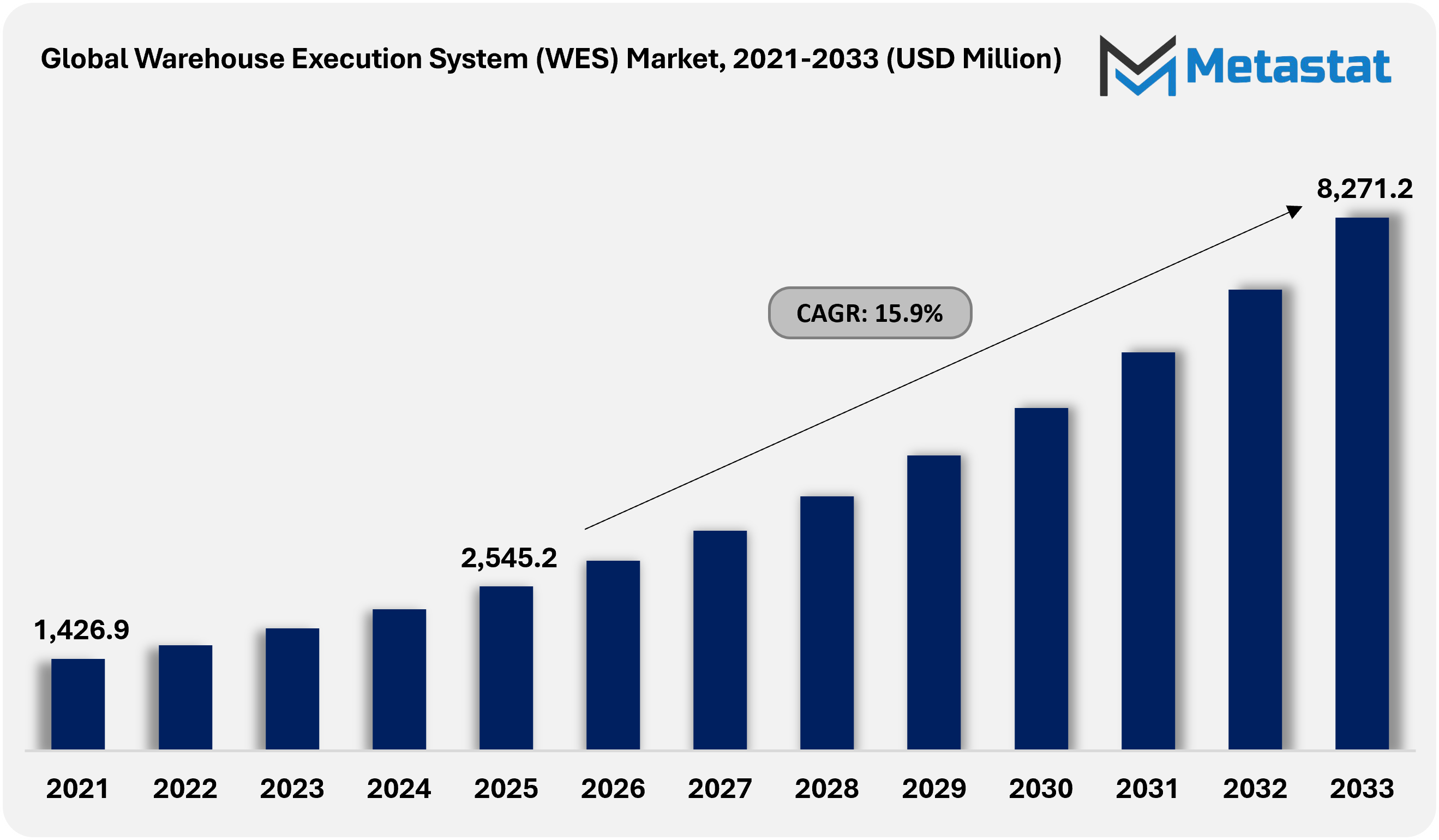
The global warehouse execution system (WES) market is estimated to reach USD 8,271.2 million by 2033, growing at a CAGR of 15.1% from 2026 to 2033.
Warehouse Execution Systems assume a pivotal role in the contemporary realm of supply chain governance, ensuring the efficient storage, retrieval, and dispatch of goods to align with the exigencies of discerning clientele. They coalesce seamlessly with other warehousing technologies, such as Warehouse Management Systems (WMS), Automated Material Handling Systems (AMHS), and an array of sensors and contrivances, orchestrating and mechanizing tasks within the confines of a repository. Global Warehouse Execution System (WES) market is estimated to reach $8,271.2 million by 2033 with a CAGR of 15.1% from 2026 to 2033 with a market size (TAM) of $ 2,545.2 million in 2025.
The Global WES domain encompasses the universal appetite for these mechanisms. It entails the commerce and trade of WES remedies, encompassing both the ethereal realm of software and the corporeal domain of hardware, along with their attendant services. Enterprises of every magnitude and purview partake in this transaction, transcending boundaries of industry and scale. The magnitude and trajectory of this marketplace are swayed by a multitude of factors, including the burgeoning bastion of e-commerce, the surging expectations of consumers clamoring for expeditious deliveries, the imperativeness of precision in inventory stewardship, and the embracement of automation and robotics within the precincts of storehouses.
Entities proffering Warehouse Execution Systems embark upon the development and dissemination of their offerings, meticulously tailored to cater to the myriad exigencies that afflict repositories and distribution centers. These bespoke solutions are artfully architected to grapple with specific conundrums that vex businesses, encompassing the imperative task of curbing operational overheads, the enhancement of order fidelity, and the elevation of the omnibus efficiency of the repository.
In recent times, the Global WES market has borne witness to the expansion, an effulgence that can be attributed to the incremental appreciation of the manifold advantages proffered by these systems in the optimization of warehousing operations. As enterprises labor assiduously to align themselves with the ever-evolving cravings of their patronage and endeavor to retain their competitive edge within the matrix of the global market, the vogue for Warehouse Execution Systems is poised to burgeon unabatedly.
A modern Warehouse Execution System integrates sophisticated algorithmic control with daily floor orchestration:
Order Fulfillment Optimization: Dynamically waves, waveless-routes, and throttles orders to ensure equipment operates at peak utilization without creating fulfillment bottlenecks.
Task Interleaving: Merges separate workflows-such as combining putaway with replenishment or picking-to eliminate deadhead travel time for both human operators and mobile robots.
Dynamic Slotting Optimization: Continuously analyzes SKU velocity, seasonality, and order profiles to suggest optimal storage locations, minimizing travel distance across pick zones.
Intelligent Labor Management: Allocates labor dynamically according to real-time workload spikes across distinct warehouse zones, balancing manual picking lines with high-density automated zones.
Proactive Exception Handling: Detects physical bottlenecks, inventory discrepancies, and machinery stoppages instantaneously, automatically rerouting pending tasks to secondary workflows without halting line operations.
Understanding the operational boundary between these three platforms is critical for designing an efficient warehouse technology stack:
Warehouse Management System (WMS): Operates at the macro level. It manages broad inventory tracking, facility configuration, purchase orders, shipping documentation, and high-level labor planning. It operates primarily on
transactional business logic rather than sub-second machine feedback.
Warehouse Control System (WCS): Operates at the physical equipment layer. A WCS communicates directly with PLCs (Programmable Logic Controllers), sensors, and conveyor hardware to control discrete movements, divert shoes, and guide automated sorters.
Warehouse Execution System (WES): Sits directly between the WMS and WCS. It adds an intelligent, real-time optimization layer that the WMS lacks and provides workflow logic that a WCS cannot compute. It coordinates physical automation with labor tasks dynamically to optimize throughput across the entire facility.
Deploying a dedicated WES delivers tangible operational advantages across complex fulfillment ecosystems:
Accelerated Order Turnaround Times: Waveless order processing allows facilities to ingest e-commerce orders and initiate picking within seconds, meeting compressed same-day shipping cut-offs.
Maximized ROI on Automation: Ensures high-capital assets-such as goods-to-person systems, sortation loops, and automated storage units-run at target utilization rates without idle time.
Reduced Labor Costs and Travel Times: Through smart task interleaving and synchronized work queues, travel distances drop significantly, driving higher lines-per-hour productivity.
Resilient Throughput Capacity: Dynamic load balancing ensures that equipment breakdowns or unexpected order volume spikes do not derail daily shipping targets.
An effective WES integrates seamlessly into heterogeneous software and hardware environments:
Enterprise Software & WMS Layers: Modern WES platforms connect via high-speed REST APIs, WebSockets, and messaging queues to industry-standard platforms such as SAP Extended Warehouse Management, Manhattan Associates, and Blue Yonder. This ensures smooth bidirectional data flow for order lines, inventory updates, and shipment confirmations.
Advanced Automation & Robotics: Direct integration with high-density automated storage solutions like AutoStore, autonomous mobile robots (AMRs), automated guided vehicles (AGVs), and automated storage and retrieval systems (AS/RS).
Assisted Picking Hardware: Direct protocol connectivity to pick-to-light systems, voice-directed picking devices, put-walls, and wearable RF scanners, creating unified orchestration across automated and manual work cells.
Visibility in a WES-enabled warehouse moves beyond static dashboards to deliver actionable operational intelligence:
Real-Time Inventory Visibility: Tracks inventory at every physical stage-from de-palletization and inducted totes to consolidation buffers and packing chutes-preventing misplaced stock and phantom shortages.
Constraint-Based Task Queuing: Evaluates hundreds of simultaneous constraints-such as conveyor line fullness, packing station backlog, and robot battery levels-to assign tasks based on immediate capacity.
Continuous Exception Handling: When a barcode fails to scan or a tote jams, the WES identifies the affected order instantly, issues a reroute command to upstream sorters, and dispatches a maintenance alert, preventing systemic line blockages.
Selecting the appropriate WES platform requires aligning software capabilities with facility complexity:
Level of Automation Diversity: Ensure the WES offers native drivers and agnostic integration capabilities across multi-vendor robotics, goods-to-person systems, and legacy conveyors.
Algorithm Sophistication: Assess whether the platform supports true waveless order execution, dynamic slotting optimization, and automated workload balancing.
Configurability and Modularity: Opt for solutions that allow warehouse engineers to adjust business rules, workflows, and routing tables without requiring custom vendor code rewrites.
Scalability and Enterprise Support: Validate that the software architecture can handle peak volume surges (e.g., promotional sales and holiday peaks) with sub-second response latency.
To ensure a successful WES rollout without disrupting existing distribution operations, follow these key implementation guidelines:
Map End-to-End Material Flows: Document all physical product flows, handoffs, and edge cases prior to software configuration.
Establish Clear Ownership Boundaries: Clearly delineate which system owns specific data domains (e.g., inventory ownership in the Warehouse Management System (WMS) versus active order orchestration in the WES).
Conduct High-Fidelity Emulation Testing: Run simulated order profiles through the WES to test its algorithmic reactions to machine downtime, order bursts, and physical bottlenecks.
Phase the Hardware Cutover: Roll out WES modules systematically-starting with manual zones or standalone picking modules-before integrating high-speed automated sorters and automated storage engines.
The next generation of Warehouse Execution Systems will shape the future of autonomous distribution:
AI-Driven Predictive Orchestration: Transitioning from reactive task assignment to predictive workload planning, where machine learning models forecast equipment congestion hours before it occurs.
Autonomous Heterogeneous Fleet Management: Direct integration and universal orchestration of multi-vendor robotic fleets, combining AMRs, robotic arms, and vertical storage under unified execution logic.
Smart Digital Twins: Deep synchronization with live 3D digital twins to simulate workflow changes, test routing adjustments, and forecast facility throughput in real time.
Convergence Toward Unified Commerce Platforms: Continued architectural alignment with enterprise supply chain ecosystems to enable hyper-responsive, demand-driven fulfillment networks.
The Warehouse Execution System (WES) market is currently experiencing robust growth, driven by the surging demand for e-commerce and the emergence of omni-channel retailing. This shift in consumer behavior has resulted in a significant uptick in online shopping, necessitating the optimization of warehousing operations. Traditional manual processes are proving insufficient to meet this demand, compelling businesses to embrace warehouse automation technologies, specifically Warehouse Execution Systems (WES). Omni-channel retailing, with its array of shopping options, underscores the vital importance of WES in harmonizing inventory management and order processing.
In today's dynamic business landscape, supply chain visibility and real-time data analytics have become indispensable. WES solutions offer comprehensive insights into warehouse operations, enabling continuous monitoring, precise inventory tracking, and real-time order status updates. Real-time data analytics plays a pivotal role in proactive decision-making and operational streamlining. Furthermore, it empowers organizations to swiftly adapt to shifting market conditions, thereby elevating customer satisfaction levels.
Nevertheless, the WES market confronts certain challenges, most notably the high costs associated with implementation and maintenance. The intricacies of integrating WES into existing infrastructure can result in substantial expenditures, potentially deterring small and medium-sized enterprises. Businesses must judiciously weigh these costs against the benefits before committing to WES adoption.
Another significant obstacle lies in the complexities of integrating WES with existing Warehouse Management Systems (WMS) and Enterprise Resource Planning (ERP) systems. The diverse array of technology stacks and operational workflows within organizations necessitates meticulous planning and close collaboration to ensure seamless integration. Legacy systems and multiple operational units can compound these challenges.
Despite these impediments, the market offers exciting prospects through the incorporation of artificial intelligence (AI) and machine learning (ML) algorithms. This synergy enhances the capabilities of WES, delivering predictive analytics and advanced demand forecasting. AI and ML algorithms analyze historical and real-time data, empowering businesses to make informed decisions regarding inventory management, resource allocation, and order fulfillment. Predictive analytics proactively identifies potential operational hurdles, enabling businesses to take preemptive measures. This integration aligns perfectly with the ongoing trends of automation and intelligent decision-making, ultimately enhancing operational efficiency.
The Warehouse Execution System market is thriving thanks to the surge in e-commerce and omni-channel retailing. Supply chain visibility and data analytics are pivotal, albeit accompanied by challenges related to costs and integration complexities. The integration of AI and ML algorithms holds great promise, ushering in improved predictive analytics and advanced demand forecasting capabilities.
The Global Warehouse Execution System (WES) market, a closer examination reveals a nuanced segmentation, notably into two pivotal components: Software and Service. These components serve as the heartbeat of the industry, each contributing its unique rhythm to the overarching symphony of growth and evolution.
Firstly, Software, the digital architect of this domain, is projected to ascend to a substantial valuation of 3764.3 USD Million by the year 2033. It functions as the bedrock upon which the operational prowess of WES is built, wielding the power to orchestrate and optimize warehouse processes with precision and efficiency. Its anticipated growth is a testament to the increasing reliance on advanced software solutions to navigate the complexities of modern supply chain management.
On the other hand, Service emerges as a dynamic force within this ecosystem, poised for remarkable expansion. It is forecasted to experience a robust Compound Annual Growth Rate (CAGR) of 15.3% during the period spanning 2026to 2033. This growth trajectory underscores the indispensable role that service providers play in the WES landscape. Their expertise in implementation, customization, maintenance, and support services serves as the backbone upon which businesses rely to ensure the seamless functioning of their warehouse execution systems.
In the Global Warehouse Execution System (WES) market, there are two primary deployment methods: On-Premises and Cloud-Based. Let's elaborate on each of these deployment options:
On-Premises Deployment: On-Premises deployment refers to the installation and operation of Warehouse Execution Systems within a company's own physical infrastructure, typically within their own data centers or servers located on-site. This approach involves purchasing and maintaining the hardware and software required to run the WES within the company's facilities.
In 2022, the On-Premises segment of the WES market was valued at 724.9 USD Million. It is important to note that this segment is substantial but slightly less dominant than the Cloud-Based segment. The growth forecast for On-Premises deployment is significant, with a projected Compound Annual Growth Rate (CAGR) of 14.9% between 2026 and 2033.
On-Premises deployment offers companies a high level of control over their WES, as they have direct oversight of the infrastructure and data. This deployment method is often chosen by businesses with specific security or compliance requirements that necessitate keeping data and software in-house.
Cloud-Based Deployment: Cloud-Based deployment, on the other hand, involves hosting the Warehouse Execution System on remote servers provided by a third-party cloud service provider. Users access and utilize the system over the internet, eliminating the need for companies to maintain their own physical infrastructure.
This segment holds the majority of the market, reflecting the growing trend towards cloud-based solutions. The growth outlook for Cloud-Based deployment is also strong, with a projected CAGR of 15.2% from 2026 to 2032. Cloud-Based deployment offers scalability, flexibility, and reduced upfront costs for businesses. It allows for remote access and automatic updates, making it an attractive option for companies seeking agility and the ability to adapt to changing business needs quickly.
The Global Warehouse Execution System market offers two primary deployment options: On-Premises and Cloud-Based. While On-Premises provides control and security, Cloud-Based offers scalability and flexibility. Both segments are poised for substantial growth in the coming years, reflecting the evolving needs of businesses in optimizing their warehouse operations and supply chain management.
In the context of the Global Warehouse Execution System (WES) market, it's essential to elaborate on the various end-user segments to understand how different industries utilize. First is the Consumer Electronics market being a significant player in the WES market. In 2022, it accounted for a value of 198.2 USD Million, representing 12.3% of the total WES market. This industry includes companies involved in the production, distribution, and sales of consumer electronic devices such as smartphones, tablets, laptops, and other gadgets.
Warehouse Execution Systems are crucial for the Consumer Electronics industry to efficiently manage inventory, optimize order picking and packing processes, and ensure accurate and timely deliveries to meet the fast-paced demands of the tech-savvy consumer market. This segment's adoption of WES is driven by the need for precision and speed in handling delicate electronic products.
Next, the Pharmaceuticals market also plays a substantial role in the WES market. While the specific market share percentage is not provided in the information, it is undoubtedly a significant contributor. The pharmaceutical industry encompasses the production and distribution of medicines, vaccines, and healthcare products. Warehouse Execution Systems are vital in pharmaceutical warehouses to maintain strict inventory control, adhere to regulatory compliance, and ensure the secure and efficient distribution of critical medications. Accuracy, traceability, and security are of utmost importance in this market, making WES an indispensable tool.
Although not explicitly mentioned in the information provided, the Food & Beverages industry is a major end-user of Warehouse Execution Systems. This market includes the production and distribution of food and beverage products, ranging from fresh produce to packaged goods. WES is instrumental in managing perishable inventory, optimizing order fulfillment, and maintaining food safety standards. This industry relies on efficient warehouse operations to meet consumer demands and comply with strict quality and safety regulations.
Apart from this, the Automotive market involves the manufacturing and distribution of vehicles and automotive parts. It is another crucial end-user of WES, although specific market share details are not provided. In the automotive industry, precision and efficiency are essential. Warehouse Execution Systems help manage a vast array of automotive components and streamline supply chain processes, ensuring the right parts are available when needed for manufacturing and servicing vehicles. Along with Third-Party Logistics (3PL) companies provide outsourced logistics and supply chain services to various industries. While the exact market share is not mentioned, 3PLs are significant users of WES. WES is a core technology for 3PLs, enabling them to efficiently handle and manage inventory on behalf of their clients. It allows for real-time tracking and visibility of goods in transit and at distribution centers, enhancing the overall efficiency and transparency of the logistics process.
All said, the categories are not just these many, there are several other end users. The Others category typically includes various industries not explicitly listed, such as retail, apparel, and industrial goods. These markets also benefit from Warehouse Execution Systems to improve warehouse operations, reduce costs, and enhance customer service.
The Global Warehouse Execution System (WES) market caters to a diverse range of end-user segments, each with its unique requirements and challenges. These segments, including Consumer Electronics, Pharmaceuticals, Food & Beverages, Automotive, Third-Party Logistics, and others, leverage WES to enhance warehouse and supply chain efficiency, ultimately contributing to the growth and evolution of the WES industry.
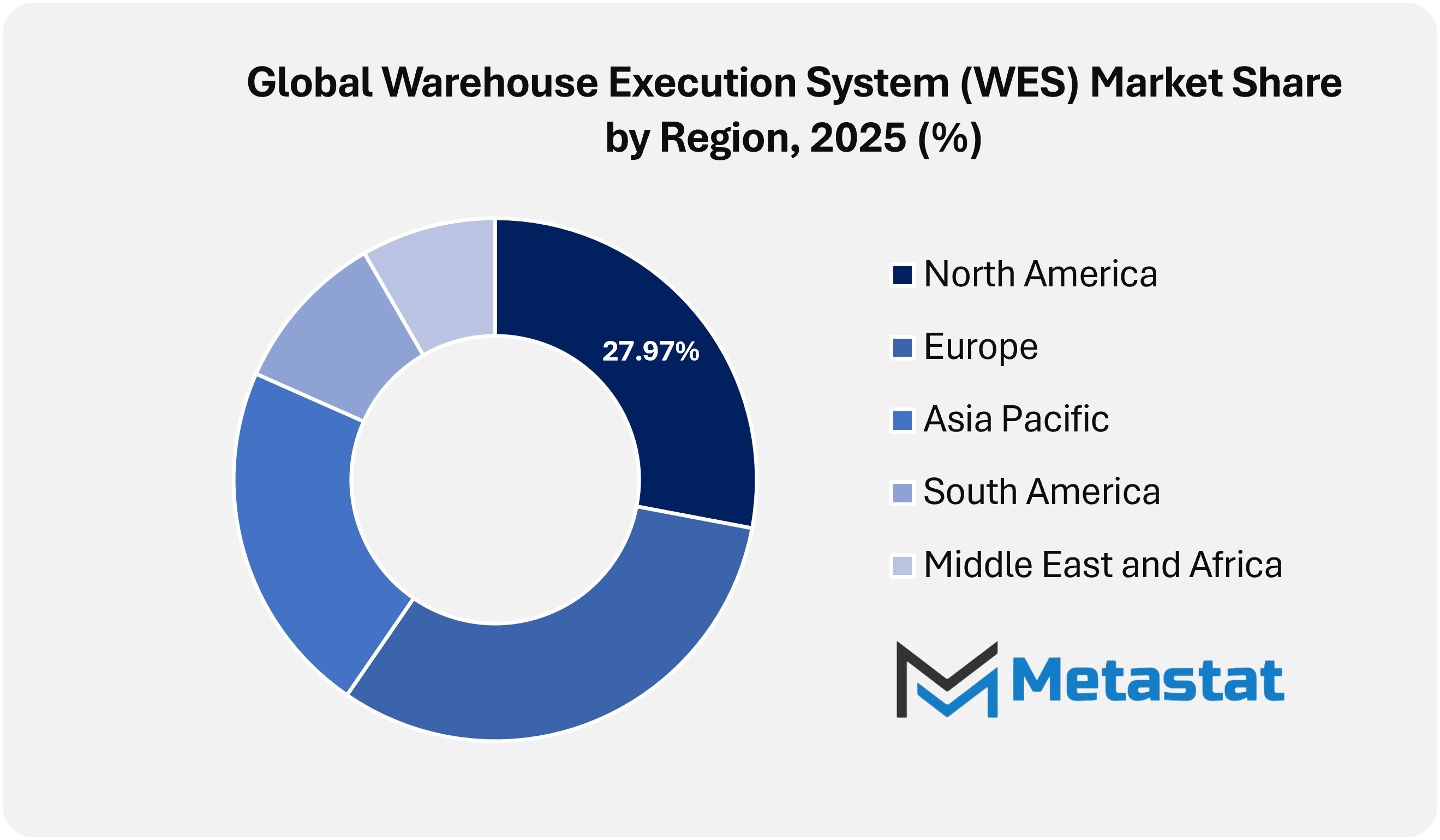
The Global Warehouse Execution System (WES) market can be categorized by region into North America, Europe, Asia Pacific, South America, and the Middle East and Africa. The North America market encompasses the United States, Canada, and Mexico. In Europe, we find countries such as Germany, France, the United Kingdom, Italy, and Russia, while the rest of Europe includes additional nations. Meanwhile, the Asia Pacific Warehouse Execution System (WES) market is divided into China, Japan, South Korea, India, and the rest of Asia Pacific. South America's market includes Brazil, Argentina, and other regions. Lastly, the Middle East and Africa region can be further segmented into Saudi Arabia, the UAE, Israel, South Africa, and the rest of MEA.
The North America Warehouse Execution System (WES) market is anticipated to exhibit a robust CAGR of 14.9% from 2026 to 2033. In 2018, the European Warehouse Execution System (WES) market boasted a valuation of 356.5 USD Million. Meanwhile, the Asia Pacific Warehouse Execution System (WES) market recorded values of 243 USD Million in 2018 and an impressive 348.5 USD Million in 2022.
COMPETITIVE PLAYERS
Within the Warehouse Execution System (WES) industry, several key players are orchestrating the future. Bastian Solutions, LLC, Dematic, Extensiv, Fortna Inc., Generix Group, Honeywell International Inc., Hy-Tek Intralogistics, Interlink Technologies, Invata Intralogistics, Inyxa, Lucas Systems, Inc., Matthews International Corporation, Softeon, VARGO, and Westfalia Technologies, Inc. all dance to the rhythm of innovation and evolution.
However, Bastian Solutions has crafted its reputation on the anvil of successful implementations, pioneering problem-solving, and a profound grasp of the ever-shifting landscape of warehouse automation. By consistently pushing the boundaries of technological ingenuity and remaining finely attuned to the symphony of industry trends, the company establishes itself as a forward-thinking partner, bestowing businesses with the confidence to voyage through the labyrinthine intricacies of contemporary supply chains.
Dematic's distinguished eminence in the realm of intelligent intralogistics originates from its unwavering commitment to steering transformative automation solutions. By weaving advanced technologies into the tapestry of operations, tailoring solutions with artisanal precision to the unique needs of each client, and nurturing symbiotic collaborations, the company positions itself as an unwavering conductor of streamlined and highly efficient supply chain orchestrations.
Find answers to common questions about this report
Top players operating in the Warehouse Execution System (WES) industry includes Bastian Solutions, LLC, Dematic, Extensiv, Fortna Inc., Generix Group,
Global Warehouse Execution System (WES) market is valued at $ 2,545.2 million in 2025.
Global Warehouse Execution System (WES) market is estimated to grow with a CAGR of 15.1% from 2026 to 2033.
Global Warehouse Execution System (WES) market is estimated to reach $ 8,271.2 million by 2033.
E-commerce, retail omnichannel distribution, 3PL logistics, pharmaceuticals, food and beverage, and consumer packaged goods (CPG) benefit most from a WES. These industries face high SKU volumes, fluctuating seasonal peaks, compressed delivery windows, and heavy reliance on mixed automation systems like goods-to-person robotics, automated sorting lines, and high-density storage buffers.
Essential WES features include dynamic waveless order processing, automated task interleaving, real-time resource allocation, proactive exception handling, and intelligent slotting optimization. Additionally, prioritize vendor-agnostic hardware integration for robotics and material handling equipment, sub-second latency data processing, customizable rule engines, and modular architectures that scale seamlessly with future automation additions.
Cloud-based WES solutions offer lower upfront capital costs, automatic updates, rapid scalability, and seamless multi-site visibility across distributed supply chains. On-premise deployments provide dedicated low-latency execution and uninterrupted floor control during internet outages. Increasingly, modern architectures adopt hybrid models-hosting optimization algorithms in the cloud while retaining local edge computing for real-time equipment orchestration.
Yes, modern WES platforms easily integrate with legacy WMS environments using RESTful APIs, flat-file transfers, SOAP web services, and middleware message queues. A WES acts as an intelligent optimization layer, extracting static order files from older systems and translating them into dynamic, real-time machine execution without requiring an expensive, full-scale WMS replacement.
A WES deployment generally ranges from $150,000 to over $1,000,000. Entry-level, modular deployments for mid-sized warehouses typically cost between $150,000 and $350,000. Enterprise-grade implementations involving large-scale automation, custom API connectors, multi-facility licensing, and specialized robotic orchestration often exceed $500,000 to $1,000,000+, excluding ongoing maintenance and cloud hosting fees.
A WES improves fulfillment accuracy by integrating directed workflows like pick-to-light, voice picking, and barcode verification directly with automated material handling equipment. By validating SKU attributes at each scan, enforcing precise routing rules, and catching discrepancies through real-time exception handling, the system prevents mispicks, wrong-item shipments, and mislabeled parcels before orders reach packing stations.
A Warehouse Management System (WMS) manages broad inventory tracking, facility configuration, and macro-level logistics planning. A Warehouse Execution System (WES) operates dynamically in real time, orchestrating physical automation, task interleaving, and labor queues. While a WMS plans high-level fulfillment workflows, a WES executes and balances those tasks across equipment and manual work cells sub-second.
A Warehouse Execution System (WES) is an advanced software solution designed to bridge the operational gap between high-level inventory planning and physical equipment control. In modern supply chain architectures, warehouse operations require real-time decision-making capabilities that traditional software cannot deliver alone.
A standard WES implementation typically takes 4 to 9 months, depending on operational complexity. Standalone software deployments integrated with simple picking modules can launch in 3 to 5 months. Complex facilities requiring extensive integration with multi-vendor robotics, automated storage systems (AS/RS), custom conveyor networks, and legacy ERPs generally take 6 to 12 months.
The analysts below cover Automotive and Transportation research at Metastat Insights.
LEAD ANALYST
Utkarsh Khirodkar is a Lead Market Research Analyst at MetaStat Insight, specializing in market intelligence, technology sector assessments, and competitive strategy.

ENERGY & INFRASTRUCTURE INDUSTRY CONSULTANT
Automotive and Transportation · Electronics and Semiconductor · Energy and Power · Machinery & Equipment
Saurabh Vasant Ganvir consults for Energy & Infrastructure Industry at MetaStat Insight, specializing in renewable energy, solar EPC, and electric vehicle (EV) infrastructure markets.
Last Updated: September, 2026
Decarbonizing industrial thermal processes hinges on refrigerant regulations and compressor efficiency limits. Metastat Insights delivered a thorough market analysis that evaluated natural refrigerants like CO2 and hydrocarbons against synthetic low-GWP alternatives. The breakdown of utility incentives and grid capacity constraints across key European manufacturing hubs offered valuable perspective. The follow-up conversation with their sector analysts addressed our specific questions on mechanical vapor recompression systems efficiently.
Assessing 200mm wafer transition schedules and substrate supply bottlenecks requires precise technical intelligence. MetaStat Insight supplied an actionable breakdown comparing planar and trench MOSFET architectures across automotive and industrial drive markets. The regional capacity estimates for Asia-Pacific foundries helped clarify lead-time uncertainties during our strategic planning session. When we needed additional clarification on high-purity raw material sourcing, their analyst team responded with helpful context within twenty-four hours.
Tracking maintenance cycle demand for secondary flight display units and terrain collision avoidance systems across regional jet fleets involves complex aftermarket dynamics. MetaStat Insight provided practical analysis separating airline retrofit programs from OEM forward-fit production schedules in North America and Southeast Asia. The supplier matrix highlighted component obsolescence timelines without resorting to vague generalizations. The dataset served as a dependable reference during our annual program review meetings.
Explore related market intelligence reports worth reading alongside this one.