
LEAD ANALYST
Utkarsh Khirodkar is a Lead Market Research Analyst at MetaStat Insight, specializing in market intelligence, technology sector assessments, and competitive strategy.

Aluminium Wire Rod Market Size, Share, By Product Type (Bare Wire Rod, Coated Wire Rod, and Alloyed Wire Rod), By Application (Electrical Conductors, Automotive, Construction, Electronics, Packaging, Aerospace, Machinery, Consumer Goods, and Others), By End Use Industry (Aerospace, Automotive, Power Generation, Consumer Goods, Construction, Electronics, Packaging, Marine, and Others), By Form (Round, Square, and Flat), Industry Analysis, Growth, Trends, and Forecast, 2026-2033
Report ID
MSI-4547
Published
February, 2026
Pages
320 Pages
Format
Report Details
Choose Your License
Aluminium Wire Rod Market
The global Aluminium Wire Rod market size was valued at USD 31.9 billion in 2025. The market is projected to grow from USD 33 billion in 2026 to USD 43.3 billion by 2033, exhibiting a CAGR of 4.0% during the forecast period.
Global Aluminium Wire Rod market was valued at USD 31.9 billion in 2025 and is projected to reach USD 43.3 billion by 2033, reflecting a CAGR of 4.0% during 2026-2033.
Global Aluminium Wire Rod market Volume is valued at 9,975.9 kilotons in 2025 and is projected to a CAGR of 1.7% during 2026-2033.
North America accounted for 25.3% in 2025, led by the United States.
Bare Wire Rod segment accounts for a market share of 48.3% in 2025, supported by wide use across conductors, cables, and industrial applications.
Key trend driving growth: Rising use of aluminium conductors in power transmission, supported by weight advantages and strong conductivity performance.
The key opportunity includes expansion of renewable energy infrastructure creating long-term demand for aluminium wiring systems
Key insight: The global aluminium wire rod market reflects steady demand driven by the expansion of power infrastructure, industrial applications and the ongoing shift towards lightweight, conductive materials worldwide.
The global Aluminium Wire Rod market and its industry will be positioned as enabler of systems that will sit far beyond traditional manufacturing narratives, shaping how the material will interact with future infrastructure, mobility and energy frameworks. The market is expected to move beyond conventional supply chain structures by increasingly adopting design philosophies that emphasize adaptability, lightweight engineering, and long-term material accountability within the industrial ecosystem.
In the coming years, the use of aluminium wire rod will expand into hybrid applications where electrical performance, structural flexibility and recyclability will be expected to co-exist without compromising. Product development will not simply address dimensional or conductivity requirements it will anticipate how wire rod will be embedded in smart grids, modular manufacturing, and automated production environments. The shift will encourage closer coordination between metallurgical science and digital manufacturing, where predictive modelling and precision manufacturing will influence how wire rod is specified before physical production begins.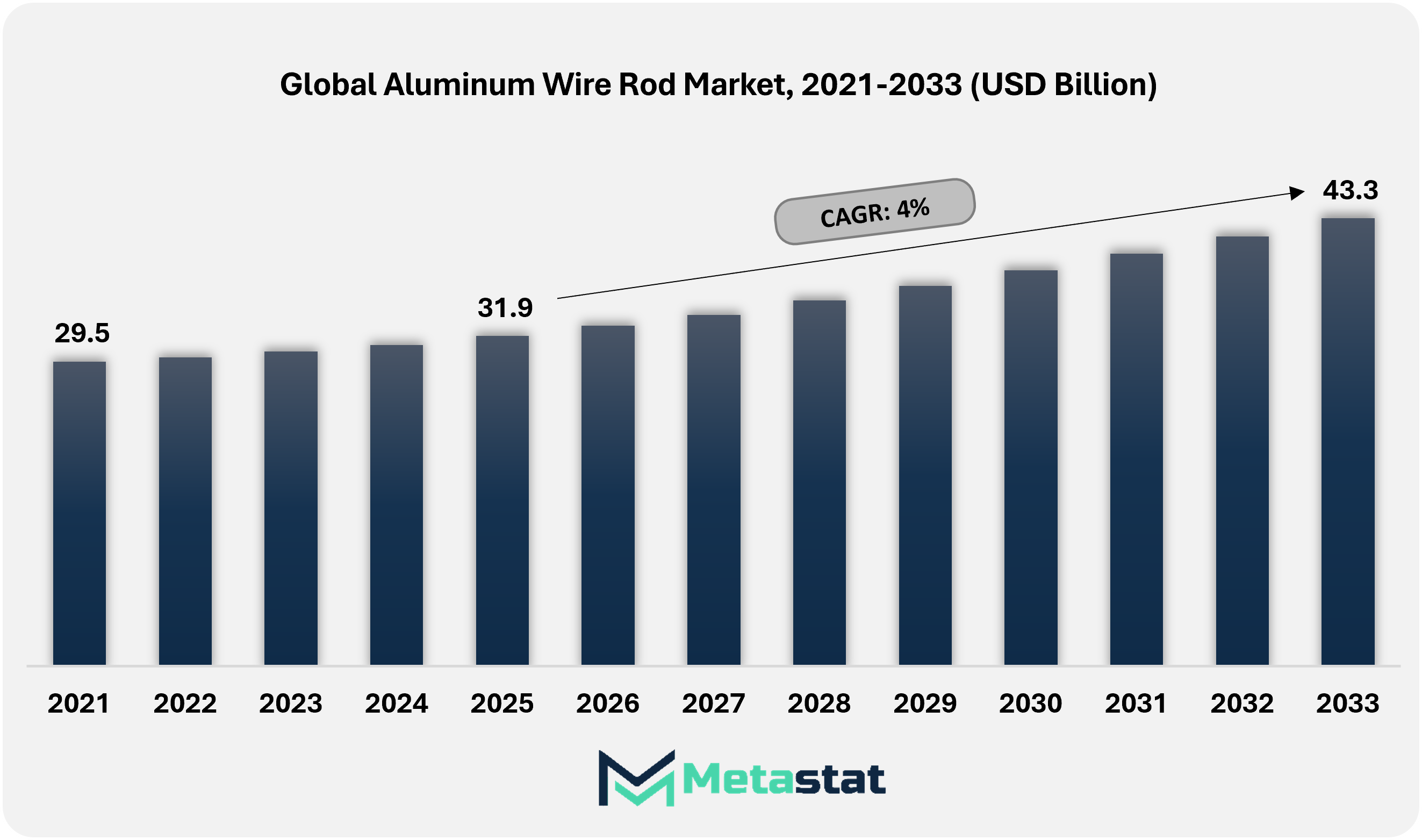
Increasing funding within the power grid will increase dependence on aluminium conductors. The lightweight shape will support smooth installation on long-distance transmission lines. High conductivity with low weight will support efficiency goals. Over time, application-scale initiatives will opt for aluminium wire rods to balance performance and cost stability
Electric automobile production will continue to amplify, driving demand for light-weight materials in vehicle systems. Aluminium wire rods will support weight reduction targets and energy efficiency requirements. will help weight reduction goals and strength performance requirements. Automotive manufacturers will adopt aluminium-based wiring to improve range and performance, leading to steady fabric integration into future car systems.
Fluctuations in aluminium prices will continue to affect price planning and profitability. Price volatility will project lengthy-term supply contracts and investment decisions. Manufacturers will face stress to optimize sourcing strategies and enhance operational performance. Such volatility may slow expansion plans during periods of adverse pricing conditions.
Availability of copper wire will continue to be a competitive factor in specific applications. Established infrastructure priorities will delay a full transition to aluminium alternatives. Some industries will continue to select copper due to legacy systems and performance familiarity, limiting immediate adoption for aluminium wire rod solutions in particular sectors.
Renewable energy projects will expand into solar and wind installations, supporting stable material demand. Aluminium wiring systems will largely align with renewable layouts due to the durability and weight advantages. The global aluminium wire rod market will benefit from the policy-driven energy transition and continued infrastructure development across the globe.
The global Aluminium Wire Rod market is mainly classified based on Product Type, Application, End Use Industry, and Form.
Bare Wire Rod segment was valued at USD 15.9 Billion in 2026 and is projected to reach USD 20.4 Billion by 2033, at a CAGR of 3.6% during the forecast period.
Bare wire rod holds a stable position in the global aluminium wire rod market due to its wide acceptance in electrical and industrial use. Demand will continue to increase as expansion of infrastructure increases power distribution needs. Future manufacturing improvements will focus on purity and conductivity, which will support consistent performance in transmission networks and industrial infrastructure.
Coated Wire Rod segment was valued at USD 6.7 Billion in 2026 and is projected to reach USD 9.1 Billion by 2033, at a CAGR of 4.4% during the forecast period.
Coated wire rod is becoming increasingly important as corrosion protection becomes essential in long-term installations. The uses will expand in outdoor and high-moisture environments where durability matters. The global aluminium wire rod market will benefit from surface treatment innovations that improve lifetime while maintaining cost balance, making coated solutions a preferred option.
Alloyed Wire Rod segment was valued at USD 10.3 Billion in 2026 and is projected to reach USD 13.8 Billion by 2033, at a CAGR of 4.2% during the forecast period.
Alloyed Wire Rod supports applications requiring strength and flexibility beyond standard grades. Adoption of lightweight materials in transportation and structural applications will drive demand in the future. The global aluminium wire rod market will see alloy growth focusing on performance stability, fatigue resistance and adaptability to advanced engineering requirements.
Electrical Conductors segment is projected to reach USD 16.2 Billion by 2033, at a CAGR of 4% during the forecast period.
Electrical conductors remain a key consumption sector driven by grid modernization and renewable integration. As energy access expands in regions, demand will increase. The global aluminium wire rod market will align with future power efficiency targets, support transmission reliability and reduce energy loss through material sustainability and scalable production.
Automotive segment is projected to reach USD 7.9 Billion by 2033, at a CAGR of 4.2% during the forecast period.
Automotive use will increase as lighter materials replace heavy metals to improve efficiency. Aluminium wire rod will support electrical systems and reinforcement requirements. The global aluminium wire rod market will grow alongside electric vehicle development, address safety standards and performance requirements while maintaining affordability for large-scale manufacturing.
Construction segment is projected to reach USD 9.7 Billion by 2033, at a CAGR of 4.3% during the forecast period.
Construction activities will continue to drive demand through residential and commercial development. Aluminium wire rod will support the electrical structure and reinforcement requirements. The global aluminium wire rod market will adapt to smart building trends with emphasis on physical strength, fire safety compatibility and long-term structural support.
Electronics segment is projected to reach USD 4.4 Billion by 2033, at a CAGR of 3.6% during the forecast period.
Electronics applications require stable conductivity performance and dimensional consistency. Future adoption will rise alongside equipment manufacturing growth and increased automation. The worldwide market for aluminium wire rod will facilitate the miniaturization process with stability in the signal while being compatible with circuit components and wire systems.
Packaging segment is projected to reach USD 1.4 Billion by 2033, at a CAGR of 3.4% during the forecast period.
Packaging usage is set to rise, supported by preference for lightweight, recyclable materials. Aluminium wire rod will also contribute to sealing packaging as well as packaging that provides structural functions. The global aluminium wire rod industry will develop according to environmental sustainability requirements for material recycling purposes.
Others (Aerospace, Machinery, Consumer Goods, etc.) segment is projected to reach USD 3.7 Billion by 2033, at a CAGR of 3.3% during the forecast period.
Specialized applications across aerospace, machinery, and consumer goods will increase. Aluminium wire rod will support precision manufacturing, with region-specific standards encouraging alloy development and application-specific specifications.
Aerospace segment is projected to reach USD 1.3 Billion by 2033 with a share of 3.4% in 2025.
Focus on lightweight strength and fuel efficiency will drive demand for aerospace. Aluminium wire rod will support internal systems and structural components. The global aluminium wire rod market will grow along with aerospace engineering needs, emphasizing sustainability, safety compliance and resistance to extreme operating conditions.
Automotive segment is projected to reach USD 7.9 Billion by 2033 with a share of 17.9% in 2025.
Automotive end use will expand further with electric and hybrid vehicle adoption. Aluminium wire rod will support the wiring harness and lightweight assemblies. The global aluminium wire rod market will respond to future mobility requirements through increased material reliability and scalable supply networks.
Power Generation segment is projected to reach USD 16.2 Billion by 2033 with a share of 37.3% in 2025.
Capacity additions across renewable and conventional generation will increase aluminium wire rod requirements across transmission and plant electrical systems. Aluminium wire rods will support the transmission and internal electrical systems. The global aluminium wire rod market will be in line with energy transition goals while ensuring material efficiency and long-term operational sustainability.
Consumer Goods segment is projected to reach USD 1.9 Billion by 2033 with a share of 4.7% in 2025.
There will be stable demand in consumer goods manufacturing due to widespread electrical product use. The aluminium wire rod will support the internal wiring and component structure. The global Aluminium Wire Rod market will benefit from rising household appliance demand and ongoing product innovation cycles.
Construction segment is projected to reach USD 9.7 Billion by 2033 with a share of 21.8% in 2025.
Construction end use will remain strong due to urban expansion and infrastructure upgrading. Aluminium wire rod will support electrical distribution and reinforcement requirements. The global Aluminium Wire Rod market will evolve with building safety standards and sustainable material adoption.
Others (Electronics, Packaging, Marine, etc.) segment is projected to reach USD 6.3 Billion by 2033 with a share of 14.9% in 2025.
Others (Electronics, Packaging, Marine, etc.) will continue to contribute to the overall demand through specialized applications. Aluminium wire rod will support sea resistance requirements, electronic stability and packaging efficiency. The global aluminium wire rod market will strengthen through diversified use and long-term industry integration.
Round segment is projected to grow at a CAGR of 4.2% during the forecast period.
Round aluminium wire rods hold strong relevance due to consistent geometry and stable performance in electrical and mechanical applications. In the coming years, demand will grow from energy distribution networks and automation systems where uniform conductivity and smooth drawing capabilities support scalable manufacturing and reliable installation results.
Square segment is projected to grow at a CAGR of 2.2% during the forecast period.
Square aluminium wire rods support structural and engineered applications where alignment and surface contact matter. Future-focused manufacturing techniques will favor square forms for modular assembly, transportation components, and precision structures. Growth will be driven by industrial designs prioritizing space efficiency, load balance and compatibility with advanced machining systems.
Flat segment is projected to grow at a CAGR of 3.9% during the forecast period.
Flat aluminium wire rods will gain visibility in renewable energy setups, electronic assemblies and architectural details. Expanding solar infrastructure and compact electrical layouts will encourage wider adoption. Forward-looking production methods will refine flat rod stability, enabling improved heat dissipation, flexible integration and material optimization in evolving industrial layouts.
Based on geography, the global Aluminium Wire Rod market is divided into North America, Europe, Asia-Pacific, South America, Middle East, and Africa.
North America Aluminium Wire Rod Market is set to expand at a CAGR of 4.0% within the forecast period, reaching a market size of USD 11.2 billion by the end of 2033.
In North America, large-scale grid modernization projects and continued investment in renewable energy infrastructure will continue to support demand for aluminium wire rod.
North America’s strong automotive and aerospace manufacturing base will further encourage the use of aluminium wire rods due to their favourable strength-to-weight characteristics.
Across Asia-Pacific, rapid urban expansion and extensive power transmission development will create long-term opportunities for aluminium wire rod manufacturers.
Asia-Pacific’s increasing focus on electric mobility and local manufacturing will open new application areas for aluminium wire rods in advanced power systems.
Collectively, the Middle East, Africa, and South America are expected to demonstrate distinct market trajectories shaped by infrastructure development, industrial diversification, and resource availability, with steady aluminium wire rod demand supported by smart city initiatives, electrification programs, construction growth, and expanding renewable energy installations.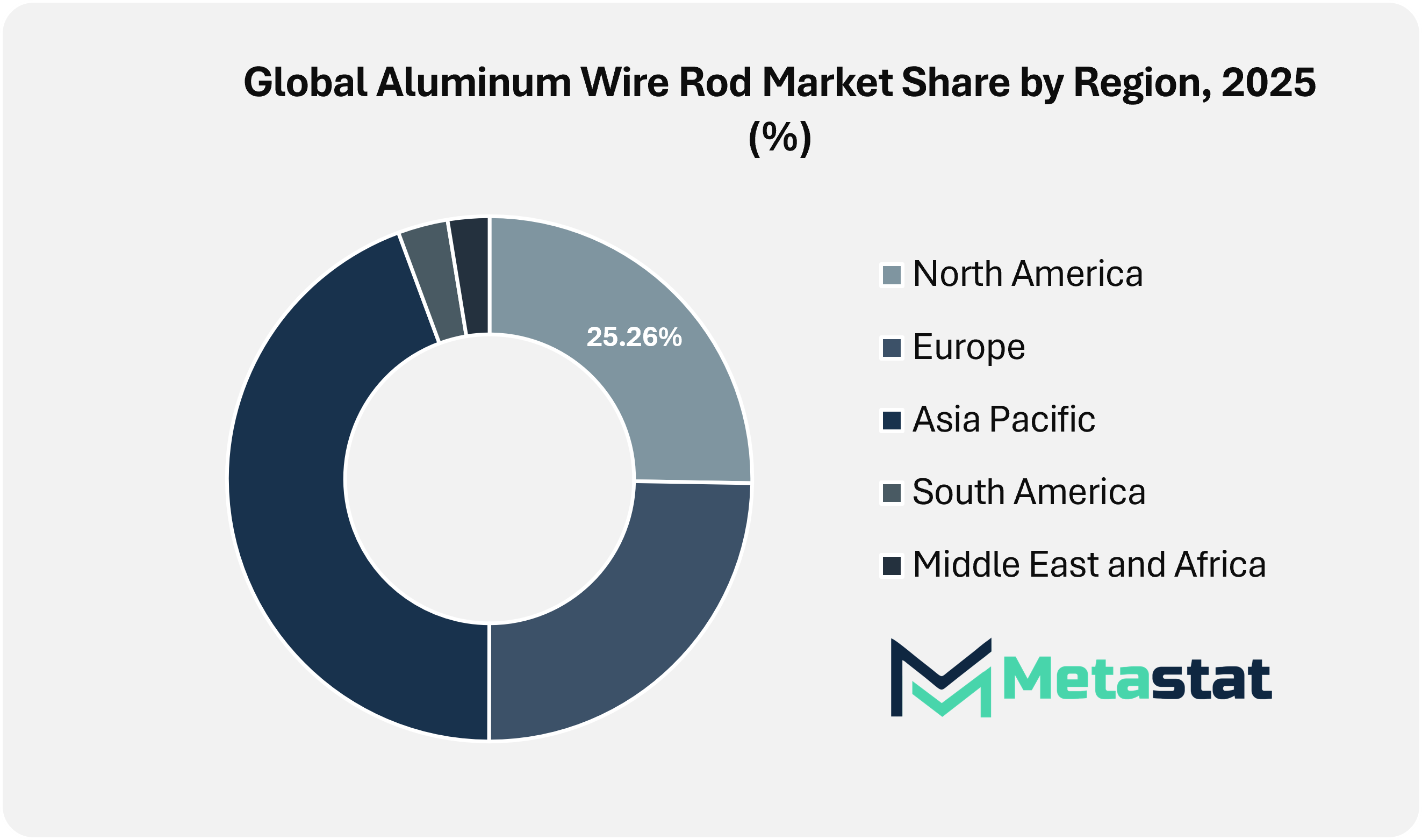
Aluminium wire rod remains a core upstream input for conductors, cables, and select construction applications, supported by grid investment and lightweighting trends as aluminium wire rods will always be in demand in power transmission and construction applications. Furthermore, these products will always be required in industries that require conductivity and lightweight properties in products. With increasing power demand and urbanization, industries will always use aluminium wire rods in their processes to ensure efficiency in production processes despite high production costs associated with these products.
Major players in the Aluminium Wire Rod market across the globe have a crucial role in determining supply stability, as well as quality of production. Norsk Hydro ASA and Emirates Global Aluminium PJSC are among the major players in the market with strong strength plus production capacity, thereby having the capability to meet the demand with quality material globally. Their future operations are likely to see improvements in production efficiency.
Other key participants, such as Kaiser Aluminium Corporation, RUSAL, Hindalco Industries Ltd., and Vedanta Aluminium, offer a diverse range of experience related to aluminium processing. These participants support the market by operating locally as well as globally, thus guaranteeing a continued supply of wire rods to make cables, conductors, and other materials. The existing network will help establish trust among their clients, who prefer to rely on continuous supply sources.
Asian and Middle Eastern companies like Sumitomo Electric Industries, Ltd., Bahra Cables Company, Midal Cables B.S.C. (C), Oman Aluminium Processing Industries LLC, and Trans Gulf Aluminium Industries LLC are also important for the industry since they are well-positioned within their region, catering to their local infrastructure demands.
European and specialty producers such as ALRO S.A., Elka Mehr Kimiya, and Prysmian S.p.A. contributes with advanced processing methods and robust distribution networks. In addition to these, their focus on quality standards and customer specific needs will contribute toward the consistency of the global aluminium wire rod market in various applications.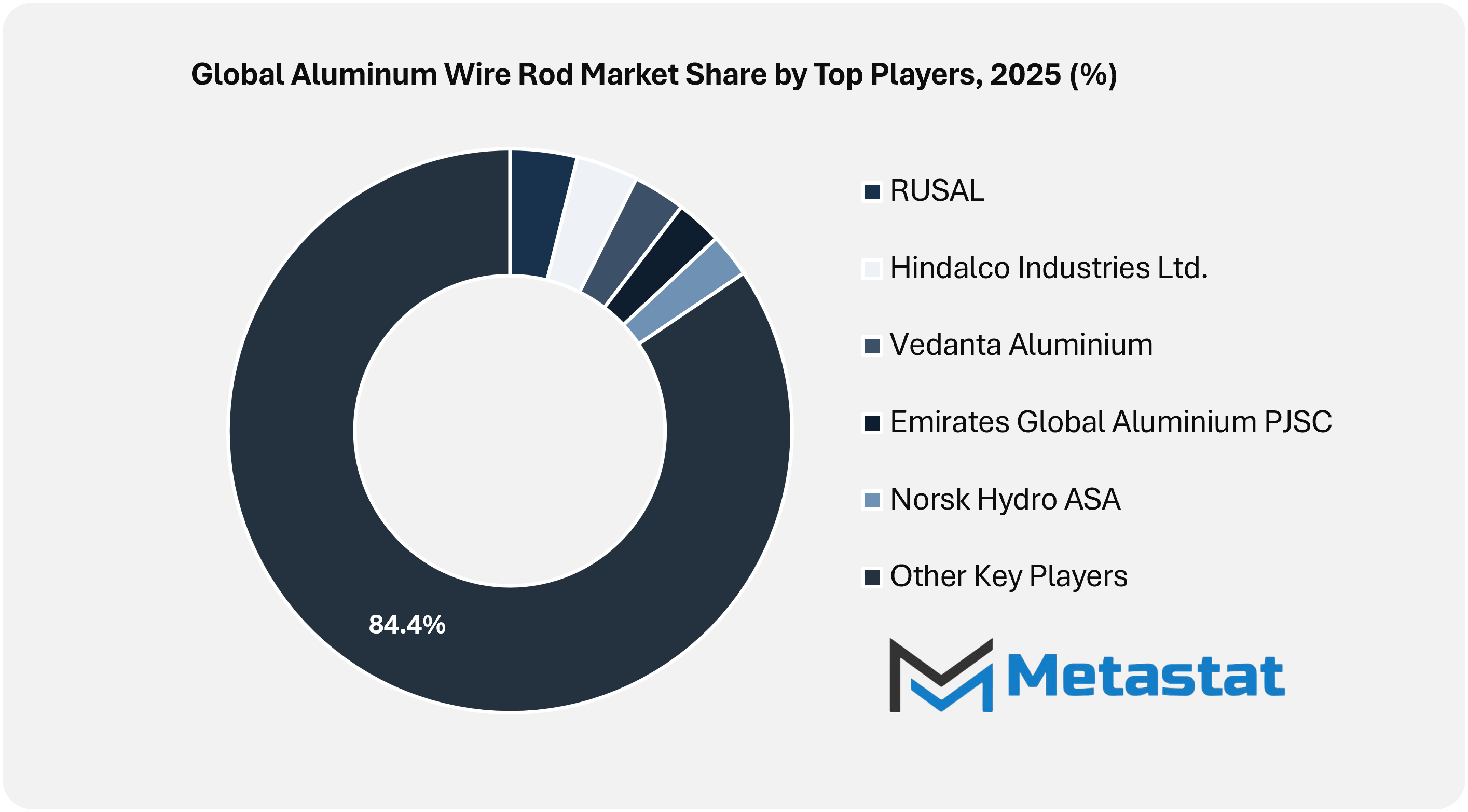
Market size is forecast to rise from USD 31.9 billion in 2025 to over USD 43.3 billion by 2033.
The global market for aluminium wire rod policy and customer requirements for traceability and lifecycle accountability will influence procurement and certification across aluminium wire rod supply chains. in terms of tracing material procurement and material accountability throughout its entire lifecycle. The use of material documentation standards and closed-loop material recovery systems will become standard operating practices across major supply chains. The suppliers will be forced to look beyond overall product output by understanding the final loop the product will undertake through various industrial cycles. In the coming years, the market would evolve from a base material to the strategic material interface. The future would be determined by how the market would integrate with the advanced system that requires insights such as resilience and material intelligence.
This research report categorizes the Aluminium Wire Rod market based on key segments and regions, forecasts revenue growth, and analyses trends in each submarket. The report analyses the key growth drivers, opportunities, and challenges influencing the Aluminium Wire Rod market. Recent market developments and competitive strategies such as expansion, product launches, partnerships, merger, and acquisition have been included to draw the competitive landscape in the market.
The report strategically identifies and profiles the key market players and analyses their core competencies in each sub-segment of the Aluminium Wire Rod market.
|
Report Attributes |
Details |
|
Study Period |
2021-2033 |
|
Base Year |
2025 |
|
Estimated Year |
2026 |
|
Forecast Period |
2026-2033 |
|
Historical Period |
2021-2025 |
|
Growth Rate |
CAGR 4.0% from 2026 to 2033 |
|
Revenue Unit |
USD billion |
|
Sales Volume Unit |
Kilotons |
|
Segmentation |
By Product Type, Application, End Use Industry, Form, and Region |
|
By Region |
North America (By Product Type, Application, End Use Industry, Form, and Country)
|
|
Europe (By Product Type, Application, End Use Industry, Form, and Country)
|
|
|
Asia Pacific (By Product Type, Application, End Use Industry, Form, and Country)
|
|
|
South America (By Product Type, Application, End Use Industry, Form, and Country)
|
|
|
Middle East and Africa (By Product Type, Application, End Use Industry, Form, and Country)
|
Find answers to common questions about this report
The Metastat Insights study shows that the global Aluminium Wire Rod market size was USD 31.9 billion in 2025.
The global Aluminium Wire Rod market is likely to grow at a CAGR of 4.0% over the forecast period (2026-2033).
The Metastat Insights analysis shows that the North America Aluminium Wire Rod market size is estimated to be USD 11.2 billion by 2033.
The Bare Wire Rod is the leading type segment in the global market.
Rising demand for aluminium conductors in power transmission due to their lightweight, conductivity advantages and growth in electric vehicle (EV) automotive manufacturing boosting the need for lightweight wiring components are key driving factors, boosting the market.
Asia Pacific region dominates the market.
Volatility in raw material prices impacting production costs and margins will hamper market growth within the forecast period.
Global Aluminium Wire Rod market is estimated to reach USD 43.3 billion by 2033.
Top players operating in the Aluminium Wire Rod industry include Norsk Hydro ASA, Emirates Global Aluminium PJSC, Kaiser Aluminium Corporation, RUSAL, and Hindalco Industries Ltd.
The analysts below cover Chemicals and Materials research at Metastat Insights.
LEAD ANALYST
Utkarsh Khirodkar is a Lead Market Research Analyst at MetaStat Insight, specializing in market intelligence, technology sector assessments, and competitive strategy.

INDUSTRY CONSULTANT - CHEMICALS & ADVANCED MATERIALS
Chemicals and Materials · Machinery & Equipment · Packaging
Amit Gadhekar Consultant for Chemicals and Materials at MetaStat Insight, directing sector-specific intelligence, research, and strategic consulting across global chemical and processing markets.
Tracking maintenance cycle demand for secondary flight display units and terrain collision avoidance systems across regional jet fleets involves complex aftermarket dynamics. MetaStat Insight provided practical analysis separating airline retrofit programs from OEM forward-fit production schedules in North America and Southeast Asia. The supplier matrix highlighted component obsolescence timelines without resorting to vague generalizations. The dataset served as a dependable reference during our annual program review meetings.
Evaluating secondary resin quality across post-consumer packaging streams requires reliable technical segmentation. MetaStat Insight delivered an objective assessment that distinguished between extrusion-grade flake pricing and optical sorting throughput limitations across Western Europe. The competitive positioning breakdown for licensed depolymerization technology providers answered several questions during our feedstock feasibility audit. Their team clarified regional trade restrictions on mixed plastic scrap quickly when our team submitted follow-up requests.
Evaluating sovereign cloud deployments for core banking platforms demands a clear view of data residency regulations and migration exit strategies. MetaStat Insight delivered an exhaustive review of regional latency tolerances, mainframe decommission milestones, and third-party vendor concentration risk. The regulatory compliance mapping across European and Asian financial jurisdictions gave our team a dependable baseline for multi-cloud infrastructure discussions.
Explore related market intelligence reports worth reading alongside this one.
Starting from
$2950