
LEAD ANALYST
Utkarsh Khirodkar is a Lead Market Research Analyst at MetaStat Insight, specializing in market intelligence, technology sector assessments, and competitive strategy.

Bone Incremental Material Market Size, Share, By Types (Allogeneic Transplant, Xenotransplantation, and Synthetic Graft), By Application (Dental, Orthopedic Surgery, Spinal Fusion, Trauma, and Extremities), By End User (Ambulatory Surgery Centers, Dental Clinics, Hospitals, and Research Institutes), Industry Analysis, Growth, Trends, and Forecast, 2026-2033
Report ID
MSI-4601
Published
April, 2026
Pages
320 Pages
Format
Report Details
Choose Your License
Bone Incremental Material Market
Global Bone Incremental Material market size is valued at USD 958.1 million in 2025 and projected to grow at a CAGR of 21.1% during the forecast period, reaching USD 4,435.1 million by 2033.
North America accounts for 33.7% of the global market in 2025, with the U.S. leading regional demand.
Allogeneic Transplant segment accounts for a market share of 38.1% in 2025.
Key trends driving growth: Rising dental implant volumes propel demand for predictable ridge augmentation and faster site readiness, along with increased geriatric population and chronic periodontitis cases increase graft usage to restore bone loss and improve implant success rates.
Opportunities include next-generation biomaterials create premium growth via bioactive composites, growth-factor enhanced matrices, and patient-specific 3D-printed graft solutions.
Key insight: Rising orthopedic procedure volumes and regenerative innovation position the Global Bone Incremental Material market for sustained expansion amid cost and regulatory pressures.
The global Bone Graft Materials market operates within the advanced biomaterials and reconstructive surgery industry, serving dental, orthopedic, spinal, trauma, and extremity procedures. Over the forecast period, the market will expand through wider use of allograft, xenograft, and synthetic bone graft materials that support bone regeneration, structural repair, and improved procedural outcomes. Clinical adoption will be reinforced by rising implant volumes, increasing degenerative and trauma-related bone defects, and stronger integration of regenerative biomaterials into modern surgical workflows.
The market is moving toward personalized solutions developed through additive manufacturing and biofabrication technologies. Custom-designed graft structures and implants are being aligned with patient anatomy through advanced imaging datasets and 3D modeling platforms. Surgeons are increasingly adopting materials that support controlled bone formation and improved host tissue integration. Ongoing collaboration between biomaterial engineers and tissue scientists will accelerate the development of hybrid constructs that combine mineral components with bioresorbable polymers for more predictable remodeling outcomes.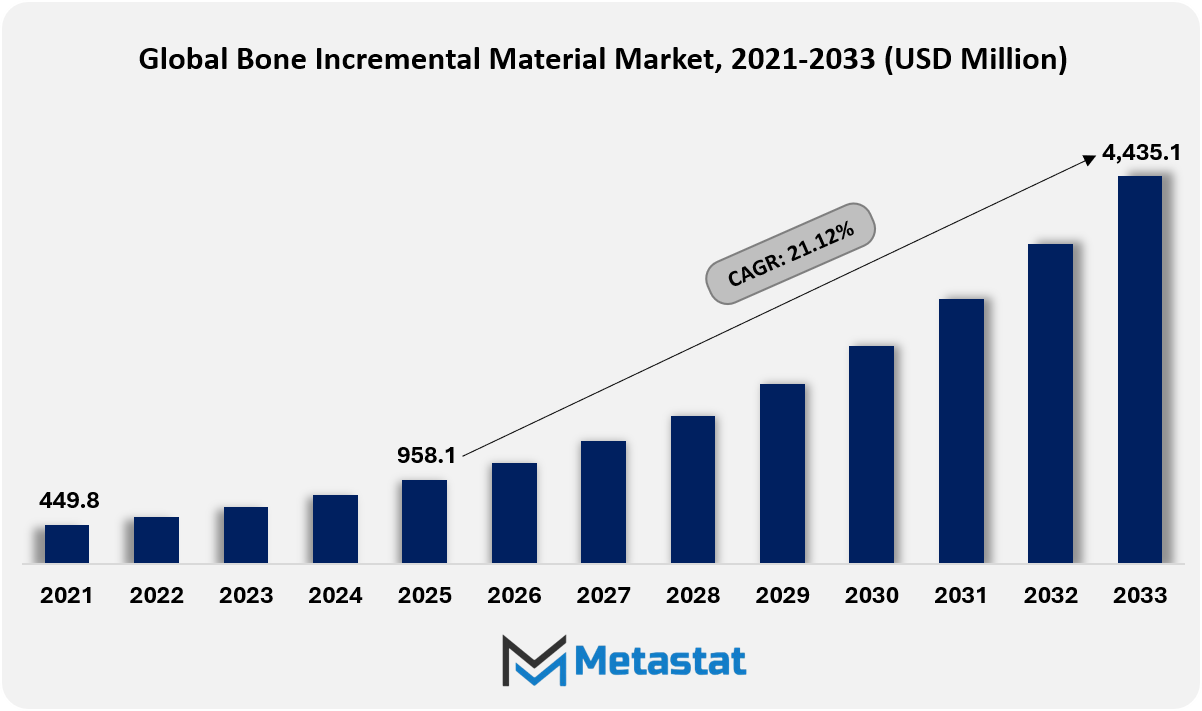
Rising dental implant volumes propel demand for predictable ridge augmentation and faster site readiness.
Rising implant procedures across urban hospitals and specialty dental centers are strengthening the need for effective ridge preservation and augmentation materials. Surgeons are prioritizing products that offer stable volume retention and faster osseointegration. The global Bone Incremental Material market will expand steadily with wider adoption of standardized surgical protocols, shorter recovery timelines, and growing patient preference for improved functional and aesthetic outcomes.
Increased geriatric population and chronic periodontitis cases increase graft usage to restore bone loss and improve implant success rates.
Aging populations across developed and emerging economies are increasing the need for restorative interventions for alveolar bone deficiency and related bone loss conditions. Chronic inflammatory disorders such as periodontitis continue to support demand for graft materials that restore structural integrity before implantation. The global Bone Incremental Material market will benefit from expanding preventive dentistry programs, earlier diagnosis, and stronger awareness of long-term implant success supported by reliable graft materials.
Higher procedure and material costs constrain uptake in price-sensitive clinics and emerging markets.
High pricing of advanced graft substitutes and related surgical procedures will limit broader adoption across price-sensitive healthcare settings. Budget constraints in regional clinics and smaller care centers will reduce procurement of premium materials. The global Bone Incremental Material market will face pricing pressure, encouraging manufacturers to improve production efficiency, optimize pricing strategies, and introduce value-oriented product lines.
Clinical variability and complication risk limit adoption with graft resorption, infection risk, and inconsistent outcomes across techniques.
Variations in surgeon experience and procedural technique will affect clinical predictability and patient outcomes. Concerns related to graft resorption, post-operative infection, and inconsistent healing responses remain important barriers to wider adoption. The global Bone Incremental Material market will continue addressing these challenges through stronger clinical evidence, improved surgeon training programs, and material innovation focused on enhancing safety, performance, and long-term integration.
Next-generation biomaterials create premium growth via bioactive composites, growth-factor enhanced matrices, and patient-specific 3D-printed graft solutions.
Advanced biomaterial engineering is enabling the development of bioactive scaffolds that support stronger osteogenesis and improved vascularization. Integration of digital imaging with additive manufacturing is also making patient-specific graft design more feasible, improving anatomical fit and surgical precision. The global Bone Incremental Material market will witness premium segment expansion driven by regenerative science, precision surgery, and regulatory support for advanced therapeutic solutions.
The Global Bone Incremental Material market is classified based on Types, Application, and End User.
Allogeneic Transplant segment is valued at USD 441.4 million in 2026 and is projected to reach USD 1,604.6 million by 2033, at a CAGR of 20.2% during the forecast period.
Allogeneic Transplant will gain wider clinical acceptance through improved donor screening, advanced sterilization standards, and more efficient tissue processing methods. Demand for these materials will increase owing to their biological compatibility and established use in reconstructive procedures. Expanded tissue bank networks and improving regulatory alignment across regions will further support steady supply and more predictable procedural outcomes.
Xenotransplantation segment is valued at USD 187.2 million in 2026 and is projected to reach USD 821.8 million by 2033, at a CAGR of 23.5% during the forecast period.
Xenotransplantation will advance through improved purification technologies and bioengineered modifications that strengthen safety and performance profiles. Ongoing research in xenogenic graft processing is improving surgeon confidence and expanding clinical relevance. Cost efficiency and scalable manufacturing capabilities will position these materials for broader procurement across hospitals and institutional care settings.
Synthetic Graft segment is valued at USD 530.9 million in 2026 and is projected to reach USD 2,008.6 million by 2033, at a CAGR of 20.9% during the forecast period.
Synthetic Graft will continue to strengthen through advances in material science, including bioactive ceramics, calcium phosphate formulations, and polymer composites. Product development is increasingly focused on structural strength, faster integration, and shape customization. Additive manufacturing technologies are also supporting patient-specific graft fabrication, which is improving surgical precision and long-term stability.
Dental segment is projected to reach USD 966 million by 2033, at a CAGR of 20.3% during the forecast period.
Dental applications will expand with rising dental implant adoption and broader use of preventive oral reconstruction planning. Growing awareness of aesthetic dentistry and the increasing elderly population are supporting procedure volumes. Integration of digital imaging with graft planning software is also improving placement accuracy and treatment predictability.
Orthopedic Surgery segment is projected to reach USD 1,389.9 million by 2033, at a CAGR of 21.7% during the forecast period.
Orthopedic Surgery will witness steady growth, supported by increasing joint reconstruction procedures and sports-related injuries. Improvements in graft durability and infection control are contributing to better recovery outcomes. Hospitals are increasingly prioritizing materials with proven biomechanical performance and strong clinical evidence.
Spinal Fusion segment is projected to reach USD 1,301.7 million by 2033, at a CAGR of 21.6% during the forecast period.
Spinal Fusion applications will benefit from advancements in minimally invasive procedures and surgical navigation systems. Surgeons are placing greater emphasis on graft materials that support faster bone growth and strong mechanical stability. Aging populations and the rising prevalence of degenerative spine disorders will continue to support procedure demand globally.
Trauma And Extremities segment is projected to reach USD 777.5 million by 2033, at a CAGR of 20.5% during the forecast period.
Trauma and Extremities will expand with improvements in emergency care infrastructure and fracture management protocols. Urbanization and the rising incidence of accidents will continue to support clinical need. Graft solutions offering load-bearing strength and faster osteointegration will influence procurement decisions across trauma care settings.
Ambulatory Surgery Centers segment is projected to reach USD 1,320.6 million by 2033.
Ambulatory Surgery Centers will increase adoption, supported by the growing preference for cost-efficient outpatient procedures. Standardized graft kits and efficient storage solutions align well with the operational needs of these facilities. Reimbursement trends favoring shorter hospital stays are also likely to accelerate material demand in outpatient settings.
Dental Clinics segment is projected to reach USD 862.8 million by 2033.
Dental Clinics in the will increase purchasing volumes with the expansion of implantology and cosmetic reconstruction services. Streamlined supply chains and chairside graft preparation systems are improving workflow efficiency. Independent clinics are increasingly seeking reliable materials that support predictable healing and consistent clinical outcomes.
Hospitals segment is projected to reach USD 1,944.8 million by 2033.
Hospitals will remain the primary revenue contributors in the global Bone Incremental Material market, supported by high patient volumes and a greater concentration of complex surgical procedures. Investment in advanced operating infrastructure is increasing the use of premium graft alternatives. Multidisciplinary surgical teams are also driving demand for versatile materials with strong clinical validation.
Research Institutes segment is projected to reach USD 306.9 million by 2033.
Research Institutes in the will expand experimental studies focused on regenerative medicine and biomaterial innovation. Collaborative clinical trials and public research funding will accelerate prototype validation and translational development. Academic partnerships with manufacturers will also support the commercialization of laboratory-stage innovations into scalable market products. Research Institutes related to the Global Bone Incremental Material market will increase experimental research focused on regenerative medication and biomaterial innovation. Collaborative scientific trials and public funding tasks will boost up prototype validation. Academic partnerships with producers will aid translation of laboratory findings into scalable commercial products.
Based on geography, the Global Bone Incremental Material market is divided into North America, Europe, Asia-Pacific, South America, Middle East, and Africa.
North America Bone Incremental Material Market is set to expand at a CAGR of 21.1% within the forecast period, reaching a market size (TAM) of USD 1,406.4 million by the end of 2033.
North America drives the Bone Incremental Material market via superior orthopedic studies infrastructure and strong adoption of regenerative biomaterials throughout leading hospitals.
Asia Pacific creates possibilities for the Bone Incremental Material market through increasing medical tourism hubs and rising demand for low-cost bone regeneration answers.
Asia Pacific offers increase potential for the Bone Incremental Material market owing to increasing healthcare expenditure and fast growth of private dental and orthopedic clinics.
Across the Middle East, Africa, and South America, the Bone Incremental Material market gains constant traction from improving surgical capabilities, rising trauma instances, and slow modernization of healthcare centers.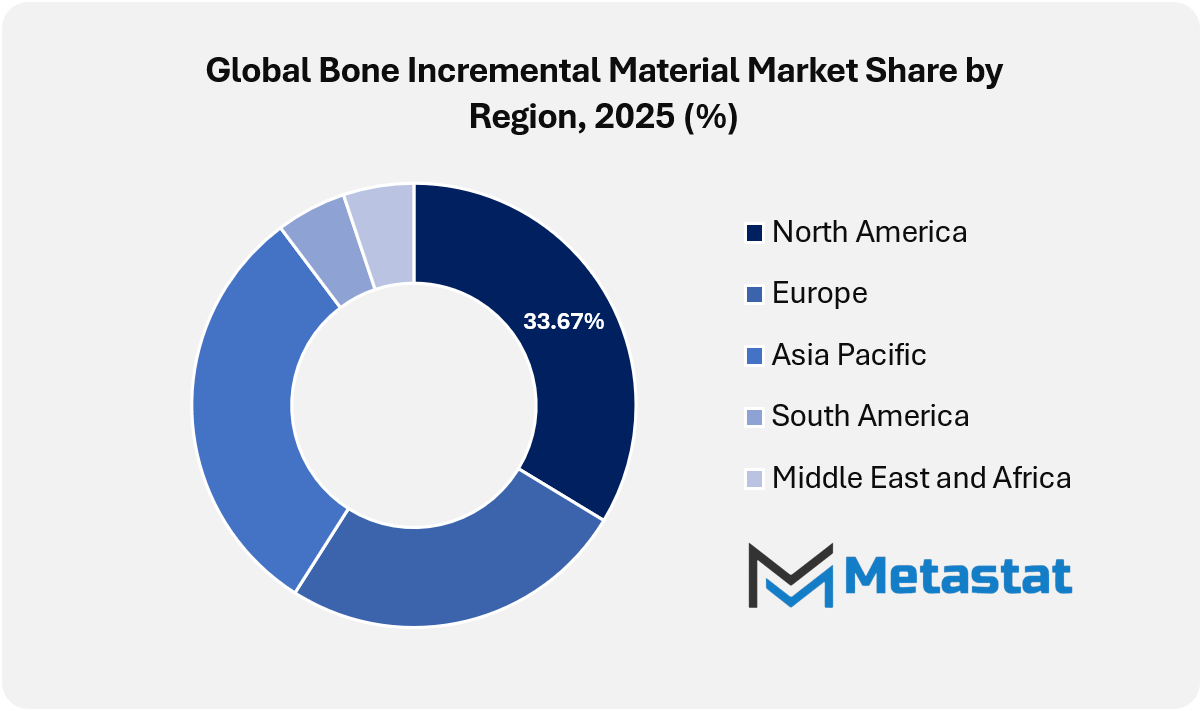
The global Bone Incremental Material market will continue to gain attention as dental, orthopedic, spinal, and trauma procedures increase across both developed and emerging regions. These materials are widely used in dental implants, trauma repair, spinal fusion, and reconstructive surgeries. Rising cases of tooth loss, sports injuries, road accidents, and age-related bone disorders will support demand. Patients increasingly prefer faster healing and long-term stability, while surgeons rely on advanced grafting materials to improve treatment outcomes. Advances in biomaterials, including synthetic substitutes and biologically derived grafts, are expanding clinical options and strengthening procedural success.
In dental applications, bone grafting has become a routine step before implant placement. Companies such as Geistlich Pharma AG, botiss biomaterials GmbH, Institut Straumann AG, and Nobel Biocare Services AG maintain strong visibility through established product portfolios and continued clinical research support. Firms including Dentsply Sirona Inc., BioHorizons, Inc., CAMLOG Biotechnologies GmbH, and Thommen Medical AG continue to introduce graft materials designed to improve osseointegration and reduce healing time. Regional players such as Tecnoss Dental S.r.l., Purgo Biologics, Inc., Dentium Co., Ltd., Osstem Implant Co., Ltd., MegaGen Implant Co., Ltd., GENOSS Co., Ltd., Augma Biomaterials, Ltd., and Septodont SAS are also expanding their presence through cost-effective and procedure-friendly solutions.
Beyond dentistry, orthopedic and trauma care will drive broader adoption of bone incremental materials. Large medical device companies such as ZimVie Inc., Zimmer Biomet Holdings, Inc., Medtronic plc, Stryker Corporation, and Johnson & Johnson Services, Inc. are strengthening market presence through spine and joint reconstruction portfolios. Companies including Orthofix Medical Inc., LifeNet Health, Inc., MTF Biologics, AlloSource, and Xtant Medical Holdings, Inc. are contributing through allografts and regenerative products used in complex bone repair procedures. Their focus on clinical data, surgeon education, and distribution strength is supporting adoption across hospitals and specialty clinics.
Innovation in synthetic bone substitutes and bioactive materials will continue to shape competition in the market. Companies such as Biocomposites Ltd, BONESUPPORT AB, Kuros Biosciences AG, and NovaBone Products, LLC are focusing on calcium-based materials and bioactive glass technologies that support bone regeneration. With aging populations and rising preference for minimally invasive surgery, demand for dependable graft substitutes will increase steadily. The market will remain competitive, driven by product development, regulatory approvals, and partnerships between implant manufacturers and biomaterial specialists. Over the forecast period, continued research investment and stronger clinical confidence will support wider patient access to advanced treatment options.
Market size is forecast to rise from USD 958.1 million in 2025 to over USD 4,435.1 million by 2033.
Regulatory pathways are expected to evolve to address composite biomaterials that combine synthetic and biologically derived components. Manufacturing standards will increasingly focus on microarchitecture validation, mechanical simulation testing, and long-term biointegration performance. Strategic partnerships among medical device companies, biotechnology firms, and academic research centers will reshape future product pipelines. As clinical expectations continue to advance, the market will place greater emphasis on durability, osteoconductive stability, and controlled resorption behavior. The future landscape will be shaped by precision engineering, translational research, and continued innovation in reconstructive solutions that more closely replicate natural bone physiology.
By Types:
By Application:
By End User:
This research report categorizes the Bone Incremental Material market based on key segments and regions, forecasts revenue growth, and analyses trends in each submarket. The report analyses the key growth drivers, opportunities, and challenges influencing the Bone Incremental Material market. Recent market developments and competitive strategies such as expansion, product launch, partnership, merger, and acquisition have been included to draw the competitive landscape in the market.
The report strategically identifies and profiles the key market players and analyses their core competencies in each sub-segment of the Bone Incremental Material market.
|
Report Attributes |
Details |
|
Study Period |
2021-2033 |
|
Base Year |
2025 |
|
Estimated Year |
2026 |
|
Forecast Period |
2026-2033 |
|
Historical Period |
2021-2025 |
|
Growth Rate |
CAGR 21.1% from 2026 to 2033 |
|
Revenue Unit |
USD million |
|
Segmentation |
By Types, Application, End User, and Region |
|
By Region |
North America (By Types, Application, End User, and Country)
|
|
Europe (By Types, Application, End User, and Country)
|
|
|
Asia Pacific (By Types, Application, End User, and Country)
|
|
|
South America (By Types, Application, End User, and Country)
|
|
|
Middle East and Africa (By Types, Application, End User, and Country)
|
Find answers to common questions about this report
Top players operating in the Bone Incremental Material industry include Geistlich Pharma AG, botiss biomaterials GmbH, Institut Straumann AG, Nobel Biocare Services AG, Dentsply Sirona Inc., and BioHorizons, Inc.
Global Bone Incremental Material market is estimated to reach USD 4,435.1 million by 2033.
Rising dental implant volumes propel demand for predictable ridge augmentation and faster site readiness. and Increased geriatric population and chronic periodontitis cases increase graft usage to restore bone loss and improve implant success rates are key driving factors, boosting the market.
Higher procedure and material costs constrain uptake in price-sensitive clinics and emerging markets will hamper the market growth within the forecast period.
North America region dominates the market.
The Global Bone Incremental Material market is expected to grow at a CAGR of 21.1% over the forecast period (2026-2033).
The Metastat Insights study shows that the Global Bone Incremental Material market size was USD 958.1 million in 2025.
The Synthetic Graft is the leading type segment in the Global market.
The Metastat Insights analysis shows that the North America Bone Incremental Material market size is estimated to be USD 1,406.4 million by 2033.
The analysts below cover Medical Devices research at Metastat Insights.
LEAD ANALYST
Utkarsh Khirodkar is a Lead Market Research Analyst at MetaStat Insight, specializing in market intelligence, technology sector assessments, and competitive strategy.

LEAD PRINCIPAL ANALYST, PHARMA AND HEALTHCARE
Food and Beverages · Healthcare · Healthcare IT · Medical Devices
Ajay Devgire is the Lead Healthcare Analyst at MetaStat Insight, leading strategic research and market intelligence initiatives across the global healthcare domain.

SENIOR RESEARCH ANALYST
Biotechnology · Food and Beverages · Medical Devices · Packaging
Snehal Pasalkar is a Research Analyst at MetaStat Insight, operating at the intersection of life sciences research, competitive strategy, and market intelligence.
Tracking capacity expansion in single-use bioprocessing requires dependable data on raw material availability and cleanroom-grade polymer supply chains. The competitive landscape chapter gave a grounded evaluation of secondary component suppliers across North America and Asia-Pacific rather than simply reprinting press releases. Having that level of supplier benchmarking helped clarify dual-sourcing considerations for our clinical pipeline planning.
When evaluating distributed energy resource management systems, standard research summaries tend to gloss over the operational differences between front-of-the-meter utility deployments and behind-the-meter industrial sites. The MetaStat Insight report addressed those distinctions directly, especially regarding software interoperability standards and grid interconnection backlogs. The five-year market sizing across regional transmission organizations provided actionable context for our grid modernization strategy.
Most industry reports on warehouse automation bundle autonomous mobile robots and fixed conveyor installations into the same top-level numbers, which complicates advisory work. This study split the market cleanly by payload tiers, navigation technology, and fleet management software layers. The regional forecast for Western Europe gave our team defensible adoption benchmarks when evaluating capital allocation for logistics clients, saving us days of secondary data scrubbing.
Explore related market intelligence reports worth reading alongside this one.