
LEAD ANALYST
Utkarsh Khirodkar is a Lead Market Research Analyst at MetaStat Insight, specializing in market intelligence, technology sector assessments, and competitive strategy.

Global Corrugated Board Market Size, Share, By Product Type (Boxes, Trays, Sheets & Pads, Inserts & Dividers, Pallets and Others), By Wall Type (Single Wall, Double Wall and Triple Wall), By Material (Virgin Fiber and Recycled Fiber), By End-Use Industry (Food & Beverage, E-commerce, Healthcare & Pharmaceuticals, Personal Care & Cosmetics, Electrical & Electronics, Retail, Automotive and Transportation & Logistics), Industry Analysis, Growth, Trends, and Forecast, 2026-2033
Report ID
MSI-5672
Published
November, 2026
Pages
284 Pages
Format
Historical
Base year
Forecast
Forecast period
Report Details
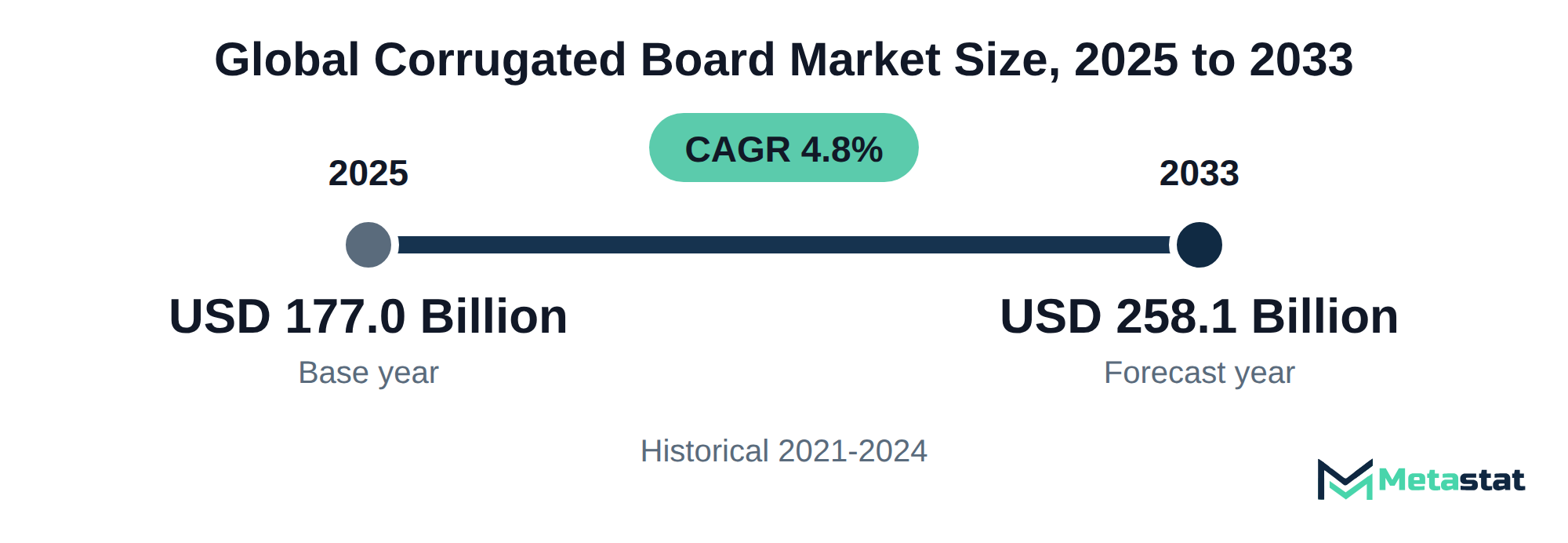
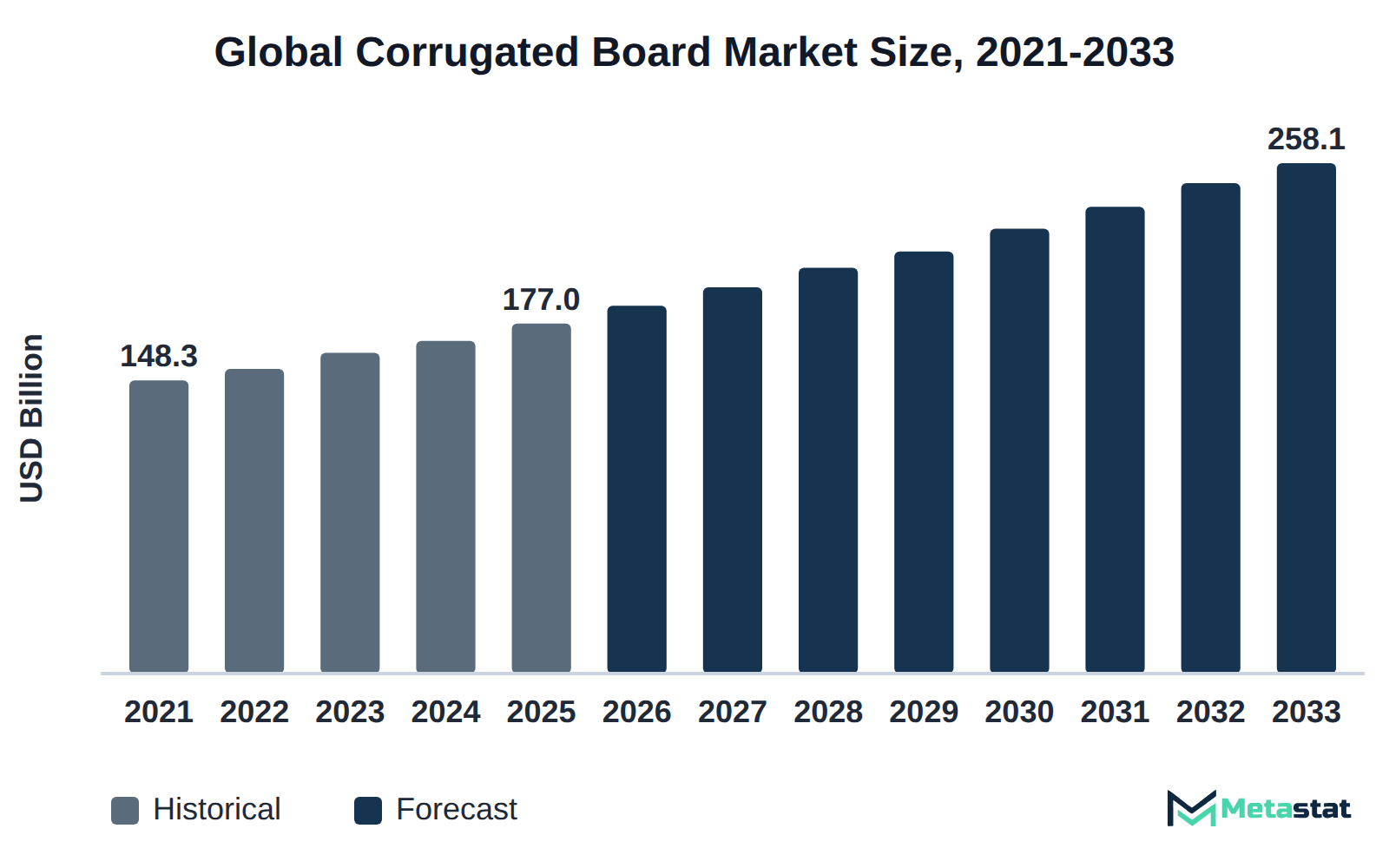
Market Valuation: Valued at $177 Billion in 2025, projected to reach $258.1 Billion by 2033 at a 4.8% CAGR.
Dominant Segment: The boxes segment leads the market, driven by the increasing demand for reliable packaging solutions in e-commerce and food and beverage industries.
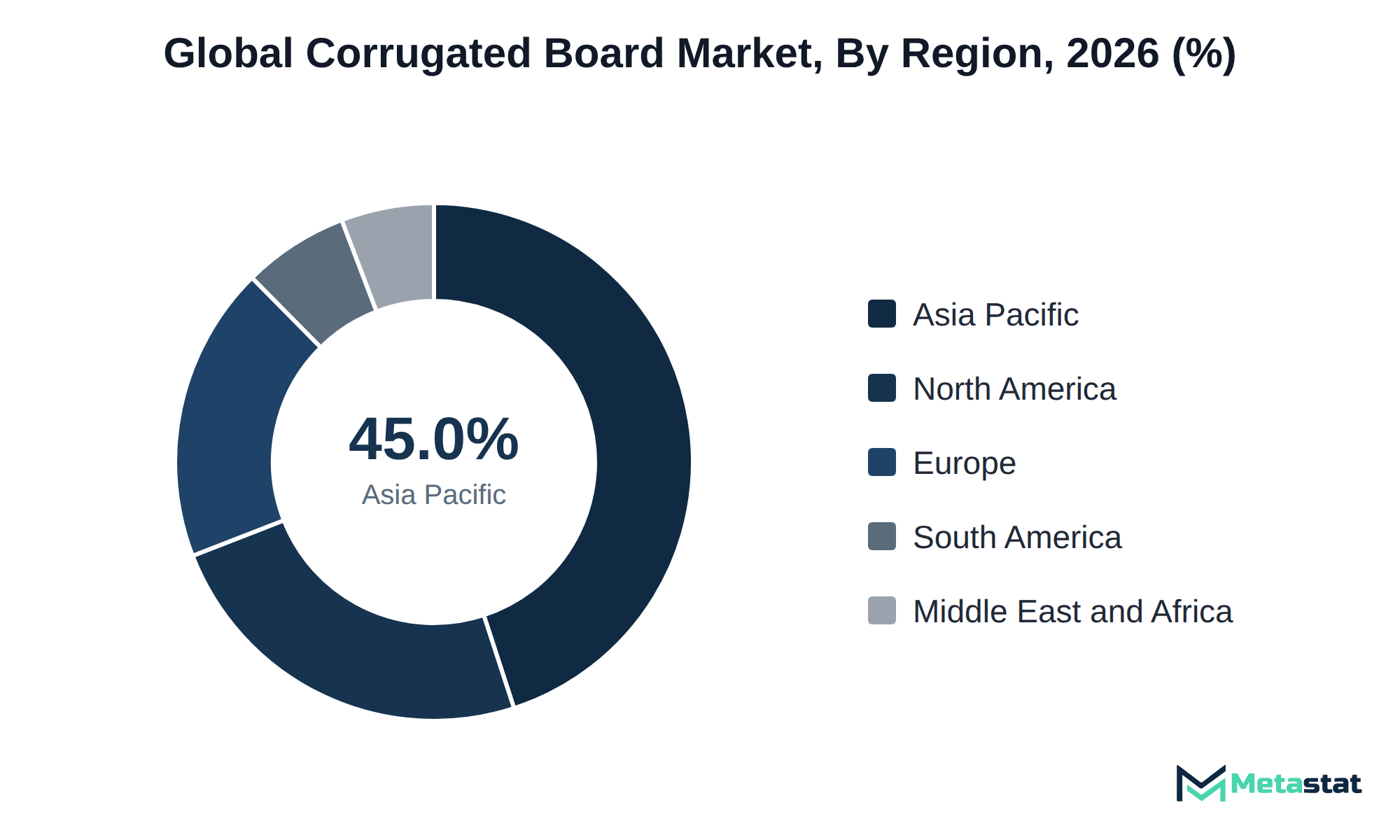
Geographic Lead: Asia Pacific holds the largest market share at 45%, attributed to extensive industrial activities and a growing consumer base in countries like China and India.
What's Inside: The report provides a comprehensive analysis of the competitive landscape, market dynamics, and detailed forecasts from 2026 to 2033 across various segments and regions.
Technological Advancements: Innovative technologies in automation and digitalization are enhancing production efficiency, allowing manufacturers to optimize resources and reduce waste.
Sustainability Trends: The rising adoption of recycled fiber reflects a significant shift towards sustainable packaging solutions, driven by environmental awareness and regulatory mandates.
Choose Your License
Global Corrugated Board Market
The global Corrugated Board market was valued at USD 177 billion in 2025 and is projected to reach USD 258.1 billion by 2033, growing at a CAGR of 4.8% over the forecast period.
The Corrugated Board market encompasses various products and materials used in packaging, shipping, and storage applications. Buyers invest in this market primarily due to the increasing demand for sustainable and efficient packaging solutions. The trend toward e-commerce and retail growth significantly influences purchasing decisions, with companies seeking reliable packaging to protect goods during transit.
Rising demand for boxes, the largest segment by value, drives corrugated board market growth. North America holds 24.1% of the market in 2025, with the US leading in 2026. The Asia Pacific region commands the highest market share at 45%, attributed to extensive industrial activities and a growing consumer base in countries including China and India.
Innovations in material technology, including the use of recycled fiber, enhance the sustainability profile of corrugated products. This focus on environmentally friendly materials aligns with the growing consumer preference for sustainable options. Advanced production techniques further support market expansion by helping manufacturers meet changing industry demands.
The demand for corrugated board primarily stems from its essential role in packaging and distribution across various industries. Industries including food and beverage, e-commerce, and healthcare frequently invest in corrugated solutions to ensure product safety and integrity during transportation. The ability to customize designs and sizes further enhances its appeal, catering to the specific requirements of different products. This versatility drives significant spending within the market.
Growth in the corrugated board market is propelled by the increasing demand for sustainable packaging solutions. The shift towards eco-friendly materials has led many companies to adopt corrugated options, which use recyclable materials and reduce environmental impact. Among the various segments, boxes represent the largest value share, reflecting their widespread use in diverse applications. Asia Pacific holds the largest market share, accounting for 45% of the total, with North America following closely behind.
The expanding e-commerce sector significantly influences growth, driving higher demand for efficient and reliable packaging solutions. As consumer preferences change, the corrugated board market continues to adapt and remains a core part of global supply chains.
Right-sizing and fanfold automation significantly impact the efficiency and sustainability of corrugated packaging for parcel shipping. The corrugated board market increasingly adopts these technologies to optimize packaging processes, reducing material waste and enhancing operational efficiency. For instance, right-sizing reduces packaging dimensions to fit products more accurately, minimizing excess space and lowering shipping costs. In 2023, the market for corrugated boxes reached USD 162.2 billion, reflecting the growing demand for efficient packaging solutions.
Fanfold automation complements this trend by enabling integration of packaging processes. This technique streamlines production, allowing manufacturers to create fanfold sheets that conform to varying box sizes on demand. Consequently, producers swiftly adapt to diverse shipping requirements without compromising material integrity. The corrugated board market is projected to reach USD 258.1 billion by 2033, which shows the commercial value of these advancements. Together, right-sizing and fanfold automation help suppliers strengthen their competitive edge and meet changing customer expectations.
The implementation of the EU Packaging and Packaging Waste Regulation (PPWR) drives brand owners toward adopting recyclable fiber-based board solutions. This regulatory framework emphasizes sustainability and encourages companies to transition from traditional plastic packaging to green packaging and other more environmentally friendly options. An increased emphasis on sustainability aligns with the growing consumer demand for eco-conscious products.
In the Corrugated Board market, the shift toward recyclable fiber-based materials reflects the broader industry trend toward reducing plastic usage. The market for recycled fiber is projected to reach USD 90.8 billion by 2033, demonstrating significant growth potential. Brand owners actively seek cost-efficient and sustainable packaging solutions, drawing attention to corrugated board products that meet both regulatory requirements and consumer expectations.
These trends are significantly changing purchasing models. While companies increasingly prioritize sustainability, procurement strategies evolve toward long-term contracts with suppliers that guarantee compliance with environmental standards. This shift enhances the competitive edge of suppliers who offer innovative, recyclable materials. The shift toward fiber-based solutions helps businesses benefit from changing market dynamics and drives growth in the corrugated board segment.
Pharmaceutical cold-chain logistics require packaging solutions that meet stringent regulatory standards while ensuring product integrity. This demand drives the need for specialized corrugated board solutions, particularly those featuring micro-flute specifications. These specifications improve structural integrity without significantly increasing weight, making them ideal for transporting temperature-sensitive pharmaceutical products.
The corrugated board market reflects this shift, with pharmaceutical applications expected to boost the demand for advanced packaging solutions. The food and beverage sector, a significant contributor to overall demand, highlights the increasing focus on maintaining product quality during transportation. For example, the segment for food and beverage within the market is projected to expand from USD 72.5 billion in 2026 to USD 98.9 billion by 2033, representing a compound annual growth rate (CAGR) of 4.5%.
Suppliers that invest in developing micro-flute options for cold-chain applications position themselves advantageously within the market. The ability to provide tailored solutions enhances operational efficiency and increases commercial potential. By ensuring compliance with regulatory standards while delivering cost-effective solutions, these suppliers contribute to the overall growth of the market.
Specific flute profiles and wall constructions significantly enhance the performance of corrugated board used in e-commerce, food, and pharmaceutical shipments. For instance, a single wall flute profile, known for its durability and lightweight properties, serves optimally for e-commerce packaging. Demand for boxes in this segment is projected to reach USD 181.2 billion by 2033, reflecting a compound annual growth rate of 5.1%. This growth is driven by the expanding online retail sector, which requires efficient and reliable packaging solutions.
In food and beverage packaging, double wall constructions provide additional strength and protection, essential for maintaining product integrity during transit. Food and beverage shipments need packaging that ensures freshness while minimizing waste, which satisfies both consumer and retailer demands.
Pharmaceutical products benefit from inserts and dividers, which enhance organization and safety. These features are critical for maintaining compliance with stringent regulations governing medical supplies. The rising importance of safety in pharmaceuticals significantly influences packaging choices, positioning corrugated board as a preferred material due to its high protective qualities. Consequently, manufacturers focusing on these specialized constructions align with market trends prioritizing safety and efficiency, reinforcing the strategic value of tailored packaging solutions in the corrugated board market.
Rapid e-commerce expansion drives increased demand for packaging solutions, particularly corrugated board. Retailers and logistics companies require efficient, durable packaging to meet heightened online purchasing activities. The shift toward online shopping has resulted in significant growth in the volume of goods shipped, requiring more packaging material. E-commerce's share in the overall packaging market is expected to reach USD 43.1 billion by 2033, reflecting a compound annual growth rate of 6.1%. This growth places substantial pressure on suppliers to enhance production capabilities and innovate packaging designs that cater to evolving consumer needs. The Corrugated Board market benefits from these dynamics, with players focusing on tailored solutions that improve shipping efficiency and sustainability while addressing the demands of various end-use industries.
Innovative technologies enhance production efficiency within the Corrugated Board market, enabling manufacturers to optimize resources and reduce waste. Automation and digitalization streamline processes, resulting in lower operational costs and improved output consistency. Advanced packaging machinery, including high-speed printers and cutting equipment, supports the production of customized packaging solutions tailored to specific customer needs.
The integration of artificial intelligence and machine learning into production lines assists suppliers in predicting demand patterns, allowing for better inventory management. This shift toward smart manufacturing practices benefits industries reliant on corrugated board, including food and beverage, healthcare, and e-commerce. Enhanced production capabilities reduce lead times and increase the capacity to meet rising consumer demands.
Suppliers adopting these technological advancements influence competitive dynamics within the market. Companies that invest in advanced technologies gain a larger market share and support sustainable growth. Consequently, the expansion of technological capabilities reinforces demand for corrugated board products across various end-use sectors.
Fluctuations in raw material prices hinder consistent procurement strategies among buyers in the Corrugated Board market. Increases in costs for key inputs, including virgin and recycled fibers, lead to higher overall expenses for manufacturers, complicating pricing strategies. This situation creates uncertainty for buyers who require predictable pricing to manage their budgets effectively. Consequently, this volatility results in smaller purchase orders and delayed replacement of packaging solutions, particularly among small to medium-sized enterprises, which lack the financial flexibility to absorb these shifts. Limited budgetary capacity influences their ability to invest in newer materials or technologies, ultimately restricting market growth. Price fluctuations affect demand dynamics, resulting in cautious procurement practices and stalling innovation in the sector.
Suppliers in the Corrugated Board market face rising input costs that exert pressure on profit margins. Increased prices for raw materials, particularly recycled fiber, contribute to this challenge, prompting many manufacturers to explore alternative sourcing strategies. The heightened cost environment results from global supply chain disruptions and increased demand across various sectors.
In response, suppliers focus on enhancing operational efficiencies and optimizing production processes to mitigate the impacts of these rising costs. Investment in technology, including automated manufacturing systems, allows companies to minimize waste and improve throughput. Suppliers prioritize collaborations with alternative fiber producers to secure more stable pricing and availability. These strategies aim to maintain competitiveness and ensure sustainable growth within the market.
Recycled fiber segments show significant growth potential within the market, driven by heightened environmental awareness and sustainability initiatives. The CAGR for recycled fiber is projected at 6.1% through 2033, indicating strong demand for these materials. This trend aligns particularly well with industries emphasizing eco-friendly practices, including food and beverage, e-commerce, and healthcare, which prioritize sustainable packaging solutions. The rising preference for recycled materials aligns with regulatory mandates and consumer expectations for sustainable practices. Companies adopting recycled fiber gain a competitive advantage by tapping into this growing consumer base. Such strategic moves enhance market penetration and yield substantial economic benefits for players embracing sustainable practices. The corrugated board market reflects a clear shift towards recycled solutions, highlighting a significant opportunity for investment and innovation in this sector.
The Global Corrugated Board market is segmented based on Product Type, Wall Type, Material, and End-Use Industry.
The boxes segment of the corrugated board market serves various industries, including e-commerce and food and beverage, primarily for packaging products to ensure safe transit and storage. The continuous growth of online shopping fuels demand for boxes, with consumers increasingly seeking reliable packaging solutions. Rising consumer preferences for sustainable packaging options drive manufacturers to adopt eco-friendly materials, further enhancing the market's growth. Compared to other segments, including trays and sheets, the boxes segment experiences a higher growth rate, highlighting its critical role in the overall market. With an increasing focus on user-friendly packaging designs, this segment positions itself favorably in response to shifting consumer behavior.
Trays segment is estimated to reach USD 29.3 billion by 2033, at a CAGR of 3.8% during the forecast period. Used primarily for food packaging and e-commerce solutions, trays offer an effective method for transporting goods while ensuring product integrity. Demand for this segment grows due to the increase in online shopping and the need for efficient packaging solutions among retailers. Unlike boxes, trays focus on specific end-use applications, leading to a slower growth trajectory compared to boxes, which exhibit a CAGR of 5.1%. The segment's distinct advantages, including ease of stacking and design flexibility, appeal to manufacturers in the food and beverage sector, differentiating it from other product types in the market.
Sheets & Pads segment is expected to reach USD 19.2 billion by 2033. This segment finds extensive application in various industries, including food, healthcare, and e-commerce, primarily serving protective packaging and storage solutions. Rising demand in the food and beverage sector influences its growth, driven by increasing online grocery shopping and the need for efficient logistics. With a CAGR of 4.5%, the growth of this segment remains steady, yet it does not match the rapid expansion observed in other segments including E-commerce, which is anticipated to grow at a CAGR of 6.1%. The focus on sustainability and recycled materials further enhances its market appeal, differentiating it from traditional packaging methods that rely heavily on non-recyclable materials. The combination of these factors positions the Sheets & Pads segment for continued relevance and growth in response to evolving market needs.
Inserts and Dividers segment is projected to grow at a CAGR of 4.9% during the forecast period. This segment fulfills a crucial role in organizing and protecting products during shipping and storage, primarily serving industries including e-commerce, food and beverage, and pharmaceuticals. Demand for Inserts and Dividers is driven by increasing focus on product safety and presentation. A notable trend involves rising preference for sustainable packaging solutions, influencing buyers to consider recycled materials. Compared to other segments, Inserts and Dividers exhibit moderate growth, with e-commerce demand propelling faster expansion in related segments. The current market value reflects evolving industry standards geared toward enhanced functionality and environmentally friendly practices.
Pallets serve a critical role in the transportation and storage of goods across various industries, including food and beverage, e-commerce, and retail. These packaging solutions facilitate the efficient movement of products, ensuring safety and stability during transit. The growing trend toward e-commerce significantly influences the demand for pallets, with retailers seeking reliable packaging to optimize shipping processes. The adoption of pallets shows a higher growth rate compared to trays, indicating a strong preference among buyers for robust and reusable solutions. Technological advancements in design and manufacturing enhance the performance and adaptability of pallets, allowing for customization to meet specific industry requirements. This segment's emphasis on sustainability drives innovation, focusing on materials that reduce environmental impact while maintaining strength and durability. Overall, the pallets segment illustrates a dynamic area within the Corrugated Board market, marked by evolving consumer needs and industry standards.
Others encompass octabins, clamshells, and display units, providing versatile packaging solutions for various applications. These products serve industries including food, retail, and e-commerce, facilitating efficient product presentation and protection during transport. The growing need for sustainable packaging solutions significantly influences this segment, with brands seeking alternatives to plastic packaging. This shift reflects a broader industry trend prioritizing environmentally friendly materials. Compared to other sub-segments, these products cater to specific consumer needs, resulting in differentiated pricing strategies. The segment distinguishes itself through unique design requirements and customization potential, appealing to a diverse range of buyers focused on enhancing brand visibility while adhering to sustainability goals. Emphasizing innovative designs contributes to the segment's unique position within the market, highlighting the importance of aesthetics alongside functionality.
Single Wall segment is valued at USD 94.7 billion in 2026 and is projected to reach USD 135.3 billion by 2033, at a CAGR of 5.2% during the forecast period. This segment primarily serves industries requiring lightweight and cost-effective packaging solutions, particularly in the food and beverage and e-commerce sectors. Increasing demand for sustainable packaging solutions drives growth, with consumers favoring eco-friendly options. This segment exhibits a higher growth rate compared to others, including Double Wall, which has a CAGR of 4.5%. The Single Wall construction offers advantages in terms of pricing and accessibility, appealing to a broader range of buyers while supporting the operational needs of various industries. These dynamics position the segment favorably in the Corrugated Board market, contributing to ongoing market expansion.
Double Wall segment is estimated to reach USD 95 billion by 2033, at a CAGR of 4.5% during the forecast period. Double wall corrugated board is used primarily in heavy-duty applications, including shipping and storage, where enhanced strength and durability are critical. Industries including automotive and construction utilize this segment extensively due to its ability to withstand significant stress and impact. Demand for this segment is driven by ongoing growth in e-commerce and the need for robust packaging solutions. Compared to other wall types, Double Wall exhibits a slower growth trajectory, with a CAGR of 4.5%, differing from Single Wall offerings, which grow at 5.2%. Increased adoption of reusable and sustainable packaging solutions further supports the market’s growth, highlighting the importance of innovation in packaging technology.
Triple Wall segment is expected to reach USD 21.6 billion by 2033. This segment sees use in applications requiring enhanced strength and durability, often favored by industries including construction and heavy machinery. The increasing demand for robust packaging solutions drives this segment, particularly among manufacturers seeking to protect their products during transit and storage. Competitive pricing in the Triple Wall segment contrasts with other wall types, reflecting a higher value due to the added material and manufacturing complexity. This segment's growth rate of 4.5% indicates a steady rise, although slower than the CAGR of 5.2% seen in Single Wall applications. The emphasis on sustainable packaging is shaping buyer preferences, with a shift toward eco-friendly materials influencing purchasing decisions across the market.
Others (Single Face, Specialty Constructions) segment is projected to grow at a CAGR of 5.5% during the forecast period. This segment finds application in various industries seeking lightweight and cost-effective packaging solutions. Manufacturers apply these constructions for unique product shapes and to optimize space during shipping. The demand for this segment is driven by the increasing focus on sustainable packaging solutions, with buyers prioritizing recyclable materials. In contrast to other wall types, the Others segment offers flexibility and customization, appealing to specific customer needs. Sustainability continues to influence purchasing decisions, and the unique characteristics of this segment differentiate it from more conventional options, ensuring steady growth in the market.
Virgin Fiber segment is valued at USD 125.9 billion in 2026 and is projected to reach USD 167.3 billion by 2033, at a CAGR of 4.1% during the forecast period. This segment primarily finds application in various packaging solutions, predominantly within the food and beverage and e-commerce industries, where durable and high-quality materials are essential. Increasing demand for sustainable packaging options drives significant interest in this segment. The differentiating factor lies in the higher growth rate of recycled fibers, which is anticipated to grow at a CAGR of 6.1% during the same period, reflecting the industry's shift towards eco-friendly alternatives. In contrast, the Virgin Fiber segment maintains a steady growth trajectory, appealing to sectors that prioritize quality and strength in packaging solutions. The segment's stable demand supports ongoing investments in production and innovation.
Recycled Fiber segment is estimated to reach USD 90.8 billion by 2033, at a CAGR of 6.1% during the forecast period. This segment finds extensive use in sustainable packaging solutions, catering to industries including food and beverage, e-commerce, and healthcare. The demand for recycled fiber is propelled by increasing environmental awareness among consumers and businesses, driving a shift towards eco-friendly materials. Unlike other segments, the Recycled Fiber sub-segment shows a stronger growth trajectory, reflecting a growing preference for sustainable packaging alternatives. This growth is supported by rising costs of virgin materials, making recycled options more appealing both economically and environmentally. Buyers focused on reducing their carbon footprint particularly favor this segment, distinguishing it from others within the material category, which do not experience the same level of demand growth.
The food and beverage segment of the corrugated board market serves various applications, primarily packaging for food items and beverages. Demand in this segment is driven by growing consumer preferences for convenience and sustainable packaging options. Compared to the other segments in the market, Food & Beverage exhibits a moderate growth rate, supported by increasing e-commerce activities and an emphasis on food safety. This segment has a stable customer base, including manufacturers and retailers, necessitating reliable packaging solutions. Regulation concerning food safety standards influences packaging decisions, prompting manufacturers to adopt corrugated solutions that ensure product integrity. The unique characteristics of the Food & Beverage segment contribute to its distinct position in the broader Corrugated Board market.
The e-commerce segment of the corrugated board market involves packaging solutions primarily used by online retailers to ship products directly to consumers. The increasing popularity of online shopping drives significant demand for this segment. Unlike other segments, the E-commerce segment experiences faster growth due to rising consumer preferences for convenience and immediate access to goods. Factors including technological advancements in packaging design and materials contribute to its expansion, differentiating it from more traditional packaging applications including those in Food & Beverage or Healthcare. The competitive landscape continues to evolve, with suppliers developing innovative and sustainable packaging solutions to meet the specific needs of e-commerce businesses.
Healthcare & Pharmaceuticals segment is expected to reach USD 34.2 billion by 2033. This segment provides packaging solutions for pharmaceutical logistics, including the safe transport and storage of pharmaceuticals, medical devices, and other healthcare products. Demand in this sector is driven by the increasing focus on healthcare quality and the expansion of the pharmaceutical industry. Regulatory requirements for packaging materials that ensure product integrity and safety significantly influence this segment. Compared to others, including Food & Beverage, which has a projected CAGR of 4.5%, the Healthcare & Pharmaceuticals segment features a distinct growth trajectory, emphasizing specialized materials that meet stringent health standards. The market adapts to evolving consumer preferences for sustainable packaging, driving innovation and investment.
Personal Care & Cosmetics segment is projected to grow at a CAGR of 4.3% during the forecast period. This segment serves personal care packaging needs for various products, including skincare and haircare items, primarily targeting consumers in retail and e-commerce. Consumer trends emphasizing sustainable packaging drive demand for corrugated solutions in this sector. The shift toward environmentally friendly materials aligns with growing preferences for recycled options, reflecting a broader industry trend. Compared to other segments, including E-commerce, which is anticipated to grow at a faster rate of 6.1%, Personal Care & Cosmetics experiences steady growth driven by brand loyalty and product innovation. The market's emphasis on effective branding and visibility highlights the importance of high-quality packaging. Manufacturers focusing on this segment benefit from adapting to changing consumer preferences while maintaining competitive pricing strategies.
Electrical & Electronics packaging involves specialized corrugated board solutions tailored for the safe transport and storage of electronic components and devices. This segment services manufacturers and retailers in the electronics sector, requiring packaging that minimizes risk during shipping and handling. A primary driver of demand includes the growing e-commerce trends that heighten the need for protective packaging solutions. Advancements in technology increase the adoption of innovative packaging designs, enhancing product protection and appeal. Compared to other segments, packaging for Electrical & Electronics typically experiences slower growth due to the high standards for safety and performance required in this industry. Such requirements often lead to higher production costs compared to other categories, impacting pricing strategies across the market.
The retail sector encompasses various applications where corrugated board packaging is vital for product presentation, protection, and transportation. Retailers including grocery stores, convenience stores, and specialty shops apply this packaging to efficiently display goods and facilitate customer access. The ongoing growth in e-commerce and shifting consumer preferences toward sustainable packaging drive demand for corrugated solutions tailored for retail use. With the increasing focus on brand visibility and effective merchandising, the retail sector increasingly opts for innovative designs and custom shapes in corrugated packaging, enhancing product appeal on the shelves. Unlike other segments, retail packaging often demands higher design complexity and immediate availability to meet changing consumer trends, positioning it uniquely within the broader market. The emphasis on customization and sustainability distinguishes this segment from others, influencing purchasing decisions and strategic packaging choices across the industry.
Automotive packaging is essential in the transportation and protection of vehicle components and parts. Manufacturers in this sector prioritize durable and lightweight solutions to ensure optimal delivery and storage conditions. Increasing production rates in the automotive industry drive demand for innovative corrugated board solutions, specifically for protecting sensitive components during transport. This segment typically experiences stable growth, reflecting steady demand from automotive manufacturers who require reliable packaging options. Compared to other segments, the automotive sector demands higher durability standards, leading to distinct pricing strategies. This emphasis on quality positions automotive packaging differently from sectors including e-commerce and food and beverage, where rapid turnover drives different requirements and pricing dynamics. The growth trajectory aligns with trends in automotive production expansion, contributing to the overall evolution of the corrugated board market.
Transportation & Logistics packaging relies on corrugated board solutions for the movement and protection of goods throughout supply chains. This segment finds extensive use in shipping and warehousing operations, primarily serving manufacturers, distributors, and retail businesses that require reliable packaging to ensure product integrity during transit. Growth in e-commerce and international trade significantly fuels demand for these solutions, with rising online shopping trends pushing logistics companies to seek durable yet lightweight packaging options. Compared to other segments, the Transportation & Logistics segment experiences stable growth, supported by a consistent need for efficient packaging that minimizes shipping costs while maximizing protection. Unlike sectors including Food & Beverage, which see rapid expansion, the Transportation & Logistics segment demonstrates steady performance tied to broader economic activity and global trade patterns. The Corrugated Board market's response to these dynamics indicates ongoing opportunities for innovation and efficiency improvements in packaging solutions.
This segment encompasses corrugated board products used in construction, publishing, and household goods, catering to various packaging needs. Packaging for construction materials, publications, and household items demands durability and protection, ensuring safe transport and storage. Driven by the increasing trend of sustainable packaging, buyers seek eco-friendly solutions, steering the demand towards recyclable options. Compared to other segments, this sub-segment experiences slower growth, primarily due to the stability of its core industries and lower price sensitivity among buyers. The market exhibits a unique character, focusing on specialized applications that prioritize functionality over aesthetic appeal. While other segments like E-commerce show rapid expansion, this segment remains essential for maintaining quality standards across industries reliant on reliable packaging solutions.
Based on geography, the Global Corrugated Board market is divided into North America, Europe, Asia-Pacific, South America, Middle East, and Africa.
Projections indicate North America will reach USD 62.3 billion by the end of 2033, representing 24.1% of the global Corrugated Board market in 2025. Demand in this region primarily stems from the food and beverage sector, driven by the increasing requirement for sustainable packaging solutions. Strong growth in the e-commerce industry significantly influences the market, with businesses seeking efficient packaging for shipping goods. The presence of major players, including International Paper and Georgia-Pacific, enhances competitive dynamics within the market. Regulatory initiatives promoting recycling and sustainability further encourage the adoption of corrugated board products. The combination of these factors positions North America as a key region for growth in the corrugated board sector.
The growth of the Corrugated Board market in Europe largely stems from demand in the food and beverage, e-commerce, and healthcare sectors. In particular, the food and beverage industry drives significant consumption due to the need for secure packaging solutions for perishable products. The region's emphasis on sustainability has prompted an increased focus on recycled fiber materials, aligning with consumer preferences for environmentally friendly options. Countries within Europe, including Germany, France, and the UK, actively pursue initiatives to reduce packaging waste, further enhancing the market's growth potential. The market in Europe holds an 18.5% share of the global total in 2025, reflecting the region's strong manufacturing capabilities and strategic investments in innovative packaging technologies. These factors collectively contribute to a favorable outlook for the market through 2033.
Asia-Pacific represents a significant portion of the Corrugated Board market, accounting for 45% of the global market share in 2025. The region's growth is driven by robust demand from key industries, particularly in food and beverage, e-commerce, and healthcare. China, India, and Japan are leading countries in adopting innovative packaging solutions to enhance product protection and sustainability. Infrastructure improvements, including enhanced logistics and transportation networks, further facilitate market expansion. The rising preference for recycled materials in packaging aligns with environmental initiatives across the region. Competitive pricing and superior supply chain efficiencies enhance the market position of local manufacturers. Overall, the combination of strong demand and strategic investments positions the Asia-Pacific region as a vital contributor to Corrugated Board market growth.
Demand for the market in South America finds strong support from the food and beverage sector, particularly in Brazil and Argentina. Increased urbanization and a growing middle class contribute to higher consumption of packaged goods, driving the need for efficient packaging solutions. The region's corrugated board market benefits from the rising e-commerce sector, which requires robust packaging options for safe product delivery. Infrastructural development, particularly in logistics and transportation networks, enhances distribution capabilities for manufacturers and suppliers. Shared market dynamics reinforce competitive pricing strategies, allowing businesses to maintain margins while addressing the increasing demand. South America holds a 6.6% share of the global Corrugated Board market in 2025, with growth anticipated to reflect the region's evolving consumer landscape.
Demand within this region for the corrugated board market features strong contributions from industries including food and beverage, e-commerce, and healthcare. Rising urbanization and changing consumer preferences drive the need for efficient packaging solutions. Growth in e-commerce in particular fuels investments in packaging materials to ensure product protection during transit. The market in the region reflects a share of 5.8% of the global market in 2025. Countries like Saudi Arabia and the UAE invest significantly in infrastructure development, enhancing logistics capabilities and broadening access to corrugated board products. South Africa's manufacturing sector contributes to regional expansion by focusing on sustainable packaging solutions. Overall, these dynamics shape the competitive landscape of the corrugated board market within the region.
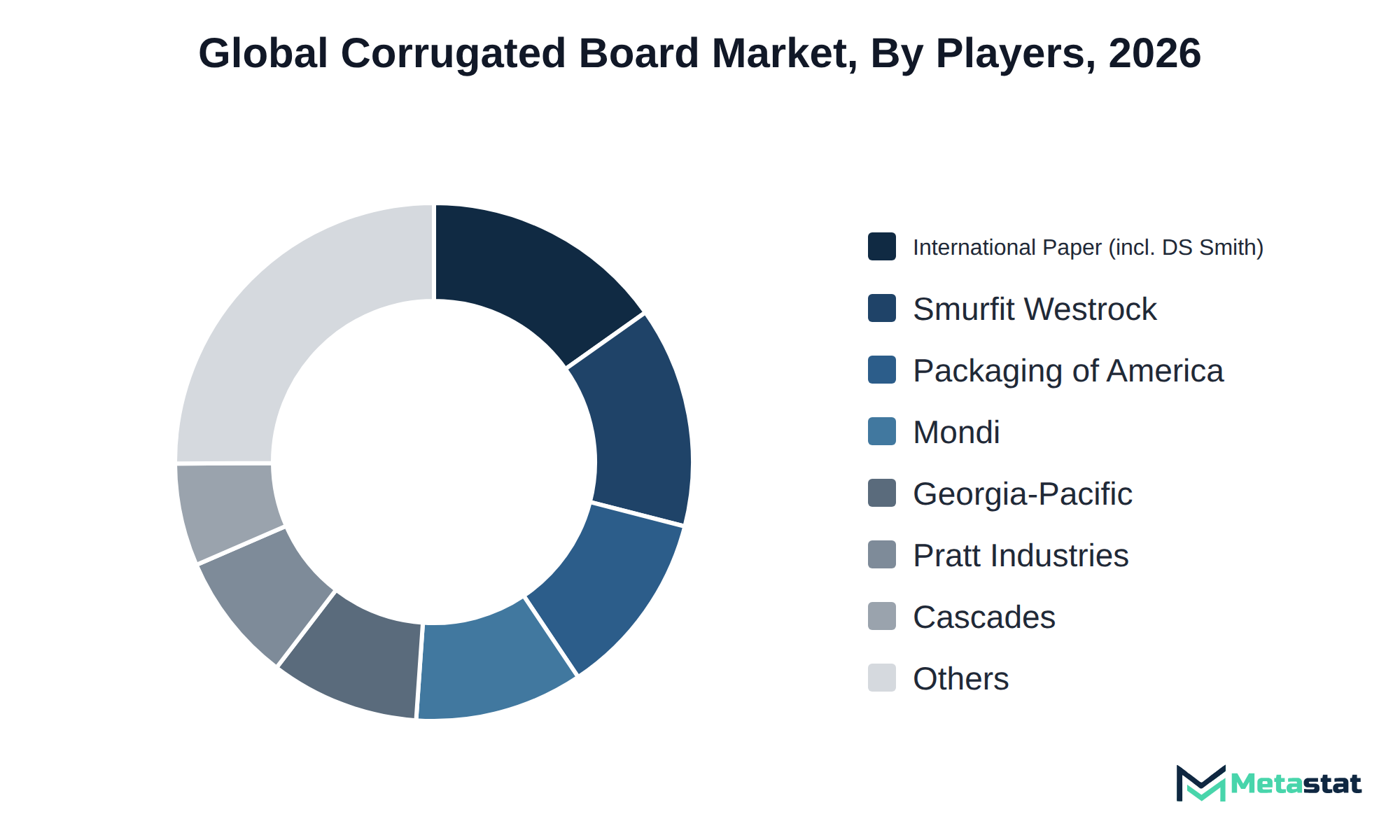
Competition in the Corrugated Board market centers on product differentiation and service offerings. Companies employ various strategies to attract buyers, focusing on price, customization, certification, and overall service quality. Buyers prioritize factors including material quality, supplier reliability, and the ability to meet specific packaging needs, resulting in a competitive environment that drives innovation and efficiency.
International Paper (incl. DS Smith) emphasizes innovation in sustainable packaging solutions, catering to environmentally conscious consumers. Smurfit Westrock focuses on expanding its product portfolio to serve diverse end-use industries, enhancing its market appeal. Mondi leverages its expertise in high-performance materials, offering tailored solutions for complex packaging requirements, which strengthens its competitive position in the market.
This growth relies on several key developments within the market. First, the expansion of e-commerce significantly drives demand for corrugated board packaging, particularly in the Asia Pacific region, which accounts for 45% of the global market share. Growth in the food and beverage sector, projected to reach USD 98.9 billion by 2033, will further enhance corrugated board consumption, especially in North America and Europe. Increasing adoption of recycled fiber materials will support sustainability goals, appealing to environmentally conscious consumers and businesses alike.
However, potential risks include fluctuations in raw material prices, which could negatively impact production costs and, subsequently, market growth. Any economic downturn affecting major consumer industries slows demand. Addressing these challenges will be crucial for maintaining the upward trajectory of the Corrugated Board market, ensuring that it approaches the projected USD 258.1 billion by 2033.
By Product Type: Boxes, Trays, Sheets & Pads, Inserts & Dividers, Pallets, Others (Octabins, Clamshells, Display Units)
By Wall Type: Single Wall, Double Wall, Triple Wall, Others (Single Face, Specialty Constructions)
By Material: Virgin Fiber, Recycled Fiber
By End-Use Industry: Food & Beverage, E-commerce, Healthcare & Pharmaceuticals, Personal Care & Cosmetics, Electrical & Electronics, Retail, Automotive, Transportation & Logistics, Others (Construction, Publishing, Household Goods)
The report strategically identifies and profiles the key market players and analyses their core competencies in each sub-segment of the Corrugated Board market.
Report Attributes | Details |
Study Period | 2021-2033 |
Base Year | 2025 |
Estimated Year | 2026 |
Forecast Period | 2026-2033 |
Historical Period | 2021-2025 |
Growth Rate | CAGR 4.8% from 2026 to 2033 |
Revenue Unit | USD billion |
Segmentation | By Product Type, Wall Type, Material, End-Use Industry, and Region |
By Region | North America (By Product Type, Wall Type, Material, End-Use Industry, and Country)
|
Europe (By Product Type, Wall Type, Material, End-Use Industry, and Country)
| |
Asia Pacific (By Product Type, Wall Type, Material, End-Use Industry, and Country)
| |
South America (By Product Type, Wall Type, Material, End-Use Industry, and Country)
| |
Middle East and Africa (By Product Type, Wall Type, Material, End-Use Industry, and Country)
|
Find answers to common questions about this report
The Corrugated Board market size was valued at USD 177 billion in 2025.
The market is projected to grow at a CAGR of 4.8% during the forecast period from 2026 to 2033.
The North America Corrugated Board market size is estimated to reach USD 62.3 billion by 2033.
The leading segment in the Corrugated Board market is Boxes, with a projected value of USD 181.2 billion in 2033. This segment outpaces others in terms of growth and revenue generation.
Key drivers for the Corrugated Board market include rapid e-commerce expansion, which increases demand for packaging solutions, and heightened environmental awareness that boosts growth in the recycled fiber segment. This shift towards eco-friendly practices supports overall market growth.
Fluctuations in raw material prices restrain growth in the Corrugated Board market by complicating procurement strategies and creating pricing uncertainty. Rising input costs pressure profit margins, prompting manufacturers to explore alternative sourcing strategies to maintain competitiveness.
Heightened environmental awareness and sustainability initiatives favor the adoption of recycled fiber in the corrugated board market. This trend aligns with regulatory mandates and consumer expectations for eco-friendly practices, providing a significant opportunity for companies embracing sustainable solutions.
The Corrugated Board market is estimated to reach a valuation of USD 258.1 billion by 2033.
Key players operating in the Corrugated Board market include International Paper (incl. DS Smith), Smurfit Westrock, Mondi, Georgia-Pacific, Packaging Corporation of America, and Pratt Industries.
Asia Pacific leads the Corrugated Board market, holding a significant share of 45 percent.
The analysts below cover Packaging research at Metastat Insights.
LEAD ANALYST
Utkarsh Khirodkar is a Lead Market Research Analyst at MetaStat Insight, specializing in market intelligence, technology sector assessments, and competitive strategy.

SENIOR RESEARCH ANALYST
Biotechnology · Food and Beverages · Medical Devices · Packaging
Snehal Pasalkar is a Research Analyst at MetaStat Insight, operating at the intersection of life sciences research, competitive strategy, and market intelligence.

INDUSTRY CONSULTANT - CHEMICALS & ADVANCED MATERIALS
Chemicals and Materials · Machinery & Equipment · Packaging
Amit Gadhekar Consultant for Chemicals and Materials at MetaStat Insight, directing sector-specific intelligence, research, and strategic consulting across global chemical and processing markets.
Assessing 200mm wafer transition schedules and substrate supply bottlenecks requires precise technical intelligence. MetaStat Insight supplied an actionable breakdown comparing planar and trench MOSFET architectures across automotive and industrial drive markets. The regional capacity estimates for Asia-Pacific foundries helped clarify lead-time uncertainties during our strategic planning session. When we needed additional clarification on high-purity raw material sourcing, their analyst team responded with helpful context within twenty-four hours.
Tracking maintenance cycle demand for secondary flight display units and terrain collision avoidance systems across regional jet fleets involves complex aftermarket dynamics. MetaStat Insight provided practical analysis separating airline retrofit programs from OEM forward-fit production schedules in North America and Southeast Asia. The supplier matrix highlighted component obsolescence timelines without resorting to vague generalizations. The dataset served as a dependable reference during our annual program review meetings.
Evaluating secondary resin quality across post-consumer packaging streams requires reliable technical segmentation. MetaStat Insight delivered an objective assessment that distinguished between extrusion-grade flake pricing and optical sorting throughput limitations across Western Europe. The competitive positioning breakdown for licensed depolymerization technology providers answered several questions during our feedstock feasibility audit. Their team clarified regional trade restrictions on mixed plastic scrap quickly when our team submitted follow-up requests.
Explore related market intelligence reports worth reading alongside this one.