
LEAD ANALYST
Utkarsh Khirodkar is a Lead Market Research Analyst at MetaStat Insight, specializing in market intelligence, technology sector assessments, and competitive strategy.

Global Data Center Virtualization Market Size, Share, By Virtualization Type (Server Virtualization, Storage Virtualization, Network Virtualization, Desktop Virtualization, Application Virtualization), By Offering (Software and Services), By Deployment Model (On-Premises, Hybrid, and Cloud-Based), By End-Use Industry (IT and Telecommunications, BFSI, Government and Public Sector, Healthcare and Life Sciences, Manufacturing and Automotive, Retail and E-Commerce, Education and Research, Media and Entertainment, Energy and Utilities), Industry Analysis, Growth, Trends, and Forecast, 2026-2033
Report ID
MSI-5581
Published
October, 2026
Pages
268 Pages
Format
Historical
Base year
Forecast
Forecast period
Report Details
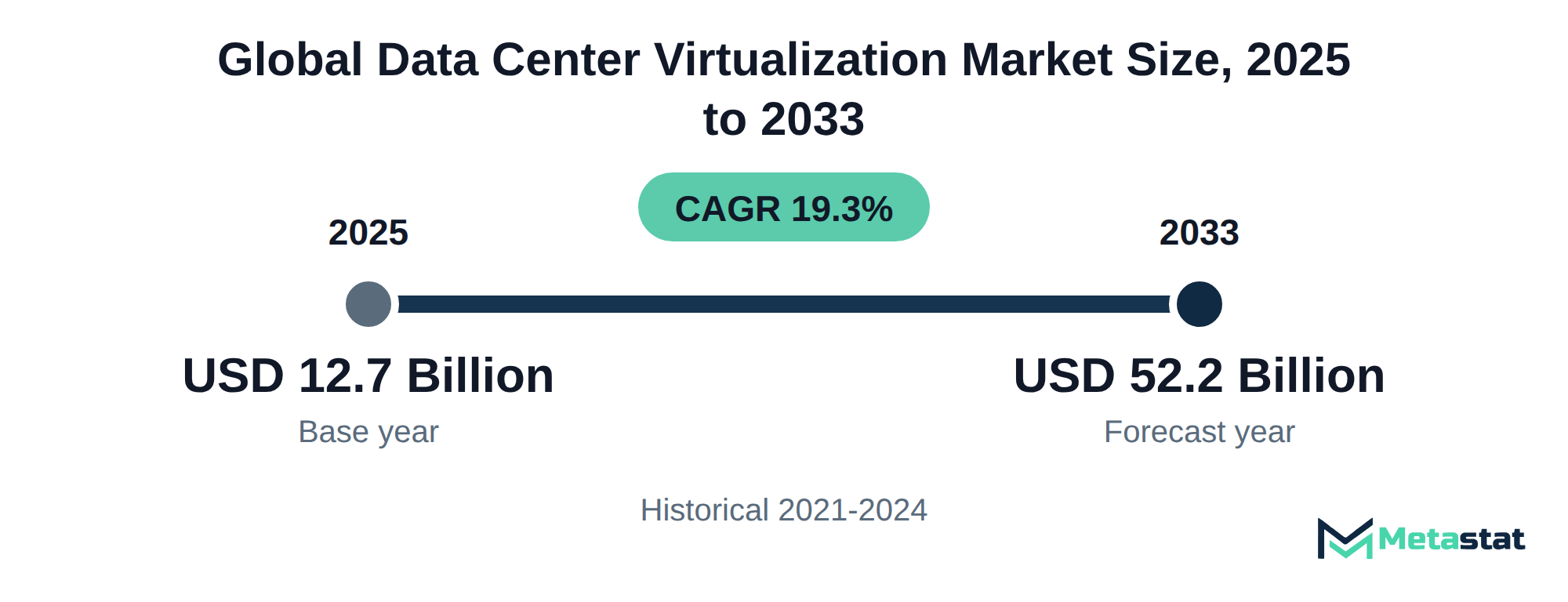
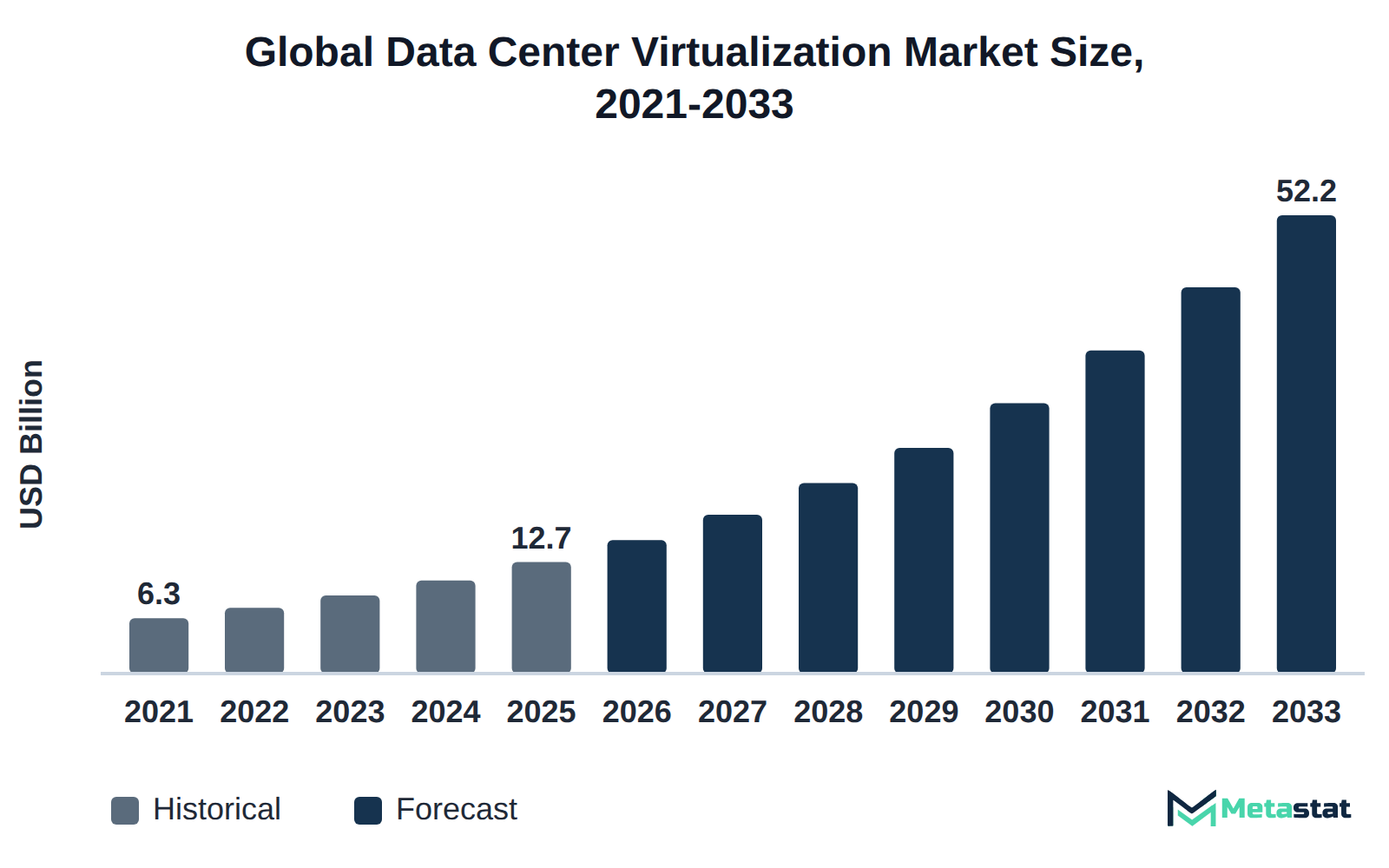
Market Valuation: Valued at $12.7 Billion in 2025, projected to reach $52.2 Billion by 2033 at a 19.3% CAGR.
Dominant Segment: Server virtualization leads the Data Center Virtualization market, driven by its critical role in optimizing resource utilization and enhancing operational efficiency for organizations.
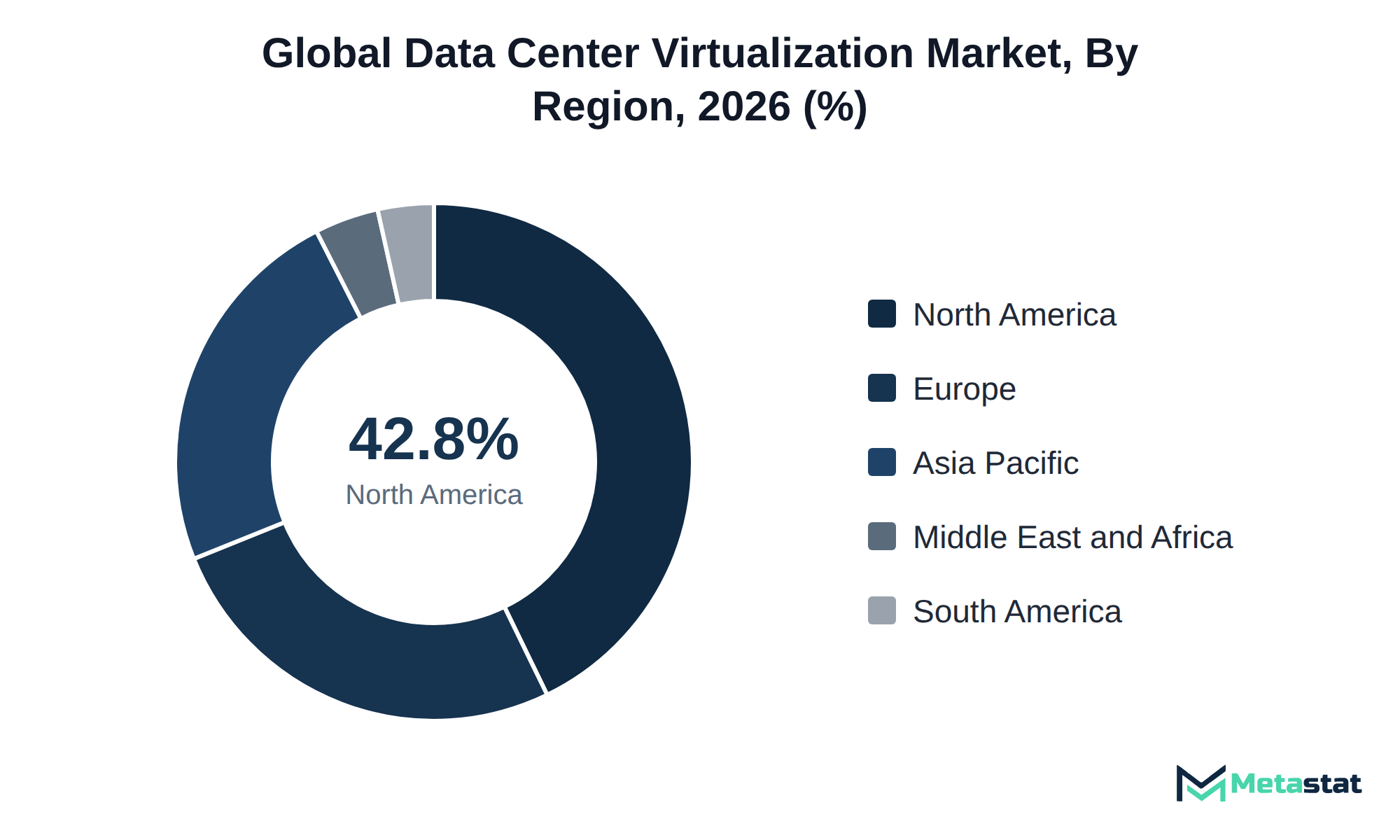
Geographic Lead: North America is the leading region in the Data Center Virtualization market, accounting for 42.8% in 2025, fueled by rapid digital transformation initiatives and a strong demand for virtualization solutions.
What's Inside: This report provides comprehensive coverage of the Data Center Virtualization market, including competitive analysis, segment breakdowns by virtualization type, offering, deployment model, and end-use industry, along with growth forecasts through 2033.
High Growth in Hybrid Deployment Model: The hybrid deployment model is projected to grow at a CAGR of 23.8%, reflecting a significant shift towards flexible solutions that combine on-premises and cloud resources.
Increased Adoption Among Key Industries: The IT and telecommunications sectors are driving increased spending on virtualization technologies, seeking enhanced operational efficiency and scalability in response to growing data demands.
Choose Your License
Global Data Center Virtualization Market
The global Data Center Virtualization market was valued at USD 12.7 billion in 2025 and is projected to reach USD 52.2 billion by 2033, growing at a CAGR of 19.3% over the forecast period.
The Data Center Virtualization market encompasses a range of technologies that enable the efficient management and operation of data centers. Buyers invest in virtualization solutions to enhance resource utilization, reduce operational costs, and improve scalability. This market addresses the increasing demand for IT infrastructure capable of supporting diverse workloads while optimizing energy consumption and space efficiency. Organizations across industries rely on virtualization to maintain competitive advantages and adopt new technologies.
Growth in the market is driven by the rising adoption of cloud services and the need for flexible IT solutions. Among the segments, server virtualization holds the largest share, providing significant value to organizations seeking to streamline their operations. North America holds 42.8% of the market in 2025, with the US leading in 2026. The rapid expansion of digital transformation initiatives across sectors accelerates the demand for virtualization solutions, enabling businesses to adapt to changing market conditions.
The increasing focus on cost efficiency and operational agility further drives market growth. Companies are deploying virtualization technologies to facilitate integration of cloud services and on-premises infrastructure. This trend enhances overall productivity and supports the dynamic requirements of modern businesses in a competitive environment.
The Data Center Virtualization market features various solutions that enhance the efficiency and flexibility of IT infrastructure. Organizations invest in these technologies to streamline operations, reduce costs, and improve overall performance. The increasing demand for scalable and adaptable IT environments drives spending, particularly among industries including IT and telecommunications, where rapid advancements necessitate significant investment in virtualization technologies.
Rising adoption of cloud computing and the need for effective data management solutions also propel market growth. Server Virtualization holds the highest value within the market, reflecting its critical role in optimizing resource utilization. This dominance stems from advanced technological capabilities and a strong inclination toward digital transformation across various sectors.
The market experiences significant momentum due to the increasing focus on operational efficiency among businesses. Organizations prioritize virtualization to enhance agility and respond quickly to changing market demands. The accessibility of hybrid deployment models further supports growth, allowing enterprises to tailor solutions that meet their specific needs while balancing cost and performance effectively.
VMware's transition to a subscription-based model significantly impacts the Data Center Virtualization market. This shift offers customers more flexibility in licensing, enabling them to align costs with their usage patterns. By adopting a subscription model, organizations lower upfront investments while facilitating access to the latest features and updates. The software offering segment is projected to grow from USD 11.8 billion in 2026 to USD 38.9 billion by 2033, reflecting an annual growth rate of 18.6%. This dynamic encourages businesses to evaluate alternative hypervisors that present competitive pricing and features, particularly in an environment focused on cost efficiency and scalability.
Organizations reassess their virtualization strategies, with many exploring open-source and vendor-neutral hypervisors, which often provide lower total cost of ownership compared to VMware solutions. The trend toward hybrid and cloud-based deployments further accelerates this migration, allowing organizations to optimize their infrastructure. The market's competitive landscape will likely see increased innovation from alternative providers, facilitating adoption in various sectors. Subscription economics and alternative hypervisors are reshaping how enterprises approach virtualization and driving demand for solutions tailored to their operational needs.
The integration of Kernel-based Virtual Machine (KVM) with Kubernetes represents a significant evolution in managing enterprise virtual machine (VM) estates. Organizations increasingly recognize the benefits of combining both technologies, enabling efficient resource management and rapid deployment of applications. The projected growth of the software segment in the Data Center Virtualization market, expected to increase from USD 11.8 billion in 2026 to USD 38.9 billion by 2033, highlights the rising demand for such integrated solutions.
Enterprises typically purchase KVM and Kubernetes solutions through subscription models or perpetual licensing agreements. Subscription models, often preferred for their flexibility, allow businesses to scale resources according to operational needs. This approach reduces upfront costs and provides a predictable expense structure, improving financial planning and resource allocation. Perpetual licensing requires a higher initial investment, appealing to organizations favoring long-term ownership of their infrastructure.
The convergence of KVM and Kubernetes streamlines management and influences competitive pricing strategies among vendors. Providers that offer integrated solutions hold an advantage in the market and appeal to businesses pursuing broad virtualization strategies. This trend enhances market competition, driving innovation and benefiting end-users through improved service delivery and cost efficiency.
IT and telecommunications industries need solutions that manage their data infrastructures efficiently. Hyperconverged platforms and software-defined storage provide scalable options tailored to the unique demands of this sector. In the Data Center Virtualization market, the segment of IT and telecommunications shows significant growth potential, with a projected increase from USD 5.9 billion in 2026 to USD 19.4 billion by 2033, reflecting a compound annual growth rate of 18.5%. This growth is driven by the need for enhanced operational efficiency and cost reduction in managing complex data environments.
Businesses in this industry face challenges related to data management, flexibility, and resource allocation. Cloud-based and hybrid deployment models emerge as preferred options, allowing companies to optimize resource utilization while minimizing overhead costs. The increasing complexity of data requirements in IT and telecommunications drives the demand for hyperconverged solutions that streamline operations and simplify management. Suppliers offering tailored solutions that address these specific needs position themselves advantageously within the market, strengthening relationships with clients and enhancing competitiveness.
Choosing the right Data Center Virtualization platform for a hybrid IT estate hinges on understanding specific operational needs. With the market trending toward hybrid solutions, the demand for Hybrid Deployment Models is noteworthy, projected to reach USD 19.2 billion by 2033. This figure indicates a strong shift in preference among organizations seeking to blend on-premises and cloud-based systems effectively.
Organizations in diverse sectors, including IT and Telecommunications, are increasingly adopting hybrid models to draw on the advantages of both environments. A platform that integrates both local and cloud infrastructure improves operational efficiency, flexibility, and scalability. Platforms that cater to multi-cloud environments facilitate easier management and resource allocation, aligning well with the strategic goals of enterprises aiming for digital transformation.
The increasing adoption of Hybrid Deployment Models emphasizes a critical opportunity for vendors in the Data Center Virtualization market. Offering solutions tailored for hybrid environments captures significant market share, especially from the IT and Telecommunications sectors, where operational agility is essential. The platform choice affects both immediate operational effectiveness and long-term strategic positioning in data center management.
The IT and telecommunications sectors drive increased spending on virtualization technologies. Organizations seek enhanced operational efficiency, scalability, and improved resource management in response to growing data demands. This shift toward virtualization supports the transformation of traditional IT environments into dynamic and flexible infrastructures. With a compound annual growth rate of 19.3% projected from 2026 to 2033, the market experiences significant growth, influenced by the need for cost savings and improved performance. Investments in server virtualization solutions, projected to rise from USD 6.5 billion in 2026 to USD 21.2 billion by 2033, illustrate this trend. The focus on virtualization enhances competitive positioning, as companies in these sectors strive to optimize resource allocation and adapt to rapidly changing market conditions.
Adoption patterns reflect increasing engagement across various industries, reinforcing the importance of virtualization in modern IT strategies. Improved integration of cloud-based solutions further accelerates demand, creating new opportunities for innovation within the market.
Increased cloud adoption significantly influences the Data Center Virtualization market by driving organizations to embrace efficient resource management and flexible deployment options. Businesses transitioning to cloud-based solutions experience heightened operational efficiency through scalability and reduced infrastructure costs. The demand for hybrid deployment models, which combine on-premises and cloud solutions, reflects organizations' desire to leverage the benefits of both environments. This trend is particularly strong among IT and telecommunications sectors, where firms require scalable solutions to accommodate increasing data workloads.
Cloud solutions offer reduced time to market for applications, allowing businesses to maintain competitive advantages in dynamic markets. The shift towards cloud-based virtualization solutions enables enterprises to adapt quickly to changing requirements, enhancing overall agility. While companies increasingly recognize the potential benefits of cloud adoption, investments in virtualization technologies are projected to rise, driving significant growth in the market.
High costs associated with implementing Data Center Virtualization technologies restrict adoption among enterprises, particularly in the IT and telecommunications sectors. Budget constraints often lead to slower uptake of virtualization solutions, with organizations prioritizing investments with immediate returns over long-term infrastructure improvements. The need for strong virtualization capabilities remains significant, but the financial burden of initial deployment delays decision-making and results in smaller orders. These dynamics create a challenging environment, where potential buyers opt for alternatives or delay upgrades to existing systems. In response, suppliers adjust pricing strategies to stimulate interest and facilitate a broader reach among cost-sensitive buyers. This price sensitivity reflects the ongoing competitive environment and highlights the importance of value propositions in driving market growth.
Increasing operational costs exert significant margin pressure on suppliers in the Data Center Virtualization market. Factors including talent costs for skilled personnel and competitive pricing lead to challenges in maintaining profitability. Suppliers respond by investing in automation technologies and refining their service offerings to enhance efficiency and reduce dependency on manual resources. Companies focus on optimizing existing infrastructures to deliver virtualized solutions more effectively while managing costs.
In parallel, a shift toward cloud-based platforms allows firms to scale operations flexibly, mitigating financial burdens. This strategy enables a more sustainable growth trajectory while addressing customer demands for robust and cost-effective virtualization solutions. Suppliers need to innovate continuously and adapt to changing market conditions to sustain competitiveness and profitability.
Hybrid deployment models present a significant growth opportunity in the Data Center Virtualization market. This segment is projected to experience a compound annual growth rate (CAGR) of 23.8%, highlighting its potential for expansion through 2033. Organizations increasingly seek flexible solutions that combine both on-premises and cloud resources, driven by demand for optimized performance and cost-effective management. Hybrid models enable businesses to balance workloads across environments, catering to unique operational requirements while enhancing scalability and resource utilization.
Key sectors adopting hybrid deployment include IT and telecommunications, which rely on integrated systems to support diverse applications and services. The anticipated revenue for hybrid deployment in 2033 is USD 19.2 billion, underlining the market's attractiveness. This growth trajectory reflects a broader shift toward versatile infrastructure solutions, enhancing competitive positioning among industry players while addressing evolving needs of enterprises.
The Global Data Center Virtualization market is segmented based on Virtualization Type, Offering, Deployment Model, and End-Use Industry.
Server virtualization allows organizations to run multiple virtual servers on a single physical server, enhancing resource utilization and operational efficiency. IT and telecommunications industries frequently adopt server virtualization to streamline their infrastructure and reduce hardware costs. Driving factors for this segment include increasing demand for efficient data center management and the need for scalable solutions. Compared to other virtualization types, server virtualization experiences faster growth due to its fundamental role in modern data center strategies, making it a primary choice among buyers prioritizing cost-efficiency and scalability in the market. Its expansion is evidenced by projected growth figures, highlighting a trend toward accelerated adoption across various sectors.
Storage Virtualization segment is estimated to reach USD 11.2 billion by 2033, at a CAGR of 18.4% during the forecast period. This technology allows organizations to manage their data storage resources more efficiently by abstracting physical storage devices into a single logical storage pool. Enterprises across various industries, particularly IT and telecommunications, leverage this segment to enhance data management and flexibility while reducing costs related to physical storage infrastructure. Rapidly increasing data volumes and the need for more agile storage solutions drive demand for Storage Virtualization. Compared to other segments, including Server Virtualization, this segment exhibits slightly slower growth, yet it remains essential for organizations seeking effective data management solutions. The emphasis on cost efficiency and scalability differentiates it from other virtualization types, ultimately shaping market dynamics.
Network Virtualization segment is expected to reach USD 11.1 billion by 2033. This segment focuses on optimizing network resources and enhancing the performance of data communication. Network virtualization primarily benefits IT and telecommunications companies that require agile and scalable network management solutions. Key drivers include increasing demand for efficient bandwidth allocation and improved network security. Compared to other segments, including Server Virtualization, which demonstrates a CAGR of 18.5%, Network Virtualization experiences slightly slower growth dynamics. Adoption of software-defined networking (SDN) technologies significantly influences this segment, providing enhanced flexibility and control over network resources. This technology shift aligns with the growing emphasis on automation and orchestration in the market.
Desktop Virtualization segment is projected to grow at a CAGR of 18.1% during the forecast period. This segment provides end-users with the ability to access desktop environments remotely, enabling efficient management of desktop resources across various devices. Typically used by IT departments within organizations, this virtualization type supports remote work, enhances security through centralized management, and improves operational efficiency. Virtual desktop infrastructure is a closely related area for organizations that manage these remote desktop environments centrally. The growing demand for flexible work arrangements drives adoption. Compared to other segments within the market, Desktop Virtualization shows faster growth due to increasing remote working trends. Organizations continuously seek solutions that reduce hardware costs while delivering scalable desktop environments, differing from other virtualization types that focus more on server or storage efficiency.
Application Virtualization focuses on delivering and managing applications without relying on a specific operating system or hardware. This approach enables businesses to streamline application deployment and enhance user accessibility, particularly in remote work environments. Sectors including IT and telecommunications increasingly adopt this technology, driven by the demand for flexible application access and better resource allocation. High demand for integration with existing systems presents an opportunity for growth in this segment. Compared to other virtualization types, Application Virtualization distinguishes itself through its unique capability to support diverse operating environments without significant hardware investment. This adaptation flexibility attracts a broader range of buyers, including several enterprises seeking efficient application management solutions. The market continues to evolve, reflecting the increasing necessity for effective application delivery in a rapidly changing digital landscape.
Data Center Virtualization software serves various industries, including IT and telecommunications, which apply it to optimize resource allocation and enhance operational efficiency. Increasing demand for flexible and scalable solutions drives growth in this segment. The software segment differentiates itself from other offerings through its higher CAGR of 18.6%, compared to services projected to grow at a CAGR of 21.8%. The software segment primarily caters to organizations looking to streamline operations, while services target firms seeking specialized support and management. This dynamic contributes to the robust expansion of the software segment within the Data Center Virtualization market.
Services segment is estimated to reach USD 13.4 billion by 2033, at a CAGR of 21.8% during the forecast period. This segment encompasses a range of professional services aimed at optimizing data center operations and enhancing virtualization capabilities. Key users include enterprises in IT and telecommunications, where the focus on efficient resource utilization drives demand. Factors including the increasing complexity of IT environments and the need for expert support drive growth in this segment. The Services segment demonstrates a more rapid growth trajectory compared to the Software segment, which is projected to reach USD 38.9 billion by 2033 with a CAGR of 18.6%. This difference highlights accelerated investment in service-oriented solutions tailored for specific virtualization needs, positioning it as a vital component for organizations seeking to enhance operational efficiency.
The On-Premises segment is valued at USD 9.4 billion in 2026 and is projected to reach USD 26.8 billion by 2033, at a CAGR of 16.2% during the forecast period. This segment caters primarily to organizations seeking to maintain full control over their IT infrastructure, serving industries including IT and telecommunications, BFSI, and government. Demand for on-premises solutions is driven by heightened security and compliance requirements, which necessitate local data management. In contrast to cloud-based models, this segment attracts buyers willing to invest in physical infrastructure to gain better operational control. The relatively slower growth of this segment, compared to hybrid solutions, reflects the increasing shift towards cloud adoption. However, the on-premises approach maintains relevance for enterprises prioritizing data sovereignty and proprietary security measures, ensuring steady demand amid evolving market dynamics.
Hybrid deployment models are estimated to reach USD 19.2 billion by 2033, at a CAGR of 23.8% during the forecast period. Organizations increasingly adopt hybrid solutions to combine the benefits of on-premises and cloud infrastructure, enhancing flexibility and efficiency in resource management. This segment attracts a diverse range of buyers, particularly within IT and telecommunications, where the demand for adaptable solutions continues to rise. Factors driving growth in this segment include a growing preference for flexible and scalable infrastructure options and the pursuit of cost-effective operations. Compared to other deployment models, hybrid solutions show faster growth rates, positioning them as a compelling choice for enterprises seeking to balance control with agility. The market continues to evolve, with demands for hybrid models likely influencing broader trends in the Data Center Virtualization market.
The Cloud-Based segment is expected to reach USD 6.2 billion by 2033. This segment supports organizations in deploying applications and services over the internet, enhancing accessibility and scalability. Industries including IT, telecommunications, and healthcare adopt this model to adapt to fluctuating demands and optimize resource allocation. The growth of this segment is driven by increasing demand for flexible IT solutions and the necessity for remote access to applications. Cloud-Based solutions exhibit faster growth compared to On-Premises models, which experience a CAGR of 16.2%. The market benefits from the rising trend of digital transformation, compelling businesses to migrate to cloud infrastructures for enhanced operational efficiency. Cloud-Based deployment enables organizations to reduce capital expenditure while improving overall service delivery, contributing to the robust expansion of the Data Center Virtualization market.
This segment encompasses various organizations that rely on virtualization technologies to enhance operational efficiency, improve resource allocation, and facilitate service delivery. A significant driver of growth stems from the increasing demand for advanced connectivity and data processing capabilities. Organizations within this segment need solutions capable of handling large data volumes and ensuring effective network operations. Compared to other segments, IT and Telecommunications exhibits a stronger growth trajectory due to its essential role in supporting digital transformation across industries. The market experiences unique challenges, including the need for consistent technological updates and integration with existing infrastructures, which impact overall adoption rates.
BFSI segment is estimated to reach USD 10.2 billion by 2033, at a CAGR of 19.6% during the forecast period. Focused on banking, financial services, and insurance, this segment adopts virtualization technologies to enhance operational efficiency, data security, and compliance with regulatory standards. Increased investment in digital transformation initiatives drives demand for virtualization solutions within BFSI firms, allowing for streamlined operations and improved customer service. Compared to other segments, including IT and telecommunications, which grow at a CAGR of 18.5%, BFSI exhibits a higher growth rate, reflecting its critical need for robust and secure IT infrastructure. Rapid advancements in technology and a shift towards cloud-based solutions contribute significantly to the industry's expansion, providing opportunities for innovation and enhanced service delivery. Rising demand for efficient data management and disaster recovery solutions further drives growth in this segment. Data protection and recovery solutions are a closely related investment area for BFSI firms with these needs.
The Government and Public Sector segment is expected to reach USD 4.6 billion by 2033. This segment serves various governmental and public organizations seeking to enhance operational efficiency and data management. The demand for improved digital infrastructure drives this segment, particularly in response to increasing cybersecurity threats and the need for more efficient data processing capabilities. With a CAGR of 22.2%, this segment experiences significant growth compared to other segments in the market. The unique requirements of public sector entities, including regulatory compliance and security, differentiate it from industries including IT and Telecommunications. Government and public organizations prioritize security and compliance, influencing their virtualization strategies. Such factors contribute to the distinct dynamics of the Government and Public Sector segment within the broader landscape of the Data Center Virtualization market.
The Healthcare and Life Sciences segment is projected to grow at a CAGR of 22.2% during the forecast period. This segment serves healthcare providers, pharmaceutical companies, and biotechnology firms, focusing on improving patient outcomes and streamlining operations through enhanced data management and virtualized infrastructure. Demand for advanced virtualization solutions stems from the need for secure and efficient data storage, regulatory compliance, and the integration of new technologies including telemedicine and electronic health records. Compared to other segments, this area exhibits faster growth due to increasing investments in digital health initiatives and the rising importance of data analytics in healthcare. Investment in technologies that enhance patient care efficiency drives this segment, distinguishing it from others with lower growth rates.
Manufacturing and Automotive incorporates advanced technologies to enhance production efficiency and quality control. This segment serves industries focusing on optimizing operations and reducing costs through improved resource management. Key drivers include increasing demand for automation and the need for real-time data analytics to support decision-making processes. Compared to other segments, the Manufacturing and Automotive segment experiences higher adoption rates due to the industry's strong emphasis on innovation and competitive advantage. This segment exhibits growth potential driven by technological advancements and regulatory demands for sustainability, distinguishing it from segments that focus on less dynamic industries. Such forces shape the strategies of businesses involved in this segment, leading to higher investments in virtualization solutions. The Data Center Virtualization market supports these initiatives, facilitating integration of virtualization technologies in manufacturing processes.
Retail and E-Commerce highlights the increasing reliance on virtual solutions to optimize operations and enhance customer experiences. This segment is primarily used by businesses aiming to improve efficiency, reduce costs, and offer a smoother shopping experience through integrated digital platforms. The demand for advanced data management and customer interaction is driven by the rapid growth of online shopping and the need for robust cybersecurity measures. This segment differentiates itself from others by emphasizing the necessity for agile, scalable solutions tailored to dynamic consumer behaviors, reflecting trends more rapidly than traditional industries. Compared to sectors including IT and Telecommunications, which entail larger infrastructure investments, Retail and E-Commerce focuses on maximizing customer engagement through innovative technologies, shaping the evolution of the Data Center Virtualization market.
Education and Research relies on Data Center Virtualization to facilitate learning environments and conduct research efficiently. Educational institutions, universities, and research organizations employ virtualization technologies to optimize their IT resources, enabling enhanced collaboration and data sharing. The demand for these solutions is driven by the increasing need for remote learning capabilities and the integration of advanced technologies in educational infrastructure. This segment differentiates itself from others through a focus on specialized requirements, including secure data management and scalable resources for large numbers of simultaneous users. Educational and research institutions prioritize cost-effective solutions that support high availability and reliability, ensuring uninterrupted access to critical applications and resources. Given the dynamic nature of educational demands, this segment reflects unique growth patterns and requirements compared to sectors including IT and Telecommunications within the Data Center Virtualization market.
Media and Entertainment relies on advanced technologies to deliver content, enhance user experiences, and improve production processes. This segment serves various stakeholders, including streaming services, production studios, and broadcasting companies. Demand for high-quality content and efficient streaming drives growth in this sector. Increasing consumer expectations for immersive experiences and rapid content delivery heighten the need for efficient data management. Compared to other segments, Media and Entertainment exhibits unique challenges related to data security and intellectual property, impacting adoption rates and operational strategies. This segment experiences a dynamic shift due to evolving technologies and consumer preferences, influencing the overall growth trajectory in the Data Center Virtualization market. Organizations invest in creative solutions, and the sector faces a competitive landscape driven by innovation and technological advancements.
Energy and Utilities involve the integration of advanced virtualization technologies to optimize resource management and enhance operational efficiency. Organizations within this segment focus on renewable energy sources, grid management, and smart technologies to support sustainability efforts. Key drivers influencing this segment include increasing demand for energy efficiency and regulatory compliance aimed at reducing carbon footprints. Unlike other segments, Energy and Utilities seeks tailored solutions that enhance legacy infrastructure, setting it apart in terms of specialized needs and experiences. This segment shows strong adoption among large-scale energy providers and utility companies seeking to modernize operations through virtualization. The Data Center Virtualization market facilitates these advancements, ensuring that organizations remain competitive and adaptive to evolving energy demands.
This sub-segment includes various industries including Transportation, Hospitality, and Professional Services. Organizations in these sectors apply data center virtualization to enhance efficiency, improve resource allocation, and ensure agile operations. Increased digital transformation initiatives drive demand for robust virtualization solutions, allowing businesses to optimize their IT environments while addressing specific operational challenges. Unlike segments including IT and Telecommunications, which exhibit faster growth rates, this sub-segment's expansion is influenced by unique requirements, including customization and integration with existing systems. Investment in virtualization technologies across these diverse industries supports enhanced service delivery and operational flexibility, which are crucial in a competitive environment. Adoption of advanced virtualization solutions within Transportation, Hospitality, and Professional Services leads to improved performance and responsiveness to market changes, contributing significantly to the overall dynamics of the Data Center Virtualization market.
Based on geography, the Global Data Center Virtualization market is divided into North America, Europe, Asia-Pacific, South America, Middle East, and Africa.
Strong growth in the Data Center Virtualization market in North America is driven by significant advancements in technology and increased demand for efficient resource utilization. Key industries, including IT and Telecommunications, benefit from enhanced operational capabilities and cost efficiencies, prompting increased investments. The region's focus on digital transformation initiatives supports the adoption of virtualization technologies across various sectors. North America holds a 42.8% share of the global market in 2025, reflecting its leading position in driving virtualization solutions. Additional growth factors include the robust infrastructure in the United States, Canada, and Mexico, which encourages innovation and supports the deployment of advanced virtualization strategies. North America is projected to reach USD 20.7 billion by the end of 2033.
Demand for Data Center Virtualization market solutions in Europe stems from industries seeking efficiency and scalability. The increasing adoption of advanced technologies in countries including Germany, France, and the UK drives substantial investments in virtualization. IT and Telecommunications serve as major contributors, with organizations focusing on enhancing operational capabilities. The region's regulatory environment emphasizes data protection and privacy, influencing the deployment of virtualization solutions. By 2025, the share of the European market is projected at 26.1%. Significant growth potential exists in sectors including Healthcare and Life Sciences, where innovative virtualization technologies support improved patient outcomes and operational efficiency. Overall, Europe's continued investment in the Data Center Virtualization market reflects a commitment to technological advancement and competitive positioning.
Rapid growth in the Data Center Virtualization market arises from significant demand across multiple industries, particularly in China and India. Rising adoption of cloud computing and the Internet of Things fuels increased investments in data centers, enhancing virtualization solutions. South Korea and Japan demonstrate strong interest in software-driven solutions, driven by a competitive technological landscape and a skilled workforce. Australia’s focus on digital transformation initiatives contributes to a growing need for efficient data management systems. Infrastructure advancements in Southeast Asia further support market expansion by enabling more robust virtualization capabilities. The share of the global market for this region is 23.6%, reflecting the critical role of Asia-Pacific in the overall growth trajectory of the market.
Growth in the Data Center Virtualization market within South America is largely influenced by the increasing adoption of advanced technologies in Brazil and Argentina. The region's IT and Telecommunications sector significantly drives demand, with companies investing in virtualization solutions to enhance operational efficiency and reduce costs. A notable factor affecting the market is the rising focus on hybrid models, which facilitate a balance between on-premises and cloud-based infrastructure. Local infrastructure challenges, including limited bandwidth and access to high-speed internet in certain areas, create opportunities for virtualization technologies to optimize resource usage. By 2025, South America is projected to represent 3.5% of the global market, with expectations for continued expansion driven by companies pursuing digital transformation initiatives.
Demand for the Data Center Virtualization market in the Middle East and Africa is driven primarily by the IT and Telecommunications industry, particularly in countries including Saudi Arabia and the UAE. The region's focus on digital transformation and infrastructure development continues to strengthen the adoption of virtualization technologies. South Africa experiences growth in various public sector initiatives aimed at enhancing service delivery through efficient resource management. The market share for this region is projected at 4.0% in 2025, reflecting ongoing investments in data center infrastructure and cloud solutions. Local companies increasingly recognize the benefits of virtualization in reducing operational costs and improving system performance. Continued enhancement of network capabilities and cloud adoption efforts will further shape the Data Center Virtualization market in this region.
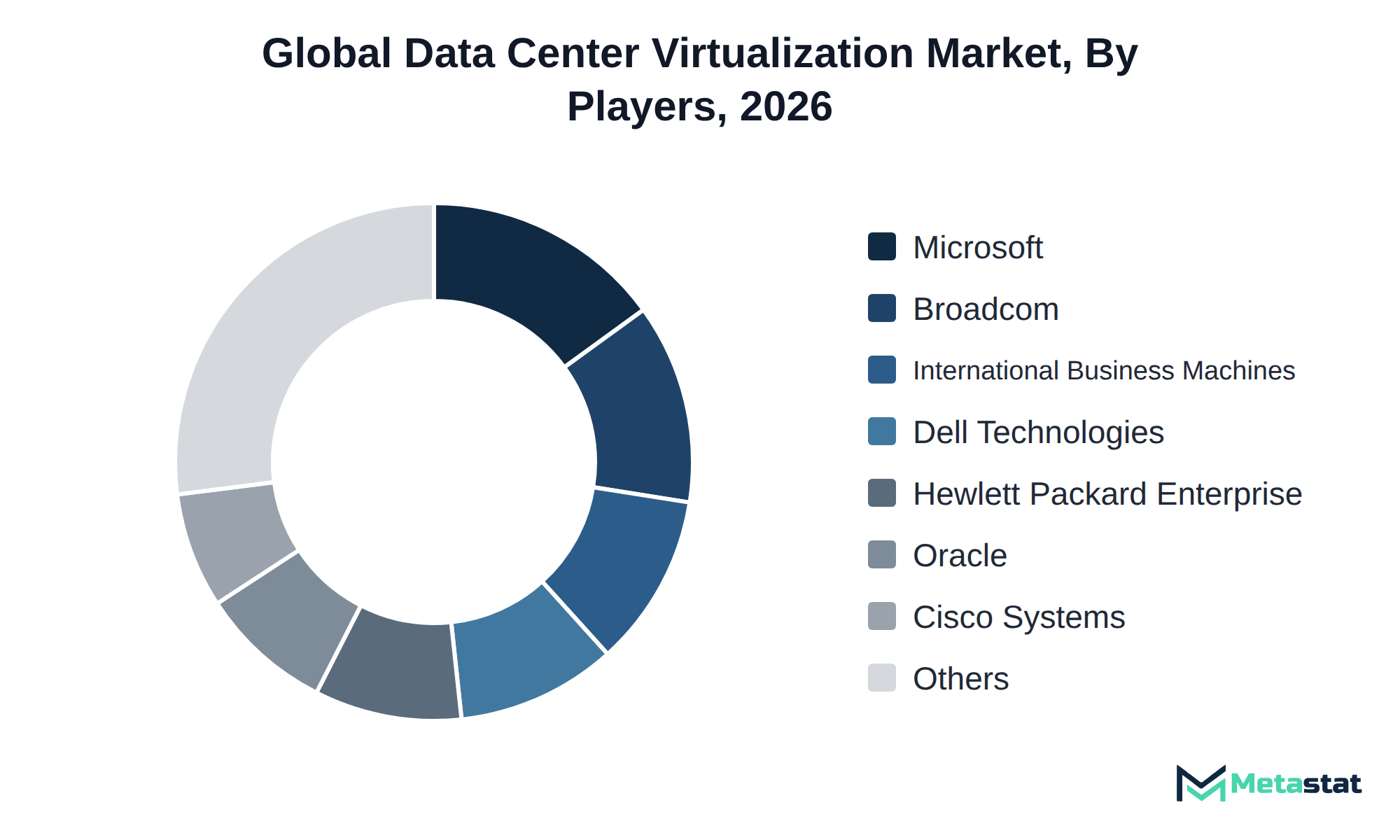
Companies in the Data Center Virtualization market engage in competition through various strategies, focusing on specific segments and offerings. Providers differentiate themselves by offering a range of virtualization types, including server, storage, network, and desktop virtualization. Within these categories, buyers consider factors including pricing, customization options, and the robustness of service ecosystems.
Broadcom Inc. and Microsoft Corporation emphasize software solutions, with Microsoft focusing on cloud integration and enterprise support. Hewlett Packard Enterprise Company and Oracle Corporation prioritize on-premises virtualization capabilities, catering to enterprises seeking control over their infrastructure. Nutanix, Inc. and VMware illustrate the demand for enhanced performance and user-friendly deployment models, influencing buyer choices in the market.
Growth hinges on several developments, including the acceleration of server virtualization adoption across various industries, particularly in IT and Telecommunications. This segment is projected to expand significantly, driven by the need for efficiency and scalability. Hybrid deployment models are expected to thrive, with organizations seeking flexible solutions that blend on-premises and cloud-based resources. The anticipated CAGR of 23.8% for hybrid models reflects this trend. However, potential risks exist that could impede progress, including regulatory challenges and security concerns surrounding virtualization technologies. These factors particularly affect the North American market, which currently holds the largest share at 42.8%. The Data Center Virtualization market faces a dynamic environment, necessitating continuous adaptation by players to meet evolving demands and address emerging challenges. Achieving USD 52.2 billion in market size relies on navigating these developments and risks effectively.
By Virtualization Type: Server Virtualization, Storage Virtualization, Network Virtualization, Desktop Virtualization, Application Virtualization
By Offering: Software, Services
By Deployment Model: On-Premises, Hybrid, Cloud-Based
By End-Use Industry: IT and Telecommunications, BFSI, Government and Public Sector, Healthcare and Life Sciences, Manufacturing and Automotive, Retail and E-Commerce, Education and Research, Media and Entertainment, Energy and Utilities, Others (Transportation, Hospitality, Professional Services)
The report strategically identifies and profiles the key market players and analyses their core competencies in each sub-segment of the Data Center Virtualization market.
Report Attributes | Details |
Study Period | 2021-2033 |
Base Year | 2025 |
Estimated Year | 2026 |
Forecast Period | 2026-2033 |
Historical Period | 2021-2025 |
Growth Rate | CAGR 19.3% from 2026 to 2033 |
Revenue Unit | USD billion |
Segmentation | By Virtualization Type, Offering, Deployment Model, End-Use Industry, and Region |
By Region | North America (By Virtualization Type, Offering, Deployment Model, End-Use Industry, and Country)
|
Europe (By Virtualization Type, Offering, Deployment Model, End-Use Industry, and Country)
| |
Asia Pacific (By Virtualization Type, Offering, Deployment Model, End-Use Industry, and Country)
| |
South America (By Virtualization Type, Offering, Deployment Model, End-Use Industry, and Country)
| |
Middle East and Africa (By Virtualization Type, Offering, Deployment Model, End-Use Industry, and Country)
|
Find answers to common questions about this report
The Data Center Virtualization market size was valued at USD 12.7 billion in 2025.
The market is projected to grow at a CAGR of 19.3% during the forecast period from 2026 to 2033.
The North America Data Center Virtualization market size is estimated to reach USD 20.7 billion by 2033.
Server Virtualization leads the Data Center Virtualization market with a projected value of USD 21.2 billion by 2033, reflecting its significant share compared to other segments.
Increased spending on virtualization technologies is driven by the IT and telecommunications sectors seeking enhanced operational efficiency and scalability. The demand for hybrid deployment models reflects organizations' desire for flexible solutions that optimize performance and cost-effective management.
North America holds the dominant share of the Data Center Virtualization market, with a value of USD 20.7 billion projected for 2033, representing 42.8 percent of the total market.
High costs associated with implementing technologies restrict adoption among enterprises, particularly in IT and telecommunications. Budget constraints often lead to slower uptake of virtualization solutions, as organizations prioritize investments with immediate returns over long-term infrastructure improvements.
Several factors favor adoption in the Data Center Virtualization industry. The demand for hybrid deployment models, projected to grow at a compound annual growth rate of 23.8% through 2033, reflects organizations' desire for flexible solutions that enhance performance and cost management. increasing operational efficiency and the need for scalable infrastructure drive investment in virtualization technologies.
The Data Center Virtualization market is estimated to reach a valuation of USD 52.2 billion by 2033.
Key players operating in the Data Center Virtualization market include Broadcom Inc., Microsoft Corporation, Nutanix, Inc., International Business Machines Corporation, Hewlett Packard Enterprise Company, Oracle Corporation, and Cisco Systems, Inc.
The analysts below cover Information & Technology research at Metastat Insights.
LEAD ANALYST
Utkarsh Khirodkar is a Lead Market Research Analyst at MetaStat Insight, specializing in market intelligence, technology sector assessments, and competitive strategy.

PRINCIPAL CONSULTANT - ENTERPRISE AI & EMERGING TECHNOLOGIES
Banking & Finance · Electronics and Semiconductor · Energy and Power · Healthcare IT · Information & Technology · Professional Services
Vijay Gunti is a Principal Consultant at MetaStat Insight, bringing over two decades of experience across enterprise digital transformation, technology strategy, and intelligent systems.

LEAD CONSULTANT - COMMUNICATION, TELECOM, AND IT
Electronics and Semiconductor · Information & Technology · Machinery & Equipment · Professional Services
Ravindra Sathe Consultants for Communication, Telecom, and IT at MetaStat Insight. He leads the firm's industry research initiatives across telecommunications infrastructure, digital connectivity, enterprise networking, and emerging information technology domains.
Evaluating calorific value requirements and air permit compliance across municipal waste facilities requires localized data. Metastat Insight structured their analysis around operational throughput capacity and feedstock composition variations in Latin America and Eastern Europe. Their competitive mapping of sorting equipment vendors helped clarify technology differences between optical separators and heavy media systems. The study provided an objective baseline during our capital expenditure reviews.
Decarbonizing industrial thermal processes hinges on refrigerant regulations and compressor efficiency limits. Metastat Insights delivered a thorough market analysis that evaluated natural refrigerants like CO2 and hydrocarbons against synthetic low-GWP alternatives. The breakdown of utility incentives and grid capacity constraints across key European manufacturing hubs offered valuable perspective. The follow-up conversation with their sector analysts addressed our specific questions on mechanical vapor recompression systems efficiently.
Assessing 200mm wafer transition schedules and substrate supply bottlenecks requires precise technical intelligence. MetaStat Insight supplied an actionable breakdown comparing planar and trench MOSFET architectures across automotive and industrial drive markets. The regional capacity estimates for Asia-Pacific foundries helped clarify lead-time uncertainties during our strategic planning session. When we needed additional clarification on high-purity raw material sourcing, their analyst team responded with helpful context within twenty-four hours.
Explore related market intelligence reports worth reading alongside this one.
Starting from
$2950