
LEAD ANALYST
Utkarsh Khirodkar is a Lead Market Research Analyst at MetaStat Insight, specializing in market intelligence, technology sector assessments, and competitive strategy.

Dental Laboratory Handpieces Market By Operation (Air-Driven Handpieces, and Electric Handpieces), By Speed Type (High-Speed Handpieces, and Low-Speed Handpieces), By Application (Endodontics, Oral Surgery & Implantology, Restoration, and Orthodontics & Research), By End User (Hospitals, Dental Clinics, Dental Laboratories, and Academic & Research Institutes), Industry Analysis, Size, Share, Growth, Trends, and Forecasts 2025-2032
Report ID
MSI-4484
Published
January, 2026
Pages
256 Pages
Format
Report Details
Choose Your License
Dental Laboratory Handpieces Market
This means that the global dental laboratory handpieces market and its broader industry are going to shift to a space wherein innovation is no longer solely based on technical upgrades but the comfort with which these tools will blend into the artistry of dental craftsmanship. With laboratories becoming increasingly likely to demand smoother workflows, equipment will be expected to support technicians in intuitive ways that eliminate hesitation, allowing creative precision to take the lead. The market will step beyond routine manufacturing, lean toward solutions that feel lighter in hand, quieter in operation, and smarter in response, giving professionals the freedom to shape results that look and feel natural.
With increased expectations, handpieces will no longer be thought of as secondary instruments but rather as an extension of the technician's skill and an influential factor in how efficiently ideas are translated into finished restorations. Production materials will move toward combinations that can sustain longer working hours without inducing fatigue and, at the same time, offer a perceived sense of control that is valued by experienced technicians. Digital integration will begin shaping the next phase-not to replace craftsmanship but rather to enhance it by subtle guidance and enhanced consistency.
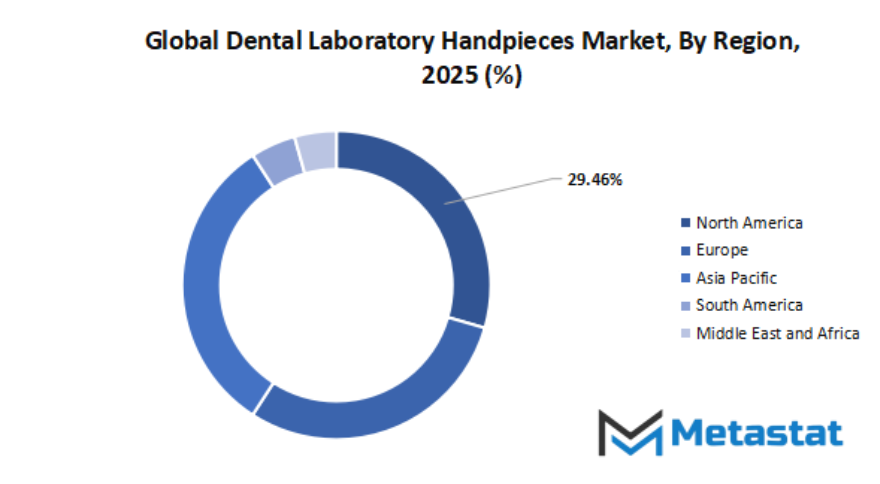
Based on geography, the global dental laboratory handpieces market is divided into North America, Europe, Asia-Pacific, South America, and Middle East & Africa. North America is further divided in the U.S., Canada, and Mexico, whereas Europe consists of the UK, Germany, France, Italy, and Rest of Europe. Asia-Pacific is segmented into India, China, Japan, South Korea, and Rest of Asia-Pacific. The South America region includes Brazil, Argentina, and the Rest of South America, while the Middle East & Africa is categorized into GCC Countries, Egypt, South Africa, and Rest of Middle East & Africa.
The global dental laboratory handpieces market is mainly classified based on Operation, Speed Type, Application, End User.
Future air-driven systems will be designed with the focus on lighter structures, smooth rotation, and torque stability. Advancements will support consistent performance in laboratory tasks for faster finishing and more control. Innovation will encourage better airflow regulation that will help technicians achieve refined results with much less strain during long working hours.
Electric models will move toward higher torque, quieter operation, and digital monitoring. Higher power output will enable the artisan to craft, polish, and cut with even greater detail and accuracy. Ongoing improvements will be made in energy efficiency and compact motor designs, assisting the laboratory workflow requiring consistent rotation and predictable performance over an array of dental materials.
High-speed tools will adopt stronger bearings, heat-reduction systems, and improved safety controls. These enhancements will support delicate trimming and shaping tasks while protecting materials from overheating. Such innovative speed management will help technicians achieve precise contours with minimal possibility of error and ensure smoother surfaces for various restorative and prosthetic components.
Low-speed devices will advance with steadier torque delivery, greater compatibility with accessories, and modularity. Upgrades will support polishing, adjustment, and finishing procedures to enhance comfort. Improved motor regulation will facilitate consistent results for repetitive tasks, while the smoothness of laboratory operations will allow for detailed refinement of dental appliances and prosthetic materials.
Refined rotation control and cleaner preparation capability, along with durable handpiece structures for repetitive canal tasks, will benefit future endodontic uses. Improvement in torque response will reduce instrument stress while maintaining accuracy during shaping. The improvements will encourage stable workflows during laboratory-based preparations linked to endodontic restorations.
Applications in surgical and implant-related tasks are focusing on stronger torque output, vibration reduction, and improved sterility-supporting surfaces. These enhancements will help to preserve accuracy in laboratory settings during adjustments of implant components and modeling exercises for restorative and implant-based treatments.
Precision-focused tools for accurate trimming, contouring, and polishing of restorative units will shape restorative uses. Improved handling combined with reliable motor behavior will help the technician to achieve smooth margins and refined surfaces. Future tools will support efficient workflows to create consistent restorative units made to meet advanced aesthetic and functional expectations.
Orthodontic and research tasks will benefit from customizable speed control, advanced motor stability, and adaptable attachments. These will be useful in material testing, appliance adjustment, and the development of experimental work. The transition to innovation will enable technicians and researchers to explore new orthodontic solutions that require accuracy, repeatability, and controlled rotational output.
Future adoption via hospitals might be inspired via possibilities for durable, hygienic, and multi-useful handpieces that may aid various approaches. Improved reliability and steady torque will contribute to the continuity of easy laboratory help features in the clinic environment, ensuring the green preparation of dental additives for restorative and surgical needs.
Dental clinics will call for compact, clean-to-keep handpieces in an effort to guide everyday laboratory and chairside adjustments. Improved structures will emphasize comfort, minimum noise, and steady performance. These upgrades will enable clinics to facilitate fabrication and change paintings, thereby imparting equal-day adjustments for prosthetics, appliances, and restorative factors.
Laboratories will tackle high-output gadget advanced for longer hours of operation, regular rotation, and more suitable sturdiness. Future systems will provide precision and versatility for ceramics, metals, and polymers. These advancements will meet the needs of technicians running on complicated restorations, helping consistent craftsmanship and higher productiveness.
Institutes will be dependent on versatile handpieces for training, experimentation, and equipment studies. Improved stability, user-friendly controls, and extended durability will support both educational needs and research trials. These will allow students and researchers to practice while exploring new material behaviours and procedural techniques.
|
Forecast Period |
2025-2032 |
|
Market Size in 2025 |
$1045.9 Million |
|
Market Size by 2032 |
$1542.4 Million |
|
Growth Rate from 2025 to 2032 |
5.7% |
|
Base Year |
2024 |
|
Regions Covered |
North America, Europe, Asia-Pacific, South America, Middle East & Africa |
The global dental laboratory handpieces market will retain to forge beforehand as a mixture of lengthy-standing global manufacturers and younger nearby brands that regularly upward thrust to prominence. Many laboratories round the arena rely upon handpieces each day, and the industry certainly attracts groups that need to refine comfort, accuracy, and long-term reliability for technicians. With developing demand for higher healing first-rate, the marketplace will see regular interest with the aid of clinics and labs that search for tools capable of guide both recurring paintings and special completing.
Popular brands like Dentsply Sirona, KaVo Dental, NSK / Nakanishi Inc, Bien-Air Dental SA, and W&H Dentalwerk Burmoos GmbH have received their popularity by using imparting merchandise focused on clean overall performance and durability. These brands often become the go-to choice for those laboratories seeking stability and familiar systems. Having been in the market for years allows them to introduce new upgrades with confidence, while many technicians continue to trust these names for their after-sales service networks and the consistency of their products.
Along with such world leaders, there also exist companies that operate with a more focused or specialized approach: J Morita Corp, Brasseler USA, Medidenta, TeKne Dental srl, MTI Dental, A-dec Inc, Envista (Kerr), Lares Research, Nouvag AG, DentalEZ Group, ACTEON Group, COXO Medical, Saeyang Microtech, Dentflex, VDW GmbH, Faro SpA, and Beyes Dental have shaped their identity by offering tools to meet various modern laboratories' demands. Some are focused on more precise finishing, others lean toward compact designs, and others lean toward affordability. The variety of ideas that they have keeps the market diverse, giving labs even more choices concerning comfort, workflow style, and budget.
The strong participation by technologically driven companies, such as Guilin Woodpecker Medical, who continue to introduce new features in support of cleaner cutting, reduced heat, and more manageable maintenance, will also benefit the industry. With expanded digital dental workflows, handpieces that work smoothly with scanning, milling, and advanced restorative processes will continue to be in demand. This shift encourages both established and emerging brands to strive for improvements that are practical and easy to use by technicians, rather than overly technical.
Overall, the global dental laboratory handpieces market will continue to grow through a mix of trusted names and fast-adapting competitors. Each company brings its strengths into this market, which values comfort, control, and reliable performance. With laboratories expecting tools to support accuracy and efficiency, the presence of such a wide group of manufacturers ensures that development will continue at a pace inspired by real-world needs rather than forced complexity.
High equipment cost and maintenance requirements for labs.
Increasing investments associated with handpieces in laboratories will put sustained pressure on the operation budgets of the global dental laboratory handpieces market. Frequent servicing, part replacements, and calibration efforts add to that, creating hesitation towards upgrades. Future conditions will encourage smarter budgeting models that support smoother adoption without limiting workflow ambitions.
Competition from automated milling systems reduces manual finishing.
Growing reliance on automated systems will shift the focus away from traditional hand-driven finishing methods and provide a push for purchasing decisions in the global dental laboratory handpieces market. Advanced milling units will promise faster output and consistent results, pushing laboratories toward hybrid setups where manual tools hold selective value for special adjustments rather than routine tasks.
More ergonomic, electric, and quieter handpieces are being developed.
Comfort-oriented design and low-noise electric mechanisms are also the factors that will drive future demand in the global dental laboratory handpieces market. New models will allow for longer operating times with less strain, thus providing smoother handling and higher precision for the laboratories. Gradual innovation will create new avenues for better energy efficiency, user comfort, and craftsmanship in successive generations of products.
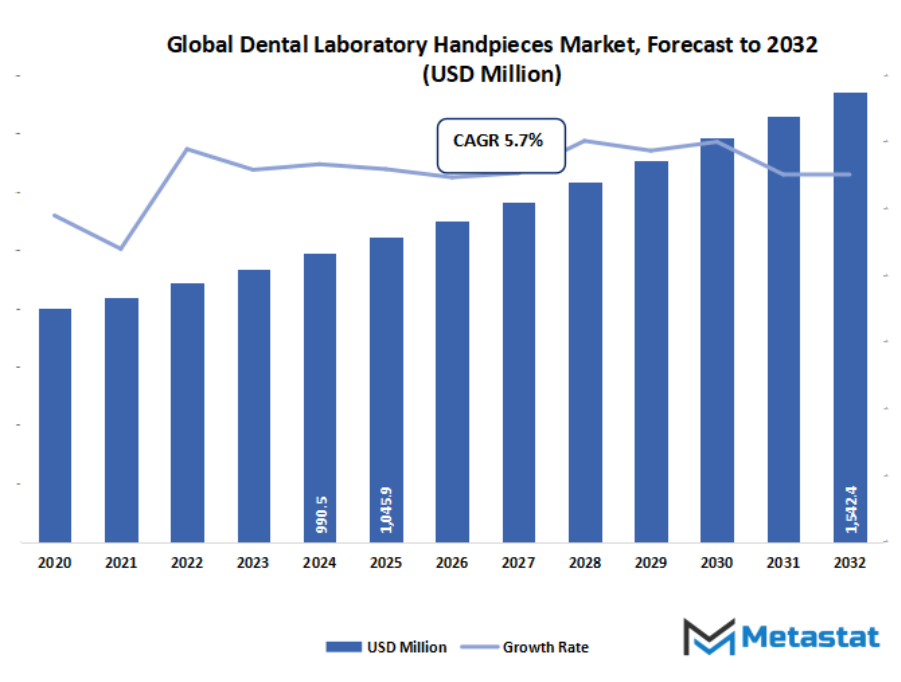
Market size is forecast to rise from USD 1045.9 million in 2025 to over USD 1542.4 million by 2032. Dental Laboratory Handpieces will maintain dominance but face growing competition from emerging formats.
Beyond the usual boundaries, the market will start addressing the emotional side of technical work. Designers will work on how textures, weight distribution, and ergonomic curves will help technicians stay focused longer without discomfort. The future is heading toward those instruments that will feel thoughtfully crafted rather than just functional. In this direction, the industry will not chase complexity but clarity; it will create handpieces that will encourage confidence and allow dental professionals to shape results with calm assurance that their tools are supporting them at every step.
This research report categorizes the global dental laboratory handpieces market based on various segments and regions, forecasts revenue growth, and analyzes trends in each submarket. The report analyses the key growth drivers, opportunities, and challenges influencing the global dental laboratory handpieces market. Recent market developments and competitive strategies such as expansion, type launch, development, partnership, merger, and acquisition have been included to draw the competitive landscape in the market. The report strategically identifies and profiles the key market players and analyses their core competencies in each sub-segment of the global dental laboratory handpieces market.
Find answers to common questions about this report
Global Dental Laboratory Handpieces market is valued at $1045.9 million in 2025.
Global Dental Laboratory Handpieces market is estimated to grow with a CAGR of 5.7% from 2025 to 2032.
Global Dental Laboratory Handpieces market is estimated to reach $1542.4 million by 2032.
Who are the key companies in the Dental Laboratory Handpieces Market?Top players operating in the Dental Laboratory Handpieces industry includes Dentsply Sirona, KaVo Dental, NSK / Nakanishi Inc, Bien-Air Dental SA, etc.
The analysts below cover Medical Devices research at Metastat Insights.
LEAD ANALYST
Utkarsh Khirodkar is a Lead Market Research Analyst at MetaStat Insight, specializing in market intelligence, technology sector assessments, and competitive strategy.

LEAD PRINCIPAL ANALYST, PHARMA AND HEALTHCARE
Food and Beverages · Healthcare · Healthcare IT · Medical Devices
Ajay Devgire is the Lead Healthcare Analyst at MetaStat Insight, leading strategic research and market intelligence initiatives across the global healthcare domain.

SENIOR RESEARCH ANALYST
Biotechnology · Food and Beverages · Medical Devices · Packaging
Snehal Pasalkar is a Research Analyst at MetaStat Insight, operating at the intersection of life sciences research, competitive strategy, and market intelligence.
Replacing petrochemical surfactants with bio-based alternatives requires realistic timelines on industrial precision fermentation scaling. The market research broke down commercialization timelines, feedstock sugar price sensitivities, and regional cosmetic ingredient regulatory approvals in Europe and East Asia. That supplier readiness mapping gave our formulations team reliable context when comparing renewable chemical sourcing roadmaps.
Tracking ceramic matrix composite adoption in high-bypass aero engines requires strict attention to material qualification cycles and FAA airworthiness testing milestones. The MetaStat Insight team provided a detailed timeline of silicon carbide fiber manufacturing capacity and commercial foundry lead times. Having clear visibility into upstream thermal barrier coating supply helped us stress-test our long-term component procurement strategy.
Transitioning ultra-class mining haul trucks to alternative power requires concrete data on remote hydrogen refueling infrastructure economics. The report evaluated megawatt-scale electrolyzer installation expenses, onsite storage safety mandates, and heavy-duty fuel cell stack degradation under continuous duty cycles. That technical rigor helped our engineers benchmark realistic total operating cost horizons for off-highway fleet decarbonization.
Explore related market intelligence reports worth reading alongside this one.