
LEAD ANALYST
Utkarsh Khirodkar is a Lead Market Research Analyst at MetaStat Insight, specializing in market intelligence, technology sector assessments, and competitive strategy.

Electric Radiators Market Size, Share, By Type (Fan Heaters, Convection Radiators, Infrared Radiators, and Oil-Based Electric Radiators), By Application (Residential, Commercial, Industrial, Infrastructure Buildings, and Others), By Mounting Type (Wall-Mounted, Floor-Standing, Ceiling-Mounted, and Portable), By Smart Features (Wi-Fi Enabled, Temperature Control, Programmable Timers, Voice Control, and Others), Industry Analysis, Growth, Trends, and Forecast, 2026-2033
Report ID
MSI-4586
Published
April, 2026
Pages
320 Pages
Format
Report Details
Choose Your License
Electric Radiators Market
The Global Electric Radiators market size is valued at USD 20.7 billion in 2025. The market is projected to grow from USD 21.9 billion in 2026 to USD 31.9 billion by 2033, exhibiting a CAGR of 5.5% during the forecast period.
Global Electric Radiators market valued at USD 20.7 billion in 2025, growing at a CAGR of 5.5% through 2033, with potential to exceed USD 31.9 billion.
North America holds 25.2% in 2025, with the United States leading within the region in 2026.
Fan Heaters segment accounts for a market share of 17.7% in 2025.
Key trends driving growth include rising residential adoption of smart, app-controlled heating systems that propels demand for modern electric radiators, along with a shift toward energy-efficient and low-maintenance heating alternatives that drives replacement of traditional fuel-based systems.
Opportunities include integration of IoT, adaptive learning thermostats, and real-time energy optimization offers strong potential for premium product growth.
Key insight: The Global Electric Radiators Market advances through efficiency-focused heating demand and smart technology convergence, despite electricity cost pressure and climate-specific performance constraints.
The Global Electric Radiators market is evolving within the building heating and thermal comfort industry, supported by electrification initiatives, space-heating retrofits, and increased preference for controllable room-level heating. Product selection is increasingly influenced by aesthetics, finish, placement, and smart controls alongside thermal output, strengthening adoption across new builds and refurbishment activity.
Manufacturers are strengthening alignment with smart living ecosystems, enabling integration with connected home platforms that respond to occupancy patterns, ambient conditions, and user schedules. Room-specific heating control is gaining priority versus centralized heating logic, supporting comfort zoning with cleaner interior integration across premium residential and commercial projects.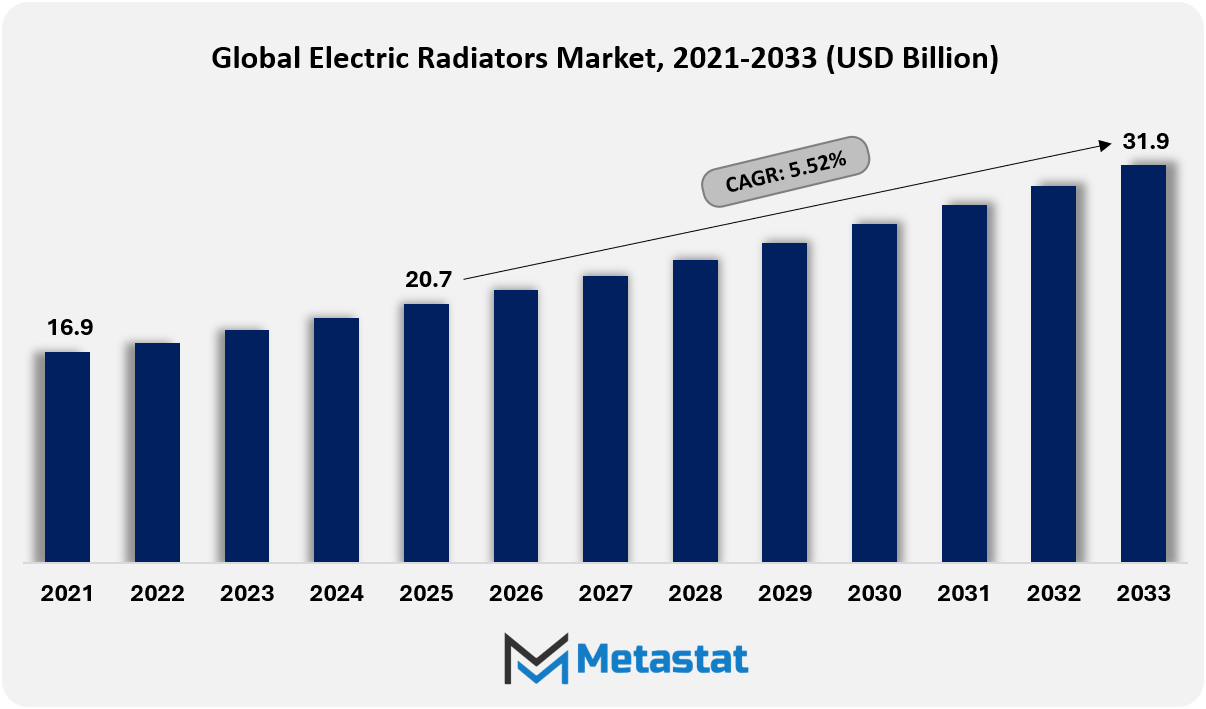
Rising residential adoption of smart, app-controlled heating systems propels demand for modern electric radiators.
Connected temperature regulation, scheduling flexibility, and remote monitoring align with digitally enabled households. Connected temperature regulation, scheduling flexibility, and faraway tracking align with digitally enabled families. Urban housing enlargement and increasing attractiveness of clever domestic ecosystems encourage the installation of electrical radiators designed for convenience, responsive manipulation, and present-day interior integration.
Shift toward energy-efficient and low-maintenance heating alternatives drives replacement of traditional fuel-based systems.
Shift toward energy-efficient and low-maintenance heating alternatives drives replacement of traditional fuel-based systems. Electric radiators lessen reliance on combustion-based infrastructure and decrease servicing frequency. Policy encouragement for cleaner indoor heating and patron awareness on predictable running conduct toughen preference for electrically powered radiator answers throughout residential developments.
Higher electricity prices in several regions limit consumer preference for fully electric heating units.
Higher electricity prices in several regions limit consumer preference for fully electric heating units. Cost-sensitive households examine long-term working expenditure cautiously, especially within markets facing risky energy price lists. Price fluctuations lessen self-belief in electric-simplest heating adoption, slowing conversion charges from gas or hybrid heating preparations.
Limited heating output in larger or poorly insulated spaces restricts utility compared with central heating systems.
Limited heating output in large or poorly insulated spaces restricts the utility compared to central heating systems. Electric radiators perform best in compact or well-insulated environments. Performance limitations create hesitation among owners of spacious residential layouts, where centralized heating infrastructure continues to offer high thermal coverage efficiency.
Integration of IoT, adaptive learning thermostats, and real-time energy optimization offers strong potential for premium product growth.
Integration of IoT, adaptive learning thermostats, and real-time energy optimization offers strong potential for premium product growth. Advanced analytics enables usage pattern recognition and efficiency tuning. High-end electric radiator models with intelligent control architecture drive the global electric radiator market towards value-driven differentiation and long-term technological progress.
The Global Electric Radiators market is classified based on Type, Application, Mounting Type, and Smart Features.
Fan Heaters segment was valued at USD 3.9 billion in 2026 and is projected to reach USD 5.0 billion by 2033, at a CAGR of 3.7% during the forecast period.
Fan Heaters within the Global Electric Radiators marketplace will benefit from attention because of rapid heat dispersion and compact construction. Future demand will stem from space-restrained interiors requiring instant warm temperature. Continuous improvement in noise reduction and airflow management will aid reputation across current living and working environments in search of responsive heating without structural change.
Convection Radiators segment was valued at USD 8.8 billion in 2026 and is projected to reach USD 13.0 billion by 2033, at a CAGR of 5.7% during the forecast period.
Convection radiators will maintain consistent relevance through a uniform warmth stream and strong temperature output. Market growth will align with choices for silent operation and regular thermal comfort. Advancements in material efficiency and floor protection will function convection-based structures as reliable solutions for lengthy-duration heating throughout climate-sensitive regions.
Infrared Radiators segment was valued at USD 4.4 billion in 2026 and is projected to reach USD 7.0 billion by 2033, at a CAGR of 6.9% during the forecast period.
Infrared radiators will appeal to the hobby for targeted heating and decreased heat dispersion. Forward-looking packages will prioritize directional warm temperature in selective zones, supporting efficiency desires. Technological refinement will decorate radiation control, allowing broader use across spaces requiring centered heating without reliance on ambient air movement.
Oil-Based Electric Radiators segment was valued at USD 4.8 billion in 2026 and is projected to reach USD 6.9 billion by 2033, at a CAGR of 5.3% during the forecast period.
Oil-based electric radiators will continue to be associated with heat retention and sustained warm temperatures. Market evolution will emphasize more advantageous thermal garage fluids and improved casing design. Long operational cycles and reduced temperature fluctuation will guide deployment in settings with prolonged heating stability and constrained guide adjustment.
Residential Use segment is projected to reach USD 20.1 billion by 2033, at a CAGR of 6.1% during the forecast period.
Residential use will represent a sustainable development avenue driven by urban housing expansion and renewal activity. Future installations will promote safe surface temperatures, aesthetic adaptability and predictable energy usage. Heating solutions tailored for individual rooms will suit household preferences for controlled comfort and manageable power consumption.
Commercial Applications segment is projected to reach USD 7.5 billion by 2033, at a CAGR of 4.9% during the forecast period.
Commercial applications will expand through office modernization and retail space optimization. Heating requirements will focus on uniform distribution and reliability during extended operating hours. The appliance design will adapt to the open layout, supporting comfort standards while maintaining compliance with energy efficiency requirements in professional environments.
Industrial & Infrastructure Buildings segment is projected to reach USD 3.1 billion by 2033, at a CAGR of 4.9% during the forecast period.
Industrial and infrastructure buildings will adopt electric radiators for local heating in controlled areas. Growth will depend on robust construction, thermal stability and integration with facility energy systems. Future demand will reflect the need for reliable heating support within large-scale structures with variable occupancy patterns.
Others segment is projected to reach USD 1.2 billion by 2033, at a CAGR of 2.5% during the forecast period.
Other applications will include temporary installations and special facilities requiring flexible heating arrangements. Market share will increase through adaptable designs suitable for diverse operating conditions. Lightweight construction and simplified deployment will support use in developing environments without permanent structural commitments.
Wall-Mounted segment is projected to reach USD 12.2 billion by 2033 and accounted for 36.2% in 2025.
Wall-mounted configurations will experience increased adoption driven by space optimization and fixed placement benefits. Future designs will emphasize slim profiles and better heat dispersion. Integration into the interior layout will support long-term use in areas that prioritize floor availability and visual arrangement.
Floor-Standing segment is projected to reach USD 4.4 billion by 2033 and accounted for 14.8% in 2025.
Floor-standing units will continue to serve locations requiring mobility without permanent installation. Market development will focus on sustainability, safety features, and balanced heat production. Adaptability in room sizes will encourage continued relevance in both residential and commercial contexts.
Ceiling-Mounted segment is projected to reach USD 2.2 billion by 2033 and accounted for 6.4% in 2025.
Ceiling-mounted systems will meet the heating needs of large rooms and public interiors. Future growth will depend on directional efficiency and minimal disruption. Elevated placement will support uniform heat coverage while preserving usable space in high-traffic environments.
Portable segment is projected to reach USD 13.1 billion by 2033 and accounted for 42.5% in 2025.
Portable electric radiators will attract demand through flexibility and ease of relocation. Product development will enhance weight management and safety control. Temporary heating needs in a variety of settings will maintain interest in portable formats that support short-term comfort needs.
Wi-Fi Enabled segment is projected to grow at a CAGR of 8.4% during the forecast period.
The Wi-Fi enabled features will shape future adoption through remote access and energy monitoring. Integration with digital platforms will allow scheduling and performance tracking. Market progress will be in line with the increasing reliance on connected home and building management ecosystems.
Temperature Control segment is projected to grow at a CAGR of 5.2% during the forecast period.
Advanced temperature control will remain central to efficiency goals. Precision adjustment capabilities will support stable indoor conditions while reducing unnecessary power usage. Continuous sensor improvements will strengthen reliability in various operating scenarios.
Programmable Timers segment is projected to grow at a CAGR of 4.6% during the forecast period.
Programmable timers will support planned heating cycles aligned with occupancy patterns. Future designs will simplify configuration while maintaining accuracy. Automated scheduling will contribute to energy optimization in residential and commercial environments.
Voice Control segment is projected to grow at a CAGR of 7.6% during the forecast period.
Voice control functionality will expand through compatibility with smart assistants. Hands-free operation will increase accessibility and convenience. Market growth will depend on secure integration and consistent responsive performance within the connected ecosystem.
Others segment is projected to grow at a CAGR of 3.3% during the forecast period.
Other smart features will emerge through predictive maintenance alerts and adaptive learning functions. Innovation will focus on practical value without operational complexity. Continued refinements will support balanced integration of intelligence and user control into electric radiator systems.
Based on geography, the Global Electric Radiators market is divided into North America, Europe, Asia-Pacific, South America, Middle East, and Africa.
North America Electric Radiators Market is set to expand at a CAGR of 5.5% within the forecast period, reaching a market size of USD 7.8 billion by the end of 2033.
North America benefits from building electrification mandates and cold-climate retrofit activity supporting electric radiator adoption.
North America sees demand pull from utility rebates, time-of-use pricing, and smart home heating integration.
Asia Pacific offers opportunity via rapid urban housing growth and increasing preference for electric space heating.
Asia Pacific offers opportunity via localized manufacturing scale, aggressive pricing, and increasing middle-income households.
Middle East, Africa, and South America reflect measured enlargement tied to grid improvements, city creation, and gradual electrification of indoor heating.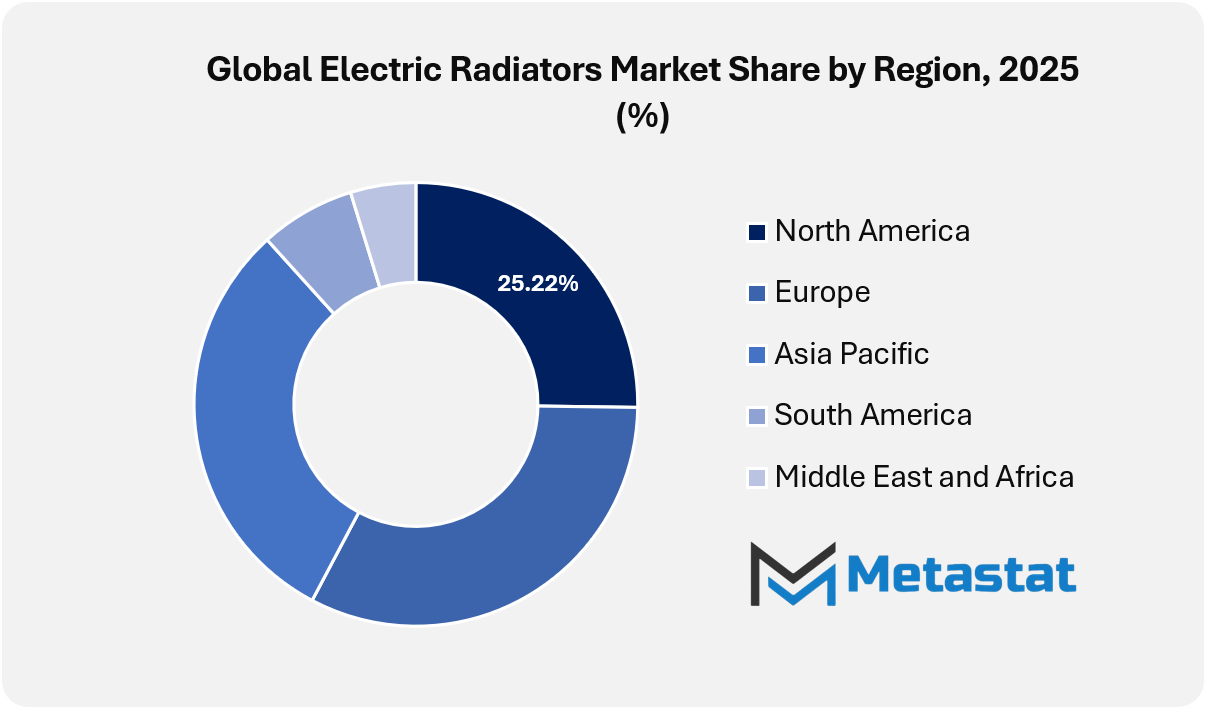
The Global Electric Radiators market reflects a steady shift towards efficient indoor heating, supported by design-led and technology-driven manufacturers. Brands in this market focus on comfort, energy management, and design appeal, supporting electric radiators that fit naturally into contemporary houses, offices, and industrial homes. Companies including Rointe, ELNUR, IRSAP S.p.A., INTELLI HEAT Ltd, Rio Heating, and Deltacalor S.r.l. continue to shape customer expectations by using presenting products that balance overall performance effectively of use. Their presence highlights how heating answers now align carefully with lifestyle wishes, interior aesthetics, and long-term strength making plans.
Several established European gamers maintain sturdy positions through regular innovation and local understanding. Haverland UK Limited, Groupe intuis, Glen Dimplex Heating & Ventilation, Dimplex, Nobo, Adax AS, and Creda have a long history of investing in product improvement and market enlargement. Glamox AS, Zehnder Group International AG, KERMI GmbH, Jaga N.V., TERMA Sp. Z o.O., and Stelrad Radiators further support the market via advanced warmth distribution designs and sturdy materials. These companies focus on reliability, clean finishes, and compatibility with evolving building standards.
The competitive panorama additionally consists of companies regarded for specialised heating solutions and premium design-led services. Runtal North America, Cordivari S.R.L., Noirot, Vasco Group NV, Radialight S.R.L., TUBES RADIATORI S.P.A., Brandoni S.P.A., ISAN Radiátory s.R.O., and Hammam Design Radiator emphasize form-driven innovation mixed with thermal performance. Redwell Manufaktur GmbH, EUCOTHERM GmbH, SUNDIRECT Technology Ltd, Radiators spa, Heat4all France, and ILO TECHNOLOGY upload depth to the marketplace via infrared heating standards and occasional-intake systems acceptable for residential and area of interest commercial use.
Global participation expands in addition through manufacturers serving industrial, smart heating, and emerging regional demand. Vulcanic, Sinus-Jevi Electric Heating B.V., Masterwatt Srl, Acim Jouanin, and De’Longhi S.P.A. Contribute scalable answers and sturdy logo recognition. Havells India Limited and Airelec represent growing demand across Asia and rate-sensitive markets, assisting wider adoption of electric radiators. Together, these players maintain a competitive environment driven by design readability, thermal efficiency, and practical usability, reinforcing the market’s constant ahead movement without losing recognition in everyday comfort.
Market size is forecast to rise from USD 20.7 billion in 2025 to over USD 31.9 billion by 2033.
In Industrial and institutional environments, electric powered radiators are projected to help modular infrastructure planning, allowing centers to evolve heating layouts in reaction to spatial reconfiguration without invasive retrofitting. Over time, the Global Electric Radiators market is anticipated to mirror a broader redefinition of heating value, wherein adaptability, visible coherence, and virtual compatibility shape lengthy-term relevance more than traditional performance metrics by myself.
By Type:
By Application:
By Mounting Type:
By Smart Features:
This research report categorizes the Electric Radiators market based on key segments and regions, forecasts revenue growth, and analyses trends in each submarket. The report analyses the key growth drivers, opportunities, and challenges influencing the Electric Radiators market. Recent market developments and competitive strategies such as expansion, type launch, development, partnership, merger, and acquisition have been included to draw the competitive landscape in the market.
The report strategically identifies and profiles the key market players and analyses their core competencies in each sub-segment of the Electric Radiators market.
|
Report Attributes |
Details |
|
Study Period |
2021-2033 |
|
Base Year |
2025 |
|
Estimated Year |
2026 |
|
Forecast Period |
2026-2033 |
|
Historical Period |
2021-2025 |
|
Growth Rate |
CAGR 5.5% from 2026 to 2033 |
|
Revenue Unit |
USD billion |
|
Sales Volume Unit |
Thousand Units |
|
Segmentation |
By Type, Application, Mounting Type, Smart Features, and Region |
|
By Region |
North America (By Type, Application, Mounting Type, Smart Features, and Country)
|
|
Europe (By Type, Application, Mounting Type, Smart Features, and Country)
|
|
|
Asia Pacific (By Type, Application, Mounting Type, Smart Features, and Country)
|
|
|
South America (By Type, Application, Mounting Type, Smart Features, and Country)
|
|
|
Middle East and Africa (By Type, Application, Mounting Type, Smart Features, and Country)
|
Find answers to common questions about this report
Top players operating in the Electric Radiators industry include Rointe (Rointe Group), ELNUR, S.A. (Elnur Gabarron), IRSAP S.p.A., INTELLI HEAT Ltd, Rio Heating (RIO Heating Ltd), and Deltacalor S.r.l.
Global Electric Radiators market is estimated to reach USD 31.9 billion by 2033.
The Global Electric Radiators market is likely to grow at a CAGR of 5.5% over the forecast period (2026-2033).
Europe dominates the market.
Higher electricity prices in several regions limit consumer preference for fully electric heating units will hamper the market growth within the forecast period.
Convection Radiators are the leading type segment in the Global market.
The Metastat Insights analysis shows that the North America Electric Radiators market size is estimated to be USD 7.8 billion by 2033.
Rising residential adoption of smart, app-controlled heating systems propels demand for modern electric radiators and Shift toward energy-efficient and low-maintenance heating alternatives drives replacement of traditional fuel-based systems. are key driving factors, boosting the market.
The Metastat Insights study shows that the Global Electric Radiators market size was USD 20.7 billion in 2025.
The analysts below cover Energy and Power research at Metastat Insights.
LEAD ANALYST
Utkarsh Khirodkar is a Lead Market Research Analyst at MetaStat Insight, specializing in market intelligence, technology sector assessments, and competitive strategy.

PRINCIPAL CONSULTANT - ENTERPRISE AI & EMERGING TECHNOLOGIES
Banking & Finance · Electronics and Semiconductor · Energy and Power · Healthcare IT · Information & Technology · Professional Services
Vijay Gunti is a Principal Consultant at MetaStat Insight, bringing over two decades of experience across enterprise digital transformation, technology strategy, and intelligent systems.

ENERGY & INFRASTRUCTURE INDUSTRY CONSULTANT
Automotive and Transportation · Electronics and Semiconductor · Energy and Power · Machinery & Equipment
Saurabh Vasant Ganvir consults for Energy & Infrastructure Industry at MetaStat Insight, specializing in renewable energy, solar EPC, and electric vehicle (EV) infrastructure markets.
Assessing 200mm wafer transition schedules and substrate supply bottlenecks requires precise technical intelligence. MetaStat Insight supplied an actionable breakdown comparing planar and trench MOSFET architectures across automotive and industrial drive markets. The regional capacity estimates for Asia-Pacific foundries helped clarify lead-time uncertainties during our strategic planning session. When we needed additional clarification on high-purity raw material sourcing, their analyst team responded with helpful context within twenty-four hours.
Tracking maintenance cycle demand for secondary flight display units and terrain collision avoidance systems across regional jet fleets involves complex aftermarket dynamics. MetaStat Insight provided practical analysis separating airline retrofit programs from OEM forward-fit production schedules in North America and Southeast Asia. The supplier matrix highlighted component obsolescence timelines without resorting to vague generalizations. The dataset served as a dependable reference during our annual program review meetings.
Evaluating secondary resin quality across post-consumer packaging streams requires reliable technical segmentation. MetaStat Insight delivered an objective assessment that distinguished between extrusion-grade flake pricing and optical sorting throughput limitations across Western Europe. The competitive positioning breakdown for licensed depolymerization technology providers answered several questions during our feedstock feasibility audit. Their team clarified regional trade restrictions on mixed plastic scrap quickly when our team submitted follow-up requests.
Explore related market intelligence reports worth reading alongside this one.