
LEAD ANALYST
Utkarsh Khirodkar is a Lead Market Research Analyst at MetaStat Insight, specializing in market intelligence, technology sector assessments, and competitive strategy.

Global Enterprise Telephony Market Size, Share, By Component (Hardware, Software, and Services), By Deployment Model (On-Premises and Cloud), By Organization Size (Small Enterprises, Medium-sized Enterprises, and Large Enterprises), By End Users (Retail Industry, Government Organizations, BFSI, and Others), Industry Analysis, Growth, Trends, and Forecast, 2026-2033
Report ID
MSI-4691
Published
April, 2026
Pages
314 Pages
Format
Report Details
Choose Your License
Enterprise Telephony Market
Global Enterprise Telephony market size is valued at USD 765.5 billion in 2025 and projected to grow at a CAGR of 6.7% during the forecast period, reaching USD 1,285.4 billion by 2033.
North America holds 31.2% in 2025 with US leading the market share in 2025.
Hardware segment account for a market share of 24.5% in 2025.
Key trends driving growth: Increasing adoption of cloud-based communication and unified collaboration platforms across enterprises, along with growth in remote and hybrid work models requiring scalable and flexible communication infrastructure.
Opportunities include integration of AI-driven analytics, automation, and omnichannel communication enhancing enterprise communication efficiency.
Key insight: Rapid shift toward cloud-based telephony, VoIP, and AI-driven unified communication platforms is transforming enterprise communication into a scalable, software-led ecosystem globally.
The Global Enterprise Telephony market is undergoing significant transformation as businesses modernize communication infrastructure to support distributed work environments, digital collaboration, and customer engagement. Traditional PBX and legacy telephony systems are being replaced or integrated with IP-based and cloud-native platforms, enabling seamless voice communication across enterprise ecosystems. Market expansion is supported by the adoption of unified communication solutions that integrate voice, messaging, conferencing, call routing, and collaboration tools into centralized platforms. Enterprises are focusing on scalability, cost optimization, interoperability, and operational flexibility, increasing adoption of cloud-enabled telephony systems.
Organizations are prioritizing interoperability, mobility, and platform reliability to ensure communication systems function consistently across devices, networks, and geographies. Enterprise telephony is evolving into a strategic layer of enterprise IT, supporting customer engagement, workforce productivity, and real-time business decision-making. Over the forecast period, telephony architecture will shift toward software-defined communication environments, with voice services embedded into business applications, CRM platforms, contact center workflows, and collaboration ecosystems. Integration with AI-driven analytics, automation tools, and customer experience platforms will further improve communication efficiency, responsiveness, and service quality.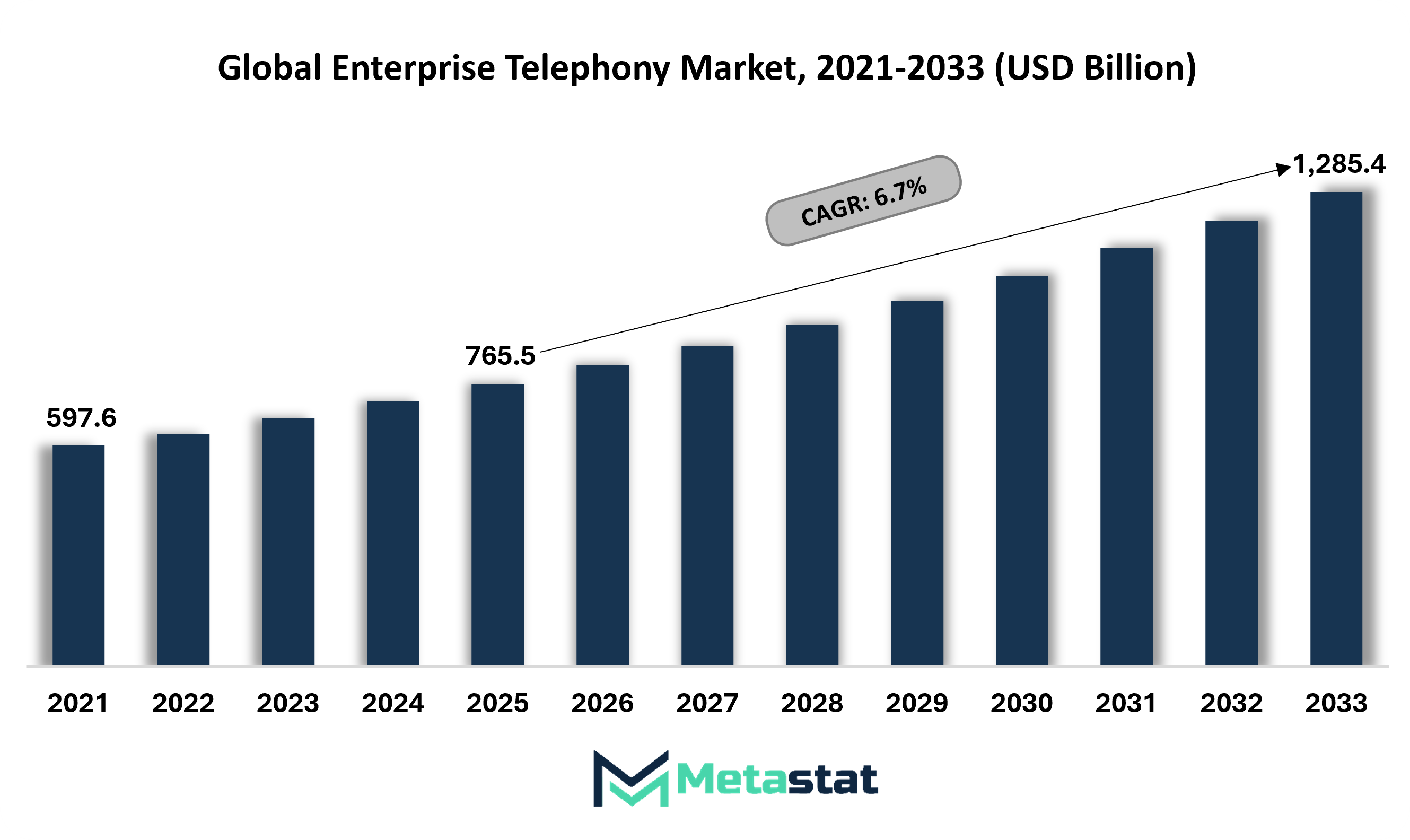
Increasing adoption of cloud-based communication and unified collaboration platforms across
Rising digital transformation initiatives across industries are accelerating adoption within the Global Enterprise Telephony Market. Organizations are shifting toward cloud-based communication platforms to improve accessibility, reduce infrastructure dependency, and support seamless collaboration across distributed teams. Unified systems integrate voice, messaging, video, conferencing, and call management into connected communication ecosystems, supporting future-ready business operations and improved enterprise productivity.
Growth in remote and hybrid work models requiring scalable and flexible communication infrastructure
Expansion of remote and hybrid work models is creating strong momentum in the Global Enterprise Telephony Market. Enterprises require scalable communication solutions capable of supporting distributed teams without performance disruption. Flexible telephony infrastructure ensures consistent connectivity, improves workforce productivity, and aligns with evolving workplace models influenced by globalization, digital operations, and multi-location enterprise structures.
High initial migration and integration costs with legacy systems
Significant upfront investment remains a major challenge in the Global Enterprise Telephony Market. Migration from traditional telephony systems to advanced platforms involves integration complexity, system downtime risks, data migration issues, and employee training requirements. Budget constraints across small and medium-sized enterprises limit adoption, while compatibility issues with existing IT and telecom infrastructure increase operational burden during transition stages.
Data security and privacy concerns associated with cloud-based telephony solutions
Security risks continue to influence investment decisions within the Global Enterprise Telephony Market. Cloud-based telephony solutions raise concerns related to data breaches, unauthorized access, call interception, identity misuse, and regulatory compliance. Enterprises handling sensitive communication data prioritize strong encryption, access control, identity management, and governance frameworks, increasing implementation complexity across highly regulated industries.
Integration of AI-driven analytics, automation, and omnichannel communication enhancing enterprise communication efficiency
Advancements in artificial intelligence create strong growth potential for the Global Enterprise Telephony Market. AI-driven analytics enable real-time insights, predictive communication patterns, automated workflows, intelligent call routing, voice recognition, and speech analytics. Integration with omnichannel platforms supports consistent customer engagement across multiple touchpoints, improving operational efficiency and enabling enterprises to deliver personalized, data-driven communication experiences.
The Global Enterprise Telephony market is segmented based on component, deployment model, organization size, end user, and region.
Hardware segment is valued at USD 199.5 billion in 2026 and is projected to reach USD 264.5 billion by 2033, at a CAGR of 4.1% during the forecast period.
The hardware segment will reflect steady demand for enterprise-grade communication devices, including IP phones, PBX systems, gateways, session border controllers, headsets, and conferencing equipment. Market outlook will align with infrastructure upgrades and digital workplace expansion, with reliable physical systems remaining important for voice quality, security compliance, and uninterrupted communication across distributed enterprise environments.
Software segment is valued at USD 331.6 billion in 2026 and is projected to reach USD 560 billion by 2033, at a CAGR of 7.8% during the forecast period.
The software segment will advance through unified communication platforms, call control systems, softphones, UCaaS applications, contact center integrations, and AI-enabled analytics tools. Adoption will rise with increasing focus on automation, integration, and data-driven communication workflows. Enterprises will prioritize scalable software ecosystems that enhance collaboration, optimize call routing, and support remote operations with improved flexibility and performance.
Services segment is valued at USD 284.8 billion in 2026 and is projected to reach USD 460.9 billion by 2033, at a CAGR of 7.1% during the forecast period.
The services segment will expand with growing reliance on managed services, consulting, system integration, implementation support, training, and maintenance. Enterprises will invest in professional expertise to ensure seamless deployment and stable performance of telephony systems. Long-term service contracts will gain traction owing to continuous upgrade requirements, cybersecurity management, platform monitoring, and operational stability.
On-Premises segment is projected to reach USD 390.1 billion by 2033, at a CAGR of 3% during the forecast period.
The on-premises deployment segment will retain relevance across industries requiring strict data control, customized infrastructure, low-latency voice systems, and regulatory compliance. Organizations with high security priorities will continue investing in in-house communication infrastructure for stable and controlled telephony environments. Stability, customization capability, and control over sensitive communication data will support sustained adoption across regulated sectors.
Cloud segment is projected to reach USD 895.3 billion by 2033, at a CAGR of 8.7% during the forecast period.
The cloud deployment segment will record strong expansion owing to scalability, cost efficiency, faster implementation, simplified upgrades, and remote accessibility. Enterprises will continue shifting toward cloud-based telephony systems to support hybrid work models, global connectivity, and multi-location collaboration. Continuous innovation in cloud security, service reliability, and performance optimization will further strengthen adoption across industries seeking agile communication solutions.
Small and Medium-sized Enterprises (SMEs) segment is projected to reach USD 516.3 billion by 2033.
The SME segment will witness rising adoption supported by affordable cloud solutions, simplified deployment models, subscription-based pricing, and minimal infrastructure requirements. Smaller enterprises will use telephony systems to improve customer engagement, internal coordination, and operational efficiency. Cost-effective communication platforms will support faster digital transformation across growing businesses.
Large Enterprises segment is projected to reach USD 769 billion by 2033.
The large enterprise segment will dominate revenue contribution owing to extensive communication requirements, complex infrastructure needs, multi-location operations, and higher investment capacity. Large organizations will invest in advanced telephony ecosystems integrating voice, video, messaging, analytics, and data services. Emphasis will remain on scalability, security, interoperability, and seamless global connectivity to support large-scale operations.
Retail Industry segment is projected to grow at a CAGR of 7.9% during the forecast period.
The retail segment will advance with increasing focus on customer interaction, store support, contact center operations, and omnichannel communication. Retail firms will adopt advanced telephony solutions to manage customer queries, support sales operations, and improve service responsiveness. Integration with CRM platforms will enhance personalized engagement, service tracking, and operational coordination.
Government Organizations segment is projected to grow at a CAGR of 5.7% during the forecast period.
The government and public sector segment will emphasize secure, reliable, and compliant communication infrastructure. Adoption will increase for emergency response systems, administrative coordination, public service delivery, and interdepartmental communication. Investment in modern telephony solutions will support efficient information exchange while ensuring compliance with national security, data protection, and governance requirements.
Banks, Financial Services and Insurance (BFSI) Sector segment is projected to grow at a CAGR of 7.5% during the forecast period.
The BFSI segment will prioritize high-security communication systems to manage sensitive financial interactions, customer support centers, fraud alerts, transaction verification, and compliance-driven workflows. Telephony solutions will support secure customer engagement, branch connectivity, and contact center modernization. Strong adoption will emerge for encrypted communication platforms that enhance trust, transparency, and operational control.
Others segment is projected to grow at a CAGR of 5.3% during the forecast period.
The others segment includes healthcare, education, manufacturing, IT, and professional services, where communication efficiency remains critical for service delivery and operational coordination. Adoption will increase for teleconsultation, remote learning, industrial communication, helpdesk support, and internal collaboration. Advanced telephony systems will support sector-specific communication needs, improving connectivity, productivity, and service delivery across varied operating environments.
Based on geography, the Global Enterprise Telephony market is divided into North America, Europe, Asia-Pacific, South America, Middle East, and Africa.
North America leads the Enterprise Telephony market owing to early adoption of cloud communication technologies, strong enterprise IT infrastructure, high UCaaS penetration, and mature digital workplace investments.
Europe holds a significant position in the Enterprise Telephony market, supported by strong enterprise digitalization, mature telecom infrastructure, and rising adoption of cloud-based communication platforms across major economies such as Germany, the UK, France, Italy, and Spain.
Asia-Pacific offers significant opportunities for the Enterprise Telephony market through rapid digital transformation, expanding SME adoption, growing enterprise IT investments, and increasing cloud communication deployment.
Across the Middle East, Africa, and South America, the market is progressing through rising digital infrastructure investments, enterprise modernization initiatives, cloud migration, and growing requirements for reliable business connectivity.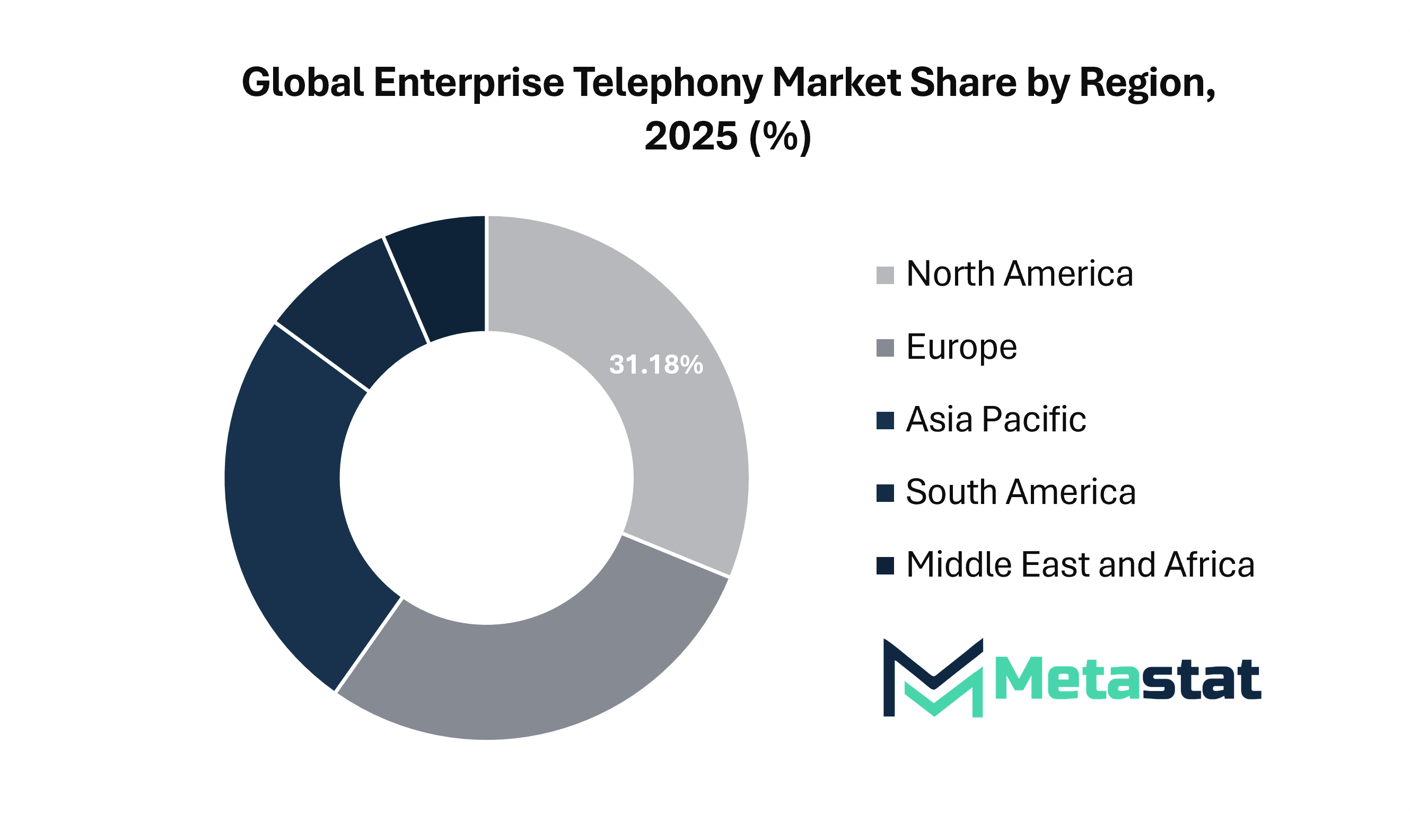
The Global Enterprise Telephony Market continues to expand as organizations seek advanced ways to manage communication across teams, customers, departments, and locations. Enterprises are shifting from conventional telephone systems to cloud-based and IP-driven solutions that offer flexibility, scalability, cost control, and easier integration with business applications. Market transformation is supported by the need for remote work support, simplified scalability, and improved customer interaction. Companies increasingly expect communication platforms to combine voice, video, messaging, conferencing, and call management in one connected environment, making daily operations smoother and efficient.
Many companies are investing in platforms that enable employees to stay connected across office, remote, and hybrid work environments. With hybrid work becoming a standard operating model, enterprise telephony is no longer limited to office-based infrastructure. Cloud solutions reduce hardware dependency, support faster updates, and improve scalability without major operational disruption. Security and data privacy remain critical priorities, since enterprises handle large volumes of sensitive voice and customer communication data through these systems. Service providers are focusing on secure networks, encryption, access control, compliance support, and resilient service delivery to meet enterprise requirements.
Key Global Enterprise Telephony Industry Players include Microsoft Corporation, Cisco Systems, Inc., Zoom Communications, Inc., RingCentral, Inc., 8x8, Inc., Avaya LLC, Mitel Networks Corporation, Huawei Technologies Co., Ltd., Dialpad, Inc., 3CX Ltd, Sangoma Technologies Corporation, GoTo Group, Inc., Vonage, Nextiva, Inc., Ooma, Inc., Xiamen Yeastar Digital Technology Co., Ltd., Grandstream Networks, Inc., NEC Corporation, ALE International, Panasonic Connect Co., Ltd., Intermedia.net, Inc., NFON AG, Gamma Communications plc, Wildix OÜ, Aircall SAS, CloudTalk s.r.o., Verizon Communications Inc., AT&T Inc., BT Group plc, and Vodafone Group Plc. These companies offer a broad range of solutions, including unified communication platforms, VoIP systems, cloud telephony, PBX systems, contact center solutions, SIP trunking, and advanced call management platforms, supporting enterprises in improving internal and external communication.
Competition among these players remains strong, with vendors focusing on innovation, platform integration, customer experience, and AI-enabled communication capabilities. Many providers are adding features such as call analytics, voice recognition, automated responses, intelligent routing, transcription, and speech-to-text tools to improve service quality. Integration with enterprise applications such as CRM, ERP, collaboration tools, and contact center platforms adds value by enabling organizations to work efficiently and improve customer response management.
Market size is forecast to rise from USD 765.5 billion in 2025 to over USD 1,285.4 billion by 2033.
The Global Enterprise Telephony market will continue evolving through the integration of artificial intelligence, automation, cloud computing, API-based communication, and unified collaboration platforms. Enterprises will increasingly adopt software-driven communication systems that improve flexibility, scalability, security, and integration with business workflows. Future market expansion will be supported by cloud migration, hybrid workplace adoption, omnichannel customer engagement, and rising demand for intelligent communication platforms.
This research report categorizes the Enterprise Telephony market based on key segments and regions, forecasts revenue growth, and analyses trends in each submarket. The report analyses the key growth drivers, opportunities, and challenges influencing the Enterprise Telephony market. Recent market developments and competitive strategies such as expansion, product launch, partnership, merger, and acquisition have been included to draw the competitive landscape in the market.
The report strategically identifies and profiles the key market players and analyses their core competencies in each sub-segment of the Enterprise Telephony market.
|
Report Attributes |
Details |
|
Study Period |
2021-2033 |
|
Base Year |
2025 |
|
Estimated Year |
2026 |
|
Forecast Period |
2026-2033 |
|
Historical Period |
2021-2025 |
|
Growth Rate |
CAGR 6.7% from 2026 to 2033 |
|
Revenue Unit |
USD billion |
|
Segmentation |
By Component, Deployment Model, Organization Size, End Users, and Region |
|
By Region |
North America (By Component, Deployment Model, Organization Size, End Users, and Country)
|
|
Europe (By Component, Deployment Model, Organization Size, End Users, and Country)
|
|
|
Asia Pacific (By Component, Deployment Model, Organization Size, End Users, and Country)
|
|
|
South America (By Component, Deployment Model, Organization Size, End Users, and Country)
|
|
|
Middle East and Africa (By Component, Deployment Model, Organization Size, End Users, and Country)
|
Find answers to common questions about this report
Top players operating in the Enterprise Telephony industry include Microsoft Corporation, Cisco Systems, Inc., Zoom Communications, Inc., RingCentral, Inc., 8x8, Inc., Avaya LLC, Mitel Networks Corporation, and Huawei Technologies Co., Ltd.
High initial migration and integration costs with legacy systems will hamper the market growth within the forecast period.
Increasing adoption of cloud-based communication and unified collaboration platforms across enterprises and Growth in remote and hybrid work models requiring scalable and flexible communication infrastructure are key driving factors, boosting the market.
North America region dominates the market.
The Metastat Insights analysis shows that the North America Enterprise Telephony market size is estimated to be USD 381.5 billion by 2033.
The Global Enterprise Telephony market is expected to grow at a CAGR of 6.7% over the forecast period (2026-2033).
The Metastat Insights study shows that the Global Enterprise Telephony market size was USD 765.5 billion in 2025.
The analysts below cover Information & Technology research at Metastat Insights.
LEAD ANALYST
Utkarsh Khirodkar is a Lead Market Research Analyst at MetaStat Insight, specializing in market intelligence, technology sector assessments, and competitive strategy.

PRINCIPAL CONSULTANT - ENTERPRISE AI & EMERGING TECHNOLOGIES
Banking & Finance · Electronics and Semiconductor · Energy and Power · Healthcare IT · Information & Technology · Professional Services
Vijay Gunti is a Principal Consultant at MetaStat Insight, bringing over two decades of experience across enterprise digital transformation, technology strategy, and intelligent systems.

LEAD CONSULTANT - COMMUNICATION, TELECOM, AND IT
Electronics and Semiconductor · Information & Technology · Machinery & Equipment · Professional Services
Ravindra Sathe Consultants for Communication, Telecom, and IT at MetaStat Insight. He leads the firm's industry research initiatives across telecommunications infrastructure, digital connectivity, enterprise networking, and emerging information technology domains.
Most industry reports on warehouse automation bundle autonomous mobile robots and fixed conveyor installations into the same top-level numbers, which complicates advisory work. This study split the market cleanly by payload tiers, navigation technology, and fleet management software layers. The regional forecast for Western Europe gave our team defensible adoption benchmarks when evaluating capital allocation for logistics clients, saving us days of secondary data scrubbing.
Analyzing the transition from natural gas to green hydrogen in iron ore reduction requires realistic infrastructure timelines. Meta stat insight supplied a detailed regional assessment of DRI plant conversion costs and scrap metal availability in North America and Western Europe. Their report carefully examined pellet quality specs and electrical grid access constraints without making oversimplified market assumptions. The research material served as a practical reference during internal technology roadmap discussions.
Integrating zero-trust access controls across legacy electronic health record systems involves complex compliance overhead. Team produced an analysis that clearly separated identity governance and administration tools from privileged access management platforms. Their evaluation of HIPAA and GDPR compliance features across cloud native solutions gave our architecture group clear baseline criteria. The custom data request regarding biometric authentication adoption in hospital networks was returned promptly with clear documentation.
Explore related market intelligence reports worth reading alongside this one.