
LEAD ANALYST
Utkarsh Khirodkar is a Lead Market Research Analyst at MetaStat Insight, specializing in market intelligence, technology sector assessments, and competitive strategy.

Global Titanium Mesh Market Size, Share, By Type (Weaved Mesh, Stamped Mesh, and Expanded Mesh), By Application (Manufacturing, Electronics, Semiconductors, Aerospace, Military, Medical, and Others), Industry Analysis, Growth, Trends, and Forecast, 2026-2033
Report ID
MSI-4639
Published
April, 2026
Pages
320 Pages
Format
Report Details
Choose Your License
Global Titanium Mesh Market
Global Titanium Mesh market size is valued at USD 1,583.9 million in 2025 and projected to grow at a CAGR of 7.5% during the forecast period, reaching USD 2,823.2 million by 2033.
North America holds 28.8% in 2025 with US leading the market share in 2025.
Weaved Mesh segment accounts for a market share of 35.8% in 2025.
Key trends driving growth: Rising use in electrochemical processing, water treatment, and hydrogen systems, along with growing adoption in cranial, maxillofacial, and dental reconstruction procedures.
Opportunities include expansion of patient-specific implants and advanced electrode mesh for hydrogen and specialty electrochemical applications.
Key insight: The Global Titanium Mesh market is advancing through material innovation and expanding
Global Titanium Mesh market is gaining steady traction owing to its corrosion resistance, high strength-to-weight ratio, and biocompatibility. These properties support adoption across medical, aerospace, industrial filtration, electrochemical, and advanced manufacturing applications. Rising demand for precision-engineered materials that perform reliably in harsh operating environments is strengthening the role of titanium mesh across high-value end-use sectors.
Manufacturers are focusing on advanced fabrication processes to improve pore uniformity, dimensional stability, structural integrity, and application-specific performance. Increased use in cranial, maxillofacial, and dental reconstruction is reinforcing market expansion in healthcare, while broader deployment in water treatment, chemical processing, and hydrogen-related systems is supporting industrial demand.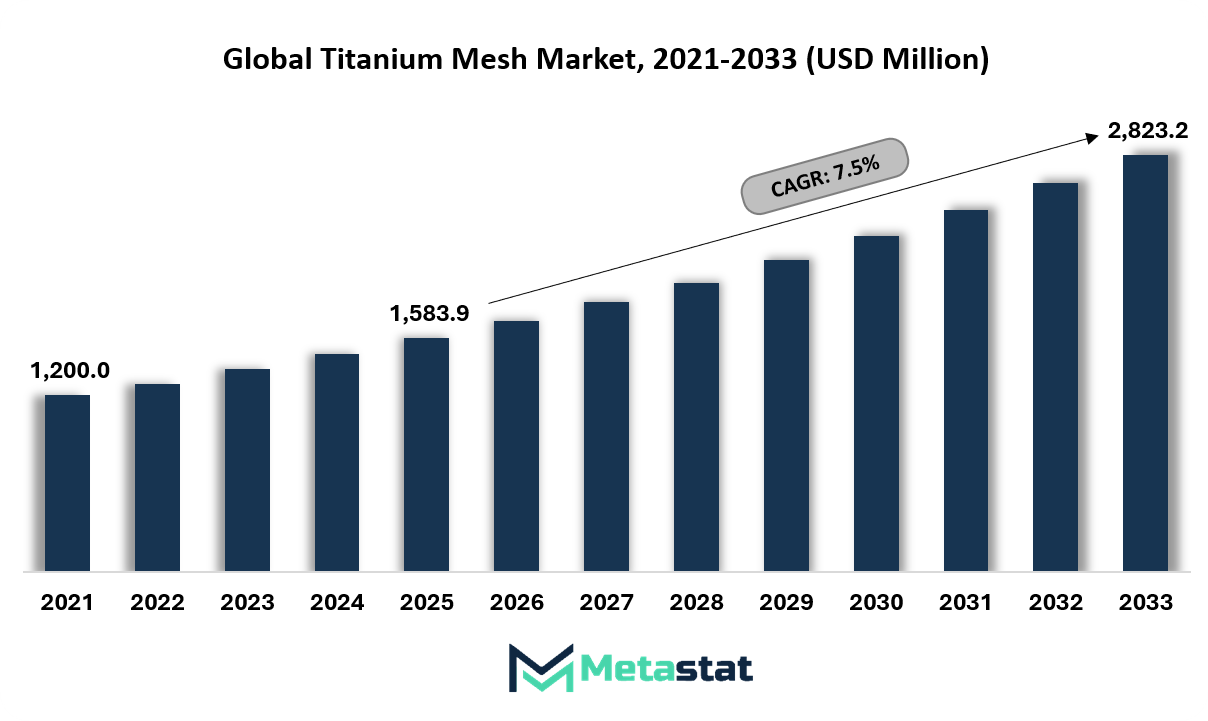
Rising use in electrochemical processing, water treatment, and hydrogen systems.
Rising use in electrochemical processing, water treatment, and hydrogen systems is supporting Titanium Mesh market expansion. Titanium mesh is increasingly preferred in these environments owing to strong corrosion resistance, conductivity suitability in selected electrode applications, and long operating life under chemically demanding conditions. Growth in hydrogen infrastructure and advanced water purification systems will further strengthen product adoption.
Growing adoption in cranial, maxillofacial, and dental reconstruction procedures.
Growing adoption in cranial, maxillofacial, and dental reconstruction procedures is strengthening market demand. Titanium mesh offers biocompatibility, structural support, and long-term stability, making it suitable for bone repair and reconstructive applications. Increased procedure volumes, improved surgical techniques, and rising healthcare investment are supporting broader usage across developed and emerging markets.
High titanium production cost and energy-intensive processing.
High titanium production cost and energy-intensive processing remain key restraints for the Titanium Mesh market. Extraction, refining, and fabrication involve significant cost inputs, which affect pricing competitiveness across end-use industries. Cost sensitivity in industrial applications and substitution by lower-cost materials will restrict wider penetration in selected markets.
Application-specific fabrication and customization complexity.
Application-specific fabrication and customization complexity continue to create operational challenges. Precision shaping, pore design, and product tailoring often require specialized equipment, technical expertise, and controlled manufacturing conditions. These requirements increase lead times and production costs, creating barriers for smaller manufacturers and limiting rapid scale-up.
Expansion of patient-specific implants and advanced electrode mesh for hydrogen and specialty electrochemical applications.
Expansion of patient-specific implants and advanced electrode mesh for hydrogen and specialty electrochemical applications presents a strong growth opportunity. Customized implant design is gaining relevance in reconstructive procedures, while hydrogen production technologies are creating demand for durable and high-performance mesh materials. Ongoing research in advanced materials and engineered surface performance will open additional high-value application areas.
The Global Titanium Mesh market is classified based on Type and Application.
Weaved Mesh segment is valued at USD 609.6 million in 2026 and is projected to reach USD 951.2 million by 2033, at a CAGR of 6.6% during the forecast period.
Woven Mesh segment is supported by its uniform pore structure, high tensile strength, and suitability for precision filtration and reinforcement applications. Consistent spacing and reliable structural performance make it well-suited for medical, industrial, and engineered use cases where dimensional accuracy and durability remain important.
Stamped Mesh segment is valued at USD 297.5 million in 2026 and is projected to reach USD 458.5 million by 2033, at a CAGR of 6.4% during the forecast period.
Stamped Mesh segment benefits from production efficiency, repeatable pattern formation, and good mechanical stability. Its suitability for scalable manufacturing supports adoption in industrial applications that require structured mesh formats, stable geometry, and cost-effective fabrication across medium- to high-volume demand environments.
Expanded Mesh segment is valued at USD 794 million in 2026 and is projected to reach USD 1,413.6 million by 2033, at a CAGR of 8.6% during the forecast period.
Expanded Mesh segment is witnessing strong demand owing to its lightweight structure, strength efficiency, and broad utility across shielding, ventilation, support, and reinforcement applications. Material continuity during processing also supports performance consistency, making expanded formats attractive across industrial and specialty engineering applications.
Manufacturing segment is projected to reach USD 694.0 million by 2033, at a CAGR of 6.3% during the forecast period.
Titanium mesh finds growing use in manufacturing applications that require corrosion-resistant and structurally stable materials. It supports filtration, separation, reinforcement, and process equipment functions across harsh industrial environments, helping improve operating efficiency and reduce maintenance frequency in selected production systems.
Electronics and Semiconductors segment is projected to reach USD 380.6 million by 2033, at a CAGR of 8.7% during the forecast period.
In electronics and semiconductors, titanium mesh is gaining relevance in applications requiring heat resistance, dimensional stability, and contamination control. Precision processing environments increasingly value materials that support consistent performance, making titanium mesh suitable for selected shielding, filtration, and specialty fabrication functions.
Aerospace segment is projected to reach USD 466.1 million by 2033, at a CAGR of 8% during the forecast period.
Aerospace applications are supporting Titanium Mesh market growth through rising use of lightweight and durable materials in high-performance operating conditions. Resistance to temperature variation, mechanical stress, and corrosive exposure enhances suitability for selected structural, protective, and engineered aerospace components.
Military segment is projected to reach USD 257.5 million by 2033, at a CAGR of 6.2% during the forecast period.
Military applications are contributing to market demand through the need for durable materials with strong structural performance under demanding field conditions. Titanium mesh is used in selected protection, filtration, and defense-related engineering applications where durability, weight efficiency, and corrosion resistance remain important.
Medical segment is projected to reach USD 754.9 million by 2033, at a CAGR of 9% during the forecast period.
Medical application remains a major growth area for Titanium Mesh market. Strong biocompatibility, corrosion resistance, and structural support characteristics make titanium mesh suitable for cranial, maxillofacial, dental, and orthopedic reconstruction procedures, supporting continued clinical adoption.
Others segment is projected to reach USD 270.2 million by 2033, at a CAGR of 5.8% during the forecast period.
Other applications include energy, environmental, architectural, and specialty industrial uses where corrosion resistance and long-term performance are critical. Titanium mesh is increasingly evaluated for advanced infrastructure, renewable energy systems, and engineered processing environments requiring durable material solutions.
Based on geography, the Titanium Mesh market is divided into North America, Europe, Asia-Pacific, South America, Middle East, and Africa.
North America holds a significant position in the Titanium Mesh market, supported by advanced medical infrastructure, aerospace manufacturing capabilities, and strong demand for high-performance industrial materials.
Europe represents an important market for titanium mesh, driven by established medical device manufacturing, aerospace engineering strength, and demand for precision materials in industrial applications.
Asia Pacific will witness strong growth in the Titanium Mesh market owing to expanding manufacturing activity, rising healthcare investment, and increasing demand for advanced materials across industrial sectors.
South America is showing gradual growth in Titanium Mesh market, supported by industrial processing needs, infrastructure development, and increasing use of corrosion-resistant materials in water treatment and selected medical applications.
Middle East & Africa is progressing steadily in Titanium Mesh market through demand from industrial processing, desalination-linked systems, energy infrastructure, and selected healthcare applications.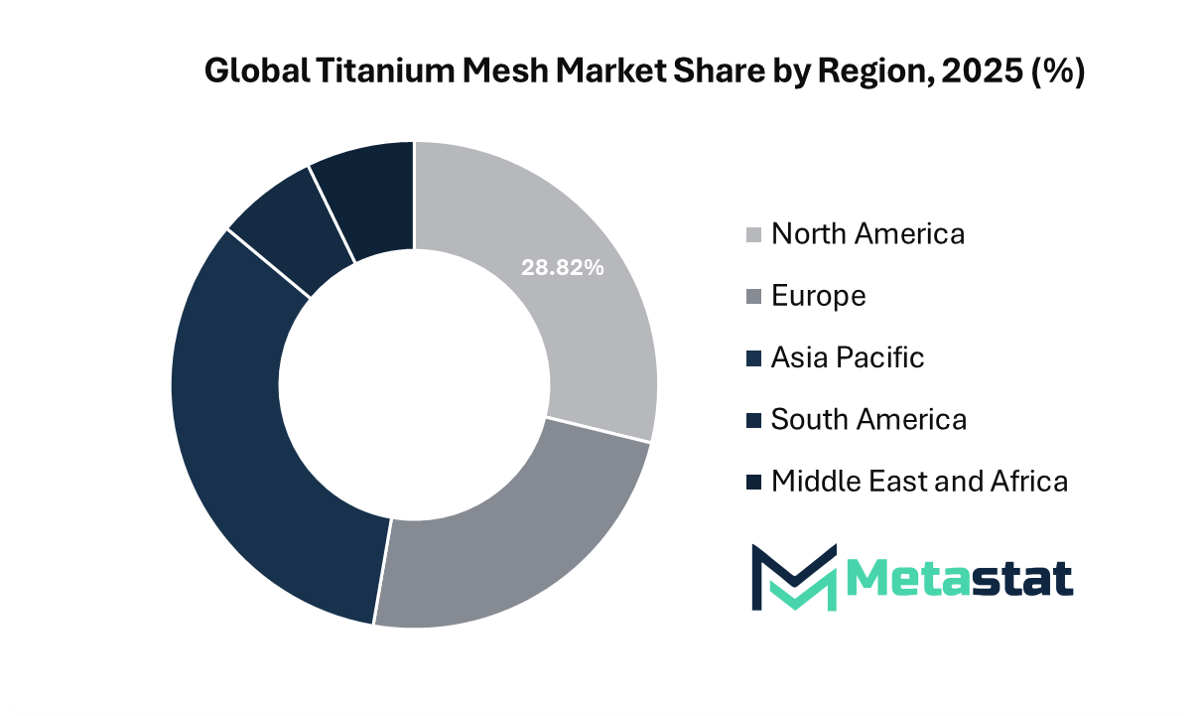
The Global Titanium Mesh market reflects a steady shift toward high-performance materials that offer strength, flexibility, corrosion resistance, and long-term reliability across medical and industrial applications. Titanium mesh continues to gain traction owing to its ability to balance durability with biocompatibility, making it suitable for procedures and systems that require structural support without significant weight addition. In healthcare, titanium mesh is widely used in cranial, maxillofacial, and dental reconstruction, where precision, stability, and patient safety remain essential. Across industrial settings, end users are adopting titanium mesh for filtration, separation, and structural functions supported by its resistance to heat and corrosive environments.
The competitive landscape includes a mix of established medical device companies, industrial material suppliers, and specialized mesh manufacturers working to strengthen market position through product innovation, fabrication quality, and application-focused development. Companies such as Zimmer Biomet Holdings, Inc., Medtronic, and Globus Medical, Inc. are positioned strongly in medical applications, while Stanford Advanced Materials, Edgetech Industries LLC, and Ambani Metals support industrial and material supply requirements. In addition, Geistlich Pharma AG, ReOss GmbH, and KLS Martin Group continue to expand their presence through specialized reconstructive and surgical product offerings.
Regional and niche participants are also contributing to market expansion through customized product supply and targeted end-use support. Acumed LLC, Double Medical Technology Inc., and ZMD Orthopedics Co., Ltd. are helping broaden access to medical-grade solutions, particularly across price-sensitive markets. At the same time, Rajkrupa Metal Industries, Siriram Filteration & Engineering Company, and Timex Metals remain focused on industrial applications. Companies such as THE ELECTRODE STORE (TES), Saveions Ltd., Ray Wire Mesh, and Qishan Metal Titanium Co., Ltd. (MTCO) are addressing specific technical requirements with tailored mesh products for specialized use cases.
Additional manufacturers including Hele Titanium, Jennings Anodes USA Inc., Boedon Industech Limited, Toho Titanium Co., Ltd., UTron Technology Co., Ltd., Jiangsu Shuangyang Medical Instrument Co., Ltd., and Shanghai Metal Corporation are supporting market development through manufacturing capability, product consistency, and supply reliability. Companies such as GDT Implants, Princeton Powder, Baoji Yinggao Metal Materials Co., Ltd., and Mott Corporation are also contributing through material innovation and specialized engineering expertise. The Global Titanium Mesh market will witness sustained growth driven by increasing demand across healthcare, aerospace, industrial filtration, water treatment, and electrochemical applications. Advancements in material science and manufacturing technologies will continue to improve product performance and expand the application scope of titanium mesh.
Market size is forecast to rise from USD 1,583.9 million in 2025 to over USD 2,823.2 million by 2033.
Global Titanium Mesh market is expected to maintain steady growth through the forecast period, supported by rising adoption across medical, aerospace, industrial filtration, electrochemical, and water treatment applications. Continued progress in fabrication technology, precision forming, and customization capability is expected to improve product performance and widen the commercial scope of titanium mesh across high-value end-use industries.
By Type:
By Application:
This research report categorizes the Titanium Mesh market based on key segments and regions, forecasts revenue growth, and analyses trends in each submarket. The report analyses the key growth drivers, opportunities, and challenges influencing the Titanium Mesh market. Recent market developments and competitive strategies such as expansion, product launch, partnership, merger, and acquisition have been included to draw the competitive landscape in the market.
The report strategically identifies and profiles the key market players and analyses their core competencies in each sub-segment of the Titanium Mesh market.
|
Report Attributes |
Details |
|
Study Period |
2021-2033 |
|
Base Year |
2025 |
|
Estimated Year |
2026 |
|
Forecast Period |
2026-2033 |
|
Historical Period |
2021-2025 |
|
Growth Rate |
CAGR 7.5% from 2026 to 2033 |
|
Revenue Unit |
USD million |
|
Segmentation |
By Type, Application, and Region |
|
By Region |
North America (By Type, Application, and Country)
|
|
Europe (By Type, Application, and Country)
|
|
|
Asia Pacific (By Type, Application, and Country)
|
|
|
South America (By Type, Application, and Country)
|
|
|
Middle East and Africa (By Type, Application, and Country)
|
Find answers to common questions about this report
Asia Pacific region dominates the market.
The Global Titanium Mesh market is expected to grow at a CAGR of 7.5% over the forecast period (2026-2033).
Rising use in electrochemical processing, water treatment, and hydrogen systems. and Growing adoption in cranial, maxillofacial, and dental reconstruction procedures are key driving factors, boosting the market.
Global Titanium Mesh market is estimated to reach USD 2,823.2 million by 2033.
High titanium production cost and energy-intensive processing. will hamper the market growth within the forecast period.
The Metastat Insights analysis shows that the North America Titanium Mesh market size is estimated to be USD 725.3 million by 2033.
Top players operating in the Titanium Mesh industry include Zimmer Biomet Holdings, Inc., Medtronic, Stanford Advanced Materials, Edgetech Industries LLC, Ambani Metals, Geistlich Pharma AG, and ReOss GmbH.
The Expanded Mesh is the leading type segment in the Global market.
The Metastat Insights study shows that the Global Titanium Mesh market size was USD 1,583.9 million in 2025.
The analysts below cover Chemicals and Materials research at Metastat Insights.
LEAD ANALYST
Utkarsh Khirodkar is a Lead Market Research Analyst at MetaStat Insight, specializing in market intelligence, technology sector assessments, and competitive strategy.

INDUSTRY CONSULTANT - CHEMICALS & ADVANCED MATERIALS
Chemicals and Materials · Machinery & Equipment · Packaging
Amit Gadhekar Consultant for Chemicals and Materials at MetaStat Insight, directing sector-specific intelligence, research, and strategic consulting across global chemical and processing markets.
Evaluating sensor fusion reliability across harsh operating environments can be tricky without field-validated data. The study on agricultural autonomous guidance systems clearly separated stereo vision setups from automotive-grade solid-state LiDAR. We appreciated the regional infrastructure analysis, specifically around RTK network density across North America and South America. During our follow-up consultation, the MetaStat Insight team walked through tier-two perception software partnerships, giving our engineering leads a practical basis for vendor shortlisting.
Analyzing the transition from natural gas to green hydrogen in iron ore reduction requires realistic infrastructure timelines. Meta stat insight supplied a detailed regional assessment of DRI plant conversion costs and scrap metal availability in North America and Western Europe. Their report carefully examined pellet quality specs and electrical grid access constraints without making oversimplified market assumptions. The research material served as a practical reference during internal technology roadmap discussions.
Integrating zero-trust access controls across legacy electronic health record systems involves complex compliance overhead. Team produced an analysis that clearly separated identity governance and administration tools from privileged access management platforms. Their evaluation of HIPAA and GDPR compliance features across cloud native solutions gave our architecture group clear baseline criteria. The custom data request regarding biometric authentication adoption in hospital networks was returned promptly with clear documentation.
Explore related market intelligence reports worth reading alongside this one.
Starting from
$2950