
LEAD ANALYST
Utkarsh Khirodkar is a Lead Market Research Analyst at MetaStat Insight, specializing in market intelligence, technology sector assessments, and competitive strategy.

Industrial Fasteners Market By Material (Metal Fasteners, Plastic Fasteners), By Product (Externally Threaded Fasteners, Internally Threaded Fasteners, Non-threaded Fasteners, Aerospace Grade Fasteners), By Application (Automotive, Aerospace, Building & Construction, Industrial Machinery, Home Appliances, Lawns and Gardens, Motors and Pumps, Furniture, Others), By Distribution Channel (Direct Sales, Distributors), Industry Analysis, Size, Share, Growth, Trends, and Forecasts 2025–2032
Report ID
MSI-4372
Published
November, 2025
Pages
255 Pages
Format
Report Details
Choose Your License
Industrial Fasteners Market
The global industrial fasteners market has come a long way from the simple hand-made metal bolts and screws and has now grown into a sophisticated industry that caters to nearly all the manufacturing sectors around the world. Its origin can be traced back to the era of the Industrial Revolution when the use of dependable joining parts was a must for machines and buildings. The art of making fasteners started in small workshops and with the passage of time, it led to the large-scale production of fasteners as the industrialization trend moved from Europe to North America. The first half of the twentieth century saw the market getting standardization with regard to the establishment of uniform threading and material specifications being some of the market's first defining milestones.
During the middle of the 1900s, when the automotive and aerospace industries made a big leap, the need for precision-engineered fasteners increased enormously. Manufacturers moved from using the conventional iron and steel materials to using lightweight alloys, then to stainless steel, and finally to composite materials that are very expensive but also very efficient. With the setting up of automated assembly lines, the manual production techniques lost their edge in terms of skill and volume acceptance. A new generation of specialized fasteners for applications with such features as high temperature, vibration resistance, and corrosion control was launched around the same time.
In the following decades, the market began to reflect the shifts in the global economy. The manufacturing power of the Asia Pacific region has been rising and this has resulted in the transformation of supply chains that allow for mass production at lower prices but also require quality assurance efforts. The regulatory framework regarding the safety of materials and their impact on the environment has been getting stricter, leading to the emergence of green coatings and recyclable materials. In the meantime, the consumer sectors such as electronics and renewable energy were already asking for very small and powerful fasteners that could handle compact designs and complex assembly.
At present, the global industrial fasteners market is positioned exactly where old engineering meets the digital transformation of the future. Amongst the smart manufacturing practices will be the use of robotics, additive manufacturing, and real-time quality control that will totally change the way fasteners are produced and delivered. The fasteners industry has come a long way from simple mechanical connectors to precision-engineered parts and this has been a journey of adaptation and innovation that will continue to drive industrial progress for many more years. Furthermore, every new development has not only intensified the efficiency but has also opened up new areas of application for the industries that consume these essential products.
The global industrial fasteners market is mainly classified based on Material, Product, Application, Distribution Channel.
|
Forecast Period |
2025-2032 |
|
Market Size in 2025 |
$90.7 Billion |
|
Market Size by 2032 |
$117 Billion |
|
Growth Rate from 2025 to 2032 |
3.7% |
|
Base Year |
2024 |
|
Regions Covered |
North America, Europe, Asia-Pacific, South America, Middle East & Africa |
The global industrial fasteners market continues to play a crucial role in supporting multiple manufacturing and construction sectors. Fasteners serve as the foundation of product assembly and infrastructure development, ensuring safety, reliability, and durability across various applications. The demand for these essential components remains steady, driven by the growth of industries such as automotive, aerospace, construction, and machinery production. As technology advances, manufacturers are focusing on improving material strength, corrosion resistance, and precision engineering to meet the performance requirements of modern designs.
The market has witnessed continuous improvements in both production processes and product quality. Innovation in design and the use of advanced materials have led to better performance and longer lifespan of fasteners. Increased awareness of quality standards and stricter regulations have encouraged manufacturers to adopt sustainable methods and efficient supply chains. In addition, automation and digital tools are becoming more common in manufacturing plants, enhancing productivity and consistency in product output.
The industry is a mix of both international industry leaders and emerging regional competitors. Important competitors include Arconic Fastening Systems and Rings, Acument Global Technologies, In, ATF, Inc., Dokka Fasteners A S, LISI Group - Link Solutions for Industry, Nippon Industrial Fasteners Company (Nifco), Hilti Corporation, MW Industries, Inc., Birmingham Fasteners and Supply, Inc., SESCO Industries, Inc., Precision Castparts Corp., Rockford Fasteners, Inc., Slidematic, Manufacturing Associates, Inc., Eastwood Manufacturing, Brunner Manufacturing CO., Inc., Decker Industries Corporation, Penn Engineering & Manufacturing Corporation, EJOT, Illinois Tool Works, Inc., Stanley Black & Decker, Inc., and KOVA Fasteners Pvt. Ltd. in market. These competitors represent a wide range of expertise, offering products designed for specific applications and sectors. Their continuous focus on research, innovation, and global expansion helps maintain a competitive environment that encourages steady growth.
Growing infrastructure projects in developing countries and the expanding electric vehicle sector have also contributed to market growth. The focus on lightweight materials and energy-efficient solutions is pushing manufacturers to develop fasteners that support sustainability goals. Regional players are gaining importance as they cater to local demand with flexible production and cost-effective distribution. On the other hand, established global brands maintain strong relationships with major clients and rely on advanced research facilities to stay ahead in product development.
Price fluctuations in raw materials such as steel, aluminum, and titanium remain a major challenge. To manage costs and maintain profitability, many manufacturers are focusing on long-term contracts and strategic sourcing. Additionally, the shift toward environmentally friendly production methods is creating new opportunities for companies that invest in sustainable technologies and recycling processes. The global supply chain disruptions seen in recent years have further emphasized the need for diversification and reliable logistics networks to ensure timely delivery and stable operations.
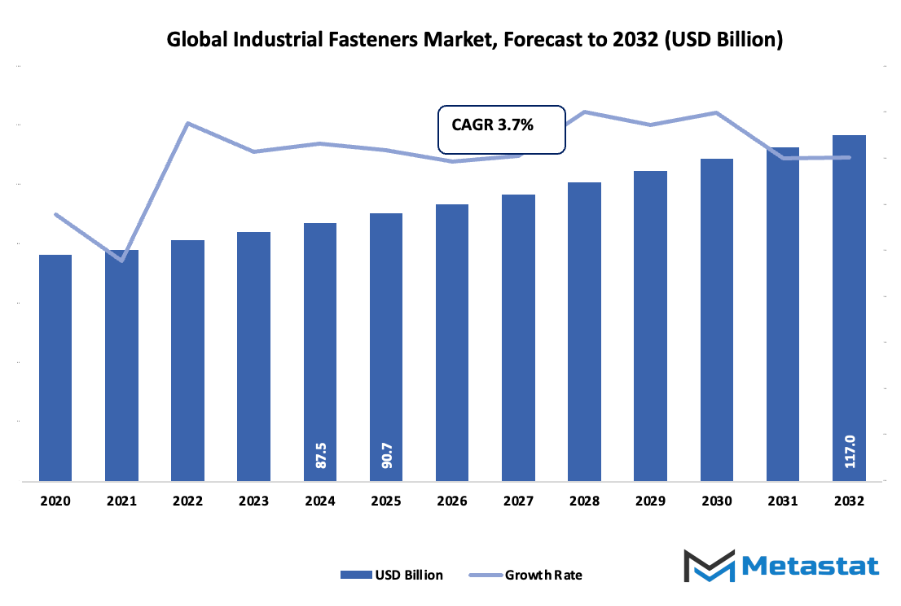
Market size is forecast to rise from USD 90.7 billion in 2025 to over USD 117 billion by 2032. Industrial Fasteners will maintain dominance but face growing competition from emerging formats.
Overall, the market continues to grow steadily, supported by innovation, modernization, and expanding industrial activities. The focus on quality, efficiency, and sustainability will define the market’s future direction, ensuring that manufacturers remain competitive and capable of meeting the increasing demands of modern industries.
This research report categorizes the global industrial fasteners market based on various segments and regions, forecasts revenue growth, and analyzes trends in each submarket. The report analyses the key growth drivers, opportunities, and challenges influencing the global industrial fasteners market. Recent market developments and competitive strategies such as expansion, type launch, development, partnership, merger, and acquisition have been included to draw the competitive landscape in the market. The report strategically identifies and profiles the key market players and analyses their core competencies in each sub-segment of the global industrial fasteners market.
Find answers to common questions about this report
Global Industrial Fasteners market is valued at $90.7 billion in 2025.
Global Industrial Fasteners market is estimated to grow with a CAGR of 3.7% from 2025 to 2032.
Global Industrial Fasteners market is estimated to reach $117 billion by 2032.
Top players operating in the Industrial Fasteners industry includes Arconic Fastening Systems and Rings, Acument Global Technologies, In, ATF, Inc., D
The analysts below cover Chemicals and Materials research at Metastat Insights.
LEAD ANALYST
Utkarsh Khirodkar is a Lead Market Research Analyst at MetaStat Insight, specializing in market intelligence, technology sector assessments, and competitive strategy.

INDUSTRY CONSULTANT - CHEMICALS & ADVANCED MATERIALS
Chemicals and Materials · Machinery & Equipment · Packaging
Amit Gadhekar Consultant for Chemicals and Materials at MetaStat Insight, directing sector-specific intelligence, research, and strategic consulting across global chemical and processing markets.
Evaluating secondary resin quality across post-consumer packaging streams requires reliable technical segmentation. MetaStat Insight delivered an objective assessment that distinguished between extrusion-grade flake pricing and optical sorting throughput limitations across Western Europe. The competitive positioning breakdown for licensed depolymerization technology providers answered several questions during our feedstock feasibility audit. Their team clarified regional trade restrictions on mixed plastic scrap quickly when our team submitted follow-up requests.
Evaluating sovereign cloud deployments for core banking platforms demands a clear view of data residency regulations and migration exit strategies. MetaStat Insight delivered an exhaustive review of regional latency tolerances, mainframe decommission milestones, and third-party vendor concentration risk. The regulatory compliance mapping across European and Asian financial jurisdictions gave our team a dependable baseline for multi-cloud infrastructure discussions.
Replacing petrochemical surfactants with bio-based alternatives requires realistic timelines on industrial precision fermentation scaling. The market research broke down commercialization timelines, feedstock sugar price sensitivities, and regional cosmetic ingredient regulatory approvals in Europe and East Asia. That supplier readiness mapping gave our formulations team reliable context when comparing renewable chemical sourcing roadmaps.
Explore related market intelligence reports worth reading alongside this one.
Starting from
$2950