
LEAD ANALYST
Utkarsh Khirodkar is a Lead Market Research Analyst at MetaStat Insight, specializing in market intelligence, technology sector assessments, and competitive strategy.

Industrial Temperature Sensors Market Size, Share, By Type (Contact Sensors and Non-Contact Sensors), By Sensor Type (Level Sensors, Temperature Sensors, Flow Sensors, Gas Sensors, Position Sensors, Pressure Sensors, Force Sensors, Humidity Sensors, Moisture Sensors, Image Sensors, and Others), By Technology (Packaging Technologies (SiP, SoC), Microelectromechanical Systems (MEMS) Technology, CMOS Technology, Optical Sensing Technology, Thermocouples, Resistance Temperature Detectors (RTDs), and Others), By End Users (Manufacturing, Oil, Gas, Chemicals, Pharmaceuticals, Energy, Power, Mining, and Others), Industry Analysis, Growth, Trends, and Forecast, 2026-2033
Report ID
MSI-4728
Published
May, 2026
Pages
314 Pages
Format
Report Details
Choose Your License
Industrial Temperature Sensors Market
Global Industrial Temperature Sensors market size is valued at USD 30.7 billion in 2025 and projected to grow at a CAGR of 8.6% during the forecast period, reaching USD 59.0 billion by 2033.
North America holds 27.2% in 2025 with US leading the market share in 2025.
Contact Sensors segment account for a market share of 66.4% in 2025.
Key trends driving growth: Rapid industrial automation and Industry 4.0 adoption are increasing demand for real-time temperature monitoring solutions, along with stringent safety and quality regulations in process industries are accelerating deployment of high-accuracy sensing systems.
Opportunities include integration of wireless, IoT-enabled smart temperature sensors enables predictive maintenance and advanced process analytics across industrial facilities.
Key insight: Rising automation and precision control needs accelerate demand across the Global Industrial Temperature Sensors Market.
Global Industrial Temperature Sensors Market within the industrial instrumentation industry is evolving beyond conventional measurement functions and becoming deeply embedded in intelligent manufacturing ecosystems. Temperature sensing is no longer limited to isolated data points on control panels instead it is increasingly integrated into adaptive systems that support manual and automated decision-making across production facilities, process plants, and energy infrastructure. Over the forecast period, sensing systems will increasingly connect with digital twins, enabling engineers to simulate thermal behavior before physical adjustments are implemented on equipment.
Industrial operations are increasingly demanding sensors that can perform reliably in harsh environments, ranging from hydrogen processing systems to advanced semiconductor fabrication facilities. These applications require advanced materials, corrosion-resistant designs, and miniaturized components capable of withstanding rapid thermal cycling. Data transmission is shifting toward secure edge architectures, where thermal readings are processed locally and transmitted when anomalies are detected.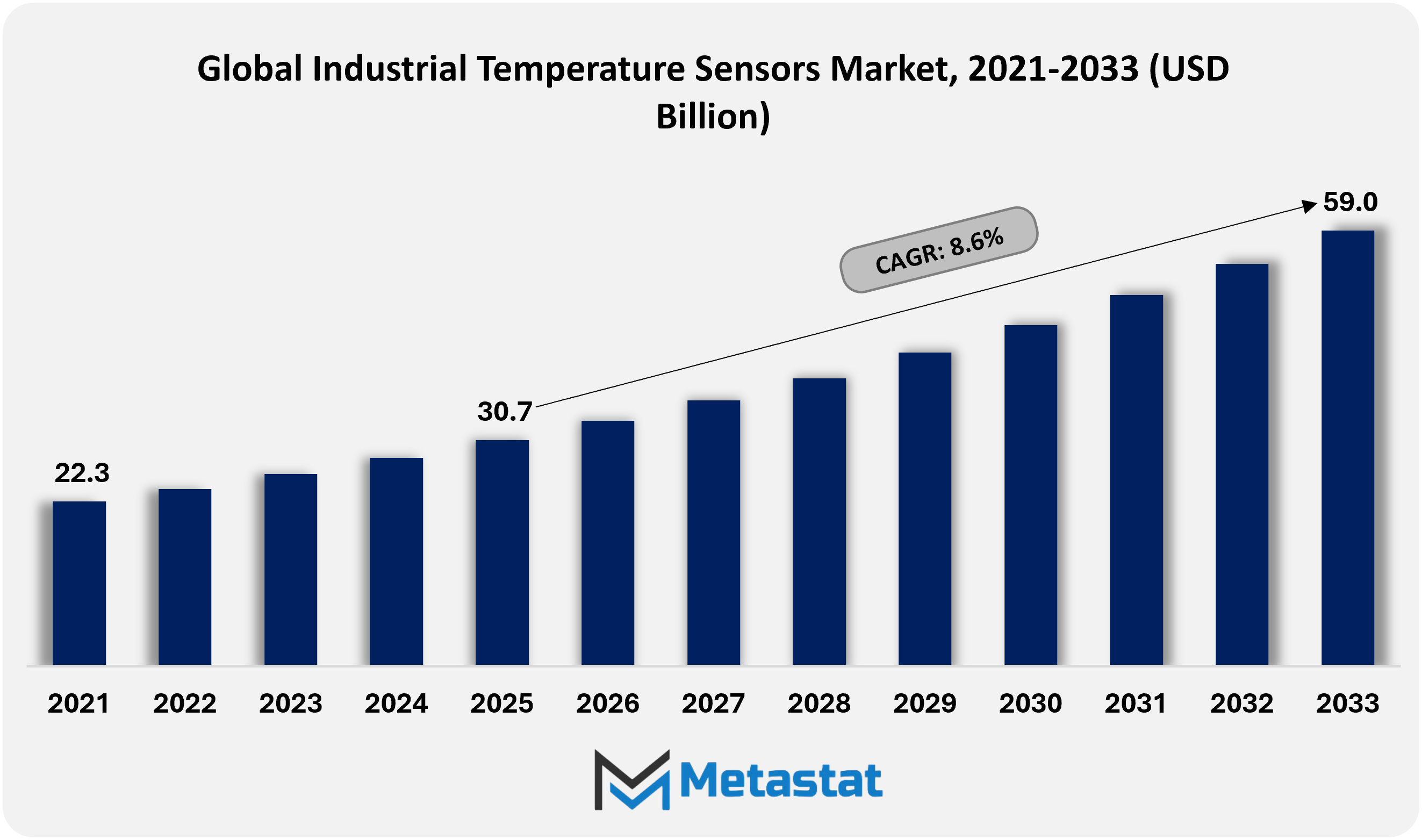
Rapid industrial automation and Industry 4.0 adoption are increasing demand for real-time temperature monitoring solutions.
Expansion of smart factories across manufacturing, power generation, and process industries is reinforcing the Global Industrial Temperature Sensors Market. Advanced robotics, connected machinery, and data-driven production systems rely on continuous temperature monitoring to maintain operational stability. Integration with digital control systems supports predictive decision-making, reduces downtime, and improves production accuracy across automated industrial environments.
Stringent safety and quality regulations in process industries are accelerating deployment of high-accuracy sensing systems.
Tight regulatory frameworks across oil and gas, chemicals, food processing, and pharmaceuticals are increasing precision monitoring requirements within the Global Industrial Temperature Sensors Market. Compliance standards are encouraging deployment of high-accuracy devices capable of consistent measurement under demanding operating conditions. Reliable thermal monitoring supports product integrity, worker safety, and audit readiness across complex industrial operations.
High calibration and maintenance costs in harsh industrial environments limit cost-sensitive adoption.
Industrial equipment exposed to corrosive substances, moisture, dust, and mechanical stress requires frequent calibration and maintenance, increasing lifecycle costs across the Global Industrial Temperature Sensors Market. Cost sensitivity remains a challenge across small and mid-sized industrial facilities, where capital allocation remains closely monitored. Durable sensor designs, lower maintenance requirements, and cost-efficient deployment models will remain important for wider adoption across price-sensitive operations.
Signal drift and performance degradation under extreme temperature and vibration conditions affect long-term reliability.
Prolonged exposure to extreme heat, vibration, and pressure fluctuations reduces measurement stability across industrial environments. Long-term reliability concerns are influencing procurement decisions and product development priorities. Market participants are focusing on stronger materials engineering, thermal durability, and improved signal stability to maintain performance across extended operating cycles.
Integration of wireless, IoT-enabled smart temperature sensors enables predictive maintenance and advanced process analytics across industrial facilities.
Adoption of connected sensing networks is strengthening operational visibility across industrial environments and creating strong opportunities in the Global Industrial Temperature Sensors Market. Wireless communication, cloud connectivity, and analytics platforms are supporting predictive maintenance programs and helping reduce unplanned shutdowns. Data-driven monitoring is also improving energy efficiency, process optimization, and equipment life, positioning smart temperature sensing systems at the center of industrial digital transformation.
The Global Industrial Temperature Sensors market is classified based on Type, Sensor Type, Technology, and End Users.
Contact Sensors segment is valued at USD 22.1 billion in 2026 and is projected to reach USD 36.7 billion by 2033, at a CAGR of 7.5% during the forecast period.
Contact Sensors will maintain a strong position in the Industrial Temperature Sensors Market owing to its suitability for direct and precise temperature measurement across heavy industrial applications. These sensors remain widely preferred across machinery, reactors, pipelines, and process equipment where stable contact-based monitoring is required. Continued adoption across manufacturing and process industries will support reliable thermal control, improved process stability, and better compliance with operational safety standards.
Non-Contact Sensors segment is valued at USD 11.2 billion in 2026 and is projected to reach USD 22.3 billion by 2033, at a CAGR of 10.4% during the forecast period.
Non-Contact Sensors will expand at a healthy pace in the Industrial Temperature Sensors Market with rising adoption of automation, remote diagnostics, and high-speed inspection systems. Infrared-based sensing solutions support real-time temperature measurement without direct surface contact, making them suitable for moving equipment, hazardous zones, and heat-sensitive applications. Wider deployment across automated industrial facilities will improve maintenance efficiency, operator safety, and process responsiveness.
Level Sensors segment is projected to reach USD 0.9 billion by 2033, at a CAGR of -5% during the forecast period.
Level Sensors integrated with thermal monitoring systems are supporting process visibility across storage tanks, fluid handling systems, and industrial process equipment. When used in temperature-linked applications, these solutions help improve storage safety, process efficiency, and operational planning across chemical, energy, and treatment facilities. Integration of multi-parameter sensing will improve monitoring accuracy across industrial environments.
Temperature Sensors segment is projected to reach USD 18.0 billion by 2033, at a CAGR of 9.6% during the forecast period.
Temperature Sensors will remain the core category within the Industrial Temperature Sensors Market, supported by their critical role across process control, machinery monitoring, and product quality assurance. Advancements in calibration systems, digital output capability, and diagnostic intelligence are improving measurement precision across industrial environments. Strong adoption across manufacturing, chemicals, energy, and pharmaceutical operations will continue to support segment expansion over the forecast period.
Flow Sensors segment is projected to reach USD 5.6 billion by 2033, at a CAGR of 7.6% during the forecast period.
Flow Sensors linked with temperature monitoring systems are improving process efficiency across cooling systems, fluid transfer lines, and heat-sensitive industrial operations. Combined sensing capability supports better control over fluid movement and thermal balance, helping industrial facilities maintain consistent operating conditions. Growth in industrial automation will strengthen adoption of such integrated monitoring systems across production environments.
Gas Sensors segment is projected to reach USD 6.2 billion by 2033, at a CAGR of 9.7% during the forecast period.
Gas Sensors used alongside temperature sensing systems support safe operations across hazardous industrial environments such as petrochemicals, mining, and heavy processing. Integrated detection systems improve visibility across gas concentration and heat conditions, helping operators strengthen workplace safety, emission control, and process reliability. Wider use of multi-sensor monitoring platforms will support industrial risk management strategies.
Position Sensors segment is projected to reach USD 4.4 billion by 2033, at a CAGR of 7.3% during the forecast period.
Position Sensors integrated with temperature monitoring frameworks help improve alignment accuracy and thermal-sensitive equipment performance across industrial automation systems. Sensor fusion across motion and temperature parameters supports smoother machinery operation, lower mechanical stress, and longer equipment life. Industrial manufacturers are increasingly adopting such integrated systems to strengthen operational precision and asset protection.
Pressure Sensors segment is projected to reach USD 9.2 billion by 2033, at a CAGR of 9.3% during the forecast period.
Pressure Sensors operating alongside temperature monitoring systems provide broader visibility across process conditions in industrial environments. Combined pressure and thermal analytics support stable equipment operation, improved process control, and lower risk of unplanned failure across high-pressure applications. Integration of multi-variable sensing platforms will rise across process industries seeking better operational reliability.
Force Sensors segment is projected to reach USD 3.4 billion by 2033, at a CAGR of 9.4% during the forecast period.
Force Sensors combined with temperature data are supporting structural monitoring and process control across advanced manufacturing facilities. These systems help identify stress variation influenced by heat exposure, mechanical loading, and operating intensity. Adoption of such integrated sensing platforms will rise with increased focus on predictive maintenance and equipment durability.
Humidity and Moisture Sensors segment is projected to reach USD 5.3 billion by 2033, at a CAGR of 10.7% during the forecast period.
Humidity and Moisture Sensors linked with thermal monitoring systems are improving environmental control across sensitive industrial operations. Such integration supports stable storage, material protection, and process consistency across sectors such as pharmaceuticals, electronics, and food processing. Rising demand for tightly controlled industrial environments will continue to support adoption of these sensing combinations.
Image Sensors segment is projected to reach USD 3.1 billion by 2033, at a CAGR of 11.1% during the forecast period.
Image Sensors supporting thermal visualization are expanding diagnostic capability across industrial inspection and maintenance environments. Thermal imaging systems enable real-time monitoring of production lines, electrical infrastructure, and critical mechanical assets, helping operators detect faults early and reduce unexpected downtime. Increased emphasis on preventive maintenance and real-time inspection is supporting adoption across industrial facilities.
Others segment is projected to reach USD 2.9 billion by 2033, at a CAGR of 3.2% during the forecast period.
Other specialized sensing solutions will continue to support niche requirements across the Industrial Temperature Sensors Market. Custom-developed sensing platforms are increasingly being deployed across aerospace, advanced robotics, precision engineering, and highly controlled industrial applications. Innovation in integrated thermal monitoring will widen the role of specialized sensors across complex operating environments.
Packaging Technologies (SiP, SoC) segment is projected to reach USD 4.2 billion by 2033.
Packaging Technologies such as System in Package and System on Chip are supporting sensor miniaturization and integration across the Industrial Temperature Sensors Market. Compact module design is improving space efficiency, signal performance, and connectivity across industrial IoT environments. Adoption of highly integrated sensor packaging will rise across next-generation automation and edge-monitoring applications.
Microelectromechanical Systems (MEMS) Technology segment is projected to reach USD 12.9 billion by 2033.
MEMS Technology is strengthening sensor precision, response speed, and scalability across the Industrial Temperature Sensors Market. Lightweight and low-power sensor architectures are supporting broader deployment across automated facilities where compact design and measurement consistency remain important. Increased use of MEMS-based platforms will support cost-efficient expansion across industrial sensing applications.
CMOS Technology segment is projected to reach USD 8.2 billion by 2033.
CMOS Technology is supporting digital integration and signal processing efficiency across the Industrial Temperature Sensors Market. Improved semiconductor fabrication is enabling compact sensor systems with better power efficiency, stable output, and compatibility with connected industrial platforms. Such capabilities are supporting wider use of digital thermal monitoring across smart manufacturing facilities.
Optical Sensing Technology segment is projected to reach USD 5.5 billion by 2033.
Optical Sensing Technology is gaining relevance across the Industrial Temperature Sensors Market for non-invasive thermal measurement in demanding industrial settings. Fiber-optic and light-based sensing systems offer strong resistance to electromagnetic interference and perform well across high-temperature and high-voltage environments. Growth in advanced industrial monitoring will support broader adoption of optical sensing solutions.
Thermocouples segment is projected to reach USD 12.1 billion by 2033.
Thermocouples will continue to hold a strong position in the Industrial Temperature Sensors Market owing to their durability, wide operating temperature range, and cost efficiency. These sensors remain widely used across heavy industrial sectors where rugged performance and dependable temperature measurement are required.
Resistance Temperature Detectors (RTDs) segment is projected to reach USD 10.8 billion by 2033.
Resistance Temperature Detectors are gaining strong traction in the Industrial Temperature Sensors Market owing to their high accuracy, stability, and repeatability across precision-driven industrial applications. These sensors are widely used across pharmaceuticals, chemicals, food processing, and advanced manufacturing where measurement consistency remains critical. Growth in quality-sensitive operations will continue to support broader RTD adoption.
Others segment is projected to reach USD 5.3 billion by 2033.
Other emerging technologies are contributing to innovation across the Industrial Temperature Sensors Market through integration of smart diagnostics, wireless connectivity, and advanced analytics capability. These developments are improving predictive maintenance performance and expanding the role of temperature sensing within digitally connected industrial systems.
Manufacturing segment is projected to grow at a CAGR of 9.7% during the forecast period.
Manufacturing remains a major end-use industry in the Industrial Temperature Sensors Market, supported by rising adoption of automation, connected production systems, and real-time quality monitoring. Industrial facilities are increasingly deploying advanced sensing networks to improve process consistency, reduce waste, and strengthen equipment performance under varying thermal conditions.
Oil & Gas segment is projected to grow at a CAGR of 7.1% during the forecast period.
Oil and Gas remains a critical end-use industry in the Industrial Temperature Sensors Market owing to the need for reliable thermal monitoring across upstream, midstream, and downstream operations. Temperature sensing supports refinery safety, pipeline monitoring, asset performance, and process stability across demanding operating conditions.
Chemicals segment is projected to grow at a CAGR of 9.8% during the forecast period.
Chemical processing industries are strengthening demand in the Industrial Temperature Sensors market through rising need for reaction control, process safety, and regulatory compliance. High-precision thermal monitoring plays a key role in maintaining stable production conditions and safe handling of volatile materials across complex processing environments.
Pharmaceuticals segment is projected to grow at a CAGR of 10.4% during the forecast period.
Pharmaceuticals sector will record strong growth in the Industrial Temperature Sensors Market with increased focus on controlled environments, validated process conditions, and product integrity. Accurate temperature monitoring remains essential across laboratories, production lines, storage systems, and transport environments where regulatory discipline remains high.
Energy & Power segment is projected to grow at a CAGR of 7.8% during the forecast period.
Energy and Power sector is expanding adoption in the Industrial Temperature Sensors Market to improve turbine performance, asset reliability, grid stability, and energy efficiency across conventional and renewable power systems. Stronger monitoring capability is helping operators manage thermal variation under changing load conditions and improve overall system performance.
Mining segment is projected to grow at a CAGR of 6.1% during the forecast period.
Mining sector is adopting rugged thermal monitoring systems across the Industrial Temperature Sensors Market to support heavy equipment reliability, underground safety, and operational continuity. Temperature sensing helps reduce equipment stress, detect abnormal conditions early, and improve maintenance planning across demanding mining environments.
Others segment is projected to grow at a CAGR of 6.5% during the forecast period.
Other industrial sectors are contributing to stable growth in the Industrial Temperature Sensors Market through specialized use across transportation infrastructure, engineering systems, utilities, and industrial services. Integration of thermal monitoring across such applications is supporting better operational safety, efficiency, and equipment management.
Based on geography, the Global Industrial Temperature Sensors market is divided into North America, Europe, Asia-Pacific, South America, Middle East, and Africa.
North America Industrial Temperature Sensors Market is set to expand at a CAGR of 8.6% within the forecast period, reaching a market size (TAM) of USD 14.2 billion by the end of 2033.
North America drives the Industrial Temperature Sensors Market via strong adoption of automation throughout production, oil & gasoline, and electricity generation sectors.
North America supports the market growth with strict industrial safety standards and excessive investment in superior method monitoring systems.
Europe holds a strong position in the Industrial Temperature Sensors Market, supported by advanced manufacturing capability, strong process industry presence, and strict quality and environmental compliance standards.
Asia Pacific presents important possibilities within the Industrial Temperature Sensors Market owing to the speedy industrialization and expansion of electronics and car production hubs.
Across the Middle East, Africa, and South America, the Industrial Temperature Sensors Market profits constant traction supported by power tasks, mining activities, and slow modernization of business centers.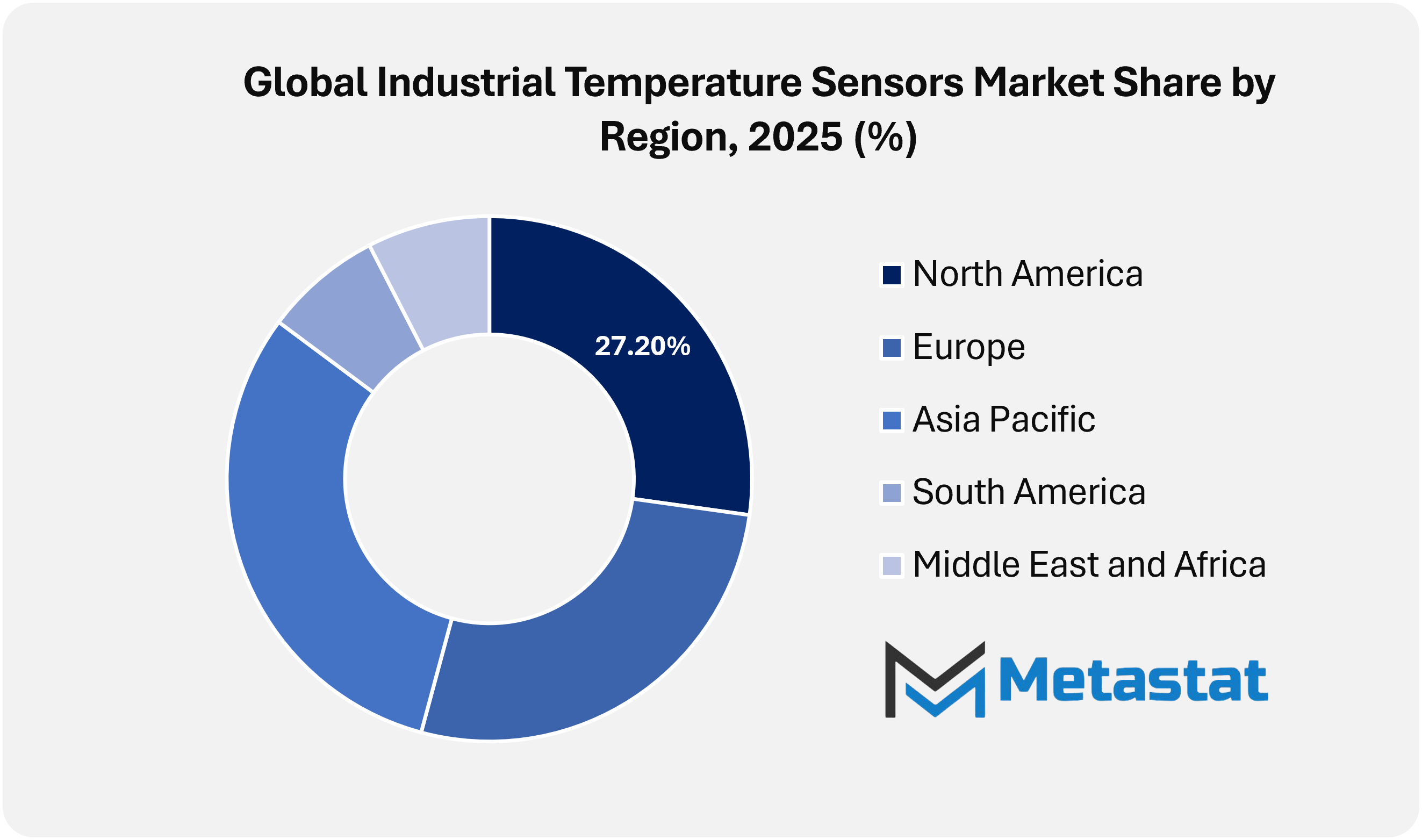
Global Industrial Temperature Sensors Market will expand steadily with rising demand for accurate thermal monitoring across manufacturing, energy and power, oil and gas, chemicals, food processing, and pharmaceuticals. Temperature control remains critical for maintaining product quality, protecting industrial equipment, improving workplace safety, and supporting regulatory compliance. Increased emphasis on automation, process optimization, and smart industrial operations is strengthening long-term demand for reliable sensing systems across industrial environments.
Technological advancement is further supporting market expansion through development of sensors with higher accuracy, faster response times, and stronger durability under demanding operating conditions. Wireless monitoring capabilities, digital interfaces, and connected analytics platforms are improving real-time visibility across industrial facilities. Rising adoption of predictive maintenance is also supporting market growth, as temperature sensing helps detect equipment abnormalities early, reduce downtime, and improve asset utilization across complex production systems.
The competitive landscape includes several global companies with broad product portfolios, established distribution networks, and strong industrial customer relationships. Major participants such as Emerson Electric Co., Siemens Aktiengesellschaft, Honeywell International Inc., ABB Ltd, and Yokogawa Electric Corporation continue to strengthen their market position through research and development, automation integration, and expansion of advanced sensing solutions. Other important players including Endress+Hauser Group Services AG, Rockwell Automation, Inc., WIKA Alexander Wiegand SE & Co. KG, TE Connectivity Ltd., and Amphenol Corporation are also focused on expanding product offerings and strengthening partnerships across industrial end-use sectors.
The market also features specialized sensor manufacturers that compete through product innovation, application-specific expertise, and niche industrial capabilities. Companies such as Sensata Technologies Holding plc, Watlow Electric Manufacturing Company, OMEGA Engineering, Inc., JUMO GmbH & Co. KG, Baumer Holding AG, ifm electronic gmbh, Balluff GmbH, Hans Turck GmbH & Co. KG, KROHNE Messtechnik GmbH, and Danfoss A/S continue to strengthen competition across the industry. Additional players including Belimo Holding AG, Vaisala Oyj, E+E Elektronik Ges.m.b.H., Testo SE & Co. KGaA, Fluke Corporation, Micro-Epsilon Messtechnik GmbH & Co. KG, Optris GmbH, Chino Corporation, Land Instruments International Ltd., Minco Products, Inc., YAGEO Nexensos GmbH, Innovative Sensor Technology IST AG, Trafag AG, Anderson-Negele GmbH, Dwyer Instruments, LLC, and Ashcroft Inc. are contributing to market development through innovation and specialized thermal sensing solutions. Growing industrial investment across Asia Pacific, North America, and Europe will support steady market expansion, while companies that prioritize accuracy, durability, and digital integration will strengthen their long-term competitive position.
Market size is forecast to rise from USD 30.7 billion in 2025 to over USD 59.0 billion by 2033.
Customization is expected to expand with development of modular sensing assemblies designed for robotics, additive manufacturing, and smart grid applications. Calibration services are also likely to evolve toward digital and subscription-led service models supported by cloud-based diagnostics and remote monitoring platforms. In this environment, the Global Industrial Temperature Sensors Market is moving beyond standalone hardware and toward integrated thermal intelligence solutions where temperature data supports strategic industrial decision-making.
This research report categorizes the Industrial Temperature Sensors market based on key segments and regions, forecasts revenue growth, and analyses trends in each submarket. The report analyses the key growth drivers, opportunities, and challenges influencing the Industrial Temperature Sensors market. Recent market developments and competitive strategies such as expansion, product launch, partnership, merger, and acquisition have been included to draw the competitive landscape in the market.
The report strategically identifies and profiles the key market players and analyses their core competencies in each sub-segment of the Industrial Temperature Sensors market.
|
Report Attributes |
Details |
|
Study Period |
2021-2033 |
|
Base Year |
2025 |
|
Estimated Year |
2026 |
|
Forecast Period |
2026-2033 |
|
Historical Period |
2021-2025 |
|
Growth Rate |
CAGR 8.6% from 2026 to 2033 |
|
Revenue Unit |
USD billion |
|
Sales Volume Unit |
Thousand Units |
|
Segmentation |
By Type, Sensor Type, Technology, End Users, and Region |
|
By Region |
North America (By Type, Sensor Type, Technology, End Users, and Country)
|
|
|
Europe (By Type, Sensor Type, Technology, End Users, and Country)
|
|
|
Asia Pacific (By Type, Sensor Type, Technology, End Users, and Country)
|
|
|
South America (By Type, Sensor Type, Technology, End Users, and Country)
|
|
|
Middle East and Africa (By Type, Sensor Type, Technology, End Users, and Country)
|
Find answers to common questions about this report
Top players operating in the Industrial Temperature Sensors industry include Emerson Electric Co., Siemens Aktiengesellschaft, Honeywell International Inc., ABB Ltd, Yokogawa Electric Corporation, Endress+Hauser Group Services AG, Rockwell Automation, Inc., and Others.
Rapid industrial automation and Industry 4.0 adoption are increasing demand for real-time temperature monitoring solutions along with stringent safety and quality regulations in process industries are accelerating deployment of high-accuracy sensing systems. are key driving factors, boosting the market.
Global Industrial Temperature Sensors market is estimated to reach USD 59.0 billion by 2033.
High calibration and maintenance costs in harsh industrial environments limit cost-sensitive adoption. will hamper the market growth within the forecast period.
North America dominates the Industrial Temperature Sensors Market in 2025.
Contact Sensors is the leading type segment in the Industrial Temperature Sensors Market.
Integration of wireless, IoT-enabled smart temperature sensors for predictive maintenance and advanced process analytics is expected to favor product adoption.
The Metastat Insights analysis shows that the North America Industrial Temperature Sensors market size is estimated to be USD 14.2 billion by 2033.
The Global Industrial Temperature Sensors market is expected to grow at a CAGR of 8.6% over the forecast period (2026-2033).
The Metastat Insights study shows that the Global Industrial Temperature Sensors market size was USD 30.7 billion in 2025.
The analysts below cover Electronics and Semiconductor research at Metastat Insights.
LEAD ANALYST
Utkarsh Khirodkar is a Lead Market Research Analyst at MetaStat Insight, specializing in market intelligence, technology sector assessments, and competitive strategy.

PRINCIPAL CONSULTANT - ENTERPRISE AI & EMERGING TECHNOLOGIES
Banking & Finance · Electronics and Semiconductor · Energy and Power · Healthcare IT · Information & Technology · Professional Services
Vijay Gunti is a Principal Consultant at MetaStat Insight, bringing over two decades of experience across enterprise digital transformation, technology strategy, and intelligent systems.

PRINCIPAL CONSULTANT - QUALITY SYSTEMS & COMPLIANCE
Electronics and Semiconductor · Machinery & Equipment · Professional Services
Omkar Phadtare is an Industry Consultant at MetaStat Insight, specializing in quality systems, regulatory compliance, and standards benchmarking to drive data-driven market intelligence and strategic industry research.

ENERGY & INFRASTRUCTURE INDUSTRY CONSULTANT
Automotive and Transportation · Electronics and Semiconductor · Energy and Power · Machinery & Equipment
Saurabh Vasant Ganvir consults for Energy & Infrastructure Industry at MetaStat Insight, specializing in renewable energy, solar EPC, and electric vehicle (EV) infrastructure markets.

LEAD CONSULTANT - COMMUNICATION, TELECOM, AND IT
Electronics and Semiconductor · Information & Technology · Machinery & Equipment · Professional Services
Ravindra Sathe Consultants for Communication, Telecom, and IT at MetaStat Insight. He leads the firm's industry research initiatives across telecommunications infrastructure, digital connectivity, enterprise networking, and emerging information technology domains.
Transitioning ultra-class mining haul trucks to alternative power requires concrete data on remote hydrogen refueling infrastructure economics. The report evaluated megawatt-scale electrolyzer installation expenses, onsite storage safety mandates, and heavy-duty fuel cell stack degradation under continuous duty cycles. That technical rigor helped our engineers benchmark realistic total operating cost horizons for off-highway fleet decarbonization.
Enterprise zero-trust network rollouts are often slowed down by multi-cloud transit latency and proprietary hardware retirement schedules. This study provided realistic total cost of ownership models comparing cloud-delivered security edge solutions against traditional hardware refreshes. The analysis of contract renewal lengths and software maintenance fees gave us clear visibility into enterprise replacement cycles over the next three to five years.
Scaling antibody-drug conjugate manufacturing hinges on contract manufacturing availability for high-potency active ingredients. The MetaStat Insight analysis looked closely at global cleanroom slot constraints, bioconjugation batch failure rates, and supply chain redundancies between the US, Europe, and India. The supplier capability matrix proved genuinely useful for our team when mapping secondary source options across our clinical pipeline.
Explore related market intelligence reports worth reading alongside this one.