
LEAD ANALYST
Utkarsh Khirodkar is a Lead Market Research Analyst at MetaStat Insight, specializing in market intelligence, technology sector assessments, and competitive strategy.

Global InP Lasers Market Size, Share, By Product (Less than 1300nm, 1300nm-1600nm, and Above 1600nm), By Application (Telecommunications, Consumer Electronics, Medical Diagnostics, Optical Networks, and Automotive), By End-users (Silicon Photonics, Data Centers, Mobile Backhaul, Access Networks, Metro Markets, and Others), Industry Analysis, Growth, Trends, and Forecast, 2026-2033
Report ID
MSI-4721
Published
May, 2026
Pages
314 Pages
Format
Report Details
Choose Your License
InP Lasers Market
Global InP Lasers market size is valued at USD 96.2 million in 2025 and projected to grow at a CAGR of 11.7% during the forecast period, reaching USD 232.9 million by 2033.
North America holds 25.1% in 2025 with US leading the market share in 2026.
Less than 1300nm segment account for a market share of 22.3% in 2025.
Key trends driving growth: Rising deployment of high-speed fiber-optic networks and data centers propel demand for InP-based optical transmitters, along with increased adoption of photonic integrated circuits in telecom and hyperscale computing environments accelerates usage.
Opportunities include expansion of 5G, AI-driven data traffic, and coherent optics unlocks growth potential for advanced InP laser integration.
Key insight: InP lasers are becoming critical components for high-speed optical communication and photonic integration, driven by data center scaling and 5G expansion.
The Global InP Lasers Market represents a specialized segment within the semiconductor and photonics industry, focusing on indium phosphide-based laser devices used in high-speed optical communication and advanced sensing applications. These lasers offer strong performance in wavelength control, efficiency, and integration with photonic circuits, making them important for telecom networks, data centers, optical interconnects, and emerging photonics technologies.
Manufacturers are investing in photonic integrated circuits, advanced packaging, and scalable fabrication techniques to improve performance and reduce production costs. Increasing demand for high-bandwidth communication, cloud computing, AI workloads, and next-generation networking technologies continues to support the global adoption of InP lasers.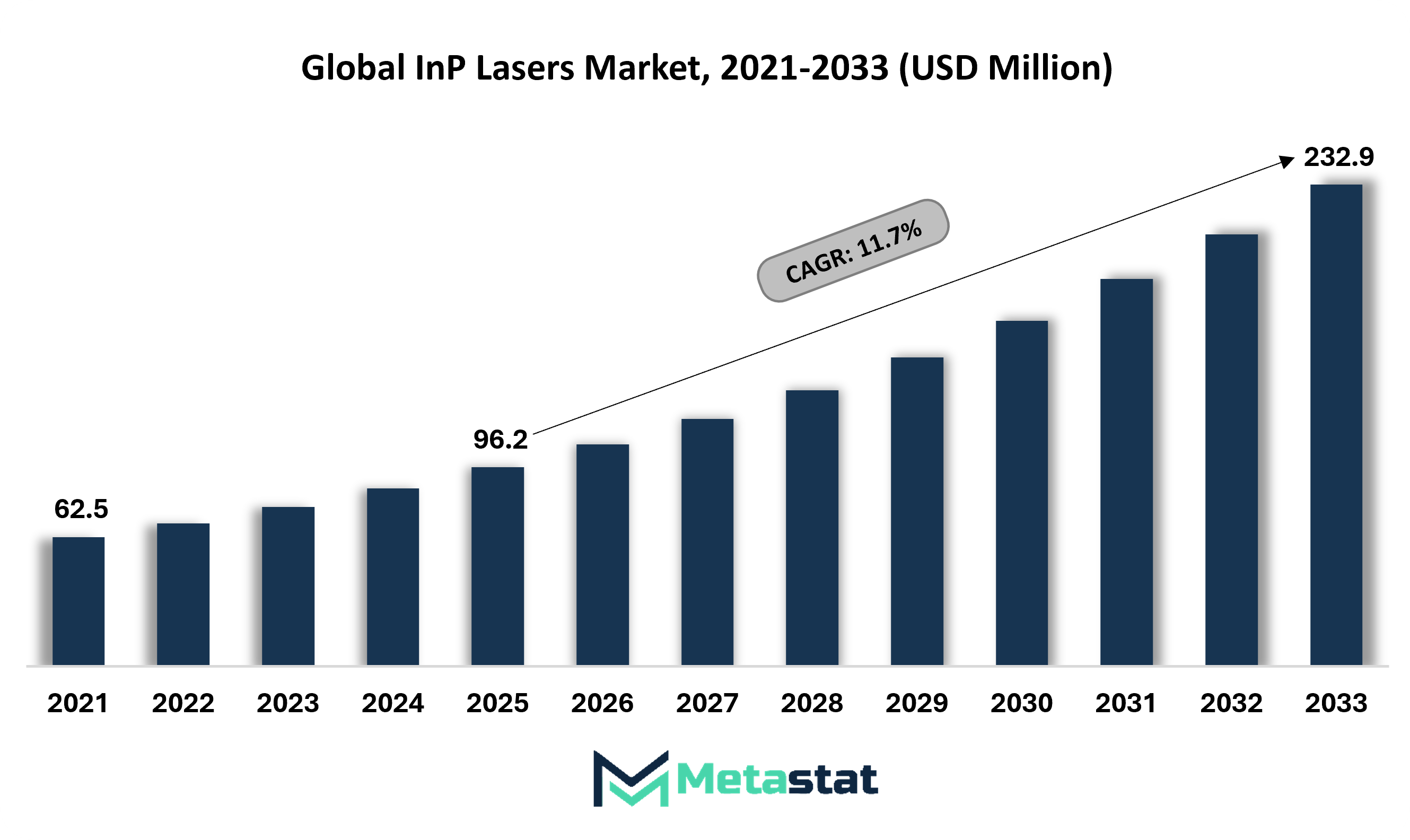
Rising deployment of high-speed fiber-optic networks and data centers propel demand for InP-based optical transmitters.
Rising deployment of high-speed fiber-optic networks and data centers strengthens momentum in the Global InP Lasers Market. Continuous expansion of cloud infrastructure, edge computing nodes, and bandwidth-intensive applications creates sustained demand for efficient optical transmitters, enabling faster data transmission, improved signal integrity, and enhanced network reliability across global digital infrastructure ecosystems.
Increased adoption of photonic integrated circuits in telecom and hyperscale computing environments accelerates usage
Increased adoption of photonic integrated circuits within telecom networks and hyperscale computing centers accelerates expansion in the Global InP Lasers Market. Integration of multiple optical functions onto compact chips supports reduced power consumption, higher performance density, and scalable architecture, driving innovation in next-generation communication systems and advanced computing environments.
High fabrication complexity and cost compared to silicon photonics limit large-scale commercialization
High fabrication complexity and elevated production costs compared to silicon photonics create barriers to broader adoption in the Global InP Lasers Market. Advanced manufacturing processes require precision engineering, specialized equipment, and advanced technical expertise, leading to higher capital expenditure, limited accessibility, and slower transition toward mass commercialization across cost-sensitive applications.
Supply chain dependency on specialized semiconductor materials constrains scalability
Supply chain dependency on specialized semiconductor materials creates scalability challenges for the Global InP Lasers Market. Limited availability of indium phosphide substrates, coupled with geopolitical risks and sourcing constraints, affects manufacturing stability, increases lead times, and creates uncertainty in maintaining consistent supply for expanding industrial and technology applications.
Expansion of 5G, AI-driven data traffic, and coherent optics unlocks growth potential for advanced InP laser integration
Expansion of 5G infrastructure, rapid growth in AI-driven data traffic, and advancements in coherent optical technologies unlock strong potential in the Global InP Lasers Market. Increasing need for high-speed, low-latency communication systems supports deeper integration of InP-based solutions, encouraging innovation in optical networking, data processing, and future-ready communication architectures.
The Global InP Lasers Market is segmented based on product, application, end-user, and region.
Less than 1300nm segment is valued at USD 23.9 million in 2026 and is projected to reach USD 44 million by 2033, at a CAGR of 9.1% during the forecast period.
Less than 1300 nm indium phosphide laser solutions are gaining traction owing to their suitability for short-distance transmission and compact device integration. Growth is supported by increasing demand for efficient optical components in consumer devices and sensing technologies. Future progress highlights improved miniaturization, enhanced power efficiency, and broader adoption across emerging photonic-based applications.
1300nm-1600nm segment is valued at USD 63.7 million in 2026 and is projected to reach USD 146 million by 2033, at a CAGR of 12.6% during the forecast period.
1300 nm-1600 nm variants dominate performance-sensitive applications owing to strong compatibility with fiber-optic communication systems. Expansion of high-speed data transfer infrastructure strengthens demand across telecom and data center networks. Future developments indicate improved signal stability, lower attenuation, and expanded deployment across advanced communication networks supporting growing digital consumption worldwide.
Above 1600nm segment is valued at USD 19.7 million in 2026 and is projected to reach USD 42.9 million by 2033, at a CAGR of 11.8% during the forecast period.
Above 1600 nm lasers are gaining importance in specialized industrial, medical, and sensing applications requiring precision, stability, and deep penetration. Growth is linked to advancements in sensing, environmental monitoring, and defense technologies. Future outlook highlights stronger innovation in material engineering and broader integration into high-performance optical systems.
Telecommunications segment is projected to reach USD 82.9 million by 2033, at a CAGR of 10.2% during the forecast period.
Telecommunications remain a key growth avenue driven by continuous expansion of high-speed internet infrastructure and 5G deployment. Demand is strengthening with rising data traffic across global networks. Future outlook indicates stronger reliance on advanced laser technologies that enable faster and more reliable communication channels across long-distance transmission systems.
Consumer Electronics segment is projected to reach USD 40.6 million by 2033, at a CAGR of 11.1% during the forecast period.
Consumer electronics segment is witnessing steady adoption owing to integration of optical components in smart devices, wearables, and advanced display technologies. Innovation in compact design supports wider usage. Future expansion reflects rising need for enhanced user experience, improved device performance, and increased use of photonic solutions in everyday electronic products.
Medical Diagnostics segment is projected to reach USD 32.3 million by 2033, at a CAGR of 12.8% during the forecast period.
Medical diagnostics applications benefit from the high precision and reliability of indium phosphide laser technologies in imaging and detection systems. Adoption expands with growing focus on early disease detection and non-invasive procedures. Future advancements indicate improved diagnostic accuracy, faster processing capabilities, and wider utilization across healthcare technology platforms.
Optical Networks segment is projected to reach USD 55.4 million by 2033, at a CAGR of 13.5% during the forecast period.
Optical networks segment demonstrates strong growth owing to increasing need for high-capacity data transmission and network efficiency. Expansion of cloud services and digital infrastructure strengthens adoption. Future developments highlight enhanced bandwidth capabilities, reduced latency, and deeper integration into next-generation communication architectures.
Automotive segment is projected to reach USD 21.8 million by 2033, at a CAGR of 13.2% during the forecast period.
Automotive sector is adopting laser technologies for sensing, safety systems, and autonomous driving applications. Adoption is increasing with rising focus on advanced driver assistance systems and vehicle automation. Outlook indicates higher precision sensing, improved environmental detection, and broader use across connected mobility ecosystems.
Silicon Photonics segment is projected to reach USD 61.2 million by 2033.
Silicon photonics segment is gaining traction owing to compatibility with integrated circuit manufacturing and cost-effective scalability. Adoption is rising with the need for high-speed data processing solutions. Future trends indicate deeper convergence between electronics and photonics, enabling faster computing systems and efficient data transfer within compact architectures.
Data Centers segment is projected to reach USD 59.9 million by 2033.
Data centers generate significant demand owing to rapid growth in cloud computing, artificial intelligence, and large-scale data processing. High-speed optical interconnects remain essential for improving computing performance. Future expansion reflects increasing reliance on energy-efficient laser solutions supporting large-scale data flow and enhancing operational performance across hyperscale computing environments.
Mobile Backhaul segment is projected to reach USD 33.9 million by 2033.
Mobile backhaul segment benefits from expansion of wireless communication infrastructure and rising mobile data consumption. Efficient data transmission between network nodes remains critical. Outlook indicates stronger deployment of high-capacity laser technologies supporting seamless connectivity and improved network reliability in dense urban environments.
Access Networks segment is projected to reach USD 30.8 million by 2033.
Access networks segment is witnessing steady adoption owing to last-mile connectivity requirements and broadband expansion initiatives. Increasing digital inclusion efforts support market growth. Future trends highlight improved transmission efficiency, wider coverage capabilities, and enhanced service quality across residential and commercial communication networks.
Metro Markets segment is projected to reach USD 30 million by 2033.
Metro network applications require high-speed and reliable data transmission across urban areas. Adoption is increasing with smart city development and digital infrastructure upgrades. Outlook indicates stronger integration of advanced laser technologies enabling scalable network performance and efficient handling of urban data traffic.
Others segment is projected to reach USD 17.1 million by 2033.
Other end-user segments include research institutions, defense systems, and industrial applications where precision and performance remain critical. Adoption continues to evolve with technological advancements. Future outlook indicates broader experimentation, innovation in niche applications, and gradual expansion into new areas requiring high-performance optical solutions.
Based on geography, the InP Lasers market is divided into North America, Europe, Asia-Pacific, South America, Middle East, and Africa.
North America holds a significant position in the InP Lasers Market, supported by strong deployment of hyperscale data centers, advanced optical communication networks, and rising demand for high-speed data transmission.
Europe represents a growing market for InP lasers, driven by telecom network modernization, fiber-optic infrastructure expansion, and increasing focus on energy-efficient optical communication systems.
Countries such as Germany, the U.K., France, and Italy are supporting demand through data center development, industrial photonics adoption, and research-led innovation in photonic integrated circuits.
Asia Pacific dominates the InP Lasers Market owing to rapid 5G deployment, large-scale broadband expansion, strong optical component manufacturing, and rising data center investments.
China, Japan, South Korea, and Taiwan remain key contributors owing to their strong semiconductor, photonics, and telecom equipment ecosystems.
South America and the Middle East & Africa are emerging regions in the InP Lasers Market, supported by telecom infrastructure development, broadband connectivity programs, 5G rollout, and gradual data center expansion.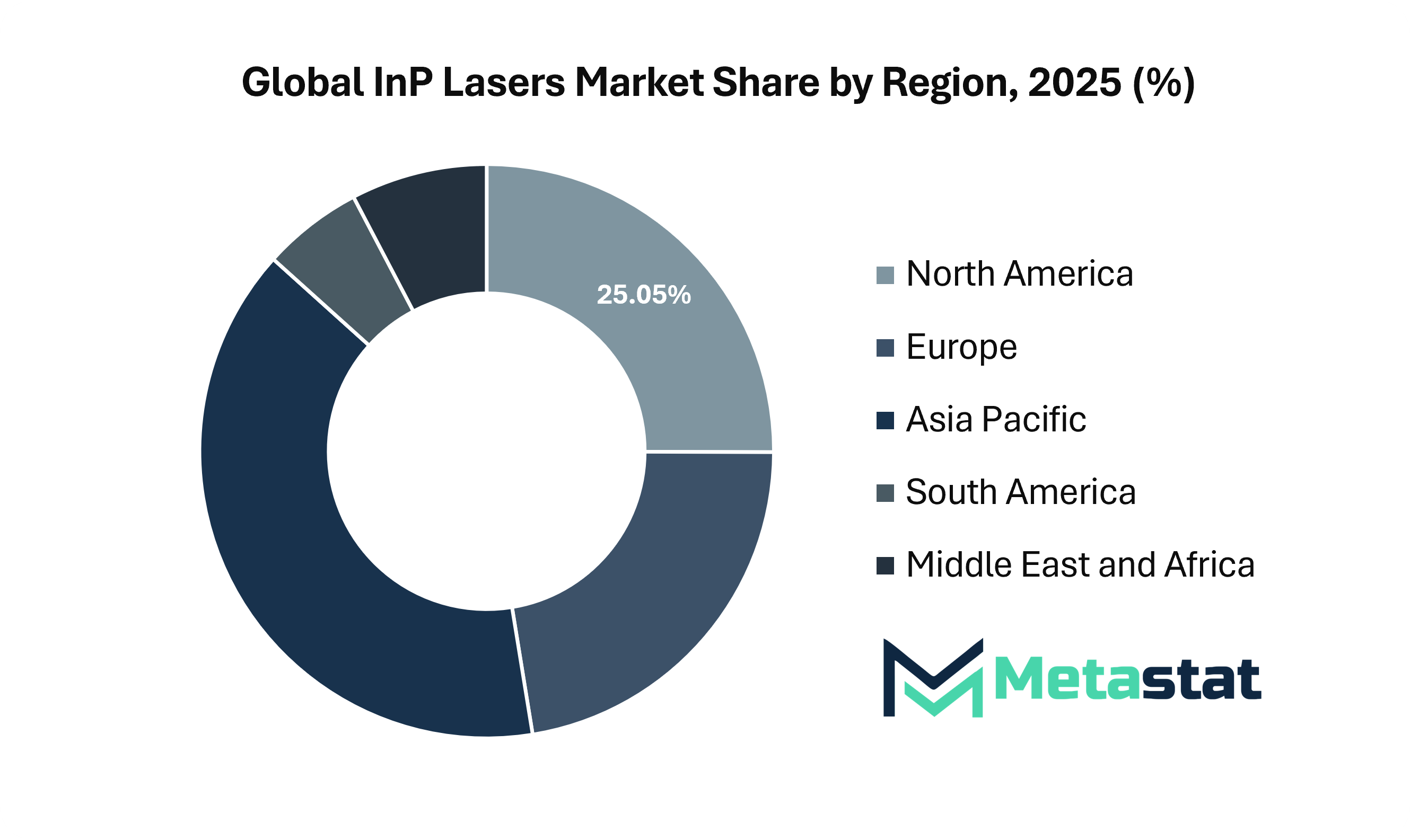
The Global InP Lasers Market will continue to gain attention owing to rising demand for faster data transmission and efficient optical communication systems. Indium phosphide lasers are widely used in telecom networks, data centers, optical interconnects, and advanced sensing applications where precision, wavelength stability, and speed are critical. Market growth will be supported by increasing internet usage, cloud computing, AI-driven workloads, and expansion of 5G infrastructure. These factors will push companies to improve laser performance, reduce power consumption, and enhance integration with photonic platforms. High production costs and complex fabrication techniques will remain key challenges, particularly for smaller firms entering the market.
Competition in the industry will remain strong, with established companies focusing on research, partnerships, and product innovation to maintain their market position. Players such as Lumentum Holdings Inc., Coherent Corp., and Broadcom Inc. will continue to invest in advanced photonics solutions to address evolving customer requirements. MACOM Technology Solutions Holdings, Inc. and NTT Innovative Devices Corporation will also strengthen their presence through innovation and targeted applications. The presence of experienced manufacturers will create a stable yet competitive environment where performance, reliability, and integration capability will determine long-term success.
Several companies will focus on niche and emerging applications to strengthen their market identity. Sumitomo Electric Device Innovations, Inc., Furukawa Electric Co., Ltd., and Anritsu Corporation will explore opportunities in high-speed communication and testing equipment. Sivers Semiconductors AB, DenseLight Semiconductors Pte Ltd, and NuPhotonics Inc. will focus on compact and energy-efficient designs. Regional manufacturers such as Wuhan Elite Optronics Co., Ltd. and Hangzhou Zetta Semiconductor Co., Ltd. will contribute to supply expansion, while LD-PD Inc., InPhenix, Inc., and Lasermate Group, Inc. will expand their reach through customized solutions.
Innovation will remain a central focus, with research institutions and specialized companies shaping future technology trends. Organizations such as Fraunhofer Heinrich Hertz Institute, III-V Lab, and IQE plc will support advancements in material science and device efficiency. Companies such as Ortel, LLC, Sheaumann Laser, Inc., Vertilas GmbH, Thorlabs, Inc., Freedom Photonics LLC, OpenLight Photonics, Inc., and SMART Photonics B.V. will continue refining laser performance for broader industrial use. The Global InP Lasers Market will move forward with steady progress, driven by demand for high-speed connectivity and continuous improvements in optical technologies.
Market size is forecast to rise from USD 96.2 million in 2025 to over USD 232.9 million by 2033.
The Global InP Lasers Market will benefit from increasing demand for high-speed data transmission, expansion of 5G networks, and growth in cloud computing and AI workloads. Future expansion will be supported by photonic integration, coherent optical communication, and advancements in semiconductor manufacturing technologies.
This research report categorizes the InP Lasers market based on key segments and regions, forecasts revenue growth, and analyses trends in each submarket. The report analyses the key growth drivers, opportunities, and challenges influencing the InP Lasers market. Recent market developments and competitive strategies such as expansion, product launch, partnership, merger, and acquisition have been included to draw the competitive landscape in the market.
The report strategically identifies and profiles the key market players and analyses their core competencies in each sub-segment of the InP Lasers market.
|
Report Attributes |
Details |
|
Study Period |
2021-2033 |
|
Base Year |
2025 |
|
Estimated Year |
2026 |
|
Forecast Period |
2026-2033 |
|
Historical Period |
2021-2025 |
|
Growth Rate |
CAGR 11.7% from 2026 to 2033 |
|
Revenue Unit |
USD million |
|
Segmentation |
By Product, Application, End-users and Region |
|
By Region |
North America (By Product, Application, End-users and Country)
|
|
Europe (By Product, Application, End-users and Country)
|
|
|
Asia Pacific (By Product, Application, End-users and Country)
|
|
|
South America (By Product, Application, End-users, and Country)
|
|
|
Middle East and Africa (By Product, Application, End-users, and Country)
|
Find answers to common questions about this report
Top players operating in the InP Lasers industry include Lumentum Holdings Inc., Coherent Corp., Broadcom Inc., MACOM Technology Solutions Holdings, Inc., and NTT Innovative Devices Corporation
High fabrication complexity and cost compared to silicon photonics limit large-scale commercialization will hamper the market growth within the forecast period.
Asia Pacific region dominates the market.
Rising deployment of high-speed fiber-optic networks and data centers propel demand for InP-based optical transmitters and Increased adoption of photonic integrated circuits in telecom and hyperscale computing environments accelerates usage are key driving factors, boosting the market.
The Metastat Insights analysis shows that the North America InP Lasers market size is estimated to be USD 55.7 million by 2033.
The Global InP Lasers market is expected to grow at a CAGR of 11.7% over the forecast period (2026-2033).
The Metastat Insights study shows that the Global InP Lasers market size was USD 96.2 million in 2025.
The analysts below cover Electronics and Semiconductor research at Metastat Insights.
LEAD ANALYST
Utkarsh Khirodkar is a Lead Market Research Analyst at MetaStat Insight, specializing in market intelligence, technology sector assessments, and competitive strategy.

PRINCIPAL CONSULTANT - ENTERPRISE AI & EMERGING TECHNOLOGIES
Banking & Finance · Electronics and Semiconductor · Energy and Power · Healthcare IT · Information & Technology · Professional Services
Vijay Gunti is a Principal Consultant at MetaStat Insight, bringing over two decades of experience across enterprise digital transformation, technology strategy, and intelligent systems.

PRINCIPAL CONSULTANT - QUALITY SYSTEMS & COMPLIANCE
Electronics and Semiconductor · Machinery & Equipment · Professional Services
Omkar Phadtare is an Industry Consultant at MetaStat Insight, specializing in quality systems, regulatory compliance, and standards benchmarking to drive data-driven market intelligence and strategic industry research.

ENERGY & INFRASTRUCTURE INDUSTRY CONSULTANT
Automotive and Transportation · Electronics and Semiconductor · Energy and Power · Machinery & Equipment
Saurabh Vasant Ganvir consults for Energy & Infrastructure Industry at MetaStat Insight, specializing in renewable energy, solar EPC, and electric vehicle (EV) infrastructure markets.

LEAD CONSULTANT - COMMUNICATION, TELECOM, AND IT
Electronics and Semiconductor · Information & Technology · Machinery & Equipment · Professional Services
Ravindra Sathe Consultants for Communication, Telecom, and IT at MetaStat Insight. He leads the firm's industry research initiatives across telecommunications infrastructure, digital connectivity, enterprise networking, and emerging information technology domains.
Evaluating sovereign cloud deployments for core banking platforms demands a clear view of data residency regulations and migration exit strategies. MetaStat Insight delivered an exhaustive review of regional latency tolerances, mainframe decommission milestones, and third-party vendor concentration risk. The regulatory compliance mapping across European and Asian financial jurisdictions gave our team a dependable baseline for multi-cloud infrastructure discussions.
Replacing petrochemical surfactants with bio-based alternatives requires realistic timelines on industrial precision fermentation scaling. The market research broke down commercialization timelines, feedstock sugar price sensitivities, and regional cosmetic ingredient regulatory approvals in Europe and East Asia. That supplier readiness mapping gave our formulations team reliable context when comparing renewable chemical sourcing roadmaps.
Tracking ceramic matrix composite adoption in high-bypass aero engines requires strict attention to material qualification cycles and FAA airworthiness testing milestones. The MetaStat Insight team provided a detailed timeline of silicon carbide fiber manufacturing capacity and commercial foundry lead times. Having clear visibility into upstream thermal barrier coating supply helped us stress-test our long-term component procurement strategy.
Explore related market intelligence reports worth reading alongside this one.
Starting from
$2950