
LEAD ANALYST
Utkarsh Khirodkar is a Lead Market Research Analyst at MetaStat Insight, specializing in market intelligence, technology sector assessments, and competitive strategy.

Global Maritime Safety Systems Market Size, Share, By System Type (Navigation and Collision Prevention Systems, Vessel Traffic and Situational Awareness Systems, Maritime Communication and Distress Systems, Fire Detection and Suppression Systems, Life-Saving and Evacuation Systems, Safety Management and Training Systems), By Offering (Hardware, Software, Services), By Application (Navigation and Collision Avoidance, Monitoring and Tracking, Emergency Response and Search and Rescue, Security and Safety Management, Fire and Hazard Protection), By End-Use Industry (Commercial Shipping, Ports and Terminals, Government and Defense, Offshore Energy, Passenger and Cruise Vessels), Industry Analysis, Growth, Trends, and Forecast, 2026-2033
Report ID
MSI-5746
Published
November, 2026
Pages
307 Pages
Format
Historical
Base year
Forecast
Forecast period
Report Details
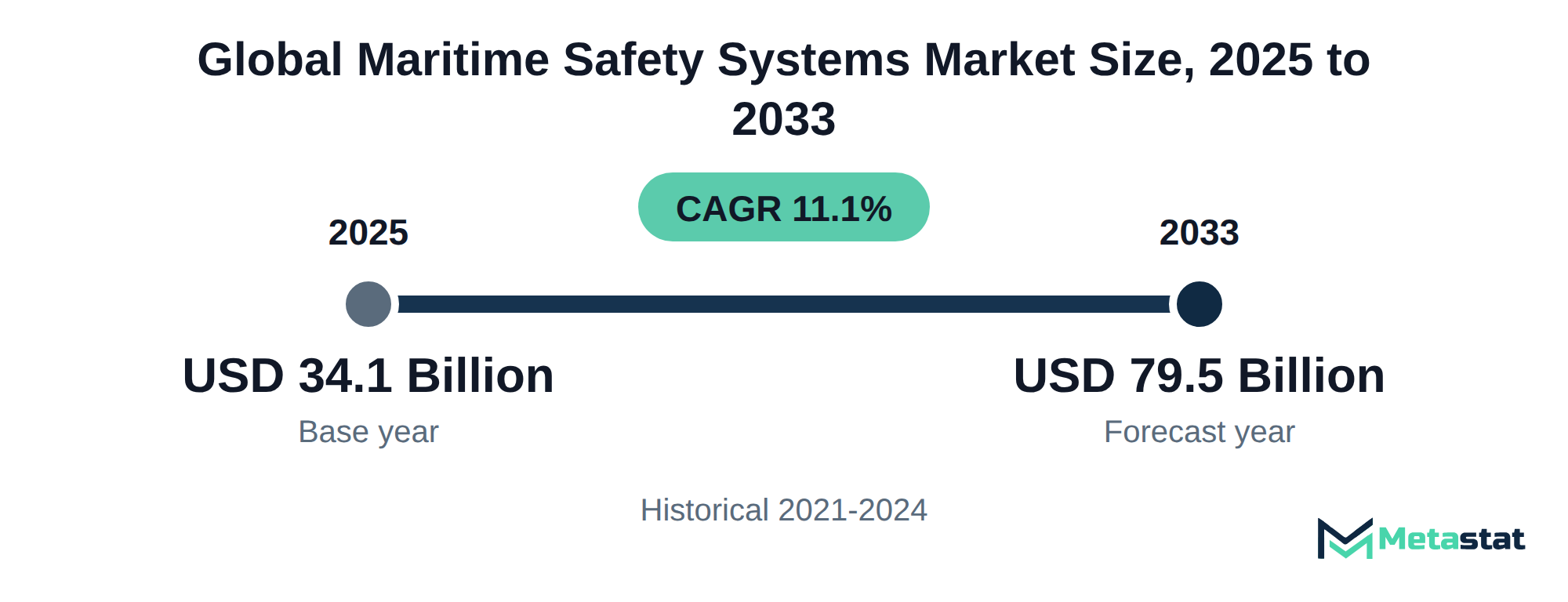
Market Valuation: Valued at $34.1 Billion in 2025, projected to reach $79.5 Billion by 2033 at a 11.1% CAGR.
Dominant Segment: Navigation and Collision Prevention Systems lead the Maritime Safety Systems market, driven by significant investments aimed at enhancing operational safety and compliance with increasing maritime traffic.
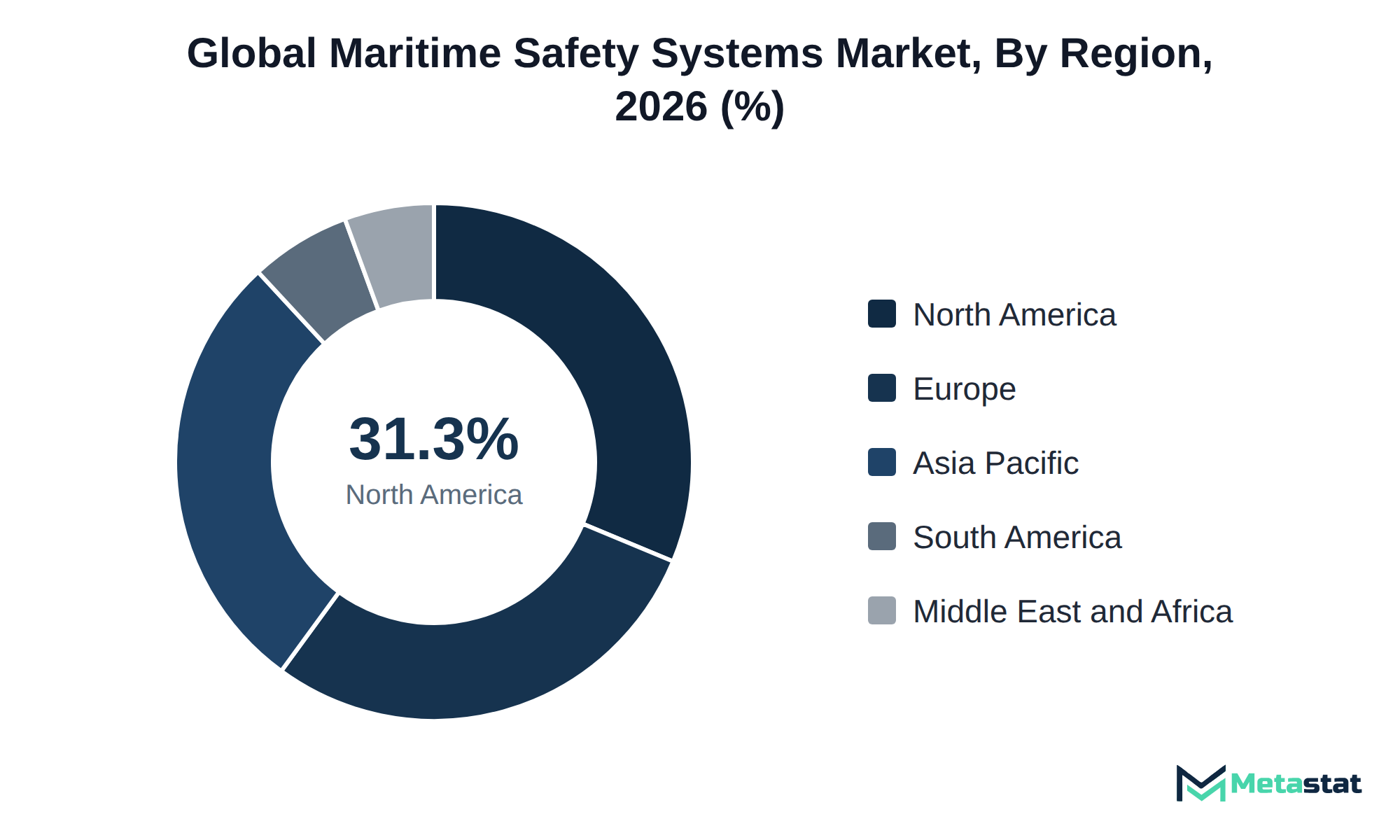
Geographic Lead: North America is the leading region in the market, holding 31.3% in 2025, with the US projected to maintain its dominance due to a robust maritime infrastructure and stringent regulatory environment.
What's Inside: This report provides comprehensive analysis, including market segmentation by system type, offering, application, and end-use industry, along with detailed forecasts and competitive coverage.
Growth in Software Offerings: The software segment is expected to reach USD 19 billion by 2033, reflecting a CAGR of 13.7%, driven by the increasing demand for advanced safety solutions integrated with hardware systems.
Rising Demand for Emergency Response Sys: The market for emergency response systems is projected to grow to USD 12.5 billion by 2033, highlighting the critical need for effective emergency management in maritime operations.
Choose Your License
Global Maritime Safety Systems Market
The global Maritime Safety Systems market was valued at USD 34.1 billion in 2025 and is projected to reach USD 79.5 billion by 2033, growing at a CAGR of 11.1% over the forecast period.
The Maritime Safety Systems market covers technologies and services that ensure the safety and security of maritime operations. Buyers invest in these solutions to enhance navigation, prevent collisions, and respond effectively to emergencies. The growing demand for safer maritime activities drives expenditure across various sectors, including commercial shipping, government, and offshore energy. The focus on compliance with international safety regulations and advancements in technology further compels organizations to adopt sophisticated safety systems.
Growth in the market is propelled by several factors, with the increasing frequency of maritime incidents highlighting the need for advanced safety measures. Navigation and Collision Prevention Systems represent the segment with the highest value, reflecting significant investment while organizations prioritize operational safety. North America holds 31.3% of the market in 2025, with the US leading in 2026. The region's well-developed maritime infrastructure and regulatory environment contribute to its dominance in the market.
The market is projected to experience substantial expansion fueled by the rising emphasis on technological advancements and the integration of innovative solutions. The increasing adoption of software solutions within safety systems indicates a trend toward enhancing operational efficiency. Organizations adapt to evolving maritime challenges, driving demand for comprehensive safety systems, which continues to grow, indicating a promising outlook for the market.
The Maritime Safety Systems market includes various safety technologies and services that protect vessels and maritime operations from hazards. Buyers invest in these systems primarily to enhance safety, ensure compliance with regulatory standards, and mitigate risks associated with maritime activities. The increasing global focus on maritime security drives investment, as organizations prioritize safeguarding personnel, assets, and the environment.
Growth in the market is driven by rising demand for advanced navigation and collision prevention systems. This segment commands the most significant share, reflecting the critical need for enhanced safety measures in increasingly congested maritime environments. Other regions, including Europe and Asia Pacific, exhibit substantial market activity, with shares of 28.8% and 28.1%, respectively, highlighting a competitive landscape.
The Maritime Safety Systems market is supported by technological advancements and the continuous evolution of safety regulations. Innovations in software and hardware solutions enable more efficient safety management and emergency response capabilities. The growing importance of integrated systems that provide real-time monitoring and situational awareness positions the market for significant expansion over the forecast period.
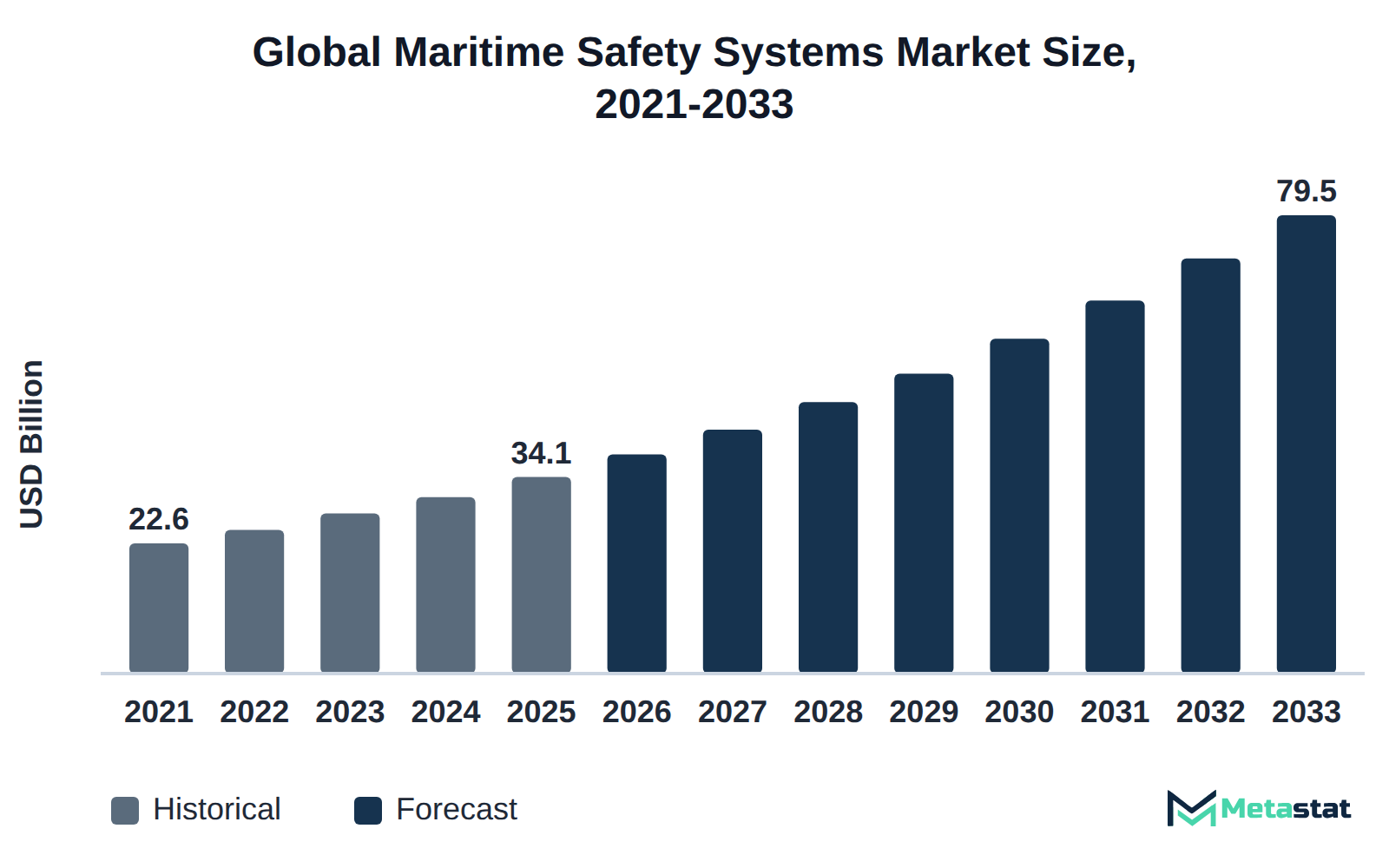
AI-enabled navigation and collision prevention systems represent a significant technological advancement in the Maritime Safety Systems market. These systems enhance situational awareness and decision-making, directly impacting vessel safety. By applying algorithms and real-time data analysis, these solutions provide accurate predictions of potential collisions, enabling timely evasive actions. Adoption of such systems is projected to drive market growth. Navigation and Collision Prevention Systems are expected to rise in value from USD 9.8 billion in 2026 to USD 21.8 billion by 2033, a compound annual growth rate (CAGR) of 12%.
Commercial shipping companies, ports, and government entities increasingly invest in AI-enabled technologies to optimize operations and mitigate risks associated with maritime activities. The heightened focus on safety regulations and operational efficiency fuels demand for these advanced systems. By enhancing safety protocols, organizations benefit from reduced liability risks and improved operational reliability, contributing positively to their bottom lines. Vessel operators prioritize safety, and AI solutions play a significant role in meeting that objective.
Purchasing behaviors within the Maritime Safety Systems market reflect a trend toward long-term contracts and service agreements. Many buyers prioritize comprehensive solutions that encompass hardware, software, and services, thereby opting for multi-year contracts that guarantee updates and support. Hardware is a significant segment, valued at USD 19.1 billion in 2026 and projected to reach USD 36.8 billion by 2033, which shows how central equipment acquisition is to overall purchasing strategy.
Contract structures often include performance-based pricing, which ties costs to the effectiveness of the systems in enhancing safety and operational efficiency. This approach aligns the interests of suppliers and buyers, creating a collaborative relationship that emphasizes ongoing support and system performance metrics. With such pricing models, buyers secure technology along with a commitment to safety improvements and incident response capabilities.
The emphasis on long-term partnerships and service-based agreements enhances market stability, encouraging investment in advanced technologies. Buyers seek to optimize safety outcomes while managing costs, and the evolution of contract models shapes future purchasing decisions and influences supplier competition within the Maritime Safety Systems market.
Ports and commercial fleets increasingly prioritize connected safety infrastructure to enhance operational efficiency and meet stringent regulatory compliance. The Maritime Safety Systems market reflects this trend, with significant investments directed toward advanced safety solutions. For instance, the segment for Commercial Shipping is projected to grow from USD 14.5 billion in 2026 to USD 29.5 billion by 2033, achieving a compound annual growth rate (CAGR) of 10.7%. This substantial growth indicates an accelerating commitment among fleet operators to adopt advanced systems that improve safety and operational capabilities.
The push for connected safety infrastructure arises from the need to mitigate risks associated with maritime operations. Enhanced communication and situational awareness systems enable real-time monitoring and response to potential hazards, reducing the likelihood of accidents and operational disruptions. Such systems protect assets and personnel and align with environmental regulations and sustainability initiatives, which matters for ports aiming to minimize their ecological footprint.
Consequently, the integration of connected safety solutions into maritime operations yields long-term operational benefits. Increased safety measures lead to reduced insurance premiums and lower liability risks for operators, translating into significant cost savings. The continuous evolution of the Maritime Safety Systems market positions ports and commercial fleets to capitalize on these advancements, ensuring safer and more efficient maritime operations.
Maritime Safety Systems strengthen emergency response and support compliance across the maritime industry. The adoption of advanced systems for emergency response and search and rescue applications significantly improves operational readiness and efficacy. By 2033, the market for emergency response systems is projected to reach USD 12.5 billion, reflecting a growing acknowledgment of the importance of effective emergency management on water. This growth stems from the increasing complexity of maritime operations and the subsequent need for robust safety protocols.
Key players in the Maritime Safety Systems market invest in technological advancements that facilitate better situational awareness and rapid response capabilities. Enhanced systems provide real-time tracking, communication, and coordination, which are essential during emergencies. The market sees strong demand for navigation and collision avoidance systems, projected to achieve a value of USD 24.5 billion by 2033, further highlighting the emphasis on improving safety standards.
Investment in these systems addresses urgent safety requirements and helps organizations meet regulatory compliance demands. Companies operating in this space benefit from decreased liability risks and improved operational efficiency, contributing to overall profitability. Consequently, the continued evolution of Maritime Safety Systems strengthens the industry's commitment to safety and compliance.
Recent advancements in technology drive heightened demand for vessel traffic and situational awareness systems. Commercial shipping operators prioritize these systems to enhance navigation safety and operational efficiency. Increased focus on safety standards and risk mitigation has prompted buyers to invest in modern solutions that offer improved monitoring capabilities. An estimated USD 15.5 billion is projected for this segment by 2033, reflecting a significant growth trajectory. The emphasis on efficient traffic management in busy maritime routes leads to increased spending, effectively raising both volume and market prices. These developments highlight the critical role of sophisticated navigation technologies in the evolving maritime environment.
Investment in maritime safety systems continues to grow, with operators seeking solutions to address the complexities of modern shipping operations. Enhanced situational awareness contributes to reduced collision risks, boosting buyer confidence in these systems. The market is expected to expand further as stakeholders recognize the importance of proactive safety measures.
Innovation within the Maritime Safety Systems market drives the development of enhanced safety features and functionalities. Recent technological advancements improve navigation, communication, and emergency response systems, enabling more effective management of maritime operations. Suppliers prioritize integrating artificial intelligence and machine learning into these systems, allowing for predictive analytics and real-time data processing, which enhances situational awareness on board vessels. Increased reliance on these advanced systems stems from a growing need for robust safety measures in commercial shipping and other maritime sectors. This trend reflects an upward trajectory in revenue growth and system adoption.
The introduction of smart technologies streamlines operations while reducing risks associated with maritime activities. Enhanced software platforms offer improved user interfaces, allowing operators to interact seamlessly with safety systems. This technology-driven approach leads to greater efficiency, driving demand from various stakeholders within the maritime ecosystem. Overall, innovation in safety technologies reinforces the competitive position of suppliers in the market, encouraging continued investment and growth opportunities.
High costs associated with Maritime Safety Systems limit adoption among commercial shipping companies. Budget constraints in this sector lead to slower uptake of advanced safety solutions, with firms prioritizing essential investments. The higher initial expenditure required for implementing advanced systems often results in smaller orders and delayed replacements for outdated technology. Economic fluctuations further strain budgets, causing firms to defer safety upgrades. This situation creates a ripple effect throughout the market, hindering overall demand for new systems.
In ports and terminals, the financial burden linked to comprehensive safety solutions restricts investment in necessary upgrades. The maritime industry's reliance on established technologies reflects a cautious approach to adopting new systems. Buyers within government and defense sectors face similar challenges, with funding limitations impacting decision-making regarding safety enhancements. The increased emphasis on cost efficiency highlights the importance of scalable solutions in the Maritime Safety Systems market.
Increasing competition within the Maritime Safety Systems market leads to margin pressure, influencing suppliers' ability to maintain profitability. A rise in operational costs, particularly for materials and technology development, intensifies this challenge. Suppliers face difficulties in balancing pricing strategies while ensuring product quality and technological advancements. This situation compels suppliers to enhance operational efficiencies, streamline production processes, and explore cost-effective materials. By focusing on innovation and adopting advanced manufacturing techniques, companies attempt to mitigate margin pressure and sustain their market position.
Suppliers invest in research and development to create more efficient product lines, which reduce long-term costs and improve profit margins. Collaborative partnerships among suppliers further facilitate resource sharing and knowledge transfer, enhancing competitiveness. The focus on integrated solutions within the market encourages suppliers to diversify offerings, addressing a wider range of customer needs while improving overall profitability.
The software segment within the market demonstrates significant growth potential, projected to reach USD 19 billion by 2033, driven by increasing demand for advanced safety solutions. This growth results from the rising emphasis on integrating software solutions with hardware systems to enhance operational efficiency and safety compliance. Stakeholders in commercial shipping and government sectors prioritize software capabilities that provide real-time monitoring and data analytics, aligning with the need for improved safety and regulatory adherence. This trend reflects a shift towards more sophisticated maritime safety applications, strengthening the market's overall expansion. The software segment’s growth rate of 13.7% CAGR indicates strong demand for innovative solutions that address safety challenges and helps suppliers strengthen their market position.
The Global Maritime Safety Systems market is segmented based on System Type, Offering, Application, and End-Use Industry.
Navigation and Collision Prevention Systems enhance maritime safety through advanced technologies that help vessels avoid collisions and navigate safely. Primarily used by commercial shipping companies and maritime operators, these systems support critical functions including radar tracking, automated navigation, and route optimization. The growing emphasis on safety regulations and the increasing number of maritime traffic drive demand for these systems. Compared to other segments, Navigation and Collision Prevention Systems exhibit a faster growth rate, highlighting the urgency for improved safety standards in maritime operations. The rising complexity of maritime routes necessitates these systems, distinguishing this segment from others including Vessel Traffic and Situational Awareness Systems, which have a relatively lower CAGR of 11.7%.
Vessel Traffic and Situational Awareness Systems segment is estimated to reach USD 15.5 billion by 2033, at a CAGR of 11.7% during the forecast period. This segment ensures safe navigation and communication among vessels, often used by commercial shipping companies, ports, and maritime authorities. Increasing adoption of advanced technologies for real-time monitoring and situational awareness drives demand in this segment. Regulatory requirements aimed at improving maritime safety and operational efficiency further enhance its appeal. Compared to other segments, including Navigation and Collision Prevention Systems, this segment exhibits a slightly slower growth trajectory; however, it remains crucial for enhancing overall safety and operational effectiveness within the market. The distinct focus on situational awareness differentiates it from other segments that primarily emphasize collision prevention or communication capabilities.
Maritime Communication and Distress Systems segment is expected to reach USD 13 billion by 2033. These systems facilitate critical communication and distress management for vessels, ensuring safety during emergencies. Primarily used by commercial shipping companies and maritime organizations, these systems enhance operational security and response capabilities. Increasing regulatory requirements related to vessel safety and communication standards drive demand for this segment. In contrast to other segments, including Navigation and Collision Prevention Systems, which is projected to grow at a CAGR of 12%, Maritime Communication and Distress Systems exhibit steady growth, focusing on reliability and compliance rather than rapid technological advancements. This differentiation highlights the specific needs of buyers who prioritize communication reliability in high-stakes environments, reinforcing the value of these systems in the broader maritime safety ecosystem.
Fire Detection and Suppression Systems segment is projected to grow at a CAGR of 10.1% during the forecast period. This segment provides essential technologies for identifying and controlling fires on vessels, ensuring the safety of crew and cargo. Primarily used by commercial shipping companies and offshore energy sectors, these systems enhance operational safety and compliance with stringent regulations. The growth of this segment is driven by the increasing focus on safety standards and the rise in maritime incidents related to fire hazards. Compared to other system types, Fire Detection and Suppression Systems experience a balanced growth trajectory, reflecting steady demand that differs from the more rapidly advancing Navigation and Collision Prevention Systems segment, which is expected to reach USD 21.8 billion by 2033. Investment in advanced fire suppression technologies enhances safety while meeting regulatory requirements, making this segment vital for maritime operations.
Life-Saving and Evacuation Systems provide essential tools and technologies designed to protect personnel in emergency situations at sea. These systems serve various maritime stakeholders, including commercial shipping companies and offshore energy operations, facilitating safe evacuation and survival during incidents. Significant demand for these systems stems from stringent safety regulations and increasing awareness of safety protocols in maritime operations. Higher adoption of innovative technologies enhances the effectiveness of evacuation procedures. Compared to other segments, Life-Saving and Evacuation Systems experience unique growth dynamics driven by specific regulatory requirements, which influence buyers more heavily than in segments including Vessel Traffic and Situational Awareness Systems. This segment remains critical for ensuring compliance with safety standards while differing in focus from systems aimed primarily at navigation and communication.
Safety Management and Training Systems encompass essential tools designed to enhance operational safety and compliance within maritime operations. These systems serve various sectors, including commercial shipping and government agencies, focusing on safety training, risk management, and compliance assurance. Factors contributing to the segment's growth include stringent regulatory requirements and increasing awareness of safety standards across the industry. Unlike other segments, including Navigation and Collision Prevention Systems, which experience faster growth rates, the Safety Management and Training Systems segment focuses on long-term compliance and training initiatives. This aspect leads to a different buyer profile, often involving long-term contracts and investments in personnel training and development. Regulatory pressures significantly influence this segment, driving investments in safety management solutions that fulfill compliance mandates. The market experiences unique dynamics that support organizations in improving their safety culture and operational efficiency.
Cybersecurity and Environmental Protection Systems focus on safeguarding maritime operations from cyber threats while ensuring compliance with environmental regulations. These systems serve government and defense sectors, port operators, and commercial shipping companies, reflecting a growing recognition of the need for enhanced security and sustainability practices. Increasing regulatory scrutiny surrounding environmental protection and cybersecurity drives demand for these systems, pushing organizations to adopt advanced solutions. Unlike traditional safety systems that prioritize physical security, this segment emphasizes software solutions and integrated technology to address emerging threats, positioning it for growth. This differentiation highlights the unique challenges and opportunities faced by buyers, who invest in new technologies to mitigate risks and enhance operational resilience. While specific figures for this sub-segment are unavailable, it remains an essential part of the broader Maritime Safety Systems market, contributing to the goals of safety and compliance.
Hardware in maritime safety systems encompasses physical devices, including navigation instruments, communication devices, and emergency equipment. Commercial shipping companies, ports, and government agencies rely on this hardware to enhance operational safety and compliance with regulations. Increasing demand for vessel traffic monitoring and collision avoidance drives growth in this segment. The hardware segment exhibits slower growth compared to the software segment, which is projected to reach USD 19 billion by 2033 at a CAGR of 13.7%. This difference stems from ongoing digital transformation in maritime operations, emphasizing the development of advanced software solutions that enhance decision-making and situational awareness. The market evolves to accommodate these technological trends, shaping the future of maritime safety systems.
Software for maritime safety encompasses advanced applications for navigation, collision avoidance, monitoring, and safety management in maritime operations. Key users include commercial shipping companies, ports, and governmental organizations, all seeking to enhance operational effectiveness and safety. A strong demand driver stems from the increasing focus on regulatory compliance and safety standards, compelling organizations to invest in sophisticated software solutions. This segment exhibits a faster growth rate compared to hardware offerings, reflecting the growing importance of digital solutions in the market. The distinct emphasis on software capabilities positions this segment as a key player in the overall Maritime Safety Systems market.
Services segment is expected to reach USD 23.7 billion by 2033. This segment encompasses various offerings designed to support maritime operations, including maintenance, training, and consultation services primarily for commercial shipping companies, ports, and government agencies. Demand for these services increases due to a growing emphasis on compliance with safety regulations and the need for advanced operational efficiency. The segment exhibits a CAGR of 10.7% through the forecast period, reflecting significant growth compared to other offerings. This growth trajectory stems from the rising complexity of maritime operations, necessitating specialized support and expertise. Compared to hardware and software segments, which face intense competition and pricing pressures, the services segment offers stable pricing and a more predictable revenue stream. The focus on training and safety management further differentiates this segment, strengthening its critical role in the overall market.
Navigation and Collision Avoidance segment is valued at USD 11.1 billion in 2026 and is projected to reach USD 24.5 billion by 2033, at a CAGR of 12% during the forecast period. This segment focuses on systems that ensure safe navigation and prevent collisions among vessels, primarily by commercial shipping companies and government agencies. The rising emphasis on maritime safety standards drives demand for these systems, contributing to their growth. This segment experiences faster growth compared to other application segments, benefiting from advancements in navigation technologies. The increasing adoption of automated systems and enhanced safety protocols further supports the segment's expansion. In contrast, Monitoring and Tracking segment grows at a CAGR of 11.8%, reflecting a slower growth trajectory in comparison.
Monitoring and Tracking segment is estimated to reach USD 18 billion by 2033, at a CAGR of 11.8% during the forecast period. This application focuses on real-time vessel positioning, movement tracking, and situational awareness, employed by commercial shipping companies, port authorities, and maritime regulatory bodies. The increasing demand for enhanced safety protocols and regulatory compliance contributes to the growth of this segment. In comparison to other applications, Monitoring and Tracking experiences higher growth rates due to the rising need for transparency in maritime operations. This segment's growth is driven by advancements in GPS tracking and AIS technologies that enhance tracking accuracy and operational efficiency, positioning it as a key player in the Maritime Safety Systems market.
Emergency Response and Search and Rescue segment is expected to reach USD 12.5 billion by 2033. This segment focuses on providing critical solutions for maritime emergencies, used by coast guard agencies, commercial shipping operators, and humanitarian organizations. The rising need for effective emergency response strategies drives demand for innovative technologies and systems, ensuring the safety of personnel and assets at sea. Factors including increasing maritime traffic and heightened awareness of safety protocols contribute to segment growth. Unlike other segments, emergency response solutions often involve higher investments due to advanced technology requirements and specialized operational capabilities. The segment's growth aligns with overall trends in the market, while its unique focus on life-saving measures emphasizes the urgency and importance of these systems in critical situations.
Security and Safety Management segment is projected to grow at a CAGR of 11.6% during the forecast period. This segment encompasses tools and processes focused on maintaining security and ensuring the safety of maritime operations. Users include commercial shipping companies, ports, and government agencies that prioritize safety measures to mitigate risks associated with maritime activities. Increasing regulatory requirements regarding safety standards drive demand for these solutions, with organizations seeking to comply with evolving regulations. Heightened awareness of security threats within the maritime industry further increases the adoption of security management systems. Compared to other segments, this segment exhibits a moderate growth rate, influenced by its essential nature in supporting operational safety and compliance. Overall, the emphasis on both safety and security management reflects a crucial aspect of the maritime safety systems market, necessitating ongoing investment and innovation.
Fire and Hazard Protection encompasses active fire safety systems designed to detect and suppress fires and hazardous situations on maritime vessels. These systems ensure the safety of crew members and cargo, preventing significant losses due to fire incidents. The demand for fire and hazard protection is driven by stringent safety regulations and increasing awareness of the need for robust safety measures in maritime operations. Commercial shipping and government vessels primarily deploy these systems to comply with international safety standards. Unlike other segments, including Navigation and Collision Avoidance, which experience faster growth, fire and hazard protection exhibits steadier demand growth due to the consistent regulatory environment and the critical nature of safety compliance. The market focuses on integrating advanced technologies to enhance response times and improve the reliability of these systems, ensuring a comprehensive approach to maritime safety.
Environmental Protection and Communication Management encompasses systems that address ecological concerns and enhance communication capabilities in maritime operations. This segment targets various maritime stakeholders, including commercial shipping companies and regulatory bodies, focusing on compliance with environmental standards and improving maritime communication. Increasing regulatory pressure related to environmental sustainability drives demand in this area. Technological advancements in communication systems create new opportunities for growth. Compared to other segments, this sub-segment experiences slower growth due to the intricate and evolving nature of environmental regulations. The focus on compliance leads to higher costs associated with implementation compared to other applications in the market, impacting adoption rates among several smaller operators.
This segment primarily serves shipping companies and logistics providers focused on transporting goods worldwide. Demand drivers include increasing global trade and the expansion of e-commerce, which intensify the need for reliable maritime safety solutions. Compared to other segments, the Commercial Shipping segment experiences a higher growth rate, reflecting the essential role of safety systems in navigating congested waterways and maintaining vessel compliance with international regulations. Enhanced safety measures reduce risks associated with maritime accidents and facilitate smoother operations, directly impacting profitability in this competitive field.
Ports and Terminals segment is estimated to reach USD 16.6 billion by 2033, at a CAGR of 12% during the forecast period. This segment supports port services at various maritime facilities, including cargo handling, passenger traffic, and logistics management. Key drivers include increased global trade and advancements in port infrastructure, which enhance operational efficiency. Unlike other segments, including Commercial Shipping, which is projected to grow at a CAGR of 10.7%, the Ports and Terminals segment benefits from rapid modernization efforts and investments in technology, driving higher growth rates. Regulatory measures aimed at improving safety and environmental standards further influence this segment's trajectory. The increasing focus on safety improvements and efficiency in maritime operations plays a significant role in shaping the demand for Maritime Safety Systems in ports and terminals.
Government and Defense segment is expected to reach USD 13.5 billion by 2033. This segment primarily encompasses systems employed by military and governmental organizations to enhance maritime security and safety operations. Increased focus on national security and maritime defense strategies drives growth in this sector. The segment experiences a different pricing structure compared to commercial shipping, often resulting in higher costs due to advanced technology requirements and compliance standards. With a CAGR of 10.7%, Government and Defense exhibits significant growth but at a slower pace compared to the Ports and Terminals segment, which grows at a CAGR of 12%. Investments in advanced technologies and systems are crucial for enhancing operational capabilities, thereby influencing demand dynamics in the market.
Offshore Energy is projected to grow at a CAGR of 10.2% during the forecast period. This segment focuses on providing safety systems essential for the operation and maintenance of offshore oil and gas facilities, wind farms, and other marine energy sources. Companies in this sector require advanced safety solutions to protect personnel and assets from hazards including explosions, equipment failures, and adverse environmental conditions. The increasing global demand for renewable energy sources drives the need for robust safety systems, differentiating this segment from others with higher growth potential. The Offshore Energy segment benefits from a regulatory landscape that emphasizes safety standards, enhancing investment opportunities while addressing specific challenges that affect the market dynamics. Overall, the Offshore Energy segment plays a critical role in the broader Maritime Safety Systems market, highlighting the significance of safety technology in energy production and marine operations.
Passenger and Cruise Vessels represent a vital area within maritime transportation, focusing on the safety and operational efficiency of leisure and passenger ships. These vessels require sophisticated safety systems to ensure passenger protection and compliance with international regulations. Demand in this sector is driven by cruise tourism, reflected in the increasing number of cruise passengers, and a growing emphasis on safe and enjoyable traveling experiences. Compared to other segments, this sub-segment experiences unique challenges related to regulatory requirements, influencing both investment and operational strategies in the Maritime Safety Systems market. Enhanced safety protocols and advanced technology adoption differentiate this segment, with cruise lines seeking to improve their safety standards while ensuring passenger satisfaction. This growing focus on safety enhances the operational integrity of these vessels and contributes to the overall reputation of the cruise industry.
Fishing and Recreational Vessels employ maritime safety systems to enhance safety and operational efficiency for small boats and leisure craft. Users primarily include private owners and recreational boaters who prioritize safety measures during their activities. This segment experiences unique demand drivers, including the increasing popularity of recreational boating and fishing activities, which promote investment in safety technologies. Compared to other segments, this area typically sees slower growth due to reliance on discretionary spending, differing from more commercial-focused segments including Commercial Shipping. The emphasis on safety regulations and technological advancements further influences the adoption of safety systems in this segment, ensuring that users effectively manage risks associated with maritime activities.
Based on geography, the Global Maritime Safety Systems market is divided into North America, Europe, Asia-Pacific, South America, Middle East, and Africa.
In North America, the maritime safety systems market is driven by significant investment in commercial shipping and offshore energy sectors. The United States, Canada, and Mexico prioritize enhanced safety measures due to increasing maritime traffic and regulatory requirements. Infrastructure improvements in ports and terminals facilitate the adoption of advanced safety systems. By 2033, North America is projected to reach USD 23.7 billion, capturing 31.3% of the global market share after holding 31.3% in 2025. Strong demand for navigation and collision prevention systems, along with monitoring and tracking technologies, supports market growth. These factors contribute to an environment that encourages innovation while addressing safety and security challenges within the maritime domain.
Strong demand for maritime safety systems in Europe is driven by robust regulations and rigorous safety standards across various industries, particularly in commercial shipping and government sectors. Countries including Germany, France, and the UK prioritize safety protocols, resulting in substantial investments in systems that enhance navigation and collision prevention. The emphasis on environmental sustainability further contributes to the market's growth, with initiatives aimed at reducing maritime hazards and improving operational safety. The market is anticipated to account for 28.8% of the global share in 2025. While the region embraces technological advancements in maritime safety, the market is projected to expand, benefiting from increasing adoption of innovative solutions.
Asia-Pacific holds 28.1% of the global Maritime Safety Systems market in 2025. Countries including China, Japan, India, South Korea, and Australia drive demand through rapid advancements in maritime technology and increasing investments in safety infrastructure. The region's expanding commercial shipping industry necessitates enhanced navigation and collision prevention systems to improve operational efficiency and safety standards. Governmental initiatives focusing on maritime safety regulations further boost demand for innovative safety solutions. The market is projected to thrive, influenced by the growing emphasis on compliance with international maritime safety standards across the region.
Demand for maritime safety systems in South America primarily stems from the commercial shipping and ports and terminals sectors. Brazil and Argentina represent key drivers, with significant investments in infrastructure improvements enhancing safety and operational efficiency in maritime activities. The market benefits from evolving regulations that emphasize safety standards across the shipping industry, creating a conducive environment for growth. By 2025, South America is projected to hold a 6.3% share of the global maritime safety systems market. This region's unique focus on expanding port facilities and modernizing shipping operations contributes to the increasing adoption of advanced safety systems.
Demand for maritime safety systems in the Middle East and Africa derives from the growing emphasis on safety standards and regulatory compliance across various sectors. Countries like Saudi Arabia and the UAE invest significantly in advanced maritime technologies to enhance operational safety and efficiency, particularly in commercial shipping and offshore energy. South Africa shows a rising focus on improving maritime infrastructure, contributing to increased adoption of safety systems. The region's share of the global market in 2025 stands at 5.6%. Technological advancements and a commitment to safeguarding maritime operations drive the market growth trajectory, ensuring stakeholders prioritize safety measures in their operational frameworks.
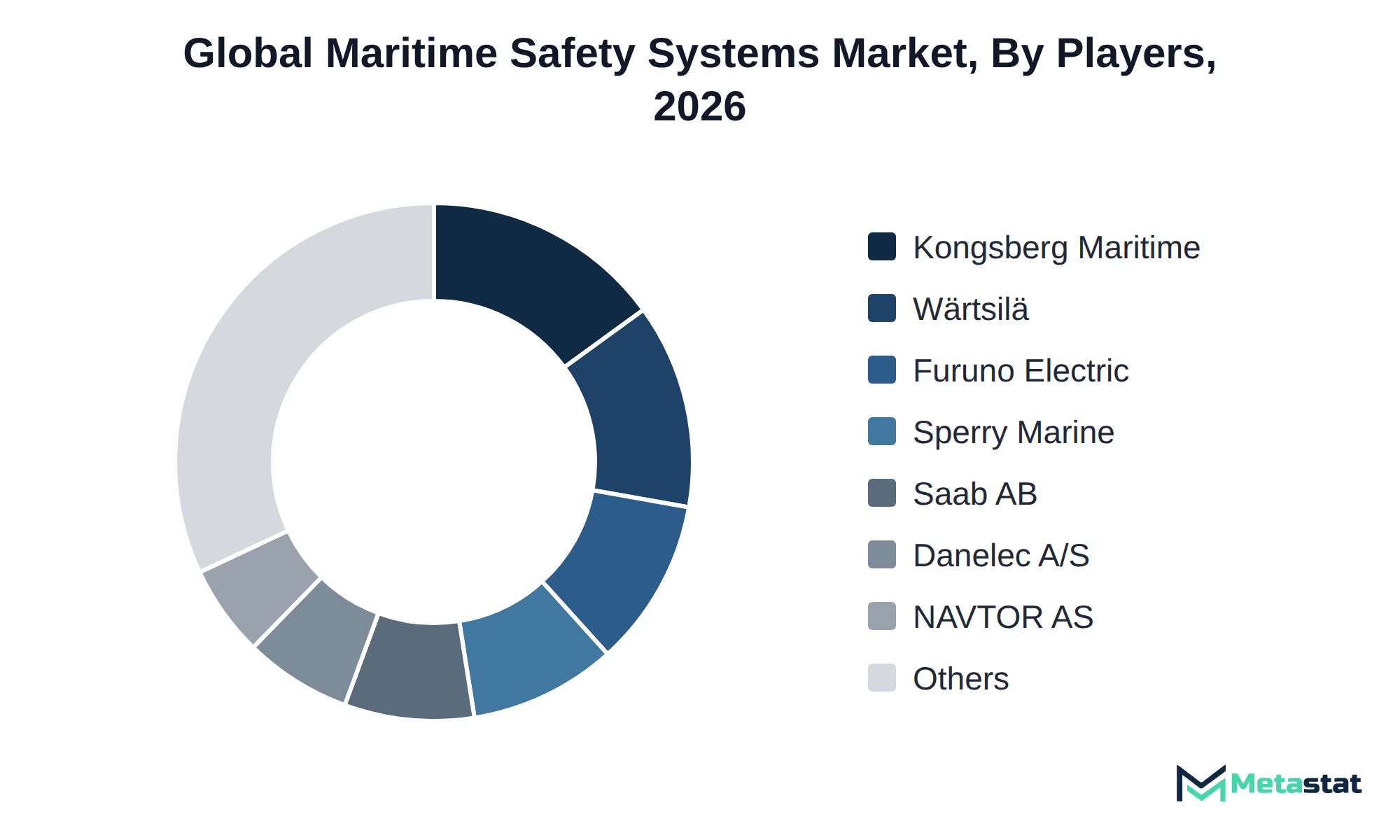
In the Maritime Safety Systems market, companies compete based on various factors including price, certification, customization, and service offerings. Strategic behavior varies among firms, focusing on hardware solutions while others emphasize software development. For example, Kongsberg Maritime prioritizes advanced navigation systems, while Wärtsilä Corporation enhances vessel traffic management solutions. Furuno Electric Co., Ltd. specializes in maritime communication technologies.
Buyers in the market select providers based on the ability to meet specific regulatory requirements and the availability of robust service support. Customization options play a significant role in decision-making, with companies like Saab AB offering tailored solutions for unique operational environments. Firms including Jotron AS and Viasat, Inc. (Inmarsat Maritime) leverage their ecosystems to provide integrated safety solutions that appeal to various end-use industries.
This growth depends on several key developments in the Maritime Safety Systems market. First, rising demand for advanced safety technologies across commercial shipping and government sectors supports growth. Second, a shift towards software solutions, anticipated to reach USD 19 billion by 2033, aligns with increasing digitalization within the maritime industry, particularly in monitoring and tracking applications.
However, potential risks could hinder this growth trajectory. Economic fluctuations affecting investment in maritime infrastructure, particularly in regions including South America and the Middle East and Africa, represent a significant concern. Reduced funding in these areas could impede expansion efforts and delay the adoption of innovative safety systems. Addressing these challenges will be crucial to ensuring the market achieves its forecasted growth.
By System Type: Navigation and Collision Prevention Systems, Vessel Traffic and Situational Awareness Systems, Maritime Communication and Distress Systems, Fire Detection and Suppression Systems, Life-Saving and Evacuation Systems, Safety Management and Training Systems, Others (Cybersecurity and Environmental Protection Systems)
By Offering: Hardware, Software, Services
By Application: Navigation and Collision Avoidance, Monitoring and Tracking, Emergency Response and Search and Rescue, Security and Safety Management, Fire and Hazard Protection, Others (Environmental Protection and Communication Management)
By End-Use Industry: Commercial Shipping, Ports and Terminals, Government and Defense, Offshore Energy, Passenger and Cruise Vessels, Others (Fishing and Recreational Vessels)
The report strategically identifies and profiles the key market players and analyses their core competencies in each sub-segment of the Maritime Safety Systems market.
Report Attributes | Details |
Study Period | 2021-2033 |
Base Year | 2025 |
Estimated Year | 2026 |
Forecast Period | 2026-2033 |
Historical Period | 2021-2025 |
Growth Rate | CAGR 11.1% from 2026 to 2033 |
Revenue Unit | USD billion |
Segmentation | By System Type, Offering, Application, End-Use Industry, and Region |
By Region | North America (By System Type, Offering, Application, End-Use Industry, and Country)
|
Europe (By System Type, Offering, Application, End-Use Industry, and Country)
| |
Asia Pacific (By System Type, Offering, Application, End-Use Industry, and Country)
| |
South America (By System Type, Offering, Application, End-Use Industry, and Country)
| |
Middle East and Africa (By System Type, Offering, Application, End-Use Industry, and Country)
|
Find answers to common questions about this report
The Maritime Safety Systems market size was valued at USD 34.1 billion in 2025.
The market is projected to grow at a CAGR of 11.1% during the forecast period from 2026 to 2033.
The North America Maritime Safety Systems market size is estimated to reach USD 23.7 billion by 2033.
Navigation and Collision Prevention Systems leads the Maritime Safety Systems market, with a projected value of USD 21.8 billion by 2033. This segment demonstrates the highest growth rate within the system type category, reflecting a compound annual growth rate of 12 percent.
Recent advancements in technology drive heightened demand for vessel traffic and situational awareness systems. Increased focus on safety standards and risk mitigation prompts buyers to invest in modern solutions that offer improved monitoring capabilities.
North America holds the dominant share of the Maritime Safety Systems market, with a projected value of USD 23.7 billion in 2033, representing 31.3 percent of the total market. This figure surpasses the shares of other regions, including Europe and Asia Pacific.
High costs associated with Maritime Safety Systems limit adoption among commercial shipping companies. Budget constraints lead to slower uptake of advanced safety solutions, causing firms to defer safety upgrades and hindering overall demand for new systems.
Recent technological advancements and increased emphasis on safety standards drive demand for enhanced maritime safety systems. The integration of innovative software and hardware solutions facilitates improved operational efficiency and safety compliance, encouraging adoption across commercial shipping and government sectors.
The Maritime Safety Systems market is estimated to reach a valuation of USD 79.5 billion by 2033.
Key players operating in the Maritime Safety Systems market include Kongsberg Maritime, Wärtsilä Corporation, Furuno Electric Co., Ltd., Sperry Marine, Saab AB, and Maritime Safety & Security Ltd.
The analysts below cover Aerospace and Defense research at Metastat Insights.
LEAD ANALYST
Utkarsh Khirodkar is a Lead Market Research Analyst at MetaStat Insight, specializing in market intelligence, technology sector assessments, and competitive strategy.
Our group needed clearer visibility into out-of-autoclave processing timelines for high-temperature thermoplastic composites. MetaStat Insight delivered an objective assessment that contrasted automated fiber placement scrap rates with traditional thermoset prepreg layup cycles. The supplier landscape mapped out primary resin suppliers and tape slitting capacity across France, Germany, and Japan with solid technical accuracy. Their analyst handled our questions on precursor supply risks during an unscheduled inquiry call, providing clear, unembellished context.
Evaluating sensor fusion reliability across harsh operating environments can be tricky without field-validated data. The study on agricultural autonomous guidance systems clearly separated stereo vision setups from automotive-grade solid-state LiDAR. We appreciated the regional infrastructure analysis, specifically around RTK network density across North America and South America. During our follow-up consultation, the MetaStat Insight team walked through tier-two perception software partnerships, giving our engineering leads a practical basis for vendor shortlisting.
Analyzing the transition from natural gas to green hydrogen in iron ore reduction requires realistic infrastructure timelines. Meta stat insight supplied a detailed regional assessment of DRI plant conversion costs and scrap metal availability in North America and Western Europe. Their report carefully examined pellet quality specs and electrical grid access constraints without making oversimplified market assumptions. The research material served as a practical reference during internal technology roadmap discussions.
Explore related market intelligence reports worth reading alongside this one.