
LEAD ANALYST
Utkarsh Khirodkar is a Lead Market Research Analyst at MetaStat Insight, specializing in market intelligence, technology sector assessments, and competitive strategy.

Middle East Customer Experience Management Market Size, Share, By Analytical Tools (EFM Software, Speech Analytics, Text Analytics and Others (Web Analytics & Content Management)), By Deployment Model (Cloud-Based and On-Premises), By End-Use Industry (Banking, Financial Services and Insurance, Telecommunications and Media, Retail and E-Commerce, Travel and Hospitality, Healthcare and Life Sciences, Government and Public Sector, Information Technology and Business Services, Manufacturing and Automotive, Energy and Utilities and Others (Education, Real Estate, Logistics)), By Region (Saudi Arabia, United Arab Emirates (UAE), South Africa, Egypt, Nigeria and Rest of Middle East), Industry Analysis, Growth, Trends, and Forecast, 2026-2033
Report ID
MSI-5765
Published
November, 2026
Pages
303 Pages
Format
Historical
Base year
Forecast
Forecast period
Report Details
Market Valuation: Valued at $810.6 Million in 2025, projected to reach $1,815.4 Million by 2033 at a 10.6% CAGR.
Dominant Segment: The analytical tools segment leads the market, driven by the demand for sophisticated software that optimizes customer feedback management and engagement.
Geographic Lead: Saudi Arabia holds the largest market share, supported by significant investments in digital transformation and customer-centric strategies.
What's Inside: The report provides a comprehensive analysis of market dynamics, competitive landscape, and detailed forecasts from 2026 to 2033, focusing on various segments and deployment models.
Emerging Trends: The increasing adoption of cloud-based solutions is transforming customer experience management, offering scalability and flexibility to businesses across sectors.
Sector Growth: The banking, financial services, and insurance segment is projected to grow significantly, reflecting the urgency for these industries to invest in technologies that enhance customer satisfaction.
Choose Your License
Middle East Customer Experience Management Market
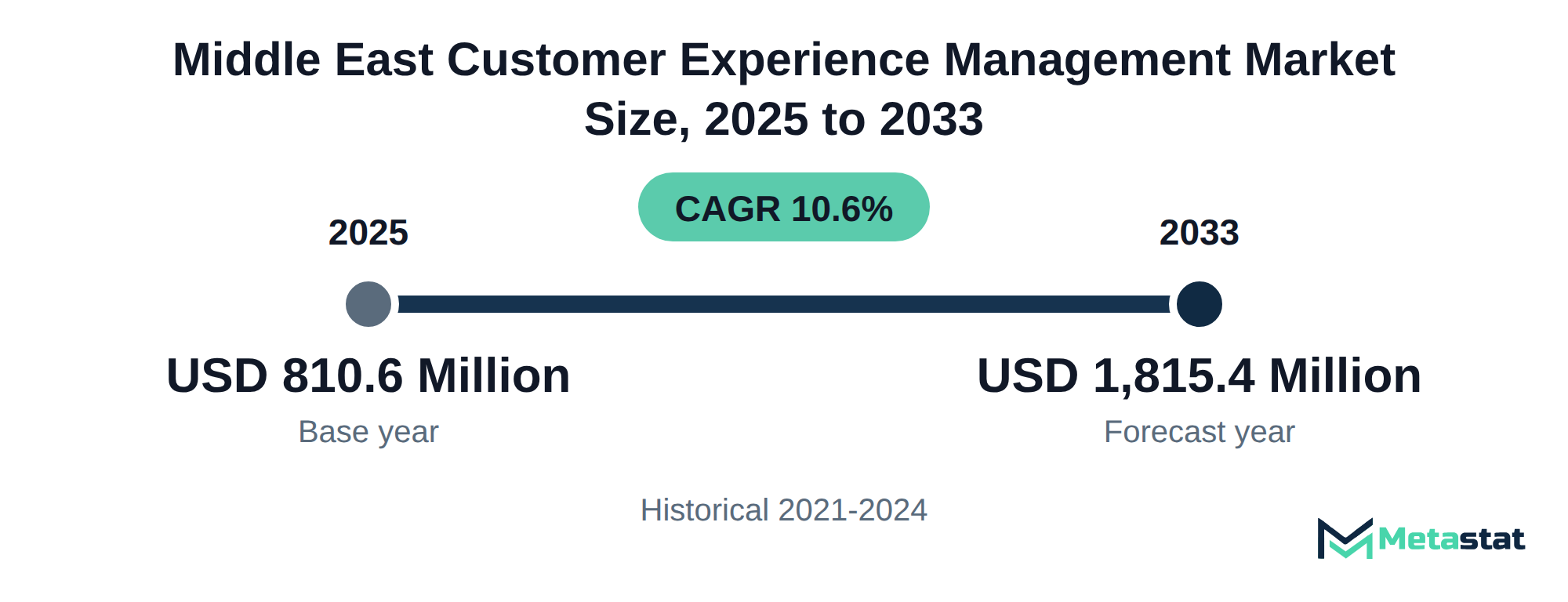
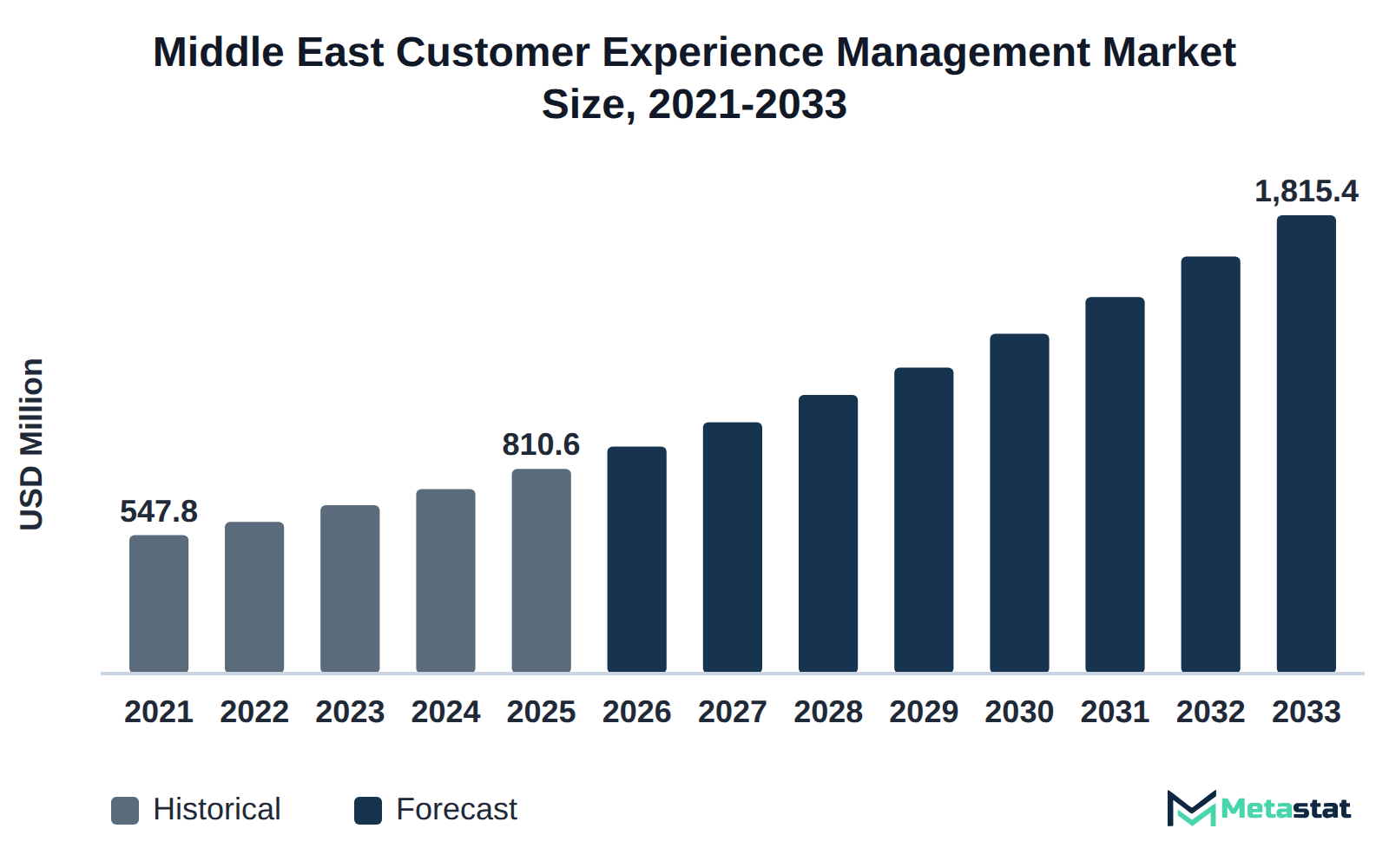
The Middle East Customer Experience Management market was valued at USD 810.6 million in 2025 and is projected to reach USD 1,815.4 million by 2033, growing at a CAGR of 10.6% over the forecast period.
The Middle East Customer Experience Management market encompasses a range of products and services designed to enhance customer interactions and improve overall satisfaction. Organizations invest in these solutions to build stronger relationships with their customers, resulting in increased loyalty and revenue. The focus on personalized experiences and data-driven insights drives buyers toward advanced analytics, enabling them to understand customer behavior and preferences effectively.
Growth in the market is propelled by the increasing adoption of cloud-based solutions, which streamline deployment and enhance scalability. The analytical tools segment commands the largest portion of market value, reflecting the demand for sophisticated software that optimizes customer feedback management and engagement. Among the regions, Saudi Arabia stands out with the largest share, supported by significant investments in digital transformation and customer-centric strategies.
Demand for customer experience management solutions continues to rise, driven by the necessity for companies to differentiate themselves in a competitive marketplace. Organizations across various sectors, including banking and telecommunications, prioritize customer experience initiatives to capture and retain market share effectively. This trend shows how central customer experience has become to business success, fueling further investment in new technologies.
Investment in the Middle East Customer Experience Management market reflects organizations' commitment to enhancing client interactions and optimizing service delivery. Buyers across various sectors, including banking, telecommunications, and retail, recognize the value of effective customer experience solutions in building loyalty and driving revenue growth. Advanced analytics and tailored service offerings have become essential to meeting customer expectations.
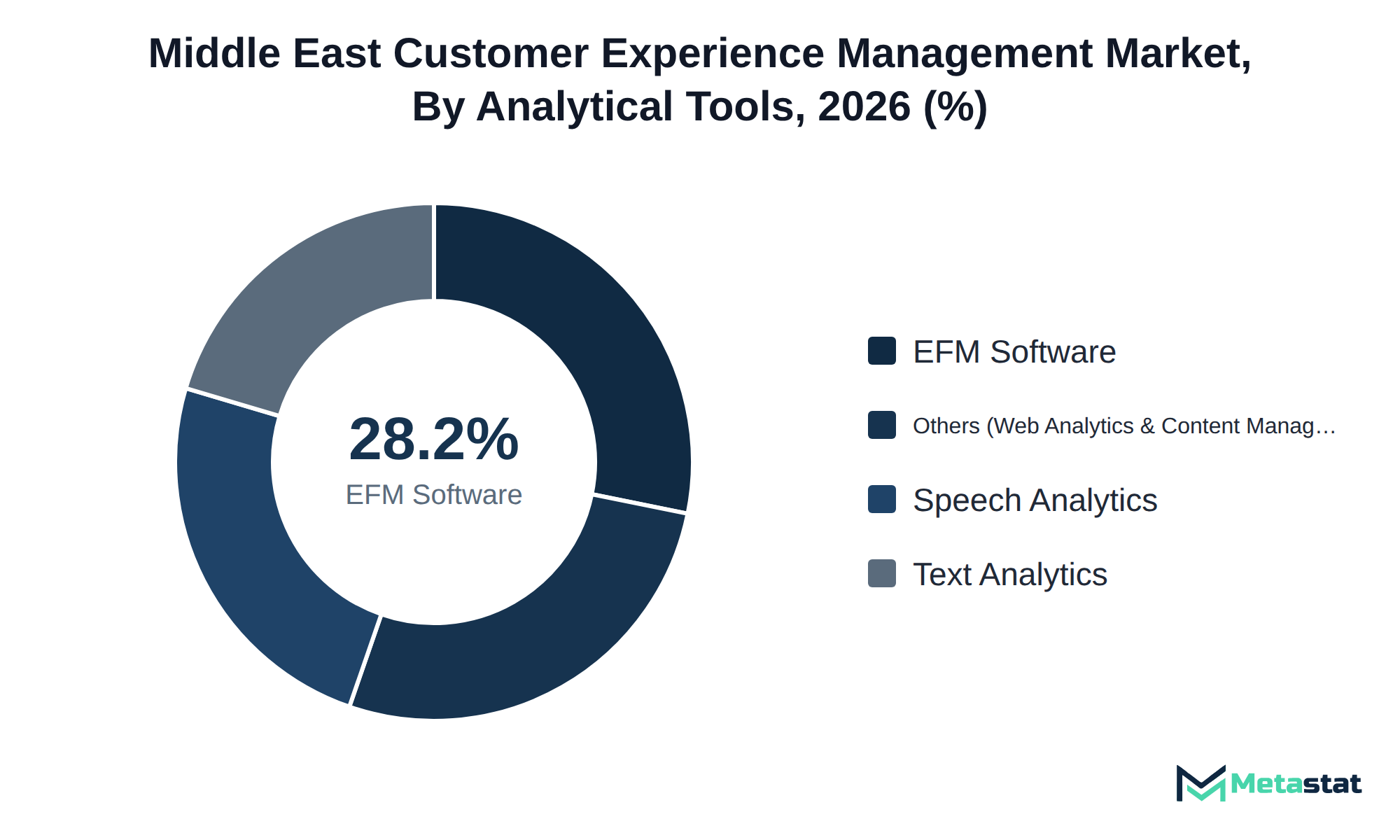
Growth in the market is primarily driven by the increasing adoption of cloud-based solutions, which offer scalability and flexibility. Among the different segments, EFM (Enterprise Feedback Management) Software stands out with significant value, projected to grow from USD 252.7 million in 2026 to USD 492.5 million by 2033. The region of Saudi Arabia holds the largest market share, reflecting robust investment in customer experience initiatives across various industries.
Strategic focus on data-driven insights and personalized customer interactions is reshaping the competitive landscape. Organizations increasingly turn to advanced analytical tools to enhance their service offerings, leading to improved customer satisfaction and loyalty. Innovation therefore remains central to sustained market growth through 2033.
The adoption of cloud-based customer experience platforms is transforming the operational landscape for businesses within the Middle East Customer Experience Management market. This shift allows organizations to access advanced features without significant upfront investments in infrastructure. Cloud-based solutions facilitate scalability and flexibility, enabling firms to adapt quickly to changing market demands.
The cloud-based deployment model is projected to grow from USD 592.5 million in 2026 to USD 1,285.7 million by 2033, reflecting a compound annual growth rate of 11.7%. This growth is driven by the increasing need for businesses to provide effective omnichannel engagement across various customer touchpoints. Companies that leverage cloud platforms enhance their service delivery, leading to improved customer satisfaction and loyalty.
AI-driven technologies integrated into these platforms offer sophisticated analytics capabilities and personalization features, allowing businesses to engage customers more effectively. This technological advancement reduces operational costs and enhances the overall customer experience. As firms continue to invest in these solutions, market demand is expected to strengthen significantly.
Speech and text analytics significantly influence purchasing behaviors in the Middle East Customer Experience Management market. Organizations increasingly seek tools that enhance customer insights and enable personalized interactions. A growing emphasis on data-driven decision-making drives this shift, with companies aiming to optimize their customer engagement strategies.
The demand for speech analytics is projected to reach USD 461.5 million by 2033, reflecting a compound annual growth rate (CAGR) of 11.2%. This substantial market growth indicates a strong preference among buyers for solutions that provide deeper insights into customer preferences and behaviors. Buyers prioritize analytics capabilities, leading to the evolution of pricing models associated with these solutions. Subscription-based pricing has emerged as a common approach, offering flexibility and scalability to clients.
Contract models often include tiered pricing structures, enabling organizations to select packages that align with their specific needs. This structure allows businesses to manage costs effectively while accessing advanced analytics tools. Vendors with competitive pricing strategies therefore broaden their appeal across sectors and position themselves well for sustained growth.
Adoption of advanced customer experience solutions significantly impacts the banking, telecommunications, and retail sectors. Retailers increasingly prioritize these solutions to enhance customer interactions and boost loyalty. In the Middle East Customer Experience Management market, the banking, financial services, and insurance segment is projected to grow from USD 200.2 million in 2026 to USD 394.5 million by 2033, reflecting a compound annual growth rate (CAGR) of 10.2%. This growth highlights the urgency for these industries to invest in technologies that improve customer satisfaction.
Telecommunications companies face fierce competition, prompting them to adopt innovative solutions that enhance customer engagement. By leveraging advanced analytics and real-time feedback, these firms develop tailored services that meet evolving customer expectations. The retail sector, with its diverse customer base, benefits from insights gained through customer experience management tools that allow for targeted marketing strategies, including digital advertising, and personalized offerings.
Advanced customer experience solutions position these industries to capture greater market share and drive revenue growth. Businesses in the Middle East investing in these technologies enhance their competitive edge, ensuring long-term success in a rapidly changing marketplace.
Artificial Intelligence (AI) is transforming customer experience management strategies across the Middle East. The implementation of enterprise artificial intelligence technologies enhances analytical capabilities, enabling organizations to process vast amounts of customer data more efficiently. This marks a significant shift in how businesses use AI to understand customer sentiment and behavior.
AI-driven tools facilitate real-time insights, allowing companies to tailor their services to meet evolving customer expectations. Enhanced engagement through personalized interactions strengthens customer loyalty, which is crucial in competitive industries including telecommunications and media. The adoption of AI technologies in these sectors results in improved service delivery and operational efficiency, ultimately driving revenue growth.
The integration of AI within customer experience management frameworks positions companies to respond proactively to market changes. Organizations that prioritize AI adoption are likely to gain a competitive edge, enhancing their ability to innovate and maintain customer satisfaction. The Middle East Customer Experience Management market is expected to expand significantly, driven by the growing reliance on AI technologies across various industries.
Investment in analytical tools drives significant growth in customer experience management. Businesses, particularly in the banking, financial services, and telecommunications sectors, increasingly seek advanced analytics to enhance customer engagement and retention. The shift toward data-driven decision-making stems from the necessity to understand customer preferences and behavior better. This demand results in higher volumes of analytics software purchases, reflecting a strong market trend. The focus on analytics enables organizations to tailor services and improve overall customer satisfaction, establishing a competitive edge in the market.
Cloud-based customer experience solutions facilitate enhanced service delivery and operational efficiency in the Middle East Customer Experience Management market. This technological shift supports scalability, allowing businesses to adapt rapidly to changing customer expectations and market demands. The rising trend toward remote work and digital interactions drives organizations to embrace cloud solutions, increasing investment in this area. Companies across various sectors, including banking and telecommunications, benefit from improved data accessibility and streamlined workflows, resulting in significant cost savings and increased productivity.
The anticipated growth of cloud-based solutions reflects a broader movement toward digital transformation within the region. This transition influences customer engagement strategies, compelling organizations to invest in technologies that offer real-time insights and analytics. The cloud-based model enables businesses to enhance personalization and customer satisfaction while minimizing infrastructure costs. Adoption rates continue to climb, and the market is expected to experience accelerated growth, underpinned by an ongoing commitment to enhancing customer interactions.
Price sensitivity among organizations in the Middle East Customer Experience Management market restrains the growth of advanced solutions. Many businesses in the banking and telecommunications sectors face budget constraints that hinder their ability to invest in effective customer experience management tools. Uptake of these solutions is slower, and orders are smaller. Companies often prioritize essential functionalities over comprehensive systems, leading to a fragmented approach that fails to fully optimize customer interaction capabilities. Consequently, this restriction impacts the overall effectiveness of service delivery and client satisfaction. The gap in financial resources leads to delayed replacement of outdated systems, further obstructing progress in enhancing customer experience strategies. The emphasis on cost efficiency among buyers limits the market potential for growth and innovation, ultimately affecting the competitive landscape.
Challenges arise from escalating talent costs within the Middle East Customer Experience Management market. Organizations strive to maintain a skilled workforce while navigating competitive compensation demands. This increase in operational expenses impacts profit margins, particularly for service providers focused on delivering high-quality customer experiences. Suppliers respond by investing in training programs and adopting intelligent automation technologies to enhance efficiency and reduce dependence on labor-intensive processes.
Firms explore strategic partnerships and business process outsourcing options to alleviate the financial pressure of securing skilled personnel. The transition toward automated solutions not only addresses talent shortages but improves service delivery capabilities. This shift allows organizations to allocate resources more effectively and focus on innovation. Overall, managing talent costs remains a critical challenge for suppliers aiming to sustain profitability in the market.
The deployment of cloud-based solutions within the market represents a significant growth opportunity, driven by increasing demand for scalable and flexible customer experience management tools. This growth reflects organizations' shift towards embracing digital transformation, enhancing customer interactions, and improving service delivery efficiency. The flexibility and cost-effectiveness of cloud-based platforms appeal to various industries, including banking and telecommunications, which prioritize robust customer engagement strategies. Consequently, businesses increasingly invest in cloud solutions to streamline operations and improve customer satisfaction, indicating a strong trajectory for the market. The expansion of cloud-based offerings aligns with evolving consumer expectations, emphasizing the necessity for organizations to adapt to digital advancements.
The Middle East Customer Experience Management market is segmented based on Analytical Tools, Deployment Model, End-Use Industry, and Region.
This software enhances customer feedback management through various channels, allowing organizations to capture, analyze, and respond to customer insights effectively. Businesses across sectors including banking, telecommunications, and retail leverage EFM software to improve customer engagement and satisfaction. A growing emphasis on data-driven decision-making fuels demand for this segment, supported by the increasing need for organizations to improve their customer experience. Compared to other analytical tools, EFM software experiences steady growth, driven by its unique focus on feedback management, while segments including speech analytics show even higher growth rates at 11.2%. Investment in EFM software positions organizations to respond proactively to customer needs, thus enhancing competitiveness in the market.
This segment uses voice analytics to extract insights from spoken interactions, enhancing customer service efficiency and decision-making for industries including telecommunications and financial services. Organizations apply this technology to analyze customer sentiments and improve service quality. Demand for Speech Analytics is driven by the increasing emphasis on customer satisfaction and the need to streamline operations through automation. Compared to other analytical tools, including EFM Software, which has a CAGR of 10%, Speech Analytics experiences faster growth. This growth is attributed to the growing importance of voice interactions in service delivery, making it a vital component in the Middle East Customer Experience Management market.
The Text Analytics segment is expected to reach USD 388 million by 2033. This segment focuses on deriving insights from unstructured text data through natural language understanding and other analytical methods, primarily used by organizations to enhance customer engagement and satisfaction. Key adopters include the banking, telecommunications, and retail industries, where understanding customer sentiment and preferences is crucial. Growth in this area is driven by the increasing volume of customer-generated text data, prompting companies to invest in advanced analytics solutions. Compared to other analytical tools, Text Analytics exhibits growth at a moderate pace, supported by a compound annual growth rate (CAGR) of 11.2%, which outpaces several segments but remains lower than that of Speech Analytics at 11.2%. The growing emphasis on personalized customer experiences highlights the strategic importance of text analytics, promoting ongoing demand within the market.
Others (Web Analytics & Content Management) segment is projected to grow at a CAGR of 10.1% during the forecast period. This segment focuses on tools and software that facilitate the analysis and management of web content and user interactions, catering to organizations seeking to enhance digital customer experiences. Companies in sectors like retail, telecommunications, and hospitality leverage these tools to better understand consumer behavior and optimize content strategies. Increasing demand for data-driven insights and personalized content drives growth in this segment. Compared to other analytical tool segments, Others (Web Analytics & Content Management) experiences moderate growth, with a CAGR lower than Speech Analytics at 11.2% but higher than On-Premises deployment models, which grow at 8.1%. This positioning reflects pricing and technology developments that align with evolving consumer preferences and organizational requirements for digital engagement.
Cloud-based customer experience management is used by industries that prioritize efficient customer engagement and service delivery. The increasing demand for scalable solutions drives growth in this segment, with organizations seeking flexibility and cost-effectiveness in their operations. Cloud-Based solutions differ from On-Premises models, which grow at a lower CAGR of 8.1%. The ability to easily adapt to changing customer needs positions Cloud-Based solutions as a preferred choice among businesses, enhancing customer experience management strategies significantly. Adoption among the banking and telecommunications sectors highlights the growing reliance on cloud technology for real-time data analytics and customer insights.
On-Premises segment is estimated to reach USD 529.7 million by 2033, at a CAGR of 8.1% during the forecast period. This deployment model primarily serves organizations that require control over their customer experience management systems, including those in sectors including banking, telecommunications, and retail. Adoption of on-premises solutions is often driven by the necessity for enhanced security and compliance with strict regulations, which is particularly pertinent in the banking and financial services industry. Compared to the cloud-based segment, which exhibits a higher CAGR of 11.7%, the on-premises model presents a slower growth trajectory. Price sensitivity in this segment affects the willingness of businesses to invest in on-premises solutions, impacting overall market dynamics in the Middle East Customer Experience Management market.
This segment serves financial institutions, insurance companies, and investment firms, focusing on enhancing customer interactions and satisfaction. A significant driver of growth stems from the increasing emphasis on personalized services and improved customer engagement. Regulatory requirements further compel organizations to adopt advanced customer experience solutions, ensuring compliance while enhancing loyalty and retention. Compared to other segments, this segment demonstrates steady growth, with a CAGR of 10.2%, aligning closely with the overall trends observed in the market. The emphasis on digital transformation and data-driven strategies distinguishes this segment, highlighting its unique approach to addressing customer needs and expectations.
Telecommunications and Media segment is estimated to reach USD 287.2 million by 2033, at a CAGR of 10.2% during the forecast period. This segment serves telecommunications providers and media companies focusing on enhancing customer interactions through innovative solutions. Demand for customer experience management solutions within this segment is driven by increasing competition and the necessity for personalized customer engagement. Unlike other sub-segments, the Telecommunications and Media segment experiences higher growth due to rapid adoption of digital technologies, enabling these companies to analyze customer behavior and improve service offerings. The ongoing shift toward cloud-based solutions further contributes to this growth, ensuring scalability and flexibility in service delivery.
Retail and E-Commerce segment is expected to reach USD 259.1 million by 2033. This segment focuses on enhancing customer interactions across various retail platforms, primarily driven by businesses aiming to improve customer satisfaction and loyalty. Factors driving growth in this segment include increasing reliance on digital shopping experiences and the need for personalized customer engagement. Retailers leverage Customer Experience Management tools to analyze customer data, optimize marketing strategies, and streamline operations. Compared to other segments, this segment shows a competitive growth trajectory, influenced by evolving consumer preferences and technological advancements. The specific dynamics in retail differ from sectors including banking and telecommunications, where regulations impose additional constraints. Retail and E-Commerce stands out with its emphasis on real-time data analytics to drive sales and enhance service delivery within the market.
Travel and Hospitality segment is projected to grow at a CAGR of 11.7% during the forecast period. This segment focuses on enhancing customer interactions within travel agencies, hotels, and other hospitality services. Organizations in this sector apply customer experience management tools to improve service quality and boost customer satisfaction. Increasing travel demand and heightened competition among service providers drive growth in this segment. Unlike other segments, including Banking, Financial Services and Insurance, which exhibit a CAGR of 10.2%, the Travel and Hospitality segment demonstrates a faster growth trajectory, reflecting evolving consumer expectations and the rising importance of personalized services. Investments in smart hospitality technology to streamline customer interactions and provide tailored experiences significantly contribute to this growth.
The Healthcare and Life Sciences segment represents a vital area of focus within the market, driven by the increasing requirement for patient engagement and satisfaction. Organizations in this sector seek advanced Customer Experience Management solutions to enhance service quality and streamline operations. Factors influencing growth include the rising emphasis on personalized care and digital transformation initiatives that healthcare providers undertake. Compared to other segments, this area experiences slower growth due to regulatory pressures and the complexity of healthcare services. However, the continual push for improved patient outcomes drives demand for innovative technologies that enhance the overall customer experience in healthcare settings.
The Government and Public Sector focuses on enhancing service delivery, transparency, and engagement through customer experience management solutions. Government agencies use these solutions for better citizen interaction, performance measurement, and public satisfaction. The increasing demand for improved service quality drives this segment, with a notable focus on adopting digital transformation initiatives. Regulatory pressures for enhanced public accountability further emphasize the segment's importance. Compared to other segments, the Government and Public Sector experiences slower growth rates, driven by budget constraints and traditional procurement processes that differ from the more agile private sector. While the market expands, government entities often face unique challenges related to legacy systems and the integration of new technologies. Consequently, the dynamics of the Government and Public Sector segment present distinct opportunities for tailored customer experience management solutions that cater specifically to public needs.
The Information Technology and Business Services segment focuses on improving operational efficiency and customer satisfaction through tailored solutions. Companies within this segment primarily apply customer experience management tools for process automation, data analytics, and customer interaction improvement. The growing focus on digital transformation drives organizations to adopt innovative strategies to meet evolving customer expectations. This segment exhibits a higher demand for advanced analytics compared to others, reflecting the necessity for data-driven insights. The importance of compliance and security protocols in this sector introduces unique challenges, differentiating it from segments including Telecommunications and Media, which face varied operational dynamics. Sustained investment in technology infrastructure reinforces its distinct position within the broader Middle East Customer Experience Management market.
Manufacturing and Automotive involves the application of customer experience management strategies tailored to enhance operational efficiency and customer satisfaction within production environments. Organizations in this sector leverage these solutions to optimize processes, improve product quality, and strengthen customer relationships. Demand for advanced analytics and automation in production lines drives growth in this segment. The sector demonstrates unique characteristics compared to others, particularly in its focus on optimizing manufacturing processes while ensuring customer feedback directly influences product development. This segment faces different adoption barriers, including the complexity of integrating new solutions into existing production systems. The market is evolving, with technological advancements supporting better integration and responsiveness to customer needs.
The Energy and Utilities segment focuses on managing customer experiences specific to energy providers and utility companies. These organizations employ customer experience management solutions to enhance service delivery, streamline operations, and improve customer satisfaction. Demand for advanced analytics and data-driven insights drives this segment, with energy companies seeking to optimize performance and meet regulatory requirements. This segment operates differently from others, emphasizing a higher focus on regulatory compliance and operational efficiency. The market's distinctive characteristics include a varied pricing structure driven by project scale and complexity. This segment stands apart from others due to its unique requirements related to energy consumption patterns and infrastructure management. Stakeholders in this segment include energy suppliers, utility companies, and regulatory bodies that benefit from enhanced customer engagement and operational transparency, ultimately leading to more efficient service delivery within the Middle East Customer Experience Management market.
This segment involves customer experience management tailored specifically for education, real estate, and logistics sectors. Educational institutions apply these solutions to enhance student engagement and streamline administrative processes. Real estate companies leverage customer experience tools to improve client interactions and build long-term relationships. In logistics, effective customer experience management facilitates better communication and operational efficiencies.
Growing demand for personalized services drives the expansion of this segment, with educational institutions and real estate firms focusing on improving client satisfaction. These sectors face distinct challenges compared to others in the market, including the need for tailored solutions that address specific operational requirements. Growth in this segment differs from faster-growing areas, reflecting unique buyer behaviors and pricing strategies. The Middle East Customer Experience Management market is expected to evolve, adapting to the nuances of these diverse industries.
Saudi Arabia segment is valued at USD 228.5 million in 2026 and is projected to reach USD 473.7 million by 2033, at a CAGR of 11% during the forecast period. This segment primarily supports businesses in enhancing customer engagement and satisfaction through various tools and technologies. The demand for customer experience management solutions is driven by the increasing need for personalized services and real-time feedback mechanisms, particularly in sectors including banking and telecommunications. Compared to other segments, this segment demonstrates significant growth, outpacing certain categories due to rapid digital transformation within the region. With a projected CAGR of 11%, Saudi Arabia's segment highlights its important role in the Middle East Customer Experience Management market, positioning itself as a key player in shaping customer interactions and service delivery.
United Arab Emirates (UAE) segment is estimated to reach USD 408.3 million by 2033, at a CAGR of 11.3% during the forecast period. This segment plays a critical role in enhancing customer interactions across various industries, particularly in retail, telecommunications, and banking. Businesses apply customer experience management solutions to optimize customer engagement and satisfaction. Accelerated digitalization within the UAE drives demand, reflecting a strong consumer preference for effective interactions. Compared to other segments, this segment enjoys a higher growth rate, driven by the increasing adoption of cloud-based solutions and advanced analytics tools. The market aligns with regional trends seeking enhanced service delivery and customer insights.
South Africa segment is expected to reach USD 230.4 million by 2033. This segment focuses on customer experience management solutions employed by various sectors, including telecommunications, retail, and financial services. The increasing demand for improved customer interactions drives growth in this area, with companies seeking to enhance engagement and satisfaction. South Africa experiences a unique dynamic due to its diverse economic landscape, which influences the adoption of customer experience technologies. Compared to other regions, this segment exhibits slower growth, with significant growth rates observed in Saudi Arabia and the United Arab Emirates (UAE). The market encourages investment in analytical tools and cloud-based solutions, ensuring organizations remain competitive and responsive to customer needs.
Egypt is projected to grow at a CAGR of 11.5% during the forecast period. This segment focuses on providing customer experience management solutions tailored for various sectors, including retail, telecommunications, and healthcare. Organizations in Egypt leverage these solutions to enhance customer engagement and satisfaction, driven by a growing emphasis on digital transformation and service personalization. The retail sector particularly benefits from customer experience management, with businesses seeking to cultivate loyalty and attract a more diverse clientele. While the growth rate reflects a robust trajectory, the segment distinguishes itself with unique challenges, including fluctuating economic conditions and varying levels of technological adoption compared to regional peers. In the context of the Middle East Customer Experience Management market, investments in training and technology integration play critical roles in shaping the competitive environment.
Nigeria's customer experience management landscape serves various industries focused on enhancing customer interactions and satisfaction. This segment is used by businesses in telecommunications, retail, and government sectors to improve engagement with their customers. Demand is driven by the increasing emphasis on personalized services and competitive differentiation. Challenges include limited technological infrastructure and budget constraints, which hamper the adoption of advanced customer experience solutions. Differentiating from other regions, Nigeria's market dynamic reflects a unique blend of emerging technologies and localized customer preferences, impacting the overall strategy for businesses aiming to improve service quality. The Middle East Customer Experience Management market incorporates diverse regional characteristics, with Nigeria presenting distinct challenges and opportunities in its development trajectory.
The Rest of Middle East segment encompasses a diverse range of industries adopting customer experience management solutions tailored to local needs. Organizations in sectors including telecommunications, retail, and government increasingly prioritize enhancing customer engagement and satisfaction through these technologies. Demand in this region is driven by the growing emphasis on digital transformation and the quest for personalized customer interactions. Factors influencing this segment include advancements in technology and rising consumer expectations, which necessitate innovative approaches to customer experience. This sub-segment experiences differing growth dynamics compared to more mature markets, reflecting unique challenges and opportunities in the local context. The Middle East Customer Experience Management market presents a broad spectrum of capabilities to address these evolving demands, reflecting its adaptability and potential to cater to varied consumer requirements.
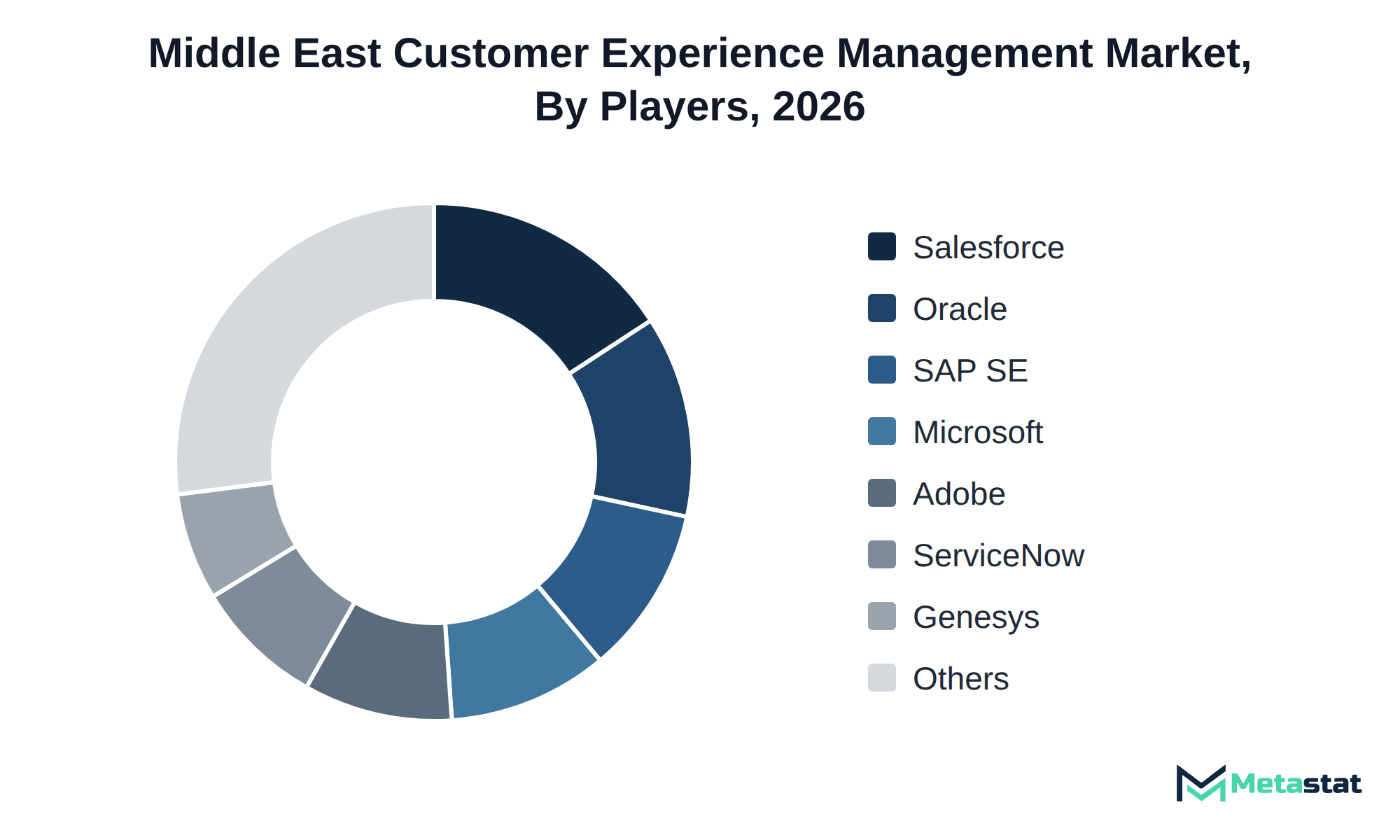
The Middle East Customer Experience Management market features intense competition among key players, including Salesforce, Inc., Oracle Corporation, SAP SE, and Microsoft Corporation. Companies differentiate themselves through a mix of pricing strategies, customization options, and the breadth of services offered. Buyers prioritize factors including service quality, ecosystem compatibility, and certification standards when selecting providers.
Salesforce, Inc. emphasizes cloud-based solutions that enable integration with other systems, targeting businesses seeking scalability and efficiency. Oracle Corporation focuses on comprehensive analytics and data management, appealing to customers in industries with high data processing needs. In contrast, Adobe Inc. offers tailored solutions that enhance customer engagement, highlighting its strengths in creative software and marketing automation.
The competitive environment extends to firms like Genesys and Zendesk, which cater to customer support and engagement needs, highlighting their capabilities in real-time communication and customer interaction. ServiceNow, Inc. leverages its IT service management expertise to provide innovative solutions for improving customer experiences across various sectors.
Enhanced customer engagement through advanced analytical tools, particularly in speech analytics, supports growth. Regional demand from markets including Saudi Arabia and the United Arab Emirates is critical, with their respective CAGRs of 11% and 11.3% contributing significantly to overall growth. Risk factors, including economic fluctuations and competition among suppliers, could hinder market progress. These conditions make strategic investment in customer experience solutions important for industries across the region.
By Analytical Tools: EFM Software, Speech Analytics, Text Analytics, Others (Web Analytics & Content Management)
By Deployment Model: Cloud-Based, On-Premises
By End-Use Industry: Banking, Financial Services and Insurance, Telecommunications and Media, Retail and E-Commerce, Travel and Hospitality, Healthcare and Life Sciences, Government and Public Sector, Information Technology and Business Services, Manufacturing and Automotive, Energy and Utilities, Others (Education, Real Estate, Logistics)
By Region: Saudi Arabia, United Arab Emirates (UAE), South Africa, Egypt, Nigeria, Rest of Middle East
The report strategically identifies and profiles the key market players and analyses their core competencies in each sub-segment of the Customer Experience Management market.
Report Attributes | Details |
Study Period | 2021-2033 |
Base Year | 2025 |
Estimated Year | 2026 |
Forecast Period | 2026-2033 |
Historical Period | 2021-2025 |
Growth Rate | CAGR 10.6% from 2026 to 2033 |
Revenue Unit | USD million |
Segmentation | By Analytical Tools, Deployment Model, End-Use Industry, Region, and Region |
Find answers to common questions about this report
The Customer Experience Management market size was valued at USD 810.6 million in 2025.
The market is projected to grow at a CAGR of 10.6% during the forecast period from 2026 to 2033.
The leading segment in the Customer Experience Management market is Cloud-Based deployment, with a projected value of USD 1,285.7 million by 2033. This segment outpaces the On-Premises deployment model, which is expected to reach USD 529.7 million in the same year.
Investment in analytical tools drives significant growth in customer experience management, particularly in the banking, financial services, and telecommunications sectors. The deployment of cloud-based solutions represents a significant growth opportunity, enhancing customer interactions and improving service delivery efficiency.
Price sensitivity among organizations in the Middle East Customer Experience Management market restrains the growth of advanced solutions. Escalating talent costs present a challenge, impacting profit margins and leading to increased operational expenses for service providers focused on delivering high-quality customer experiences.
Key factors favoring adoption in the Middle East Customer Experience Management industry include the rising demand for scalable cloud-based solutions and the shift towards digital transformation. Organizations prioritize enhanced service delivery efficiency and improved customer interactions, driving investment in advanced analytics and customer experience management tools.
The Customer Experience Management market is estimated to reach a valuation of USD 1,815.4 million by 2033.
Key players operating in the Customer Experience Management market include Salesforce, Inc., Oracle Corporation, SAP SE, Microsoft Corporation, Adobe Inc., and ServiceNow, Inc.
The cloud-based segment is projected to grow at a CAGR of 11.7% from 2026 to 2033, increasing from USD 592.5 million to USD 1,285.7 million during this period.
The banking, financial services, and insurance sector demonstrates substantial investment in customer experience management, with a projected growth from USD 200.2 million in 2026 to USD 394.5 million by 2033.
The analysts below cover Information & Technology research at Metastat Insights.
LEAD ANALYST
Utkarsh Khirodkar is a Lead Market Research Analyst at MetaStat Insight, specializing in market intelligence, technology sector assessments, and competitive strategy.

PRINCIPAL CONSULTANT - ENTERPRISE AI & EMERGING TECHNOLOGIES
Banking & Finance · Electronics and Semiconductor · Energy and Power · Healthcare IT · Information & Technology · Professional Services
Vijay Gunti is a Principal Consultant at MetaStat Insight, bringing over two decades of experience across enterprise digital transformation, technology strategy, and intelligent systems.

LEAD CONSULTANT - COMMUNICATION, TELECOM, AND IT
Electronics and Semiconductor · Information & Technology · Machinery & Equipment · Professional Services
Ravindra Sathe Consultants for Communication, Telecom, and IT at MetaStat Insight. He leads the firm's industry research initiatives across telecommunications infrastructure, digital connectivity, enterprise networking, and emerging information technology domains.
Tracking maintenance cycle demand for secondary flight display units and terrain collision avoidance systems across regional jet fleets involves complex aftermarket dynamics. MetaStat Insight provided practical analysis separating airline retrofit programs from OEM forward-fit production schedules in North America and Southeast Asia. The supplier matrix highlighted component obsolescence timelines without resorting to vague generalizations. The dataset served as a dependable reference during our annual program review meetings.
Evaluating secondary resin quality across post-consumer packaging streams requires reliable technical segmentation. MetaStat Insight delivered an objective assessment that distinguished between extrusion-grade flake pricing and optical sorting throughput limitations across Western Europe. The competitive positioning breakdown for licensed depolymerization technology providers answered several questions during our feedstock feasibility audit. Their team clarified regional trade restrictions on mixed plastic scrap quickly when our team submitted follow-up requests.
Evaluating sovereign cloud deployments for core banking platforms demands a clear view of data residency regulations and migration exit strategies. MetaStat Insight delivered an exhaustive review of regional latency tolerances, mainframe decommission milestones, and third-party vendor concentration risk. The regulatory compliance mapping across European and Asian financial jurisdictions gave our team a dependable baseline for multi-cloud infrastructure discussions.
Explore related market intelligence reports worth reading alongside this one.
Starting from
$2950