
LEAD ANALYST
Utkarsh Khirodkar is a Lead Market Research Analyst at MetaStat Insight, specializing in market intelligence, technology sector assessments, and competitive strategy.

Global HTML5 Games Market Size, Share, By Game Genre (Puzzle Games, Arcade Games, Action and Adventure Games, Strategy Games, Role-Playing Games, Sports and Racing Games, Card and Board Games, Simulation Games), By Device Type (Smartphones, Computers, Tablets), By Rendering Type (2D Games, 3D Games), By Revenue Stream (In-Game Advertising, In-Game Purchases, Subscriptions, Paid Game Access, Business Licensing and Sponsorship), Industry Analysis, Growth, Trends, and Forecast, 2026-2033
Report ID
MSI-2434
Published
November, 2026
Pages
258 Pages
Format
Historical
Base year
Forecast
Forecast period
Report Details
Market Valuation: Valued at $4,006.3 Million in 2025, projected to reach $7,593.1 Million by 2033 at a 8.3% CAGR.
Dominant Segment: The Puzzle Games segment leads the market, projected to reach USD 1,775.3 million by 2033, driven by consumer preference for engaging yet accessible gameplay.
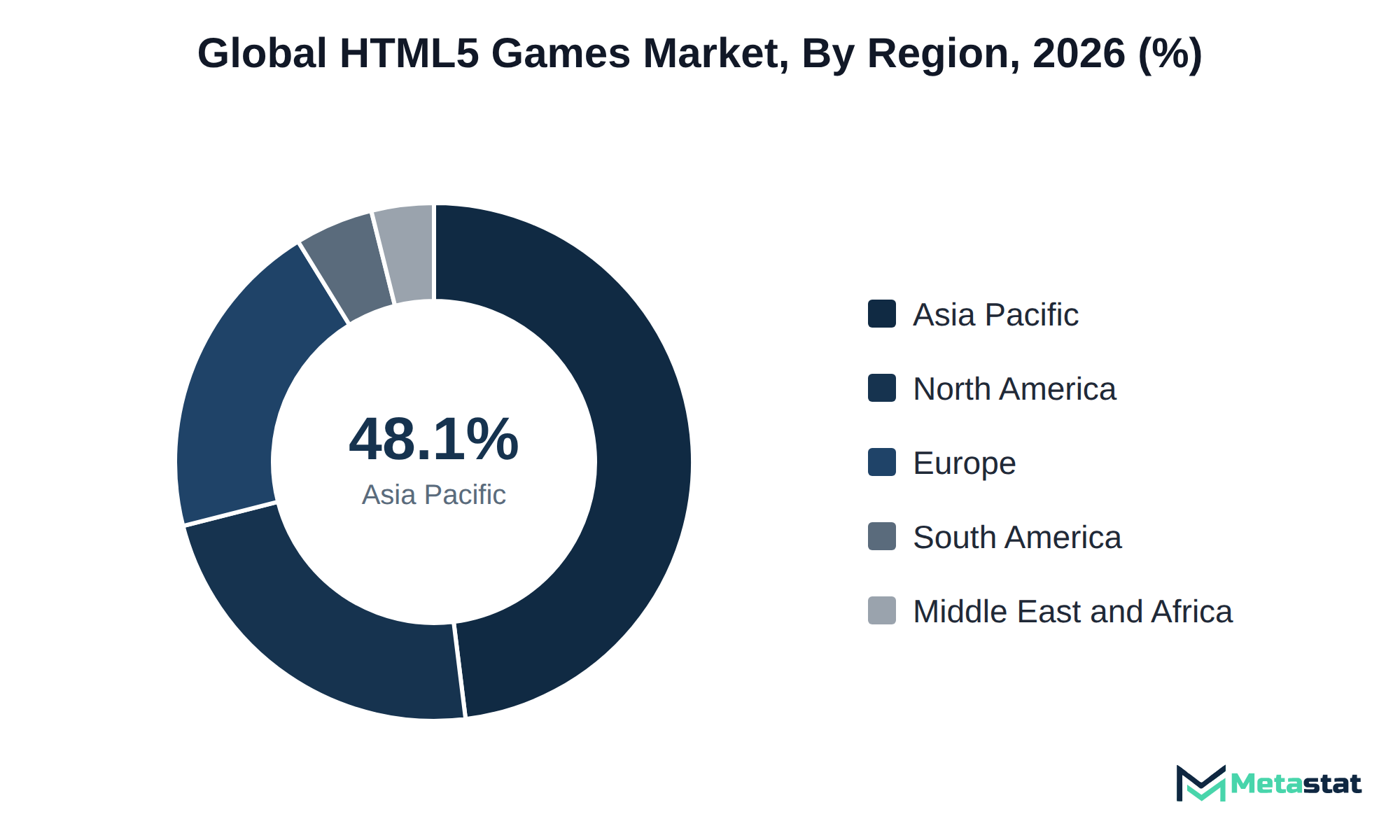
Geographic Lead: Asia Pacific holds a dominant market share at 48.1%, supported by the region's high smartphone penetration and growing demand for mobile gaming.
What's Inside: The report provides comprehensive coverage of market dynamics, competitive analysis, and detailed forecasts from 2026 to 2033, focusing on various game genres and revenue streams.
Emerging Opportunity: Strategy Games are poised for significant growth with a projected CAGR of 9.7%, appealing to players who enjoy tactical challenges and complex gameplay.
Choose Your License
Global HTML5 Games Market
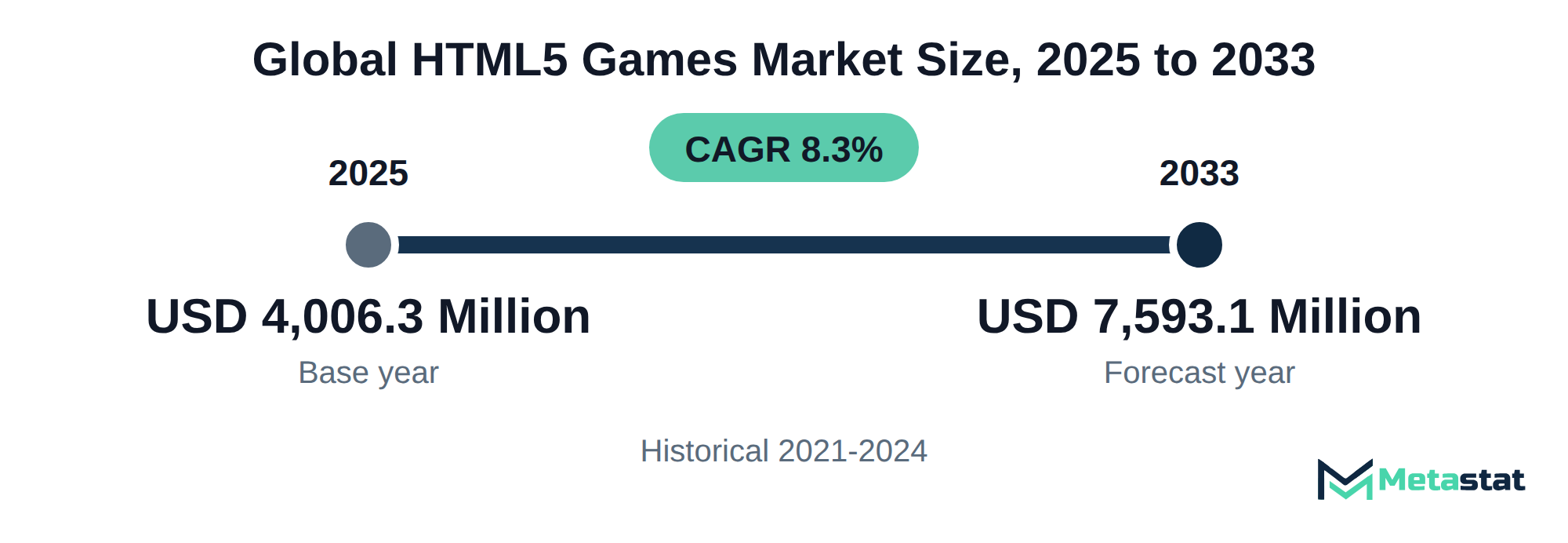
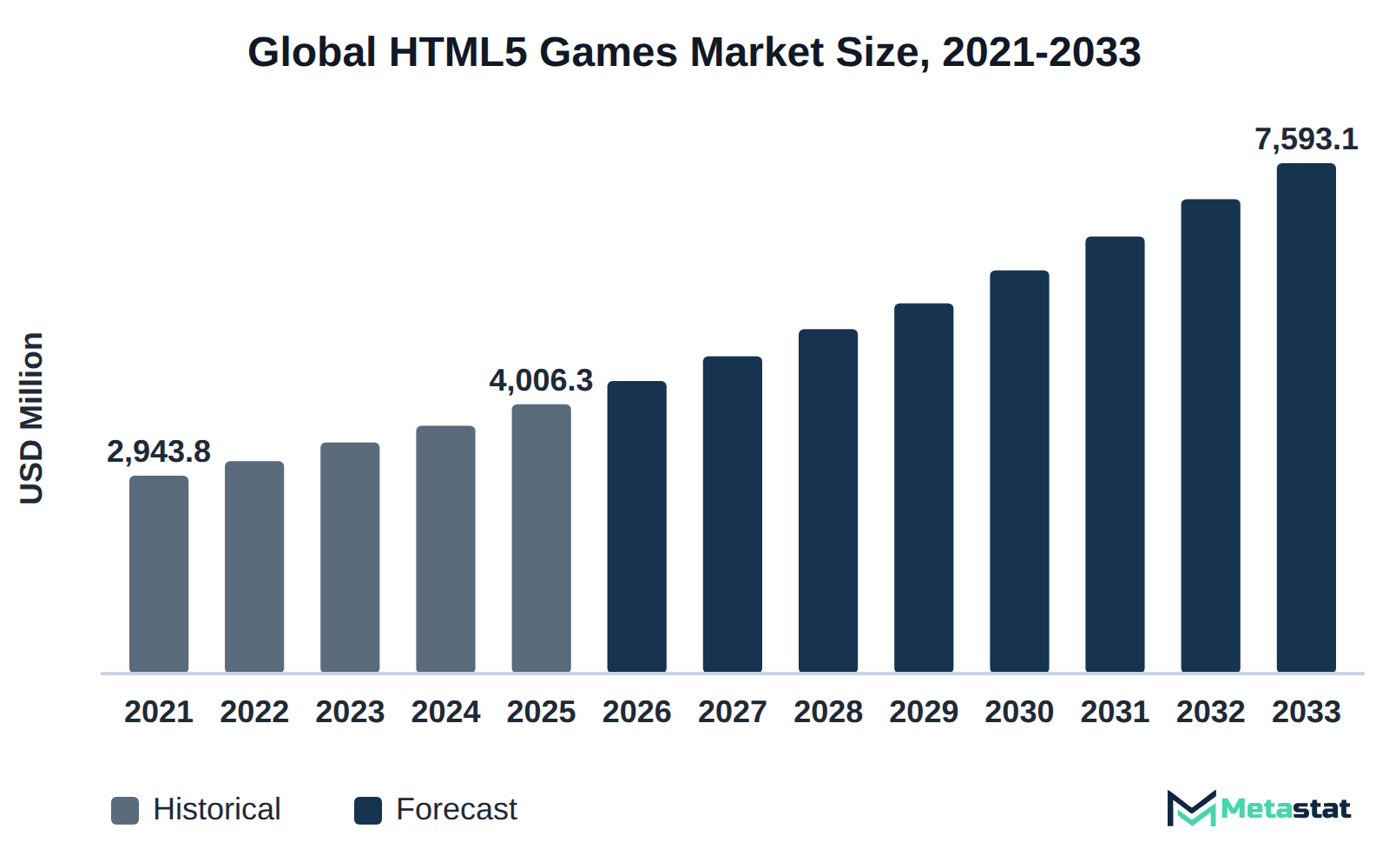
The global HTML5 Games market was valued at USD 4,006.3 million in 2025 and is projected to reach USD 7,593.1 million by 2033, growing at a CAGR of 8.3% over the forecast period.
The HTML5 Games market encompasses a diverse range of interactive gaming experiences delivered through web technologies. Buyers invest in this market due to the increasing demand for accessible entertainment options that do not require extensive downloads or installations, a need that cloud gaming services also address. This convenience appeals to various demographics, particularly younger audiences and casual gamers seeking engaging yet straightforward gameplay.
Growth in the market derives from several factors, including the rising popularity of mobile gaming across the broader gaming industry. The segment focusing on smartphones generates the highest revenue, underlining the shift in consumer preferences towards portable gaming devices. In terms of regional distribution, Asia Pacific holds a dominant share, accounting for 48.1% of the market. North America holds 23.0% of the market in 2025, with the US leading in 2026. The expansion of 2D and 3D gaming experiences further supports this growth trajectory.
Investments in innovative game design and development attract and retain users. Game publishers are increasingly adopting advanced technologies, including augmented reality and artificial intelligence, to enhance gaming experiences. This trend creates competitive advantages and increases demand within the HTML5 Games market.
HTML5 Games market players focus on creating engaging gaming experiences that appeal to a wide audience. Buyers invest in this market due to the growing demand for accessible entertainment options across various devices. The popularity of mobile and web-based gaming continues to rise, driven by advancements in technology and increased internet penetration, allowing users to enjoy games anytime and anywhere.
The segment generating the highest revenue within the market is Puzzle Games, which illustrates a strong consumer preference for challenging yet enjoyable gameplay. The Asia Pacific region represents 48.1% of the market, making it the leading regional contributor. The increasing emphasis on mobile gaming experiences influences market dynamics.
One primary growth factor stems from the rise in in-game advertising, which offers developers a sustainable revenue stream while providing targeted advertising opportunities for brands. This revenue model encourages continuous investment in game development and enhances the overall gaming experience. The HTML5 Games market is positioned for sustained growth, reflecting the evolving preferences of players and the ongoing advancements in gaming technology.
Rewarded advertising increasingly influences player engagement within the HTML5 Games market. This method offers players incentives including in-game currency or exclusive content in exchange for engaging with advertisements, effectively improving user retention. In 2026, the revenue from in-game advertising is projected to reach USD 2,082.6 million, demonstrating substantial growth. This figure highlights the financial viability of integrating rewarded advertising, a format within digital advertising, into game design.
Engagement strategies focusing on rewarded advertising align with the growing trend of repeat play among users. Players often return to games that provide tangible benefits for their time, creating a cycle of increased interaction and revenue. This trend is particularly relevant in the smartphone segment, projected to achieve a value of USD 4,921.8 million by 2033, driven by the high accessibility of mobile devices. Rewarded advertising enhances player satisfaction and improves monetization opportunities for developers.
Incorporating rewarded advertising strategies enhances the competitive positioning of developers. By prioritizing user engagement through incentives, game creators strengthen player loyalty and, in turn, boost overall market revenues. The HTML5 Games market is expected to benefit significantly from this approach, effectively addressing the dual objectives of user retention and revenue generation.
Mobile browser performance significantly influences the purchasing behavior of buyers in the HTML5 Games market. With an estimated revenue of USD 2,676.4 million from smartphones in 2026, the importance of mobile-optimized gaming experiences is evident. Buyers prioritize efficient gameplay and quick loading times, which are often determined by the efficiency of mobile browsers. The rise in mobile gaming adoption reflects a shift towards more casual gaming experiences, attracting a diverse consumer base willing to spend.
Buyers typically engage in flexible pricing models that cater to varying levels of commitment. Subscription-based services and in-game purchases represent popular revenue streams, allowing users to pay for enhanced experiences while progressing through the game. In-game advertising offers a cost-efficient approach for users seeking free-to-play options, creating opportunities for developers to monetize their offerings effectively while maintaining player retention. Optimizing mobile browser performance enhances user experience and drives revenue growth for developers, supporting long-term success in the competitive environment.
The introduction of 3D HTML5 games has transformed the purchasing landscape for buyers in the market. With an expected revenue of USD 2,678.1 million from 3D games by 2033, developers focus on immersive gaming experiences that require innovative payment models. Consumer demand for high-quality graphics and engaging gameplay drives the need for substantial investment in development and marketing, leading developers to explore flexible pricing strategies.
Buyers engage in transactions through multiple revenue streams, including in-game purchases, subscriptions, and traditional paid game access. This diversity in payment models accommodates different user preferences and spending capabilities, ensuring accessibility for a wider audience. The significance of 3D HTML5 games lies in their entertainment value and their potential to generate substantial revenue, prompting developers to refine their pricing strategies continuously to capture the shifting dynamics of the market.
Licensing HTML5 games for embedded entertainment represents a strategic opportunity for various industries, including hospitality and retail, seeking to enhance customer engagement. The increasing demand for interactive experiences has led to a significant rise in the adoption of these games. By 2033, revenue from in-game advertising is projected to reach USD 3,464.7 million, reflecting the growing integration of entertainment into commercial spaces.
Embedded entertainment through HTML5 games allows businesses to attract and retain customers by providing engaging content. For instance, hotels and restaurants provide interactive games to entertain guests, thereby improving user experience. This approach increases customer dwell time and boosts average spending. The market supports this trend, with mobile devices driving the accessibility and popularity of HTML5 games. In 2033, revenue from smartphones in this sector is expected to climb to USD 4,921.8 million, demonstrating the potential for embedded gaming solutions.
Licensing HTML5 games furnishes businesses with unique branding opportunities. Customized games featuring brand elements create a memorable interaction with customers. Companies focusing on embedded systems find that this strategy enhances their service offerings and distinguishes them from competitors. The HTML5 games market, therefore, emerges as a significant growth area for businesses aiming to innovate within entertainment.
In-game purchases significantly enhance monetization strategies within the HTML5 Games market. These transactions allow players to access additional content, enhance gameplay, or acquire virtual goods, providing an engaging experience that drives revenue. In the segment of in-game purchases, expected revenue by 2033 reaches USD 3,091.9 million, reflecting growing acceptance of this monetization model among players.
Developers prioritize in-game purchases due to their potential to generate continuous income streams. Players become more invested in games when they perceive value in optional purchases, leading to increased spending. The implementation of enticing offers, rewards, and exclusive content encourages players to engage more deeply, further driving this revenue model within the market.
The market for in-game purchases continues to expand, increasing competition among developers who seek to optimize user experience while maximizing revenue. The trend toward integrating in-game purchases indicates a promising avenue for growth and pushes developers to adapt their strategies to evolving player expectations within the HTML5 Games market.
Purchasing activity within the HTML5 Games market reflects a surge in smartphone usage, especially among younger demographics. This shift stems from the growing accessibility of mobile devices and their enhanced capabilities, enabling users to engage with games easily. Increased smartphone adoption leads to higher demand for mobile-friendly gaming options, prompting developers to create more HTML5 games tailored for these devices. The market's revenue from smartphones is projected to reach USD 4,921.8 million by 2033, demonstrating substantial growth driven by this trend. Enhanced mobile experiences and broader accessibility contribute to an expanding player base, significantly influencing overall market dynamics.
In addition, the growing popularity of casual gaming among users has led to increased spending on in-game purchases and advertising. This behavior change reinforces the market's revenue potential through diverse monetization strategies, highlighting the significance of mobile platforms in shaping buying patterns. Overall, rising smartphone use drives greater investment and strategic focus on mobile gaming within the market.
Advancements in rendering technologies, including 3D rendering software, significantly influence the performance of HTML5 Games, contributing to a more immersive gaming experience. The introduction of sophisticated graphics capabilities, especially in 3D rendering, positions developers to create visually appealing games that attract a broader audience. Enhanced performance on various devices, particularly smartphones, facilitates wider adoption and usage among consumers. The increasing demand for high-quality graphics and smooth gameplay experiences drives developers to invest in better rendering solutions, thereby improving user satisfaction and retention rates. Improved rendering capabilities directly impact the quality of game experience, which, in turn, supports higher monetization potential through in-game purchases and advertising. Consequently, the HTML5 Games market benefits from these innovations, leading to a projected growth trajectory and expanding its footprint across various demographic segments.
Development costs for HTML5 Games present a significant barrier to market growth, especially for smaller developers focused on niche genres. High expenses associated with game design and testing lead to slower uptake among independent studios, resulting in fewer new titles entering the market. These financial constraints deter investment in innovative gameplay mechanics and technology enhancements. Consequently, the market experiences a slower pace of innovation, which affects player engagement and retention. The impact of these costs is particularly pronounced among new entrants who struggle to compete with established players benefiting from economies of scale. The reluctance to invest in ambitious projects hampers the diversity and appeal of available titles, limiting opportunities for broader audience reach and engagement.
Suppliers within the HTML5 Games market face significant margin pressure, primarily driven by rising operational costs and competitive pricing strategies. Increased competition has led to aggressive pricing, forcing developers to optimize their cost structures while maintaining quality. This dynamic creates challenges in sustaining profit margins, particularly for smaller developers, who lack the economies of scale enjoyed by larger competitors. Developers are responding by adopting more efficient development practices and using cloud-based technologies to reduce infrastructure costs. The integration of analytics and data-driven insights enables these suppliers to refine their offerings and enhance user engagement, which in turn supports retention and monetization opportunities. Collaboration with strategic partners allows smaller firms to pool resources, share technology, and access wider distribution channels, ultimately strengthening their market position. The ongoing evolution of player preferences further necessitates innovation and adaptability, compelling suppliers to explore new revenue models to preserve profitability.
Strategy games represent a significant growth opportunity within the HTML5 Games market, driven by a projected compound annual growth rate (CAGR) of 9.7%. This segment attracts a dedicated player base due to its engaging gameplay mechanics and competitive elements. The increasing interest in mobile gaming and the expansion of user demographics contribute to this upward trend, particularly among younger players seeking interactive and challenging experiences. Game developers focusing on strategy games are positioned to capture this segment's growth by using advanced features including multiplayer modes and innovative storytelling techniques. While the market evolves, strategy games diversify offerings and strengthen player retention. The anticipated growth in this segment aligns with the overall expansion of the market, which is expected to reach USD 7,593.1 million by 2033.
The Global HTML5 Games market is segmented based on Game Genre, Device Type, Rendering Type, and Revenue Stream.
Puzzle Games segment is valued at USD 1,063.2 million in 2026 and is projected to reach USD 1,775.3 million by 2033, at a CAGR of 7.6% during the forecast period. This genre engages players through various challenges and problem-solving elements, attracting audiences across multiple demographics. The growing smartphone penetration and a tendency towards casual gaming significantly drive demand. Unlike other segments, including Action and Adventure Games, which focus on narrative and immersive experiences, Puzzle Games appeal to users seeking quick and accessible entertainment. While the Action and Adventure segment grows at a steady rate, Puzzle Games provide a unique blend of cognitive challenge and enjoyment, reinforcing their position in the market. The user-friendly nature of these games makes them particularly popular among individuals with limited time for gaming, further distinguishing them from other genres.
Arcade Games segment is estimated to reach USD 1,158.7 million by 2033, at a CAGR of 6.8% during the forecast period. These games engage users through quick, entertaining gameplay, appealing to casual gamers who seek immediate gratification. The growth of this segment stems from rising smartphone penetration, particularly among younger audiences, enhancing accessibility and convenience. Unlike Puzzle Games, which exhibit a higher CAGR of 7.6%, Arcade Games display slightly slower growth. This difference reflects varied preferences among gamers, with Puzzle Games attracting a more strategic audience compared to the dynamic nature of Arcade Games. The market anticipates increasing demand for innovative game mechanics and graphics, further fueling the segment's expansion. Enhanced features, including multiplayer functionalities and social sharing options, contribute significantly to user engagement, setting Arcade Games apart from other game genres.
Action and Adventure Games segment is expected to reach USD 1,038 million by 2033. This genre combines elements of exploration and puzzle-solving, appealing primarily to players seeking immersive narratives and dynamic gameplay. Demand for this segment stems from the popularity of engaging storylines and character development, attracting a diverse player base across various age groups. The projected compound annual growth rate (CAGR) for Action and Adventure Games is lower than that of Puzzle Games, which has a CAGR of 7.6%. Competitive pricing of similar genres challenges growth, while innovation in storytelling techniques enhances interest. Overall, the segment's storytelling capabilities set it apart from faster-growing segments like Strategy Games and add to market competition.
Strategy Games segment is projected to grow at a CAGR of 9.7% during the forecast period. This category attracts players who appreciate tactical planning and decision-making, engaging them in extensive gameplay that often involves complex scenarios and resource management. The rising popularity of mobile gaming drives demand, supported by a younger demographic that favors strategic challenges. Unlike other genres including Arcade or Action and Adventure Games, Strategy Games often require sustained engagement, leading to a longer lifecycle per user. The anticipated revenue from this segment aligns with trends observed in in-game purchases, where players invest in enhancements or expansions, reflected in the projected increase in revenue through this model. By 2033, the segment is expected to significantly contribute to the overall growth of the market, reflecting evolving preferences among gamers.
Role-Playing Games employ storytelling and character development to create immersive adventures for players. These games attract a dedicated audience that seeks engaging narratives and social interactions. Demand for this segment grows, driven by the increasing popularity of multiplayer experiences and community engagement features. Unlike other segments, Role-Playing Games often command higher price points due to their complex narratives, detailed graphics, and extensive gameplay. The adoption of advanced technologies enhances the gaming experience, encouraging developers to invest in richer content. This segment generally exhibits slower growth compared to others, reflecting the specialized nature of its audience and the resources required for development. The demand for high-quality content drives competition among suppliers, challenging them to innovate and improve their offerings to meet player expectations.
Sports and Racing Games deliver a thrilling experience for players who enjoy competitive and engaging gameplay. This segment targets a diverse audience, including casual gamers and dedicated enthusiasts, who seek adrenaline-fueled challenges. The growing demand for real-time multiplayer experiences significantly influences this segment's expansion, driven by increasing smartphone penetration and advancements in online connectivity. Unlike Puzzle or Strategy Games, which typically emphasize problem-solving and tactical elements, Sports and Racing Games prioritize speed and reflexes, appealing to a different set of gaming preferences. The competitive nature of these games creates a strong community, further enhancing their appeal. Demand for high-quality graphics and realistic gameplay continues to impact development trends, encouraging developers to invest in innovative features that enhance user engagement. Overall, the success of Sports and Racing Games reflects the market's shift toward immersive and engaging content that connects with a broad user base.
Card and Board Games encompass a variety of traditional and modern games that players enjoy on digital platforms. This segment attracts users seeking social interaction and strategic play, often targeting families and casual gamers looking for entertainment options. The growing trend of multiplayer and interactive experiences drives demand in this segment, enhancing user engagement and building community. Compared to other genres, Card and Board Games face slower growth due to established preferences for more dynamic genres like Action and Adventure Games, which feature engaging gameplay. This segment relies heavily on familiar game mechanics and nostalgia, differentiating it from genres that leverage advanced graphics or immersive experiences. While the market continues to expand, developers find opportunities for innovation within this genre by integrating newer technologies while retaining the essence of traditional gameplay in digital board games.
Simulation Games immerse players in virtual environments that simulate real-world processes, appealing to users seeking educational or training experiences. These games attract various user groups, including educators and corporate trainers, who employ them for skill development and knowledge retention. The demand for such games is driven by increasing interest in gamification software and other gamified learning solutions, facilitating engagement and improving learning outcomes. Innovation in game design and user interfaces enhances accessibility, making these games appealing to a broader audience. Compared to other game genres, Simulation Games yield higher user engagement through realistic scenarios and interactive elements, distinguishing them from genres like Action or Puzzle Games, which focus on different gameplay mechanics and audience interaction.
Others (Music, Trivia, Educational Games) encompasses various genres that engage users through interactive and educational content. This segment attracts players seeking entertainment that combines enjoyment with learning, appealing to students and families. Rising demand for gamified learning solutions drives growth in this area, particularly within digital education, where institutions pursue innovative methods for engagement. Compared to other segments, this sub-segment tends to have a lower price point, attracting a broader audience that seeks free or lower-cost gaming options. The emphasis on accessibility and educational value differentiates it from more traditional gaming genres focused solely on entertainment. Enhanced digital platforms enable developers to create diverse experiences that cater to evolving consumer preferences, fueling interest in these unique gaming offerings.
Smartphones segment is valued at USD 2,676.4 million in 2026 and is projected to reach USD 4,921.8 million by 2033, at a CAGR of 9.1% during the forecast period. Smartphones have become a primary gaming platform due to their accessibility and portability, appealing to casual gamers and younger audiences. Increasing smartphone penetration in emerging markets drives demand for mobile games, thus supporting growth. This segment exhibits a faster growth trajectory compared to Computers, which is projected to grow at a CAGR of 5.8%. The differentiated user experience offered by smartphones, including touch interfaces and mobile connectivity, enhances engagement, setting this segment apart from others in the device category. Revenue generation through in-game advertising and purchases further contributes to its strong performance in the market.
The computers segment is estimated to reach USD 1,760.8 million by 2033, at a CAGR of 5.8% during the forecast period. This segment appeals primarily to players who prefer a more immersive gaming experience on larger screens, including desktops and laptops. The increasing availability of high-performance computers facilitates greater adoption of HTML5 games, particularly among gamers seeking enhanced graphics and gameplay quality. Compared to other device types, the growth in this segment lags behind smartphones, which are expected to expand at a CAGR of 9.1%. However, steady demand from users who prioritize performance and visual fidelity ensures sustained revenue generation for developers targeting this platform. Market dynamics indicate an ongoing shift, with developers optimizing games for both computers and mobile devices, thus reflecting the diverse preferences of players.
The Tablets segment is expected to reach USD 566.4 million by 2033. This segment caters to gamers seeking a portable and flexible gaming experience, particularly appealing to casual players who enjoy gaming on larger screens compared to smartphones. Demand for HTML5 games on tablets is driven by the increasing popularity of mobile gaming and the user-friendly interface that tablets offer. This segment experiences slower growth compared to smartphones, which are anticipated to grow at a CAGR of 9.1%. This slower growth rate reflects the preference for more versatile devices among casual gamers, who prioritize smartphones for on-the-go gaming. While tablets provide a better visual experience, they face competition from smartphones, which have a larger user base and faster adoption rates in the market.
Others (Smart TVs, in-Vehicle Displays) segment is projected to grow at a CAGR of 13.2% during the forecast period. This segment caters to users who enjoy gaming experiences on larger screens or while traveling. Increased demand for interactive entertainment, including smart TV gaming and games on in-vehicle displays, drives growth in this area. The rapid adoption of smart technologies in households, along with advancements in display quality, supports this trend. Compared to other device types, this segment displays faster growth due to its unique appeal; while smartphones and computers offer portability and convenience, the immersive experience of larger displays cannot be matched. This segment is distinct in its ability to engage users in a social setting, making it attractive for families and groups seeking entertainment options.
2D Games segment is valued at USD 3,126.5 million in 2026 and is projected to reach USD 4,915 million by 2033, at a CAGR of 6.7% during the forecast period. This segment appeals to a broad audience, particularly casual gamers who enjoy engaging and straightforward gameplay experiences. Increased smartphone penetration has propelled demand, with the segment benefiting from the growing preference for mobile gaming. While 2D Games enjoy steady growth, the segment's CAGR is lower compared to 3D Games, which has a CAGR of 11.8%. This difference indicates a shift in consumer preferences toward more immersive graphics and experiences, compelling developers to invest in advanced rendering technologies. The market encourages developers to innovate, ensuring 2D Games remain appealing while expanding their libraries to include diverse titles that capture player interest, supporting sustained engagement and revenue growth.
3D Games segment is estimated to reach USD 2,678.1 million by 2033, at a CAGR of 11.8% during the forecast period. This segment appeals to players seeking immersive and visually striking gaming experiences, often adopted by developers targeting technology-savvy audiences. Increasing advancements in graphics and rendering technology significantly influence growth, with players drawn to the enhanced realism and engaging gameplay provided by 3D rendering. Compared to other segments, including 2D Games with a CAGR of 6.7%, 3D Games exhibit faster growth. This trend reflects a shift in consumer preferences toward more interactive and visually appealing games, suggesting that the demand for 3D experiences will drive further investments in this segment, contributing positively to the overall HTML5 Games market.
In-Game Advertising segment is valued at USD 2,082.6 million in 2026 and is projected to reach USD 3,464.7 million by 2033, at a CAGR of 7.5% during the forecast period. This revenue stream monetizes online games by displaying advertisements, appealing primarily to game developers and advertisers seeking to engage users. The increasing trend of integrating advertising within games enhances revenue opportunities while providing targeted advertising solutions for brands. Demand for this segment is driven by the growth of mobile gaming and the need for advertisers to connect with audiences in innovative formats. In contrast, In-Game Advertising exhibits a slower growth rate compared to In-Game Purchases, which has a CAGR of 9.7%. This difference highlights the potential for developers to explore multiple revenue avenues while balancing user experience and monetization strategies in the HTML5 Games market.
In-Game Purchases segment is estimated to reach USD 3,091.9 million by 2033, at a CAGR of 9.7% during the forecast period. This segment allows players to enhance their gaming experiences through the purchase of virtual goods, upgrades, and benefits within games, appealing to avid gamers across various demographics. The growing trend of microtransactions in mobile gaming drives demand, with players seeking personalized experiences and competitive advantages. In-Game Purchases stand out from other revenue streams due to their higher projected growth rate compared to Paid Game Access and Subscriptions, which have lower CAGRs. Revenue through this segment is expected to significantly contribute to the overall expansion of the HTML5 Games market, reflecting changing consumer preferences toward in-game monetization strategies.
Subscriptions segment is expected to reach USD 479.1 million by 2033. This segment offers players access to a range of games through a recurring payment model, appealing primarily to avid gamers seeking consistent content updates and exclusive features. Growth is driven by increasing demand for complete gaming experiences without the hassle of in-game purchases, aligning with consumer preferences for value and convenience. The anticipated CAGR of 9.7% distinguishes this segment, reflecting a strong growth trajectory compared to other revenue streams, including Paid Game Access, which experiences slower expansion. The distinct pricing strategy associated with subscriptions allows developers to generate steady revenue, ensuring ongoing engagement and loyalty among players. Transitioning to a subscription model enhances revenue predictability, contributing positively to the overall dynamics of the HTML5 Games market.
Paid Game Access is projected to grow at a CAGR of 5.3% during the forecast period. This segment provides players with direct access to games through a one-time purchase fee, appealing primarily to dedicated gamers seeking high-quality experiences. The growth of this segment is driven by an increasing preference for premium content, with consumers willing to pay for enhanced game features and experiences without interruption from advertisements. Compared to other revenue streams including In-Game Purchases, which is estimated to experience a CAGR of 9.7%, Paid Game Access shows relatively slower growth. The segment differentiates itself through its pricing structure, catering to a distinct buyer group that values upfront payment over ongoing microtransactions. This pricing strategy influences how developers approach game design and user engagement, creating a market environment that prioritizes quality and user satisfaction over transaction frequency.
Business Licensing and Sponsorship provides opportunities for entities to leverage brand partnerships and collaborations within games. Game developers engage with this segment to generate revenue through licensing agreements that benefit both parties involved. Demand for this segment is driven by the increasing interest of brands in reaching target audiences through engaging content. Unlike other revenue streams, including In-Game Advertising, this segment focuses on long-term strategic partnerships rather than immediate monetization tactics. Brands that align with gaming experiences enhance their visibility and create memorable interactions with potential customers. This approach attracts businesses seeking innovative ways to connect with consumers, distinguishing it from traditional revenue streams in the HTML5 Games market.
Based on geography, the Global HTML5 Games market is divided into North America, Europe, Asia-Pacific, South America, Middle East, and Africa.
Demand for HTML5 Games in North America is driven by the growing popularity of mobile and casual gaming among consumers. Major players in this market include the United States, Canada, and Mexico, where mobile devices and internet accessibility support gaming engagement. The region's share of the global market was 23.0% in 2025, reflecting a strong consumer base and interest in diverse gaming formats. North America is projected to reach USD 1,642.4 million by the end of 2033. Innovative gaming experiences and advancements in technology contribute to the region's expansion, encouraging developers to create more engaging content. This evolving landscape creates opportunities for growth within the HTML5 Games market.
The demand for the HTML5 Games market in Europe benefits from strong engagement among users in the gaming sector, particularly in countries like Germany, France, and the UK. The rising popularity of puzzle and arcade games contributes significantly to market expansion. Advancements in internet infrastructure and mobile technology enhance user access and experience, spurring growth in game development. This region's market share stands at 20.2% in 2025, reflecting robust consumer interest in gaming. Enhanced distribution channels, including online platforms, facilitate easier access to games, resulting in increased player participation and revenue generation. The market's future in Europe is expected to be promising, driven by continuous technological advancements and a growing base of active users seeking diverse gaming experiences.
Significant growth in the HTML5 Games market is evident in Asia-Pacific, driven by high smartphone penetration and an expanding internet infrastructure. Countries like China and India lead this surge, with rising disposable incomes fueling demand for mobile gaming. The region's diverse gaming audience, particularly in action and adventure genres, contributes to a robust gaming culture. Notable advancements in 5G technology enhance user experiences, allowing for smoother gameplay and richer graphics. The market's share is projected to reach 48.1% in 2025, reflecting the increasing preference for mobile and online gaming platforms. Strong engagement in in-game advertising and purchases supports revenue streams, further cementing Asia-Pacific's role in shaping the future of the HTML5 Games market.
The market in South America, particularly in Brazil and Argentina, experiences a unique demand landscape due to growing smartphone accessibility and internet penetration. The increasing popularity of casual gaming among younger demographics drives the adoption of HTML5 Games, with platforms integrating localized content to engage regional audiences effectively. Infrastructure improvements, including enhanced broadband connectivity, facilitate smoother gaming experiences, enabling wider participation in online gaming communities. South America contributes a notable share to the global HTML5 Games market, holding a share of approximately [figure] in 2025. This region's gaming landscape aims to capitalize on opportunities presented by in-game advertising, which aligns with emerging trends in user engagement and monetization strategies. Continuing advancements in technology and content offerings present further potential for growth and investment in the market.
Growth in the market reflects increasing engagement from users in countries including Saudi Arabia, UAE, and South Africa. Rising internet penetration and smartphone adoption contribute significantly to expanding user bases for HTML5 Games. The region's emphasis on digital entertainment drives demand, with a notable rise in mobile gaming preferences among consumers. Cost conditions, including affordable mobile data plans, facilitate access to gaming platforms. The market share for the Middle East and Africa stands at 3.9% in 2025, indicating ongoing potential for growth and investment. With developing infrastructure and a youthful population, the region presents opportunities for game developers and publishers focused on localized content and culturally relevant themes in the HTML5 Games market.
Competition in the HTML5 Games market involves various strategies focused on game genres, device types, and revenue streams. Buyers prioritize factors including pricing, game variety, user experience, and platform compatibility when selecting games. The demand for innovative features enhances the focus on customization and service quality among suppliers, driving competition and influencing market dynamics.
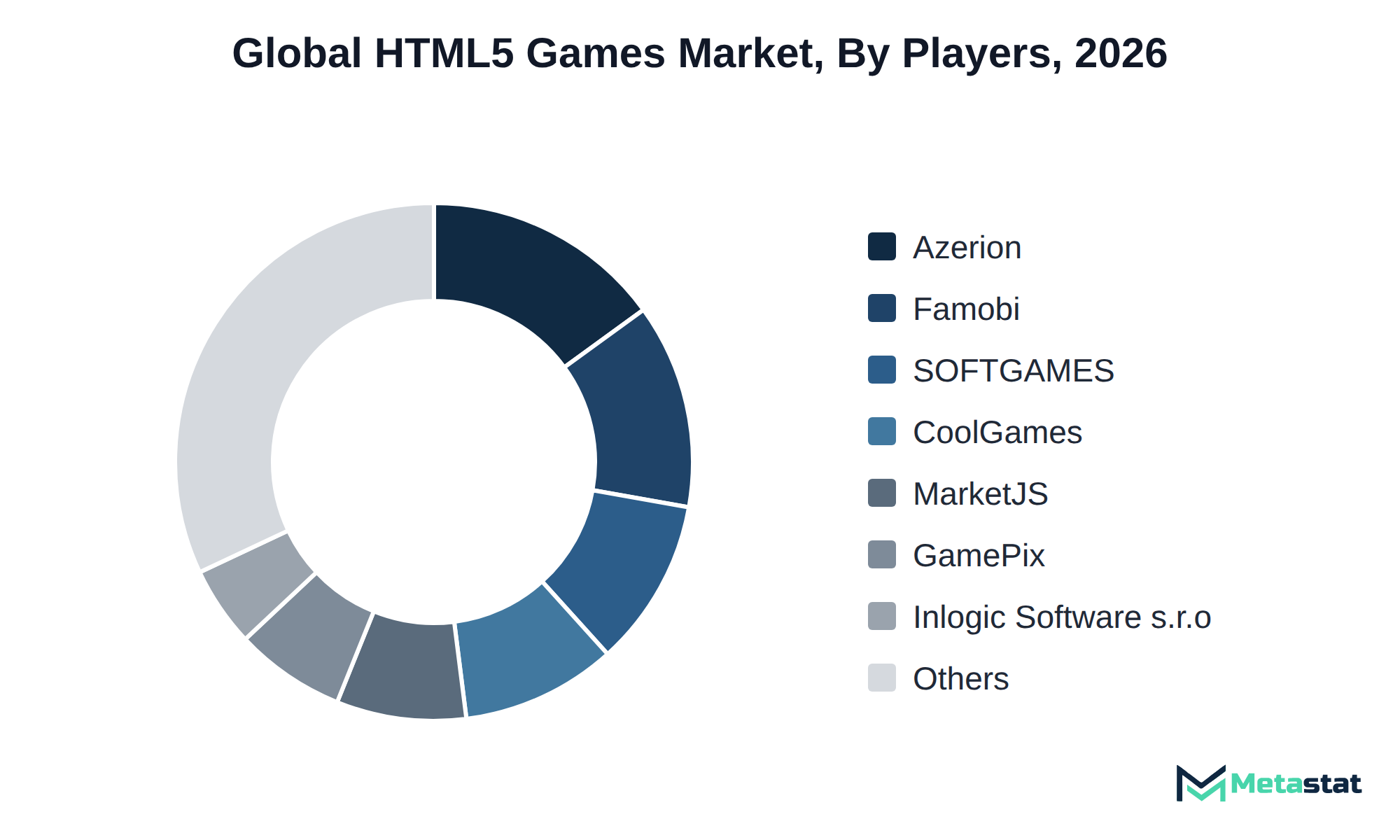
Famobi GmbH focuses on integrating a diverse range of puzzle and arcade games, appealing to casual gamers seeking flexibility in gameplay. Similarly, CoolGames emphasizes the development of engaging browser-based games, targeting users on multiple platforms, including smartphones and computers. Inlogic Software s.r.o. offers solutions tailored to the educational segment, aligning products with emerging trends in interactive learning experiences, thereby enhancing its market presence.
The growth of the HTML5 Games market relies on several key developments. First, the increase in smartphone adoption facilitates access to mobile gaming, propelling demand for games optimized for these devices. Second, the expansion of in-game purchases, anticipated to reach USD 3,091.9 million by 2033, creates additional income streams for developers, enhancing profitability within the market. Third, the growing popularity of 3D games, projected to achieve a CAGR of 11.8%, captures the interest of players and boosts engagement. A potential risk to this growth includes economic downturns impacting consumer spending on entertainment, which could hinder revenue generation in various regions. These developments and risks will shape the trajectory of the market through the forecast period.
By Game Genre: Puzzle Games, Arcade Games, Action and Adventure Games, Strategy Games, Role-Playing Games, Sports and Racing Games, Card and Board Games, Simulation Games, Others (Music, Trivia, Educational Games)
By Device Type: Smartphones, Computers, Tablets, Others (Smart TVs, in-Vehicle Displays)
By Revenue Stream: In-Game Advertising, In-Game Purchases, Subscriptions, Paid Game Access, Business Licensing and Sponsorship
The report strategically identifies and profiles the key market players and analyses their core competencies in each sub-segment of the HTML5 Games market.
|
Report Attributes |
Details |
|
Study Period |
2021-2033 |
|
Base Year |
2025 |
|
Estimated Year |
2026 |
|
Forecast Period |
2026-2033 |
|
Historical Period |
2021-2025 |
|
Growth Rate |
CAGR 8.3% from 2026 to 2033 |
|
Revenue Unit |
USD million |
|
Segmentation |
By Game Genre, Device Type, Rendering Type, Revenue Stream, and Region |
|
By Region |
North America (By Game Genre, Device Type, Rendering Type, Revenue Stream, and Country)
|
|
Europe (By Game Genre, Device Type, Rendering Type, Revenue Stream, and Country)
|
|
|
Asia Pacific (By Game Genre, Device Type, Rendering Type, Revenue Stream, and Country)
|
|
|
South America (By Game Genre, Device Type, Rendering Type, Revenue Stream, and Country)
|
|
|
Middle East and Africa (By Game Genre, Device Type, Rendering Type, Revenue Stream, and Country)
|
Find answers to common questions about this report
The HTML5 Games market size was valued at USD 4,006.3 million in 2025.
The market is projected to grow at a CAGR of 8.3% during the forecast period from 2026 to 2033.
The North America HTML5 Games market size is estimated to reach USD 1,642.4 million by 2033.
Puzzle Games lead the HTML5 Games market with a value of USD 1,063.2 million in 2026. This segment demonstrates significant growth potential, with a projected value of USD 1,775.3 million by 2033, reflecting a CAGR of 7.6%.
Increased smartphone adoption fuels demand for mobile-friendly gaming options, prompting developers to create more HTML5 games tailored for these devices. The growing popularity of casual gaming leads to increased spending on in-game purchases and advertising, reinforcing the market's revenue potential.
Development costs for HTML5 Games present a significant barrier to market growth, particularly for smaller developers focused on niche genres. High expenses associated with game design and testing lead to slower uptake among independent studios, resulting in fewer new titles entering the market.
The growing popularity of casual gaming and the increasing smartphone adoption are favoring market adoption. Enhanced mobile experiences and diverse monetization strategies are driving higher demand for HTML5 games, particularly among younger demographics.
The HTML5 Games market is estimated to reach a valuation of USD 7,593.1 million by 2033.
Key players operating in the HTML5 Games market include Famobi GmbH, SOFTGAMES - Mobile Entertainment Services GmbH, CoolGames, MarketJS, Azerion Group N.V., and Absolutist Ltd.
Revenue from smartphones in the HTML5 Games market is projected to reach USD 4,921.8 million by 2033.
The analysts below cover Information & Technology research at Metastat Insights.
LEAD ANALYST
Utkarsh Khirodkar is a Lead Market Research Analyst at MetaStat Insight, specializing in market intelligence, technology sector assessments, and competitive strategy.

PRINCIPAL CONSULTANT - ENTERPRISE AI & EMERGING TECHNOLOGIES
Banking & Finance · Electronics and Semiconductor · Energy and Power · Healthcare IT · Information & Technology · Professional Services
Vijay Gunti is a Principal Consultant at MetaStat Insight, bringing over two decades of experience across enterprise digital transformation, technology strategy, and intelligent systems.

LEAD CONSULTANT - COMMUNICATION, TELECOM, AND IT
Electronics and Semiconductor · Information & Technology · Machinery & Equipment · Professional Services
Ravindra Sathe Consultants for Communication, Telecom, and IT at MetaStat Insight. He leads the firm's industry research initiatives across telecommunications infrastructure, digital connectivity, enterprise networking, and emerging information technology domains.
Analyzing the transition from natural gas to green hydrogen in iron ore reduction requires realistic infrastructure timelines. Meta stat insight supplied a detailed regional assessment of DRI plant conversion costs and scrap metal availability in North America and Western Europe. Their report carefully examined pellet quality specs and electrical grid access constraints without making oversimplified market assumptions. The research material served as a practical reference during internal technology roadmap discussions.
Integrating zero-trust access controls across legacy electronic health record systems involves complex compliance overhead. Team produced an analysis that clearly separated identity governance and administration tools from privileged access management platforms. Their evaluation of HIPAA and GDPR compliance features across cloud native solutions gave our architecture group clear baseline criteria. The custom data request regarding biometric authentication adoption in hospital networks was returned promptly with clear documentation.
Evaluating calorific value requirements and air permit compliance across municipal waste facilities requires localized data. Metastat Insight structured their analysis around operational throughput capacity and feedstock composition variations in Latin America and Eastern Europe. Their competitive mapping of sorting equipment vendors helped clarify technology differences between optical separators and heavy media systems. The study provided an objective baseline during our capital expenditure reviews.
Explore related market intelligence reports worth reading alongside this one.
Starting from
$2950