
LEAD ANALYST
Utkarsh Khirodkar is a Lead Market Research Analyst at MetaStat Insight, specializing in market intelligence, technology sector assessments, and competitive strategy.

Global Military Robot Dogs Market Size, Share, By Product Type (Quadruped Unmanned Ground Vehicles (Q-UGVs), Armed Quadruped Robots, Reconnaissance and Surveillance Robot Dogs, Explosive Ordnance Disposal (EOD) Robot Dogs, Logistics and Payload-Carrying Robot Dogs, CBRN Detection Robot Dogs and Others (Specialized Mission-Specific Quadruped Robots)), By Control Mode (Teleoperated, Fully Autonomous and Semi-autonomous), By Technology (AI-Based Target Recognition, Autonomous Navigation and Path Planning, Sensor Fusion and Environmental Perception, Terrain Adaptation and Mobility, Mission Payload Integration and Others (Advanced Communication and Navigation Technologies)), By Application (Intelligence, Surveillance, and Reconnaissance, Installation Security and Perimeter Patrol, Explosive Ordnance Disposal, Chemical, Biological, Radiological, and Nuclear Detection, Tactical Logistics and Resupply, Combat Support and Others (Communications Relay, Search and Rescue)), Industry Analysis, Growth, Trends, and Forecast, 2026-2033
Report ID
MSI-5537
Published
October, 2026
Pages
284 Pages
Format
Historical
Base year
Forecast
Forecast period
Report Details
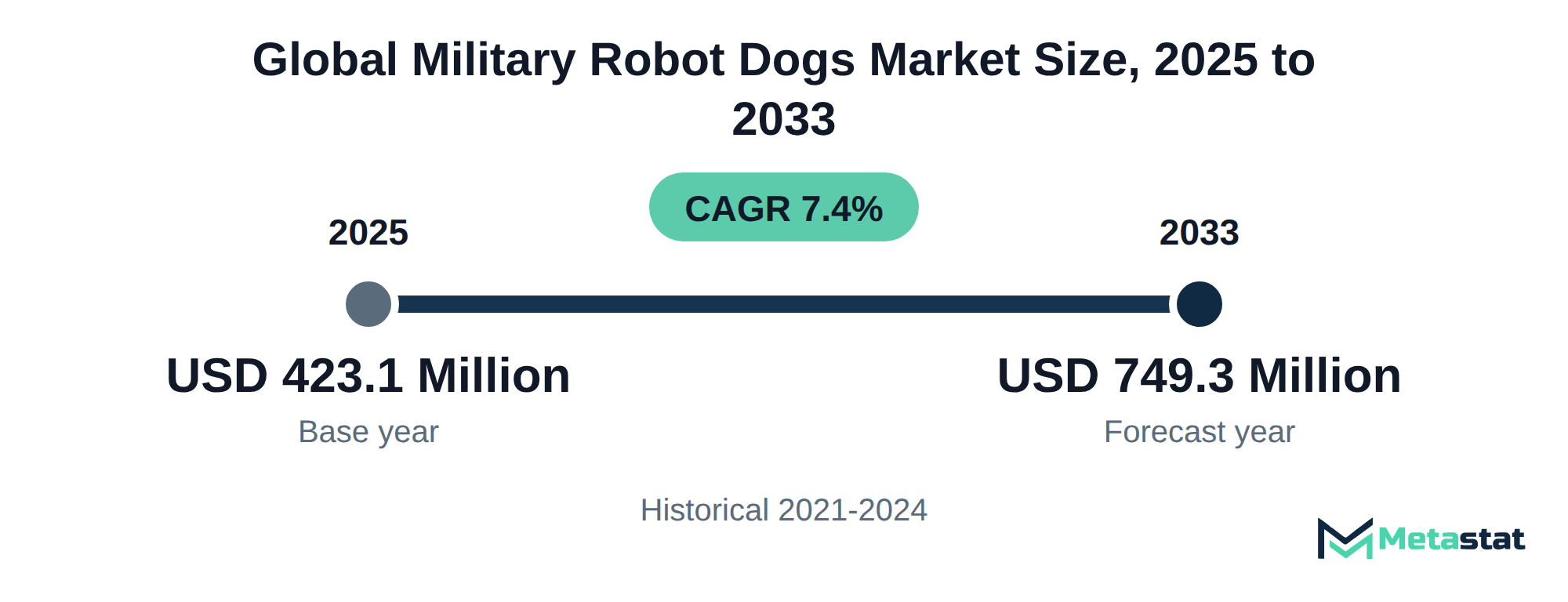
Market Valuation: Valued at $423.1 Million in 2025, projected to reach $749.3 Million by 2033 at a 7.4% CAGR.
Dominant Segment: The reconnaissance and surveillance robot dogs segment leads the market, driven by the critical need for enhanced situational awareness on the battlefield.
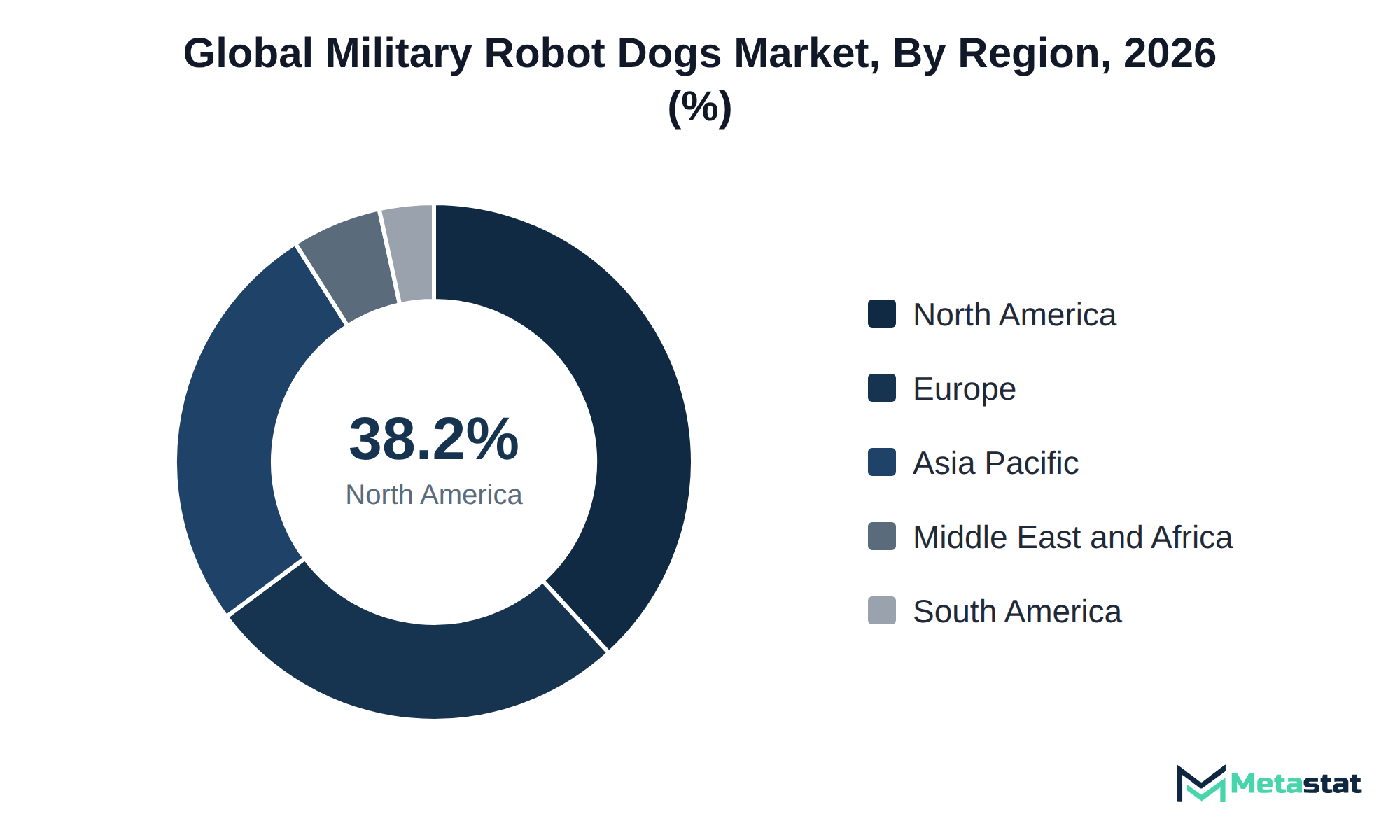
Geographic Lead: North America is the leading region, holding 38.2% of the market in 2025, with the US expected to maintain this position due to strong defense modernization efforts.
What's Inside: The report provides a comprehensive analysis of the Military Robot Dogs market, including competitive coverage, growth trends, and forecasts from 2026 to 2033.
Emerging Opportunities: The reconnaissance and surveillance robot dogs segment is projected to grow at a CAGR of 11.7%, highlighting significant growth potential driven by advancements in AI and operational capabilities.
Technological Advancements: AI-Based Target Recognition technology is expected to enhance military robot dogs, with growth projected from USD 93 million in 2026 to USD 173.4 million by 2033.
Choose Your License
Global Military Robot Dogs Market
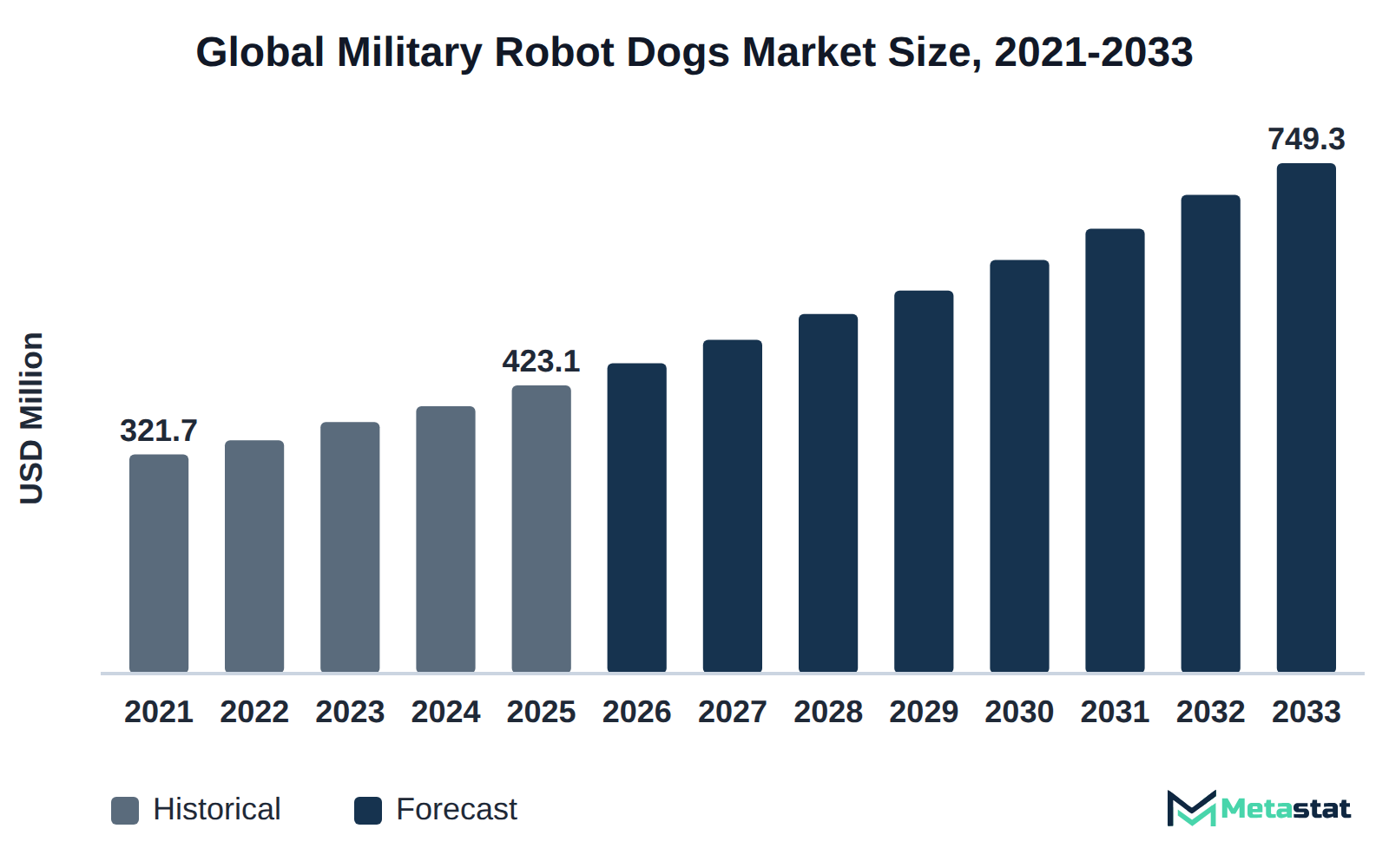
The global Military Robot Dogs market was valued at USD 423.1 million in 2025 and is projected to reach USD 749.3 million by 2033, growing at a CAGR of 7.4% over the forecast period.
The Military Robot Dogs market encompasses advanced robotic systems designed for various military applications, including reconnaissance, surveillance, and explosive ordnance disposal. Buyers invest in these technologies to enhance operational efficiency, improve safety, and ensure mission success in complex environments. The increasing demand for automation in military operations drives investment from defense agencies and contractors seeking to integrate these capabilities into their existing frameworks.
Growth in the market is propelled by advancements in technology and a rising focus on reducing personnel risk in dangerous situations. The segment dedicated to reconnaissance and surveillance robot dogs represents the largest share of the market, reflecting the critical need for enhanced situational awareness on the battlefield. North America holds 38.2% of the market in 2025, with the US leading in 2026.
The increasing emphasis on military modernization and the development of autonomous systems significantly support market expansion. The integration of artificial intelligence in military robot dogs enhances their operational capabilities, enabling more effective decision-making in real-time situations. Such innovations show the commitment of defense sectors to using advanced technology for better outcomes in military operations.
The Military Robot Dogs market addresses the increasing demand for advanced robotic systems that enhance operational efficiency and effectiveness in military operations. Buyers invest in these technologies to improve capabilities in reconnaissance, surveillance, and explosive ordnance disposal. The market's growth is driven by the need for stronger safety measures for personnel and higher mission success rates, both of which matter in modern warfare scenarios.
Growth in the market is significantly influenced by technological advancements, particularly in AI-driven systems. The segment of reconnaissance and surveillance robot dogs represents the largest share of the market, reflecting the heightened emphasis on intelligence-gathering capabilities. This region's strong focus on defense spending and innovation positions it well for continued expansion.
Investment in military robot dogs is expected to continue rising due to increasing defense budgets and the demand for automation in military operations. The market responds to the changing nature of warfare, where robotic systems enhance operational capabilities. Military operations increasingly rely on technology, positioning the market for sustained growth through 2033.
Advancements in AI-Based Target Recognition technology significantly enhance the capabilities of military robot dogs for autonomous reconnaissance and battlefield surveillance. This technology is expected to increase from USD 93 million in 2026 to USD 173.4 million by 2033, reflecting a compound annual growth rate of 9.3%. Such improvements in target recognition enable military forces to conduct intelligence, surveillance, and reconnaissance operations with greater efficiency and accuracy.
AI-Based Target Recognition systems allow military robot dogs to identify and assess potential threats in complex environments, minimizing the risk to human operatives. AI in computer vision underpins this ability to detect and classify objects in complex scenes. By automating the recognition process, these systems facilitate faster response times during reconnaissance missions, ensuring that critical information is relayed promptly. The integration of advanced sensors and machine learning algorithms in this technology equips military personnel with the necessary tools to make informed decisions on the battlefield.
The growing adoption of AI-Based Target Recognition in military robot dogs reflects a shift towards more autonomous systems within the Military Robot Dogs market. This trend improves operational effectiveness and reduces reliance on human resources, which helps optimize costs associated with military operations. Investments in this technology are anticipated to yield substantial returns, positioning military organizations for success in future combat scenarios.
The procurement strategies for military robot dogs involve complex pricing models and contract frameworks. Buyers typically engage in long-term contracts, ensuring a steady supply of advanced robotic solutions tailored for explosive detection and tactical operations. In the segment of explosive ordnance disposal (EOD) robot dogs, the market exhibits a compound annual growth rate (CAGR) of 7.8%, reflecting increasing demand for these specialized robots.
Pricing structures often reflect the advanced technology integrated into these robots, including AI-based target recognition and autonomous navigation. The evolving landscape of military contracts emphasizes collaboration between manufacturers and defense organizations, facilitating a tailored approach to procurement. Buyers benefit from this model, gaining access to innovative features and regular upgrades that support mission success.
Effective procurement strategies in the military robot dogs market enable defense buyers to optimize operations while addressing specific tactical requirements, enhancing the overall effectiveness of military engagements.
Military organizations increasingly prioritize armed robotic dogs and unmanned ground systems to enhance their operational capabilities. These advanced systems support a range of functions, from intelligence gathering to combat support. In the Military Robot Dogs market, armed quadruped robots are projected to reach a value of USD 92.7 million by 2033, reflecting an 11.7% compound annual growth rate. This growth indicates strong demand from military buyers seeking to modernize their fleets with technology that enhances effectiveness while reducing risks to personnel.
The shift toward these innovative solutions stems from the need for enhanced operational efficiency and responsiveness in modern warfare. Military procurement agencies focus on equipping their forces with advanced capabilities that robots deliver, including improved surveillance and reconnaissance. Conflicts evolve, and the integration of unmanned systems into defense strategies becomes critical. The emphasis on armed robotic dogs and unmanned ground systems streamlines operations and increases tactical advantages on the battlefield, ultimately shaping the future of military engagements.
Military Robot Dogs significantly enhance soldier safety and mission effectiveness through advanced technology and innovative applications. One notable contribution arises from the segment of reconnaissance and surveillance robot dogs, projected to reach a valuation of USD 241 million by 2033. These robots facilitate the collection of real-time intelligence, allowing military personnel to assess threats without direct exposure to danger. The deployment of these robots reduces the risk associated with reconnaissance missions, providing a safer approach to gathering critical information.
Armed quadruped robots, anticipated to achieve a value of USD 92.7 million by 2033, serve in combat scenarios where human presence poses heightened risks. Their ability to engage targets while minimizing human risk highlights the technological advancements within the Military Robot Dogs market. This shift towards automation enhances operational efficiency while safeguarding soldiers' lives. Developments in the market reflect a growing commitment to integrating robotic solutions that protect personnel while improving the overall effectiveness of military operations.
Military organizations increasingly invest in robotic systems driven by enhanced operational capabilities and efficiency. This shift reflects a broader trend toward automation in defense operations, with a focus on systems that improve reconnaissance, surveillance, and explosive ordnance disposal. The rise of autonomous technologies supports the effective deployment of military robot dogs across diverse applications, leading to a notable increase in procurement activities. In the Military Robot Dogs market, the segment for fully autonomous systems is projected to reach USD 173.5 million by 2033, highlighting robust demand for these advanced capabilities. Increased reliance on autonomous technologies streamlines operations, reduces risk to personnel, and enhances mission effectiveness. The transition to automated systems creates significant growth opportunities for the market in the coming years.
Significant advancements in robotics and AI technologies drive innovation in military applications. Enhanced sensor capabilities and improved autonomous navigation systems allow military robot dogs to perform complex tasks with higher precision. The integration of AI-Based Target Recognition technology enables these robotic systems to identify and respond to threats effectively, thereby increasing operational efficiency in surveillance and reconnaissance missions.
These technological enhancements directly influence procurement strategies, with military organizations prioritizing systems that offer superior performance and reliability. The Military Robot Dogs market reflects this trend, with a growing number of defense contracts focusing on advanced robotic capabilities. This shift toward sophisticated technologies supports market expansion and attracts investment from defense contractors aiming to enhance product offerings and gain a competitive edge.
High procurement costs represent a significant restraint on adoption among military organizations. The investment required for advanced technologies, coupled with ongoing maintenance expenses, leads to slower uptake of military robot dogs. Budget constraints across defense sectors directly impact procurement decisions, resulting in smaller orders and delayed replacement of outdated systems. Several military buyers prioritize cost-effectiveness, often opting for conventional solutions over innovative robotic alternatives. This hesitance to invest in advanced robotic systems limits market expansion and reduces overall competitiveness. Addressing high costs through strategic initiatives and funding could enhance accessibility for military organizations, ultimately driving broader adoption of military robot dogs in operational settings.
Suppliers in the Military Robot Dogs market encounter significant challenges associated with rising input costs, including materials and technology components required for advanced robotic systems. Fluctuations in costs for essential materials, including metals and specialized electronic components, directly impact profit margins. To address these challenges, suppliers implement strategic sourcing practices and explore alternative materials that provide cost efficiencies without compromising performance. Several suppliers invest in research and development to enhance the durability and functionality of their products, ultimately reducing long-term operational costs for military organizations. This emphasis on improving the cost structure supports a competitive edge in the market, allowing suppliers to maintain profitability while meeting the increasing demand for military robot dogs. Efforts to streamline production processes through automation further help mitigate input cost pressures and keep suppliers responsive to market dynamics while they sustain growth.
The segment of reconnaissance and surveillance robot dogs presents significant growth potential in the Military Robot Dogs market. This segment is projected to reach USD 241 million by 2033, reflecting a compound annual growth rate (CAGR) of 11.7%. This positions it as the highest-growing category within the market. Enhanced operational capabilities in intelligence gathering and surveillance drive procurement among military organizations seeking advanced robotic solutions. The integration of AI-based target recognition and autonomous navigation technologies further improves the efficiency and effectiveness of these systems in challenging environments. Military forces prioritize these features due to the increasing complexity of modern warfare scenarios, which demand advanced surveillance capabilities. The focus on reconnaissance and surveillance robot dogs aligns with ongoing investments in military technologies that aim to enhance operational readiness and situational awareness.
The Global Military Robot Dogs market is segmented based on Product Type, Control Mode, Technology, and Application.
Quadruped Unmanned Ground Vehicles (Q-UGVs) segment is valued at USD 98.8 million in 2026 and is projected to reach USD 139.5 million by 2033, at a CAGR of 5.1% during the forecast period. These robotic systems serve various military functions, including reconnaissance, surveillance, and logistics support, employed by defense agencies to enhance operational capabilities. Demand for Q-UGVs is largely driven by the need for advanced surveillance and reconnaissance technologies, allowing for improved situational awareness in complex environments. This segment demonstrates slower growth compared to the Armed Quadruped Robots segment, which has a CAGR of 11.7%. Higher price points associated with Q-UGVs, resulting from sophisticated technology and capabilities, influence procurement decisions. Buyers prioritize these vehicles for their agility and versatility, which set them apart from other robotic systems in the market.
These robots serve primarily in combat environments, assisting military personnel with tasks that demand high levels of mobility and firepower. The demand for this segment accelerates due to rising security concerns and the need for enhanced tactical capabilities in military operations. Buyers include defense agencies and military contractors focused on integrating advanced systems for improved ground support and reconnaissance. Compared to other segments, Armed Quadruped Robots exhibit a more rapid growth rate, driven by technological advancements and shifting military strategies emphasizing robotic assistance. The unique combination of firepower and mobility distinguishes this segment, making it a crucial player within the Military Robot Dogs market. Larger armed ground platforms fall within the robotic combat vehicle industry.
This segment focuses on providing military organizations with enhanced capabilities for intelligence gathering, surveillance, and reconnaissance missions. Users of this technology include defense forces and security agencies, which seek to improve operational efficiency and reduce risk in high-stakes environments. The growth of this segment is driven by increasing investments in unmanned systems and the demand for remote capabilities. Compared to other types including Armed Quadruped Robots, which have a CAGR of 11.7%, the growth rate for this segment remains more moderate, reflecting its specialized application. Nonetheless, its significance in enhancing situational awareness and mission effectiveness positions this sub-segment as a key player in the Military Robot Dogs market.
Explosive Ordnance Disposal (EOD) Robot Dogs segment is projected to grow at a CAGR of 7.8% during the forecast period. These robotic systems safely handle and dispose of explosive threats in military operations, reducing risk to personnel in high-stakes environments. Military organizations and defense contractors widely employ EOD robot dogs for their precision and efficiency in hazardous situations. Growing threats from improvised explosive devices (IEDs) significantly drive demand for this segment. The segment also overlaps with the explosives detection equipment industry. Compared to other sub-segments, EOD Robot Dogs face unique challenges related to stringent safety regulations and the necessity for advanced technology integration. This segment offers substantial growth potential, supported by increasing defense budgets and the need for enhanced safety protocols in military missions.
Logistics and Payload-Carrying Robot Dogs serve critical roles in military operations, transporting essential supplies and equipment across various terrains. Military organizations employ these robotic systems to enhance logistical capabilities, ensuring timely delivery of resources during operations. The segment experiences growth driven by increasing demand for efficient supply chain management in the field. Unlike other segments, logistics-oriented robot dogs focus on payload capacity rather than combat capabilities, attracting interest from defense procurement officials seeking to optimize operational logistics. This segment differentiates itself with a strong emphasis on reliability and versatility, enabling military units to execute missions effectively while minimizing human risk. Investment in advanced technology for terrain adaptation and mobility enhances the operational range and load-bearing capacity of these robotic systems, supporting their adoption in the market.
CBRN Detection Robot Dogs are specialized robotic systems designed for chemical, biological, radiological, and nuclear detection tasks. Military organizations employ these systems for identifying hazardous substances in various operational environments. The growing demand for enhanced safety measures during military operations drives interest in this segment, particularly among defense agencies focused on responding to CBRN threats. Compared to other segments, CBRN Detection Robot Dogs require advanced sensor technologies and incur higher development costs due to their specialized capabilities. Chemical sensing on these platforms parallels the technology used in gas detection equipment. This segment differs from others, including reconnaissance and surveillance robot dogs, in its specific applications and technology requirements, reflecting a targeted approach to unique defense challenges. The market is expected to evolve, aligning with the increasing emphasis on safety and detection in defense strategies.
Specialized mission-specific quadruped robots perform tailored tasks to meet unique military requirements, enhancing operational efficiency and effectiveness. These robots serve various roles, including support for reconnaissance, logistics, and specialized defense applications, appealing to military organizations focused on enhancing strategic capabilities. Demand for these specialized robots thrives due to the increasing need for adaptability in complex environments, enabling forces to address unique mission challenges effectively. This sub-segment differentiates itself from others by focusing on niche applications rather than broad functionality. While segments like reconnaissance and surveillance robot dogs experience significant growth, specialized mission-specific quadruped robots cater to specific operational requirements, impacting their adoption rates and overall market dynamics. The Military Robot Dogs market benefits from continued investment in advanced robotics, driving innovation and expanding potential applications across defense sectors.
Teleoperated segment is valued at USD 229.4 million in 2026 and is projected to reach USD 331.7 million by 2033, at a CAGR of 5.4% during the forecast period. This segment primarily supports military operations by providing remote control capabilities for robotic systems, enabling operators to conduct tasks from a safe distance. Military organizations employ teleoperated robot dogs for reconnaissance, surveillance, and explosive ordnance disposal. The increasing demand for real-time data collection and threat assessment drives growth in this segment. Compared to fully autonomous robots, the teleoperated segment experiences slower growth due to ongoing developments in autonomous technologies, which are gaining traction with a CAGR of 11.3%. The operational flexibility offered by teleoperated systems remains critical for many military applications, ensuring effective responses to dynamic battlefield conditions while maintaining personnel safety.
The Fully Autonomous segment is estimated to reach USD 173.5 million by 2033, at a CAGR of 11.3% during the forecast period. This segment focuses on robotic systems that execute tasks independently without human intervention, primarily by military organizations for reconnaissance, surveillance, and tactical operations. Driven by advancements in artificial intelligence and machine learning, this segment distinguishes itself from others through its rapid growth and reliance on sophisticated technology. The fully autonomous robots offer enhanced operational efficiency, reducing the need for direct human control. In comparison, the Teleoperated segment shows slower growth due to its dependence on human operators. Military entities increasingly prioritize automation to improve operational effectiveness, strengthening the demand for fully autonomous systems and significantly impacting the overall Military Robot Dogs market.
The semi-autonomous segment is expected to reach USD 244 million by 2033. This segment encompasses robotic systems that operate with a degree of independence while still requiring human oversight, making them suitable for various military applications including reconnaissance and surveillance. Military forces employ semi-autonomous robots for tasks that demand situational awareness and agility in complex environments. Demand for this segment is driven by the need for enhanced operational efficiency and the ability to deploy assets without risking personnel in dangerous situations. Compared to fully autonomous systems, which are projected to reach USD 173.5 million by 2033, semi-autonomous robots offer a balance between control and autonomy, appealing to users who prioritize human intervention during critical missions. The segment's growth aligns with increasing investment in advanced technology solutions within the Military Robot Dogs market.
AI-Based Target Recognition segment is valued at USD 93 million in 2026 and is projected to reach USD 173.4 million by 2033, at a CAGR of 9.3% during the forecast period. This segment provides essential capabilities for military operations, allowing armed forces to identify and engage targets with enhanced precision. The demand for AI-Based Target Recognition systems stems from increasing emphasis on operational effectiveness and reduction of collateral damage during military engagements. Growth is driven by advancements in artificial intelligence and machine learning technologies, which significantly enhance the capabilities of military robotic systems. Compared to other segments, AI-Based Target Recognition demonstrates a higher growth rate, particularly when compared to Teleoperated systems, reflecting ongoing shifts towards automation in military operations. This shift makes it a key component of the Military Robot Dogs market.
Autonomous Navigation and Path Planning segment is estimated to reach USD 190.2 million by 2033, at a CAGR of 8.8% during the forecast period. This segment is essential for enabling military robot dogs to navigate complex environments autonomously, a feature critical for tasks including reconnaissance and surveillance. Defense forces increasingly adopt this technology due to its effectiveness in enhancing operational capabilities and reducing the risks associated with human involvement in hazardous situations. The segment's growth outpaces other technology sub-segments, including Terrain Adaptation and Mobility, which experiences a CAGR of 6.3%. Advancements in AI and sensor technologies drive demand, owing to military organizations recognizing the importance of autonomous systems for effective mission execution. Enhanced navigation capabilities significantly influence procurement decisions among defense contractors and governmental buyers, ultimately shaping the competitive dynamics within the Military Robot Dogs market.
Sensor Fusion and Environmental Perception segment is expected to reach USD 140.3 million by 2033. This segment enables military robot dogs to interpret and understand their surroundings through advanced sensor technologies. Military applications including reconnaissance and surveillance leverage this capability, targeting defense organizations that require enhanced environmental awareness. The adoption of sophisticated sensor systems is driven by increased demand for real-time data analysis and situational awareness in operational environments. This segment shows a different growth trajectory compared to others, with unique requirements for high integration capabilities and accuracy. While other segments exhibit faster growth, the focus on precise environmental perception ensures steady advancements in technology and operational effectiveness. Growth in this segment highlights the importance of innovative sensor technology in enhancing military operations and decision-making processes.
The Terrain Adaptation and Mobility segment is projected to grow at a CAGR of 6.3% during the forecast period. This segment focuses on enhancing robotic systems' ability to navigate various terrains, allowing for effective deployment in diverse environments. Legged mobility relies on robot joint actuator modules that drive each limb. Military personnel apply this capability for surveillance, reconnaissance, and tactical support missions. The increasing demand for robots that operate efficiently in challenging terrains drives growth in this segment. Compared to other technology segments, Terrain Adaptation and Mobility exhibits a slower growth trajectory, influenced by the need for advanced engineering and integration with existing robotic systems. This segment's focus on adaptability distinguishes it from more specialized technologies, which cater to narrower application areas in the market.
Mission Payload Integration refers to the incorporation of various mission-specific payloads into military robot dogs, enhancing their utility in diverse operational scenarios. This integration allows military personnel to employ robot dogs for a range of applications, including reconnaissance, surveillance, and explosive ordnance disposal. The forces driving this segment involve advancements in technology that enable more sophisticated payload capabilities and the growing demand for versatile robotic solutions across military applications. Compared to other segments, including fully autonomous systems, Mission Payload Integration experiences slower growth due to the complexity of integrating multiple payloads and the specialized training required for operators. The military increasingly seeks solutions that offer flexibility and adaptability in mission execution, which highlights the importance of this segment in the military robot dogs market.
Advanced Communication and Navigation Technologies enhance the operational capabilities of military robot dogs through improved connectivity and navigational precision. This sub-segment is primarily used by defense forces and security agencies to support various missions, including reconnaissance and strategic operations. The growing reliance on advanced technologies in military applications drives demand for these communication and navigation solutions. Differentiating this segment from others is the focus on enhancing real-time data exchange and situational awareness, which is critical for autonomous operations. Demand for sophisticated communication capabilities reflects a broader trend toward integrating advanced technologies into military platforms, supporting the overall growth of the military robot dogs market. These capabilities depend on military tactical communication networks that connect robots with operators. This segment is essential for ensuring effective mission execution and adaptability in various environments.
The Intelligence, Surveillance, and Reconnaissance segment is valued at USD 154.2 million in 2026 and is projected to reach USD 238.6 million by 2033, at a CAGR of 6.4% during the forecast period. This segment enables forces to gather vital information and conduct assessments in real-time, which is critical to military operations. The demand for advanced reconnaissance capabilities drives adoption among defense agencies and militaries across various nations. The segment differs from others by focusing on intelligence and surveillance needs, which prioritize real-time data accuracy over immediate cost considerations. This trend contrasts with segments like Explosive Ordnance Disposal, which experiences slower growth due to specific operational challenges and budget constraints. The increasing complexity of modern warfare scenarios further emphasizes the importance of this segment in the Military Robot Dogs market.
Installation Security and Perimeter Patrol segment is estimated to reach USD 151.1 million by 2033, at a CAGR of 6% during the forecast period. This segment focuses on enhancing security measures for military installations and critical infrastructure. Military personnel employ these robotic systems for surveillance and patrol tasks, increasing operational efficiency and safety. The growing threat landscape and the need for effective security solutions drive demand in this segment. Compared to other segments, this area experiences moderate growth, influenced by increasing investments in security technologies. The Installation Security and Perimeter Patrol segment exhibits a lower CAGR than the Armed Quadruped Robots segment, which has a CAGR of 11.7%. This difference highlights the varying priorities within military applications, with armed robots emphasizing combat capabilities while security-focused systems enhance perimeter defenses, thereby contributing to the overall growth of the military robot dogs market.
Explosive Ordnance Disposal segment is expected to reach USD 106.9 million by 2033. Primarily used by military and defense organizations, this segment focuses on the safe detection, identification, and neutralization of explosive devices. Increasing terrorist threats and the rising need for enhanced safety protocols drive demand in this area. Compared to other applications, the Explosive Ordnance Disposal segment experiences a distinct growth trajectory. With a CAGR of 7.8%, this segment grows slower than Armed Quadruped Robots, which is anticipated to grow at a CAGR of 11.7%. Technological advancements in robotics, including improved sensors and AI capabilities, enhance the effectiveness of Explosive Ordnance Disposal robot dogs. This segment enhances the safety of personnel and civilians, leading to greater investment in advanced robotic solutions within the Military Robot Dogs market.
The Chemical, Biological, Radiological, and Nuclear Detection segment is projected to grow at a CAGR of 9.3% during the forecast period. This segment focuses on detecting hazardous substances that pose severe risks to military personnel and operations. Military entities employ advanced robotic systems for this purpose, enhancing safety during reconnaissance missions. The rising incidences of chemical and biological threats drive the adoption of these technologies, with defense organizations prioritizing safety and efficiency. Compared to other applications, this segment experiences faster growth due to increasing investments in advanced detection technologies. The projected value of this segment highlights the growing commitment of military forces to enhance operational capabilities in chemical, biological, radiological, and nuclear detection tasks, reflecting a crucial aspect of the evolving dynamics in the Military Robot Dogs market.
Tactical Logistics and Resupply involves the deployment of robotic systems to support logistics activities in military operations. These robots transport supplies, equipment, and other essential materials to various locations, enhancing operational efficiency on the battlefield. Forces driving demand in this segment include the growing emphasis on operational readiness and the need for real-time supply chain management. Military organizations adopt these technologies to reduce human error and improve response times in logistics operations.
This segment distinguishes itself from others by focusing on supply chain efficiency rather than reconnaissance or combat roles. It engages a different set of buyers, specifically military logistics departments, which prioritize speed and reliability in resupply missions. This unique focus provides opportunities for technological advancements that optimize logistics processes, integrating features including autonomous navigation and real-time tracking. These innovations contribute to the overall growth of the military robot dogs market, meeting the evolving demands of modern warfare.
Combat Support involves the utilization of military robot dogs for various operational tasks, enhancing mission effectiveness on the battlefield. These systems assist military personnel in combat scenarios, providing capabilities including reconnaissance, logistics, and immediate support in high-risk environments. Factors driving demand in this segment include the increasing need for enhanced operational efficiency and the growing reliance on robotic systems to reduce human exposure to danger. Compared to other segments, this segment experiences different growth dynamics due to its specific applications and technological advancements tailored for combat situations. While segments including Intelligence, Surveillance, and Reconnaissance target broader uses, Combat Support focuses intensively on tactical operations, differentiating its buyer requirements and operational deployment strategies. The Military Robot Dogs market experiences a trend toward innovation, with new technologies enhancing the capabilities of combat support systems.
Search and rescue operations employ military robot dogs equipped for communications relay. These systems serve critical roles in emergency situations, facilitating coordination and information exchange between human operators and robotic units. Defense agencies and disaster response teams favor this segment for its ability to enhance operational efficiency in challenging environments. Demand for reliable communication technology drives growth, particularly in scenarios where human presence is limited or dangerous. Compared to other segments, this sub-segment experiences a slower adoption rate due to the complexity of integrating advanced communication systems and the need for specialized training for operators. The Military Robot Dogs market reflects a diversification in applications, ensuring enhanced support in both military and civil operations.
Based on geography, the Global Military Robot Dogs market is divided into North America, Europe, Asia-Pacific, South America, Middle East, and Africa.
Demand for military robot dogs in North America stems from a strong focus on defense and security, with countries including the United States, Canada, and Mexico prioritizing technological advancements in military applications. The increasing need for effective surveillance and reconnaissance capabilities drives investments in these robotic systems. North America represents 38.2% of the global market in 2025, reflecting the region's commitment to enhancing military operational efficiency. By the end of 2033, the region is projected to reach USD 264.4 million. Ongoing advancements in AI-based technologies and autonomous navigation systems contribute significantly to the growth of the market. Government programs aimed at modernization and improved tactical capabilities further strengthen demand for military robot dogs.
Interest in advanced military applications drives growth in the market across Europe. Countries like Germany, France, and the UK emphasize modernization of defense systems, prompting investment in robotic technologies. The need for enhanced surveillance and reconnaissance capabilities motivates defense contractors and government agencies to adopt military robot dogs. In 2025, Europe accounts for a 26.6% share of the global market, highlighting its significance in this sector. The increasing focus on autonomous solutions aligns with strategic initiatives aimed at improving operational efficiency and safety in military environments. Innovations in robotic technologies enhance the region's capabilities in various applications, including explosive ordnance disposal and perimeter security, creating competitive advantages for European suppliers.
Demand for military robot dogs in Asia-Pacific stems from a growing focus on advanced defense capabilities and security needs. Countries including China and India prioritize modernization efforts within their military sectors, leading to increased investments in automation and robotics. The robust manufacturing base in Japan contributes to the development and integration of these technologies, enhancing operational effectiveness. Economic factors and regional geopolitical dynamics significantly influence procurement decisions. The region's share of the global market in 2025 reflects its strategic importance in defense spending and technology adoption. Military robot dog market players in Southeast Asia are expanding their portfolios to address specific regional requirements, emphasizing the role of these systems in reconnaissance and surveillance applications.
In South America, the demand for military robot dogs arises from the growing need for enhanced security measures and defense capabilities. Countries like Brazil and Argentina prioritize modernization of their armed forces, leading to increased investments in advanced military technologies. The market benefits from government initiatives aimed at improving national security infrastructure, particularly in combating organized crime and terrorism. Challenges related to budget constraints affect procurement cycles, but ongoing military modernization efforts support gradual market growth. With a share of the global market estimated at 3.4% in 2025, the South American segment of the military robot dogs market is expected to expand, particularly in reconnaissance and surveillance applications.
Investment in defense technologies drives growth in the Military Robot Dogs market within the Middle East and Africa. Countries like Saudi Arabia and the UAE prioritize military modernization and advanced surveillance capabilities. The focus on enhancing security protocols contributes to the demand for robotic solutions capable of surveillance and explosive ordnance disposal. Infrastructure development, particularly in urban areas, supports the integration of these technologies into military operations. South Africa stands out for its commitment to improving national defense strategies through innovative applications of military robot dogs. The market in this region reflects the increasing emphasis on technological advancements in military applications.
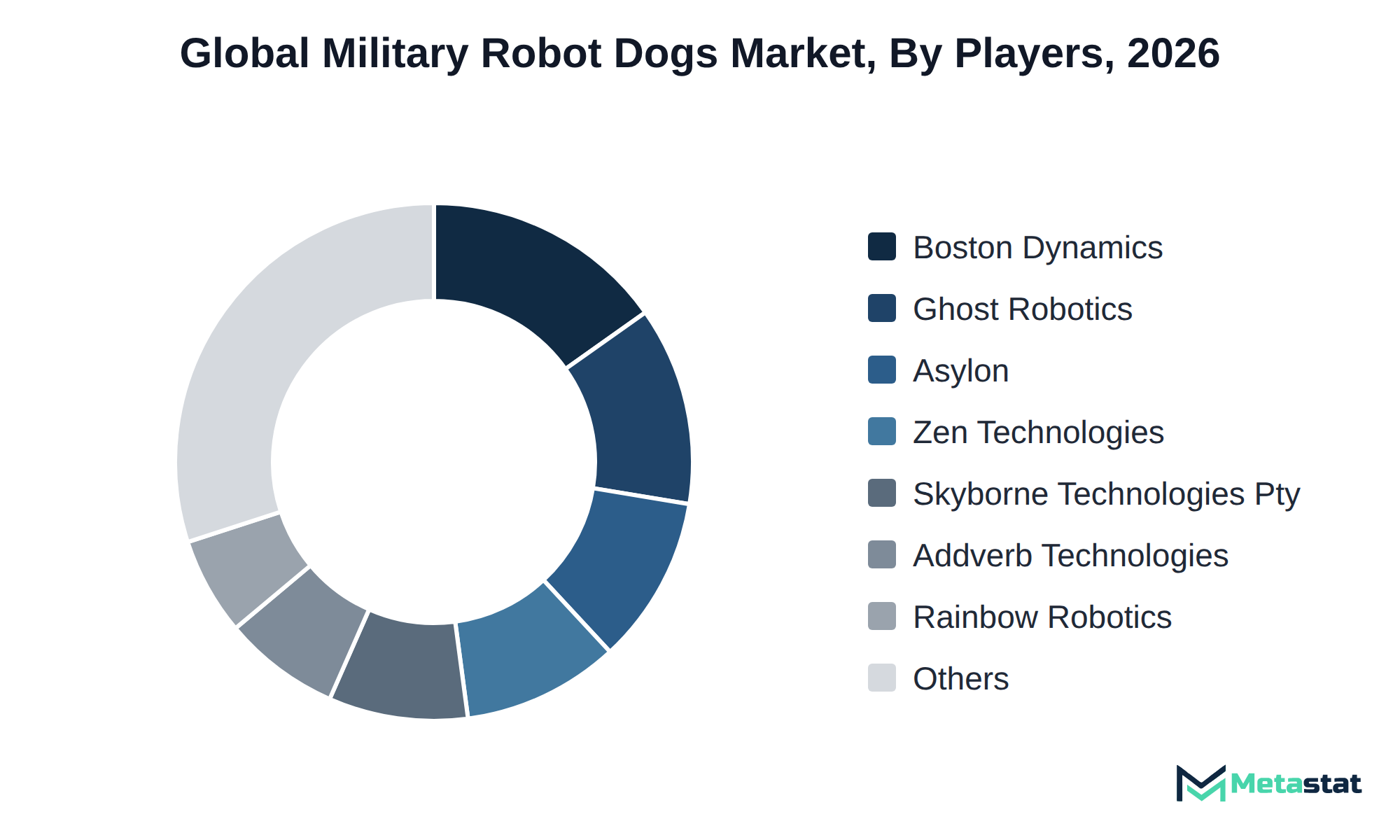
Competition in the Military Robot Dogs market involves various strategic approaches, with companies focusing on different product types and technologies. Players including Ghost Robotics Corporation and Boston Dynamics, Inc. emphasize advanced robotics capabilities, while others like Zen Technologies Limited target specific applications including reconnaissance and surveillance.
Buyers evaluate options based on factors including price, customization, and service quality. For instance, companies like Addverb Technologies Limited and Rainbow Robotics Co., Ltd. provide tailored solutions that meet unique customer requirements. The emphasis on ecosystem integration further influences buyer decisions, as firms seek products that support interoperability with existing systems.
Technological innovation is a critical differentiator in the market. Companies like Asylon, Inc. and Skyborne Technologies Pty Ltd focus on integrating advanced AI-based target recognition and autonomous navigation capabilities into their offerings. This positions them effectively to address evolving military needs and operational efficiencies.
Strategic behaviors and product offerings vary across companies, and competition in the Military Robot Dogs market continues to evolve, driven by innovation and tailored solutions.
This growth hinges on several critical developments within the Military Robot Dogs market. First, advancements in fully autonomous control modes are expected to enhance operational efficiency and expand use cases, especially in reconnaissance and surveillance applications. Second, increasing demand for armed quadruped robots, driven by geopolitical tensions, is projected to accelerate market growth, particularly in regions including North America where defense budgets remain robust. Lastly, the integration of AI-based target recognition technologies into military robot dogs will improve their capabilities, appealing to a broader range of defense contractors and government agencies.
However, potential risks, including budget constraints imposed by economic fluctuations, could hinder market expansion. Regions facing tighter defense spending slow down adoption rates, particularly in Europe and South America. Mitigating these challenges will be essential to achieving the projected market size and sustaining growth through the forecast period.
By Product Type: Quadruped Unmanned Ground Vehicles (Q-UGVs), Armed Quadruped Robots, Reconnaissance and Surveillance Robot Dogs, Explosive Ordnance Disposal (EOD) Robot Dogs, Logistics and Payload-Carrying Robot Dogs, CBRN Detection Robot Dogs, Others (Specialized Mission-Specific Quadruped Robots)
By Control Mode: Teleoperated, Fully Autonomous, Semi-autonomous
By Technology: AI-Based Target Recognition, Autonomous Navigation and Path Planning, Sensor Fusion and Environmental Perception, Terrain Adaptation and Mobility, Mission Payload Integration, Others (Advanced Communication and Navigation Technologies)
By Application: Intelligence, Surveillance, and Reconnaissance, Installation Security and Perimeter Patrol, Explosive Ordnance Disposal, Chemical, Biological, Radiological, and Nuclear Detection, Tactical Logistics and Resupply, Combat Support, Others (Communications Relay, Search and Rescue)
The report strategically identifies and profiles the key market players and analyses their core competencies in each sub-segment of the Military Robot Dogs market.
Report Attributes | Details |
Study Period | 2021-2033 |
Base Year | 2025 |
Estimated Year | 2026 |
Forecast Period | 2026-2033 |
Historical Period | 2021-2025 |
Growth Rate | CAGR 7.4% from 2026 to 2033 |
Revenue Unit | USD million |
Segmentation | By Product Type, Control Mode, Technology, Application, and Region |
By Region | North America (By Product Type, Control Mode, Technology, Application, and Country)
|
Europe (By Product Type, Control Mode, Technology, Application, and Country)
| |
Asia Pacific (By Product Type, Control Mode, Technology, Application, and Country)
| |
South America (By Product Type, Control Mode, Technology, Application, and Country)
| |
Middle East and Africa (By Product Type, Control Mode, Technology, Application, and Country)
|
Find answers to common questions about this report
The Military Robot Dogs market size was valued at USD 423.1 million in 2025.
The market is projected to grow at a CAGR of 7.4% during the forecast period from 2026 to 2033.
The North America Military Robot Dogs market size is estimated to reach USD 264.4 million by 2033.
Reconnaissance and Surveillance Robot Dogs lead the Military Robot Dogs market, with a projected value of USD 241 million by 2033. This segment surpasses others in terms of revenue generation.
Increased reliance on autonomous technologies enhances operational capabilities and efficiency, supporting effective deployment across diverse applications. Significant advancements in robotics and AI technologies drive innovation, allowing for complex tasks to be performed with higher precision.
North America holds the dominant share of the Military Robot Dogs market, with a projected value of USD 264.4 million in 2033, representing 38.2 percent of the total market. This region surpasses others in market share, including Europe and Asia Pacific.
High procurement costs represent a significant restraint on adoption among military organizations. Budget constraints across defense sectors directly impact procurement decisions, resulting in smaller orders and delayed replacement of outdated systems.
The Military Robot Dogs market is estimated to reach a valuation of USD 749.3 million by 2033.
Key players operating in the Military Robot Dogs market include Ghost Robotics Corporation, Boston Dynamics, Inc., Asylon, Inc., Zen Technologies Limited, Skyborne Technologies Pty Ltd, Addverb Technologies Limited, Rainbow Robotics Co., Ltd., and QuadRobotics.
The fully autonomous segment is projected to reach USD 173.5 million by 2033, reflecting a strong demand for advanced capabilities within the Military Robot Dogs market.
The analysts below cover Aerospace and Defense research at Metastat Insights.
LEAD ANALYST
Utkarsh Khirodkar is a Lead Market Research Analyst at MetaStat Insight, specializing in market intelligence, technology sector assessments, and competitive strategy.
Our team was tracking whether regional recycling infrastructure could realistically absorb the growing volume of lithium iron phosphate batteries over the next decade. The report did a solid job separating announced hydrometallurgical plant capacity from active, permitted operational throughput. That distinction made the feedstock availability projections and regional recovery rate models far more credible than standard commercial overviews.
Tracking capacity expansion in single-use bioprocessing requires dependable data on raw material availability and cleanroom-grade polymer supply chains. The competitive landscape chapter gave a grounded evaluation of secondary component suppliers across North America and Asia-Pacific rather than simply reprinting press releases. Having that level of supplier benchmarking helped clarify dual-sourcing considerations for our clinical pipeline planning.
When evaluating distributed energy resource management systems, standard research summaries tend to gloss over the operational differences between front-of-the-meter utility deployments and behind-the-meter industrial sites. The MetaStat Insight report addressed those distinctions directly, especially regarding software interoperability standards and grid interconnection backlogs. The five-year market sizing across regional transmission organizations provided actionable context for our grid modernization strategy.
Explore related market intelligence reports worth reading alongside this one.