
LEAD ANALYST
Utkarsh Khirodkar is a Lead Market Research Analyst at MetaStat Insight, specializing in market intelligence, technology sector assessments, and competitive strategy.

Odor Monitoring Equipment Market Size, Share, By Type (Portable Gas Chromatographs, Electronic Nose Devices, Photoionization Detectors (PIDs), Others), By End-use Industry (Oil and Gas, Chemical, Food and Beverage, Research Organizations, Defense, Others), Industry Analysis, Growth, Trends, and Forecast, 2026-2033
Report ID
MSI-2280
Published
February, 2026
Pages
309 Pages
Format
Report Details
Choose Your License
Odor Monitoring Equipment Market
Odor monitoring equipment is a type of air monitoring equipment that is used to detect, measure, and analyze odors in the air. This equipment can include sensors that detect the presence of specific chemicals or compounds, as well as instruments that measure the strength and concentration of odors. Some examples of odor monitoring equipment include portable gas chromatographs, electronic nose devices, and photoionization detectors (PIDs). These devices can be used in a variety of settings, including industrial sites, waste management facilities, and residential areas, to ensure compliance with air quality regulations and to assess the impact of odors on the environment and human health.
The growing awareness about the negative impact of odors on human health and stringent government regulations on standards for air quality and odor control are key driving factors of the market. However, high cost of advanced odor monitoring equipment and lack of standardization and regulations on odor measurement and monitoring, leading to a lack of uniformity in the industry, might hamper the market growth. The increasing adoption of odor monitoring equipment in developing countries would provide lucrative opportunities for the market in coming years.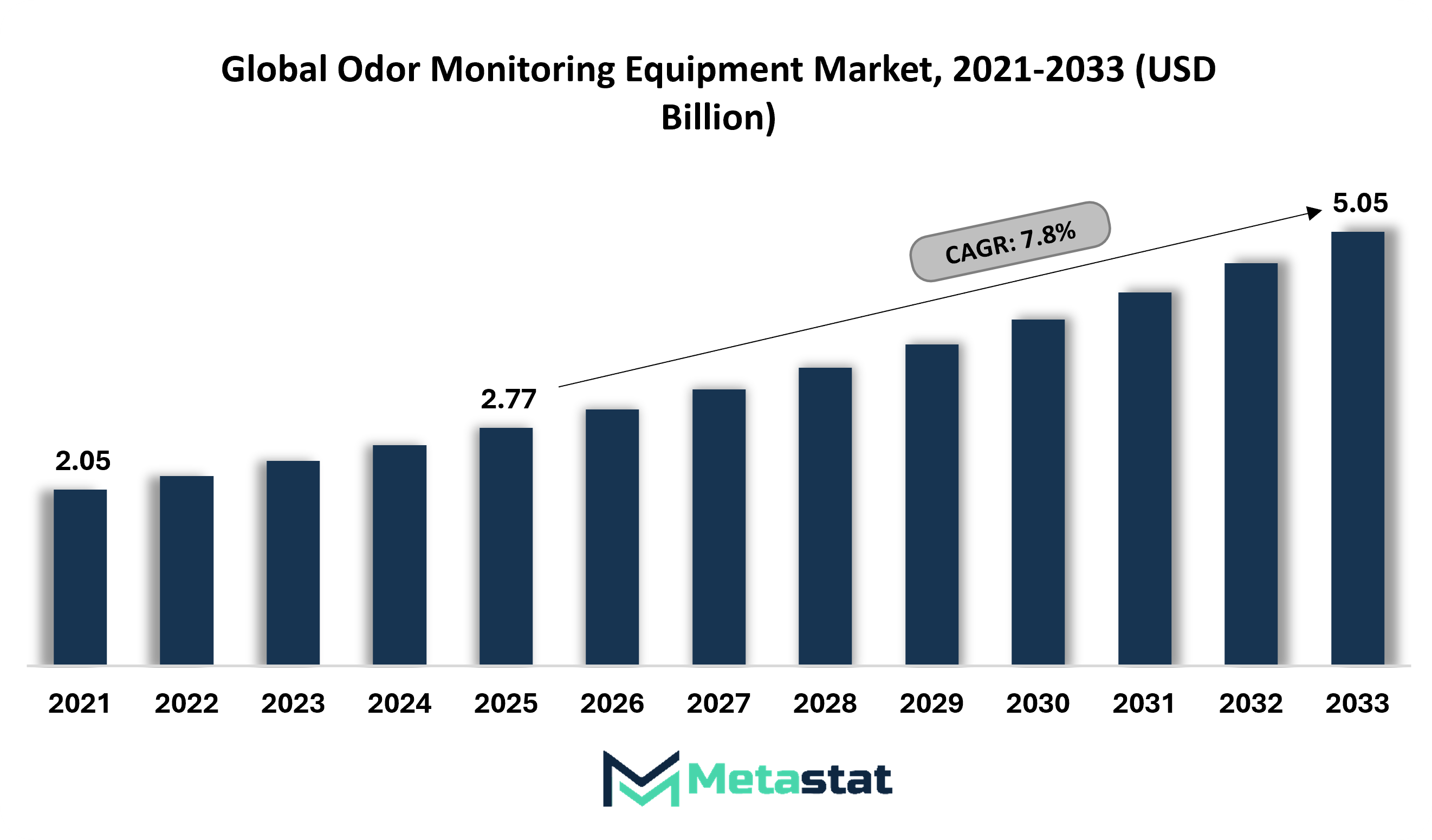
The global Odor Monitoring Equipment market is mainly classified based on Type, and End-use Industry.
Type is further segmented into Portable Gas Chromatographs, Electronic Nose Devices, Photoionization Detectors (PIDs), and Others.
Portable Gas Chromatographs segment is valued at USD 0.7 billion in 2026 and is projected to reach USD 1.1 billion by 2033, at a CAGR of 6.5% during the forecast period.
By End-use Industry the market is divided into Oil and Gas, Chemical, Food and Beverage, Research Organizations, Defense, and Others.
Oil and Gas segment is projected to reach USD 1.1 billion by 2033, at a CAGR of 7.2% during the forecast period.
Based on geography, the global Odor Monitoring Equipment market is divided into North America, Europe, Asia-Pacific, South America, and Middle East & Africa. North America is further divided in the U.S., Canada, and Mexico, whereas Europe consists of the UK, Germany, France, Italy, and Rest of Europe. Asia-Pacific is segmented into India, China, Japan, South Korea, and Rest of Asia-Pacific. The South America region includes Brazil, Argentina, and the Rest of South America, while the Middle East & Africa is categorized into GCC Countries, Egypt, South Africa, and Rest of Middle East & Africa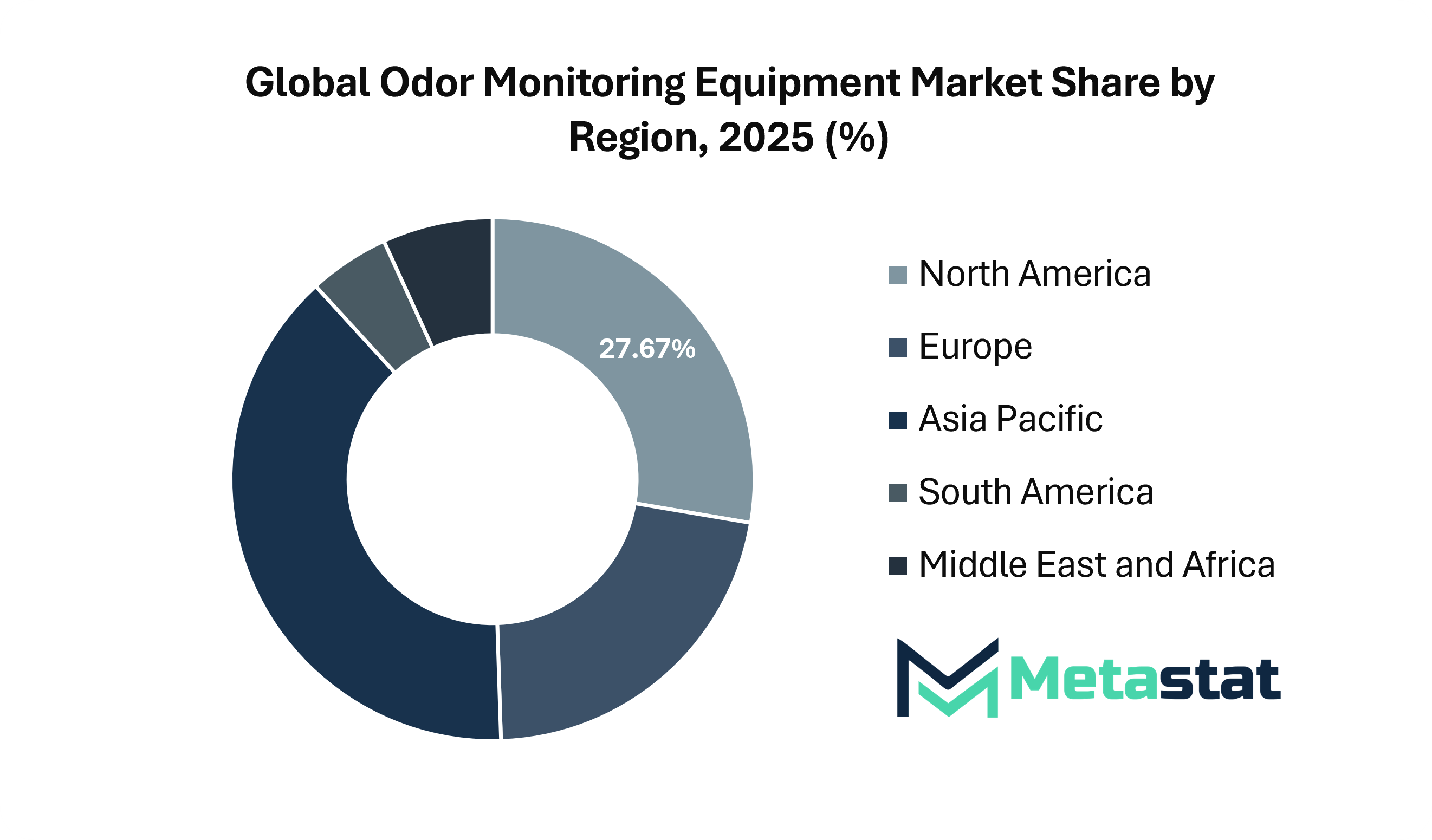
Key players operating in the Odor Monitoring Equipment industry include ABB, 3M Company, Agilent Technologies, Airsense, Alpha MOS, Drägerwerk AG & Co. KGaA, Ecotech, Ellutia, Emerson Electric Co., E-Nose Pty Ltd., Enviro' & Industrial Solutions ME, Honeywell BW, OIZOM INSTRUMENTS PVT. LTD., PerkinElmer Inc., RoboScientific Ltd., Scentroid, SENKO International Inc., Sensigent, Shimadzu Corporation, Siemens, Sollae Systems, SRI Instruments GmbH, The eNose Company, Thermo Fisher Scientific Inc., and Vernier Software & Technology.
Find answers to common questions about this report
Top players operating in the Odor Monitoring Equipment industry includes ABB, 3M Company, Agilent Technologies, Airsense, Alpha MOS, Drägerwerk AG & Co. KGaA, Ecotech, Ellutia, Emerson Electric Co., E-Nose Pty Ltd., Enviro’ & Industrial Solutions ME, Honeywell BW, OIZOM INSTRUMENTS PVT. LTD., PerkinElmer Inc., RoboScientific Ltd., Scentroid, SENKO International Inc., Sensigent, Shimadzu Corporation, Siemens, Sollae Systems, SRI Instruments GmbH, The eNose Company, Thermo Fisher Scientific Inc., Vernier Software & Technology.
The Odor Monitoring Equipment market is estimated to reach a valuation of USD 5 billion by 2033.
According to Metastat Insights analysis, the North America Odor Monitoring Equipment market size is estimated to reach USD 1.2 billion by 2033.
The Odor Monitoring Equipment market is projected to grow at a CAGR of 7.8% during the forecast period from 2026 to 2033.
The Metastat Insights study reveals that the Odor Monitoring Equipment market size was valued at USD 2.8 billion in 2025.
The analysts below cover Electronics and Semiconductor research at Metastat Insights.
LEAD ANALYST
Utkarsh Khirodkar is a Lead Market Research Analyst at MetaStat Insight, specializing in market intelligence, technology sector assessments, and competitive strategy.

PRINCIPAL CONSULTANT - ENTERPRISE AI & EMERGING TECHNOLOGIES
Banking & Finance · Electronics and Semiconductor · Energy and Power · Healthcare IT · Information & Technology · Professional Services
Vijay Gunti is a Principal Consultant at MetaStat Insight, bringing over two decades of experience across enterprise digital transformation, technology strategy, and intelligent systems.

PRINCIPAL CONSULTANT - QUALITY SYSTEMS & COMPLIANCE
Electronics and Semiconductor · Machinery & Equipment · Professional Services
Omkar Phadtare is an Industry Consultant at MetaStat Insight, specializing in quality systems, regulatory compliance, and standards benchmarking to drive data-driven market intelligence and strategic industry research.

ENERGY & INFRASTRUCTURE INDUSTRY CONSULTANT
Automotive and Transportation · Electronics and Semiconductor · Energy and Power · Machinery & Equipment
Saurabh Vasant Ganvir consults for Energy & Infrastructure Industry at MetaStat Insight, specializing in renewable energy, solar EPC, and electric vehicle (EV) infrastructure markets.

LEAD CONSULTANT - COMMUNICATION, TELECOM, AND IT
Electronics and Semiconductor · Information & Technology · Machinery & Equipment · Professional Services
Ravindra Sathe Consultants for Communication, Telecom, and IT at MetaStat Insight. He leads the firm's industry research initiatives across telecommunications infrastructure, digital connectivity, enterprise networking, and emerging information technology domains.
Assessing 200mm wafer transition schedules and substrate supply bottlenecks requires precise technical intelligence. MetaStat Insight supplied an actionable breakdown comparing planar and trench MOSFET architectures across automotive and industrial drive markets. The regional capacity estimates for Asia-Pacific foundries helped clarify lead-time uncertainties during our strategic planning session. When we needed additional clarification on high-purity raw material sourcing, their analyst team responded with helpful context within twenty-four hours.
Tracking maintenance cycle demand for secondary flight display units and terrain collision avoidance systems across regional jet fleets involves complex aftermarket dynamics. MetaStat Insight provided practical analysis separating airline retrofit programs from OEM forward-fit production schedules in North America and Southeast Asia. The supplier matrix highlighted component obsolescence timelines without resorting to vague generalizations. The dataset served as a dependable reference during our annual program review meetings.
Evaluating secondary resin quality across post-consumer packaging streams requires reliable technical segmentation. MetaStat Insight delivered an objective assessment that distinguished between extrusion-grade flake pricing and optical sorting throughput limitations across Western Europe. The competitive positioning breakdown for licensed depolymerization technology providers answered several questions during our feedstock feasibility audit. Their team clarified regional trade restrictions on mixed plastic scrap quickly when our team submitted follow-up requests.
Explore related market intelligence reports worth reading alongside this one.