
LEAD ANALYST
Utkarsh Khirodkar is a Lead Market Research Analyst at MetaStat Insight, specializing in market intelligence, technology sector assessments, and competitive strategy.

Once-through Steam Generator (OTSG) Market By Type (Horizontal, and Vertical), By Capacity (Up to 60 MW, 60-100, and Above 100 MW),By Application (Power Generation, Oil & Gas, Industrial, and Others), Industry Analysis, Size, Share, Growth, Trends, and Forecasts 2025-2032
Report ID
MSI-4465
Published
November, 2025
Pages
255 Pages
Format
Report Details
Choose Your License
Once-through Steam Generator (OTSG) Market
The global once-through steam generator (OTSG) market started to take shape at the end of the 20th century when energy producers were looking for small equipment that could produce steam quickly without the bulky drum designs of the older boilers. The oil recovery projects in North America, where the operators required the unit to heat water quickly and tolerate the fluctuating field conditions, were the main reasons for the first OTSG use. With time, in the course of recognizing the industry through a series of engineering advancements, the 1990s saw the industry shift to modular skid-mounted structures and the introduction of low-NOx burner systems, which, besides their performance, were becoming subject to stringent environmental rules issued by the U.S. Environmental Protection Agency and the Canadian Energy Regulator. Eventually, these milestones were a technological breakthrough that would later dominate the direction of the global OTSG market.
Over time, the expectations of end users changed as oilfield operators, gas processors, and industrial facilities began seeking equipment that would cut maintenance downtime and reduce water use. This shift coincided with research programs led by national laboratories documenting that once-through systems could achieve thermal efficiencies above 90 percent under optimized conditions, a figure confirmed in several U.S. Department of Energy technical papers. Manufacturers responded by designing units with improved heat-transfer surfaces, automated control loops, and real-time monitoring systems able to track fuel input, flue-gas temperature, and steam purity with far greater precision than earlier models.
Regulatory pressure also influenced the market’s path. The European Commission’s industrial emissions directives and updated boiler codes in Asia encouraged operators to select equipment that would align with projected environmental targets. As a result, producers began investing in metallurgy capable of handling higher pressures, anticipating that future installations will demand even cleaner combustion and lower water discharge. Industry bodies such as the American Society of Mechanical Engineers documented rising adoption of advanced alloys in pressure-vessel components, driven by the need for longer operational lifespans.
Today the global once-through steam generator (OTSG) market stands at a turning point shaped by decades of technological refinement and shifting operational expectations. Newer installations will continue emphasizing efficiency, automated diagnostics, and regulatory alignment, building on a lineage that started with field-driven ingenuity and evolved through sustained innovation.
The global once-through steam generator (OTSG) market is mainly classified based on Type, Capacity, Application.
By Type is further segmented into:
|
Forecast Period |
2025-2032 |
|
Market Size in 2025 |
$1311.9 Million |
|
Market Size by 2032 |
$2263.8 Million |
|
Growth Rate from 2025 to 2032 |
8.1% |
|
Base Year |
2024 |
|
Regions Covered |
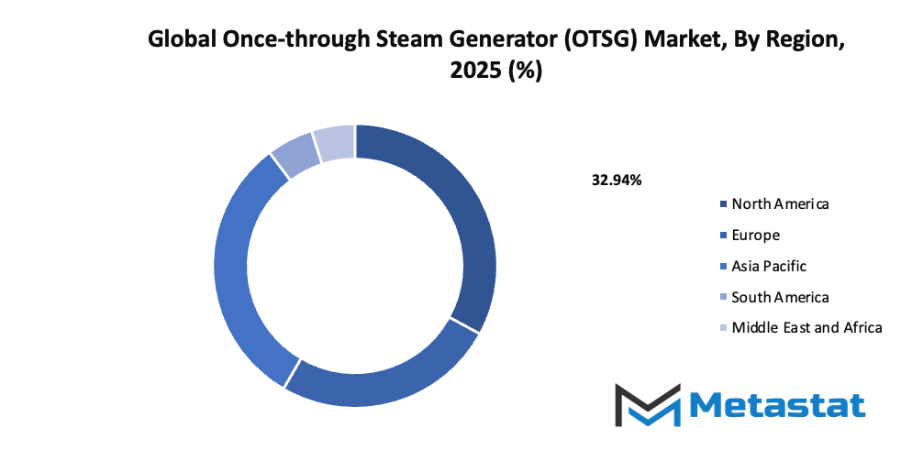
North America, Europe, Asia-Pacific, South America, Middle East & Africa |
The global once-through steam generator (OTSG) market shows strong activity, with constant pressure for higher efficiency, dependable performance, and cleaner energy production. Demand for advanced steam generation continues to rise, and competition among major manufacturers encourages steady improvement in design, safety, and operational standards. Many long-standing engineering groups bring deep experience, while newer regional producers add fresh approaches and lower-cost options, creating a balanced competitive landscape.
Major participants such as Babcock & Wilcox Enterprises Inc., Mitsubishi Heavy Industries Ltd., General Electric Company, Doosan Heavy Industries & Construction Co. Ltd., Siemens AG, Alstom SA, Foster Wheeler AG, Thermax Limited, Harbin Electric Company Limited, Nooter/Eriksen Inc., Bharat Heavy Electricals Limited (BHEL), Hangzhou Boiler Group Co. Ltd., John Wood Group PLC, and Shanghai Electric Group Company Limited contribute to broad product variety and continuous innovation. Each organization brings unique strengths, from large-scale power solutions to flexible systems suited for industrial projects. This mix supports wide adoption across sectors that require stable heat transfer, reduced fuel waste, and strict environmental compliance.
Growing interest in energy efficiency encourages manufacturers to focus on designs that support steady output with lower emissions. Strong research investment helps develop materials that handle high pressure, reduce corrosion, and extend equipment lifespan. Service support also plays a major role, as many operators look for reliable maintenance programs, fast replacement parts, and long operational guarantees. These added services help build long-term trust between suppliers and industrial users.
Regional markets show rising activity as governments set clearer rules for cleaner production. Supportive policies, funding programs, and stronger infrastructure planning give producers more confidence to expand manufacturing lines and enter new partnerships. This wider participation strengthens supply chains and offers buyers more competitive prices and shorter delivery times.
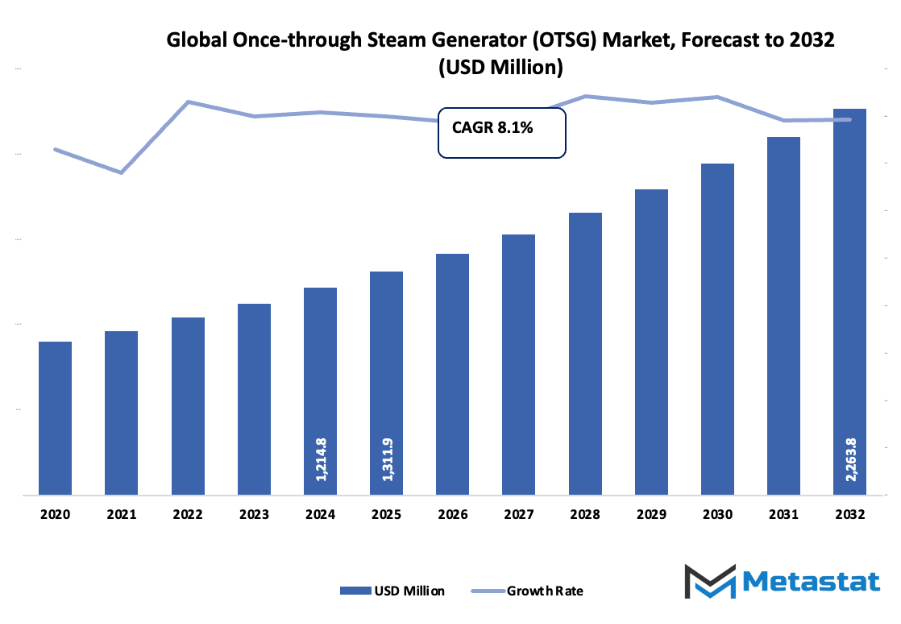
Market size is forecast to rise from USD 1311.9 million in 2025 to over USD 2263.8 million by 2032. Once-through Steam Generator (OTSG) will maintain dominance but face growing competition from emerging formats.
Overall growth in the global market reflects steady demand for dependable steam generation and continuous improvement across major manufacturers. Strong competition, active research, and expanding regional capabilities shape a market that encourages better performance and broader access to advanced thermal technology.
This research report categorizes the global once-through steam generator (OTSG) market based on various segments and regions, forecasts revenue growth, and analyzes trends in each submarket. The report analyses the key growth drivers, opportunities, and challenges influencing the global once-through steam generator (OTSG) market. Recent market developments and competitive strategies such as expansion, type launch, development, partnership, merger, and acquisition have been included to draw the competitive landscape in the market. The report strategically identifies and profiles the key market players and analyses their core competencies in each sub-segment of the global once-through steam generator (OTSG) market.
Find answers to common questions about this report
Global Once-through Steam Generator (OTSG) market is valued at $1311.9 million in 2025.
Global Once-through Steam Generator (OTSG) market is estimated to grow with a CAGR of 8.1% from 2025 to 2032.
Global Once-through Steam Generator (OTSG) market is estimated to reach $2263.8 million by 2032.
Top players operating in the Once-through Steam Generator (OTSG) industry includes Babcock & Wilcox Enterprises Inc., Mitsubishi Heavy Industries Ltd.
The analysts below cover Energy and Power research at Metastat Insights.
LEAD ANALYST
Utkarsh Khirodkar is a Lead Market Research Analyst at MetaStat Insight, specializing in market intelligence, technology sector assessments, and competitive strategy.

PRINCIPAL CONSULTANT - ENTERPRISE AI & EMERGING TECHNOLOGIES
Banking & Finance · Electronics and Semiconductor · Energy and Power · Healthcare IT · Information & Technology · Professional Services
Vijay Gunti is a Principal Consultant at MetaStat Insight, bringing over two decades of experience across enterprise digital transformation, technology strategy, and intelligent systems.

ENERGY & INFRASTRUCTURE INDUSTRY CONSULTANT
Automotive and Transportation · Electronics and Semiconductor · Energy and Power · Machinery & Equipment
Saurabh Vasant Ganvir consults for Energy & Infrastructure Industry at MetaStat Insight, specializing in renewable energy, solar EPC, and electric vehicle (EV) infrastructure markets.
Enterprise zero-trust network rollouts are often slowed down by multi-cloud transit latency and proprietary hardware retirement schedules. This study provided realistic total cost of ownership models comparing cloud-delivered security edge solutions against traditional hardware refreshes. The analysis of contract renewal lengths and software maintenance fees gave us clear visibility into enterprise replacement cycles over the next three to five years.
Scaling antibody-drug conjugate manufacturing hinges on contract manufacturing availability for high-potency active ingredients. The MetaStat Insight analysis looked closely at global cleanroom slot constraints, bioconjugation batch failure rates, and supply chain redundancies between the US, Europe, and India. The supplier capability matrix proved genuinely useful for our team when mapping secondary source options across our clinical pipeline.
Floating offshore wind feasibility relies heavily on specialized installation vessel availability and port crane limits, which most broad renewable energy forecasts ignore. The report delivered a thorough analysis of dry dock capacity, mooring chain supply constraints, and raw material pricing trends for deepwater anchor installations. It served as a solid independent sanity check for our offshore project capital expenditure assumptions.
Explore related market intelligence reports worth reading alongside this one.