
LEAD ANALYST
Utkarsh Khirodkar is a Lead Market Research Analyst at MetaStat Insight, specializing in market intelligence, technology sector assessments, and competitive strategy.

Smart Glasses Market Size, Share, By Type (Monocular, Binocular, Audio, Immersive, and Others), By Glass Tinting Technology (Polymer-Dispersed Liquid Crystals, Electrochromic (EC) Smart Glass, Photochromic, Suspended Particles Device (SPD), and Others), By Connectivity (Bluetooth, HDMI, and USB), By Application (Education, Gaming, Healthcare, Industrial, and Others), Industry Analysis, Growth, Trends, and Forecast, 2026-2033
Report ID
MSI-4676
Published
April, 2026
Pages
314 Pages
Format
Report Details
Choose Your License
Smart Glasses Market
The Global Smart Glasses market size was valued at USD 2,591.1 million in 2025 and projected to grow at a CAGR of 24.2% during the forecast period, reaching USD 14,663.6 million by 2033.
North America held 34.4% of the global market in 2025, with the U.S. accounting for the largest regional share.
Binocular segment accounted for the largest market share in 2025.
Key trends driving growth: Growing Adoption of AR & Enterprise Use and Advancements in Display & AI Technologies.
Opportunities include integration with AI and IoT Ecosystems.
Key insight: The market is set to grow considerably in value over the next decade, highlighting significant growth opportunities.
The Global Smart Glasses market within the consumer electronics and wearable technology industry is expected to transform how digital information is integrated into everyday life. Rather than remaining novelty devices, smart glasses are evolving into intelligent visual interfaces that support professional, social, and personal activities. Product design is shifting from bulky prototypes toward eyewear that closely resembles conventional fashion frames, supporting adoption across a broader consumer base. Lighter frames, adaptive lens technologies, and advanced embedded sensors will improve comfort, usability, and contextual awareness.
In enterprise environments, head-mounted displays will support remote collaboration through spatial annotations and real-time overlays. Field engineers will be able to access schematic projections aligned with physical equipment, while healthcare professionals will consult live data without interrupting procedural focus. Educational institutions will adopt immersive visualization tools that convert traditional learning materials into 3D simulations, improving instructional delivery. Retail experiences are also expected to integrate virtual try-on capabilities through transparent displays that respond to eye movement and gesture recognition, helping improve customer engagement and purchase decisions.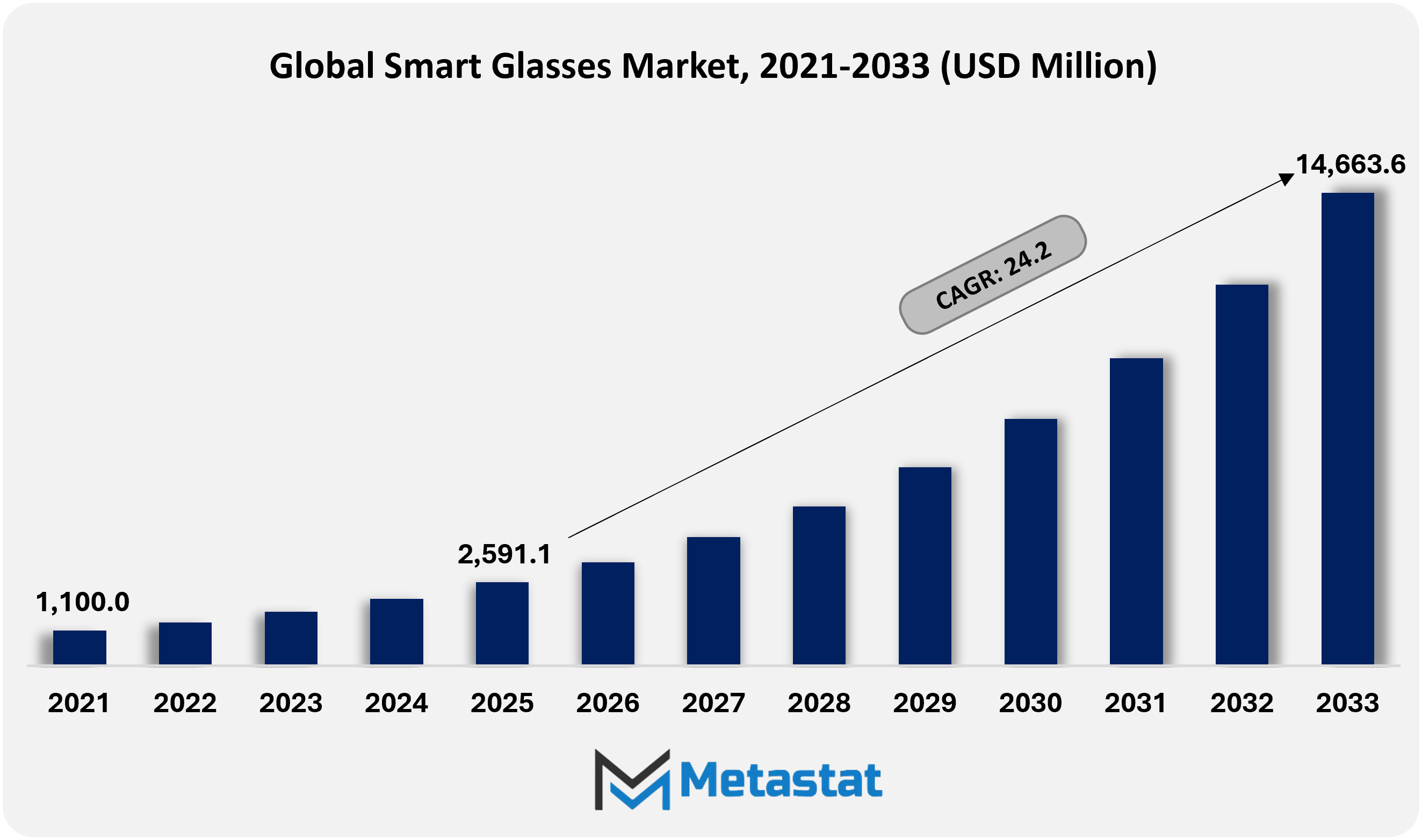
Growing Adoption of AR & Enterprise Use.
Rising deployment of augmented reality solutions across manufacturing, healthcare, logistics, and field services will drive demand in the Global Smart Glasses market. Enterprises are increasingly integrating wearable visualization tools to improve workflow accuracy, remote collaboration, and training efficiency. Ongoing industrial digitalization is supporting adoption of head-mounted interfaces that enhance productivity and reduce operational errors.
Advancements in Display & AI Technologies
Continuous advancements in micro-display systems, lightweight optics, and artificial intelligence processors will accelerate innovation in the Global Smart Glasses market. Improvements in image clarity, gesture recognition, voice control, and contextual data processing are enhancing overall user experience. AI-enabled analytics are also strengthening the role of smart glasses as intelligent assistants for both enterprise and consumer applications.
High Device Cost
High product costs remain a major restraint for the Global Smart Glasses market. Premium pricing, continued R&D spending, and advanced sensor integration keep average selling prices elevated, limiting adoption among small enterprises and price-sensitive consumers. Broader commercialization will depend on cost optimization, manufacturing scale, and improved affordability across key markets.
Limited Battery Life & Technical Barriers
Battery life and technical complexity continue to present challenges for the Global Smart Glasses market. High-resolution displays, connectivity modules, and AI processing functions place considerable pressure on power consumption, which affects device runtime and performance. Thermal management issues and hardware miniaturization also influence product design, making improvements in energy efficiency and compact battery technology essential for long-duration use.
Integration with AI and IoT Ecosystems
Expansion of connected digital infrastructure will create strong growth opportunities for the Global Smart Glasses market. Integration with artificial intelligence platforms, cloud computing systems, and Internet of Things ecosystems will enable real-time analytics, synchronized device communication, and intelligent decision support. Cross-industry collaboration will accelerate the development of immersive solutions for smart cities, healthcare monitoring, and industrial automation.
The Global Smart Glasses market is classified based on Type, Glass Tinting Technology, Connectivity, and Application.
Monocular segment is estimated at USD 679.7 million in 2026 and is projected to reach USD 1,747.9 million by 2033, at a CAGR of 14.4% during the forecast period.
Monocular smart glasses are gaining relevance through lightweight optical modules designed for single-eye projection. Enterprise users are adopting these devices for guided workflows, field inspections, and remote assistance. Their compact design, lower power consumption, and focused display capability make Monocular glasses well suited for logistics, maintenance, and professional training applications.
Binocular segment is estimated at USD 1,140.8 million in 2026 and is projected to reach USD 4,214.3 million by 2033, at a CAGR of 20.5% during the forecast period.
Binocular smart glasses will gain traction owing to their ability to deliver dual-eye visualization, improved depth perception, and stronger spatial awareness. The Global Smart Glasses market is witnessing rising demand for high-resolution stereoscopic displays integrated with motion sensors and gesture controls. A wider field of view and improved weight distribution are enhancing user comfort, supporting extended usage in design simulation, advanced training, and complex task execution.
Audio segment is estimated at USD 471.2 million in 2026 and is projected to reach USD 2,591.1 million by 2033, at a CAGR of 27.6% during the forecast period.
Audio-focused smart glasses are expanding the scope of the Global Smart Glasses market by emphasizing voice assistance, spatial audio, and hands-free communication. Embedded microphones and directional speakers support seamless interaction across enterprise and consumer settings. Noise reduction features and real-time translation capabilities are further strengthening their use in multilingual workplaces and collaborative environments.
Immersive segment is estimated at USD 670.2 million in 2026 and is projected to reach USD 5,067.7 million by 2033, at a CAGR of 33.5% during the forecast period.
Immersive smart glasses will combine augmented overlays with the real-world environment to create advanced mixed-reality experiences. Growth in the Global Smart Glasses market for this segment is aligned with progress in AI processing, sensor fusion, and visual computing. High refresh rates, precise tracking, and adaptive brightness control are supporting interactive visualization across training, design review, and experiential marketing applications.
Others segment is estimated at USD 253.5 million in 2026 and is projected to reach USD 1,042.6 million by 2033, at a CAGR of 22.4% during the forecast period.
Other product categories include hybrid wearable formats and specialized industrial variants developed for niche use cases. These products are supporting adoption across defense, navigation, and accessibility-focused applications. Modular architecture and customizable firmware are also enabling manufacturers to address industry-specific performance requirements and deployment standards.
Polymer-Dispersed Liquid Crystals segment is projected to reach USD 2,706.9 million by 2033, at a CAGR of 17.9% during the forecast period.
Polymer-Dispersed Liquid Crystals technology enables rapid light modulation through liquid crystal droplets embedded within polymer matrices. This technology supports adjustable opacity with relatively low power requirements. Strong durability and uniform transparency are improving visual clarity across both indoor and outdoor usage environments.
Electrochromic (EC) Smart Glass segment is projected to reach USD 5,023.7 million by 2033, at a CAGR of 28.2% during the forecast period.
Electrochromic smart glass enables gradual tint adjustment through electrical stimulation. This technology is gaining attention for its energy-efficient glare reduction and improved visual comfort. Stable color transition and extended lifecycle performance are supporting its integration into professional, industrial, and medical-grade wearable systems.
Photochromic segment is projected to reach USD 1,489.8 million by 2033, at a CAGR of 21.7% during the forecast period.
Photochromic materials automatically respond to ultraviolet exposure by adjusting lens darkness without manual control. This adaptive capability improves user comfort during outdoor mobility and varying light conditions. Consistent optical quality and faster light response are enhancing product reliability across dynamic operating environments.
Suspended Particles Device (SPD) segment is projected to reach USD 3,668.8 million by 2033, at a CAGR of 26.2% during the forecast period.
Suspended Particles Device technology regulates light transmission by aligning microscopic particles under an electric charge. SPD-based solutions are valued for fast tint switching and high-contrast visibility. Improved energy efficiency and uniform shading support advanced visualization tasks in bright or high-glare environments.
Others segment is projected to reach USD 1,774.3 million by 2033, at a CAGR of 24.5% during the forecast period.
Other tinting technologies in the Global Smart Glasses market include nanocoatings, hybrid smart films, and next-generation optical materials. Growth in this segment reflects rising investment in thinner substrates, faster switching performance, and improved lens adaptability. Integration of intelligent sensors with tint control is enhancing performance across different weather and lighting conditions.
Bluetooth segment is projected to reach USD 9,987.4 million by 2033.
Bluetooth connectivity supports wireless synchronization with smartphones, tablets, and enterprise platforms. Low-power protocols enable continuous data exchange while limiting battery consumption. Secure pairing and stable signal transmission are improving mobility across both professional and consumer applications.
HDMI segment is projected to reach USD 617.3 million by 2033.
HDMI connectivity enables high-definition content transmission for visually intensive applications. Wired connections remain relevant for stable video output during simulation training, design review, and technical visualization tasks. Reliable bandwidth and low latency make HDMI suitable for controlled operating environments.
USB segment is projected to reach USD 4,058.9 million by 2033.
USB connectivity provides both power delivery and data transfer within compact smart glasses architectures. Expansion of the Global Smart Glasses market is being supported by broad compatibility with computing platforms and connected devices. Rapid charging support and firmware update capability are also strengthening operational efficiency in enterprise deployments.
Education segment is projected to grow at a CAGR of 19.8% during the forecast period.
In education, smart glasses are expected to support interactive visual overlays that improve conceptual understanding and knowledge retention. The Global Smart Glasses market is benefiting from rising use in immersive lessons, remote tutoring, and skill-based simulations. Real-time feedback systems and collaborative digital environments are also strengthening classroom engagement and vocational training outcomes.
Gaming segment is projected to grow at a CAGR of 30.9% during the forecast period.
Gaming adoption is expected to increase through mixed-reality presentation and motion-responsive experiences. Within the Global Smart Glasses market, high frame rates and advanced tracking technologies are improving user interaction and immersion. Cloud-based rendering and lightweight product design are further supporting portable entertainment experiences without the limitations of bulky hardware.
Healthcare segment is projected to grow at a CAGR of 23.1% during the forecast period.
Healthcare applications are expanding across surgical assistance, diagnostic imaging, and remote consultation. The Global Smart Glasses market is integrating secure data channels and precision visual overlays to improve clinical accuracy and decision support. Hands-free access to information and real-time patient metrics is also enhancing workflows in hospitals, clinics, and research settings.
Industrial segment is projected to grow at a CAGR of 22.4% during the forecast period.
Industrial deployment of smart glasses is centered on maintenance guidance, safety monitoring, and remote expert collaboration. Growth in the Global Smart Glasses market is closely aligned with automation strategies and broader digital transformation initiatives. Rugged product designs and integrated analytics are supporting higher productivity across manufacturing, energy, and field service operations.
Others segment is projected to grow at a CAGR of 20.3% during the forecast period.
Other applications in the Global Smart Glasses market include tourism, retail visualization, defense support, and public safety coordination. Growth in these areas is being supported by customized solutions developed for specific operational requirements. Continuous software refinement and scalable hardware architecture are expected to sustain innovation across a wide range of end-use environments.
Based on geography, the Global Smart Glasses market is divided into North America, Europe, Asia-Pacific, South America, Middle East, and Africa.
North America Smart Glasses Market is set to expand at a CAGR of 24.2% within the forecast period, reaching a market size (TAM) of USD 4,547.2 million by the end of 2033.
North America statistics robust adoption of wearable technology supported via excessive client spending energy and fast integration of AR features into organization education and healthcare workflows.
North America benefits from the presence of major technology innovators such as Apple Inc. and Meta Platforms, Inc., which are accelerating product development and ecosystem expansion in the Smart Glasses market.
Europe is expected to witness steady growth in the Smart Glasses market, supported by increasing adoption of wearable technologies across healthcare, industrial training, logistics, and enterprise communication.
Asia Pacific presents strong growth opportunities owing to expanding 5G infrastructure and rising demand for immersive gaming, digital communication, and remote collaboration tools across urban markets.
Asia Pacific gains opportunity through production scale and R&D investments led by companies like Samsung Electronics and Xiaomi Corporation, strengthening supply chain performance and near affordability.
Digital transformation tasks, improving connectivity, and organisation's interest in commercial education solutions position the Middle East, Africa, and South America for slow yet regular adoption within the Smart Glasses marketplace.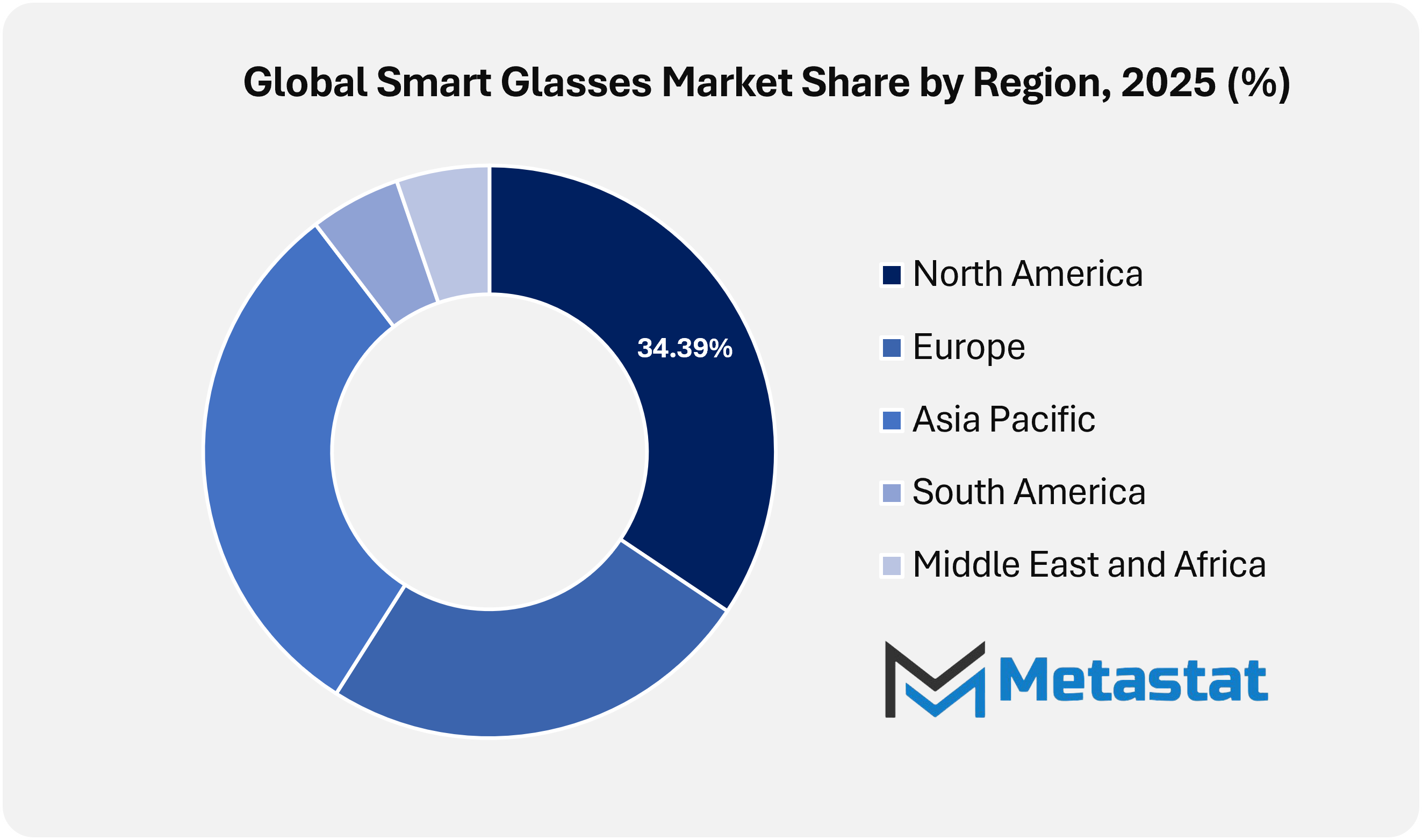
The global smart glasses market is expanding steadily as the technology becomes increasingly integrated into everyday life. Smart glasses are no longer viewed only as experimental devices and are increasingly being adopted for communication, entertainment, navigation, health tracking, and workplace productivity. Improvements in display systems, lightweight frame design, voice control, and artificial intelligence are continuing to shape market demand. Consumer interest is rising for devices that combine style with functionality, while enterprises are investing in smart glasses to improve training, remote assistance, and real-time data access. As hardware becomes more comfortable and software ecosystems mature, adoption across both consumer and enterprise segments is expected to strengthen further.
Among the most prominent competitors, Meta Platforms, Inc. has strengthened its position through partnership-led development with EssilorLuxottica S.A., combining social connectivity with established eyewear design. Sony Group Corporation and Xiaomi Corporation continue to explore smart wearables within their broader consumer electronics portfolios. Huawei Technologies Co., Ltd. and Lenovo Group Limited are integrating smart glasses into wider connected device ecosystems. Bose Corporation has developed audio-focused smart eyewear, while Seiko Epson Corporation continues to leverage its expertise in display technologies to support augmented reality applications.
Several companies are focused primarily on enterprise and industrial use cases. Vuzix Corporation and RealWear, Inc. offer hands-free devices designed for field service, manufacturing, and logistics environments. DigiLens Inc. is developing advanced waveguide displays to improve visual clarity in augmented applications. XREAL Inc., Rokid Corporation Ltd., and HTC Corporation are advancing immersive viewing experiences through lightweight AR glasses. ThirdEye Gen, Inc. and Iristick NV also support enterprise customers with rugged, task-oriented designs.
In the consumer fashion and lifestyle segment, Innovative Eyewear Inc. (LUCYD), Lenskart Solutions Limited, Solos Smartglasses, MEIZU, OPPO Guangdong Mobile Telecommunications Corp., Ltd., TCL Technology Group Corporation, and Razer Inc. are exploring designs that closely resemble conventional eyewear while offering voice assistance, notifications, and selected wellness features. Meanwhile, Everysight Ltd., Optinvent S.A., Focally, Rayneo, LLVision Technology Co., Ltd., and Goolton Technology Co., Ltd. continue to build regional presence through competitive pricing and specialized product features.
The competitive landscape is expected to remain dynamic as technology companies, eyewear brands, and AR specialists continue to invest in research, product development, and strategic partnerships. Integration with smartphones, cloud platforms, and AI assistants will remain important for product differentiation. Battery performance, privacy protection, and design appeal will continue to influence consumer acceptance. On the enterprise side, remote collaboration, digital workflow support, and training efficiency are expected to sustain demand. With innovation expanding across North America, Europe, and Asia-Pacific, the global smart glasses market is likely to witness broader use cases and stronger commercial traction over the coming years.
Market size is forecast to rise from USD 2,591.1 million in 2025 to over USD 14,663.6 million by 2033.
Software ecosystems are expected to expand around proprietary operating systems, enabling developers to build applications optimized for glance-based interaction rather than prolonged screen engagement. Voice interfaces are likely to evolve toward more natural conversational processing, reducing reliance on touch-based input. Battery architecture is also expected to improve to support longer usage durations, supported by efficient micro-LED displays and edge-based processing units that reduce latency.
This research report categorizes the Smart Glasses market based on key segments and regions, forecasts revenue growth, and analyses trends in each submarket. The report analyses the key growth drivers, opportunities, and challenges influencing the Smart Glasses market. Recent market developments and competitive strategies such as expansion, product launch, partnership, merger, and acquisition have been included to draw the competitive landscape in the market.
The report strategically identifies and profiles the key market players and analyses their core competencies in each sub-segment of the Smart Glasses market.
|
Report Attributes |
Details |
|
Study Period |
2021-2033 |
|
Base Year |
2025 |
|
Estimated Year |
2026 |
|
Forecast Period |
2026-2033 |
|
Historical Period |
2021-2025 |
|
Growth Rate |
CAGR 24.2% from 2026 to 2033 |
|
Revenue Unit |
USD million |
|
Sales Volume Unit |
Thousand Units |
|
Segmentation |
By Type, Glass Tinting Technology, Connectivity, Application, and Region |
|
By Region |
North America (By Type, Glass Tinting Technology, Connectivity, Application, and Country)
|
|
Europe (By Type, Glass Tinting Technology, Connectivity, Application, and Country)
|
|
|
Asia Pacific (By Type, Glass Tinting Technology, Connectivity, Application, and Country)
|
|
|
South America (By Type, Glass Tinting Technology, Connectivity, Application, and Country)
|
|
|
Middle East and Africa (By Type, Glass Tinting Technology, Connectivity, Application, and Country)
|
Find answers to common questions about this report
Top players operating in the Smart Glasses industry include Meta Platforms, Inc., EssilorLuxottica S.A., Innovative Eyewear Inc. (LUCYD), Bose Corporation, Lenskart Solutions Limited, Sony Group Corporation, and Solos Smartglasses.
Growing Adoption of AR & Enterprise Use and Advancements in Display & AI Technologies are key driving factors, boosting the market.
Global Smart Glasses market is estimated to reach USD 14,663.6 million by 2033.
The Metastat Insights analysis shows that the North America Smart Glasses market size is estimated to be USD 4,547.2 million by 2033.
The Global Smart Glasses market is expected to grow at a CAGR of 24.2% over the forecast period (2026-2033).
The Binocular is the leading type segment in the Global market.
North America region dominates the market.
The Metastat Insights study shows that the Global Smart Glasses market size was USD 2,591.1 million in 2025.
High Device Cost will hamper the market growth within the forecast period.
The analysts below cover Electronics and Semiconductor research at Metastat Insights.
LEAD ANALYST
Utkarsh Khirodkar is a Lead Market Research Analyst at MetaStat Insight, specializing in market intelligence, technology sector assessments, and competitive strategy.

PRINCIPAL CONSULTANT - ENTERPRISE AI & EMERGING TECHNOLOGIES
Banking & Finance · Electronics and Semiconductor · Energy and Power · Healthcare IT · Information & Technology · Professional Services
Vijay Gunti is a Principal Consultant at MetaStat Insight, bringing over two decades of experience across enterprise digital transformation, technology strategy, and intelligent systems.

PRINCIPAL CONSULTANT - QUALITY SYSTEMS & COMPLIANCE
Electronics and Semiconductor · Machinery & Equipment · Professional Services
Omkar Phadtare is an Industry Consultant at MetaStat Insight, specializing in quality systems, regulatory compliance, and standards benchmarking to drive data-driven market intelligence and strategic industry research.

ENERGY & INFRASTRUCTURE INDUSTRY CONSULTANT
Automotive and Transportation · Electronics and Semiconductor · Energy and Power · Machinery & Equipment
Saurabh Vasant Ganvir consults for Energy & Infrastructure Industry at MetaStat Insight, specializing in renewable energy, solar EPC, and electric vehicle (EV) infrastructure markets.

LEAD CONSULTANT - COMMUNICATION, TELECOM, AND IT
Electronics and Semiconductor · Information & Technology · Machinery & Equipment · Professional Services
Ravindra Sathe Consultants for Communication, Telecom, and IT at MetaStat Insight. He leads the firm's industry research initiatives across telecommunications infrastructure, digital connectivity, enterprise networking, and emerging information technology domains.
Evaluating secondary resin quality across post-consumer packaging streams requires reliable technical segmentation. MetaStat Insight delivered an objective assessment that distinguished between extrusion-grade flake pricing and optical sorting throughput limitations across Western Europe. The competitive positioning breakdown for licensed depolymerization technology providers answered several questions during our feedstock feasibility audit. Their team clarified regional trade restrictions on mixed plastic scrap quickly when our team submitted follow-up requests.
Evaluating sovereign cloud deployments for core banking platforms demands a clear view of data residency regulations and migration exit strategies. MetaStat Insight delivered an exhaustive review of regional latency tolerances, mainframe decommission milestones, and third-party vendor concentration risk. The regulatory compliance mapping across European and Asian financial jurisdictions gave our team a dependable baseline for multi-cloud infrastructure discussions.
Replacing petrochemical surfactants with bio-based alternatives requires realistic timelines on industrial precision fermentation scaling. The market research broke down commercialization timelines, feedstock sugar price sensitivities, and regional cosmetic ingredient regulatory approvals in Europe and East Asia. That supplier readiness mapping gave our formulations team reliable context when comparing renewable chemical sourcing roadmaps.
Explore related market intelligence reports worth reading alongside this one.
Starting from
$2950