
LEAD ANALYST
Utkarsh Khirodkar is a Lead Market Research Analyst at MetaStat Insight, specializing in market intelligence, technology sector assessments, and competitive strategy.

Global Tennis Overgrips Market Size, Share, By Material (Cloth, Synthetic, Leather, Microfiber, Hybrid, Composite, and Others), By Design (Textured, Patterned, Smooth, Solid, Perforated, and Ventilated), By Player (Professional Players, Competitive Players, Recreational Players, Junior Players, and Youth Players), By Distribution Channel (Sports Specialty Stores, Online Retail, Direct-to-Consumer, and Club Pro Shops), Industry Analysis, Growth, Trends, and Forecast, 2026-2033
Report ID
MSI-4628
Published
April, 2026
Pages
320 Pages
Format
Report Details
Choose Your License
Tennis Overgrips Market
Global Tennis Overgrips market size is valued at USD 4,550.4 million in 2025 and projected to grow at a CAGR of 4.3% during the forecast period, reaching USD 6,368.8 million by 2033.
North America holds 27.0% in 2025 with US leading the market share in 2025.
Cloth/Synthetic segment account for a market share of 44.5% in 2025.
Key trends driving growth: Rising participation in recreational and professional tennis driving frequent replacement demand for performance-enhancing accessories, along with increased focus on player comfort and sweat management supporting adoption of high-absorption and tacky overgrips.
Opportunities include innovation in eco-friendly, moisture-wicking, and long-lasting materials creating differentiation and premium product positioning.
Key insight: Rising global tennis participation combined with frequent replacement cycles of overgrips is ensuring steady, recurring demand across both amateur and professional segments.
The Global Tennis Overgrips Market is expanding steadily, supported by consistent participation across both recreational and competitive tennis segments. Overgrips are consumable accessories that generate recurring purchase cycles, particularly among active players who require frequent replacement to maintain grip performance, sweat absorption, and racket control. The market reflects a balance between performance-driven innovation and value-oriented consumption, with both premium and affordable products coexisting.
Growth in the Global Tennis Overgrips Market is closely linked to rising awareness of player ergonomics and injury prevention. Players are increasingly seeking products that improve grip while reducing strain during extended gameplay. Manufacturers are responding with specialized materials that offer greater tackiness, moisture management, and durability. In addition, branding, endorsements, and product differentiation through texture, thickness, and feel are influencing purchasing decisions across different player categories.
Rising participation in recreational and professional tennis driving frequent replacement demand for performance-enhancing accessories.
Growing participation across clubs, academies, and community courts will support demand in the Global Tennis Overgrips Market, as frequent play increases replacement needs. Professional tournaments and amateur leagues are encouraging regular equipment upgrades, prompting manufacturers to focus on durability, grip texture, and performance consistency.
Increased focus on player comfort and sweat management supporting adoption of high-absorption and tacky overgrips
Rising awareness of hand comfort, moisture control, and grip stability is strengthening demand across the Global Tennis Overgrips Market. Product development is increasingly focused on sweat absorption, soft feel, and anti-slip performance, enabling longer and more comfortable playing sessions. Competitive players and training institutions continue to invest in advanced grip solutions to improve performance outcomes.
Availability of durable replacement grips reducing frequency of overgrip usage among casual players
Long-lasting replacement grips can reduce dependence on frequent overgrip changes in the Global Tennis Overgrips Market. Casual players often prefer durable base grips, which limits routine overgrip purchases. Manufacturers therefore need to demonstrate clear value differentiation in performance, comfort, and hygiene to sustain recurring demand.
Price sensitivity in emerging markets limiting premium overgrip adoption
Price-sensitive purchasing behavior can limit adoption of premium products in the Global Tennis Overgrips Market, particularly across emerging economies. Consumers in these markets often prioritize affordability over advanced features, shaping brand positioning and pricing strategies. Market participants need to balance cost efficiency with acceptable quality standards to remain competitive across income segments.
Innovation in eco-friendly, moisture-wicking, and long-lasting materials creating differentiation and premium product positioning
Sustainable material innovation and longer product life are creating new growth avenues in the Global Tennis Overgrips Market. Manufacturers are investing in biodegradable materials, advanced moisture-management layers, and enhanced durability features. Premium positioning is gaining traction through a combination of environmental responsibility and reliable performance, attracting environmentally conscious consumers and professional users.
The Global Tennis Overgrips market is classified based on Material, Design, Player, and Distribution Channel.
Cloth/Synthetic segment is valued at USD 2,111.7 million in 2026 and is projected to reach USD 2,845.6 million by 2033, at a CAGR of 4.4% during the forecast period.
The Cloth/Synthetic segment is witnessing strong adoption owing to durability, moisture absorption, and cost efficiency. Manufacturers are introducing advanced fiber blends with improved grip stability under intensive play conditions, supporting longer usage cycles while maintaining comfort across different climates and match durations.
Leather/Microfiber segment is valued at USD 1,150.6 million in 2026 and is projected to reach USD 1,428.5 million by 2033, at a CAGR of 3.1% during the forecast period.
The Leather/Microfiber segment is supported by premium positioning and superior tactile feedback. Material processing improvements are enhancing softness, sweat control, and grip consistency, making these products attractive for performance-oriented players seeking precision handling and long-lasting feel.
Hybrid/Composite segment is valued at USD 995.4 million in 2026 and is projected to reach USD 1,494.1 million by 2033, at a CAGR of 6% during the forecast period.
The Hybrid/Composite segment is expanding with materials designed to combine multiple performance attributes such as shock absorption, tackiness, and moisture control. Product development is focused on balancing synthetic durability with natural texture, creating adaptable solutions for varied playing styles and court conditions.
Others segment is valued at USD 483.6 million in 2026 and is projected to reach USD 600.6 million by 2033, at a CAGR of 3.1% during the forecast period.
The Others segment includes niche material categories featuring eco-conscious compounds and specialized surface textures. Sustainable alternatives are gaining interest, supported by biodegradable inputs and recyclable packaging. Continued experimentation with alternative materials is helping brands differentiate their product portfolios.
Textured/Patterned segment is projected to reach USD 2,519.5 million by 2033, at a CAGR of 5% during the forecast period.
The Textured/Patterned segment will benefit from rising demand for improved grip friction and control. Surface engineering is advancing to enhance tactile responsiveness during high-intensity rallies, while distinct visual patterns also support brand recognition and appeal to style-conscious players.
Smooth/Solid segment is projected to reach USD 2,625.9 million by 2033, at a CAGR of 3.5% during the forecast period.
The Smooth/Solid segment continues to attract players seeking a uniform grip feel and dependable handling. Product refinement is centered on consistent surface quality and balanced moisture management, supporting reliable performance for players who prefer traditional grip characteristics.
Perforated/Ventilated segment is projected to reach USD 1,223.5 million by 2033, at a CAGR of 4.8% during the forecast period.
The Perforated/Ventilated segment is gaining traction as players seek better airflow and sweat management during extended play. Improved perforation design helps reduce slippage while preserving structural integrity, supporting comfort and grip stability under repeated use.
Professional/Competitive Players segment is projected to reach USD 2,133.6 million by 2033.
The Professional/Competitive Players segment is driven by demand for high-performance grip solutions that offer precision, durability, and sweat resistance. Product innovation in this segment is aligned with advanced gameplay requirements, while endorsements and tournament visibility continue to support premium product adoption.
Recreational Players segment is projected to reach USD 3,075.5 million by 2033.
The Recreational Players segment represents a broad consumer base seeking affordability, comfort, and ease of use. Offerings in this segment emphasize balanced performance for casual play, supported by growing participation in tennis as a recreational and fitness activity.
Junior/Youth Players segment is projected to reach USD 1,159.8 million by 2033.
The Junior/Youth Players segment is supported by expanding training programs and early sports participation. Product development is increasingly focused on softer materials, ergonomic sizing, and visually appealing designs that improve usability and appeal among younger players.
Sports Specialty Stores segment is projected to grow at a CAGR of 3.4% during the forecast period.
Sports Specialty Stores remain important to the Global Tennis Overgrips Market by offering expert guidance, product comparison, and in-store purchase confidence. These outlets are particularly relevant for premium products, where merchandising and product demonstration help communicate material and performance advantages.
Online Retail segment is projected to grow at a CAGR of 6.2% during the forecast period.
Online Retail will expand strongly, supported by convenience, broad product availability, and easier comparison across brands and price points. E-commerce platforms also strengthen consumer decision-making through reviews, ratings, and detailed product information, increasing access across diverse markets.
Direct-to-Consumer segment is projected to grow at a CAGR of 5.4% during the forecast period.
Direct-to-Consumer channels are gaining strength as brands seek closer relationships with end users. Personalized offerings, subscription-based replenishment models, and data-driven marketing are improving repeat purchases and helping manufacturers refine product development strategies.
Club Pro Shops segment is projected to grow at a CAGR of 0.5% during the forecast period.
Club Pro Shops continue to serve active tennis communities by providing convenient access to overgrips at the point of play. Trusted recommendations from coaches and club staff support purchasing decisions, while localized availability strengthens repeat sales among frequent players.
Based on geography, the Global Tennis Overgrips market is divided into North America, Europe, Asia-Pacific, South America, Middle East, and Africa.
A strong base of tennis clubs, academies, and professional tournaments in North America supports steady demand for performance accessories such as overgrips.
Europe Tennis Overgrips Market will witness stable growth during the forecast period, supported by strong tennis participation across club, amateur, and professional formats.
In Asia Pacific, rising tennis participation across countries such as China and India is expanding the consumer base for affordable and mid-range overgrips.
Increasing e-trade penetration enables broader product accessibility, supporting market expansion in each urban and semi-urban areas in Asia Pacific.
South America Tennis Overgrips Market is projected to grow steadily, supported by expanding interest in tennis, rising participation in urban sports clubs, and improving access to branded sporting accessories.
Middle East & Africa Tennis Overgrips Market will register gradual growth, supported by rising sports participation, increasing investment in tennis infrastructure, and growing awareness of performance-oriented accessories.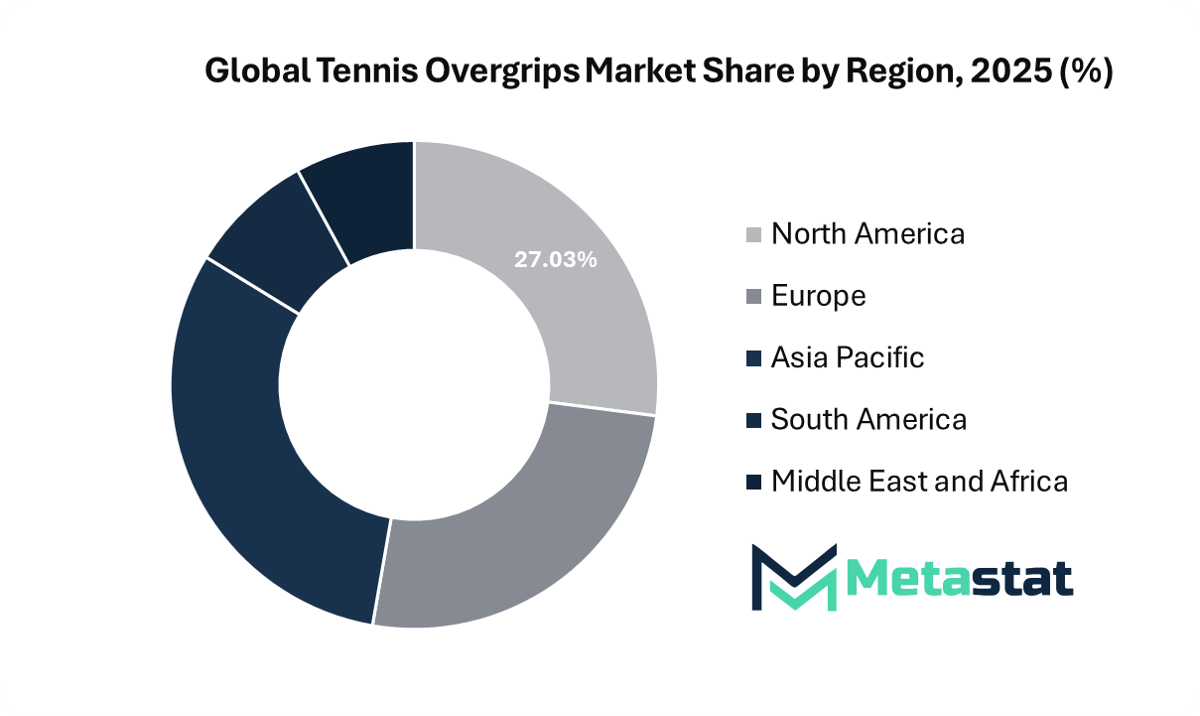
The Global Tennis Overgrips Market is witnessing steady demand growth, supported by rising participation in tennis across both amateur and professional levels. Overgrips remain essential accessories that enhance comfort, moisture control, and grip stability, directly influencing player performance during training and competitive play. Growing interest in recreational sports and fitness activities is further supporting demand for reliable and affordable tennis accessories. Manufacturers are focusing on improved texture, sweat absorption, and durability while maintaining price competitiveness for a broad consumer base.
Consumer preference is increasingly shifting toward products that combine performance, convenience, and value. Frequent replacement cycles create recurring demand, encouraging brands to introduce multi-pack formats and product variations based on thickness, texture, and feel to suit different playing preferences. Growing awareness of hygiene and grip maintenance is also supporting repeat purchases. In addition, online retail channels are strengthening market reach by improving accessibility and product comparison across regions.
Key Global Tennis Overgrips industry participants include Wilson Sporting Goods Co., Yonex Co., Ltd., Babolat VS S.A.S., Head Sport GmbH, and Prince Tennis, all of which benefit from strong brand recognition and broad distribution networks. Companies such as GAMMA Sports, Tecnifibre S.A.S., and Dunlop Sports continue to strengthen their market presence through consistent product quality and player trust. Emerging and niche-focused brands including Solinco, Tourna Sports, Diadem Sports, and Karakal (Worldwide) Limited are also gaining visibility by addressing specific player requirements and performance preferences.
Additional participants such as Pro’s Pro Versand GmbH, Völkl Tennis International, TOALSON Co., Ltd., Kimony Co., Ltd., and MSV oHG contribute to the competitive structure by offering value-oriented alternatives across different customer segments. BG SPORTS, PRO KENNEX srl, and PACIFIC GmbH maintain steady demand through regional strength and established product portfolios. Snauwaert Srl, Friedhold Stahlheber Polyfibre, and Kirschbaum USA further add to market diversity, helping sustain a competitive and well-segmented industry landscape.
Market size is forecast to rise from USD 4,550.4 million in 2025 to over USD 6,368.8 million by 2033.
The Global Tennis Overgrips Market is expected to maintain steady growth, supported by consistent tennis participation and recurring replacement demand. Future development is likely to focus on advanced material engineering, including eco-friendly, moisture-managing, and high-durability formulations that improve product life while maintaining grip performance.
By Material:
By Design:
By Player:
By Distribution Channel:
This research report categorizes the Tennis Overgrips market based on key segments and regions, forecasts revenue growth, and analyses trends in each submarket. The report analyses the key growth drivers, opportunities, and challenges influencing the Tennis Overgrips market. Recent market developments and competitive strategies such as expansion, product launch, partnership, merger, and acquisition have been included to draw the competitive landscape in the market.
The report strategically identifies and profiles the key market players and analyses their core competencies in each sub-segment of the Tennis Overgrips market.
|
Report Attributes |
Details |
|
Study Period |
2021-2033 |
|
Base Year |
2025 |
|
Estimated Year |
2026 |
|
Forecast Period |
2026-2033 |
|
Historical Period |
2021-2025 |
|
Growth Rate |
CAGR 4.3% from 2026 to 2033 |
|
Revenue Unit |
USD million |
|
Sales Volume Unit |
Million Units |
|
Segmentation |
By Material, Design, Player, Distribution Channel, and Region |
|
By Region |
North America (By Material, Design, Player, Distribution Channel, and Country)
|
|
Europe (By Material, Design, Player, Distribution Channel, and Country)
|
|
|
Asia Pacific (By Material, Design, Player, Distribution Channel, and Country)
|
|
|
South America (By Material, Design, Player, Distribution Channel, and Country)
|
|
|
Middle East and Africa (By Material, Design, Player, Distribution Channel, and Country)
|
Find answers to common questions about this report
Top players operating in the Tennis Overgrips industry include Wilson Sporting Goods Co., Yonex Co., Ltd., Babolat VS S.A.S., Head Sport GmbH, Prince Tennis, and GAMMA Sports.
The Global Tennis Overgrips market is expected to grow at a CAGR of 4.3% over the forecast period (2026-2033).
Availability of durable replacement grips reducing frequency of overgrip usage among casual players will hamper the market growth within the forecast period.
Asia Pacific region dominates the market.
The Metastat Insights analysis shows that the North America Tennis Overgrips market size is estimated to be USD 1,756.5 million by 2033.
The Metastat Insights study shows that the Global Tennis Overgrips market size was USD 4,550.4 million in 2025.
Global Tennis Overgrips market is estimated to reach USD 6,368.8 million by 2033.
Rising participation in recreational and professional tennis driving frequent replacement demand for performance-enhancing accessories and increased focus on player comfort and sweat management supporting adoption of high-absorption and tacky overgrips are key driving factors, boosting the market.
The analysts below cover Consumer Goods research at Metastat Insights.
LEAD ANALYST
Utkarsh Khirodkar is a Lead Market Research Analyst at MetaStat Insight, specializing in market intelligence, technology sector assessments, and competitive strategy.
Evaluating calorific value requirements and air permit compliance across municipal waste facilities requires localized data. Metastat Insight structured their analysis around operational throughput capacity and feedstock composition variations in Latin America and Eastern Europe. Their competitive mapping of sorting equipment vendors helped clarify technology differences between optical separators and heavy media systems. The study provided an objective baseline during our capital expenditure reviews.
Decarbonizing industrial thermal processes hinges on refrigerant regulations and compressor efficiency limits. Metastat Insights delivered a thorough market analysis that evaluated natural refrigerants like CO2 and hydrocarbons against synthetic low-GWP alternatives. The breakdown of utility incentives and grid capacity constraints across key European manufacturing hubs offered valuable perspective. The follow-up conversation with their sector analysts addressed our specific questions on mechanical vapor recompression systems efficiently.
Assessing 200mm wafer transition schedules and substrate supply bottlenecks requires precise technical intelligence. MetaStat Insight supplied an actionable breakdown comparing planar and trench MOSFET architectures across automotive and industrial drive markets. The regional capacity estimates for Asia-Pacific foundries helped clarify lead-time uncertainties during our strategic planning session. When we needed additional clarification on high-purity raw material sourcing, their analyst team responded with helpful context within twenty-four hours.
Explore related market intelligence reports worth reading alongside this one.