
LEAD ANALYST
Utkarsh Khirodkar is a Lead Market Research Analyst at MetaStat Insight, specializing in market intelligence, technology sector assessments, and competitive strategy.

Global Tobacco Cutting Machines Market Size, Share, By Machine Type (Industrial Primary Processing Cutters, Small-Batch Tobacco Cutters, Tobacco Shredders, Integrated Cutter-Feeder Systems), By Cutting Mechanism (Rotary Drum Cutters, Guillotine and Linear Blade Cutters, Roller Shredders, Disc and Knife-Assembly Cutters), By Output Capacity (Up to 300 kg/H, 301 to 1,500 kg/H, 1,501 to 5,000 kg/H, Above 5,000 kg/H), By End-Use Application (Cigarette Tobacco Processing Lines, Roll-Your-Own and Pipe Tobacco, Cigar and Cigarillo Manufacturing, Shisha and Hookah Tobacco Processing, Tobacco Research and Pilot Plants), Industry Analysis, Growth, Trends, and Forecast, 2026-2033
Report ID
MSI-5731
Published
November, 2026
Pages
286 Pages
Format
Historical
Base year
Forecast
Forecast period
Report Details
Market Valuation: Valued at $367.7 Million in 2025, projected to reach $527.5 Million by 2033 at a 4.6% CAGR.
Dominant Segment: Industrial Primary Processing Cutters lead the market, driven by the demand for high efficiency in large-scale tobacco processing operations. This segment is projected to reach USD 291.3 million by 2033, reflecting a CAGR of 4.8%.
Geographic Lead: The Asia Pacific region dominates the market, accounting for 40.8% in 2025, due to its strong manufacturing base and rising tobacco consumption. North America follows, with the US expected to lead in 2026.
What's Inside: The report provides a comprehensive analysis of the Tobacco Cutting Machines market, including competitive coverage, detailed segment insights, and a forecast window extending to 2033. It explores various machine types, cutting mechanisms, and end-use applications.
Technological Advancements: The market is experiencing growth driven by automation and precision upgrades, particularly in Integrated Cutter-Feeder Systems, which are projected to grow at a CAGR of 6.4%. These innovations enhance operational efficiency and product quality.
Investment Trends: Investment in rotary drum cutters is increasing, reflecting a shift towards high-capacity processing lines. This segment is expected to achieve a market value of USD 249.7 million by 2033, growing at a CAGR of 5.1%.
Choose Your License
Global Tobacco Cutting Machines Market
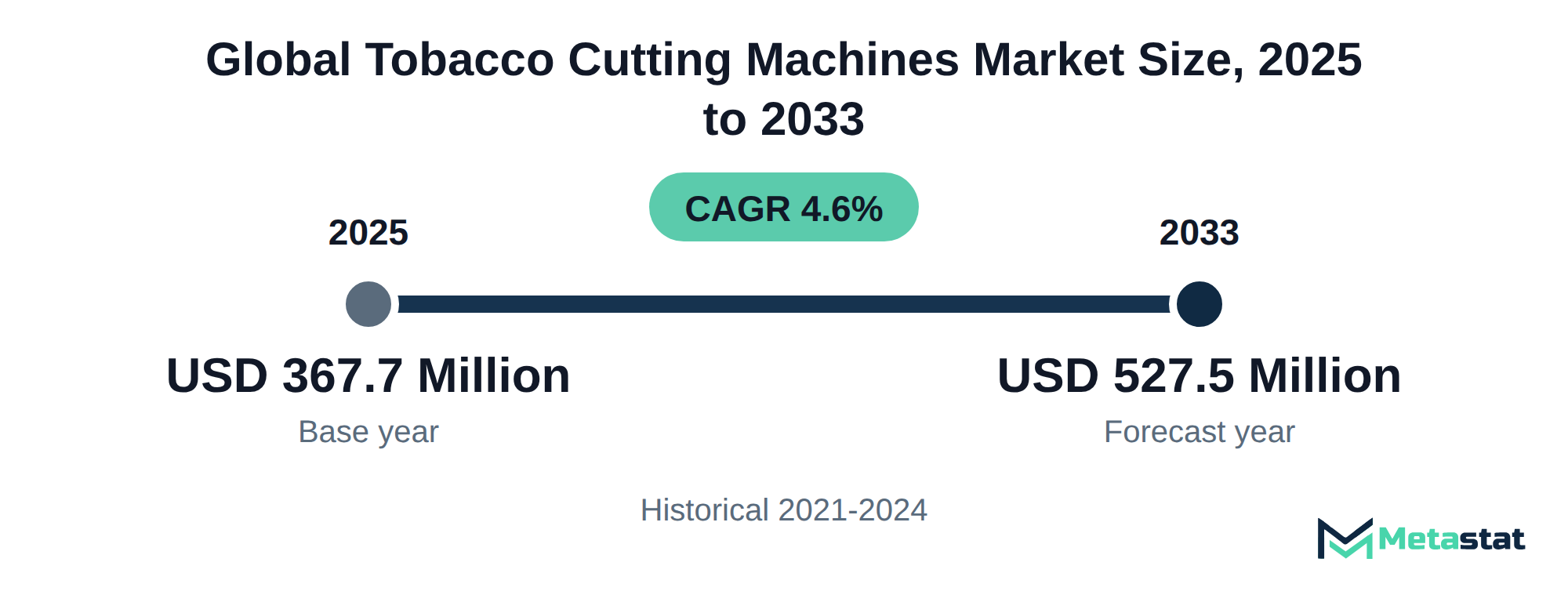
The global Tobacco Cutting Machines market was valued at USD 367.7 million in 2025 and is projected to reach USD 527.5 million by 2033, growing at a CAGR of 4.6% over the forecast period.
The Tobacco Cutting Machines market encompasses various equipment used to process tobacco, primarily focusing on cutting and shredding. Buyers invest in this market due to increasing demand for efficient and high-quality tobacco processing solutions. This demand arises from sectors including cigarette manufacturing, roll-your-own tobacco production, and cigar manufacturing, where precision and consistency in product quality are essential to meet consumer preferences.
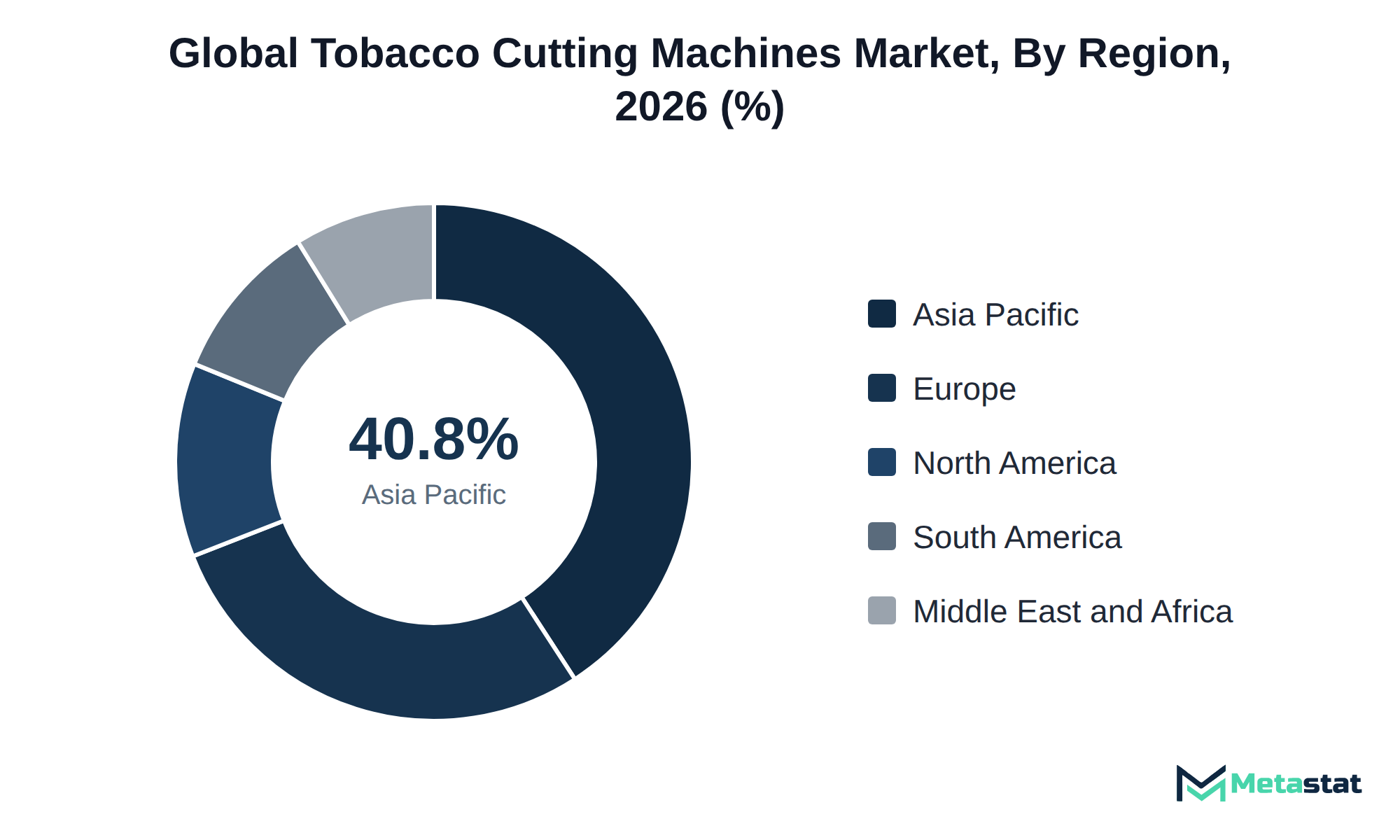
Growth in the market is driven by advancements in technology that enhance the operational efficiency of tobacco processing machinery. Among the segments, Industrial Primary Processing Cutters represent the highest value, supporting large-scale production needs. In terms of regional distribution, the Asia Pacific region accounts for 40.8% of the market in 2025. North America holds 12.1% of the market in 2025, with the US leading in 2026.
Continuous innovation in cutting mechanisms, including Rotary Drum Cutters and Integrated Cutter-Feeder Systems, contributes to market expansion. Manufacturers focus on improving the performance and reliability of their machines, responding to the evolving needs of tobacco processors. This focus on technology positions the market for steady growth through the forecast period.
The Tobacco Cutting Machines market includes various types of machinery that facilitate the cutting, shredding, and processing of tobacco. Buyers invest in these machines driven by the growing demand for processed tobacco products, which are essential for manufacturing cigarettes, cigars, and other tobacco-related goods. The efficiency and precision offered by advanced cutting machines enhance production processes, leading to reduced waste and increased output, motivating investments in this technology.
Among the segments within the market, Industrial Primary Processing Cutters represent the highest value, reflecting their critical role in large-scale tobacco processing operations. The Asia Pacific region stands out with the largest share of the market, accounting for 40.8% in 2025, indicating a strong manufacturing base and rising consumption in this area. The US is projected to lead the North America market in 2026.
Technological advances that raise machine efficiency and productivity are driving growth in the Tobacco Cutting Machines market. Innovations in cutting mechanisms, including Rotary Drum Cutters and Integrated Cutter-Feeder Systems, improve processing capabilities, allowing manufacturers to meet the rising demand for processed tobacco. Ongoing investment in equipment aligns with evolving market needs.
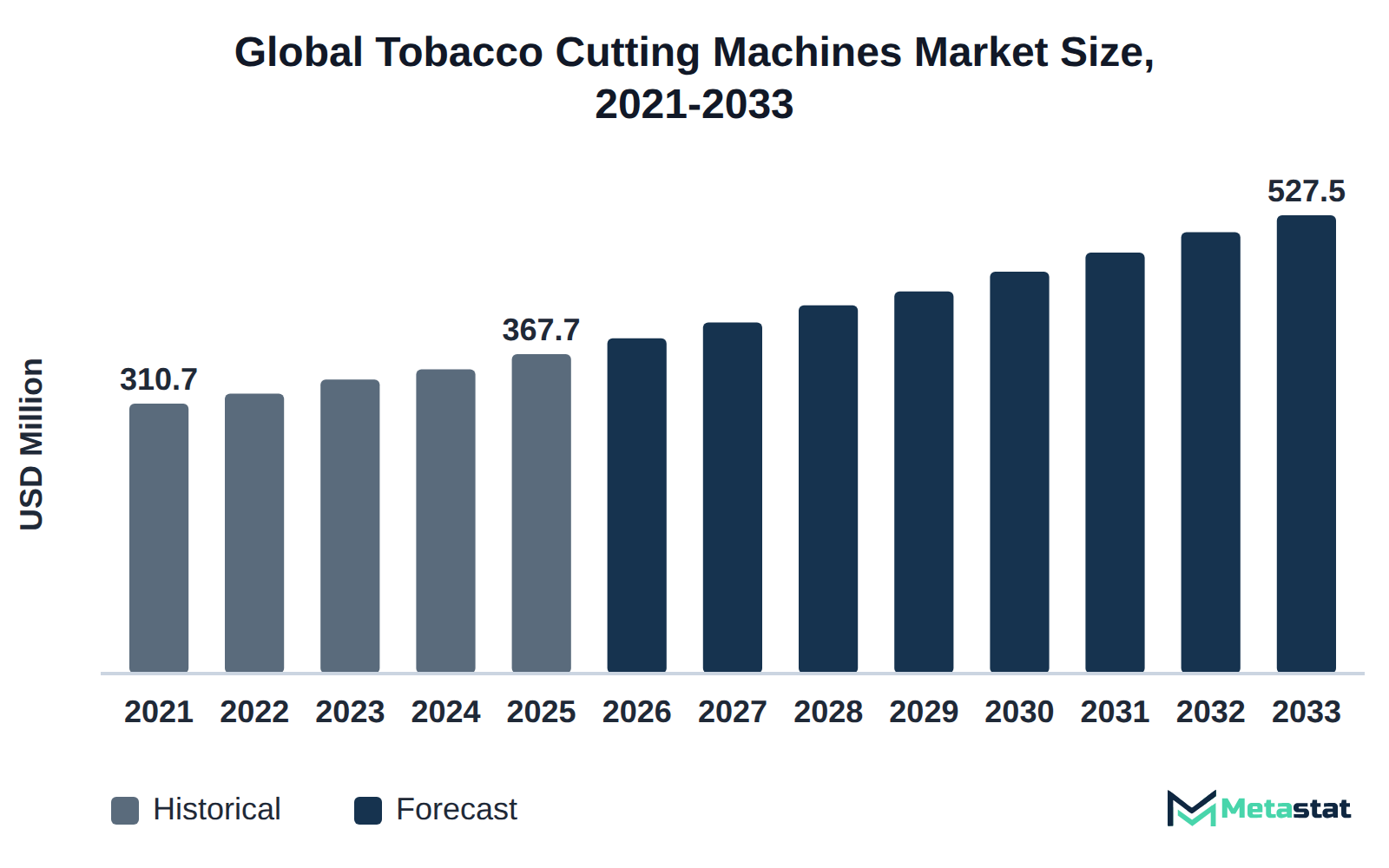
The adoption of automation and precision upgrades in tobacco cutting machines significantly enhances efficiency and product quality. These advancements lead to a reduction in operational waste and increase production rates, appealing to manufacturers aiming to optimize their processes. For instance, the Integrated Cutter-Feeder Systems segment benefits from such technological advancements and is anticipated to grow at a compound annual growth rate (CAGR) of 6.4%. This reflects the rising focus on efficiency in tobacco processing.
Automation facilitates streamlined operations, allowing manufacturers to maintain consistent product quality while reducing labor costs. This shift aligns with industry trends that prioritize operational excellence and competitive pricing. It also reflects the wider move toward smart manufacturing in industrial processing. The Tobacco Cutting Machines market experiences growing demand from manufacturers seeking equipment that meets stringent quality standards while enhancing output capabilities. In this context, adopting automated systems contributes to improved profit margins and positions companies favorably within the industry.
Investment in high-capacity primary processing lines, particularly rotary cutters, reflects a trend towards enhanced operational efficiency in the Tobacco Cutting Machines market. Buyers prioritize long-term value in their procurement strategies, often opting for fixed-price contracts that facilitate predictable budgeting and financial planning. Such contracts align with the growing demand for rotary drum cutters, projected to achieve a market value of USD 249.7 million by 2033, representing a compound annual growth rate (CAGR) of 5.1% from 2026.
Flexible payment terms often emerge as a vital consideration when buyers negotiate contracts. Buyers frequently explore installment plans or leasing options to manage capital expenditure effectively while ensuring access to advanced cutting technologies. The diversity of payment structures allows companies to align their investments with expected returns, especially in an industry where technological upgrades play a critical role in maintaining competitive advantages. The demand for rotary drum cutters ties closely to the need for processing efficiency, which drives investment decisions.
Understanding the pricing landscape significantly influences purchasing strategies in the market. Buyers assess the total cost of ownership, including maintenance, operational costs, and potential downtime, while comparing suppliers. This evaluation leads to informed decisions, enabling buyers to select equipment that meets current processing needs while accommodating future growth. The emphasis on cost-effective solutions ensures that investments yield optimal returns, propelling businesses forward in the competitive landscape of the Tobacco Cutting Machines market. Predictive maintenance can help limit unplanned downtime, one of the cost factors buyers weigh when comparing suppliers.
Choosing the appropriate cutting capacity is critical for tobacco manufacturers, particularly those engaged in large-scale operations. The selection process hinges on several factors, including production volume requirements, product type, and operational efficiency. For instance, manufacturers processing cigarette tobacco will likely focus on higher output capacities, with projections indicating the segment for capacities of 1,501 to 5,000 kg/H targeting a value of USD 188.2 million by 2033.
Manufacturers producing roll-your-own and pipe tobacco lean toward lower capacities, with a target value of USD 85 million by 2033. This segment requires precision and consistency, emphasizing the importance of selecting machines that meet specific operational demands. The right capacity impacts production speed and quality, influencing overall market competitiveness.
Investing in the right cutting capacity enhances production efficiency and aligns with market trends toward quality and precision. As the market develops, manufacturers that choose optimal cutting capacities gain a significant advantage, meeting changing consumer preferences while maintaining cost-effectiveness.
Feedstock flexibility helps optimize the processing of tobacco types such as lamina, stem, and reconstituted tobacco. This flexibility allows manufacturers to adapt their production processes according to the specific characteristics of the tobacco feedstock, enhancing the overall efficiency of operations. In the Tobacco Cutting Machines market, different cutting mechanisms cater to these varying feedstock types, ensuring that the quality and consistency of the final product meet market demands.
For instance, the market forecasts that Rotary Drum Cutters, which provide versatile cutting options, will experience a compound annual growth rate (CAGR) of 5.1% from 2026 to 2033. This segment's growth indicates rising demand for machinery capable of handling diverse tobacco materials efficiently. Manufacturers focusing on this adaptability capitalize on the increasing trend towards custom tobacco blends, aimed at meeting consumer preferences for unique smoking experiences.
Investing in feedstock flexibility within production lines enables companies to streamline their operations while reducing the risk of product waste. This operational agility positions firms favorably in a competitive environment and supports market share and revenue growth.
The rising demand for high-capacity tobacco processing lines fuels investment in rotary drum cutters. Manufacturers focused on large-scale operations prioritize enhanced efficiency and reduced operational costs. A shift toward automation and precise cutting processes has become prevalent as manufacturers work to maintain competitive pricing in a challenging market. Buyers prioritize machinery that delivers consistent quality and output, positioning rotary drum cutters as a preferred choice for firms aiming to optimize production capabilities. This focus on these cutting mechanisms enables manufacturers to cater to evolving consumer preferences while ensuring operational efficiency across production lines.
Integrating cutter-feeder systems into processing lines significantly boosts operational efficiency. These systems streamline the tobacco processing workflow by feeding tobacco material into cutting machines, optimizing the cutting process. This integration minimizes downtime and reduces manual handling, addressing labor shortages faced by manufacturers in the Tobacco Cutting Machines market. The demand for automation in tobacco manufacturing drives investment in these advanced systems, appealing to larger manufacturers aiming for enhanced productivity.
With a projected CAGR of 6.4% through the forecast period, integrated cutter-feeder systems capture the interest of companies focusing on improving throughput and reducing waste. By enhancing operational efficiency and ensuring consistent quality in cut tobacco, these systems position themselves as a vital component in modern manufacturing setups. The expansion of such technologies contributes to overall market growth and helps manufacturers stay competitive and cost-effective.
Price sensitivity among tobacco processors restricts the adoption of guillotine and linear blade cutters. Many buyers, particularly in emerging markets, face challenges in justifying the capital investment required for advanced cutting machinery. This situation results in slower uptake of these systems, leading to smaller orders and delayed replacement of older equipment. High operational costs associated with maintenance and parts for such specialized machines hinder market growth. Smaller-scale manufacturers, focused on cost-efficiency, often opt for lower-priced alternatives, contributing to a fragmented market where high-quality options struggle to gain traction. The transition to more efficient cutting solutions in the Tobacco Cutting Machines market moves at a measured pace, impacting overall demand for this specific cutting mechanism.
Investments in guillotine and linear blade cutters depend on producers' ability to recognize the long-term benefits of improved efficiency over initial costs. Without significant education and demonstration of value, market participants remain cautious in their spending, ultimately affecting the growth trajectory for these cutting machines.
Rising input costs present significant challenges for suppliers within the Tobacco Cutting Machines market. Prices for essential materials including steel and electronic components remain volatile, resulting in margin pressure for manufacturers. This situation compels suppliers to explore alternative sourcing strategies and negotiate more favorable agreements with vendors. In response, many companies invest in technology upgrades to enhance production efficiency, thereby offsetting costs. Utilization of advanced manufacturing processes, including automated assembly lines, allows for reduced labor expenses and improved output. Suppliers increasingly focus on developing more cost-effective cutting mechanisms to maintain competitiveness while addressing these challenges. Fluctuating material costs influence market dynamics, impacting pricing strategies and supplier profitability within the tobacco processing sector.
The segment of Integrated Cutter-Feeder Systems demonstrates significant growth potential within the Tobacco Cutting Machines market. This segment exhibits a compound annual growth rate (CAGR) of 6.4% reflecting heightened adoption among manufacturers seeking efficient processing solutions. Increasingly, end-users require streamlined operations to manage production demands effectively. The integration of cutting and feeding functionalities within a single system addresses this need by improving throughput and minimizing labor costs.
With rising expectations for output capacity, manufacturers focusing on integrated systems experience heightened demand from cigarette tobacco processing lines and small-batch operations. Advancements in technology enable better synchronization between cutting and feeding processes, resulting in more efficient material handling and reduced waste. This innovation positions integrated cutter-feeder systems as a strong choice for companies operating in competitive markets, driving further investment and growth.
The Global Tobacco Cutting Machines market is segmented based on Machine Type, Cutting Mechanism, Output Capacity, and End-Use Application.
Industrial Primary Processing Cutters segment is valued at USD 210.4 million in 2026 and is projected to reach USD 291.3 million by 2033, at a CAGR of 4.8% during the forecast period. This segment primarily serves tobacco manufacturers engaged in large-scale operations that process raw tobacco into forms suitable for various products. The growing demand for higher efficiency and cost-effectiveness in production drives investment in this segment, reflecting a significant trend toward automation. Compared to other segments, Industrial Primary Processing Cutters demonstrate stronger growth potential, with a CAGR of 4.8%, surpassing the growth rates of small-batch tobacco cutters and tobacco shredders. This trend highlights the increased emphasis on high-capacity processing lines that enhance productivity while maintaining quality standards. Technological advancements in cutting mechanisms contribute to the growing adoption of these machines, providing manufacturers with competitive advantages in the market.
Small-Batch Tobacco Cutters segment is estimated to reach USD 95.6 million by 2033, at a CAGR of 3.6% during the forecast period. This segment is used primarily by small-scale tobacco processors and artisanal producers, who focus on niche products and custom blends. The growing interest in specialty tobacco and artisanal production drives demand for these machines, allowing producers to manage smaller batches efficiently. Compared to other segments, including Industrial Primary Processing Cutters, which exhibit a higher CAGR of 4.8%, Small-Batch Tobacco Cutters experience slower growth. However, their appeal lies in serving a unique market segment with distinct preferences. The lower production volume translates to different pricing and operational requirements, creating a unique position within the market. Continuous innovation and adaptation in technology support small-batch production, enhancing quality and customization options for consumers.
Tobacco Shredders are expected to reach USD 81.3 million by 2033. These machines primarily serve the needs of manufacturers involved in tobacco processing, specifically in shredding and preparing tobacco for various applications. The demand for these shredders is influenced by the increasing need for efficiency in processing operations. This segment experiences steady growth, driven by manufacturers focusing on reducing waste and optimizing production processes. Compared to other machine types, Tobacco Shredders exhibit a lower growth rate, with a CAGR of 3.6%, indicating a more stable market position relative to rapidly expanding segments including Integrated Cutter-Feeder Systems, which demonstrate a CAGR of 6.4%. Manufacturers in this segment prioritize cost-effectiveness and reliability, distinguishing themselves from competitors offering higher-capacity solutions.
Integrated Cutter-Feeder Systems are integral to modern tobacco processing, enabling streamlined operations by combining cutting and feeding functions in one system. This segment is projected to grow at a CAGR of 6.4% during the forecast period. These systems find application primarily in large-scale processing facilities, where efficiency and speed are critical. The increasing demand for high-capacity outputs, combined with the push for automation within the industry, drives investment in this segment. Compared to other segments, Integrated Cutter-Feeder Systems offer higher operational throughput, appealing to manufacturers focused on maximizing production while minimizing manual handling. With a projected market value influenced by expanding processing lines, the segment stands out due to its capability to enhance overall workflow efficiency, positioning itself favorably within evolving market dynamics.
This sub-segment includes a range of additional machine types that support various tobacco processing needs. These machines are used in smaller operations and specific applications that do not fall under the primary categories. Buyers typically include boutique manufacturers and specialized processors, focusing on niche markets where tailored solutions are essential. The growth trajectory for this segment is influenced by trends in customization and the demand for innovative tobacco products, which require unique cutting solutions. Compared to other segments, this category experiences slower growth, reflecting a more targeted market appeal and lower overall production scales. Differentiation from larger systems arises from specific customer requirements for flexibility and adaptability in processing, aligning with emerging consumer preferences in the tobacco industry. Investment in this sub-segment emphasizes innovation and precision, catering to a diverse array of end-use applications.
Rotary drum cutters are primarily used in the cigarette tobacco processing industry, catering to large-scale manufacturers who require consistent and high-quality cuts for further processing. The increasing demand for automation in production lines drives the adoption of rotary drum cutters, which offer improved efficiency and reduced labor costs. Compared to other cutting mechanisms, rotary drum cutters exhibit a higher growth rate, outpacing guillotine and linear blade cutters, which are projected to achieve a CAGR of 3.7%. This differentiation in growth stems from the advanced technology employed in rotary drum cutters, enabling them to handle diverse feedstock types while maintaining operational efficiency. The market emphasis on higher production capacity supports the trajectory of this segment.
Guillotine and Linear Blade Cutters segment is estimated to reach USD 114.3 million by 2033, at a CAGR of 3.7% during the forecast period. This segment serves primarily in the production of cut tobacco for various applications, including cigarette manufacturing. Cigarette manufacturers favor guillotine and linear blade cutters for their ability to deliver precise cuts, which are essential for product consistency and quality. Key factors driving this segment include improved processing efficiency and the demand for uniformity in product size. Compared to other cutting mechanisms, this segment experiences slower growth due to the increasing popularity of rotary drum cutters, which are anticipated to grow at a CAGR of 5.1%. The market for guillotine and linear blade cutters remains competitive, with price sensitivity influencing purchasing decisions and prompting manufacturers to invest in higher efficiency solutions.
Roller Shredders segment is expected to reach USD 85.4 million by 2033. This segment processes tobacco into smaller, more manageable pieces, commonly used in various tobacco production lines, including those focused on shisha and hookah products. Demand for Roller Shredders is influenced primarily by the increasing popularity of these end-use applications, which cater to a diverse consumer base across different regions. Compared to other cutting mechanisms, including guillotine and linear blade cutters, Roller Shredders experience slower growth due to the specific preferences of niche markets. The CAGR for this segment stands lower than that of integrated cutter-feeder systems, reflecting a more specialized application that limits broader adoption. In the context of the Tobacco Cutting Machines market, Roller Shredders contribute to a vital segment that addresses specific operational needs in tobacco processing.
Disc and Knife-Assembly Cutters segment is projected to grow at a CAGR of 4.9% during the forecast period. Industrial blades and discs process various tobacco types efficiently, primarily for large-scale manufacturers focused on achieving precision cuts. The growing trend toward automation in tobacco processing drives demand for advanced cutting solutions, with manufacturers favoring this technology due to its efficiency and reliability. Compared to other cutting mechanisms, including Guillotine and Linear Blade Cutters, which are expected to reach USD 114.3 million by 2033 at a CAGR of 3.7%, Disc and Knife-Assembly Cutters demonstrate a more favorable growth trajectory. This difference highlights the increasing adoption of high-efficiency equipment among tobacco processors, contributing to the overall growth of the market.
This sub-segment includes a variety of specialized cutting methods that cater to unique processing requirements in tobacco production. Equipment in this category serves manufacturers seeking alternatives to conventional cutting mechanisms. The growth of this segment is driven by technological advancements that facilitate the development of new cutting methods, enhancing operational efficiency. Companies focusing on customization and flexibility particularly benefit from innovations in this area. Compared to other segments, the "Others" sub-segment offers distinct advantages due to its ability to address niche markets with tailored solutions. While other cutting mechanisms demonstrate higher projected growth rates, this sub-segment retains relevance by meeting specific needs within the Tobacco Cutting Machines market.
The Up to 300 kg/H segment is valued at USD 62.1 million in 2026 and is projected to reach USD 76.8 million by 2033, at a CAGR of 3.1% during the forecast period. Machines in this category serve predominantly in small to medium tobacco processing operations, catering to manufacturers requiring lower output capacities. Demand in this segment is driven by the increasing trend toward customized and artisanal tobacco products, where smaller batches are preferred. Compared to other segments including the 301 to 1,500 kg/H, which exhibits a higher CAGR of 3.8%, the Up to 300 kg/H segment experiences a slower growth rate. The price point for machines in this segment typically remains lower, making it an attractive option for smaller producers looking to optimize operations without substantial capital investment. Increased focus on quality and precision in tobacco processing further enhances the relevance of this segment in the broader Tobacco Cutting Machines market.
The 301 to 1,500 kg/H segment is estimated to reach USD 131.3 million by 2033, at a CAGR of 3.8% during the forecast period. This segment primarily serves medium to large-scale tobacco processors engaged in producing high volumes of cut tobacco. Demand in this segment is driven by the increasing need for efficient processing technologies that deliver consistent product quality while managing production costs. Unlike smaller capacity segments, the 301 to 1,500 kg/H segment experiences steady growth, attributed to the expansion of industrial processing facilities. The market exhibits a trend toward automation and advanced cutting technologies, enhancing productivity and reducing labor costs. Such factors position this segment favorably among buyers seeking to optimize operations while addressing competitive pressures in the Tobacco Cutting Machines market.
This output capacity range serves major tobacco processing operations, particularly in the production of large quantities for cigarette manufacturing and other applications. Growing demand for efficiency in tobacco production drives investments in machines that deliver higher output. The 1,501 to 5,000 kg/H segment exhibits a relatively strong growth trajectory compared to smaller capacity segments, reflecting an overall CAGR of 5.6%. Unlike smaller machines, which cater to niche markets, this segment focuses on larger-scale operations, appealing to manufacturers requiring significant throughput. Advancements in technology contribute to its competitiveness, enhancing the operational efficiency of tobacco processing lines.
Above 5,000 kg/H segment is projected to grow at a CAGR of 5.5% during the forecast period. This segment serves high-capacity tobacco processors that require efficient production lines capable of handling substantial volumes. Major players in this segment include large manufacturers and processing facilities that prioritize throughput. Demand for these high-capacity machines stems from increasing production requirements driven by rising consumption of tobacco products. This segment differentiates itself from others in the output capacity category through its higher growth rate and specialized application in large-scale operations. Compared to segments with lower capacities, including Up to 300 kg/H, which is projected to achieve a CAGR of 3.1%, the Above 5,000 kg/H segment attracts significant investment due to its ability to enhance efficiency and reduce operational costs, positioning it favorably in the Tobacco Cutting Machines market.
This sub-segment encompasses machine types that do not fall into the defined categories of output capacity. These machines cater to specialized tobacco processing requirements, often employed by smaller manufacturers or niche producers focused on unique product offerings. Demand for these machines arises from diverse needs in the market, including artisanal production and small-scale operations that prioritize customization over volume. Unlike larger output capacity segments, this sub-segment serves a different buyer profile, often at a higher price point, reflecting the tailored solutions offered. The growth trajectory differs from other segments, driven by increasing interest in specialty tobacco products and the shift toward personalized customer experiences.
Cigarette Tobacco Processing Lines segment is valued at USD 218.4 million in 2026 and is projected to reach USD 294.3 million by 2033, at a CAGR of 4.4% during the forecast period. This segment plays a critical role in the production process for large-scale cigarette manufacturers, focusing on efficiently processing and cutting tobacco to meet production demands. The increasing consumption of tobacco products, particularly cigarettes, drives this segment, with manufacturers seeking advanced machinery to enhance productivity and maintain quality. The growth rate for this segment outpaces that of Small-Batch Tobacco Cutters, which shows a CAGR of 3.6%, indicating a stronger demand trend for higher-capacity processing solutions. Technological advancements and automation within the machinery contribute to the segment's expansion, improving operational efficiency and reducing labor requirements in the market.
Roll-Your-Own and Pipe Tobacco segment is estimated to reach USD 85 million by 2033, at a CAGR of 4.9% during the forecast period. This segment caters to consumers who prefer to hand-roll their tobacco products or use it in pipes, making it popular among niche markets. Demand drivers include a growing preference for customized tobacco experiences and the increasing popularity of smoking alternatives such as e-cigarette and vapor products. Compared to other segments, this sub-segment exhibits slower growth, influenced by shifting consumer preferences toward ready-made products. In contrast to the Cigarette Tobacco Processing Lines segment, which shows a projected CAGR of 4.4%, the Roll-Your-Own and Pipe Tobacco segment appeals to a distinct buyer group focused on personalization. The market reflects a diversification of user preferences, highlighting the importance of innovation and unique offerings in driving growth in specialized tobacco applications.
Cigar and Cigarillo Manufacturing segment is expected to reach USD 52.9 million by 2033. This segment serves producers involved in creating cigars and cigarillos, requiring specific cutting equipment to ensure precision and quality in tobacco preparation. Demand for premium cigars has surged due to evolving consumer preferences, prompting manufacturers to invest in advanced cutting technologies. The growth rate in this segment is anticipated to align with overall market trends; however, the unique requirements for cigar production differentiate it from other sub-segments, including Cigarette Tobacco Processing Lines, which focus on higher volumes and faster production rates. With a projected CAGR of 4.9%, this segment emphasizes quality over quantity, attracting buyers who prioritize craftsmanship and flavor consistency. Market dynamics indicate strong demand for customization in product offerings, further influencing investment in specialized cutting machines tailored to this application.
Shisha and Hookah Tobacco Processing is projected to grow at a CAGR of 5.6% during the forecast period. This segment primarily caters to manufacturers involved in producing shisha and hookah tobacco products, where finely processed tobacco is essential for maintaining flavor and quality. Growth in this segment is driven by increasing consumer preference for hookah and shisha experiences, particularly in social settings. The rising trend of flavored tobacco products appeals to a younger demographic, enhancing demand further. Compared to the Cigarette Tobacco Processing Lines segment, which exhibits a CAGR of 4.4%, the Shisha and Hookah Tobacco Processing segment benefits from a more niche market, often involving higher price points for premium products. This differentiation allows manufacturers to capitalize on specialized production techniques that enhance the user experience.
Tobacco Research and Pilot Plants focus on developing and testing new tobacco products and processing techniques. These facilities support research institutions and manufacturers aiming to innovate and improve product quality. Funding and investment in research initiatives drive growth in this segment, promoting advancements in tobacco processing technologies. This segment operates under different dynamics compared to others in the group, with a focus on specialized equipment designed for smaller-scale, experimental applications. The emphasis on research results in higher initial costs due to customization and technology refinement, distinguishing it from other segments that cater to mass production. The Tobacco Cutting Machines market experiences demand for such specialized applications, reflecting growing interest in product innovation and quality improvement.
This sub-segment encompasses machine types catering to various specific applications in tobacco processing not defined by other categories. Users include smaller manufacturers and specialized producers who require tailored solutions for unique processing demands. The segment thrives on the increasing trend toward customization in tobacco production, reflecting a shift in preferences toward unique blends and niche products that differ from mainstream offerings. In contrast to larger segments including Cigarette Tobacco Processing Lines, this sub-segment experiences slower growth due to its reliance on specialized equipment that often entails higher operational costs. Nevertheless, it remains crucial for producers seeking to diversify their product lines to meet evolving consumer preferences. This focus on customization influences buying decisions, propelling demand within the Tobacco Cutting Machines market.
Based on geography, the Global Tobacco Cutting Machines market is divided into North America, Europe, Asia-Pacific, South America, Middle East, and Africa.
Demand for tobacco cutting machinery in North America stems from established cigarette production facilities in the United States, Canada, and Mexico. The increasing focus on efficiency in cigarette manufacturing drives investment in advanced cutting technologies that enhance production speed and reduce waste. North America represented 12.1% of the global market share in 2025. Regulatory compliance regarding product quality and safety continues to influence purchasing decisions among manufacturers, prompting investments in modern equipment that meet these standards. North America is projected to reach USD 57.3 million by the end of 2033, indicating a steady growth trajectory for the tobacco cutting machines market in this region.
Europe accounts for a substantial share of the Tobacco Cutting Machines market. Key drivers include robust demand from countries like Germany and France, where large-scale tobacco industries operate extensively. The market benefits from advanced manufacturing capabilities and a strong emphasis on innovation, allowing for the introduction of new technologies. Regulations within the region prioritize product quality and safety, supporting the need for state-of-the-art machinery. The presence of major players in the UK and Italy creates competitive dynamics, enhancing product offerings. This environment encourages investments in innovative solutions, promoting expansion in the market while manufacturers adapt to evolving consumer preferences.
Asia Pacific holds 40.8% of the Tobacco Cutting Machines market in 2025. The growing demand for tobacco processing equipment in countries like China, Japan, and India drives market expansion. Increasing production capacities and technological advancements characterize the region's landscape. Manufacturers in Asia Pacific focus on enhancing efficiency and reducing costs, positioning themselves to meet rising consumer preferences for diverse tobacco products. The region's infrastructure improvements, including enhanced supply chain capabilities, support market growth. A strong emphasis on innovation in cutting mechanisms and machine types enhances competitiveness among key players. Countries in this region actively contribute to the overall expansion of the market, with specific applications like cigarette processing and roll-your-own tobacco experiencing notable demand.
In South America, the Tobacco Cutting Machines market experiences steady demand driven by key players in Brazil and Argentina. The presence of established tobacco processing facilities in these countries supports growth, with an emphasis on enhancing production efficiency. Infrastructure improvements, particularly in transportation and logistics, facilitate the distribution of equipment. Regulatory aspects related to tobacco processing contribute to operational adjustments, impacting market dynamics. By 2025, the region holds a 10.00% share of the global market. This share reflects the region's unique position in the tobacco industry, where local demand aligns with international standards, creating competitive advantages in production capabilities. Growth opportunities arise from increasing investments in modern machinery that enhance processing efficiency and product quality, positioning South America as a noteworthy participant in the global market.
Demand for cutting machines arises primarily from growing tobacco production and processing facilities in countries like Saudi Arabia, UAE, and South Africa. The expansion of local processing capabilities supports the increasing requirement for efficient machinery to enhance production rates and quality. Investment in modern machinery facilitates compliance with stringent quality standards and boosts operational efficiency. The market in this region benefits from emerging trends in tobacco consumption, including the rising popularity of shisha and hookah products, which further drives demand for specialized cutting equipment. Technological advancements in machinery, combined with the need for cost-effective solutions, influence purchasing decisions among buyers. This environment creates growth opportunities for manufacturers operating within the market.
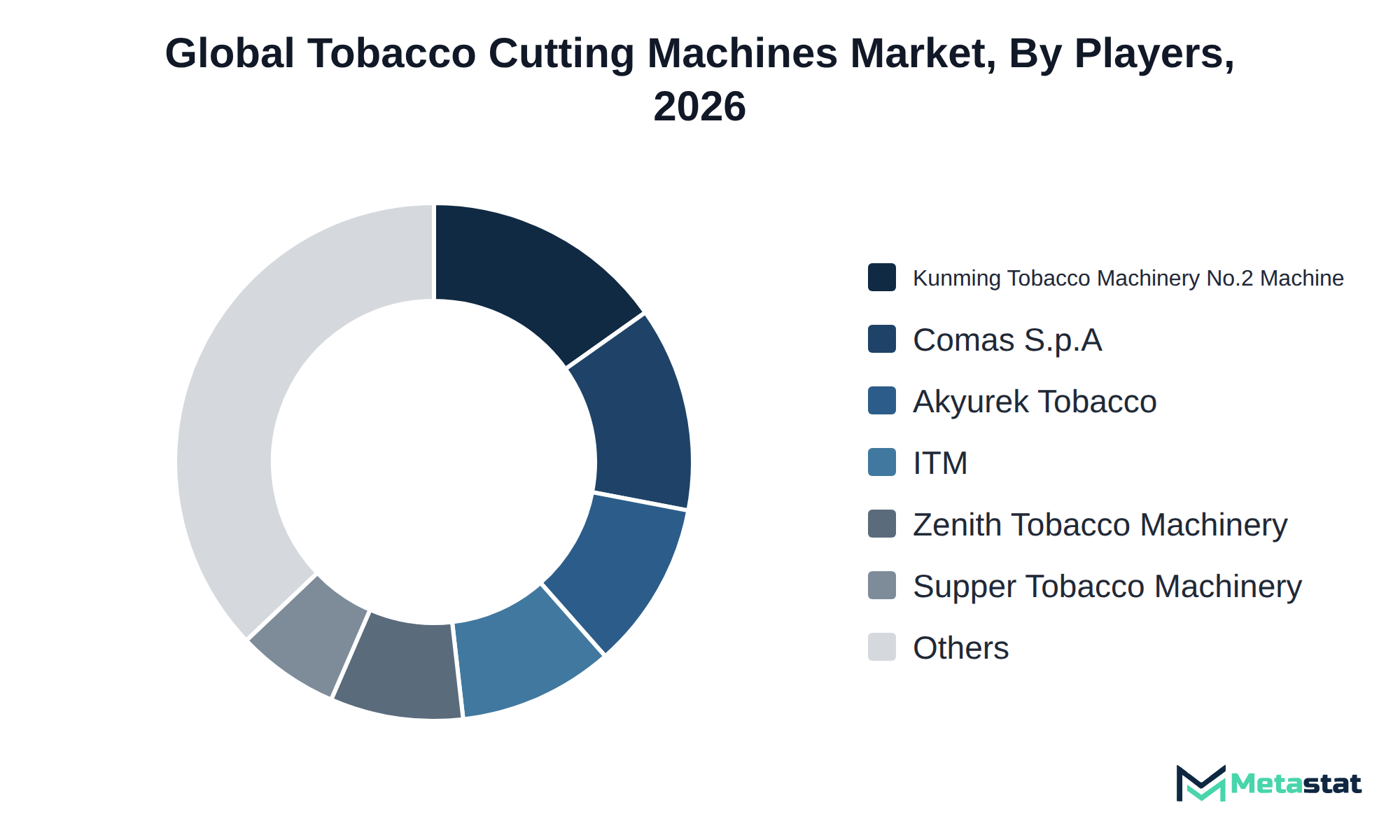
Competition within the Tobacco Cutting Machines market centers on innovation, pricing strategies, and service offerings. Buyers prioritize factors including price, customization, and support services when selecting suppliers in this sector.
Kunming Tobacco Machinery Group No.2 Machine Co., Ltd. emphasizes its comprehensive product range, targeting various segments including industrial primary processing and small-batch solutions. Comas S.p.A. focuses on advanced technology integration, appealing to clients seeking high-performance cutting mechanisms. Akyurek Tobacco highlights customization capabilities, catering to buyers requiring tailored solutions for specific processing needs.
This growth relies on several critical developments within the Tobacco Cutting Machines market. First, advancements in integrated cutter-feeder systems are expected to enhance operational efficiency for manufacturers, driving demand among tobacco processing companies. The increasing adoption of rotary drum cutters, which offer superior performance, further supports this trend, particularly in the Asia Pacific region, where market share is the highest at 40.8%. Growth in cigarette tobacco processing lines, projected to see significant investment, will contribute to a larger market size, reflecting ongoing demand for processed tobacco products. A major risk that could impede growth involves regulatory changes affecting the tobacco industry, particularly in Europe and North America, which could lead to increased compliance costs for manufacturers. If this occurs, it will slow down market expansion, impacting revenue growth potential. Overall, the trajectory of the market hinges on technological advancements and regulatory stability across key regions.
By Machine Type: Industrial Primary Processing Cutters, Small-Batch Tobacco Cutters, Tobacco Shredders, Integrated Cutter-Feeder Systems, Others
By Cutting Mechanism: Rotary Drum Cutters, Guillotine and Linear Blade Cutters, Roller Shredders, Disc and Knife-Assembly Cutters, Others
By End-Use Application: Cigarette Tobacco Processing Lines, Roll-Your-Own and Pipe Tobacco, Cigar and Cigarillo Manufacturing, Shisha and Hookah Tobacco Processing, Tobacco Research and Pilot Plants, Others
The report strategically identifies and profiles the key market players and analyses their core competencies in each sub-segment of the Tobacco Cutting Machines market.
Report Attributes | Details |
Study Period | 2021-2033 |
Base Year | 2025 |
Estimated Year | 2026 |
Forecast Period | 2026-2033 |
Historical Period | 2021-2025 |
Growth Rate | CAGR 4.6% from 2026 to 2033 |
Revenue Unit | USD million |
Segmentation | By Machine Type, Cutting Mechanism, Output Capacity, End-Use Application, and Region |
By Region | North America (By Machine Type, Cutting Mechanism, Output Capacity, End-Use Application, and Country)
|
Europe (By Machine Type, Cutting Mechanism, Output Capacity, End-Use Application, and Country)
| |
Asia Pacific (By Machine Type, Cutting Mechanism, Output Capacity, End-Use Application, and Country)
| |
South America (By Machine Type, Cutting Mechanism, Output Capacity, End-Use Application, and Country)
| |
Middle East and Africa (By Machine Type, Cutting Mechanism, Output Capacity, End-Use Application, and Country)
|
Find answers to common questions about this report
The Tobacco Cutting Machines market size was valued at USD 367.7 million in 2025.
The market is projected to grow at a CAGR of 4.6% during the forecast period from 2026 to 2033.
The North America Tobacco Cutting Machines market size is estimated to reach USD 57.3 million by 2033.
The leading segment in the Tobacco Cutting Machines market is Industrial Primary Processing Cutters, with a projected value of USD 291.3 million by 2033. This segment surpasses others in terms of revenue generation within the market.
Rising demand for high-capacity tobacco processing lines fuels investment in rotary drum cutters, while the integration of cutter-feeder systems enhances operational efficiency and reduces labor costs. These factors contribute significantly to the overall growth of the market.
Price sensitivity among tobacco processors restricts the adoption of guillotine and linear blade cutters, as many buyers, particularly in emerging markets, struggle to justify the capital investment required for advanced cutting machinery. Rising input costs for essential materials, including steel and electronic components, present significant challenges for suppliers, resulting in margin pressure and influencing pricing strategies.
Rising demand for automation and integrated cutter-feeder systems drives adoption in the Tobacco Cutting Machines market. These advanced solutions enhance operational efficiency, reduce labor costs, and improve throughput, appealing to manufacturers aiming to optimize production capabilities.
The Tobacco Cutting Machines market is estimated to reach a valuation of USD 527.5 million by 2033.
Key players operating in the Tobacco Cutting Machines market include Kunming Tobacco Machinery Group No.2 Machine Co., Ltd., Comas S.p.A., Akyurek Tobacco, Makepak International, ITM Group, and Zenith Tobacco Machinery.
The rotary drum cutter segment anticipates significant growth with a projected increase from USD 176.4 million in 2026 to USD 249.7 million by 2033, reflecting a compound annual growth rate of 5.1 percent.
The analysts below cover Packaging research at Metastat Insights.
LEAD ANALYST
Utkarsh Khirodkar is a Lead Market Research Analyst at MetaStat Insight, specializing in market intelligence, technology sector assessments, and competitive strategy.

SENIOR RESEARCH ANALYST
Biotechnology · Food and Beverages · Medical Devices · Packaging
Snehal Pasalkar is a Research Analyst at MetaStat Insight, operating at the intersection of life sciences research, competitive strategy, and market intelligence.

INDUSTRY CONSULTANT - CHEMICALS & ADVANCED MATERIALS
Chemicals and Materials · Machinery & Equipment · Packaging
Amit Gadhekar Consultant for Chemicals and Materials at MetaStat Insight, directing sector-specific intelligence, research, and strategic consulting across global chemical and processing markets.
Evaluating calorific value requirements and air permit compliance across municipal waste facilities requires localized data. Metastat Insight structured their analysis around operational throughput capacity and feedstock composition variations in Latin America and Eastern Europe. Their competitive mapping of sorting equipment vendors helped clarify technology differences between optical separators and heavy media systems. The study provided an objective baseline during our capital expenditure reviews.
Decarbonizing industrial thermal processes hinges on refrigerant regulations and compressor efficiency limits. Metastat Insights delivered a thorough market analysis that evaluated natural refrigerants like CO2 and hydrocarbons against synthetic low-GWP alternatives. The breakdown of utility incentives and grid capacity constraints across key European manufacturing hubs offered valuable perspective. The follow-up conversation with their sector analysts addressed our specific questions on mechanical vapor recompression systems efficiently.
Assessing 200mm wafer transition schedules and substrate supply bottlenecks requires precise technical intelligence. MetaStat Insight supplied an actionable breakdown comparing planar and trench MOSFET architectures across automotive and industrial drive markets. The regional capacity estimates for Asia-Pacific foundries helped clarify lead-time uncertainties during our strategic planning session. When we needed additional clarification on high-purity raw material sourcing, their analyst team responded with helpful context within twenty-four hours.
Explore related market intelligence reports worth reading alongside this one.