
LEAD ANALYST
Utkarsh Khirodkar is a Lead Market Research Analyst at MetaStat Insight, specializing in market intelligence, technology sector assessments, and competitive strategy.

Turkey Cloud Gaming Services and Platforms Market Size, Share, By Commercial Access Model (Standalone Cloud Gaming Subscription, Cloud Gaming Included in Game/Content Subscription, Bring-Your-Own-Game Cloud Access, Pay-Per-Use / Time-Based Cloud Gaming, Ad-Supported / Freemium Cloud Gaming and Telecom/ISP-Bundled Cloud Gaming), By Device (Smartphones & Tablets, PCs & Laptops, Smart TVs & Streaming Devices, Gaming Consoles and Handheld Gaming Devices), By Network Connection (Fiber Broadband, Cable & DSL Broadband, 4G/LTE Mobile Networks, 5G Mobile Networks and Fixed Wireless Access), By User Age Group (Under 18 Years, 18-24 Years, 25-34 Years, 35-44 Years, 45-54 Years and 55 Years and Above), Industry Analysis, Growth, Trends, and Forecast, 2026-2033
Report ID
MSI-5365
Published
September, 2026
Pages
264 Pages
Format
Historical
Base year
Forecast
Forecast period
Report Details
Market Valuation: Valued at $10.8 Million in 2025, projected to reach $63.6 Million by 2033 at a 24.8% CAGR.
Dominant Segment: The Standalone Cloud Gaming Subscription segment leads the market, driven by consumer demand for flexible gaming solutions that provide high-quality experiences without the need for physical hardware.
Geographic Lead: Turkey is experiencing rapid growth in cloud gaming, primarily due to the expansion of 5G infrastructure and fiber broadband, which enhance user experience through low-latency connections.
What's Inside: This report provides a comprehensive analysis of the Turkey Cloud Gaming Services and Platforms market, covering competitive dynamics, market segmentation, and a detailed forecast from 2026 to 2033.
Emerging Market Demands: The under 18 years age group is projected to see significant growth, reflecting a rising demand for interactive gaming experiences among younger demographics.
Infrastructure Development: Investment in fiber broadband and 5G mobile networks is crucial for increasing access to cloud gaming services, enhancing user engagement and subscription rates.
Choose Your License
Turkey Cloud Gaming Services and Platforms Market
The Turkey Cloud Gaming Services and Platforms market was valued at USD 10.8 million in 2025 and is projected to reach USD 63.6 million by 2033, growing at a CAGR of 24.8% over the forecast period.
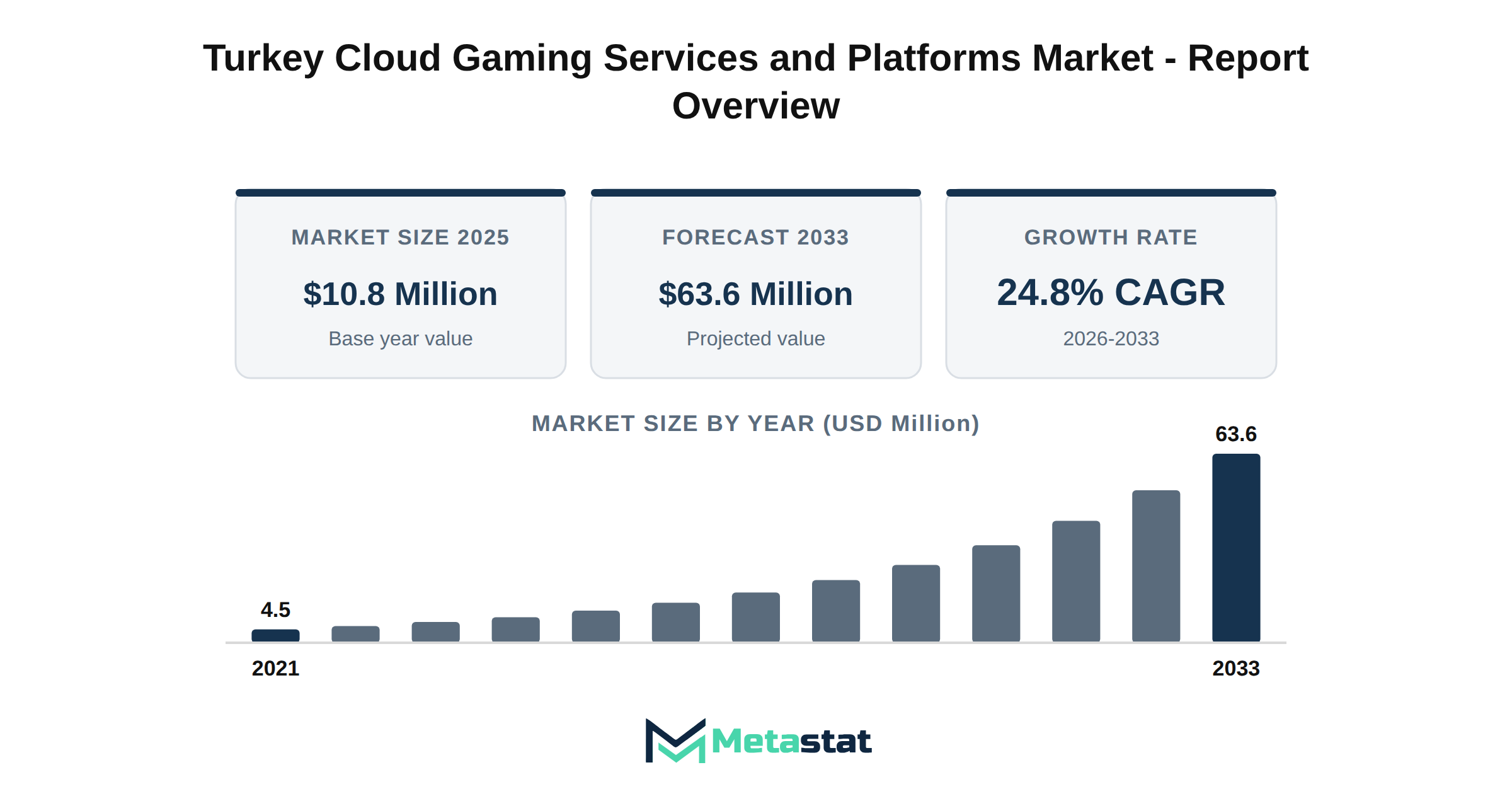
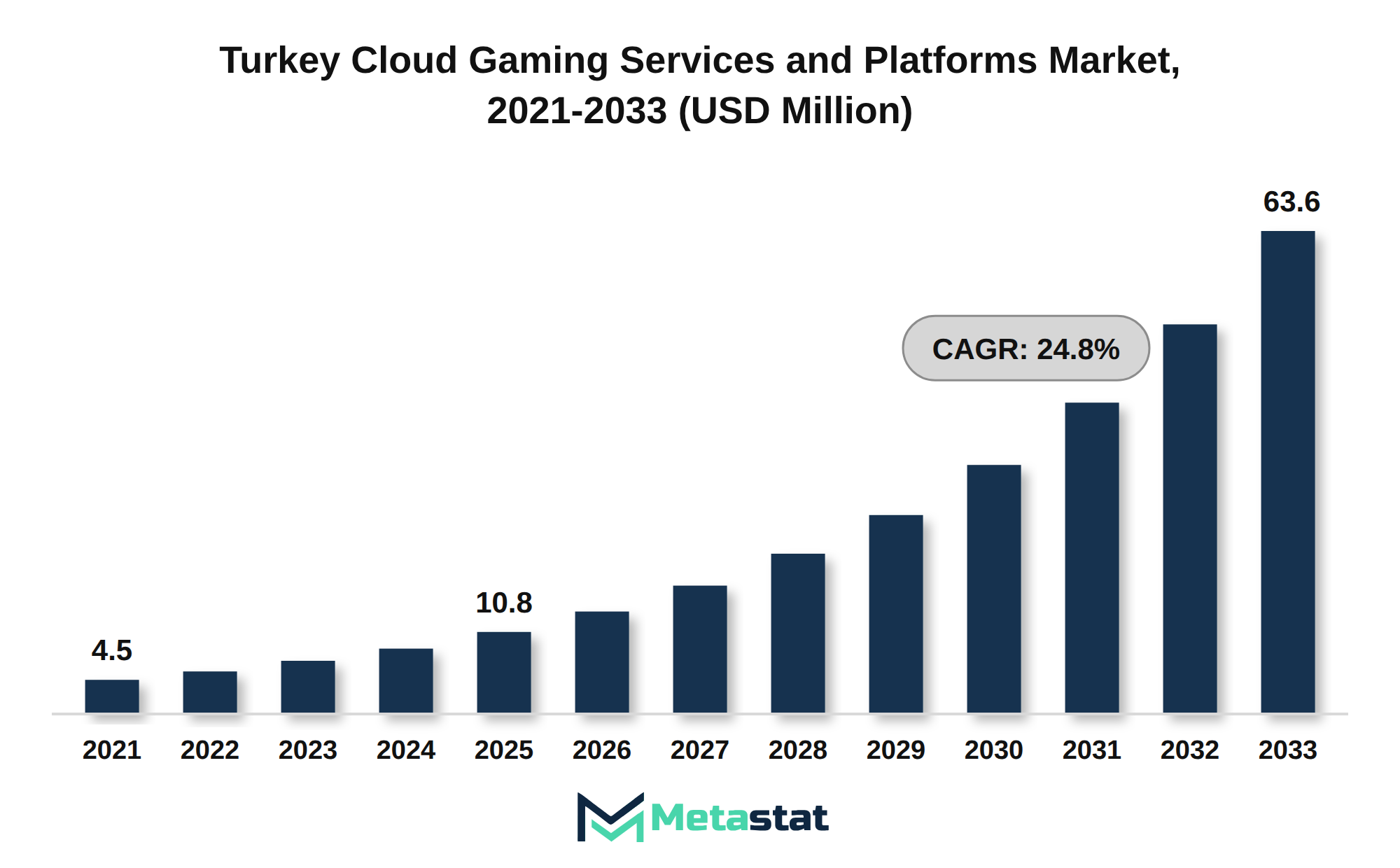
The Turkey Cloud Gaming Services and Platforms market exhibited a value of USD 10.8 million in 2025, demonstrating significant growth from USD 4.5 million in 2021. The market is projected to reach USD 63.6 million by 2033, reflecting a compound annual growth rate (CAGR) of 24.8% during the forecast period from 2026 to 2033.
Adoption trends indicate a strong preference for subscription-based services among users, driven by enhanced access to diverse gaming content and the convenience of cloud-based platforms. The expansion of 5G infrastructure significantly impacts cloud gaming in Turkey, facilitating low-latency experiences that enhance user satisfaction and engagement. Growth in fiber broadband supports these low-latency requirements, enabling effective gaming experiences across various devices.
Smartphones lead cloud gaming consumption in Turkey, with increasing numbers of users accessing games via mobile devices. Rising demand for subscription-based cloud gaming services reflects a shift in consumer preferences, emphasizing the need for affordable and flexible gaming options. Telecom-bundled cloud gaming opportunities present a strategic advantage, allowing service providers to capture a larger share of the market by integrating gaming services into existing telecommunications offerings.
Pricing strategies and consumer willingness to pay shape the market landscape. Competitive dynamics, including the presence of platforms including GeForce NOW, intensify the competitive environment, driving local cloud gaming innovations. The trend towards Bring-Your-Own-Game cloud access further supports user preferences for personalized gaming experiences, enhancing engagement among diverse gaming demographics.
The growth of smart TVs and connected devices creates additional opportunities for cloud gaming expansion, catering to a broader audience. Cloud gaming usage among Gen Z and young adults in Turkey illustrates the increasing importance of local game content and Turkish language support in driving user adoption. Infrastructure developments in cloud gaming, particularly in edge computing, enhance overall service delivery and user experience.
Turkey's cloud gaming adoption trends reflect a growing interest among users, driven by the increasing availability of high-speed internet and mobile connectivity. The rising number of smartphone users enhances the demand for cloud gaming services, particularly among younger demographics. User engagement with cloud gaming platforms expands due to more players seeking interactive and accessible gaming experiences. The market's growth aligns with a shift towards subscription-based services, appealing to users who prefer flexible payment options and diverse game libraries.
The expansion of 5G technology significantly influences cloud gaming in Turkey. With improved network speeds and reduced latency, 5G enhances the overall gaming experience, allowing for smooth streaming and real-time interactions. This development attracts gamers who seek high-quality graphics and performance, driving further investment in cloud gaming infrastructure. Telecom operators recognize the potential of 5G and actively engage in partnerships with cloud gaming services to enhance their offerings and expand their customer base.
Fiber broadband growth supports low-latency cloud gaming, providing users with reliable connections necessary for an optimal gaming experience. While fiber networks become more widespread, gamers benefit from reduced buffering times and improved overall performance. This trend contributes to the increasing popularity of cloud gaming platforms among consumers who demand high-quality gaming experiences without the need for expensive hardware.
Smartphones lead cloud gaming consumption in Turkey, with several users accessing services through mobile devices. This trend highlights the importance of mobile-optimized gaming experiences, because developers focus on creating games that cater to smartphone users. The market benefits from the convenience and portability of mobile cloud gaming, appealing to a broad audience seeking entertainment on the go.
Rising demand for subscription-based cloud gaming services reflects a shift in consumer preferences. Users appreciate the value of accessing a vast library of games for a fixed monthly fee, eliminating the need for large upfront investments in individual titles. This model encourages higher user engagement, because players explore various game genres and experiences within a single subscription.
Telecom-bundled cloud gaming opportunities present a strategic avenue for growth in the market. By integrating cloud gaming services into existing telecom packages, providers enhance their offerings and create additional value for customers. These bundles attract users who appreciate the convenience of accessing gaming services alongside their regular mobile and internet plans.
Pricing strategies and consumer willingness to pay influence the overall success of cloud gaming services in Turkey. Competitive pricing structures enable platforms to attract a diverse audience, while promotional offers enhance user acquisition. Understanding consumer preferences regarding payment methods, including local payment options and carrier billing, is crucial for optimizing user experiences and increasing conversion rates.
The competitive landscape of the market features notable players including NVIDIA Corporation and Microsoft Corporation, among others. Local cloud gaming services, like Lifecell Dijital Servisler ve Çözümler A.Ş. / GAME+, compete with global platforms, creating a dynamic environment where innovation and user engagement drive market growth. The competition encourages the development of diverse gaming options, catering to various user needs and preferences.
Bring-your-own-game cloud gaming adoption trends highlight a shift in user expectations, emphasizing flexibility and customization. Users appreciate the ability to access their existing game libraries through cloud platforms, enhancing convenience and broadening the appeal of cloud gaming services. This trend supports the growth of platforms that prioritize user-centric experiences and allow gamers to connect their personal libraries smoothly.
Smart TVs and connected devices contribute to the growth of cloud gaming, expanding the potential audience beyond traditional gaming consoles. While these devices become more prevalent in households, cloud gaming services gain traction, offering a versatile gaming experience that caters to different user preferences. This diversification opens new revenue streams for cloud gaming providers, further strengthening their presence in the market.
Cloud gaming usage among Gen Z and young adults in Turkey indicates a strong preference for interactive entertainment. This demographic actively engages with cloud gaming platforms, seeking social and competitive experiences. Understanding the preferences and behaviors of this age group will shape future strategies for cloud gaming services, ensuring alignment with user expectations and encouraging long-term loyalty.
Local game content and Turkish language demand in cloud gaming create opportunities for developers to engage the domestic audience effectively. By offering localized content, platforms enhance user experiences and attract a broader user base. Addressing these preferences is essential for capturing market share and ensuring the relevance of cloud gaming services in Turkey.
Cloud gaming infrastructure and edge computing developments play a critical role in enhancing service quality. Investments in advanced technologies support improved performance, reduced latency, and better user experiences. By prioritizing infrastructure development, cloud gaming providers position themselves for sustained growth and competitiveness in the evolving market environment.
Latency, bandwidth, and network quality challenges remain key considerations for cloud gaming services. Addressing these issues directly impacts user satisfaction and retention rates. Providers focusing on optimizing network performance through strategic partnerships and technological advancements enhance their market positioning and encourage user loyalty.
5G monetization through cloud gaming services presents significant opportunities for telecom operators. By leveraging the capabilities of 5G technology, providers attract new customers and enhance existing offerings. This trend encourages collaboration between telecom companies and cloud gaming platforms, creating a mutually beneficial approach that benefits both parties.
Partnerships between telecom operators and cloud gaming platforms enhance service delivery and user experiences. By collaborating, these entities optimize infrastructure and create bundled offers that appeal to consumers. Such alliances encourage innovation and increase market penetration, positioning the market for continued growth.
Cloud gaming business model evolution in Turkey reflects the changing landscape of consumer expectations. Platforms continually adapt to emerging trends, focusing on subscription models, ad-supported content, and freemium options to engage diverse user segments. This flexibility is crucial for remaining competitive in a changing market.
Payment preferences and carrier billing for cloud gaming users influence purchasing behaviors and subscription uptake. By providing diverse payment options, platforms cater to various consumer needs, enhancing accessibility and convenience. Understanding these preferences enables providers to optimize their offerings and improve user acquisition strategies.
Regulatory and data localization considerations for cloud gaming shape the operational landscape. Adhering to local regulations impacts platform development and service delivery, ensuring compliance while encouraging growth. While the market evolves, addressing these challenges becomes essential for long-term sustainability and success.
Turkey cloud gamer conversion funnel highlights the importance of user engagement strategies. By focusing on trial-to-paid conversion behaviors, platforms enhance user retention and loyalty. Understanding the factors that influence conversion rates is critical for optimizing marketing efforts and improving overall market performance.
5G and fiber latency readiness remains a crucial factor in determining the success of cloud gaming services. Providers focusing on minimizing latency will enhance user experiences, increasing satisfaction and engagement. The ability to deliver high-quality gaming experiences will drive user growth and market expansion.
Cloud gaming willingness-to-pay insights inform pricing strategies and service offerings. Understanding user expectations regarding pricing enables providers to create competitive packages that attract and retain customers. This approach is essential for maximizing revenue potential in the growing market.
Game library and genre preferences shape user engagement within cloud gaming platforms. By offering diverse gaming options, providers cater to various tastes and preferences, enhancing user satisfaction. This consideration is fundamental for maintaining relevance and competitiveness in the market.
Trial-to-paid conversion behavior reflects the importance of user onboarding experiences. Effective onboarding strategies increase the likelihood of converting trial users into paying subscribers, directly impacting revenue growth. This focus on user experience is essential for optimizing cloud gaming services in Turkey.
Local payment and carrier-billing preferences influence user acquisition and retention. By accommodating diverse payment methods, platforms enhance accessibility and convenience, attracting a broader audience. Understanding these preferences is crucial for optimizing marketing strategies and encouraging user loyalty.
Peak gaming usage and data consumption patterns reveal trends in user behavior and preferences. Understanding these patterns enables providers to optimize their services and infrastructure, ensuring high-quality experiences during peak times. This focus on performance is critical for maintaining user satisfaction and engagement.
Competitive strategies of cloud gaming platforms in Turkey drive innovation and user engagement. By focusing on unique value propositions and customer-centric offerings, platforms enhance their market positioning. This competitive edge is crucial for capturing market share and encouraging long-term growth.
Cloud gaming user acquisition and conversion trends highlight the effectiveness of targeted marketing strategies. By understanding user behaviors and preferences, platforms enhance their outreach efforts, driving higher conversion rates. This focus on effective user acquisition is essential for sustaining growth in the market.
PC and console substitution potential of cloud gaming reflects changing consumer preferences. While users increasingly opt for cloud gaming options, traditional gaming hardware faces challenges. This shift influences market dynamics, prompting providers to adapt their strategies for sustained relevance and competitiveness.
Emerging opportunities in freemium and ad-supported cloud gaming models cater to diverse user needs. By offering flexible access options, platforms attract a wider audience and enhance user engagement. This approach supports market growth by appealing to consumers who prefer low-cost or free gaming experiences.
Cloud gaming investment and platform expansion in Turkey signal a commitment to growth and innovation. Increased investment in infrastructure and service offerings positions providers for long-term success. This trend enhances the overall market environment, driving competition and user engagement.
Future growth prospects for Turkey Cloud Gaming Services and Platforms remain robust, supported by technological advancements and changing consumer behaviors. Continued investment in infrastructure and service offerings will drive market expansion, ensuring the sustainability of cloud gaming services in Turkey.
Digital transformation significantly influences the Turkey Cloud Gaming Services and Platforms market, enhancing user experiences and improving new service delivery models. This transformation occurs owing to companies adopting advanced technologies, including automated systems and artificial intelligence, to streamline operations and improve service offerings. Such integration allows for easy access to gaming content across various devices, meeting the evolving preferences of consumers.
Investment in digital infrastructure supports this growth, because firms upgrade their physical and digital capacities. Enhanced network capabilities enable higher-quality streaming and reduce latency, critical components for user satisfaction. The increasing adoption of cloud-based gaming services creates competitive advantages among providers, resulting in a favorable impact on revenue growth within the market.
Changing consumer behaviors, driven by lifestyle shifts and urbanization, further drive demand for cloud gaming solutions. Younger demographics, particularly those aged 18 to 34, exhibit a strong inclination toward gaming, favoring platforms that offer flexibility and convenience. This trend creates opportunities for service providers to tailor their offerings, ultimately improving market penetration and revenue generation.
Investment in infrastructure development significantly impacts the Turkey Cloud Gaming Services and Platforms market. Enhanced internet connectivity, particularly through fiber broadband and 5G mobile networks, supports increased access to cloud gaming services. Improved network capabilities enable faster data transmission, enhancing user experience and reducing latency, critical factors for gamers. Urbanization progresses, and infrastructure improvements adapt to increasing demand for high-quality digital services.
The expansion of physical and digital capacities allows for greater user engagement, driving higher subscription rates across various commercial access models. Enhanced infrastructure attracts investment, increasing competition among service providers and developers. Market growth prompts players to focus on upgrading their offerings to meet evolving consumer expectations, contributing to sustained revenue growth.
Regional demand for cloud gaming services intensifies with improved access, particularly in urban areas where younger demographics show increased interest in gaming. This shift in user demographics, combined with robust infrastructure investment, positions the Turkey Cloud Gaming Services and Platforms market for significant future growth.
Regulatory compliance presents challenges within the Turkey Cloud Gaming Services and Platforms market. Stringent requirements imposed by local authorities create hurdles for service providers, impacting their operational flexibility and market entry strategies. Compliance with evolving digital content regulations necessitates substantial resources, diverting investment from innovation and customer engagement.
Increasing demand for data privacy and security adds another layer of complexity. This focus on safeguarding user data requires capital investment in secure infrastructures, raising operational costs. Companies allocate budgets for compliance audits and technology upgrades, straining financial resources and reducing the agility needed to compete effectively in the market.
Macroeconomic headwinds, including inflationary pressures and geopolitical instability, exacerbate these challenges. Rising costs of materials and labor limit companies' ability to scale operations and enhance service offerings. Fluctuating exchange rates impact pricing strategies, making it difficult for providers to maintain competitive pricing in the Turkey Cloud Gaming Services and Platforms market.
Infrastructure gaps and connectivity deficits hinder the widespread adoption of cloud gaming solutions, particularly in less developed regions. Limited access to high-speed internet restricts user engagement, slowing growth potential. Deployment bottlenecks related to infrastructure improvements affect market entry timelines and limit the availability of gaming services across diverse demographics.
Overall, these regulatory and operational challenges present restraints on the Turkey Cloud Gaming Services and Platforms market. Companies navigate these complexities to secure market position and enhance service delivery while remaining compliant with regulatory expectations and maintaining a sustainable operational model.
Geopolitical fragmentation significantly impacts the Turkey Cloud Gaming Services and Platforms market, creating instability that affects supply chains and market operations. Political tensions and trade disputes disrupt the flow of goods and services, leading to increased tariffs and barriers that raise operational costs for companies. This creates a challenging environment for market participants who rely on global supply chains to deliver gaming content and services efficiently.
The unpredictable nature of global trade relationships forces companies in the market to adapt quickly, resulting in increased compliance overhead and legal liabilities. Continuous adjustments to trade policies impose additional costs, diverting resources from strategic investments and innovation towards managing compliance risks. While companies grapple with these challenges, a slowdown in the development and deployment of cloud gaming technologies could occur, limiting growth potential.
Market participants face heightened pressures from rising input costs and tariff frictions, which contribute to pricing compression. This environment pressures margins, ultimately impacting investment in new technologies and services. Without a concerted effort to address geopolitical challenges, the market risks stagnation, hindering the advancement of cloud gaming solutions that consumers increasingly demand.
The fragmentation of global markets complicates talent acquisition and retention. Workforce skill gaps emerge owing to companies struggling to find qualified personnel capable of navigating complex technological landscapes. The consequences of this talent shortage extend beyond immediate operational challenges, affecting long-term growth and competitiveness in the Turkey Cloud Gaming Services and Platforms market.
Rapidly increasing consumer interest drives the Turkey Cloud Gaming Services and Platforms market forward. Demographic shifts, particularly among younger users, create significant demand for interactive and engaging gaming experiences. The under 18 years age group is projected to grow from USD 2.8 million in 2026 to USD 11.9 million by 2033, reflecting a CAGR of 22.9 percent. This demographic trend emphasizes the need for service providers to adapt their offerings to meet evolving preferences.
Infrastructure modernization enhances accessibility and user engagement within the market. Investment in fiber broadband networks, expected to expand from USD 5.3 million in 2026 to USD 25.4 million by 2033, facilitates faster and more reliable connections. This improvement is crucial for maintaining the quality of cloud gaming experiences, which require stable and high-speed internet access.
Technological disruptions significantly impact the market landscape. Innovations including 5G mobile networks, projected to achieve a CAGR of 40.3 percent, enable reduced latency and improved streaming capabilities. This advancement directly influences user satisfaction and retention, encouraging broader adoption of cloud gaming services across various demographics.
Strategic consolidation and cross-industry collaborations drive competitive advantages within the market. Mergers and acquisitions between technology and gaming companies introduce new capabilities and expand market reach. These alliances contribute to enhanced product integration, ensuring a diverse range of offerings that cater to specific user needs.
Evolving buying behaviors and digital procurement shifts reshape how consumers engage with cloud gaming services. The growing preference for subscription models, particularly the Standalone Cloud Gaming Subscription and the Cloud Gaming Included in Game/Content Subscription, reflects a transition towards flexible consumption patterns. These trends signal a shift in commercial models, prompting providers to adapt their strategies to secure market presence.
The Turkey Cloud Gaming Services and Platforms market is poised for significant growth driven by these emerging demands, technological advancements, and evolving consumer behaviors. Understanding these dynamics will be essential for stakeholders aiming to capitalize on the expanding opportunities in this active sector.
The Turkey Cloud Gaming Services and Platforms market is segmented based on Commercial Access Model, Device, Network Connection, and User Age Group.
Increasing adoption of cloud technologies drives the Standalone Cloud Gaming Subscription segment, with a valuation of USD 4.4 million in 2026 and a projected growth to USD 19 million by 2033, at a CAGR of 23.2% during the forecast period. Consumer demand for flexible gaming solutions encourages the expansion of this subscription model, appealing particularly to users seeking high-quality gaming experiences without the requirement for physical hardware. Growth in internet infrastructure, especially high-speed connections, supports smooth gameplay, enhancing the attractiveness of standalone subscriptions in the Turkey Cloud Gaming Services and Platforms market.
Technological advancements, including enhanced graphics capabilities and reduced latency, significantly impact user satisfaction, leading to higher market penetration. This segment addresses evolving consumer preferences, particularly among younger demographics that favor on-demand access to a diverse range of games. While developers continue to innovate, the introduction of exclusive game titles within standalone subscriptions boosts their appeal, reinforcing the segment's growth trajectory. Overall, the Standalone Cloud Gaming Subscription segment positions itself strategically within the larger context of the Turkey Cloud Gaming Services and Platforms market.
In the Turkey Cloud Gaming Services and Platforms market, the Cloud Gaming Included in Game/Content Subscription segment is estimated to reach USD 15.9 million by 2033, at a CAGR of 26.2% during the forecast period. This significant growth results from increasing subscription-based models that attract gamers seeking convenience and a diverse content library. Consumer preferences shift towards all-in-one solutions, combining gaming and content access, which drives demand in this segment.
Technological maturation plays a critical role in the expansion of this segment. Advancements in cloud infrastructure and streaming technology enhance user experiences, enabling access to high-quality games. The proliferation of smart devices further facilitates this access, allowing a broader audience to engage with cloud gaming services.
Downstream applications, particularly in the entertainment and gaming sectors, contribute substantially to growth. Integration with existing platforms enhances visibility and convenience for users, leading to higher subscription rates. The competitive nature of the market encourages providers to innovate, continuously improving offerings to meet consumer expectations.
Cost structures within the segment reflect a balance between competitive pricing and the necessity for quality service delivery. Pricing volatility remains a consideration, particularly with fluctuating operational costs associated with technology and content licensing. Providers that effectively manage these elements position themselves favorably in the market.
Strategic opportunity windows arise from the increasing penetration of younger demographics in gaming, with significant engagement among players aged 18-24 years. This age group demonstrates a strong preference for subscription models that provide access to a variety of content. Capital investments in marketing and infrastructure are crucial to capturing this audience and ensuring sustained growth in the Turkey Cloud Gaming Services and Platforms market.
Shifts in consumer preferences significantly drive the Bring-Your-Own-Game Cloud Access segment within the Turkey Cloud Gaming Services and Platforms market. Gamers increasingly seek the flexibility to access their favorite games from various devices without being tied to specific platforms. This trend stems from the growing adoption of cloud infrastructure and advancements in streaming technologies that enable effective gaming experiences.
Projected growth in this segment is attributed to technological maturation, allowing for smoother gameplay and reduced latency. The segment is expected to reach USD 11.7 million by 2033, reflecting expansion aligned with the overall growth trajectory of the market. The influx of investments in next-gen upgrades and enhanced features further enhances the accessibility and appeal of Bring-Your-Own-Game Cloud Access offerings.
Consumer demographics play a crucial role in shaping demand. Younger age groups, particularly those under 34 years, show a strong affinity for cloud gaming solutions, favoring the flexibility and convenience provided by this access model. This dynamic encourages developers and service providers to create tailored experiences that cater to the preferences of these target audiences.
Competition intensifies owing to the entry of more players into the market, emphasizing the importance of strategic opportunity windows for existing and new entrants. Organizations that innovate and enhance their offerings will likely capture greater market share, driving further interest in Bring-Your-Own-Game Cloud Access solutions. The overall outlook for the Turkey Cloud Gaming Services and Platforms market remains positive, with this segment contributing significantly to anticipated growth.
Market dynamics indicate a notable shift towards Pay-Per-Use / Time-Based Cloud Gaming, with significant expansion projected. This segment is projected to grow at a CAGR of 21.7% during the forecast period. Factors driving this trend include the increasing demand for flexible gaming options that allow users to pay only for the time they wish to engage in gameplay, enhancing accessibility for a diverse audience.
The rise of digital payment solutions further supports the segment's growth, facilitating easy transactions and appealing to users who prefer not to commit to subscription models. This model particularly attracts casual gamers who seek cost-effective gaming experiences without long-term commitments. Advancements in network infrastructure and mobile broadband technologies contribute to a more efficient gaming experience, enhancing user satisfaction.
Increased competition among service providers intensifies innovation within the Pay-Per-Use segment, leading to improved service offerings. The Turkey Cloud Gaming Services and Platforms market expects shifts in consumer behavior driven by younger demographics, who favor pay-per-use models, becoming key participants in the gaming economy. This transformation signals an essential evolution in how gaming services are consumed and monetized in the coming years.
Consumer attraction to free access options influences the Ad-Supported / Freemium Cloud Gaming segment within the Turkey Cloud Gaming Services and Platforms market. This sub-segment appeals to users seeking cost-effective gaming experiences, allowing access to popular titles without upfront payment. The content variety and availability of lower-cost subscription models contribute to user engagement.
Freemium models create opportunities for monetization through in-game advertising, offering a revenue stream for developers while maintaining user interest. Industry players focus on integrating immersive experiences with ad-supported models to enhance user retention and satisfaction. The alignment of content with audience preferences drives engagement metrics, translating into robust advertising revenue potential.
Technological advancements in cloud infrastructure facilitate higher-quality streaming experiences, making ad-supported gaming more attractive. Enhanced network capabilities ensure high-quality gameplay, reducing latency and improving user experiences. This technological maturation supports the expansion of the segment, attracting users who prioritize performance alongside financial accessibility.
Market dynamics reflect a shift towards flexible gaming consumption patterns, with users increasingly valuing access over ownership. Evolving consumer preferences indicate strong potential for growth within the Ad-Supported / Freemium Cloud Gaming sub-segment of the Turkey Cloud Gaming Services and Platforms market, driven by both engagement strategies and cost-effective access solutions.
Bundling cloud gaming services with telecom and Internet Service Provider (ISP) offerings creates a compelling value proposition in the Turkey Cloud Gaming Services and Platforms market. This approach enhances accessibility and affordability, encouraging users to engage with cloud gaming experiences. The integration of cloud gaming into existing telecom subscriptions streamlines the purchasing process, reducing friction for consumers seeking to enter the gaming landscape.
The uptake of 5G mobile networks significantly influences the appeal of Telecom/ISP-Bundled Cloud Gaming, enhancing performance and responsiveness. Users experience improved connectivity and minimal latency, factors critical for immersive gaming experiences. Enhanced network capabilities boost consumer confidence and interest in cloud gaming, leading to increased adoption rates across various demographics, particularly among younger gamers.
The bundling strategy aligns with the growing trend of subscription-based consumption, allowing consumers to access a diverse array of gaming titles without significant upfront investment. This approach appeals to budget-conscious users, particularly during economic fluctuations. By leveraging existing customer bases, telecom and ISP providers capture market share while offering value-added services that enhance user engagement.
Strategic partnerships between cloud gaming providers and telecom/ISP companies emerge because a significant catalyst for growth in this sub-segment. Collaborative efforts enhance service offerings, improve user experience, and drive innovation. By nurturing these partnerships, stakeholders position themselves strongly within the competitive landscape of the Turkey Cloud Gaming Services and Platforms market.
While the cloud gaming ecosystem matures, the importance of regulatory compliance and consumer protection becomes pronounced. Adhering to legal standards ensures a secure environment for users, building trust and loyalty in the service. Addressing privacy concerns and data protection enhances the overall attractiveness of bundled services, driving sustained interest and adoption within the market.
Valued at USD 5.1 million in 2026, the Smartphones & Tablets segment is projected to reach USD 21.7 million by 2033, at a CAGR of 23.1% during the forecast period. Consumer demand for mobile gaming experiences drives this growth, reflecting a shift towards portable devices that offer convenience and accessibility. The proliferation of smartphones and tablets enhances cloud gaming accessibility, enabling users to engage in gaming experiences from virtually any location. Increased internet penetration and improved mobile network infrastructure strengthen this trend, facilitating connectivity for mobile gamers.
Technological advancements in mobile devices enhance graphics capabilities, further attracting gamers seeking high-quality experiences on smaller screens. The integration of advanced processors and high-resolution displays significantly influences user engagement and satisfaction. Game developers increasingly optimize titles specifically for smartphones and tablets, expanding their portfolios to cater to this growing audience.
Competitive pricing strategies within the Turkey Cloud Gaming Services and Platforms market contribute to segment growth. Providers implement diverse pricing models, including subscription plans and pay-per-use options, appealing to a wider range of consumers. The rise of freemium models captures interest, allowing users to access basic features while offering upgrades for enhanced experiences. This pricing flexibility positions the Smartphones & Tablets segment to capitalize on emerging trends and changing consumer preferences.
Investment in PCs and laptops for gaming purposes aligns with the increasing popularity of cloud gaming platforms among consumers. This trend reflects a shift in preferences towards high-performance devices capable of supporting advanced gaming experiences. The segment is estimated to reach USD 19.5 million by 2033, at a CAGR of 24.4% during the forecast period. The rising availability of high-speed internet connections, particularly fiber broadband and 5G mobile networks, enhances the feasibility of cloud gaming on PCs and laptops, further driving adoption.
Technological maturation in hardware and software developments significantly influences segment expansion. Enhanced graphics capabilities and processing power in modern PCs and laptops facilitate high-quality gaming experiences, attracting a broader audience. User age demographics, particularly among the 18-24 and 25-34 age groups, contribute significantly to the demand, driven by these age groups prioritizing advanced gaming experiences on personal devices.
Cost structures in this segment reflect the balance between device pricing and the subscription fees for cloud gaming services. Competitive pricing strategies among service providers promote affordability, influencing consumer choices in the Turkey Cloud Gaming Services and Platforms market. Market dynamics demonstrate a clear trajectory towards increased investment in PCs and laptops tailored for gaming, driven by consumer demand for a versatile gaming experience.
Consumer engagement with Smart TVs and streaming devices represents a significant driver within the Turkey Cloud Gaming Services and Platforms market. Increasing availability of high-definition content and gaming applications enhances the appeal of these devices, leading to higher adoption rates. Technological advancements, including improved processing power and internet connectivity, facilitate gaming experiences. This trend attracts a diverse user base, particularly among younger demographics seeking entertainment and gaming options from their televisions.
Smart TVs and streaming devices are projected to reach USD 10 million by 2033. Expanding capabilities of smart devices support increased demand for cloud gaming solutions, aligning with broader digital consumption trends. The shift towards integrated gaming services within existing content platforms encourages market growth, allowing users to access a variety of gaming experiences without the need for additional hardware investments.
Developers focus on optimizing applications for smart devices, enhancing overall user experience while lowering barriers to entry for new consumers. While the market evolves, strategic partnerships between content providers and hardware manufacturers will create further opportunities for expansion, benefiting both ends of the supply chain. These dynamics will drive ongoing investment in the Turkey Cloud Gaming Services and Platforms market, positioning it for significant growth in the coming years.
Growth in the Gaming Consoles segment aligns with increasing consumer demand for enhanced interactive experiences. The segment is projected to grow at a CAGR of 21.4% during the forecast period. Factors contributing to this growth include technological advancements that enhance gaming performance and connectivity, alongside the rising popularity of cloud gaming services. Increased investment in next-generation consoles and accompanying software drives substantial interest from consumers.
Investment in innovative gaming titles along with improvements in user interface and experience strengthen market dynamics. Increased accessibility to high-speed internet facilitates smoother gaming experiences, particularly in urban areas. The expansion of cloud gaming services within the Turkey Cloud Gaming Services and Platforms market contributes to the growing adoption of gaming consoles.
Demographic shifts indicate a rising number of younger users engaging with gaming consoles, further propelling market growth. The engagement of younger audiences emphasizes the importance of engaging content and community features, which gaming platforms increasingly incorporate. These elements create a competitive environment where providers focus on unique offerings to capture market share.
Overall, the Gaming Consoles segment demonstrates significant growth potential within the Turkey Cloud Gaming Services and Platforms market, driven by evolving consumer preferences and robust technological advancements.
Consumer interest in handheld gaming devices significantly impacts the Turkey Cloud Gaming Services and Platforms market. These devices offer portable gaming solutions, appealing particularly to younger demographics who prioritize convenience and accessibility. Adoption of these devices aligns with trends in mobile gaming, where users seek high-quality experiences without the constraints of traditional consoles or PCs.
Advancements in technology facilitate the evolution of handheld gaming devices, incorporating features that enhance gaming experiences. Integration of cloud gaming capabilities allows users to access a broader library of games without the need for physical copies. This technological maturation attracts developers to create titles specifically optimized for handheld platforms, further fueling the segment's growth.
Investment in handheld gaming devices reflects broader trends within the market, where consumers increasingly favor flexible gaming solutions. The convenience of accessing games anytime and anywhere provides a compelling alternative to more traditional gaming setups. Efforts to streamline content delivery and improve connectivity contribute to a strong ecosystem surrounding handheld gaming.
Shifts in consumer behavior prioritize immersive experiences and social connectivity, which handheld gaming devices support through online multiplayer options and social sharing features. This focus on interaction increases engagement and builds a dynamic gaming community. The Turkey Cloud Gaming Services and Platforms market adapts to these evolving preferences, encouraging further innovation and expansion within the handheld segment.
Consumer interest in immersive technologies drives growth within the Others segment of the Turkey Cloud Gaming Services and Platforms market. The integration of virtual reality and augmented reality in gaming experiences enhances engagement and attracts a demographic eager for innovative content. Increased accessibility of VR/AR headsets facilitates consumer adoption, positioning these technologies because vital tools for immersive gaming experiences.
Technological maturation within VR and AR systems enhances the quality and performance of offerings, further stimulating demand. High-performance hardware and software developments contribute to realistic simulations, appealing to a broader audience. This evolution aligns with the overall market expansion, allowing VR and AR applications to tap into various end-user dynamics, including education, training, and entertainment.
Investment in next-generation upgrades fuels the segment's growth potential, with manufacturers prioritizing product evolution to meet consumer expectations. The shift toward immersive gaming experiences encourages developers to innovate, leading to a broader range of available content across platforms. Consequently, this segment significantly shapes the future of the market.
Technological obsolescence poses a challenge, necessitating continuous updates to hardware and software to maintain competitive advantage. Supply chain resilience remains essential for manufacturers to ensure timely product availability, while raw material sourcing impacts cost structures. Strategic opportunity windows arise from emerging trends in gaming experiences, creating collaboration between developers and technology providers.
The Others segment within the Turkey Cloud Gaming Services and Platforms market presents significant potential driven by consumer demand for immersive experiences and ongoing technological advancements. Market dynamics continue to shape the future of this segment, highlighting the importance of innovation and adaptation in meeting consumer needs.
Significant demand for high-speed internet connectivity drives the Fiber Broadband segment within the Turkey Cloud Gaming Services and Platforms market. Valued at USD 5.3 million in 2026, this segment is projected to reach USD 25.4 million by 2033, with a CAGR of 25.1% during the forecast period. Increasing availability of fiber broadband services enhances user experiences, enabling high-quality gaming with minimal latency and reliable streaming.
Technological advancements in network infrastructure contribute to this growth, with providers investing in expanding fiber optic networks across urban and rural areas. This expansion caters to a growing consumer base seeking faster and more reliable internet connections for gaming applications. Enhanced downstream applications, including cloud-based gaming and immersive experiences, drive further adoption among various user demographics, thereby strengthening market positions for service providers.
Demographic shifts indicate that younger users demonstrate higher engagement rates with fiber broadband services, significantly influencing consumption patterns in the market. Continuous advancements in gaming technology and increasing interest in high-definition content further underline the importance of robust broadband connections. The capacity of fiber networks to support next-gen gaming experiences offers strategic opportunities, driving growth and investment in the Fiber Broadband segment.
Advancements in broadband technology significantly enhance the viability of cloud gaming solutions within the Turkey Cloud Gaming Services and Platforms market. The Cable & DSL Broadband segment benefits from the increasing demand for reliable internet connectivity, which serves because a crucial component for effective gaming experiences. A growing number of consumers prioritize high-speed internet access, driving the adoption of cloud gaming services that require stable connections.
With an estimated reach of USD 9.7 million by 2033, the segment experiences a CAGR of 18.6% during the forecast period. Consumers increasingly rely on Cable & DSL solutions for their gaming needs, resulting in an upward trajectory for this segment. The expansion of this market segment correlates with technological maturation and improvements in service delivery, which enhance user experiences.
The competitive landscape encourages investment in infrastructure upgrades and strategic partnerships that optimize service offerings for consumers. Regulatory compliance and standards related to broadband services further contribute to the segment's growth potential. Overall, the Cable & DSL Broadband segment significantly shapes the future of cloud gaming in Turkey.
With an anticipated value of USD 11.8 million by 2033, the 4G/LTE Mobile Networks segment plays a critical role in the Turkey Cloud Gaming Services and Platforms market. The growing penetration of mobile devices, coupled with the increasing reliability of 4G/LTE networks, drives demand for cloud gaming experiences. Users seek access to high-quality gaming on the go, resulting in a significant shift towards mobile-compatible platforms. Enhanced connectivity reduces latency and improves user experience, leading to greater adoption among gamers.
Technological advancements and infrastructure improvements in mobile networks support segment growth. Providers invest in upgrading their systems to accommodate high-bandwidth applications, enabling efficient streaming and interactive gameplay. This technological maturation attracts both developers and users to cloud gaming services, enhancing competitive positioning within the market.
Market dynamics indicate strong consumer preference for mobile access, particularly among younger demographics. The user age group under 18 years shows notable inclination towards mobile gaming, contributing to the segment's overall expansion. Strategic partnerships between mobile network operators and gaming platforms enhance accessibility, creating a robust ecosystem that encourages user engagement and retention.
Rapid advancements in 5G technology fuel demand within the Turkey Cloud Gaming Services and Platforms market. This segment is projected to grow at a CAGR of 40.3% during the forecast period, driven by increased mobile gaming experiences and enhanced connectivity. Users benefit from lower latency and faster download speeds, leading to improved gameplay and overall user satisfaction. The growing adoption of 5G-enabled devices, including smartphones and tablets, supports this expansion, allowing for easy access to cloud gaming platforms.
Consumer preferences shift toward high-quality gaming experiences, prompting significant investment in next-generation mobile networks. Enhanced performance from 5G facilitates more immersive and interactive gaming environments, attracting a broader audience to cloud gaming. Key participants within the market actively explore partnerships and technological innovations that leverage 5G capabilities, resulting in a competitive landscape focused on delivering superior service quality.
Investment in infrastructure supporting 5G deployment further strengthens market growth. This infrastructure enhancement not only improves user experiences but encourages more developers to create cloud gaming content optimized for high-speed networks. A focus on user engagement through targeted marketing strategies will expand the adoption of cloud gaming services among various age groups, particularly younger demographics seeking high-performance gaming solutions. The Turkey Cloud Gaming Services and Platforms market is set to experience substantial growth driven by these underlying trends.
Consumer demand for gaming remains high, with Fixed Wireless Access contributing to the Turkey Cloud Gaming Services and Platforms market. This segment experiences growth driven by ongoing advancements in wireless technology and increased adoption of mobile devices for gaming purposes. Investment in infrastructure to support high-speed connectivity enhances the appeal of cloud gaming offerings.
Competitive pricing and accessibility of Fixed Wireless Access drive its adoption, especially among younger demographics who prioritize convenience and flexibility in gaming options. The segment's alignment with consumer preferences for on-the-go gaming experiences positions it favorably for future growth.
Regulatory developments and compliance standards influence the operational framework of this segment, ensuring that service providers meet consumer expectations for quality and reliability. Strategic partnerships between telecommunications companies and gaming platforms enhance the value proposition, expanding market reach and improving service delivery.
Technological maturation within the Fixed Wireless Access segment supports integration with next-gen gaming applications, allowing for high-definition graphics and low-latency experiences. This dynamic environment encourages innovation in product development, creating opportunities for unique gaming experiences tailored to diverse user preferences.
The Turkey Cloud Gaming Services and Platforms market continues to evolve, with Fixed Wireless Access emerging because a vital contributor to the overall landscape. Future investment in this segment, combined with shifts in consumer behavior towards mobile and cloud-based gaming solutions, positions it for sustained growth and relevance.
Valued at USD 2.8 million in 2026, the Under 18 Years segment is projected to reach USD 11.9 million by 2033, at a CAGR of 22.9% during the forecast period. Increasing accessibility to cloud gaming services contributes significantly to this growth, driven by younger consumers demonstrating a strong preference for engaging with digital entertainment platforms. High penetration of smartphones and tablets among this age group drives demand for effective gaming experiences. The integration of gaming features within educational and social applications enhances user engagement, leading to higher consumption rates. The Turkey Cloud Gaming Services and Platforms market benefits from the rising trend of casual gaming among younger users, which encourages service providers to tailor offerings specifically for this demographic. Enhanced internet connectivity and affordable data plans further support this segment's expansion, allowing more under 18 users to access diverse gaming content. This trend highlights the potential for sustained revenue growth within the market, supported by a youthful and increasingly tech-savvy consumer base.
Valued at USD 17.1 million by 2033, the 18-24 Years segment experiences significant growth driven by rising interest in cloud gaming among younger demographics. This segment benefits from the proliferation of accessible gaming options and the increasing availability of high-performance devices. Enhanced internet connectivity, particularly through 5G networks, supports effective gaming experiences, driving user engagement within this age group. The Turkey Cloud Gaming Services and Platforms market reflects strong adoption rates in this demographic, contributing to a compound annual growth rate (CAGR) of 23.9% during the forecast period.
Consumer preference for subscription-based services enhances market dynamics, with many users gravitating towards platforms that offer diverse gaming experiences without the need for extensive hardware investments. The segment captures interest through its adaptability to evolving gaming trends, including social and competitive gaming environments. This evolution encourages ongoing participation from the 18-24 age group, reinforcing its position within the broader Turkey Cloud Gaming Services and Platforms market.
Growth in the 25-34 Years segment reflects changing consumer preferences and technological advancements within the Turkey Cloud Gaming Services and Platforms market. This age group increasingly seeks interactive and immersive gaming experiences, influencing demand for cloud gaming solutions. Valued at USD 10.8 million in 2025, the segment is projected to reach USD 19 million by 2033. Factors driving this growth include the proliferation of high-performance devices, improved broadband connectivity, and the availability of diverse gaming content tailored to this demographic.
While this segment expands, collaboration between developers and platform providers becomes crucial for delivering optimized gaming experiences. Strategic investments in innovative technologies, including cloud gaming infrastructure, enhance competitiveness within the market. The ongoing evolution of gaming titles, along with the integration of social features, boosts engagement among users aged 25 to 34, reinforcing their preference for cloud-based gaming solutions.
Growth within the 35-44 Years segment reflects increasing engagement with cloud gaming technologies, driven by rising adoption rates among this age group. This demographic values convenience and access to diverse gaming experiences. Enhanced device compatibility further supports this trend, allowing users to enjoy cloud gaming on smartphones, PCs, and smart TVs. The segment is projected to grow at a CAGR of 26.3% during the forecast period.
Technological maturation plays a critical role in this growth, with advancements in network infrastructure and broadband connectivity facilitating effective gaming experiences. Increased availability of high-speed internet impacts the ability of users in this age group to access cloud gaming services without difficulty. The Turkey Cloud Gaming Services and Platforms market benefits from these developments, leading to sustained demand from the 35-44 Years demographic.
Competitive pricing strategies and subscription models specifically targeting this age group enhance market penetration. Providers develop tailored content and features that align with the preferences of users aged 35-44, further encouraging adoption. The Turkey Cloud Gaming Services and Platforms market positions itself to capitalize on this segment's growth by offering engaging and relevant gaming experiences.
Engagement with the Turkey Cloud Gaming Services and Platforms market by the 45-54 Years age group reflects evolving gaming habits and preferences. This demographic typically seeks immersive and interactive experiences, aligning with trends in both technology and gaming content. Increased familiarity with digital platforms enhances the willingness to adopt cloud gaming services, especially influenced by younger family members who affect their gaming choices.
Technological maturation within the market contributes to this segment's adoption of cloud gaming solutions. Enhanced internet connectivity and advancements in streaming technology facilitate gaming experiences, appealing to users who prioritize convenience and accessibility. This age group benefits from next-gen upgrades in gaming hardware and software, which significantly improve gameplay and graphics.
Product evolution within cloud gaming offers tailored experiences that meet the needs of this user group. Subscription models that include content libraries meet the demand for variety and flexibility. Consumers in this segment often prefer platforms that provide high-quality content and performance, leading to an increase in commercial access models. This demand drives competition among service providers seeking to differentiate their offerings.
Shifts in consumption patterns for entertainment, driven by lifestyle changes and increased time spent at home, enhance cloud gaming's relevance among 45-54-year-olds. This trend aligns with broader societal shifts toward digital entertainment consumption, where gaming becomes a primary leisure activity. The market sees growing opportunities to target this demographic through tailored marketing strategies aimed at enhancing user engagement.
Regulatory compliance regarding data protection and online gaming safety shapes the operational landscape for providers targeting this age group. Adherence to standards ensures user trust and loyalty, critical factors for long-term growth. Players within the market navigate these regulations effectively to mitigate risks and enhance their competitive stance.
Continued investments in the Turkey Cloud Gaming Services and Platforms market signal confidence in the 45-54 Years segment's potential. Strategic opportunity windows exist for firms that innovate and adapt their offerings to meet the evolving demands of this demographic while ensuring a competitive edge within the expanding market.
Engagement among individuals aged 55 years and above presents unique characteristics within the Turkey Cloud Gaming Services and Platforms market. This demographic increasingly embraces digital entertainment, driven by the growing availability of user-friendly gaming platforms and content tailored to their interests. While technology becomes more accessible, this age group demonstrates a marked interest in gaming experiences that promote social interaction and cognitive engagement.
Factors contributing to the expansion of this segment include the rise of mobile devices and easy-to-navigate cloud gaming services. Preferences lean towards casual gaming experiences, appealing to older users seeking entertainment that fits into their lifestyle. The increasing integration of gaming with social features enhances the appeal for this demographic, creating connections with family and friends through shared gaming experiences.
Consumption shifts among older users show a preference for gaming that offers relaxation and cognitive stimulation rather than competitive gaming. This trend aligns with the broader shift in the market towards inclusive gaming experiences that cater to varying skill levels and interests. The Turkey Cloud Gaming Services and Platforms market is projected to adapt to these preferences, emphasizing user-friendly interfaces and engaging content for older players.
Investment in game development that focuses on this demographic is likely to yield strategic opportunities for growth. Game developers and service providers capitalize on the demand for content that appeals to users aged 55 years and above, leading to increased loyalty and long-term engagement.
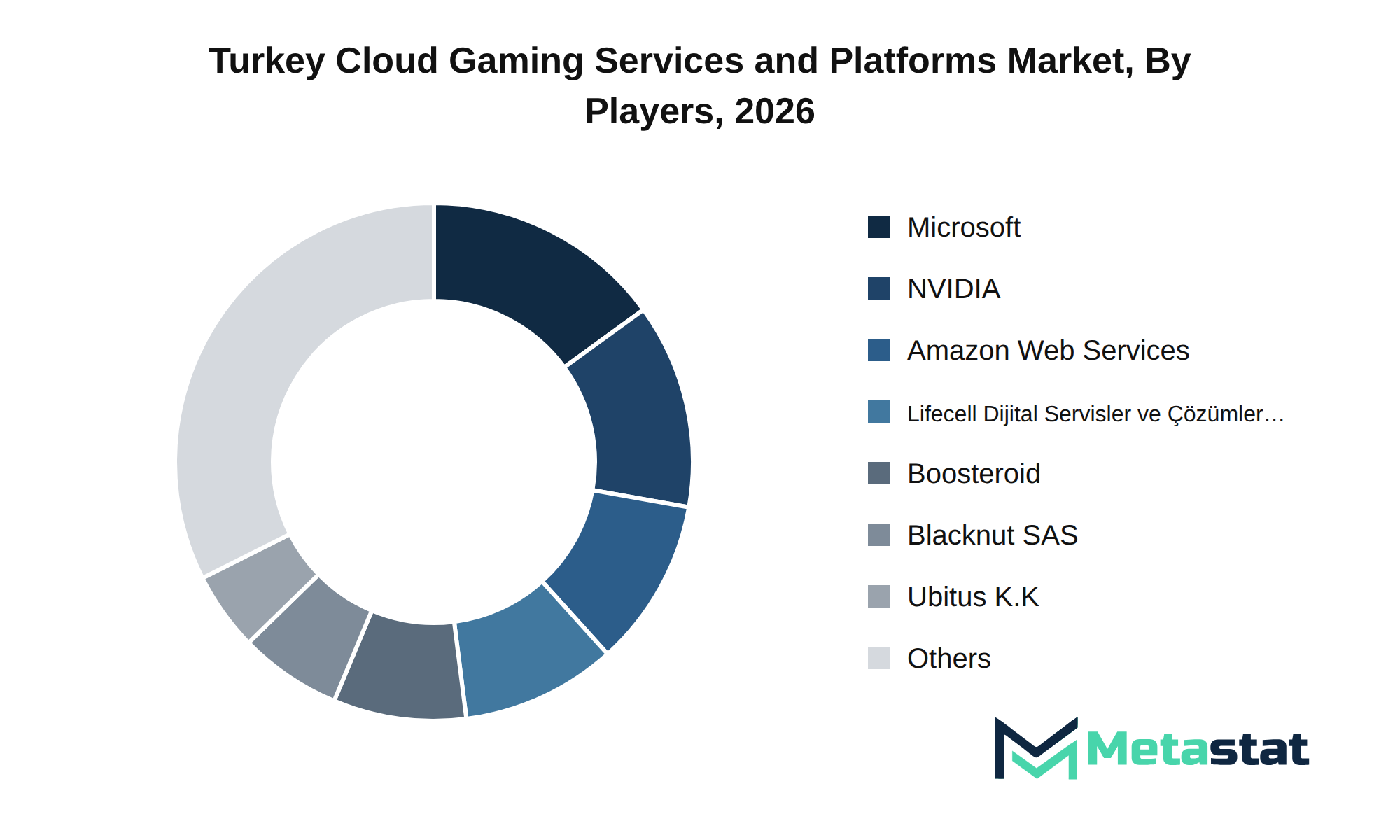
The Turkey Cloud Gaming Services and Platforms market features various players employing strategic consolidation and partnerships to enhance market positioning. Companies including NVIDIA Corporation and Microsoft Corporation focus on product differentiation and proprietary technology to maintain competitive advantages. Lifecell Dijital Servisler ve Çözümler A.Ş. / GAME+ and Antstream Ltd. leverage unique commercial models that cater to specific user demographics and preferences, while Tencent Cloud and Alibaba Cloud explore cross-industry partnerships to expand their service offerings.
Innovation in research and development pipelines and the development of robust intellectual property portfolios among companies like Amazon Web Services, Inc. and Ubitus K.K. contribute to technological defensibility in this competitive landscape. The emphasis on customer retention strategies and brand equity dynamics, particularly from Gameloft SE and Loudplay, reinforces their market presence. Overall, the competitive outlook for the Turkey Cloud Gaming Services and Platforms market remains dynamic, with growth potential driven by strategic alliances and technological advancements.
Market size is forecast to rise from USD 10.8 million in 2025 to over USD 63.6 million by 2033. The base case reflects a compound annual growth rate (CAGR) of 24.8%, indicating robust adoption and investment in cloud gaming services.
In the bull case, favorable macroeconomic conditions, including increasing disposable income and advancements in internet infrastructure, accelerate market growth. A surge in demand for next-generation technologies, including 5G mobile networks, fuels this potential. The emergence of new gaming titles and platforms enhances user experience, attracting a broader audience to the Turkey Cloud Gaming Services and Platforms market.
The bear case suggests challenges that could restrain market progress. Economic downturns or stringent regulatory environments limit investment and consumer spending in cloud gaming. Shifts in geopolitical landscapes disrupt supply chains and impact the availability of essential technologies. The market's resilience hinges on strategic capital allocation and the ability to navigate these evolving conditions.
Overall, the Turkey Cloud Gaming Services and Platforms market exhibits significant growth potential, driven by changing consumer behaviors and technological advancements. Investment in research and development, along with timely compliance with regulatory changes, remains vital for stakeholders seeking to capitalize on emerging opportunities.
The report strategically identifies and profiles the key market players and analyses their core competencies in each sub-segment of the Cloud Gaming Services and Platforms market.
Report Attributes | Details |
Study Period | 2021-2033 |
Base Year | 2025 |
Estimated Year | 2026 |
Forecast Period | 2026-2033 |
Historical Period | 2021-2025 |
Growth Rate | CAGR 24.8% from 2026 to 2033 |
Revenue Unit | USD million |
Segmentation | By Commercial Access Model, Device, Network Connection, User Age Group, and Region |
Find answers to common questions about this report
The Cloud Gaming Services and Platforms market size in Turkey was valued at USD 10.8 million in 2025.
The Cloud Gaming Services and Platforms market is projected to grow at a CAGR of 24.8% during the forecast period from 2026 to 2033.
The Standalone Cloud Gaming Subscription segment leads the Turkey Cloud Gaming Services and Platforms market, with a projected value of USD 19 million by 2033. This segment holds the largest share compared to other segments in the market.
Key drivers for the Turkey Cloud Gaming Services and Platforms market include digital transformation enhancing user experiences and investment in digital infrastructure, particularly improved internet connectivity through fiber broadband and 5G networks. Changing consumer behaviors, especially among younger demographics, increase demand for cloud gaming solutions, creating opportunities for service providers.
Regulatory compliance presents significant challenges, diverting resources from innovation and customer engagement. macroeconomic headwinds, including inflation and geopolitical instability, raise operational costs and limit companies' ability to scale operations. These factors collectively hinder growth potential in the Turkey Cloud Gaming Services and Platforms market.
Investment in digital infrastructure and enhanced internet connectivity support product adoption in the Turkey Cloud Gaming Services and Platforms market. Improved network capabilities enable faster data transmission, enhancing user experience and reducing latency, which are critical factors for gamers. changing consumer behaviors, particularly among younger demographics, drive demand for flexible and convenient gaming solutions.
The Cloud Gaming Services and Platforms market is estimated to reach a valuation of USD 63.6 million by 2033.
Key players in the Turkey Cloud Gaming Services and Platforms market include NVIDIA Corporation, Microsoft Corporation, Amazon Web Services, Inc., Tencent Cloud, Alibaba Cloud, and Huawei Cloud.
The standalone cloud gaming subscription segment is projected to reach USD 19 million by 2033, growing from USD 4.4 million in 2026, reflecting a CAGR of 23.2%.
The user age group of 18-24 years is expected to reach USD 17.1 million by 2033, with a CAGR of 23.9%.
The analysts below cover Information & Technology research at Metastat Insights.
LEAD ANALYST
Utkarsh Khirodkar is a Lead Market Research Analyst at MetaStat Insight, specializing in market intelligence, technology sector assessments, and competitive strategy.

PRINCIPAL CONSULTANT - ENTERPRISE AI & EMERGING TECHNOLOGIES
Banking & Finance · Electronics and Semiconductor · Energy and Power · Healthcare IT · Information & Technology · Professional Services
Vijay Gunti is a Principal Consultant at MetaStat Insight, bringing over two decades of experience across enterprise digital transformation, technology strategy, and intelligent systems.

LEAD CONSULTANT - COMMUNICATION, TELECOM, AND IT
Electronics and Semiconductor · Information & Technology · Machinery & Equipment · Professional Services
Ravindra Sathe Consultants for Communication, Telecom, and IT at MetaStat Insight. He leads the firm's industry research initiatives across telecommunications infrastructure, digital connectivity, enterprise networking, and emerging information technology domains.
Floating offshore wind feasibility relies heavily on specialized installation vessel availability and port crane limits, which most broad renewable energy forecasts ignore. The report delivered a thorough analysis of dry dock capacity, mooring chain supply constraints, and raw material pricing trends for deepwater anchor installations. It served as a solid independent sanity check for our offshore project capital expenditure assumptions.
Assessing commercial microgrid software adoption requires looking past top-level installation numbers and examining utility interconnection queues. The research provided verifiable data on average permitting timelines, tariff structures, and battery storage integration costs across regional utility territories. That grounded perspective was valuable for our team when building five-year demand projections for industrial microgrid controllers.
Ambulatory surgical centers have very different purchasing cycles for robotic-assisted surgery platforms than major hospital networks. The MetaStat Insight study focused squarely on capital expenditure depreciation, procedural reimbursement pathways, and surgeon training overhead. That operational clarity made it much simpler to validate multi-year procedure growth forecasts against actual ambulatory center adoption patterns.
Explore related market intelligence reports worth reading alongside this one.
Starting from
$2950
Starting from
$2950