
LEAD ANALYST
Utkarsh Khirodkar is a Lead Market Research Analyst at MetaStat Insight, specializing in market intelligence, technology sector assessments, and competitive strategy.

USA SOC as a Service Market Size, Share, By Service Type (Security Information Event Management (SIEM), Incident Response Services, Managed Detection Response, and Others), By Deployment Mode (Cloud-Based, On-Premises, and Hybrid), By Application (Network Security, Cloud Security, Endpoint Security, Application Security, and Others), By End Use (Banking, Financial Services, Insurance (BFSI), Healthcare, Government, Manufacturing, Energy, Utilities, IT, Telecom, Transportation, Logistics, and Others), Industry Analysis, Growth, Trends, and Forecast, 2026-2033
Report ID
MSI-4683
Published
April, 2026
Pages
315 Pages
Format
Report Details
Choose Your License
USA SOC as a Service Market
USA SOC as a Service market size is valued at USD 1,388.3 million in 2025 and projected to grow at a CAGR of 9.3% during the forecast period, reaching USD 2,826.1 million by 2033.
Managed Detection and Response segment holds the largest market share of 42.61% in the USA SOC as a Service market.
Key trends driving growth: Escalation in ransomware and multi-vector cyberattacks increasing need for always-on threat monitoring and response along with compliance-driven security operations requirements across regulated industries accelerating managed detection and response adoption.
Opportunities include AI-assisted detection engineering and automated triage workflows strengthening SOC productivity and lowering mean time to detect and respond for mid-market and enterprise buyers.
Key insight: Rising cyber threats and compliance pressure accelerate enterprise shift toward outsourced, AI-enabled SOC models across the United States.
The USA SOC as a Service market within the cybersecurity and managed security services industry is transforming how organizations design and manage defense operations across distributed digital environments. Organizations are increasingly shifting from maintaining in-house security operations centers toward subscription-based models that deliver 24/7 threat monitoring, behavioral analytics, incident validation, and rapid containment through cloud-native platforms. This transition reflects a broader restructuring of cyber resilience strategies across financial services, healthcare systems, manufacturing networks, and federal contractors.
As hybrid infrastructure expands, service providers are integrating artificial intelligence-driven correlation engines, extended detection and response capabilities, and automated playbooks that unify signals across endpoints, identities, cloud workloads, and operational technology environments. The USA SOC as a Service market is aligning closely with zero-trust architectures, regulatory audit readiness, and cyber insurance qualification requirements. Providers are competing on telemetry depth, triage speed, and transparent reporting dashboards that convert technical findings into executive-level threat intelligence.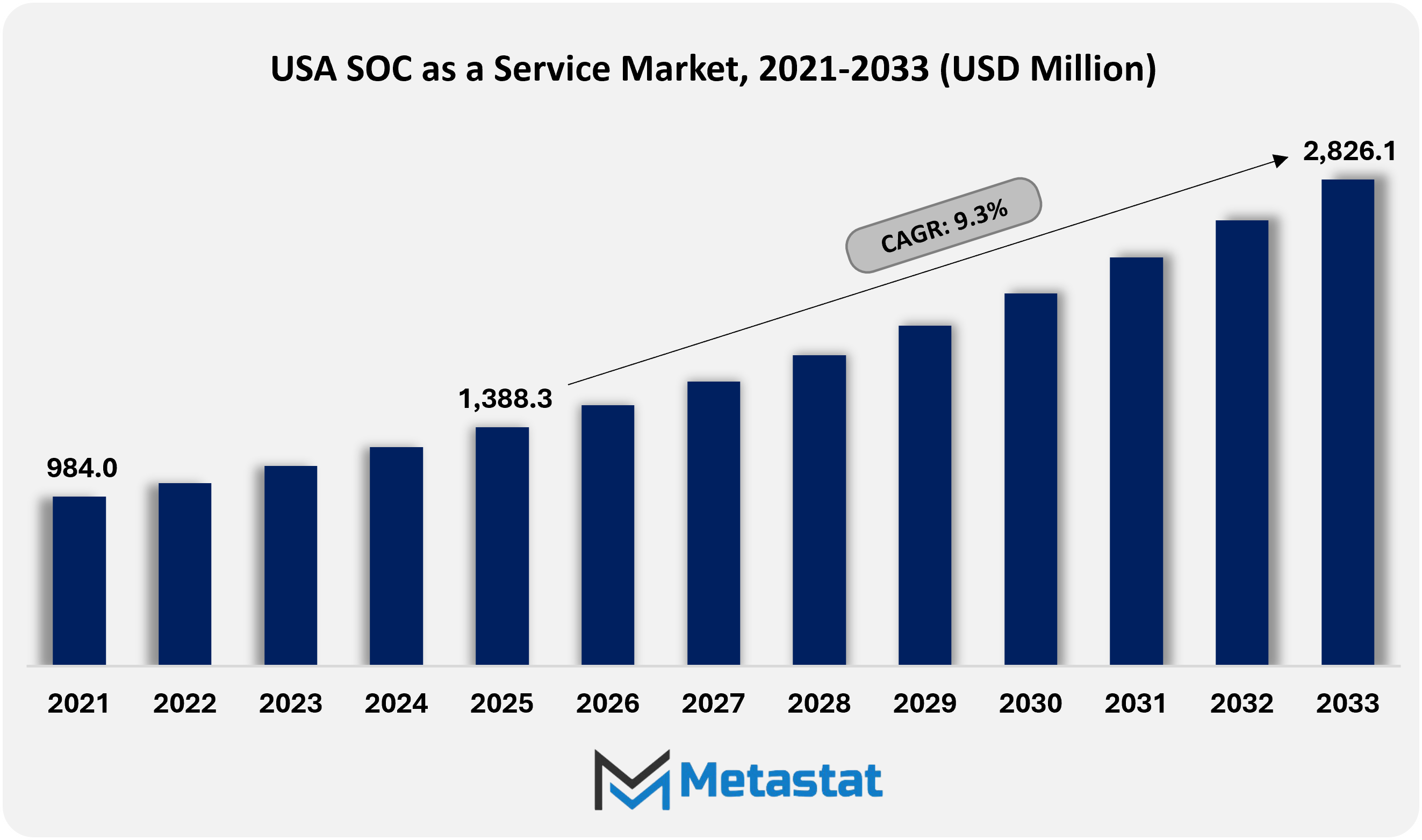
Escalation in ransomware and multi-vector cyberattacks increasing need for always-on threat monitoring and response.
The rising frequency of ransomware campaigns and coordinated multi-vector intrusions is increasing the need for continuous threat visibility across enterprise environments. Advanced threat actors using lateral movement, credential abuse, and supply chain compromise are pressuring organizations to maintain uninterrupted monitoring and rapid response capabilities. The USA SOC as a Service market is expanding as businesses seek real-time detection, rapid containment, and 24/7 incident response through specialized security operations infrastructure.
Compliance-driven security operations requirements across regulated industries accelerating managed detection and response adoption
Regulatory mandates across finance, healthcare, energy, and government sectors are reinforcing the need for structured security operations programs. Audit readiness, reporting transparency, and breach disclosure requirements are compelling organizations to adopt managed detection and response frameworks aligned with formal governance models. The USA SOC as a Service market is gaining traction through compliance-focused monitoring, standardized logging practices, and documented response protocols that support supervisory and legal requirements.
Data residency, privacy, and sensitive log telemetry governance concerns limiting full outsourcing in certain sectors
Heightened scrutiny over data residency laws and privacy mandates is limiting the outsourcing of sensitive log telemetry in critical sectors. Concerns related to cross-border data transfers, classified system information, and proprietary data exposure are slowing outsourcing decisions in highly regulated environments. The USA SOC as a Service market faces adoption barriers where governance frameworks require localized data control, segmented monitoring environments, and strong contractual safeguards for confidentiality.
Tooling integration complexity across legacy SIEM, cloud security, identity, and endpoint stacks increasing onboarding friction and cost
Fragmented security architectures that combine legacy SIEM platforms, cloud workload protection tools, identity governance systems, and endpoint detection solutions are creating operational friction during onboarding. Integration challenges, configuration mismatches, and inconsistent telemetry formats are increasing deployment complexity and transition costs. The USA SOC as a Service market requires structured migration frameworks, API harmonization strategies, and phased implementation models to reduce integration risk and deployment expense.
AI-assisted detection engineering and automated triage workflows strengthening SOC productivity and lowering mean time to detect and respond for mid-market and enterprise buyers
Adoption of AI-assisted detection engineering and automated triage workflows is improving operational efficiency within security operations centers. Machine learning models that enable anomaly correlation, behavioral analytics, and predictive alert prioritization are reducing analyst fatigue and accelerating containment timelines. The USA SOC as a Service market is benefiting from scalable automation frameworks that enhance productivity, optimize resource allocation, and reduce mean time to detect and respond across diverse enterprise environments.
The USA SOC as a Service market is classified based on Service Type, Deployment Mode, Application, and End Use.
Security Information and Event Management (SIEM) segment is valued at USD 455.7 million in 2026 and is projected to reach USD 760.8 million by 2033, at a CAGR of 7.6% during the forecast period.
Security Information and Event Management services strengthen centralized visibility across complex digital environments. Advanced analytics, automated correlation, and real-time alerting improve threat identification before operational disruption occurs. Within the USA SOC as a Service market, SIEM services are focused on predictive monitoring, regulatory alignment, and scalable data processing to manage rising security event volumes.
Incident Response Services segment is valued at USD 253.5 million in 2026 and is projected to reach USD 467.2 million by 2033, at a CAGR of 9.1% during the forecast period.
Incident Response Services are expanding through structured containment planning, forensic investigation, and rapid system recovery support. Continuous threat simulation and automation are reducing response time and limiting financial exposure from cybersecurity incidents. Within the USA SOC as a Service market, service providers are investing in proactive readiness frameworks that enable organizations to manage breaches with minimal operational disruption.
Managed Detection and Response segment is valued at USD 653.6 million in 2026 and is projected to reach USD 1,323.8 million by 2033, at a CAGR of 10.6% during the forecast period.
Managed Detection and Response is expanding through behavioral analytics, threat hunting, and system-driven intelligence. Continuous monitoring supported by expert analysts is improving early anomaly detection and accelerating threat containment. In the USA SOC as a Service market, managed detection models emphasize adaptive security mechanisms that learn from attack patterns and strengthen long-term cyber resilience.
Others segment is valued at USD 153.1 million in 2026 and is projected to reach USD 274.4 million by 2033, at a CAGR of 8.7% during the forecast period.
Other services include vulnerability assessment, compliance monitoring, risk consulting, and security advisory functions. Integrated dashboards and automated reporting are simplifying governance and improving visibility for enterprise leadership. In the USA SOC as a Service market, service diversification is increasing to support sector-specific security frameworks and tailored protection models aligned with regulatory and operational requirements.
Cloud-Based segment is projected to reach USD 1,711.2 million by 2033, at a CAGR of 10.2% during the forecast period.
Cloud-based deployment is expanding through scalable infrastructure, remote monitoring capabilities, and cost-efficient subscription models. Rapid integration across distributed networks is improving enterprise agility and deployment speed. Within the USA SOC as a Service market, cloud-based delivery is expected to support strong growth owing to flexible resource allocation, advanced analytics integration, and reduced infrastructure maintenance requirements.
On-Premises segment is projected to reach USD 232 million by 2033, at a CAGR of 4.9% during the forecast period.
On-premises deployment remains important for organizations that require direct control over sensitive data environments. Dedicated infrastructure supports strict compliance mandates, customized configurations, and tighter governance oversight. In the USA SOC as a Service market, on-premises adoption continues across regulated industries that prioritize data sovereignty, controlled network access, and stronger internal security management.
Hybrid segment is projected to reach USD 882.9 million by 2033, at a CAGR of 9% during the forecast period.
Hybrid deployment combines localized infrastructure with scalable cloud monitoring systems. This balanced architecture improves flexibility while preserving data control and compliance requirements. Across the USA SOC as a Service market, hybrid adoption is rising owing to operational continuity needs, distributed workforce protection, and adaptable security frameworks that support digital transformation initiatives.
Network Security segment is projected to reach USD 652.3 million by 2033.
Network security applications strengthen traffic monitoring, intrusion prevention, and encrypted communication oversight. Intelligent analytics improve the identification of abnormal patterns across complex enterprise environments. In the USA SOC as a Service market, network-focused solutions are advancing toward predictive protection to support uninterrupted digital operations across expanding connectivity ecosystems.
Cloud Security segment is projected to reach USD 850.9 million by 2033.
Cloud security applications are expanding with multi-cloud monitoring, identity governance, and data protection automation. Real-time threat visibility across distributed environments is improving confidence in digital infrastructure operations. Within the USA SOC as a Service market, cloud security demand is increasing alongside enterprise migration strategies, encouraging stronger compliance management and workload protection standards.
Endpoint Security segment is projected to reach USD 712.5 million by 2033.
Endpoint security is gaining momentum through device-level monitoring, behavioral detection tools, and automated containment capabilities. Workforce mobility and remote operations are increasing endpoint vulnerability exposure across enterprise networks. In the USA SOC as a Service market, endpoint-focused services prioritize continuous monitoring models capable of securing laptops, mobile devices, and connected assets.
Application Security segment is projected to reach USD 340.0 million by 2033.
Application security solutions address secure coding practices, vulnerability scanning, and runtime monitoring across software environments. Integration with development pipelines strengthens protection throughout the software lifecycle and improves issue resolution speed. In the USA SOC as a Service market, application-focused security is expanding alongside digital service growth, supporting protection across enterprise systems and customer-facing platforms.
Others segment is projected to reach USD 270.5 million by 2033.
Other applications include data security, identity management, and compliance monitoring solutions. Centralized oversight helps organizations maintain governance standards and improve operational visibility. Within the USA SOC as a Service market, specialized applications are increasing in response to sector regulations, digital innovation, and rising enterprise reliance on interconnected technology systems.
Banking, Financial Services and Insurance (BFSI) segment is projected to grow at a CAGR of 8.1% during the forecast period.
Banking, Financial Services, and Insurance institutions are investing in advanced threat monitoring to protect transaction integrity and customer data confidentiality. Continuous compliance alignment remains essential across financial operations and digital service platforms. Across the USA SOC as a Service market, BFSI adoption is rising owing to increasing digital payments, complex fraud patterns, and stricter regulatory supervision.
Healthcare segment is projected to grow at a CAGR of 9.6% during the forecast period.
Healthcare providers are strengthening cybersecurity frameworks to protect patient data, connected medical devices, and digital diagnostic systems. Strict data protection mandates continue to shape investment priorities across clinical and administrative environments. Within the USA SOC as a Service market, healthcare adoption is increasing alongside telehealth expansion and the digitization of medical workflows.
Government segment is projected to grow at a CAGR of 10% during the forecast period.
Government agencies are prioritizing critical infrastructure security, confidential data protection, and cyber defense readiness. Advanced monitoring frameworks support service continuity, threat visibility, and faster incident response across public sector systems. In the USA SOC as a Service market, government demand is increasing through modernization initiatives, rising inter-agency data exchange, and critical infrastructure resilience planning.
Manufacturing segment is projected to grow at a CAGR of 8.8% during the forecast period.
Manufacturing companies are strengthening operational technology security to prevent production disruption and intellectual property exposure. Connected equipment and automation systems require continuous monitoring across integrated industrial environments. Within the USA SOC as a Service market, manufacturing adoption is rising alongside smart factory deployment and industrial network integration.
Energy & Utilities segment is projected to grow at a CAGR of 8.8% during the forecast period.
Energy and utilities operators are investing in security solutions that protect grid systems, distribution networks, and critical infrastructure assets. Continuous monitoring reduces outage risk and strengthens resilience across interconnected energy environments. Across the USA SOC as a Service market, demand is increasing owing to infrastructure modernization, renewable energy integration, and national security priorities.
IT & Telecom segment is projected to grow at a CAGR of 10.4% during the forecast period.
IT and telecom companies require high-capacity monitoring to secure data centers, communication networks, and digital service platforms. Rising bandwidth utilization and network complexity are increasing the risk of cyber exposure across these environments. In the USA SOC as a Service market, IT and telecom adoption is increasing through 5G rollout, cloud expansion, and broader enterprise connectivity growth.
Transportation & Logistics segment is projected to grow at a CAGR of 10.1% during the forecast period.
Transportation and logistics companies are adopting advanced monitoring to protect fleet systems, tracking platforms, and supply chain data networks. Automation and digital routing tools require continuous oversight to reduce operational disruption and data compromise. Within the USA SOC as a Service market, adoption is rising through smart mobility systems and integrated distribution frameworks.
Others segment is projected to grow at a CAGR of 8.7% during the forecast period.
Other end users include retail, education, and professional services sectors seeking structured cybersecurity governance. Growing digital operations are increasing risk exposure across customer-facing and back-office environments. Across the USA SOC as a Service market, broader sector participation is expanding revenue opportunities through industry-specific monitoring strategies and compliance-focused security solutions.
The USA SOC as a Service market is gaining steady traction as organizations seek stronger ways to monitor and respond to cyber threats without building large in-house security teams. Security operations centers require skilled analysts, advanced tools, and round-the-clock monitoring, which many businesses find expensive and difficult to manage independently. SOC as a Service offers a practical alternative through continuous threat detection, incident response, and compliance support delivered under a subscription model. As cyberattacks increase in frequency and sophistication, organizations across healthcare, finance, retail, and manufacturing are expected to rely further on outsourced SOC solutions to reduce risk and maintain operational stability.
Major technology providers play a central role in shaping this market. Palo Alto Networks, Inc., Cisco Systems, Inc., Fortinet, Inc., and Check Point Software Technologies Ltd. integrate advanced firewalls, endpoint protection, and threat intelligence into managed SOC offerings. Broadcom strengthens the ecosystem through enterprise security software capabilities, while Cloudflare supports network-level protection through strong edge security architecture. These companies are focusing on automation, artificial intelligence, and unified dashboards to help security teams respond faster and reduce false positives.
Cloud and telecom leaders also contribute to market expansion. Amazon Web Services, Inc. provides scalable infrastructure that enables SOC providers to deliver flexible and remote monitoring solutions. Lumen Technologies and Verizon Business leverage network visibility to strengthen managed detection and response services. NTT DATA Inc. and DXC Technology Company combine consulting expertise with managed security operations to support large enterprises with complex IT environments. Their integrated approach is attracting organizations seeking end-to-end cybersecurity management under a single service agreement.
Specialized security firms are further intensifying competition in the USA SOC as a Service market. Rapid7, Inc., Sophos Ltd., Arctic Wolf Networks, Inc., Red Canary, Inc., eSentire, Inc., Critical Start, Inc., and Vectra AI, Inc. focus on managed detection and response, behavioral analytics, and proactive threat hunting. Companies such as ConnectWise, LLC, Kaseya, Alert Logic, Netsurion, Barracuda Networks, Inc., TierPoint, Proficio, UnderDefense, Teceze, and Eventus Security support mid-sized enterprises with cost-effective and scalable monitoring services. Deloitte Touche Tohmatsu Limited and Airbus Cybersecurity are extending advisory and cyber defense expertise into managed SOC offerings. Together, these market participants are driving innovation, improving response times, and shaping a competitive landscape where service quality, automation, and trust remain critical to long-term growth.
Market size is forecast to rise from USD 1,388.3 million in 2025 to over USD 2,826.1 million by 2033.
Future deployments are expected to emphasize modular delivery models. Enterprises will adopt tiered detection offerings, co-managed response structures, or fully outsourced operations depending on internal security maturity and risk exposure. Partnerships between SOC platforms and threat intelligence networks are likely to increase, enabling predictive analysis rather than purely reactive monitoring. The USA SOC as a Service market is also expected to see consolidation among providers seeking broader geographic redundancy and stronger sector-specific compliance expertise.
This research report categorizes the SOC as a Service market across key segments, forecasts revenue growth, and analyzes trends across each submarket. The report examines the major growth drivers, opportunities, and challenges influencing market expansion. It also includes recent market developments and competitive strategies such as expansion, service launches, partnerships, mergers, and acquisitions to present the competitive landscape.
The report strategically identifies and profiles the key market players and analyses their core competencies in each sub-segment of the SOC as a Service market.
|
Report Attributes |
Details |
|
Study Period |
2021-2033 |
|
Base Year |
2025 |
|
Estimated Year |
2026 |
|
Forecast Period |
2026-2033 |
|
Historical Period |
2021-2025 |
|
Growth Rate |
CAGR 9.3% from 2026 to 2033 |
|
Revenue Unit |
USD million |
|
Segmentation |
By Service Type, Deployment Mode, Application, End Use |
|
By Service Type |
|
|
By Deployment Mode |
|
|
By Application |
|
|
By End Use |
|
Find answers to common questions about this report
Top players operating in the USA SOC as a Service industry include Palo Alto Networks, Inc., Cisco Systems, Inc., Lumen Technologies, Airbus Cybersecurity, NTT DATA Inc.
USA SOC as a Service market is estimated to reach USD 2,826.1 million by 2033.
Data residency, privacy, and sensitive log telemetry governance concerns limiting full outsourcing in certain sectors will hamper the market growth within the forecast period.
Escalation in ransomware and multi-vector cyberattacks increasing need for always-on threat monitoring and response and Compliance-driven security operations requirements across regulated industries accelerating managed detection and response adoption are key driving factors, boosting the market.
The Metastat Insights study shows that the USA SOC as a Service market size was USD 1,388.3 million in 2025.
The USA SOC as a Service market is expected to grow at a CAGR of 9.3% over the forecast period (2026-2033).
The Managed Detection and Response is the leading type segment in the USA market.
The analysts below cover Information & Technology research at Metastat Insights.
LEAD ANALYST
Utkarsh Khirodkar is a Lead Market Research Analyst at MetaStat Insight, specializing in market intelligence, technology sector assessments, and competitive strategy.

PRINCIPAL CONSULTANT - ENTERPRISE AI & EMERGING TECHNOLOGIES
Banking & Finance · Electronics and Semiconductor · Energy and Power · Healthcare IT · Information & Technology · Professional Services
Vijay Gunti is a Principal Consultant at MetaStat Insight, bringing over two decades of experience across enterprise digital transformation, technology strategy, and intelligent systems.

LEAD CONSULTANT - COMMUNICATION, TELECOM, AND IT
Electronics and Semiconductor · Information & Technology · Machinery & Equipment · Professional Services
Ravindra Sathe Consultants for Communication, Telecom, and IT at MetaStat Insight. He leads the firm's industry research initiatives across telecommunications infrastructure, digital connectivity, enterprise networking, and emerging information technology domains.
Floating offshore wind feasibility relies heavily on specialized installation vessel availability and port crane limits, which most broad renewable energy forecasts ignore. The report delivered a thorough analysis of dry dock capacity, mooring chain supply constraints, and raw material pricing trends for deepwater anchor installations. It served as a solid independent sanity check for our offshore project capital expenditure assumptions.
Assessing commercial microgrid software adoption requires looking past top-level installation numbers and examining utility interconnection queues. The research provided verifiable data on average permitting timelines, tariff structures, and battery storage integration costs across regional utility territories. That grounded perspective was valuable for our team when building five-year demand projections for industrial microgrid controllers.
Ambulatory surgical centers have very different purchasing cycles for robotic-assisted surgery platforms than major hospital networks. The MetaStat Insight study focused squarely on capital expenditure depreciation, procedural reimbursement pathways, and surgeon training overhead. That operational clarity made it much simpler to validate multi-year procedure growth forecasts against actual ambulatory center adoption patterns.
Explore related market intelligence reports worth reading alongside this one.