
LEAD ANALYST
Utkarsh Khirodkar is a Lead Market Research Analyst at MetaStat Insight, specializing in market intelligence, technology sector assessments, and competitive strategy.

Asia Pacific Digital Textile Printing Market Size, Share, By Printing Process (Direct-to-Fabric Printing, Dye-Sublimation Transfer Printing, Direct-to-Garment Printing, Direct-to-Film Transfer Printing and Others (Pigment Paper Transfer)), By Ink Type (Sublimation Inks, Reactive Inks, Pigment Inks, Acid Inks, Direct Disperse Inks and Others (Vat and Specialty Dye Inks)), By Application (Clothing and Apparel, Home Textiles, Soft Signage, Technical Textiles and Others (Textile Art and Craft Products)), By Region (China, Japan, India, South Korea, Australia, Southeast Asia and Rest of Asia Pacific), Industry Analysis, Growth, Trends, and Forecast, 2026-2033
Report ID
MSI-5655
Published
October, 2026
Pages
261 Pages
Format
Historical
Base year
Forecast
Forecast period
Report Details
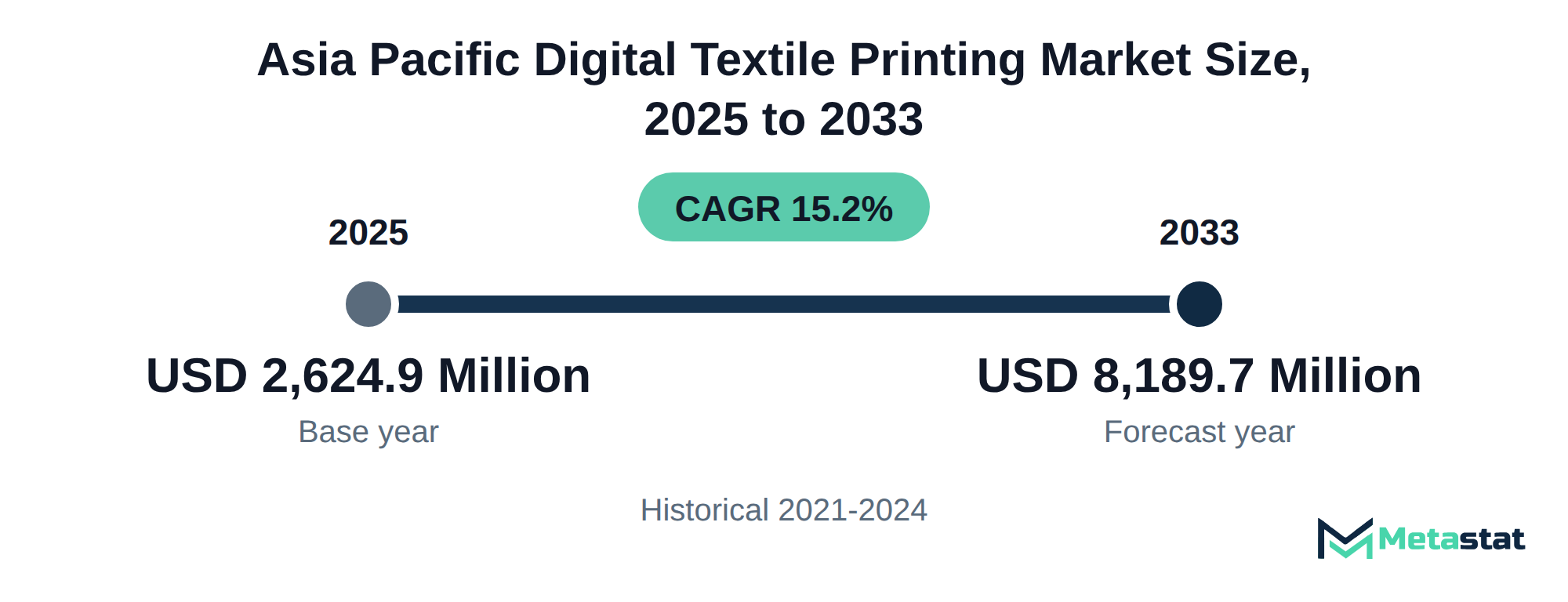
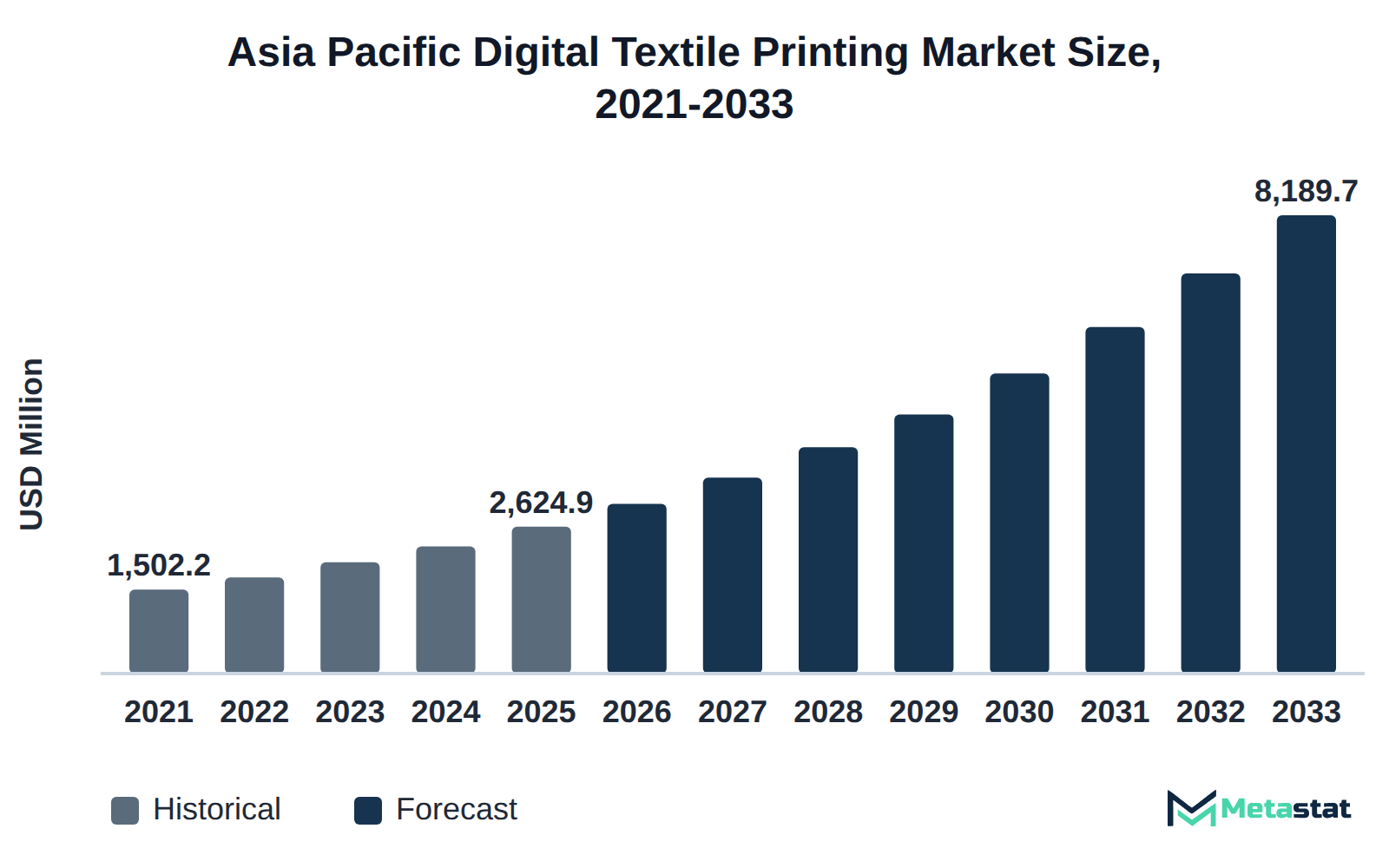
Market Valuation: Valued at $2,624.9 Million in 2025, projected to reach $8,189.7 Million by 2033 at a 15.2% CAGR.
Dominant Segment: The clothing and apparel segment leads the Asia Pacific Digital Textile Printing market, driven by increasing consumer demand for personalized and custom-designed clothing. This segment is projected to generate USD 4,894.2 million by 2033, reflecting a strong growth trajectory.
Geographic Lead: China holds the largest share of the market, with anticipated revenue of USD 1,268.4 million in 2026, growing to USD 3,207.9 million by 2033. This growth is fueled by its extensive manufacturing capabilities and a rising consumer base seeking innovative textile solutions.
What's Inside: The report provides a comprehensive analysis of the Asia Pacific Digital Textile Printing market, including competitive coverage, insights into various printing processes and ink types, and a detailed forecast window from 2026 to 2033.
Technological Advancements: Rapid advancements in printing technology are enhancing the quality and efficiency of textile production. Innovations such as direct-to-fabric and dye-sublimation printing techniques are expected to drive significant improvements in print quality and production speed.
Sustainability Trends: The increasing emphasis on sustainable practices within the textile industry is reshaping market dynamics. Manufacturers are adopting eco-friendly printing methods to address environmental concerns, which is expected to further boost the appeal of digital printing technologies.
Choose Your License
Asia Pacific Digital Textile Printing Market
The Asia Pacific Digital Textile Printing market was valued at USD 2,624.9 million in 2025 and is projected to reach USD 8,189.7 million by 2033, growing at a CAGR of 15.2% over the forecast period.
The Asia Pacific Digital Textile Printing market encompasses various technologies and applications designed for printing on textiles. Buyers invest in this market due to the increasing demand for customized and high-quality textile products across industries, including fashion, home decor, and advertising. The shift towards digital printing solutions reflects the need for more efficient production processes and the ability to create intricate designs that traditional methods cannot achieve.
Significant growth is evident in the Asia Pacific Digital Textile Printing market, driven by several factors. The clothing and apparel segment stands out as the largest contributor, reflecting ongoing trends towards personalized fashion and rapid prototyping. China represents the largest share of the market, driven by its extensive manufacturing capabilities and a growing consumer base that values innovative textile solutions.
One primary growth driver is the increasing adoption of sustainable practices within the textile industry. Environmental concerns gain prominence, prompting manufacturers to prioritize eco-friendly printing methods that minimize waste and reduce energy consumption. This trend enhances the appeal of digital printing technologies, positioning the market for sustained growth in the coming years.
Investments in the Asia Pacific Digital Textile Printing market reflect the growing demand for high-quality and customizable textile products. Buyers prioritize advanced printing technologies that offer versatility and efficiency, enabling them to meet diverse consumer preferences. The market serves industries including fashion, home textiles, and technical textiles, driving spending on innovative solutions that enhance product appeal and operational efficiency.
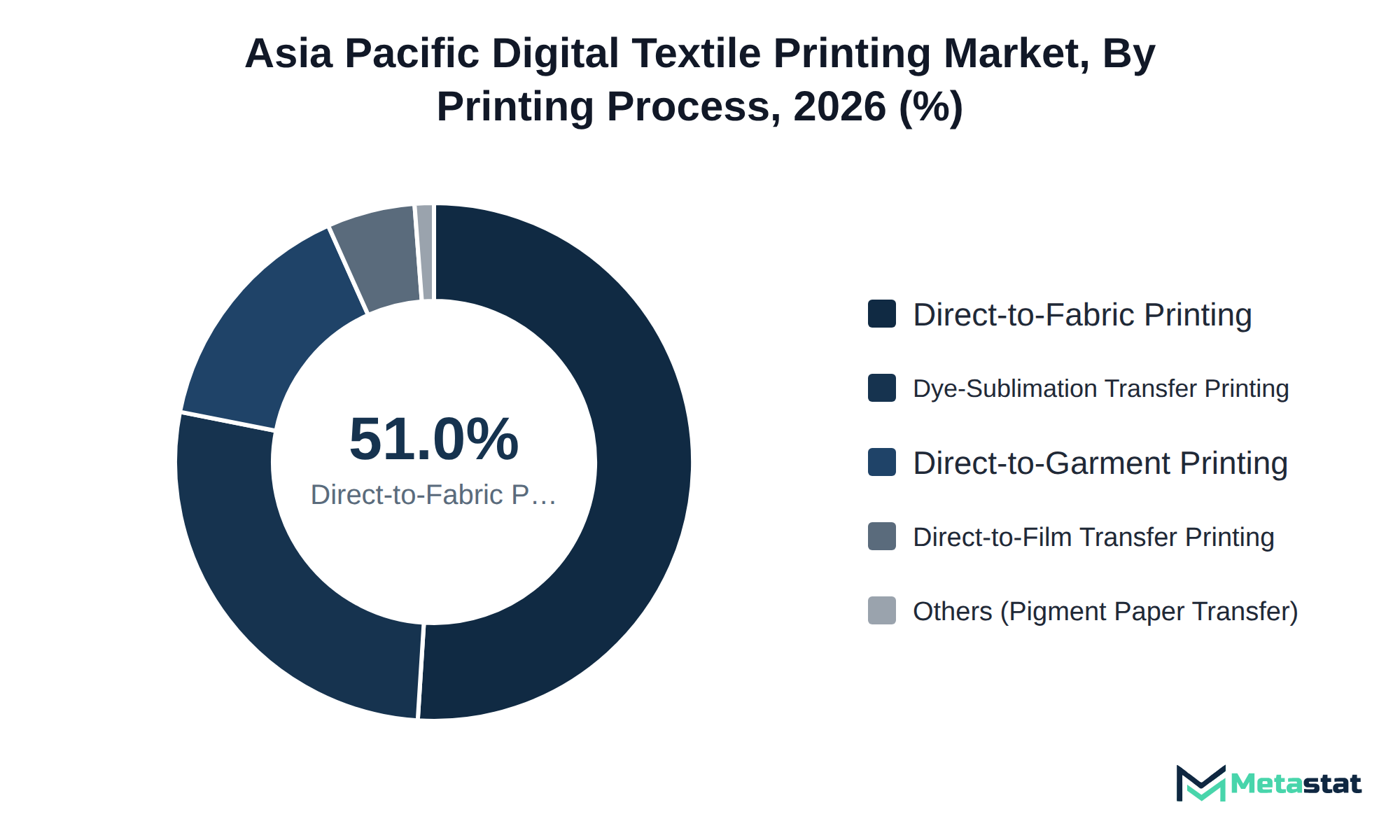
Direct-to-Fabric Printing stands out with the highest value, significantly contributing to market growth. China holds the largest share of the market, benefiting from its robust manufacturing capabilities and high demand for printed textiles. The increasing consumer inclination towards sustainable and personalized products drives growth, prompting manufacturers to adopt digital printing technologies that align with evolving market trends.
The Asia Pacific Digital Textile Printing market is expected to experience substantial growth due to advancements in printing technologies and inks. Continuous innovation leads to improved print quality, faster production times, and reduced waste, appealing to environmentally conscious consumers. This momentum, driven by the demand for customized textile solutions, is projected to position the market for expansive growth in the coming years.
The adoption of pigment inks is transforming textile production in the Asia Pacific Digital Textile Printing market. This shift allows manufacturers to achieve high-quality prints on a variety of fabrics without the need for extensive pre-treatment or post-treatment processes. The growth in pigment ink usage correlates with a projected market value of USD 2,322.6 million by 2033, reflecting its increasing significance in the industry.
One of the most notable advancements linked to pigment inks is the implementation of single-step fixation techniques. These techniques streamline the production process, significantly reducing time and labor costs while enhancing operational efficiency. The ease of application and the ability of pigment inks to bond directly with fibers make them an attractive option for textile manufacturers aiming to improve productivity.
The emphasis on sustainability drives the adoption of pigment inks, since they typically require less water and energy during production compared to traditional dyeing processes. This growing focus on sustainable practices aligns with market trends, enabling manufacturers to cater to environmentally conscious consumers. Overall, the integration of pigment inks and single-step fixation methods enhances production capabilities, positioning businesses for competitive advantage in the evolving landscape of the Asia Pacific Digital Textile Printing market.
Single-pass fabric printing presents a compelling option for buyers seeking efficiency in short production runs. This technology allows faster production speeds compared to traditional methods, resulting in reduced lead times and increased flexibility for manufacturers. In the Asia Pacific Digital Textile Printing market, the demand for rapid turnaround times directly influences purchasing decisions, particularly among businesses in the clothing and apparel sector.
In 2026, the clothing and apparel application segment is expected to generate USD 1,783 million, reflecting the growing need for customized and on-demand textile solutions. Buyers often prefer contract models that accommodate smaller batch sizes without incurring large upfront costs. This preference leads to the adoption of pay-per-print agreements, where businesses pay based on the quantity printed, allowing for more manageable financial commitments and inventory management.
The commercial consequence of embracing single-pass fabric printing and flexible pricing models includes enhanced competitiveness in the market. This approach aligns production with current demand, allowing businesses to respond swiftly to changing consumer preferences. Consequently, firms that leverage these technologies and pricing structures position themselves favorably within the Asia Pacific Digital Textile Printing market, driving growth and customer satisfaction.
China, India, and Southeast Asia have emerged as significant investment hubs within the Asia Pacific Digital Textile Printing market, driven by their diverse textile industries and increasing demand for innovative printing solutions. In 2026, China is projected to generate USD 1,268.4 million in revenue from digital textile printing, reflecting a growth trajectory that is anticipated to reach USD 3,207.9 million by 2033, corresponding to a compound annual growth rate (CAGR) of 14.2%. This growth attracts manufacturers and investors focused on advancing their technological capabilities.
India presents a unique opportunity for investors in the market, with an increasing emphasis on sustainable practices and digital transformation in the textile sector. The shift towards eco-friendly materials and processes drives demand for digital printing technologies that reduce waste and enhance efficiency. The country is expected to achieve significant growth in digital textile printing revenue, reaching USD 1,936.1 million by 2033. This focus on sustainability positions India as a critical player, appealing to firms seeking to align with environmentally conscious consumers.
Southeast Asia, characterized by its growing manufacturing capabilities and access to raw materials, represents another vital region for investment in the Asia Pacific Digital Textile Printing market. The area's strategic location facilitates trade routes and enables companies to capitalize on lower production costs. This factor, combined with the increasing trend of adopting digital printing technologies across various applications, enhances Southeast Asia's attractiveness for companies looking to expand their operations and market presence.
On-demand textile printing significantly reduces water use and unsold inventory, contributing to a more sustainable production process. Traditional textile manufacturing often involves extensive water consumption for dyeing and finishing processes. In contrast, on-demand methods apply digital printing technologies that apply inks directly to fabric, minimizing water usage. For instance, the Asia Pacific Digital Textile Printing market anticipates a significant increase in the adoption of direct-to-fabric printing, which is projected to grow from USD 1,532.9 million in 2026 to USD 3,782 million by 2033, reflecting a compound annual growth rate (CAGR) of 13.8%. This shift lowers water consumption and reduces overproduction and waste, addressing the challenge of unsold inventory.
By producing only what is necessary for immediate orders, brands align their manufacturing processes with actual demand. This approach prevents fabric from going unsold, which often leads to waste and additional environmental impact. The adoption of digital textile printing technologies in the Asia Pacific region supports a transformation in the textile industry, leading to both economic and ecological benefits. While demand for sustainable practices continues to rise, this shift towards on-demand textile printing presents a viable solution for reducing water use and managing inventory effectively.
Growing consumer interest in personalized textiles drives spending in the Asia Pacific Digital Textile Printing market. Fashion brands and home textile manufacturers seek unique designs that appeal to individual preferences, prompting a shift toward digital printing solutions. The need for customization within the clothing and apparel segment has surged, with revenue expected to reach USD 4,894.2 million by 2033, reflecting a compound annual growth rate of 15.5% from 2026. This trend results in increased volume requirements, boosting demand for digital textile printing technologies. Companies prioritize on-demand production to enhance customer satisfaction, creating significant growth opportunities fueled by this changing consumer behavior.
Rapid advancements in printing technology drive improvements in the Asia Pacific Digital Textile Printing market. Innovations including enhanced direct-to-fabric and dye-sublimation printing techniques enable manufacturers to achieve higher resolution and faster production speeds. These developments reduce printing costs while enhancing the quality and durability of printed textiles, catering to both commercial and individual consumers.
Increased efficiency in printing processes attracts companies looking to optimize their operations while meeting the rising demand for high-quality textile products. The ability to produce intricate designs and patterns without compromising speed positions suppliers to gain a competitive edge. Consequently, businesses investing in advanced printing technologies realize significant reductions in waste and operational costs, leading to greater sustainability in textile production.
The integration of automated solutions further streamlines production lines, allowing for quicker turnaround times and improved responsiveness to market trends. While manufacturers adopt these technological advancements, the market experiences growth, reflecting the ongoing shift towards smarter and more efficient textile printing solutions.
Increasing ink prices present a significant barrier for buyers in the Asia Pacific Digital Textile Printing market. Textile manufacturers face challenges in managing production costs, which leads to slower adoption of advanced printing technologies. Rising expenses cause companies to delay equipment upgrades and order sizes to shrink. The trend affects small to medium-sized enterprises (SMEs) and startups, which typically operate with tighter budgets. The hesitation to invest in innovative printing solutions results in a competitive disadvantage against larger firms that absorb higher costs. The increased financial pressure leads to reduced profitability within the industry, limiting growth potential for businesses reliant on digital textile printing. Overall, the upward trajectory of ink costs directly impacts market dynamics by constraining purchasing power and lowering demand for advanced digital printing solutions.
Supply chain disruptions in the Asia Pacific Digital Textile Printing market contribute to rising input costs, affecting profit margins for suppliers. Fluctuations in raw material prices, particularly for specialized inks and textiles, lead to increased operational expenses. Suppliers respond by optimizing sourcing strategies and seeking alternative materials, which reduces dependency on traditional inputs. Innovations in recycling technologies and the development of cost-effective ink formulations serve as strategies to mitigate these pressures. Companies within the market focus on enhancing operational efficiencies, including streamlining production processes and investing in automation, to offset rising costs. These approaches aim to improve profitability while maintaining competitive pricing for end-users. The outcome of these measures will determine the market's ability to sustain growth amid challenging economic conditions.
The clothing and apparel segment within the Asia Pacific Digital Textile Printing market presents a significant opportunity for expansion. Increasing consumer demand for personalized and custom-designed clothing drives investment in digital textile printing technologies. The ability to quickly produce unique designs aligns with evolving fashion trends and consumer preferences. Strong growth in the clothing and apparel segment contributes to overall market expansion, encouraging investment in innovative printing processes and ink types that cater specifically to this application. Suppliers equipped to address these trends are likely to enhance their competitive positioning and capture a larger share of the market. Overall, the clothing and apparel segment drives revenue growth in the years ahead.
The Asia Pacific Digital Textile Printing market is segmented based on Printing Process, Ink Type, Application, and Region.
This printing process finds extensive use in the fashion and interior design industries, where high-quality fabric prints are essential. Demand for this segment is primarily driven by the growing trend of custom textile designs and rich color applications. This process allows for quick turnaround times and caters to both large-scale production and small batch runs, setting it apart from other methods like Dye-Sublimation Transfer Printing, which shows a CAGR of 13.9%. Direct-to-Fabric Printing offers greater flexibility in design and production volume, appealing to businesses focused on rapid market response and diverse consumer preferences. The emphasis on sustainable production methods among manufacturers further enhances the appeal of this segment.
Dye-Sublimation Transfer Printing segment is estimated to reach USD 2,020.4 million by 2033, at a CAGR of 13.9% during the forecast period. This printing process is widely used for creating detailed and intricate designs on various textile materials, particularly in the fashion and home décor industries. Key buyers include textile manufacturers and businesses focused on custom apparel, where the demand for high-quality prints remains strong. The segment benefits from advancements in ink technology, enhancing print quality and color accuracy. Compared to other printing processes, Dye-Sublimation Transfer Printing offers lower production costs and faster turnaround times for small runs, positioning it as a preferred choice for on-demand production. The increasing focus on sustainability and eco-friendliness in textile printing drives interest in this segment, aligning with the broader trends shaping the Asia Pacific Digital Textile Printing market.
Direct-to-Garment Printing segment is expected to reach USD 1,533.1 million by 2033. This printing method is widely used for custom apparel production, allowing for on-demand printing of designs directly onto garments. Clothing brands and smaller independent designers frequently employ this technology to fulfill specific consumer requests and create unique offerings. Strong demand for personalized fashion and quick turnaround times drives growth in this segment. Direct-to-Garment Printing outpaces others, including Dye-Sublimation Transfer Printing, which has a CAGR of 13.9%. The segment's growth reflects an increasing preference for shorter production runs and customized apparel among buyers, contributing to its anticipated expansion within the Asia Pacific Digital Textile Printing market.
Direct-to-Film Transfer Printing segment is projected to grow at a CAGR of 23.2% during the forecast period. This printing process is primarily for transferring designs onto various substrates, particularly in industries including fashion and promotional products. Its rapid growth stems from increasing demand for customized and high-quality prints, which attract both small businesses and large manufacturers. Unlike other segments, Direct-to-Film Transfer Printing offers quicker turnaround times and lower setup costs, appealing to businesses focused on short production runs. This segment stands out due to its ability to produce high-quality prints on diverse materials, enhancing its attractiveness in the competitive landscape of the Asia Pacific Digital Textile Printing market. Innovations in film technology further support its growth, providing improved adhesion and durability of prints.
Others (Pigment Paper Transfer) employs pigment-based inks to print designs on transfer paper, which is then applied to textiles. This segment serves various industries, including fashion, home décor, and promotional products. Craft and DIY markets have embraced this method due to its versatility and cost-effectiveness. Demand for customizable and easy-to-use printing solutions influences this segment, attracting several small to medium-sized enterprises seeking to offer unique products. Compared to other printing processes, including Direct-to-Garment Printing, this sub-segment appeals to buyers focused on lower setup costs and the ability to produce smaller batches efficiently. While growth rates vary across different methods, this segment supports a diverse range of applications, enhancing its relevance in the Asia Pacific Digital Textile Printing market.
Sublimation Inks segment is valued at USD 1,300.3 million in 2026 and is projected to reach USD 3,291.5 million by 2033, at a CAGR of 14.2% during the forecast period. Widely used in applications like clothing and home textiles, sublimation inks facilitate the effective printing of designs onto synthetic fabrics, primarily polyester. This segment benefits from the rising trend of personalized and custom products, appealing to fashion brands and home décor manufacturers looking for high-quality prints. Within the Ink Type category, sublimation inks exhibit a higher growth rate compared to reactive inks, projected to reach USD 1,835.3 million by 2033 at a CAGR of 13.5%. The increasing demand for sustainable production methods and eco-friendly inks further boosts this segment's growth trajectory, positioning it favorably against other ink types. The Asia Pacific Digital Textile Printing market continues to expand, driven by innovations in ink formulations and printing technology.
These inks are primarily used in textile applications, particularly for clothing and home textiles, due to their ability to create bright colors and durable prints. This segment benefits from increasing consumer preferences for high-quality, colorful fabrics that provide longevity and resistance to fading. Growth is driven by rising demand for fashion and personalized products, where customization is important. Compared to other ink types, Reactive Inks achieve a balance between cost and performance, positioning them as a favorable choice among manufacturers. Their growth rate of 13.5% aligns closely with broader trends observed in the market, reinforcing their importance in meeting the evolving needs of textile producers.
Pigment Inks segment is expected to reach USD 2,322.6 million by 2033. Widely used in the clothing and apparel sector, pigment inks provide durable and rich colors, appealing to brands seeking high-quality prints. Growth in this segment is driven by increasing demand for customization and sustainable printing solutions. Compared to other ink types, pigment inks typically offer a slower growth trajectory, with a projected CAGR of 12.7% during the forecast period. This contrasts with the faster-growing Sublimation Inks segment, which is anticipated to reach USD 3,291.5 million by 2033. The distinct characteristics of pigment inks, including their versatility and suitability for various fabric types, enable adoption in home textiles and soft signage applications, further enhancing their relevance in the Asia Pacific Digital Textile Printing market.
Acid Inks segment is projected to grow at a CAGR of 12.7% during the forecast period. These inks find widespread application in textile printing, particularly for nylon and silk fabrics, due to their affinity for protein fibers and ability to produce bright colors. Buyers in the fashion and home textile industries prioritize Acid Inks for their high colorfastness and bright hues, which enhance the quality of final products. Competitive pricing and versatility differentiate Acid Inks from other ink types. Unlike Sublimation Inks, which perform optimally on polymer-coated substrates, Acid Inks offer a broader range of fabric compatibility. The ongoing trend toward sustainable practices further influences the segment, driven by manufacturers increasingly seeking eco-friendly ink solutions, resulting in heightened demand for high-quality Acid Inks in the Asia Pacific Digital Textile Printing market.
Direct Disperse Inks serve a specific role in the textile printing process, primarily used for printing on synthetic fabrics including polyester. This ink type is favored by manufacturers producing sportswear and fashion textiles, where bright colors and durability are critical. Adoption of Direct Disperse Inks is driven by demand for high-quality printing solutions that provide excellent color fidelity and fast drying times. Compared to other ink types, this segment typically experiences different price structures, which affect overall production costs. The segment differs from others by focusing on polyester and similar materials, while segments like Reactive Inks cater to cotton and cellulose-based fabrics. The Asia Pacific Digital Textile Printing market continues to evolve due to technology advancements, creating new opportunities for Direct Disperse Inks to meet the changing needs of the textile industry.
Vat and Specialty Dye Inks provide unique coloring solutions for specialized textile applications. These inks cater to industries requiring high-quality color reproduction and durability, including fashion, home textiles, and technical textiles. A significant force driving this segment stems from increasing demand for long-lasting prints, enhancing the appeal of various textile products. Compared to other ink types, this segment often commands a higher price due to the specialized nature and advanced technology involved in production. Competitive advantages include superior colorfastness and specific performance characteristics that attract discerning customers, particularly in niche markets requiring high quality. While growth in this segment does not outpace segments like Dye-Sublimation Transfer Printing, the unique attributes of Vat and Specialty Dye Inks continue to secure a dedicated customer base. This focus on quality and performance contributes to the overall dynamism observed in the Asia Pacific Digital Textile Printing market.
This segment encompasses a diverse range of textile applications, including fashion garments, activewear, and uniforms. A surge in consumer demand for customized clothing significantly influences this segment, driving brands to adopt digital textile printing for unique designs and quick turnaround times. Compared to other segments, clothing and apparel experiences accelerated growth due to its broad customer base, which includes both individual consumers and large retail chains. The ongoing trend towards eco-friendly materials and sustainable practices further enhances adoption, driven by brands seeking digital solutions that reduce waste and enhance production efficiency. The clothing and apparel segment stands out for its rapid growth and significant revenue potential within the Asia Pacific Digital Textile Printing market.
Home Textiles segment is estimated to reach USD 1,733.8 million by 2033, at a CAGR of 14.4% during the forecast period. This segment includes printed textiles used for home décor, upholstery, and other residential applications, appealing to consumers and businesses focused on interior design. Growing consumer interest in personalized and aesthetically pleasing home environments drives demand for printed textiles, influencing the segment's performance. Compared to other segments, including Clothing and Apparel, which is expected to grow at a CAGR of 15.5%, Home Textiles experiences slower growth but remains significant due to its specific application in home furnishings. Increased disposable income among consumers in the Asia Pacific region supports market expansion, allowing households to invest in high-quality, custom-designed textiles. The impact of fashion trends and sustainability concerns further shapes buying behavior in this segment.
Soft Signage segment is expected to reach USD 840.3 million by 2033. This segment focuses on printing graphics and visual displays for retail environments, exhibitions, and events, attracting interest from marketers and businesses aiming to create effective visual communications. Growth in the soft signage segment is driven by increasing demand for lightweight materials that offer flexibility in design and installation. The segment's growth trajectory, characterized by its unique applications, differs from other segments, with a CAGR that aligns with consumer trends toward customized and sustainable advertising solutions. Unlike traditional signage, which relies on rigid materials, soft signage provides a cost-effective and visually appealing alternative that enhances brand visibility, particularly in dynamic retail settings. The Asia Pacific Digital Textile Printing market experiences a shift toward these innovative solutions, reflecting broader changes in advertising and display strategies.
Technical Textiles segment is projected to grow at a CAGR of 17.9% during the forecast period. This segment encompasses materials designed for specific performance criteria in various industries, including automotive, medical, and construction. Such textiles are used for applications requiring durability, resistance to environmental factors, and functional properties. Key demand drivers for this segment include innovations in technology that enhance fabric performance and an increasing focus on sustainability in production processes. This segment distinguishes itself by targeting specialized applications and higher price points compared to broader categories like clothing and apparel. The market for Technical Textiles highlights a growing interest in functional materials that satisfy advancing regulatory standards and consumer demands for performance-oriented products.
Textile Art and Craft Products encompass various printed fabrics for creative applications, including handmade items and artistic designs. Crafters, artists, and hobbyists primarily use these products, driven by a growing interest in personalized and unique textile items. The segment experiences robust demand due to increased consumer preference for custom and artisanal products, encouraging creativity and self-expression among users. This segment differentiates itself from others by appealing to niche markets and often commanding higher prices due to the specialized nature of the applications. In comparison with segments like Clothing and Apparel, which have a wider commercial focus, Textile Art and Craft Products exhibit unique attributes in buyer behavior and market dynamics.
This segment primarily serves the clothing and apparel industry, where high-quality digital printing facilitates intricate designs and customization. Growing demand for personalized fashion and rapid production capabilities drive expansion in this segment. Compared to Direct-to-Garment Printing, which supports a more niche market, the China segment demonstrates stronger growth due to its broader application across various textiles. Adoption of advanced printing technologies and increasing consumer preferences for unique fabric designs further enhance market potential. The market benefits significantly from these trends, positioning China as a key contributor to overall regional growth.
Japan segment is estimated to reach USD 729.7 million by 2033, at a CAGR of 12.9% during the forecast period. This segment primarily serves the clothing and apparel sector, which requires high-quality prints for fashion products. A key driver influencing this segment is the growing demand for customized and unique textile designs, appealing to consumers seeking personalized fashion options. Japan’s market distinguishes itself due to its innovative approaches in adopting advanced printing technologies compared to other regions. Despite slower growth than the clothing and apparel segment, which grows at a CAGR of 15.5%, unique consumer preferences in Japan contribute to demand stability, enhancing the overall landscape of the Asia Pacific Digital Textile Printing market.
India segment is expected to reach USD 1,936.1 million by 2033. This segment serves key applications in clothing, textiles, and various consumer products. Growth is driven by rising demand for customized apparel and innovative textile solutions. Indian manufacturers focus on enhancing production capabilities, which supports the expansion of digital textile printing technologies. This segment exhibits a higher growth rate in comparison to other regional segments, influenced by the increasing adoption of direct-to-garment and direct-to-fabric printing methods. The market benefits from a growing fashion industry and a shift toward more sustainable production processes. Investments in technology and infrastructure to support digital printing are increasing, further enhancing India's position in the Asia Pacific Digital Textile Printing market.
South Korea segment is projected to grow at a CAGR of 13.2% during the forecast period. This segment serves various industries, including fashion design and home décor, applying digital textile printing for customized applications. Key factors driving growth include increasing demand for personalized and unique textile products, primarily from retail and fashion sectors. The South Korean market distinguishes itself from others in the region due to advanced manufacturing capabilities and technological adoption. The focus on innovation in printing processes enhances production efficiency and quality, attracting businesses seeking competitive advantages. This emphasis on quality and innovation supports South Korea's position in the Asia Pacific Digital Textile Printing market.
Australia features a notable presence in the Asia Pacific Digital Textile Printing landscape. This segment primarily serves the fashion and home textiles industries, with buyers including manufacturers and retailers that seek high-quality printed fabrics. A significant driver of growth in this segment arises from increasing demand for sustainable and customizable textile solutions. Companies prioritize eco-friendly materials, aligning with trends toward sustainable fashion and responsible production practices. Unlike other regions, Australia emphasizes innovation in textile design, creating a more niche market compared to the broader demand patterns seen in larger economies like China. The unique focus on quality and customization positions this segment distinctly within the market.
Southeast Asia is a key region in digital textile printing, presenting diverse applications across various industries. The region serves multiple sectors, including clothing, home textiles, and soft signage, with growing demand from manufacturers and retail businesses focused on innovative designs and customization. Key drivers of this segment include increasing consumer preference for personalized products and the expansion of e-commerce platforms facilitating direct-to-consumer sales. This segment differentiates itself through a unique blend of competitive pricing and adaptability to local market trends, catering to both mass production and niche markets. The market's focus on sustainability and environmentally friendly practices further influences purchasing decisions, promoting the adoption of digital printing technologies that align with modern consumer values. The Asia Pacific Digital Textile Printing market reflects the region's evolving needs, emphasizing innovation and responsiveness to changes in consumer behavior.
The sub-segment encompasses the regions of Southeast Asia and other countries outside the major market players like China, Japan, and India. This area primarily serves various small to medium enterprises involved in clothing, home textiles, and niche applications. Demand in this sub-segment is fueled by increasing adoption of digital printing technologies among local textile manufacturers, seeking to enhance customization and reduce lead times. Unlike larger markets, which benefit from significant investments and advanced technologies, this segment experiences slower growth and faces challenges related to infrastructure and operational capabilities. The competitive landscape consists of numerous smaller players, influencing pricing strategies and market dynamics. The Asia Pacific Digital Textile Printing market is expected to see continued interest in this sub-segment while companies strive to innovate and capture emerging consumer trends.
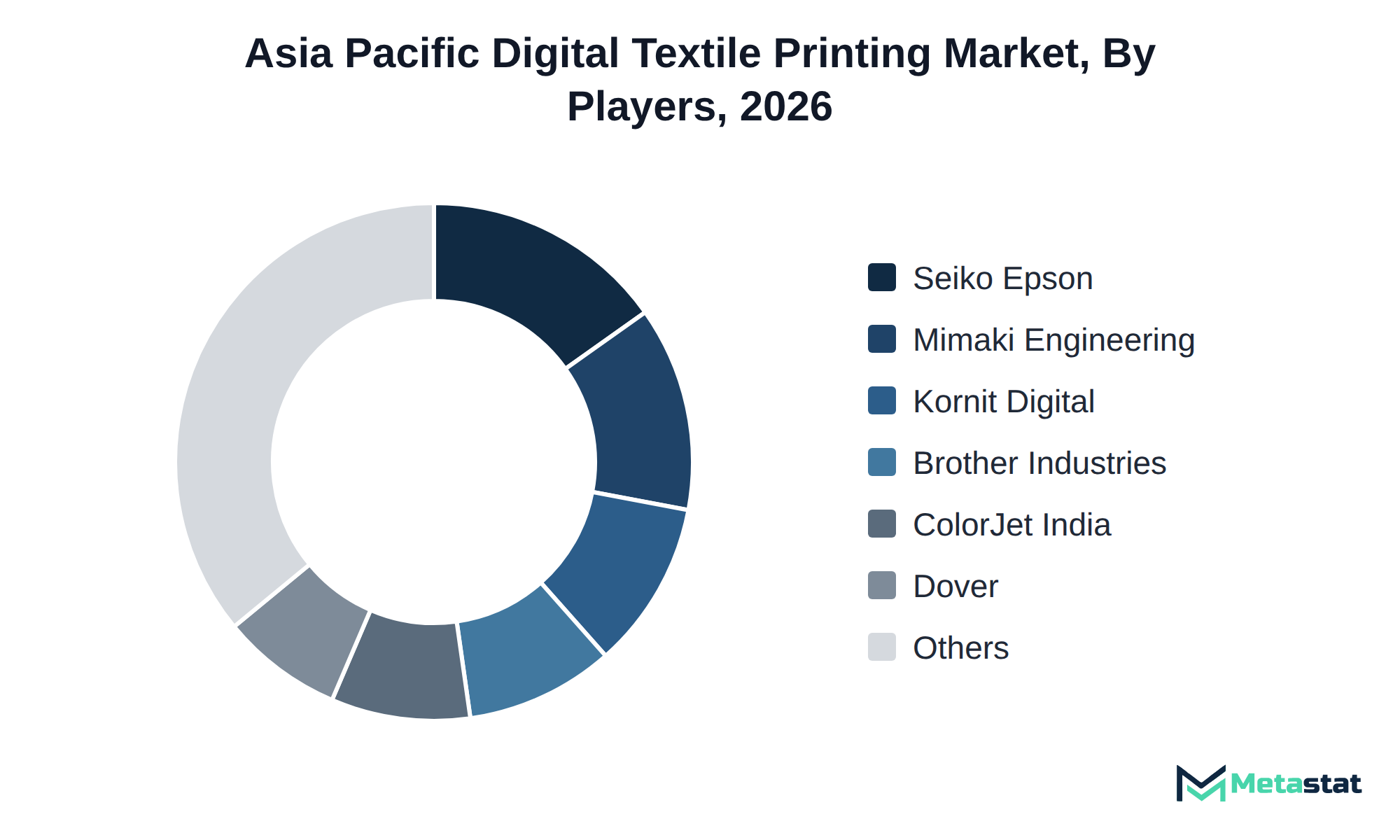
Companies in the Asia Pacific Digital Textile Printing market employ various strategies to differentiate their offerings. Firms emphasize product quality, price competitiveness, and innovation to attract buyers. Seiko Epson Corporation and Mimaki Engineering Co., Ltd. focus on advanced printing technologies, while Brother Industries, Ltd. prioritizes customization and customer service. Kornit Digital Ltd. and Durst Group AG leverage their expertise in sustainable solutions, appealing to environmentally conscious customers.
Buyers in the market choose based on several factors including pricing, product certification, and service offerings. Selection criteria often involve a company's ability to deliver customized solutions and provide ongoing technical support. ColorJet India Limited and HP Inc. cater to specific buyer segments by offering tailored solutions that enhance operational efficiency. The dynamics of competition create an environment where companies continuously innovate to meet the evolving needs of diverse customer bases.
To achieve this growth, the Asia Pacific Digital Textile Printing market relies on several key developments. Second, advancements in the dye-sublimation transfer printing segment, anticipated to reach USD 2,020.4 million by 2033, will enhance the market. Third, increasing demand for clothing and apparel, projected to rise from USD 1,783 million in 2026 to USD 4,894.2 million by 2033, will enhance market dynamics. However, challenges including rising raw material costs could hinder growth, impacting margins and slowing adoption rates within the industry. To maintain the projected growth trajectory, stakeholders navigate these challenges effectively while capitalizing on the opportunities present within the Asia Pacific Digital Textile Printing market.
By Printing Process: Direct-to-Fabric Printing, Dye-Sublimation Transfer Printing, Direct-to-Garment Printing, Direct-to-Film Transfer Printing, Others (Pigment Paper Transfer)
By Ink Type: Sublimation Inks, Reactive Inks, Pigment Inks, Acid Inks, Direct Disperse Inks, Others (Vat and Specialty Dye Inks)
By Application: Clothing and Apparel, Home Textiles, Soft Signage, Technical Textiles, Others (Textile Art and Craft Products)
By Region: China, Japan, India, South Korea, Australia, Southeast Asia, Rest of Asia Pacific
The report strategically identifies and profiles the key market players and analyses their core competencies in each sub-segment of the Digital Textile Printing market.
Report Attributes | Details |
Study Period | 2021-2033 |
Base Year | 2025 |
Estimated Year | 2026 |
Forecast Period | 2026-2033 |
Historical Period | 2021-2025 |
Growth Rate | CAGR 15.2% from 2026 to 2033 |
Revenue Unit | USD million |
Segmentation | By Printing Process, Ink Type, Application, Region, and Region |
Find answers to common questions about this report
The Digital Textile Printing market size was valued at USD 2,624.9 million in 2025.
The market is projected to grow at a CAGR of 15.2% during the forecast period from 2026 to 2033.
Direct-to-Fabric Printing leads the Digital Textile Printing market with a projected value of USD 3,782 million by 2033, based on its significant growth rate compared to other segments.
Growing consumer interest in personalized textiles drives spending in the market. Rapid advancements in printing technology enable manufacturers to achieve higher resolution and faster production speeds, enhancing quality and efficiency.
Increasing ink prices present a significant barrier for buyers, leading to slower adoption of advanced printing technologies. Supply chain disruptions contribute to rising input costs, affecting profit margins for suppliers.
Increasing consumer demand for personalized and custom-designed clothing drives investment in digital textile printing technologies. The ability to quickly produce unique designs aligns with evolving fashion trends and consumer preferences, favoring adoption in the clothing and apparel segment.
The Digital Textile Printing market is estimated to reach a valuation of USD 8,189.7 million by 2033.
Key players operating in the Digital Textile Printing market include Seiko Epson Corporation, Mimaki Engineering Co., Ltd., Kornit Digital Ltd., Brother Industries, Ltd., Konica Minolta, Inc., and HP Inc.
The clothing and apparel segment is projected to grow from USD 1,783 million in 2026 to USD 4,894.2 million by 2033, reflecting a compound annual growth rate of 15.5%.
Direct-to-Film Transfer Printing is anticipated to grow at a compound annual growth rate of 23.2%, indicating strong demand for this printing process.
The analysts below cover Chemicals and Materials research at Metastat Insights.
LEAD ANALYST
Utkarsh Khirodkar is a Lead Market Research Analyst at MetaStat Insight, specializing in market intelligence, technology sector assessments, and competitive strategy.

INDUSTRY CONSULTANT - CHEMICALS & ADVANCED MATERIALS
Chemicals and Materials · Machinery & Equipment · Packaging
Amit Gadhekar Consultant for Chemicals and Materials at MetaStat Insight, directing sector-specific intelligence, research, and strategic consulting across global chemical and processing markets.
Tracking maintenance cycle demand for secondary flight display units and terrain collision avoidance systems across regional jet fleets involves complex aftermarket dynamics. MetaStat Insight provided practical analysis separating airline retrofit programs from OEM forward-fit production schedules in North America and Southeast Asia. The supplier matrix highlighted component obsolescence timelines without resorting to vague generalizations. The dataset served as a dependable reference during our annual program review meetings.
Evaluating secondary resin quality across post-consumer packaging streams requires reliable technical segmentation. MetaStat Insight delivered an objective assessment that distinguished between extrusion-grade flake pricing and optical sorting throughput limitations across Western Europe. The competitive positioning breakdown for licensed depolymerization technology providers answered several questions during our feedstock feasibility audit. Their team clarified regional trade restrictions on mixed plastic scrap quickly when our team submitted follow-up requests.
Evaluating sovereign cloud deployments for core banking platforms demands a clear view of data residency regulations and migration exit strategies. MetaStat Insight delivered an exhaustive review of regional latency tolerances, mainframe decommission milestones, and third-party vendor concentration risk. The regulatory compliance mapping across European and Asian financial jurisdictions gave our team a dependable baseline for multi-cloud infrastructure discussions.
Explore related market intelligence reports worth reading alongside this one.