
LEAD ANALYST
Utkarsh Khirodkar is a Lead Market Research Analyst at MetaStat Insight, specializing in market intelligence, technology sector assessments, and competitive strategy.
Global Banking Software Market Size, Share, By Type (Core Banking Systems, Digital Banking Platforms, Lending and Loan Origination Software, Payments and Transaction Banking Software, Treasury, Cash and Securities Management Software, Risk, Compliance and Financial Crime Software, Open Banking and API Management Platforms, CRM and Customer Engagement Software, Banking Analytics and Business Intelligence Software, Others), By Deployment Model (On-Premises, Cloud-Based, Hybrid), By Banking Institution Size (Large Banking Institutions, Mid-Sized Banking Institutions, Small Banking Institutions), Industry Analysis, Growth, Trends, and Forecast, 2026-2033
Report ID
MSI-5457
Published
October, 2026
Pages
251 Pages
Format
Historical
Base year
Forecast
Forecast period
Report Details
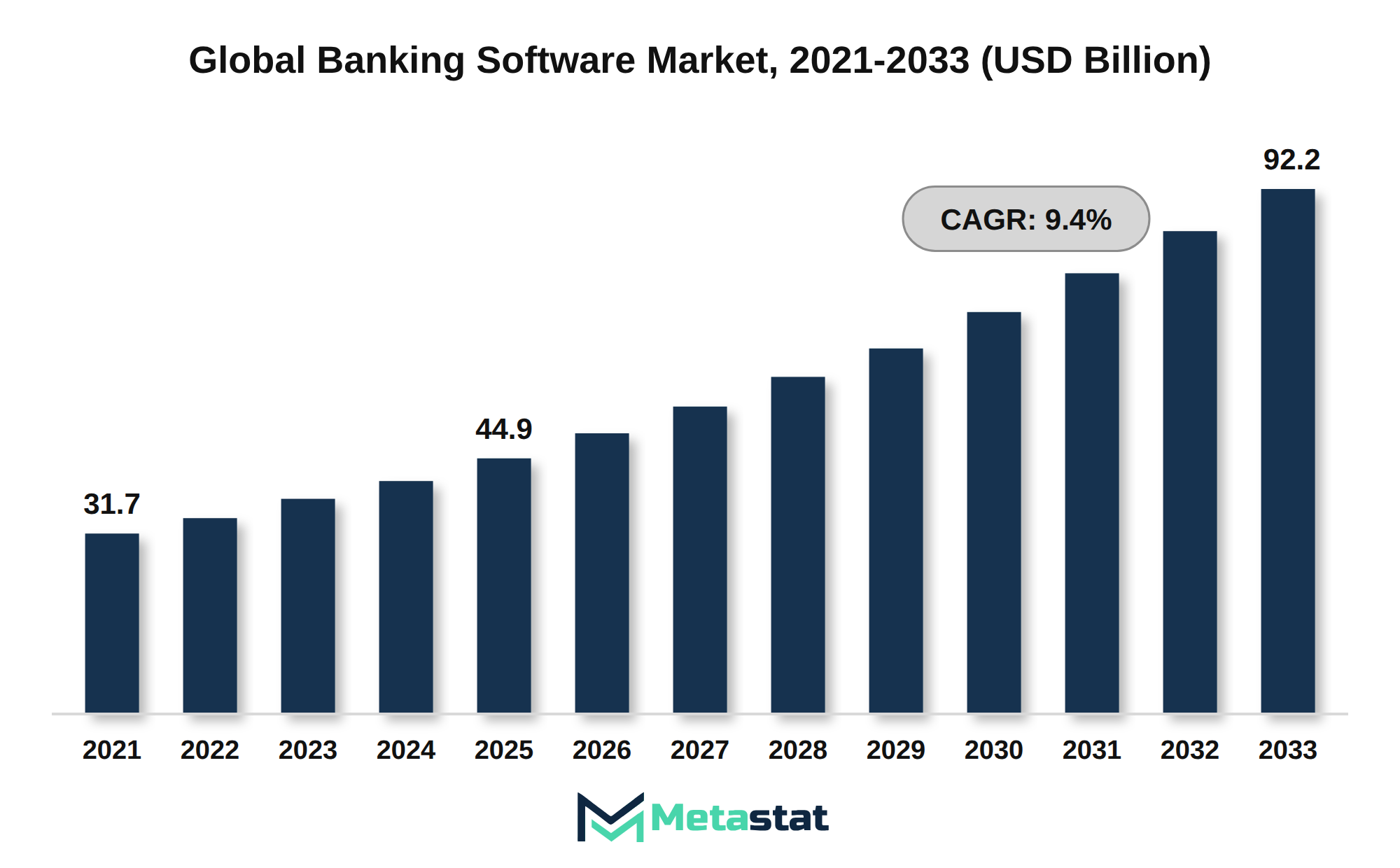
Market Valuation: Valued at $44.9 Billion in 2025, projected to reach $92.2 Billion by 2033 at a 9.4% CAGR.
Dominant Segment: Digital Banking Platforms lead the market, driven by the increasing consumer demand for enhanced digital experiences and user-friendly interfaces.
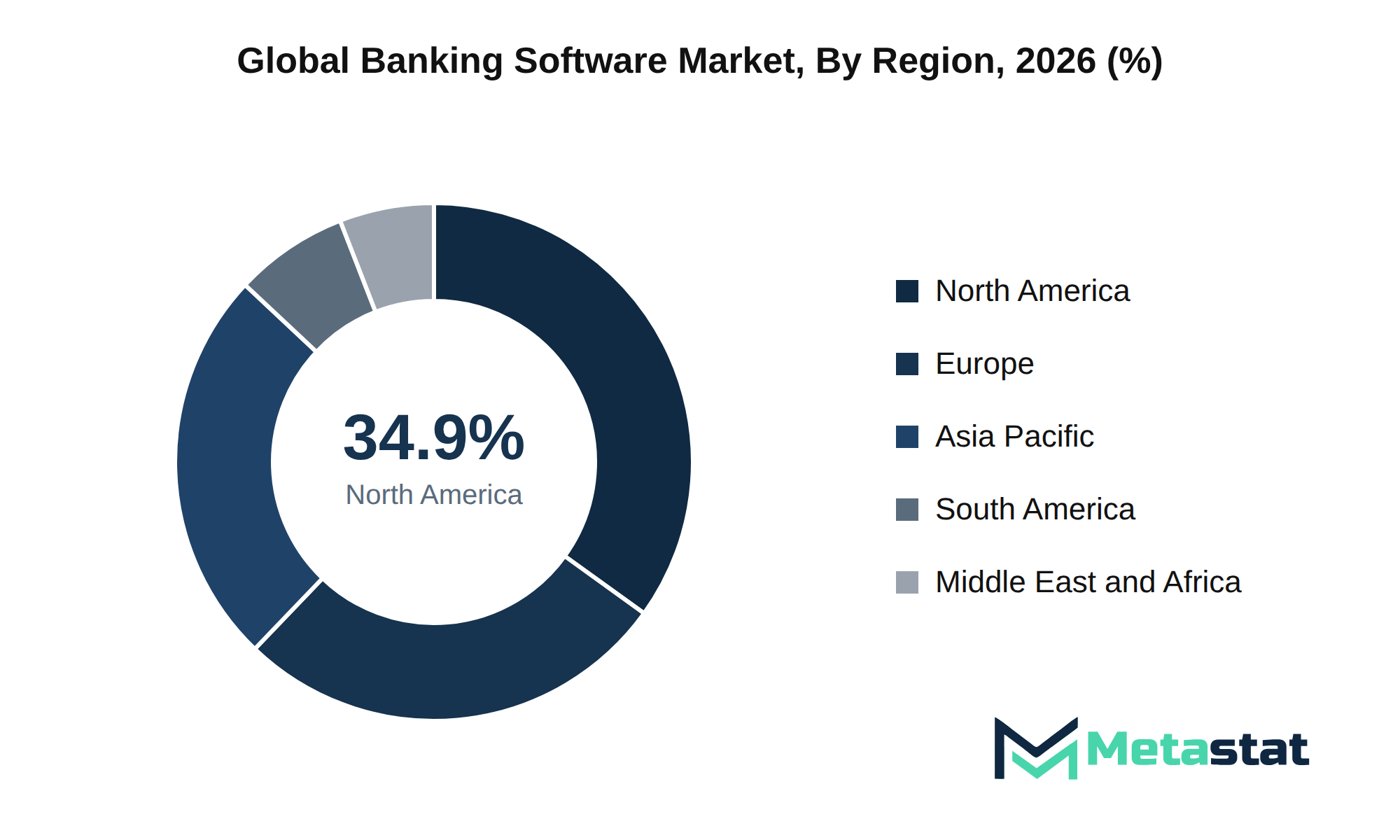
Geographic Lead: North America holds the largest market share at 34.9% in 2025, with the US expected to continue leading due to the high adoption of cloud-based solutions.
What's Inside: The report provides a comprehensive analysis of market segmentation by type, deployment model, and institution size, along with competitive coverage and growth forecasts.
Emerging Trends: The shift towards cloud-based solutions is accelerating, with a projected CAGR of 12.7%, reflecting the industry's move towards flexibility and scalability.
Investment Drivers: Rapid digital transformation and the need for regulatory compliance are key factors driving investment in advanced banking software solutions.
Choose Your License
Global Banking Software Market
The global Banking Software market was valued at USD 44.9 billion in 2025 and is projected to reach USD 92.2 billion by 2033, growing at a CAGR of 9.4% over the forecast period.
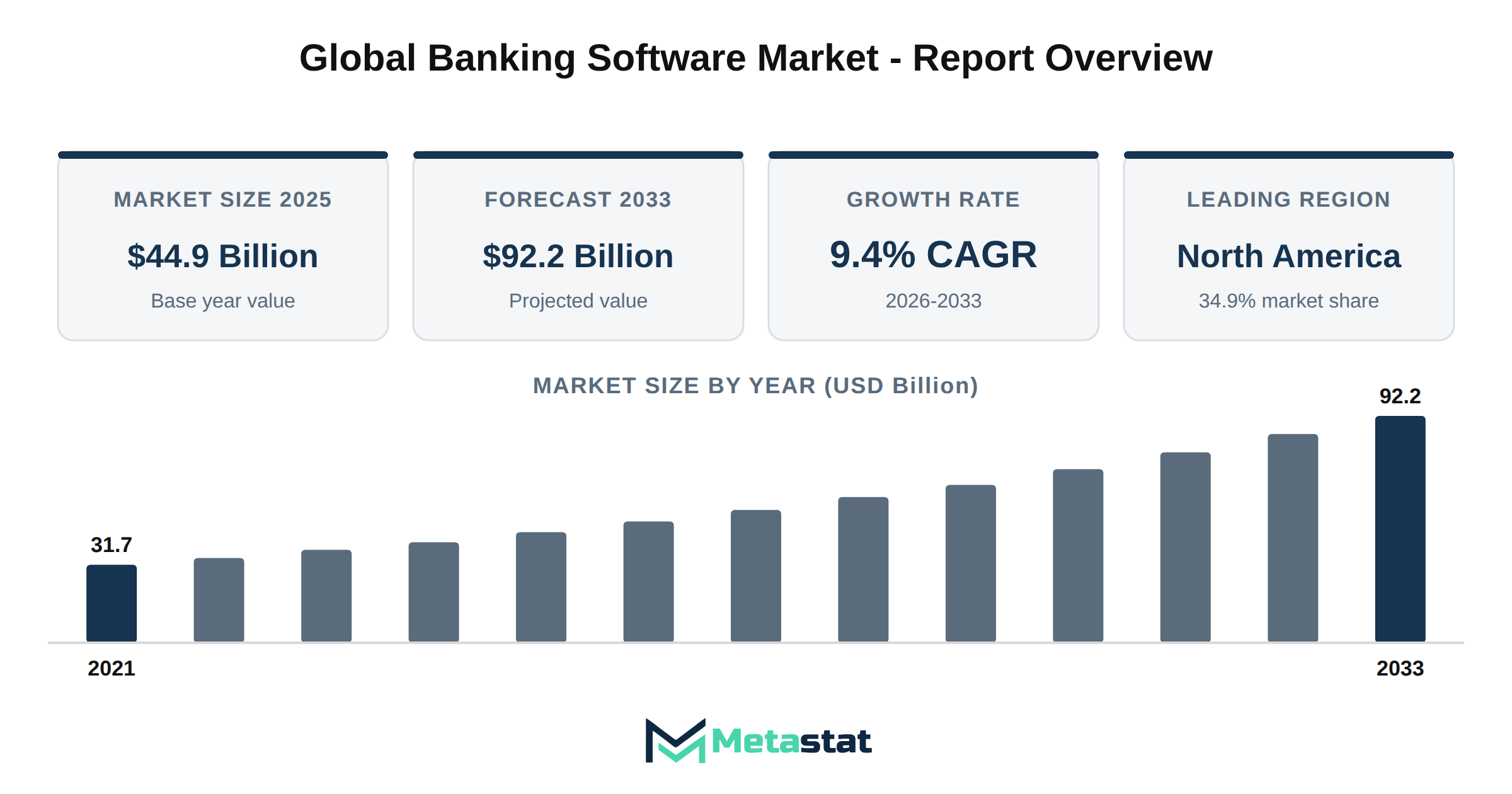
The market encompasses various software solutions designed to improve the operations of banking institutions, including core banking systems, digital banking platforms, and epayment system processing solutions. Buyers invest in these technologies to improve efficiency, ensure regulatory compliance, and enhance customer engagement. The growing demand for digital banking capabilities drives spending, with financial institutions striving to meet the evolving expectations of consumers in a competitive landscape. North America holds 34.9% of the market in 2025, with the US leading in 2026.
Growth in the market is propelled by the increasing adoption of cloud-based solutions and secure private cloud infrastructure, which offer flexibility and scalability. The digital banking platforms segment is anticipated to capture significant market value, reflecting a shift towards more customer-centric banking services. Regions vary in their market share, with North America at 34.9%, followed by Europe at 27.2% and Asia Pacific at 24.8%. This regional distribution highlights diverse demand for banking software across different geographies.
The integration of advanced technologies, including artificial intelligence and machine learning, drives innovation in the banking software market. Financial institutions prioritize the adoption of these technologies to enhance operational efficiency and improve decision-making processes. Many institutions implement automated contact center analytics to monitor client communications and evaluate customer support interactions. Such advancements not only streamline banking operations but improve the customer experience, contributing to sustained growth in the sector.
The market represents a comprehensive suite of software solutions aimed at optimizing the functionalities of banking institutions. These solutions include core banking systems, digital banking platforms, and various transaction processing applications. Organizations invest in these technologies to improve efficiency, enhance customer experiences, and comply with regulatory requirements. The demand for advanced banking solutions drives expenditure among large, mid-sized, and small banking institutions alike.
Growth in the market is propelled by the increasing adoption of digital banking platforms, which facilitate streamlined operations and offer enhanced customer engagement. Digital Banking Platforms is projected to be the segment with the most value, reflecting the shift towards online and mobile banking services. This regional dominance highlights the strong demand for innovative banking solutions in established markets.
The transition to cloud-based solutions and specialized cloud management platforms is a significant trend influencing market dynamics, as institutions seek more scalable and flexible options. Cloud-Based deployment models deliver advantages in cost, accessibility, and operational efficiency. The banking software market anticipates growth driven by these technological advancements, positioning the sector for continued expansion in the coming years.
Cloud-native core banking software represents a significant advancement in modernizing legacy systems within the Banking Software market. This technology facilitates enhanced operational efficiency, scalability, and adaptability to changing customer demands. By leveraging cloud-native solutions, financial institutions significantly reduce the time and resources required to update existing systems, allowing for a more agile response to market changes. Modern architectures frequently interface with secure cloud storage services to manage distributed customer files and digital account documentation.
From 2026 to 2033, the market for cloud-based deployments is projected to grow at a compound annual growth rate (CAGR) of 12.7%, demonstrating a strong shift towards this innovative deployment model. Legacy systems often entail high maintenance costs and limited flexibility, which challenge institutions seeking to remain competitive in an evolving landscape. The adoption of cloud-native core banking software enables these institutions to streamline processes, enhance user experiences, and introduce new products rapidly. Modern architectures also facilitate integration with specialized RegTech platforms to automate compliance reporting and risk supervision across financial operations.
Investing in cloud-native solutions results in immediate commercial advantages, including reduced operational costs and improved customer satisfaction. Financial institutions continue to evolve, and cloud-native core banking software represents a strategic investment in the Banking Software market, positioning organizations for long-term success.
Open banking APIs significantly influence purchasing decisions within the Banking Software market. These APIs enable financial institutions to enhance their digital product offerings by integrating third-party services, driving competition and innovation. The rise of these APIs leads to a shift in pricing strategies, with many providers adopting subscription-based models to accommodate the increased demand for flexible solutions. A notable growth in digital banking platforms is projected, with revenues expected to reach USD 18 billion by 2033, reflecting a compound annual growth rate of 11.2%.
This transition towards subscription-based pricing models offers institutions a more predictable cost structure, allowing for better budget management and cash flow forecasting. Buyers express a preference for solutions that are easily scalable, aligning with the operational needs of digital banking environments. With the focus on customer engagement and personalized services, financial institutions invest more in technologies that support open banking initiatives, ultimately enhancing their competitive positioning in the market. This evolution in purchasing strategies directly impacts supplier offerings and shapes the future of digital banking solutions.
AI-driven risk management and compliance solutions have gained traction among large banking institutions. These institutions prioritize security and regulatory adherence, leading to increased investment in automation technologies. The transition towards AI-enhanced systems enables banks to streamline operations and enhance decision-making processes. In the Banking Software market, the adoption of AI in risk and compliance management significantly reduces operational costs and improves efficiency.
By 2033, the investment in core banking systems is projected to reach USD 17.5 billion, with a compound annual growth rate of 7%. This growth results from banks seeking innovative ways to manage risks and comply with evolving regulatory frameworks. Large banking institutions focus on deploying these technologies to streamline their compliance operations and mitigate risks associated with lending practices.
The emphasis on AI-driven compliance and lending automation enhances overall operational effectiveness, enabling banks to navigate complex regulatory environments efficiently. This shift positions banks for sustained competitive advantage within the market, driving further investment and technological advancement.
Financial institutions increasingly transition from on-premises systems to cloud banking platforms, driven by the need for flexibility and scalability. Cloud-based solutions offer significant advantages, including enhanced speed of deployment and the capability to adapt quickly to market changes. The value of cloud-based banking solutions is expected to reach USD 41.3 billion by 2033, reflecting a compound annual growth rate (CAGR) of 12.7%. This shift allows banks to streamline operations and reduce overhead costs associated with maintaining physical infrastructure.
The shift to cloud banking platforms facilitates improved security and compliance features, which are critical in the regulatory landscape. Financial institutions benefit from the ability to implement updates and enhancements more efficiently compared to traditional on-premises systems. In this competitive environment, being agile and responsive to customer demands is essential. The migration toward cloud solutions positions banks to better meet evolving consumer expectations and strengthens their market position in the Banking Software market.
Rapid digital transformation across financial institutions influences spending in the Banking Software market. The shift towards enhanced customer experiences and operational efficiencies drives demand for advanced software solutions. Financial institutions increasingly prioritize digital banking platforms that support mobile and online transactions. This trend has escalated due to changing consumer preferences for on-demand services, which require robust digital infrastructure. In addition, the need for effective data management and analytics solutions drives the adoption of banking software. Institutions seek to streamline operations and reduce costs, making investment in innovative technologies essential for maintaining competitive advantages. The focus on customer engagement and operational agility significantly impacts software purchasing decisions, reinforcing the market's growth trajectory.
Investment in cloud-based solutions within the Banking Software market accelerates this digital transformation. Financial institutions recognize the scalability and flexibility offered by cloud technologies, enabling them to respond swiftly to market changes. The growing reliance on data-driven insights further emphasizes the necessity for advanced analytics and business intelligence tools in banking software. Overall, the push for modernization and enhanced service delivery creates significant growth opportunities within the market.
Increasing costs associated with implementing advanced banking software solutions create a barrier for mid-sized banking institutions. These organizations often face budget constraints, leading to slower adoption rates compared to larger counterparts. The financial burden of software licensing, integration, and maintenance poses challenges that result in smaller orders or delays in software upgrades. The absence of sufficient infrastructure to support new technologies compounds the issue, causing further hesitation among buyers. This restraint ultimately affects the market, with slower uptake of innovative solutions limiting operational efficiency and reducing competitive positioning. Financial institutions that struggle with these costs fall behind in the digital transformation journey, impacting long-term growth prospects in the banking software market.
Competition for skilled personnel presents a significant challenge for suppliers in the Banking Software market. The demand for technical expertise has intensified, leading to increased talent costs that impact profit margins. Suppliers rely on a highly specialized workforce to develop and implement innovative software solutions, resulting in rising labor expenses. This situation forces companies to invest heavily in recruitment, retention, and training initiatives to maintain a competitive edge.
In response, several suppliers adopt strategic partnerships with educational institutions to create talent pipelines. Collaborating with universities and training programs facilitates skill development tailored to industry needs. Several companies leverage remote work capabilities to tap into a broader talent pool, reducing geographic limitations. These strategies aim to mitigate costs while ensuring access to essential skills that drive innovation and client satisfaction.
Despite these efforts, the ongoing talent crunch continues to exert pressure on profitability. Suppliers face the challenge of balancing rising talent costs while delivering high-quality banking software solutions, ultimately shaping the competitive dynamics of the market.
The rising demand for cloud-based banking solutions presents a significant growth opportunity within the market. This trend is driven by the increasing preference of financial institutions to adopt agile and scalable systems that enhance operational efficiency. This acceleration results from the growing necessity for banks to quickly respond to changing consumer demands and regulatory requirements without the heavy investment associated with on-premises systems. Mid-sized banking institutions, in particular, are likely to adopt cloud solutions to compete effectively against larger players. By facilitating rapid deployment and integration of new features, cloud-based systems support improved customer experiences and enhance service delivery across the market. Enhanced accessibility and lower upfront costs position cloud-based solutions as a crucial driver within the evolving financial landscape.
The Global Banking Software market is segmented based on Type, Deployment Model, and Banking Institution Size.
This segment includes software solutions that facilitate essential banking operations, including account management, transaction processing, and customer service. Large and mid-sized banking institutions primarily use these systems to streamline operations and enhance customer engagement. Increasing competition in the financial services industry drives demand for innovative solutions that improve efficiency and reduce operational costs. The growth rate of this segment is slower than that of Digital Banking Platforms, projected at a CAGR of 11.2%. Core Banking Systems provide foundational support for banks, while newer segments focus on enhancing digital banking experiences, highlighting the distinct evolution in technology adoption across the market.
This segment encompasses software solutions that enable banks to provide digital services to consumers, enhancing customer engagement through user-friendly interfaces and improved transaction capabilities. Institutions including retail banks and credit unions apply these platforms to enhance service delivery and compete effectively in the evolving financial landscape. Growth in this segment is primarily driven by increasing consumer demand for digital experiences, resulting in higher service adoption rates. Compared to Core Banking Systems, which display a lower CAGR of 7%, Digital Banking Platforms exhibit faster growth due to the ongoing preference for digital services among consumers. The distinct focus on enhancing user experience differentiates this segment from others, leading to a more competitive environment in the Banking Software market.
Lending and Loan Origination Software segment is expected to reach USD 10.2 billion by 2033. This software is crucial for financial institutions to streamline the loan application process, manage credit assessments, and enhance customer service. Large banking institutions and mid-sized banks increasingly adopt these solutions to improve efficiency and reduce processing time. The segment experiences significant growth driven by increasing demand for digital transformation and automation within banking processes. Compared to other segments, including Core Banking Systems, which has a CAGR of 7%, Lending and Loan Origination Software is projected to grow at a faster rate of 11.2%. The competitive nature of the market fuels innovation and drives pricing strategies, resulting in a diverse range of offerings to meet the specific needs of various banking institutions.
Payments and Transaction Banking Software segment is projected to grow at a CAGR of 9.7% during the forecast period. This software facilitates various payment processing and transaction management functions for financial institutions, enabling efficient handling of customer transactions, payment settlements, and compliance reporting. Large banking institutions typically adopt these solutions due to their complex transaction environments and regulatory requirements. Increased demand for faster, secure, and cost-effective payment solutions drives growth in this segment. The rapid adoption of digital payment methods and the increasing prevalence of contactless transactions contribute to this momentum. Compared to other segments, Payments and Transaction Banking Software experiences significant growth, reflecting the shift in consumer preferences toward digital solutions and the ongoing digital transformation across the banking sector. This segment's projected value reinforces its vital role in the market.
Treasury, Cash and Securities Management Software focuses on the management of banking institutions' financial assets and liabilities, including cash flow, liquidity, and securities. This segment serves large banking institutions that require robust solutions for financial operations and risk management. Increasing regulatory compliance requirements drive demand for advanced software that provides real-time analytics and reporting capabilities. Unlike other segments, this software typically involves higher costs due to its complexity and the necessity for integration with existing systems. This segment experiences steady demand due to the essential nature of effective treasury management in maintaining financial stability and optimizing investment strategies. Consequently, continuous advancements in technology and regulatory frameworks will influence the uptake of these solutions, further establishing their importance in the market.
Risk, Compliance, and Financial Crime Software focuses on managing regulatory requirements, detecting fraudulent activities, and ensuring compliance with financial regulations. Financial institutions, including large banks and credit unions, adopt these solutions to mitigate risks associated with financial crimes and regulatory non-compliance. The growing emphasis on regulatory compliance, driven by stringent regulations, significantly influences demand for this software. This category experiences steady growth due to the constant evolution of regulatory environments and the increasing sophistication of financial crime. Financial institutions prioritize these solutions to safeguard their operations and maintain regulatory standards, ensuring a robust framework to combat potential threats. The market responds dynamically to these challenges, reflecting the critical need for effective risk management and compliance strategies.
Open Banking and API Management Platforms facilitate integration and interoperability among various banking services, allowing financial institutions to offer enhanced digital experiences to their customers. These platforms serve essential tools for banks seeking to innovate their offerings and improve customer engagement. Increasing demand for personalized banking experiences drives significant interest in this segment, particularly among mid-sized and large banking institutions that invest in technology to remain competitive. Regulatory changes, including open banking initiatives, further stimulate growth in this area, compelling banks to adopt technologies that promote transparency and encourage collaboration with third-party providers. Differentiating this segment from others, the focus on API management and open banking frameworks highlights its role in enabling rapid service deployment and enhancing customer satisfaction, which sets it apart from traditional software solutions that do not emphasize integration capabilities.
CRM and Customer Engagement Software plays a critical role in improving customer relationships and enhancing user experiences within banking institutions. This software is used by banks to manage customer interactions, streamline communication, and improve service delivery. The increasing demand for personalized customer experiences drives adoption, particularly among large banking institutions striving to differentiate their offerings. Integration with digital banking platforms and data analytics enhances user engagement and retention. This segment experiences significant growth due to technological advancements in data analytics and customer relationship management tools. Compared to other segments, CRM software generally attracts a broader range of buyers, including smaller institutions seeking to enhance customer relationships without the extensive financial commitment associated with core banking systems. The need for effective customer engagement strategies intensifies competition, prompting institutions to invest in sophisticated CRM solutions to meet evolving customer expectations. The market continues to show innovation in this area, reflecting the importance of customer-centric approaches within the banking software sector.
Banking Analytics and Business Intelligence Software encompasses tools and solutions that allow financial institutions to analyze data, extract insights, and make informed decisions. This segment supports various analytical processes, including risk assessment, customer behavior analysis, and profitability tracking, primarily used by large banking institutions and mid-sized banks aiming to enhance operational effectiveness. The growing emphasis on data-driven decision-making significantly increases demand within this segment. Adoption of advanced analytics tools allows institutions to gain a competitive edge through better customer insights and operational efficiencies. Compared to other software segments, this category experiences higher demand due to the critical need for improved data analysis capabilities. The market's continuous shift towards digital transformation creates an environment where analytics tools are indispensable for modern banking institutions. Increasing complexity in financial operations further drives the necessity for comprehensive analytics solutions.
Others (Factoring, Collateral Management, Workflow and Document Management Software) encompass various solutions that assist banking institutions in optimizing and managing their operational processes. These tools cater to a wide range of users, including financial service providers that require efficient management of documents and workflows. A significant force driving adoption stems from the increasing need for digital transformation initiatives aimed at enhancing operational efficiency. This segment differentiates itself from others in its group through the specific focus on workflow automation and document management solutions, which attract different buyer profiles compared to core banking systems or digital banking platforms. Factors influencing this segment include the growing emphasis on regulatory compliance, which necessitates efficient document handling, and the need for streamlined business processes to reduce operational costs, thereby enhancing overall productivity. The ongoing digital shift in the banking sector highlights the importance of these solutions in a competitive environment.
On-Premises segment is valued at USD 22.3 billion in 2026 and is projected to reach USD 32.9 billion by 2033, at a CAGR of 5.7% during the forecast period. This segment serves large and mid-sized banking institutions that prefer retaining control over their data and infrastructure. The demand for on-premises solutions is driven by the need for enhanced security and compliance with regulatory standards. Compared to other deployment models, this segment experiences slower growth due to the increasing preference for cloud-based solutions, which are projected to reach USD 41.3 billion by 2033 at a CAGR of 12.7%. Financial institutions favor on-premises systems due to existing investments and the capability to customize solutions according to specific operational requirements. The market continues to evolve, reflecting shifts in technology adoption and enterprise needs.
This deployment model serves financial institutions by providing scalable and flexible solutions that enhance operational efficiency. The growing adoption of cloud technology among banks, driven by the need for digital transformation, significantly influences this segment. Cloud-based solutions offer advantages including reduced infrastructure costs and improved accessibility, appealing to a diverse range of banking institutions, including large and mid-sized organizations. In comparison to the On-Premises deployment model, which has a lower expected CAGR of 5.7%, the Cloud-Based segment experiences faster growth. Financial institutions increasingly prioritize agility and innovation, leading to rising investment in cloud solutions, reinforcing long-term demand.
Hybrid deployment models, projected to reach USD 17.9 billion by 2033, combine the advantages of both on-premises and cloud-based solutions. This segment is widely adopted by mid-sized and large banking institutions, allowing flexibility in managing operations while enhancing digital capabilities. The shift towards hybrid models is driven by increasing demand for scalable and cost-effective solutions that allow institutions to balance their existing infrastructure with modern cloud technologies. Unlike the cloud-based segment, which is expected to grow at a CAGR of 12.7%, the hybrid segment's growth rate reflects a CAGR of 17.9%, indicating varied but significant market interest. Institutions leverage hybrid systems to optimize investments and address specific operational needs while maintaining compliance and security standards. The ability to integrate various platforms seamlessly provides a competitive edge for institutions seeking to enhance customer engagement and operational efficiency. These dynamics contribute to the evolving landscape of the Banking Software market.
Large Banking Institutions segment is valued at USD 26.3 billion in 2026 and is projected to reach USD 45.7 billion by 2033, at a CAGR of 8.2% during the forecast period. These institutions employ advanced banking software to enhance operational efficiency, streamline processes, and improve customer engagement. A significant driver for this segment includes increasing investment in digital transformation initiatives, which aim to modernize legacy systems and deliver superior customer experiences. Compared to smaller banking institutions, this segment exhibits faster growth due to larger budgets and a greater capacity for technology adoption. The growth rate of 8.2% is higher than that of mid-sized banking institutions, reflecting strong demand for comprehensive solutions tailored to complex banking operations. Enhanced focus on regulatory compliance and risk management further drives investment in banking software tailored for large institutions, contributing to strong growth dynamics within the market.
Mid-Sized Banking Institutions segment is estimated to reach USD 30.1 billion by 2033, at a CAGR of 10.5% during the forecast period. This segment primarily serves banking entities that require sophisticated software solutions for managing customer accounts, loan processing, and transaction management. A significant demand driver for this segment is the increasing adoption of digital transformation initiatives among mid-sized banks, which strive to enhance customer engagement and operational efficiency. In comparison to large banking institutions, mid-sized banks face budgetary constraints, leading them to seek cost-effective yet comprehensive banking software solutions. This segment features a strong growth trajectory, outperforming the Core Banking Systems segment's CAGR of 7%. The growth in the Mid-Sized Banking Institutions segment highlights the shifting focus in the market toward tailored software that addresses the unique challenges faced by these institutions.
Small Banking Institutions segment is expected to reach USD 16.3 billion by 2033. This segment serves smaller financial entities that require tailored solutions to manage their operations efficiently. Demand for banking software in this category is driven by the necessity for cost-effective solutions and regulatory compliance across various jurisdictions. While large banking institutions pursue expansive and integrated platforms, small banking institutions focus on straightforward, user-friendly systems that cater to their unique needs. Adoption of cloud-based solutions offers an attractive alternative, enabling these institutions to reduce upfront investments while maintaining flexibility. The Banking Software market continues to see dynamic shifts driven by evolving customer preferences and technological advancements.
Based on geography, the Global Banking Software market is divided into North America, Europe, Asia-Pacific, South America, Middle East, and Africa.
Driving factors in North America include the strong adoption of digital solutions across banking sectors, especially among large banking institutions. The United States, Canada, and Mexico exhibit significant investments in innovative banking software that enhances customer engagement and operational efficiency. North America is projected to reach USD 30.2 billion by the end of 2033. A notable trend involves the growing preference for cloud-based solutions, which enable flexibility and scalability, aligning with evolving consumer demands. The market faces pressures related to regulatory compliance, compelling institutions to adopt advanced software for managing compliance efficiently. These dynamics position the region as a key market for banking software, with ongoing growth expected throughout the forecast period.
In Europe, the demand for the Banking Software market thrives due to increasing emphasis on digital transformation among financial institutions. Countries including Germany, France, and the UK drive substantial investments in modern banking technologies to enhance operational efficiency and customer engagement. Regulatory pressures aimed at enhancing data security and compliance drive institutions to adopt advanced solutions. The focus on digital banking platforms stems from evolving consumer preferences toward online and mobile banking services. The ongoing shift toward cloud-based deployment models in the region supports faster implementation of banking solutions, aligning with the strategic goals of both large and mid-sized banking institutions.
Demand in the Asia-Pacific region for the Banking Software market reflects a growing trend among financial institutions prioritizing digital transformation. Countries like China and India exhibit a surge in adoption driven by increasing smartphone penetration and the growing popularity of online banking services. This region represents 24.80% of the global market share in 2025. Investments in technology infrastructure, particularly in South Korea and Japan, play a significant role in enhancing service delivery and operational efficiency. Australia contributes to this growth with its focus on innovative solutions that streamline transaction processes. Enhanced regulations promoting digital payment systems further support the shift toward digital banking platforms, influencing the market's trajectory across the Asia-Pacific countries.
In South America, demand for the Banking Software market sees strong influences from increasing digitalization efforts among financial institutions, particularly in Brazil and Argentina. Financial services are adopting advanced technologies to enhance operational efficiency and customer experience. This regional focus on modernization reflects a broader trend towards digital banking solutions, responding to changing consumer expectations and the competitive landscape. The market share for South America is projected at 7.1% in 2025, indicating a growing recognition of the importance of banking software solutions. Financial institutions in this region are investing in cloud-based platforms and mobile banking applications to cater to the evolving demands of their clientele. Such investments contribute to an evolving financial ecosystem that prioritizes user engagement and operational agility. The Banking Software market in South America is projected to grow, driven by the necessity for innovative solutions that align with global banking trends.
The market in the Middle East and Africa displays unique characteristics driven by increasing digitalization within the banking sector. Saudi Arabia and the UAE focus on implementing advanced financial technologies to enhance customer experience and improve operational efficiency. South Africa's banking institutions adopt innovative solutions to meet regulatory requirements and combat financial crime. The emphasis on compliance and modernization supports demand within the Banking Software market, which holds a share of 5.9% in 2025. Infrastructure investments and government initiatives boost the adoption of cloud-based and digital banking platforms, facilitating growth. The market is expected to experience a gradual increase in adoption rates throughout the forecast period, reflecting the region's evolving financial landscape.
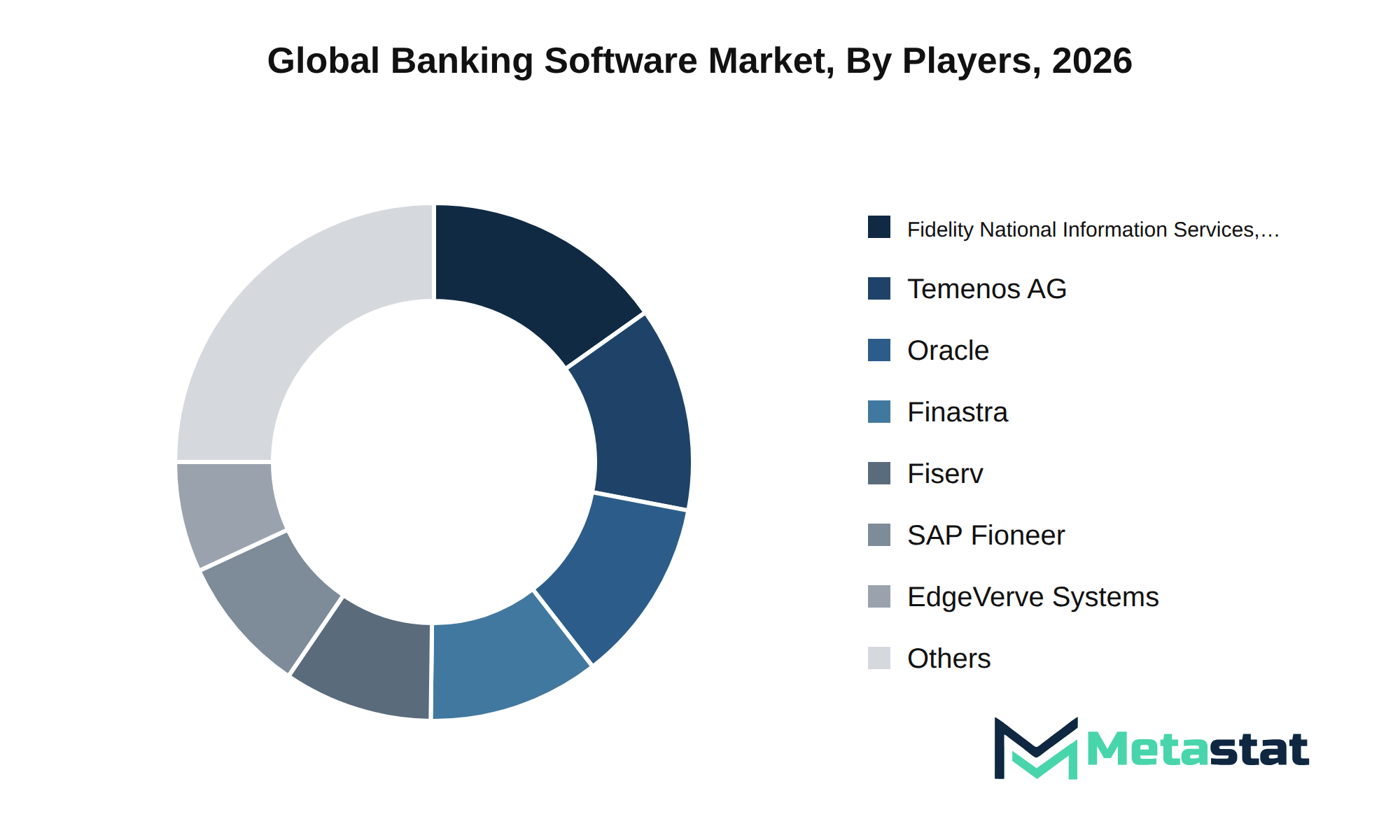
Competition within the Banking Software market features diverse strategies, focusing on varying service types, deployment models, and customer engagement approaches. Companies segment themselves based on offerings including core banking systems, digital banking platforms, and lending software, catering to distinct buyer requirements.
Buyers prioritize factors including price, service quality, and customization options when selecting software solutions. For instance, Temenos AG emphasizes flexibility and extensive customization in its core banking solutions, enabling institutions to tailor the software to their specific needs. Oracle Corporation, specializing in cloud-based solutions, focuses on scalability and integration with existing systems, appealing to large banking institutions seeking advanced technological frameworks. Finastra targets digital banking platforms, offering innovative customer engagement tools that enhance user experience.
Fidelity National Information Services, Inc. (FIS) integrates a robust ecosystem that supports varied banking services, effectively positioning itself against competitors. Tata Consultancy Services Limited focuses on consulting and technology services, helping banks transform their operations with tailored software solutions. EdgeVerve Systems Limited provides comprehensive software for payment processing, catering to the increasing demand for transaction efficiency within the market.
To achieve this growth, several key developments require attention. First, the transition toward cloud-based solutions is expected to drive significant adoption within the Digital Banking Platforms segment, which anticipates a CAGR of 11.2%, enabling greater scalability and flexibility for users. Second, the expansion of large banking institutions, projected to reach USD 45.7 billion by 2033, highlights the need for robust Core Banking Systems to support their growing operations. Conversely, a potential risk to reaching USD 92.2 billion includes regulatory challenges that could impose limitations on technology integration, particularly in regions including Europe, where compliance demands remain stringent. The connection of these factors will significantly influence growth trajectories across the market.
By Type: Core Banking Systems, Digital Banking Platforms, Lending and Loan Origination Software, Payments and Transaction Banking Software, Treasury, Cash and Securities Management Software, Risk, Compliance and Financial Crime Software, Open Banking and API Management Platforms, CRM and Customer Engagement Software, Banking Analytics and Business Intelligence Software, Others (Factoring, Collateral Management, Workflow and Document Management Software)
By Deployment Model: On-Premises, Cloud-Based, Hybrid
By Banking Institution Size: Large Banking Institutions, Mid-Sized Banking Institutions, Small Banking Institutions
The report strategically identifies and profiles the key market players and analyses their core competencies in each sub-segment of the Banking Software market.
|
Report Attributes |
Details |
|
Study Period |
2021-2033 |
|
Base Year |
2025 |
|
Estimated Year |
2026 |
|
Forecast Period |
2026-2033 |
|
Historical Period |
2021-2025 |
|
Growth Rate |
CAGR 9.4% from 2026 to 2033 |
|
Revenue Unit |
USD billion |
|
Segmentation |
By Type, Deployment Model, Banking Institution Size, and Region |
|
By Region |
North America (By Type, Deployment Model, Banking Institution Size, and Country)
|
|
Europe (By Type, Deployment Model, Banking Institution Size, and Country)
|
|
|
Asia Pacific (By Type, Deployment Model, Banking Institution Size, and Country)
|
|
|
South America (By Type, Deployment Model, Banking Institution Size, and Country)
|
|
|
Middle East and Africa (By Type, Deployment Model, Banking Institution Size, and Country)
|
Find answers to common questions about this report
The Banking Software market size was valued at USD 44.9 billion in 2025.
The market is projected to grow at a CAGR of 9.4% during the forecast period from 2026 to 2033.
The North America Banking Software market size is estimated to reach USD 30.2 billion by 2033.
Digital Banking Platforms lead the segment with a projected value of USD 18 billion by 2033. This segment outpaces others in growth potential, reflecting a significant shift in consumer preferences towards digital solutions.
Rapid digital transformation across financial institutions influences spending in the market. The rising demand for cloud-based banking solutions presents significant growth opportunities, driven by the need for agile and scalable systems that enhance operational efficiency.
North America holds the dominant share of the Banking Software market, with a value of USD 30.2 billion projected for 2033. This region accounts for 34.9 percent of the total market share.
Increasing costs associated with implementing advanced banking software solutions create a barrier for mid-sized banking institutions. Budget constraints lead to slower adoption rates compared to larger counterparts, affecting operational efficiency and competitive positioning.
The rising demand for cloud-based banking solutions is favoring adoption in the industry. Financial institutions increasingly prefer agile and scalable systems that enhance operational efficiency, allowing them to respond swiftly to changing consumer demands and regulatory requirements.
The Banking Software market is estimated to reach a valuation of USD 92.2 billion by 2033.
Key players operating in the Banking Software market include Temenos AG, Oracle Corporation, Fiserv, Inc., Fidelity National Information Services, Inc. (FIS), Finastra, Tata Consultancy Services Limited, SAP Fioneer, and Jack Henry & Associates, Inc.
The analysts below cover Banking & Finance research at Metastat Insights.
LEAD ANALYST
Utkarsh Khirodkar is a Lead Market Research Analyst at MetaStat Insight, specializing in market intelligence, technology sector assessments, and competitive strategy.

PRINCIPAL CONSULTANT - ENTERPRISE AI & EMERGING TECHNOLOGIES
Banking & Finance · Electronics and Semiconductor · Energy and Power · Healthcare IT · Information & Technology · Professional Services
Vijay Gunti is a Principal Consultant at MetaStat Insight, bringing over two decades of experience across enterprise digital transformation, technology strategy, and intelligent systems.
The technical breakdown of ISO 20022 migration readiness across correspondent banking corridors was remarkably thorough. Rather than treating cross-border corporate payments as a single block, the report drew a useful distinction between multilateral netting platforms and domestic instant payment rails across ASEAN economies. MetaStat Insight highlighted regulatory constraints on foreign exchange liquidity management that many publications gloss over. The research material offered practical clarity for our platform development roadmap.
Our group needed clearer visibility into out-of-autoclave processing timelines for high-temperature thermoplastic composites. MetaStat Insight delivered an objective assessment that contrasted automated fiber placement scrap rates with traditional thermoset prepreg layup cycles. The supplier landscape mapped out primary resin suppliers and tape slitting capacity across France, Germany, and Japan with solid technical accuracy. Their analyst handled our questions on precursor supply risks during an unscheduled inquiry call, providing clear, unembellished context.
Evaluating sensor fusion reliability across harsh operating environments can be tricky without field-validated data. The study on agricultural autonomous guidance systems clearly separated stereo vision setups from automotive-grade solid-state LiDAR. We appreciated the regional infrastructure analysis, specifically around RTK network density across North America and South America. During our follow-up consultation, the MetaStat Insight team walked through tier-two perception software partnerships, giving our engineering leads a practical basis for vendor shortlisting.
Explore related market intelligence reports worth reading alongside this one.