
LEAD ANALYST
Utkarsh Khirodkar is a Lead Market Research Analyst at MetaStat Insight, specializing in market intelligence, technology sector assessments, and competitive strategy.

Cell Therapy Biomanufacturing Market By Product Type (Consumables, Equipment, Systems & Software), By End User (Biopharmaceutical Biotechnology Companies, Research Institutes, Cell Banks, and Others), By Industry Analysis, Size, Share, Growth, Trends, and Forecasts 2025-2032
Report ID
MSI-4391
Published
November, 2025
Pages
256 Pages
Format
Report Details
Choose Your License
Cell Therapy Biomanufacturing Market
The global cell therapy biomanufacturing market will be a watershed platform in the biotechnology and healthcare sector, driving the way therapies are developed and delivered in the future. With medical science relentlessly breaking boundaries, the process of manufacturing cell-based therapies will become increasingly critical with a focus not only on innovation but on precision and safety as well. The market will go beyond its present horizon, with an accent on streamlined production processes, automation, and sophisticated quality control systems for ensuring scalability at the cost of no sacrifices in efficacy. This transformation will show a shift from conventional lab practices to highly controlled biomanufacturing environments capable of managing sophisticated therapies at a global level.
Is it possible for the global cell therapy biomanufacturing market to successfully navigate the barriers of large-scale production, still retaining the effective and safe therapeutic qualities? Are the novel technologies and robots to be the ones who will take over the future of personalized medicine in this field? The question to be asked now is how the producers will harmonize cost-efficiency with the increasingly complicated regulatory norms across the globe as demand grows?
The future of the market will not be limited to treating particular diseases. Rather, it will move into territories previously considered beyond reach, coupling sophisticated genetic tools and digital tracking systems to improve speed as well as precision in manufacturing. Cell therapies are becoming more versatile, for example, through immune-cell engineering and regenerative therapies; thus, producers are already working toward new benchmarks and regulatory pathways that allow for worldwide access. Collaboration between academia, pharmaceutical companies, and tech innovators will be the main driver in determining the following phase of this market's growth.
The global cell therapy biomanufacturing market is mainly classified based on Product Type, End User.
|
Forecast Period |
2025-2032 |
|
Market Size in 2025 |
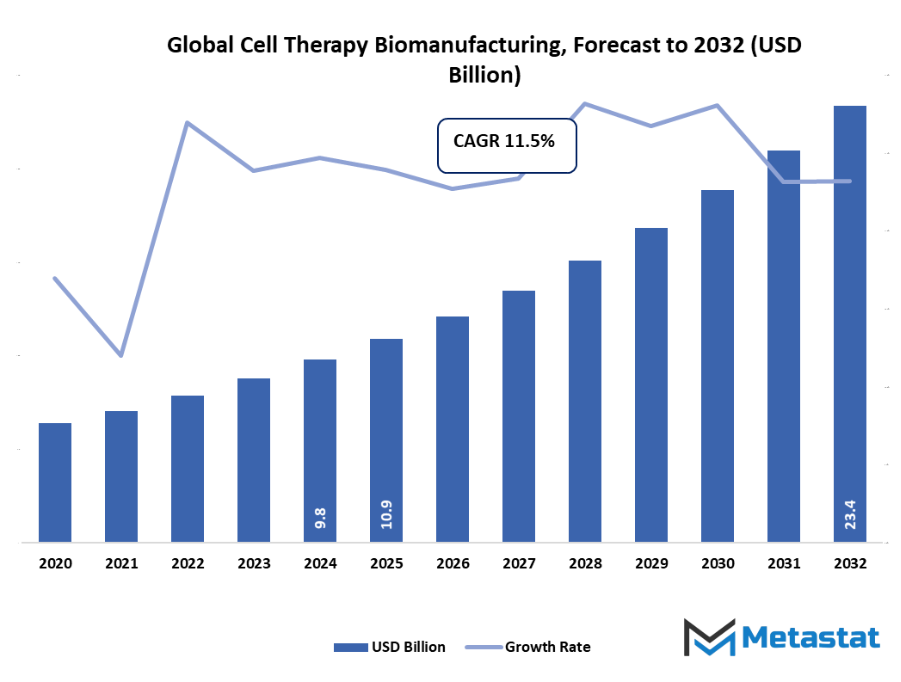
$10.9 Billion |
|
Market Size by 2032 |
$23.4 Billion |
|
Growth Rate from 2025 to 2032 |
11.5% |
|
Base Year |
2024 |
|
Regions Covered |
North America, Europe, Asia-Pacific, South America, Middle East & Africa |
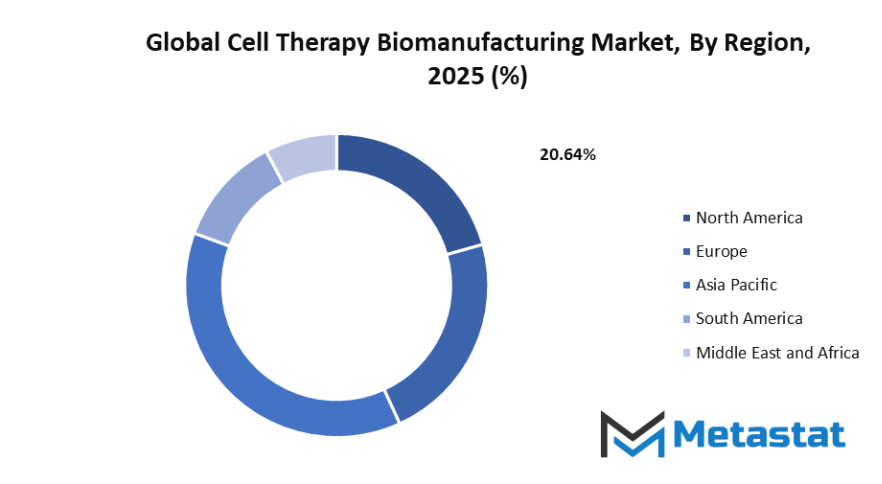
Based on geography, the global cell therapy biomanufacturing market is divided into North America, Europe, Asia-Pacific, South America, and Middle East & Africa. North America is further divided in the U.S., Canada, and Mexico, whereas Europe consists of the UK, Germany, France, Italy, and Rest of Europe. Asia-Pacific is segmented into India, China, Japan, South Korea, and Rest of Asia-Pacific. The South America region includes Brazil, Argentina, and the Rest of South America, while the Middle East & Africa is categorized into GCC Countries, Egypt, South Africa, and Rest of Middle East & Africa.
The global cell therapy biomanufacturing market has drawn a lot of attention in the last few years due to the continuous increase in demand for advanced treatment methods. The market is dealing with the development and production of cell-based therapies that can heal or at least give significant relief to diseases previously branded as incurable. These therapies are transforming healthcare by curing diseases instead of just soothing their symptoms. The foundation for continual growth in this industry has been laid by the augmented number of clinical trials, increased research activities, and larger investments in the biotechnology field.
The industry is characterized by a combination of global leaders and newly emerging regional companies, all of whom are associated with the innovation and the efficiency of production processes. The companies such as BD, Lonza, Sartorius AG, Bio-Techne, Merck KGaA, Miltenyi Biotec, Eppendorf SE, PBS Biotech, Inc., Repligen Corporation, Corning Incorporated, Thermo Fisher Scientific Inc., Bio-Rad Laboratories, Inc., and Bharat Biotech International Limited are the ones that have a lot of control over market trends. These companies are known and recognized for their strong capabilities in bioprocessing, cell culture technologies, and manufacturing platforms that are capable of meeting the increasing demand for both scalable and quality therapeutic production.
The ongoing research and technological breakthroughs are changing the cell therapy manufacturing process. Through the use of robots, single-use equipment, and sophisticated bioreactors the risk of contamination is being reduced while at the same time producing more drugs. These innovations have made it possible for the companies who make the drugs to deliver them faster than ever and the patients in need of the drugs now have shorter wait times. The biotechnology companies and the hospitals are making the drug approval process and getting the drugs to the patients more geographical areas quicker.
The global cell therapy biomanufacturing market is going to grow steadily for the next few years as new therapies are moving from the lab to the clinic. The competition among the big international companies and the new small firms will lead to more innovation and the faster adoption of cost-effective production. The market will become a major driver for the future of advanced medicine along with the increasing interest from investors, tech advances in robotics and better infrastructure, thus allowing millions of patients globally to benefit from it.
High cost and complexity of cell therapy production: The global cell therapy biomanufacturing market will continue to encounter financial and technical hurdles because of the high cost of cell therapy production. Production will require highly sterile environments, experts, and sophisticated bioprocessing systems, all of which drive up costs. Scaling personalized treatments will also add to the production weight.
Strict regulatory requirements and quality control challenges: As cell therapy continues to progress, regulatory guidelines are expected to get increasingly stringent which in turn will lead to longer product approval and commercialization periods. By the same token, ensuring quality and patient safety will mean that many international regulations have to be complied with. The global cell therapy biomanufacturing market will face difficulties in unifying different standards across countries, thus requiring more time and money.
Ramp up CDMOs for global cell therapy commercialization: The global cell therapy biomanufacturing market will be powered by the emergence of specialized CDMOs that offer top-notch manufacturing solutions to therapy developers. These entities will provide higher scaling up, lower production cost and hastened market entry times. Strategic alliances will shape a complete infrastructure for the international cell therapy commercialization that is most optimized.
Market size is forecast to rise from USD 10.9 Billion in 2025 to over USD 23.4 Billion by 2032. Cell Therapy Biomanufacturing will maintain dominance but face growing competition from emerging formats.
In addition to technological advancements, the global cell therapy biomanufacturing market will be focusing on sustainability and ethical production practices as the demand for transparency and responsible methods grows. Factories will set up new energy systems and reliable sourcing practices for their suppliers, thereby ensuring they are sustainable for the long run. In the end, the market will not only be about therapy production; it will be about changing healthcare manufacturing in a whole new way, setting the bar for how biological innovations will meet human needs in the coming decades.
This research report categorizes the global cell therapy biomanufacturing market based on various segments and regions, forecasts revenue growth, and analyzes trends in each submarket. The report analyses the key growth drivers, opportunities, and challenges influencing the global cell therapy biomanufacturing market. Recent market developments and competitive strategies such as expansion, type launch, development, partnership, merger, and acquisition have been included to draw the competitive landscape in the market. The report strategically identifies and profiles the key market players and analyses their core competencies in each sub-segment of the global cell therapy biomanufacturing market.
Find answers to common questions about this report
Global Cell Therapy Biomanufacturing market is valued at $10.9 Billion in 2025.
Global Cell Therapy Biomanufacturing market is estimated to grow with a CAGR of 11.5% from 2025 to 2032.
Global Cell Therapy Biomanufacturing market is estimated to reach $23.4 Billion by 2032.
Top players operating in the Cell Therapy Biomanufacturing industry includes BD, Lonza, Sartorius AG, Bio-Techne., Merck KGaA, Miltenyi Biotec, Eppend
The analysts below cover Biotechnology research at Metastat Insights.
LEAD ANALYST
Utkarsh Khirodkar is a Lead Market Research Analyst at MetaStat Insight, specializing in market intelligence, technology sector assessments, and competitive strategy.

SENIOR RESEARCH ANALYST
Biotechnology · Food and Beverages · Medical Devices · Packaging
Snehal Pasalkar is a Research Analyst at MetaStat Insight, operating at the intersection of life sciences research, competitive strategy, and market intelligence.
Decarbonizing industrial thermal processes hinges on refrigerant regulations and compressor efficiency limits. Metastat Insights delivered a thorough market analysis that evaluated natural refrigerants like CO2 and hydrocarbons against synthetic low-GWP alternatives. The breakdown of utility incentives and grid capacity constraints across key European manufacturing hubs offered valuable perspective. The follow-up conversation with their sector analysts addressed our specific questions on mechanical vapor recompression systems efficiently.
Assessing 200mm wafer transition schedules and substrate supply bottlenecks requires precise technical intelligence. MetaStat Insight supplied an actionable breakdown comparing planar and trench MOSFET architectures across automotive and industrial drive markets. The regional capacity estimates for Asia-Pacific foundries helped clarify lead-time uncertainties during our strategic planning session. When we needed additional clarification on high-purity raw material sourcing, their analyst team responded with helpful context within twenty-four hours.
Tracking maintenance cycle demand for secondary flight display units and terrain collision avoidance systems across regional jet fleets involves complex aftermarket dynamics. MetaStat Insight provided practical analysis separating airline retrofit programs from OEM forward-fit production schedules in North America and Southeast Asia. The supplier matrix highlighted component obsolescence timelines without resorting to vague generalizations. The dataset served as a dependable reference during our annual program review meetings.
Explore related market intelligence reports worth reading alongside this one.