
LEAD ANALYST
Utkarsh Khirodkar is a Lead Market Research Analyst at MetaStat Insight, specializing in market intelligence, technology sector assessments, and competitive strategy.

Global Content Marketing Market Size, Share, By Component (Software and Services), By Content Format (Text-Based Content (Blogs, Articles, White Papers and E-books), Video Content, Social Media Content, Infographics and Visual Content, Audio Content (Podcasts and Audio Articles), Interactive Content (Calculators and Interactive Experiences), Email Newsletters, Others (Webinars and Digital Presentations)), By Organization Size (Small and Medium-Sized Enterprises and Large Enterprises), By End-Use Industry (Retail and E-Commerce, Banking, Financial Services, and Insurance, Information Technology, Telecommunications, Media and Entertainment, Healthcare and Life Sciences, Manufacturing, Travel and Hospitality, Education, Others (Real Estate, Professional Services, Utilities)), Industry Analysis, Growth, Trends, and Forecast, 2026-2033
Report ID
MSI-5489
Published
October, 2026
Pages
265 Pages
Format
Historical
Base year
Forecast
Forecast period
Report Details
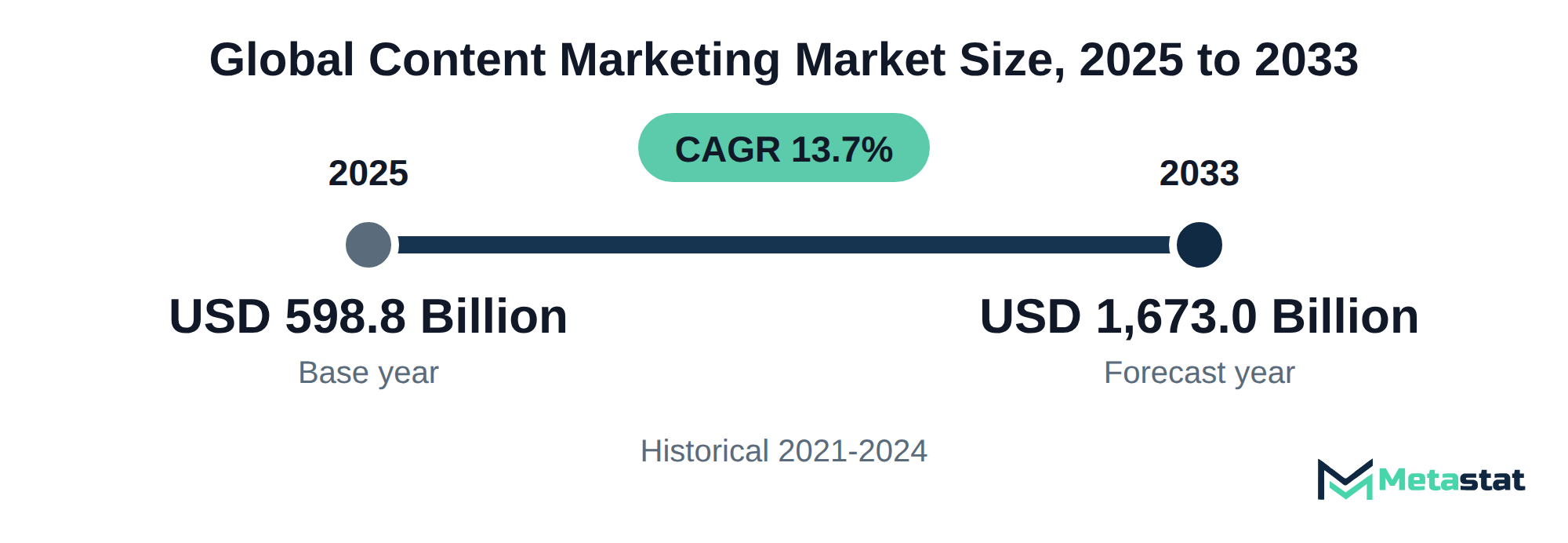
Market Valuation: Valued at $598.8 Billion in 2025, projected to reach $1,673 Billion by 2033 at a 13.7% CAGR.
Dominant Segment: Video content leads the market, driven by its effectiveness in engaging consumers through dynamic and easily digestible formats.
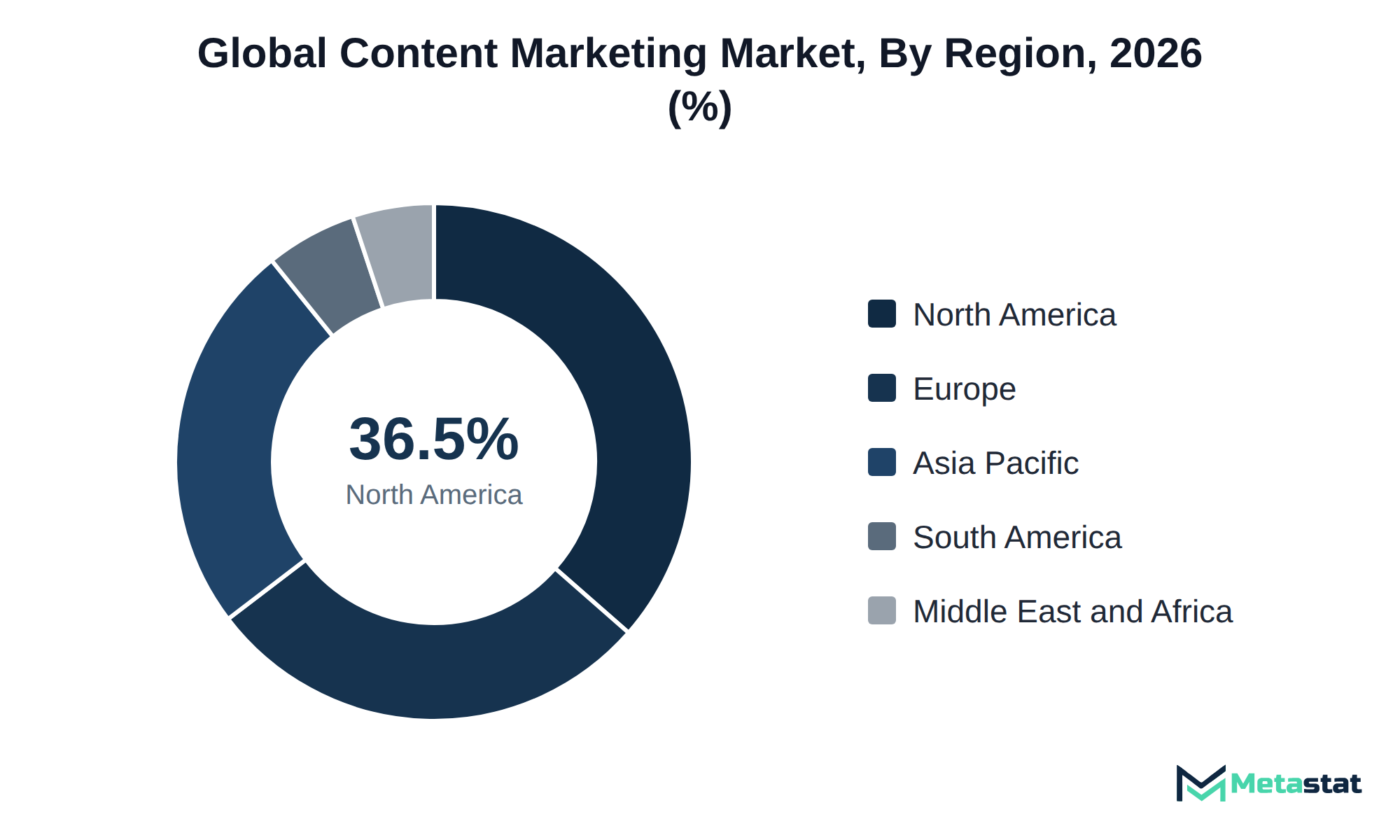
Geographic Lead: North America is the largest market, holding 36.5% in 2025, with the US expected to maintain its lead due to high digital adoption rates.
What's Inside: The report provides a comprehensive analysis of market dynamics, competitive landscape, and segment growth across various components and content formats, covering the forecast period from 2026 to 2033.
Growing Opportunity in SMEs: Small and medium-sized enterprises are projected to grow at a CAGR of 15.2%, reflecting their increasing investment in cost-effective content marketing strategies to enhance brand visibility.
Price Sensitivity Limits Adoption Rates: High costs associated with content marketing tools hinder adoption among small and medium-sized enterprises, impacting their competitive positioning in the market.
Choose Your License
Global Content Marketing Market
The global Content Marketing market was valued at USD 598.8 billion in 2025 and is projected to reach USD 1,673 billion by 2033, growing at a CAGR of 13.7% over the forecast period.
The Content Marketing market encompasses a broad range of strategies and tools aimed at creating and distributing valuable content to attract and engage target audiences. Buyers invest in this market to enhance brand awareness, drive customer engagement, and ultimately increase sales. The integration of content marketing into business strategies reflects a growing recognition of its role in connecting with consumers in a digital-first environment. Organizations across various sectors recognize the importance of effective content to build loyalty and establish relationships with customers.
Significant growth in the market stems from the increasing demand for personalized and targeted content. This demand is particularly strong among small and medium-sized enterprises, which are leveraging content marketing to compete with larger players. North America holds 36.5% of the market in 2025, with the US leading in 2026. Video content emerges as the most valuable segment, appealing to consumers through engaging and easily digestible formats.
The rapid digital transformation across industries further drives the market forward. Companies recognize the necessity of adopting innovative content strategies to maintain relevance and engage consumers effectively. Rising adoption of advanced analytics and marketing technologies facilitates the optimization of content delivery, enhancing the overall effectiveness of marketing efforts.
The Content Marketing market includes various components including software and services, catering to businesses seeking to enhance their online presence through engaging content. Buyers invest in this market to strengthen brand visibility, drive customer engagement, and generate leads. The shift towards digital platforms and the increasing importance of personalized content strategies drives spending in this sector.
The market experiences significant growth, primarily fueled by the rising demand for video content. This format has emerged as the most valuable segment, attracting substantial investment from businesses eager to leverage its effectiveness in reaching audiences. In comparison, Europe and Asia Pacific follow, representing 28.2% and 24.6% of the market, respectively.
Investments in innovative content delivery methods and platforms continue to shape the market. Companies increasingly recognize the need for high-quality, engaging content to differentiate themselves in a competitive environment. The ongoing digital transformation across industries further drives the demand for content marketing solutions, ensuring substantial opportunities for growth and expansion.
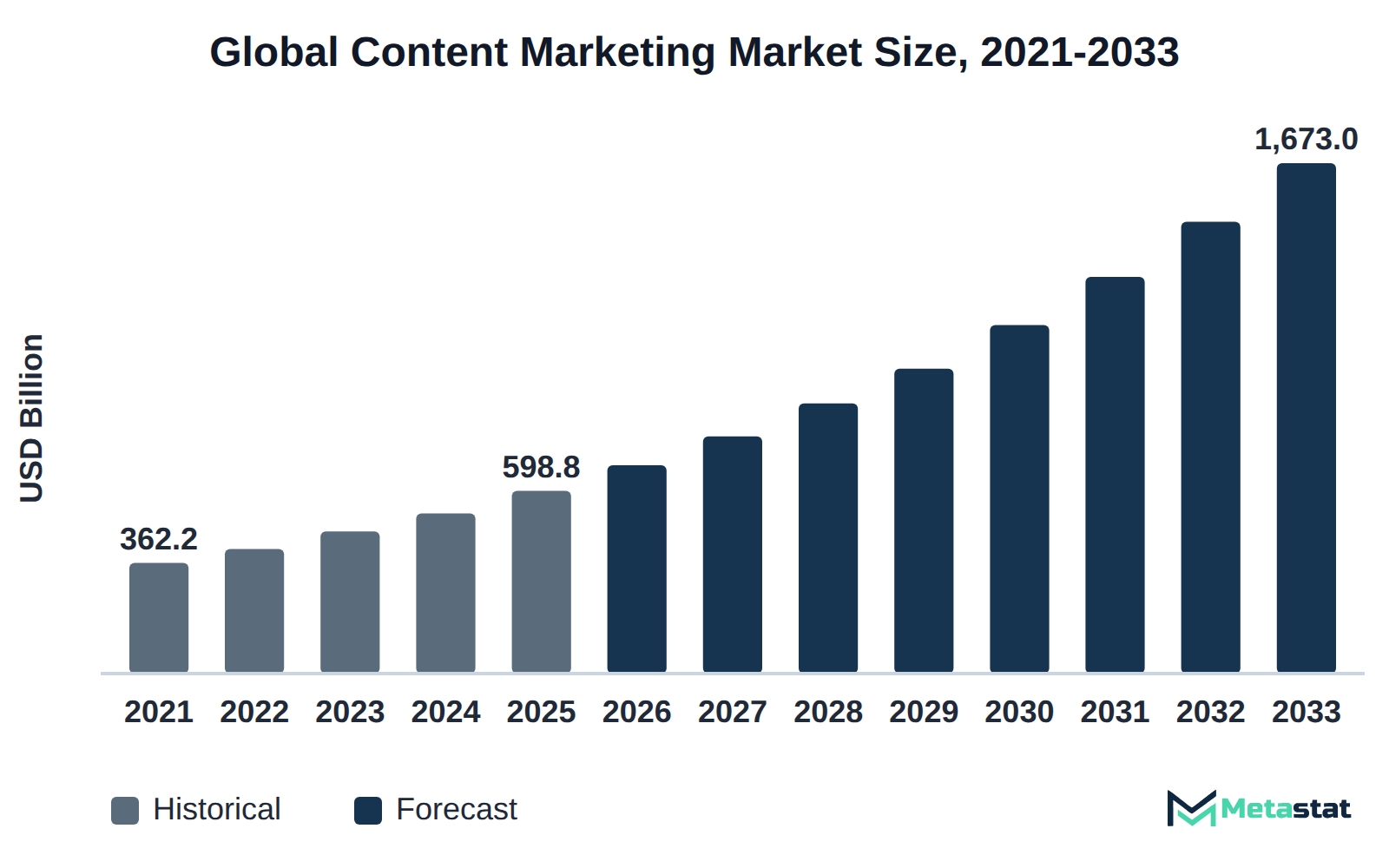
The rise of AI content marketing platforms transforms the economics of enterprise content production. Businesses seek efficient ways to generate high-quality content, and the market for AI-driven solutions accelerates. The software segment is projected to grow from USD 421.6 billion in 2026 to USD 1,090.5 billion by 2033, reflecting a compound annual growth rate (CAGR) of 14.5%. This significant growth highlights the increasing reliance on technology to streamline content creation processes.
Enterprises leverage AI tools, including generative AI in marketing applications, to create, manage, and distribute content effectively, reducing the time and resources traditionally associated with these tasks. Integration of AI in content marketing platforms enables companies to optimize their messaging, target specific audiences with precision, and measure engagement more accurately. Enhanced capabilities drive a competitive edge in the challenging market environment.
The shift toward AI-driven content solutions not only enhances production efficiency but offers significant cost savings for enterprises. These platforms facilitate customization at scale, allowing businesses to respond swiftly to market trends and consumer preferences. This transformation in the content marketing market leads to increased adoption of AI technologies, projecting robust demand for innovative solutions that reshape how enterprises approach content marketing strategies.
Short-form video content marketing plays a critical role in enhancing retail buyer engagement, with brands increasingly leveraging this format to connect with consumers. The market for this type of content is projected to reach USD 571.7 billion by 2033, reflecting a compound annual growth rate of 15%. This growth highlights a shift in how businesses approach customer interaction, with buyers responding favorably to dynamic and easily consumable content.
Retailers typically adopt subscription-based pricing models for short-form video content marketing. These models offer varying tiers based on access to analytics, content creation tools, and additional features. This flexibility allows businesses of different sizes to engage with their audiences effectively while managing costs. Mid-sized enterprises, representing a significant portion of retail buyers, show a strong inclination toward these subscription options, which balance quality and affordability.
Brands leveraging short-form video content benefit from enhanced customer loyalty and increased sales conversions. Engaging visual content creates a stronger emotional connection with consumers, translating into repeat purchases. This strategic approach to pricing and content delivery supports the evolving landscape of the Content Marketing market, emphasizing the importance of adaptability in meeting buyer preferences.
Content marketing is essential in B2B lead generation and sales conversion, allowing businesses to engage potential customers through tailored content. The effectiveness of these strategies hinges on accurate attribution, which quantifies the impact of content across various channels. In 2023, the market value reached USD 466.2 billion, reflecting the growing importance of content marketing in driving business outcomes.
Attribution in content marketing enables businesses to discern which content formats and channels yield the highest conversion rates. For instance, video content stands out, with a projected market value of USD 571.7 billion by 2033, demonstrating its increasing significance in capturing audience attention. Companies that prioritize video in their content strategies enhance their ability to generate leads and close sales, translating into higher revenue.
In the B2B sector, understanding the specific needs of prospective clients proves essential. Retail and e-commerce organizations, for example, increasingly rely on effective content marketing strategies to engage customers. With a forecasted market value of USD 421.1 billion by 2033 for this segment, businesses that tailor their content to address customer pain points and preferences experience improved engagement and conversion rates. This targeted approach strengthens customer relationships and increases market share.
Businesses increasingly compare in-house and outsourced content marketing costs, seeking strategies that optimize their budget while enhancing effectiveness. A significant factor lies in the anticipated outcomes tied to these approaches. Organizations investing in video content, for instance, have an emerging demand due to its effectiveness in engagement, with the segment projected to reach USD 571.7 billion by 2033. This growth indicates a shift in focus towards outsourcing content creation, which often provides access to specialized skills and technologies that are not available in-house.
In-house content marketing often entails fixed costs, including salaries, benefits, and training for staff, which accumulate substantially over time. Conversely, outsourcing typically involves variable costs tied to project scope and service provider rates. For small and medium-sized enterprises, the projected growth from USD 243.9 billion in 2026 to USD 657.2 billion by 2033 signifies a strong trend towards leveraging external expertise. This shift allows businesses to allocate resources more effectively while focusing on core operations.
Ultimately, the choice between in-house and outsourced content marketing hinges on balancing quality and budget. Companies investing in outsourcing frequently find enhanced content quality and reach, leading to increased engagement and higher conversion rates. This strategic decision directly influences overall marketing effectiveness within the content marketing market.
Retail and e-commerce companies increasingly invest in video content to engage consumers effectively. This shift stems from changing consumer preferences for interactive and visually engaging formats, leading to higher engagement rates. The desire for brands to stand out in the competitive environment pushes these companies to enhance their content marketing strategies. Video content is expected to reach a value of USD 571.7 billion by 2033, reflecting a growing trend among organizations to allocate budget towards dynamic content formats. This transition towards video significantly impacts the pricing and volume of content produced, driving further investment in innovative content marketing solutions.
Investments in technology such as video marketing software, which supports video content creation and distribution, expand opportunities for retailers. The Content Marketing market benefits from this trend, with businesses increasingly recognizing the value of compelling video narratives in conveying messages effectively and building customer loyalty.
The emergence of text-based content, including blogs, articles, white papers, and e-books, spurs significant growth in the Content Marketing market. Businesses increasingly prioritize text formats to enhance SEO rankings and drive organic traffic. Text-based content serves as an effective tool for information dissemination and engagement across various industries, particularly in sectors including retail and information technology. Enhanced visibility online leads to greater brand awareness and customer interaction, strengthening loyalty and driving conversions.
Small and medium-sized enterprises, seeking to optimize their marketing budgets, increasingly invest in text-based content strategies. These enterprises leverage affordable content creation methods to engage their audiences effectively. The strong demand for informative and valuable text content drives market expansion, contributing to the projected compound annual growth rate of 13.7%. This growth trajectory indicates robust opportunities for content marketers specializing in text-based formats, enabling them to capture significant market share in the years ahead.
High costs associated with content marketing hinder adoption among small and medium-sized enterprises. These organizations often face tight budgets, making the investment in advanced content marketing tools and services a difficult decision. The high pricing for high-quality content creation, management software, and strategic consulting leads to slower uptake in this buyer group. Consequently, many smaller firms opt for less expensive alternatives or delay necessary upgrades, impacting their competitive positioning in the market.
This price sensitivity affects overall demand dynamics, limiting potential revenue growth for suppliers in the Content Marketing market. The resulting hesitation to commit to comprehensive content strategies stifles innovation and reduces the effectiveness of marketing campaigns. Tightening operating margins prompt companies to reevaluate their marketing budgets, ultimately affecting their ability to engage effectively with customers and achieve growth targets.
Rising talent costs pose significant challenges for suppliers in the Content Marketing market. The competitive landscape has intensified, leading to increased demand for skilled content creators and strategists. Organizations striving to maintain quality face escalating expenses related to hiring and retaining top talent. This scenario leads to narrower profit margins for many firms, impacting their overall sustainability. Suppliers are responding by investing in training programs to upskill existing employees and streamline operations to enhance efficiency. Many organizations pursue automation tools to offset labor costs, seeking to balance quality with operational expenses. The emphasis on talent optimization reflects a strategic shift aimed at achieving profitability in a challenging economic environment.
In this evolving landscape, firms focus on leveraging technology to reduce dependency on external talent while maximizing the impact of their existing resources. Success in the market relies heavily on effective resource allocation and strategic investments in both human capital and technological infrastructure. Innovative approaches drive growth and maintain competitiveness during rising costs.
Small and medium-sized enterprises (SMEs) represent a significant growth opportunity in the Content Marketing market, with an expected compound annual growth rate (CAGR) of 15.2% from 2026 to 2033. This segment's expansion is driven by increasing digital adoption among SMEs seeking to enhance their brand presence and engage with customers effectively. These businesses prioritize cost-effective marketing solutions that deliver measurable results. The growing availability of tailored content marketing software and services allows SMEs to optimize their strategies without the hefty budgets often associated with larger enterprises.
This trend highlights an under-penetrated area that presents ample opportunities for providers offering scalable solutions designed specifically for smaller organizations. Addressing this segment significantly influences overall market dynamics and enhances competitive positioning within the broader content marketing landscape.
The Global Content Marketing market is segmented based on Component, Content Format, Organization Size, and End-Use Industry.
This segment supports businesses in managing and automating content marketing activities, enabling efficient content creation, distribution, and performance tracking. Companies leverage software solutions to enhance engagement with their audiences through tailored content strategies. The increasing demand for real-time analytics and integration of artificial intelligence in content marketing drives growth in this segment. Compared to services, which are projected to grow at a CAGR of 12.2%, software demonstrates faster growth, appealing to organizations seeking innovative tools for competitive advantage. The focus on optimizing marketing efforts through software solutions positions this segment favorably within the market.
Services segment is estimated to reach USD 582.6 billion by 2033, at a CAGR of 12.2% during the forecast period. This segment provides businesses with essential expertise and support in developing and executing content marketing strategies. Agencies and specialized firms leverage services including content creation, strategy development, and analytics to enhance brand visibility and engagement. Demand for these services is driven by the increasing complexity of digital marketing strategies, requiring organizations to focus on specialized content services to maintain competitiveness. Compared to software, this segment demonstrates slower growth and attracts different buyers, typically those prioritizing quality and personalization over automation. Organizations investing in services gain tailored solutions that adapt to evolving market demands, enhancing customer loyalty and brand authority.
Text-Based Content (Blogs, Articles, White Papers and E-books) segment is valued at USD 161.9 billion in 2026 and is projected to reach USD 345.3 billion by 2033, at a CAGR of 11.4% during the forecast period. This sub-segment primarily serves businesses aiming to generate leads, establish authority, and engage audiences through informative and educational content. Demand for this segment grows due to the increasing importance of SEO and inbound marketing strategies. Companies across various industries, including retail and e-commerce, use blogs and articles to enhance visibility and attract customers. Compared to other content formats, including video, text-based content experiences slower growth, attributed to the more established nature of written content. However, its relatively lower production costs and persistent demand ensure sustained relevance within the market.
Video Content segment is estimated to reach USD 571.7 billion by 2033, at a CAGR of 15% during the forecast period. This format primarily serves businesses and organizations aiming to engage audiences through dynamic visual storytelling. Marketers increasingly use video content to enhance brand visibility and connect with consumers across various platforms. The rapid growth in consumer demand for video-driven engagement significantly drives this segment, differentiating it from others in the content format category, which exhibit slower growth rates. Advancements in video production technologies and the declining costs associated with video creation enhance accessibility for organizations of all sizes. This accessibility supports wider adoption among small and medium-sized enterprises, further driving market expansion.
Social Media Content segment is expected to reach USD 341 billion by 2033. This segment is essential for engaging consumers across various platforms, allowing brands to build community and enhance brand loyalty. Businesses in retail, entertainment, and technology heavily rely on social media content to connect with their audiences. The rapid growth of social media usage drives demand for innovative content formats, with brands leveraging video and interactive experiences to capture attention. Compared to other content formats, social media content experiences faster growth due to the engagement it generates, aligning with changing consumer preferences. This segment's growth rate contrasts with text-based content, which sees a CAGR of 11.4%. Investment in social media strategies represents a strategic focus for companies aiming to improve outreach and relevance in an increasingly digital marketplace.
Infographics and Visual Content segment is projected to grow at a CAGR of 11.3% during the forecast period. Infographics enhance comprehension and retention of information, proving invaluable for marketers aiming to convey complex messages succinctly. Businesses across sectors including retail, education, and healthcare engage this format to attract audiences, supporting brand loyalty and awareness. The demand for visually appealing content drives growth in this segment, with organizations prioritizing quality design to distinguish themselves in the competitive landscape. Compared to other content formats, this segment exhibits slower growth, while text-based and video content capture a larger portion of market investment. However, the visual appeal of infographics offers unique advantages, leading to increased adoption in marketing strategies. Overall, the Infographics and Visual Content segment illustrates a distinct value proposition, appealing to businesses seeking innovative methods to communicate with their target markets.
Audio content, encompassing podcasts and audio articles, provides a versatile medium for delivering information and engaging audiences through auditory experiences. Brands and businesses leverage this format to enhance consumer connection, particularly targeting those who prefer listening to reading. The rapid growth in podcast popularity drives demand, attracting advertisers looking to tap into engaged listener bases. This segment experiences unique dynamics, distinguishing it from others within the content format category, particularly in terms of audience engagement and user experience. While video content gains attention for its visual appeal, audio content offers an accessible alternative for multitasking audiences, allowing them to consume content while on the go. The ongoing rise in smartphone usage further supports this trend, facilitating easier access to audio content. Continuous advancements in production quality and distribution channels influence growth, demonstrating the segment's distinct pathway in the evolving content marketing environment.
Interactive content, including calculators and other interactive experiences, engages users dynamically, enhancing their interaction with brands. This form of content finds utility among businesses aiming to increase consumer engagement, boost lead generation, and build brand loyalty. Rising consumer expectations for interactive experiences drive demand for this content format, especially in sectors like retail and e-commerce, where personalized experiences connect with customers. Compared to other content formats, interactive content often commands higher production costs due to its complexity; however, it frequently delivers superior engagement levels, making it a compelling choice for marketers. The market demonstrates a distinct trend toward increased investment in interactive content, reflecting a shift in consumer preferences toward more engaging and immersive experiences.
Email newsletters serve as an effective tool for businesses to maintain engagement with their audience. Marketers use this format, together with email marketing software, to deliver tailored content directly to subscribers, enhancing brand loyalty and building customer relationships. Growing interest in personalized communication significantly influences this segment, with companies seeking ways to connect more intimately with consumers. The demand for targeted messaging drives businesses to invest in email newsletter strategies, distinguishing this segment from others within the content format category. Compared to video or social media content, email newsletters typically attract different buyer demographics, often appealing to organizations focused on direct outreach and engagement. This segment operates in a competitive environment, requiring marketers to innovate and optimize their content to stand out in crowded inboxes.
Webinars and digital presentations serve as informative tools that engage audiences through live or recorded sessions. Various organizations leverage this format to educate customers, promote products, or host discussions that enhance brand visibility. The rising demand for interactive content has driven this segment, leading to increased adoption among businesses aiming to connect with audiences in real-time or through accessible recordings. Compared to video content, which exhibits a faster growth trajectory, webinars often require lower production costs, making them an attractive option for smaller enterprises. This segment's unique position within the Content Marketing market stems from its focus on delivering value through direct interaction, distinguishing it from other formats that prioritize pre-produced content.
Valued at USD 243.9 billion in 2026, this segment is projected to reach USD 657.2 billion by 2033, at a CAGR of 15.2% during the forecast period. Small and medium-sized enterprises adopt content marketing strategies to enhance brand visibility and engage with target audiences. Growing adoption is driven by the increasing importance of digital presence, particularly among businesses with limited budgets seeking cost-effective promotional strategies. This segment experiences faster growth compared to large enterprises, reflecting specific needs for tailored and accessible marketing solutions. The focus on budget-friendly and effective content allows SMEs to compete effectively in the market, creating a unique demand for services that prioritize efficiency and returns on investment. The surge in digital consumption patterns motivates SMEs to invest in diverse content formats, contributing to the overall growth of the market.
Large Enterprises segment is estimated to reach USD 1,015.9 billion by 2033, at a CAGR of 12.7% during the forecast period. Large enterprises employ content marketing to enhance brand visibility, engage customers, and drive sales. This segment experiences growth driven by increasing demand for personalized marketing strategies and the need for high-quality content production. Compared to small and medium-sized enterprises, which have a projected CAGR of 15.2%, large enterprises demonstrate a slightly slower growth rate due to established market presence and larger budgets. However, investment in software tools and analytics aids in maximizing the effectiveness of content campaigns. This segment attracts significant interest from industries including retail and e-commerce, where the focus on customer engagement remains critical, presenting ample opportunities for growth. The Content Marketing market reflects a strong trajectory influenced by the strategic initiatives of these large organizations.
Valued at USD 168.4 billion in 2026, this segment is projected to reach USD 421.1 billion by 2033, at a CAGR of 14% during the forecast period. Retail and E-Commerce focuses on promoting products and driving sales through various content marketing strategies, primarily by retailers and online merchants. The demand for effective digital marketing solutions fuels this segment, with businesses seeking to enhance customer engagement and conversion rates. Retail and E-Commerce outpaces many other segments in growth, supported by the increasing shift toward online shopping and digital channels. The segment's growth trajectory reflects broader trends within the Content Marketing market, with unique challenges including the necessity for personalized content strategies to remain competitive in a crowded marketplace.
Banking, Financial Services, and Insurance segment is estimated to reach USD 271.7 billion by 2033, at a CAGR of 14.1% during the forecast period. This segment provides targeted content strategies that enhance customer engagement, build trust, and promote financial products and services. Financial institutions engage in content marketing for brand awareness and customer retention. The growing emphasis on digital transformation within this sector contributes to increased investment in content marketing efforts. Compared to other segments, this segment experiences significant growth, driven by the necessity for effective communication in a competitive market. The focus on regulatory compliance drives content creation, ensuring that businesses meet industry standards while delivering valuable insights to consumers. The combination of these factors positions the Banking, Financial Services, and Insurance segment as a significant player in the overall market.
The Information Technology segment is expected to reach USD 261.5 billion by 2033. This segment finds extensive application in various technology-driven industries, including software development and IT services. Demand is primarily driven by the continuous need for digital transformation, which encourages organizations to invest in content marketing strategies that enhance customer engagement and brand visibility. Compared to other segments, this area experiences a relatively faster growth trajectory due to the rapid adoption of innovations including artificial intelligence and big data analytics. The anticipated compound annual growth rate (CAGR) for the Information Technology segment aligns with opportunities presented by evolving consumer preferences and increasing reliance on digital platforms for communication and marketing efforts. Such dynamics contribute to a distinctive position within the broader Content Marketing market.
The telecommunications segment is projected to grow at a CAGR of 12.3% during the forecast period. This segment serves various companies that provide communication services, including voice, data, and internet services. Demand for effective content marketing strategies stems from engaging consumers in a competitive environment and driving customer loyalty. Rapid technological advancements in areas including 5G network deployment and the shift toward digital communication channels drive the growth of this segment. Unlike other segments, telecommunications face unique challenges related to regulatory frameworks and infrastructure investments that impact marketing strategies. Organizations within this sector leverage content marketing to enhance user engagement, differentiate services, and improve brand visibility in a saturated market. Overall, the strong growth potential of the telecommunications segment highlights its relevance in the broader context of the market.
Media and Entertainment focuses on engaging audiences through various content formats, driving storytelling and creativity to captivate viewers. This segment is employed by businesses, production houses, and streaming services to enhance brand visibility and build audience loyalty. The growing demand for immersive experiences and high-quality content drives this segment's expansion, with video content emerging as a primary format due to its effectiveness in capturing attention. Unlike other segments, Media and Entertainment experiences rapid growth fueled by advancements in technology and shifts in consumer preferences toward on-demand content. The increasing adoption of subscription-based models and the need for continuous content creation support sustained investment in this area, reflecting a dynamic relationship between consumption trends and content delivery strategies. This segment reflects the evolving environment of entertainment consumption, where traditional boundaries blur and innovative approaches change user engagement.
Healthcare and Life Sciences involve the application of content marketing strategies targeted at medical professionals, healthcare providers, and pharmaceutical companies. This segment plays a critical role in educating audiences about health-related topics, promoting products, and engaging patients. The growth of digital health initiatives drives demand, pushing organizations to invest in content marketing to enhance patient outreach and improve brand visibility. Regulatory compliance and the necessity of accurate information present challenges specific to this sector. Compared to other segments, Healthcare and Life Sciences require a more specialized approach in content creation, driven by the need for precise medical terminology and adherence to legal standards. This distinctiveness leads to higher operational costs in content production, impacting the overall pricing structure. Content marketing strategies tailored for healthcare organizations frequently involve a longer lead time for approval, influencing the speed of campaign execution.
Manufacturing involves the production of goods through the combination of labor, machines, tools, and chemical or biological processing. This segment employs content marketing strategies to inform, engage, and persuade potential buyers, including manufacturers and suppliers, regarding product specifications, innovations, and industry standards. Key drivers influencing this segment include the increasing focus on digital transformation and the need for enhanced customer engagement strategies. Compared to other segments, including retail and e-commerce, manufacturing often requires more technical content that addresses complex products and solutions. This particular focus on technical detail differentiates it, leading to a unique set of buyer expectations and engagement methods that evolve alongside advancements in technology. The Content Marketing market reflects these dynamics, with various segments adapting their approaches to meet the specific needs of their audiences.
Travel and Hospitality encompasses businesses involved in providing services related to travel, accommodations, and tourism experiences. This segment attracts consumers seeking leisure and business travel options, relying heavily on effective marketing strategies to engage potential customers. The growing trend toward personalized travel experiences drives demand, with companies focusing on targeted content to highlight unique offerings. Digital storytelling serves as a vital tool for brands aiming to capture the attention of travelers, differentiating them from competitors. Compared to other segments, this area often faces unique challenges, including seasonality and market fluctuations, impacting advertising strategies and content planning. By adapting their approaches, firms in this segment navigate these hurdles to remain competitive in the Content Marketing market.
Education represents a critical environment for content marketing strategies aimed at enhancing engagement and information dissemination among students and educators. Institutions leverage content to provide valuable insights, resources, and learning materials. Growth in this sector is driven by the increasing adoption of e-learning tools and online education platforms, which necessitate effective marketing strategies to reach target audiences. The emphasis on personalized learning experiences distinguishes this segment from others, resulting in unique content requirements tailored to diverse educational needs. Compared to other segments, the education sector focuses on delivering content that supports knowledge retention and student engagement, contributing to its distinct positioning in the market.
This sub-segment includes businesses within the real estate, professional services, and utilities sectors. Companies in these fields leverage content marketing strategies to establish authority, engage potential clients, and promote their services. The demand for targeted content in these industries stems from the necessity to provide detailed and trustworthy information to consumers assessing their options. Unlike sectors including retail and e-commerce, which experience rapid growth driven by consumer spending, this segment operates in a steadier manner with varying demand influenced by market stability and regulatory changes. The focus on providing educational and informative content differentiates it from segments that prioritize sales-driven approaches. The Content Marketing market continues to expand. Businesses recognize the value of effective communication in building customer relationships and promoting brand loyalty.
Based on geography, the Global Content Marketing market is divided into North America, Europe, Asia-Pacific, South America, Middle East, and Africa.
This region's content marketing landscape benefits from significant investments in technology and digital infrastructure, driving demand primarily from retail and e-commerce, and banking and financial services. The United States, Canada, and Mexico collectively represent a large share of the global market, with North America projected to reach USD 570.8 billion by the end of 2033. The prevalence of social media platforms and online shopping trends has prompted businesses to enhance their content marketing strategies, increasing emphasis on video content and interactive formats. Regulatory support for digital marketing strategies and data privacy influences how companies engage with their audiences. The competitive nature of the market encourages ongoing innovation, positioning North America as a key player in the content marketing market.
In Europe, the demand for content marketing is propelled by robust interest from the retail and e-commerce sector, alongside significant contributions from banking, financial services, and insurance. Countries including Germany and the UK emphasize the integration of digital strategies to enhance customer engagement and conversion rates. The regulatory landscape, including data protection laws, influences marketing strategies and shapes content delivery methods. This market holds a share of 28.2% in 2025, reflecting its essential role within the global content marketing market. Anticipated growth in this region is expected to align with evolving consumer preferences and technological advancements, which drive businesses to invest in innovative content solutions.
Demand in Asia Pacific for the Content Marketing market is driven by the region's rapidly expanding digital landscape. Countries including China, India, and Japan invest heavily in technology and innovative marketing strategies, reflecting a strong shift towards digital engagement. The rise of e-commerce in this region fuels demand for effective content marketing solutions, enabling brands to reach wider audiences through tailored messaging. The integration of artificial intelligence into content production enhances personalization, thus improving user experience. By 2025, Asia Pacific is projected to hold a 24.6% share of the global market, highlighting its significant role in shaping content marketing trends. Increasing internet penetration across Southeast Asia and Australia contributes to an environment ripe for content marketing adoption, providing businesses with avenues to drive customer engagement and loyalty.
In South America, the content marketing landscape shows significant potential, driven primarily by the retail and e-commerce sector. Brazil and Argentina represent key markets, reflecting growing digital engagement among consumers. The market benefits from increasing internet penetration and the adoption of mobile devices, facilitating access to various content formats. Investments in digital marketing strategies highlight the awareness of businesses regarding the necessity to connect with consumers effectively. The region's share of the global market reached 5.7% in 2025, underscoring its importance in the broader content marketing ecosystem. Companies actively engage in creating localized content to connect better with their audiences, enhancing brand loyalty and customer retention. The focus on video content and interactive formats aligns with global trends, contributing to the overall growth of the content marketing market.
Growth in the Middle East and Africa for the Content Marketing market is driven by the expanding digital economy and increasing internet penetration. Saudi Arabia and the UAE are significant contributors, with a strong focus on technology adoption and engagement strategies. Brands in these countries leverage content marketing to enhance customer interactions and build loyalty. South Africa presents a growing market for various content formats, particularly video and social media content, reflecting the region's dynamic social landscape. The emphasis on localizing content for diverse audiences enhances the effectiveness of marketing strategies. The market's share in this region is projected to be 5.1% in 2025, highlighting its potential for future growth and development.
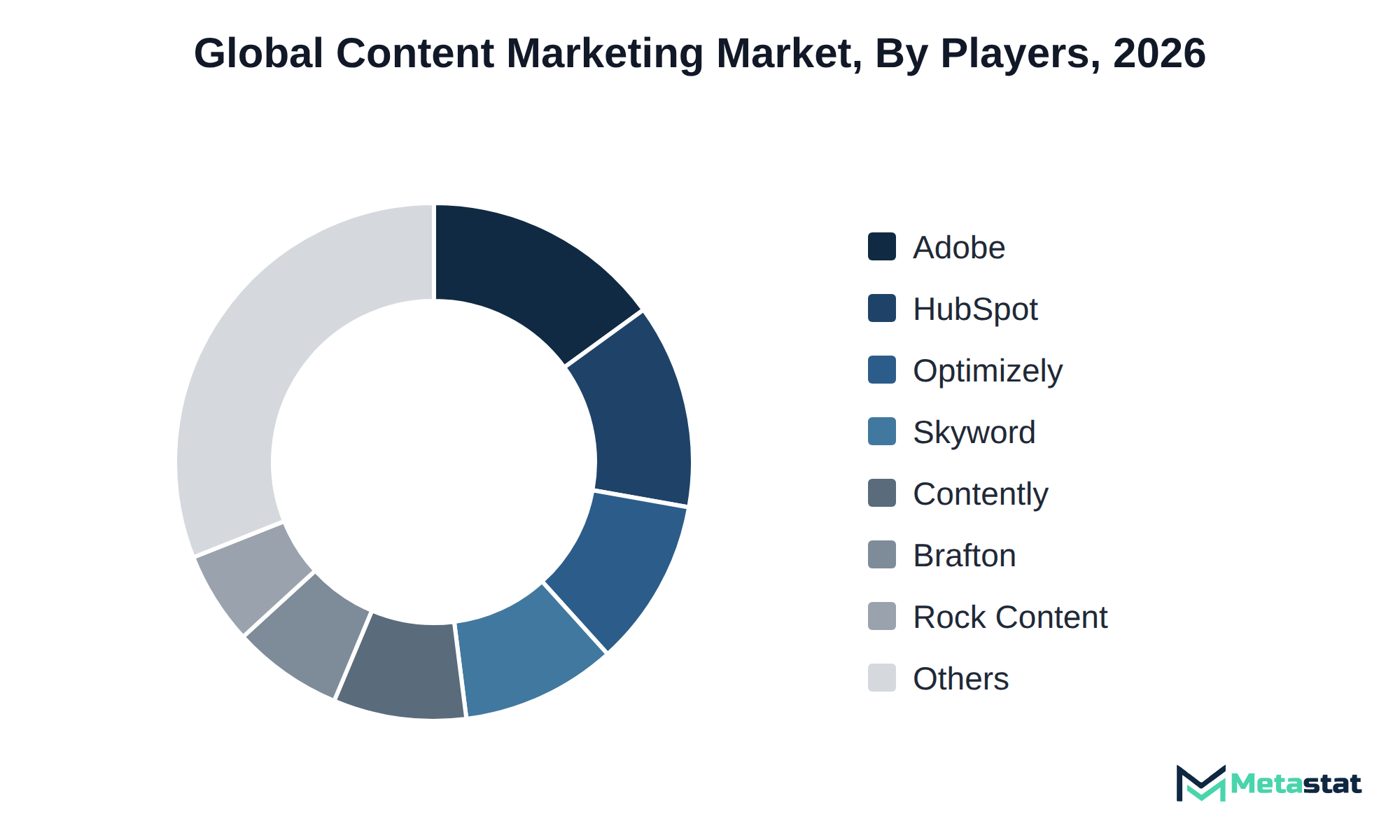
Companies in the Content Marketing market adopt various competitive strategies, focusing on service types and technological capabilities. Major players include Optimizely, HubSpot, and Adobe, each offering unique solutions tailored to distinct buyer needs.
Price, customization, and service quality emerge as primary factors influencing buyer decisions. For instance, HubSpot emphasizes integration with existing marketing ecosystems, while Adobe focuses on providing advanced creative tools. Companies like Brafton and Jasper AI, Inc. leverage unique content generation capabilities, catering to buyers seeking innovative content solutions. This diversity in offerings enables companies to differentiate themselves and meet evolving demands across various industries.
Achieving this growth depends on several critical developments. First, the increasing demand for software solutions in content marketing will support a significant rise in the market. This strong growth in software will primarily benefit small and medium-sized enterprises that seek effective content strategies to enhance their market presence.
Second, video content will play a vital role in driving market expansion, with revenues projected to reach USD 571.7 billion by 2033. This format appeals to a broad audience, enhancing engagement and conversion rates across various industries, including retail and e-commerce. Potential risks exist that could hinder growth. Economic downturns or budget constraints reduce marketing spending, particularly among large enterprises facing tougher competition. Such challenges could slow growth in segments reliant on high investment, affecting overall market performance.
By Component: Software, Services
By Content Format: Text-Based Content (Blogs, Articles, White Papers and E-books), Video Content, Social Media Content, Infographics and Visual Content, Audio Content (Podcasts and Audio Articles), Interactive Content (Calculators and Interactive Experiences), Email Newsletters, Others (Webinars and Digital Presentations)
By Organization Size: Small and Medium-Sized Enterprises, Large Enterprises
By End-Use Industry: Retail and E-Commerce, Banking, Financial Services, and Insurance, Information Technology, Telecommunications, Media and Entertainment, Healthcare and Life Sciences, Manufacturing, Travel and Hospitality, Education, Others (Real Estate, Professional Services, Utilities)
The report strategically identifies and profiles the key market players and analyses their core competencies in each sub-segment of the Content Marketing market.
Report Attributes | Details |
Study Period | 2021-2033 |
Base Year | 2025 |
Estimated Year | 2026 |
Forecast Period | 2026-2033 |
Historical Period | 2021-2025 |
Growth Rate | CAGR 13.7% from 2026 to 2033 |
Revenue Unit | USD billion |
Segmentation | By Component, Content Format, Organization Size, End-Use Industry, and Region |
By Region | North America (By Component, Content Format, Organization Size, End-Use Industry, and Country)
|
Europe (By Component, Content Format, Organization Size, End-Use Industry, and Country)
| |
Asia Pacific (By Component, Content Format, Organization Size, End-Use Industry, and Country)
| |
South America (By Component, Content Format, Organization Size, End-Use Industry, and Country)
| |
Middle East and Africa (By Component, Content Format, Organization Size, End-Use Industry, and Country)
|
Find answers to common questions about this report
The Content Marketing market size was valued at USD 598.8 billion in 2025.
The market is projected to grow at a CAGR of 13.7% during the forecast period from 2026 to 2033.
The North America Content Marketing market size is estimated to reach USD 570.8 billion by 2033.
The leading segment in the Content Marketing market is Software, with a projected value of USD 1,090.5 billion by 2033, reflecting a compound annual growth rate of 14.5 percent. This segment surpasses Services, which is expected to reach USD 582.6 billion in the same year.
The increasing investment in video content by retail and e-commerce companies drives market growth, as they seek to engage consumers through interactive formats. the emergence of text-based content, including blogs and articles, supports expansion by enhancing SEO rankings and driving organic traffic.
North America holds the dominant share of the Content Marketing market, with a projected value of USD 570.8 billion in 2033, representing 36.5 percent of the total market.
High costs associated with content marketing hinder adoption among small and medium-sized enterprises, which often face tight budgets. Rising talent costs present significant challenges for suppliers, leading to narrower profit margins and impacting overall sustainability.
The increasing digital adoption among small and medium-sized enterprises (SMEs) drives growth in the Content Marketing market, with a projected compound annual growth rate of 15.2 percent from 2026 to 2033. The availability of tailored content marketing solutions enables SMEs to engage effectively with customers while optimizing their strategies within budget constraints.
The Content Marketing market is estimated to reach a valuation of USD 1,673 billion by 2033.
Key players operating in the Content Marketing market include Optimizely, Contently, HubSpot, Inc., Adobe Inc., Brafton, and Percolate Industries Inc.
The analysts below cover Information & Technology research at Metastat Insights.
LEAD ANALYST
Utkarsh Khirodkar is a Lead Market Research Analyst at MetaStat Insight, specializing in market intelligence, technology sector assessments, and competitive strategy.

PRINCIPAL CONSULTANT - ENTERPRISE AI & EMERGING TECHNOLOGIES
Banking & Finance · Electronics and Semiconductor · Energy and Power · Healthcare IT · Information & Technology · Professional Services
Vijay Gunti is a Principal Consultant at MetaStat Insight, bringing over two decades of experience across enterprise digital transformation, technology strategy, and intelligent systems.

LEAD CONSULTANT - COMMUNICATION, TELECOM, AND IT
Electronics and Semiconductor · Information & Technology · Machinery & Equipment · Professional Services
Ravindra Sathe Consultants for Communication, Telecom, and IT at MetaStat Insight. He leads the firm's industry research initiatives across telecommunications infrastructure, digital connectivity, enterprise networking, and emerging information technology domains.
Analyzing the transition from natural gas to green hydrogen in iron ore reduction requires realistic infrastructure timelines. Meta stat insight supplied a detailed regional assessment of DRI plant conversion costs and scrap metal availability in North America and Western Europe. Their report carefully examined pellet quality specs and electrical grid access constraints without making oversimplified market assumptions. The research material served as a practical reference during internal technology roadmap discussions.
Integrating zero-trust access controls across legacy electronic health record systems involves complex compliance overhead. Team produced an analysis that clearly separated identity governance and administration tools from privileged access management platforms. Their evaluation of HIPAA and GDPR compliance features across cloud native solutions gave our architecture group clear baseline criteria. The custom data request regarding biometric authentication adoption in hospital networks was returned promptly with clear documentation.
Evaluating calorific value requirements and air permit compliance across municipal waste facilities requires localized data. Metastat Insight structured their analysis around operational throughput capacity and feedstock composition variations in Latin America and Eastern Europe. Their competitive mapping of sorting equipment vendors helped clarify technology differences between optical separators and heavy media systems. The study provided an objective baseline during our capital expenditure reviews.
Explore related market intelligence reports worth reading alongside this one.
Starting from
$2950
Starting from
$2950