
LEAD ANALYST
Utkarsh Khirodkar is a Lead Market Research Analyst at MetaStat Insight, specializing in market intelligence, technology sector assessments, and competitive strategy.

GCC Conversational AI Market Size, Share, By Solution Type (Intelligent Virtual Assistants, AI Chatbots, Voice Bots, Agentic Customer Service Agents, Agent Assist and Copilots), By Deployment Model (Cloud-Based, On-Premises and Hybrid), By Interaction Channel (Web and Mobile Chat, Messaging Applications, Voice and IVR, Social Media, Email and Other Asynchronous Channels), By End-Use Industry (Banking, Financial Services and Insurance, Retail and E-Commerce, Healthcare and Life Sciences, Travel and Hospitality, Telecom and Media, Government and Public Services), Industry Analysis, Growth, Trends, and Forecast, 2026-2033
Report ID
MSI-5725
Published
November, 2026
Pages
264 Pages
Format
Historical
Base year
Forecast
Forecast period
Report Details
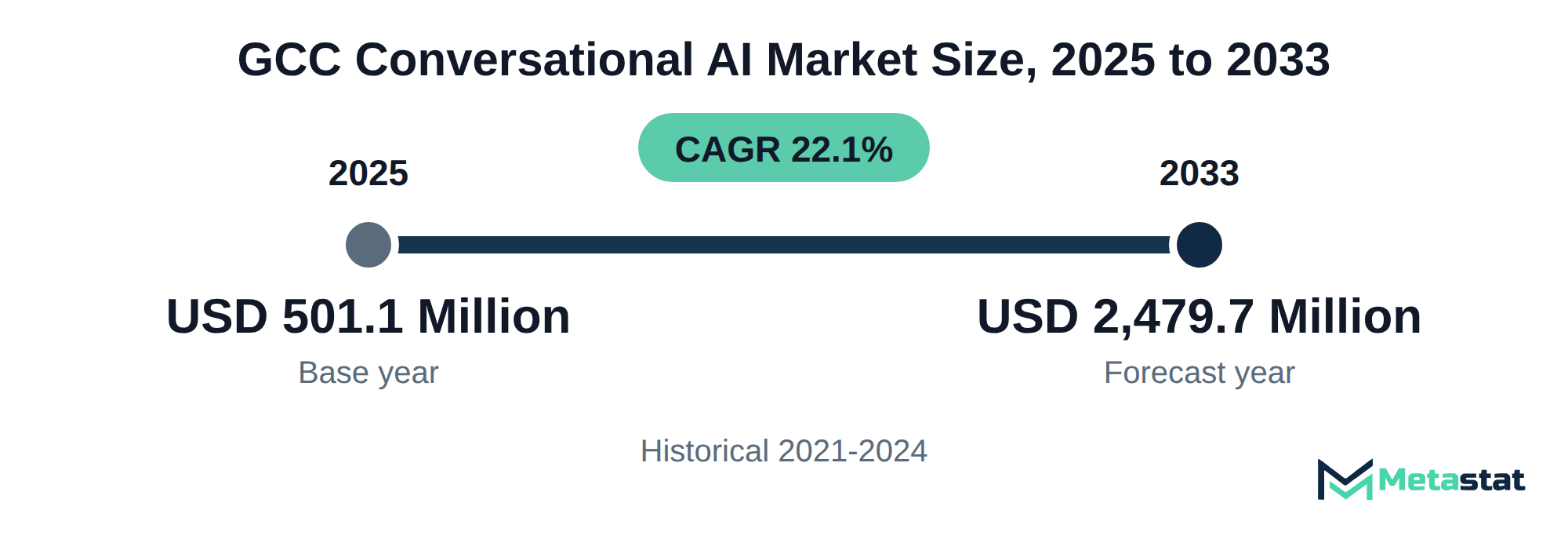
Market Valuation: Valued at $501.1 Million in 2025, projected to reach $2,479.7 Million by 2033 at a 22.1% CAGR.
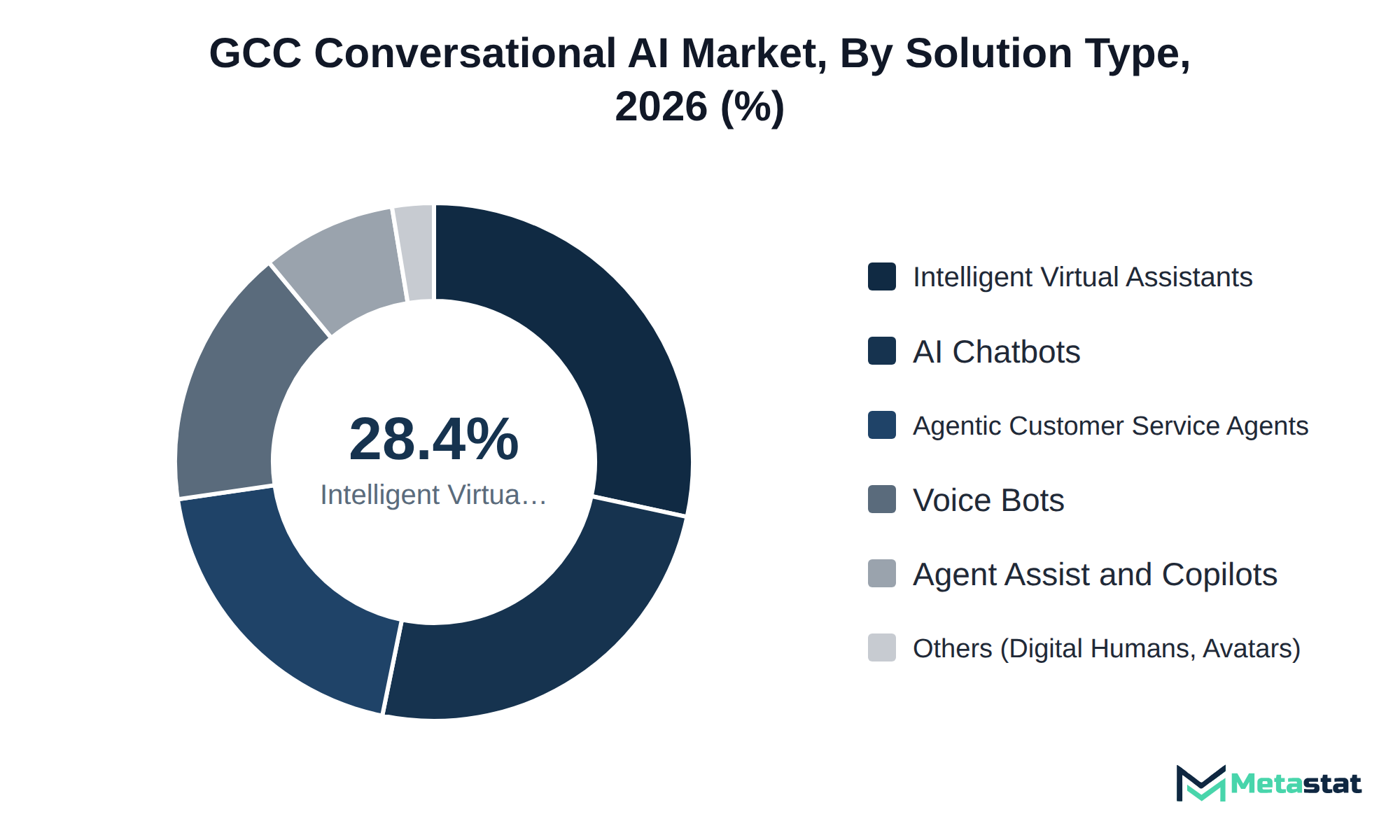
Dominant Segment: Intelligent Virtual Assistants lead the GCC Conversational AI market, driven by significant investments in personalizing customer interactions and enhancing service delivery.
Geographic Lead: The Middle East is the fastest-growing region, with substantial investments in conversational AI technologies fueled by a strong demand for automation in customer service.
What's Inside: The report provides comprehensive coverage of the competitive landscape, detailed analyses of market segments, and a forecast window extending from 2026 to 2033.
Emerging Trends: The market is witnessing a shift towards omnichannel customer service, with businesses prioritizing autonomous resolution over traditional chatbots, reflecting evolving consumer expectations.
Sector Growth: Healthcare, retail, and banking sectors are rapidly adopting conversational AI technologies to enhance customer engagement and streamline operations.
Choose Your License
GCC Conversational AI Market
The GCC Conversational AI market was valued at USD 501.1 million in 2025 and is projected to reach USD 2,479.7 million by 2033, growing at a CAGR of 22.1% over the forecast period.
The GCC Conversational AI market encompasses a range of solutions designed to enhance customer interactions through artificial intelligence technologies. Buyers invest in this market to improve operational efficiency, customer satisfaction, and overall engagement. This technology streamlines communication across various platforms, enabling businesses to respond swiftly to customer inquiries and enhance service delivery.
Growth in the market is driven primarily by increasing demand for automation in customer service, improving user experiences and operational cost savings. Among the segments, Intelligent Virtual Assistants represent the largest share, reflecting significant investment in personalizing customer interactions. The regional landscape displays a strong inclination towards advanced AI solutions, with the Middle East showing substantial growth potential.
Emerging technologies and innovations in AI continue to encourage businesses to adopt conversational solutions. The integration of these tools into existing workflows allows organizations to use data-driven insights, improving decision-making processes and customer engagement strategies. This focus on automation and efficiency supports the sustained expansion of the GCC Conversational AI market.
Investments in the GCC Conversational AI market reflect a shift in how organizations engage with customers, focusing on enhancing user experiences. Buyers prioritize solutions that streamline interactions and provide personalized support. The increasing demand for efficient customer service channels drives significant spending in this sector, with businesses recognizing the potential for improved customer satisfaction and operational efficiency.
Growth in the market is supported by a surge in digital transformation initiatives across various industries. Intelligent Virtual Assistants represent the segment with the highest value, offering versatile applications that cater to diverse customer needs. The Middle East demonstrates substantial investment in conversational AI technologies, with a notable share of the market attributed to cloud-based deployment models that facilitate scalability and flexibility.
The rapid adoption of AI chatbots is the main growth driver, particularly in banking and retail, where customer engagement is critical. This trend highlights a broader shift toward automation and efficiency, enabling businesses to respond to consumer demands effectively. The GCC Conversational AI market is expected to evolve, presenting opportunities for innovation and expansion across multiple sectors.
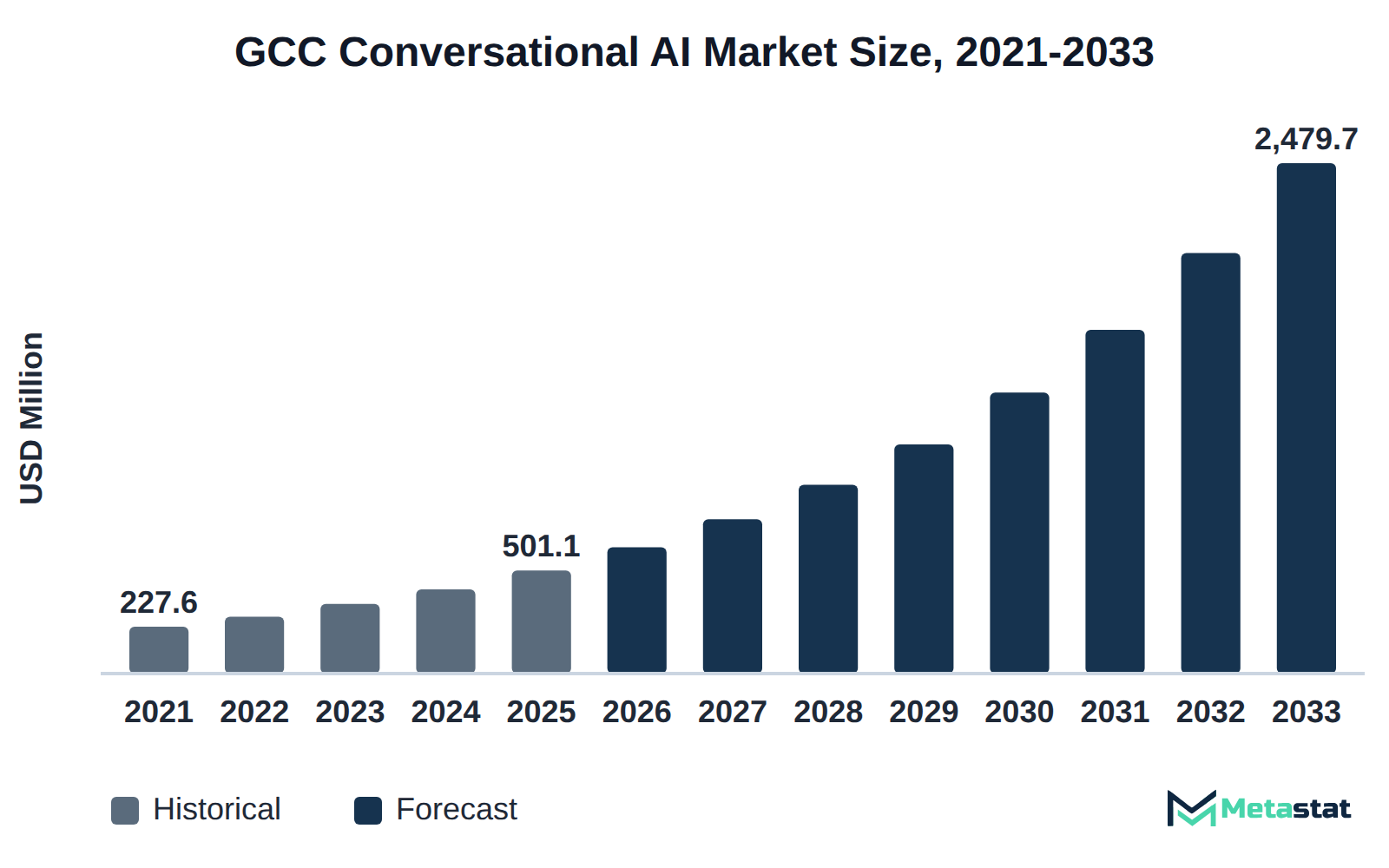
Arabic-language AI agents are transforming customer engagement strategies across the GCC. Increasing demand for localized and culturally relevant interactions drives organizations to adopt these advanced solutions. By 2033, the GCC Conversational AI market is projected to reach USD 2,479.7 million, highlighting the growing importance of tailored communication in enhancing user experiences.
The rise of intelligent virtual assistants, expected to grow from USD 173.6 million in 2026 to USD 640.3 million by 2033, demonstrates the shift towards personalized customer interactions. Businesses in banking, retail, and healthcare use Arabic-language capabilities to improve service delivery and customer satisfaction. This customization encourages loyalty and retention, which are critical in competitive markets.
Organizations investing in Arabic-language AI agents gain a significant advantage by aligning their services with customer expectations. This alignment leads to increased efficiency in handling inquiries and reducing response times, ultimately driving revenue growth. While the market evolves, integrating Arabic-language solutions becomes essential for maintaining a competitive edge and responding effectively to the diverse needs of the regional population.
The GCC Conversational AI market is experiencing a significant shift towards omnichannel customer service, where businesses prioritize autonomous resolution over traditional chatbots. This transformation stems from increasing demand for efficient and effective customer interactions across various platforms. Advanced technologies, including intelligent virtual assistants and AI chatbots, emerge to address the growing expectations of consumers for instant and reliable support.
In the market, cloud-based solutions are gaining traction, with expected growth from USD 460.8 million in 2026 to USD 1,989.7 million by 2033, reflecting a compound annual growth rate (CAGR) of 23.2%. This rising adoption of cloud services indicates a shift in buyer preferences towards scalable and flexible deployment models. Companies focus on enhancing customer experiences through integrated solutions that provide consistent support across web, mobile, and messaging applications.
Given the competitive landscape, businesses adopting these advanced technologies stand to improve operational efficiency and customer satisfaction. Investing in omnichannel strategies meets customer expectations and builds long-term loyalty, which ultimately increases revenue in the GCC Conversational AI market.
Healthcare organizations increasingly adopt conversational AI technologies to enhance patient engagement and streamline operational workflows. In 2026, the banking, financial services and insurance sector is projected to achieve a market value of USD 153.6 million, reflecting a significant investment in AI-driven solutions. The need for efficient customer interaction in healthcare, along with the demand for personalized patient experiences, drives this trend. Providers employ intelligent virtual assistants and AI chatbots to address patient inquiries, schedule appointments, and facilitate telemedicine services.
Simultaneously, the hospitality sector recognizes the potential of conversational AI to improve customer service and operational efficiency. With travel and hospitality expected to experience a compound annual growth rate of 21.3%, investment in AI solutions helps businesses address customer inquiries in real-time, manage bookings, and provide personalized recommendations. This level of responsiveness enhances customer satisfaction and loyalty.
Retailers use conversational AI to improve customer interaction across channels such as messaging applications and social media. The retail and e-commerce segment is projected to reach USD 468.2 million by 2033, driven by the need for enhanced customer engagement and streamlined purchasing processes. Retailers employing conversational AI respond to customer inquiries instantly and tailor marketing strategies based on consumer behavior, ultimately leading to increased sales and improved market positioning in the GCC market.
GCC enterprises integrate conversational AI into customer service to enhance efficiency and customer satisfaction. In the banking, financial services, and insurance sector, adoption of intelligent virtual assistants is projected to expand from USD 153.6 million in 2026 to USD 586.2 million by 2033, reflecting a compound annual growth rate (CAGR) of 21.1%. This growth represents a strategic shift towards automating customer interactions, enabling organizations to provide timely and accurate responses to customer inquiries.
The integration of AI chatbots in retail and e-commerce further demonstrates this trend, with the segment expected to reach USD 468.2 million by 2033. Enterprises recognize the importance of personalized customer experiences, driving demand for solutions that streamline transactions and support engagement across various channels. The GCC Conversational AI market supports companies aiming to improve operational efficiency while enhancing customer interactions.
Organizations across the GCC are investing significantly in digital transformation initiatives, driving demand for advanced customer engagement solutions. A notable shift has emerged among financial services, retail, and healthcare sectors, which increasingly prioritize enhancing user experiences through conversational AI technologies. This transition results from a growing recognition of the need for personalized customer interactions and operational efficiency. The adoption of intelligent virtual assistants and AI chatbots enables these industries to automate responses and improve service delivery. In 2025, the market value reached USD 501.1 million, reflecting a strong trajectory for growth. This growth shows how digital transformation is shaping customer engagement strategies across various sectors.
Technological advancements in AI chatbots drive significant growth in the GCC Conversational AI market. Enhanced natural language processing capabilities enable chatbots to understand and respond to customer inquiries with greater accuracy and context. This improvement results from ongoing investments in machine learning and AI technologies, which refine chatbot performance and user experience.
Industries including retail and banking increasingly adopt AI chatbots to streamline customer service operations. These sectors leverage chatbots to manage high volumes of customer interactions, improving response times and reducing operational costs. The deployment of AI chatbots supports efficiency while enabling businesses to allocate human resources to more complex tasks.
Projected growth in the AI chatbot segment highlights the demand for automated customer engagement solutions within the GCC market. This segment is expected to reach USD 505.4 million by 2033, growing at a compound annual growth rate of 19.1%. Enhanced capabilities of AI chatbots position them as key tools for organizations aiming to improve customer satisfaction and retention.
Operational costs present a significant barrier for organizations in the GCC Conversational AI market. Increasing expenses associated with deploying and maintaining conversational AI solutions deter many firms from adopting these technologies. Smaller businesses face heightened challenges due to limited budgets, which slows the adoption of conversational AI. This restraint particularly affects industries including retail and healthcare, where budget constraints lead to reduced investment in advanced solutions. Consequently, organizations delay the transition to newer AI technologies, opting to rely on legacy systems that do not deliver optimal customer engagement. The financial burden associated with implementing sophisticated conversational AI platforms ultimately stifles innovation within these sectors, resulting in a less competitive environment.
Profitability in the GCC Conversational AI market faces challenges due to rising talent costs. The demand for skilled professionals in artificial intelligence and machine learning continues to increase, leading to higher salaries and operational expenses for companies. Suppliers struggle to balance these costs while maintaining competitive pricing for their offerings. This financial pressure impacts profit margins and hinders expansion efforts in a changing market. In response, companies invest in training programs to develop in-house talent, which reduces reliance on external recruitment. Partnerships with educational institutions have emerged to cultivate a skilled workforce tailored to industry needs. Such initiatives enhance operational efficiency and support long-term growth strategies, positioning suppliers to navigate the competitive environment more effectively. The market adapts, ensuring that organizations remain agile in addressing talent-related challenges while pursuing growth opportunities.
Intelligent virtual assistants represent a significant growth opportunity within the GCC Conversational AI market. This segment is projected to achieve a compound annual growth rate (CAGR) of 20.5%, increasing from USD 173.6 million in 2026 to USD 640.3 million by 2033. Rising demand for personalized customer experiences across various industries fuels this growth, particularly in sectors including banking, retail, and healthcare, where enhanced customer interactions are crucial. Organizations seek to deploy intelligent virtual assistants to streamline customer service processes and improve response times, addressing increasing consumer expectations for immediate support. This demand for intelligent virtual assistants reflects a structural shift in how companies engage with customers, prioritizing technology that enhances user satisfaction and operational efficiency. The market's expansion gives developers and solution providers room to innovate and meet the changing needs of businesses across the region.
The GCC Conversational AI market is segmented based on Solution Type, Deployment Model, Interaction Channel, and End-Use Industry.
These AI-driven systems engage users through natural language processing, providing personalized assistance across various industries. Organizations in finance, retail, and healthcare use intelligent virtual assistants to enhance customer service and streamline operations. The rising demand for effective customer interactions drives this segment's growth. Compared to other segments, including AI chatbots, which exhibit a CAGR of 19.1%, intelligent virtual assistants are experiencing faster expansion due to their advanced functionality and increasing integration into business processes. This growth trajectory indicates a strong shift in how organizations prioritize user experience and operational efficiency in the GCC Conversational AI market.
AI Chatbots segment is estimated to reach USD 505.4 million by 2033, at a CAGR of 19.1% during the forecast period. This segment serves various industries, including retail, banking, and customer support, by providing automated responses to user inquiries, enhancing customer engagement, and improving operational efficiency. Key demand drivers include the increasing preference for instant communication and the growing reliance on automation to handle high volumes of customer interactions. Compared to other segments, including Intelligent Virtual Assistants with a CAGR of 20.5%, AI Chatbots exhibit strong growth but at a slightly slower pace. Organizations within the retail and e-commerce industry particularly leverage AI Chatbots to streamline processes and reduce response times, capitalizing on the need for enhanced customer service solutions. The transition toward more intelligent and context-aware chatbots is expected to further stimulate growth in the market.
Voice Bots segment is expected to reach USD 385.8 million by 2033. This solution type enables automated voice interactions, providing assistance and information to users through voice commands. Businesses in sectors including telecommunications and customer service employ voice bots to enhance user engagement and streamline processes. The growth of this segment is driven by increasing consumer expectations for responsive and efficient service. With a compound annual growth rate (CAGR) of 22.7%, voice bots demonstrate stronger growth potential compared to AI chatbots, which experience a CAGR of 19.1%. This difference highlights a shift toward more interactive and personalized customer experiences. Integration of voice technology into customer service applications reflects evolving preferences for conversational interfaces, positioning voice bots as a critical component in the GCC Conversational AI market.
Agentic Customer Service Agents segment is projected to grow at a CAGR of 27.8% during the forecast period. This segment focuses on providing automated customer service through intelligent agents, which interact with customers to resolve queries and issues efficiently. Industries including banking, retail, and healthcare employ these agents to enhance customer satisfaction and streamline service processes. Increasing demand for personalized and efficient customer service drives this segment's growth. Compared to other segments, Agentic Customer Service Agents experience faster growth due to unique capabilities in handling complex customer interactions, differentiating them from simpler solutions including AI chatbots. By 2033, the segment is anticipated to significantly influence the GCC Conversational AI market, reflecting a shift toward more sophisticated customer engagement strategies.
Agent Assist and Copilots enhance customer service by providing real-time support to agents, enabling them to resolve inquiries efficiently. This solution is widely adopted by industries including banking, retail, and healthcare, where customer interaction plays a critical role. The increasing demand for improved customer satisfaction drives growth, with organizations focusing on equipping their teams with advanced tools that streamline communication and enhance service delivery. This segment distinguishes itself from others through its focus on agent empowerment rather than direct customer interaction. While other segments including AI Chatbots or Voice Bots target end-users directly, Agent Assist and Copilots prioritize augmenting human capabilities. Investments in this sub-segment reflect a broader trend in the GCC Conversational AI market, emphasizing the importance of a hybrid approach that combines human and artificial intelligence for optimized customer engagement.
This segment includes Digital Humans and Avatars, emerging innovative solutions in customer interaction. These technologies find applications primarily within entertainment, marketing, and customer service, enhancing user engagement by providing personalized experiences. Growing consumer expectations for interactive and immersive experiences drive the adoption of Digital Humans and Avatars. Organizations leverage these technologies to stand out in competitive markets and build brand loyalty. Unlike traditional chatbots and voice assistants, this segment typically incurs higher implementation costs, limiting its immediate market penetration. The segment's growth trajectory, while promising, unfolds at a different pace compared to more established solutions like AI Chatbots and Intelligent Virtual Assistants, which cater to broader operational needs. Factors influencing acceptance include advancements in graphics and artificial intelligence, enhancing realism and functionality in digital interactions.
This model allows organizations to access scalable and flexible AI solutions without substantial upfront investments in infrastructure. Businesses in various sectors, including retail, banking, and healthcare, adopt Cloud-Based solutions for improved customer interactions and operational efficiency. The rapid growth of this segment stems from increasing demand for remote work solutions and enhanced customer service capabilities. Compared to On-Premises and Hybrid models, Cloud-Based solutions grow faster due to ease of deployment and lower initial costs, positioning them as a preferred choice for many enterprises. The shift towards digital transformation across the GCC further fuels this trend, aligning with the broader evolution in the market.
On-Premises solutions are estimated to reach USD 206.3 million by 2033, at a CAGR of 17.4% during the forecast period. This model serves organizations that prioritize data security and compliance, often seeking to maintain sensitive information on-site. The banking and financial services industries frequently deploy On-Premises solutions, which require strict control over customer data and regulatory compliance. Demand for these solutions is driven by the increasing focus on data privacy and security, prompting enterprises to invest in on-premises infrastructure. Compared to cloud-based options, which grow at a CAGR of 23.2%, On-Premises solutions exhibit slower growth due to higher initial costs and maintenance requirements. However, the unique selling points of enhanced security and customization appeal to businesses with specific operational demands, ensuring continued interest in this segment. Growth within the GCC Conversational AI market reflects evolving priorities in data management and customer engagement.
Hybrid deployment models in the GCC Conversational AI market are expected to reach USD 283.7 million by 2033. These models combine cloud-based and on-premises solutions, offering flexibility to organizations seeking to optimize their customer engagement strategies. Businesses in various sectors, including banking and retail, adopt hybrid models to enhance service delivery while managing costs effectively. The increasing need for data security and compliance drives adoption, particularly in regulated industries. Growth in this segment is supported by the rising preference for customizable solutions that allow enterprises to tailor their customer interaction approaches. Unlike purely cloud or on-premises solutions, hybrid models attract businesses aiming for a balanced approach to innovation and control, enabling them to adapt rapidly to changing customer needs. This segment is growing at a CAGR of 23.2% during the forecast period, reflecting strong demand for integrated solutions.
Web and Mobile Chat segment is valued at USD 150.4 million in 2026 and is projected to reach USD 506.3 million by 2033, at a CAGR of 18.9% during the forecast period. This segment enhances customer engagement through interactive communication channels, appealing to industries including retail and banking. The increasing demand for real-time customer support drives its growth, with organizations recognizing the value of immediate assistance in improving customer experiences. The growth rate for this segment outpaces others in the group, particularly AI Chatbots at a CAGR of 19.1%. The preference for web and mobile platforms reflects changing consumer behaviors, with users favoring quick and convenient communication methods that contribute to the market expansion.
Messaging Applications segment is estimated to reach USD 692.8 million by 2033, at a CAGR of 22% during the forecast period. This segment serves various industries for customer engagement, automating responses through platforms like WhatsApp and Facebook Messenger. Businesses in the retail and banking sectors increasingly leverage messaging applications to enhance customer interactions and streamline support services. The growth of this segment is driven by the rising demand for efficient communication channels. Compared to other segments, Messaging Applications experience a significant growth rate, aided by consumer preferences shifting towards instant messaging over traditional methods. While segments like Voice Bots and AI Chatbots show solid performance, Messaging Applications stand out due to their rapid adoption and widespread usage across multiple sectors, ensuring accessibility and customer satisfaction.
Voice and IVR segment is expected to reach USD 623.9 million by 2033. This segment primarily serves industries requiring immediate, automated responses to customer inquiries, employing AI speech recognition technology to enhance user experience. Key drivers of growth in this segment include the increasing adoption of omnichannel customer service strategies, which compel organizations to integrate voice and IVR solutions into their offerings. Organizations in telecommunications and customer support sectors drive demand for these technologies. The overall sector is projected to grow at a CAGR of 22%. The Voice and IVR segment expands strongly, with significant revenue potential compared to segments like AI chatbots, which grow at a CAGR of 19.1%. Investments in AI-driven voice solutions strengthen their role in improving operational efficiency and customer satisfaction.
The Social Media segment is projected to grow at a CAGR of 22.7% during the forecast period. This segment serves various industries, enabling businesses to interact with customers through popular platforms like Facebook, Twitter, and Instagram. Organizations leverage conversational AI to enhance customer engagement and streamline responses to inquiries, strengthening brand loyalty. The rapid adoption of Social Media for customer service reflects strong demand for efficient communication channels. Unlike other interaction channels, Social Media stands out due to its unique capability to reach a broader audience in real-time. The market's growth is driven by increasing emphasis on customer experience and the need for businesses to maintain a robust social presence in a competitive landscape. This segment's higher growth rate positions it favorably compared to traditional channels, which experience slower expansion.
Email and Other Asynchronous Channels facilitate communication through various non-real-time methods, including email and other messaging platforms. Organizations engage with this segment to enhance customer engagement by enabling users to interact at their convenience without immediate responses. The growth of this segment is driven by the increasing preference for flexible communication methods among consumers, particularly in the retail and service sectors. Compared to other interaction channels, this segment experiences slower growth due to the rapid adoption of instant messaging and chat solutions. However, its importance remains significant for businesses aiming to provide comprehensive communication options. This segment suits industries with high customer service demands, where timely responses are beneficial but not critical.
Interaction channels including kiosks and in-car systems provide unique touchpoints for engaging customers in various settings. Industries including retail and automotive leverage these channels to offer enhanced customer experiences and facilitate transactions. The growing emphasis on convenience and effective service drives demand for these interaction methods. Unlike other segments, this group differentiates itself through specific user contexts, focusing on real-time customer interactions in physical environments. Adoption barriers include the initial setup costs and the need for robust technology integration. The influence of pricing strategies makes kiosks and in-car systems a more capital-intensive option compared to digital-only solutions like web chat or messaging applications. The market recognizes the potential of these channels to enrich customer engagement, highlighting their growing importance in the evolving landscape of conversational AI.
This segment serves various financial institutions, including banks and insurance companies, focusing on enhancing customer service and operational efficiency through conversational AI technologies. Increased demand for personalized customer interactions drives growth in this sector. Regulatory compliance and the need for secure banking solutions influence deployment strategies. Compared to other segments, including Retail and E-Commerce, which is projected to grow at a CAGR of 22.4%, this segment exhibits slightly slower growth, reflecting its more complex integration requirements and the need for robust technological infrastructure. Market players target this segment with tailored solutions to improve customer engagement and streamline services.
Retail and E-Commerce segment is estimated to reach USD 468.2 million by 2033, at a CAGR of 22.4% during the forecast period. This segment primarily serves businesses involved in online sales and retail operations, enabling them to enhance customer engagement and streamline sales processes through automated interactions. A significant driver behind this growth is the increasing consumer preference for online shopping, which necessitates effective communication channels. Advancements in AI technology contribute to the enhancement of customer experiences, setting this segment apart from others in the group. Differing from segments like Banking, Financial Services and Insurance, which has a CAGR of 21.1%, Retail and E-Commerce experiences a slightly higher growth rate, reflecting its expanding role in a digital marketplace. The market adapts to the evolving needs of consumers, driving demand for innovative solutions.
The Healthcare and Life Sciences segment is expected to reach USD 271.3 million by 2033. This sector employs conversational AI for various applications, including patient interaction, appointment scheduling, and managing inquiries, primarily serving healthcare providers and pharmaceutical companies. Adoption of conversational AI in this segment benefits from the growing demand for enhanced patient engagement solutions and streamlined operations. Growth is driven by the increasing need for efficient communication solutions in healthcare settings, while the regulatory environment poses adoption challenges. Compared to other segments, the Healthcare and Life Sciences segment experiences a moderate CAGR of 21.3%, indicating steady growth potential amid evolving industry requirements. The market reflects a unique dynamic, focusing on delivering personalized service while navigating the complexities of healthcare regulations.
Travel and Hospitality segment is projected to grow at a CAGR of 21.3% during the forecast period. This segment serves hotels, airlines, and travel agencies by enhancing customer engagement and improving service delivery. Increased demand for personalized customer experiences drives this growth, with businesses investing in AI technology to streamline operations. Compared to other segments, Travel and Hospitality has a distinct focus on real-time interaction and support, which is vital for customer satisfaction in a competitive industry. While segments including Banking, Financial Services, and Insurance emphasize financial transactions, the Travel and Hospitality segment prioritizes customer experience and engagement, influencing its adoption rates. This approach aligns with the expectations of modern travelers who seek immediate assistance and information, contributing to the sector's growth within the GCC Conversational AI market.
Telecom and Media employ advanced solutions to improve customer interactions, enhance service efficiency, and streamline communication processes. Companies within this segment, including telecommunications providers and media organizations, implement conversational AI to cater to a diverse range of customer inquiries and support requests. The increase in digital engagement drives demand within this segment, with consumers seeking faster and more efficient communication methods. The shift towards online platforms raises the importance of AI-driven interactions, ensuring customers receive prompt responses. Compared to other segments, including Banking and Financial Services, Telecom and Media experiences a different pace of growth, influenced by unique customer expectations and competitive dynamics. The evolving landscape of digital communication continues to shape the operational strategies of companies operating in this area, enhancing their ability to engage with their audience effectively. The GCC Conversational AI market reflects these trends, demonstrating a commitment to innovation in customer service.
Government and Public Services solutions focus on enhancing communication and service delivery in public sector organizations. These solutions assist government agencies in managing citizen inquiries, facilitating access to information, and improving operational efficiency. The push for digital transformation in public services drives the adoption of conversational AI technologies, helping agencies streamline operations and engage citizens effectively. Unique challenges, including regulatory compliance and data privacy concerns, slow down implementation in this area. The emphasis on improving public service delivery aligns with broader government initiatives aimed at modernization and transparency. The GCC Conversational AI market increasingly recognizes the importance of addressing these specific needs, setting this segment apart from others that prioritize speed of growth over regulatory considerations.
This sub-segment encompasses applications in education, utilities, and professional services, facilitating better interactions and service delivery. Educational institutions enhance learning experiences through conversational AI, offering personalized support to students. The utilities sector employs these technologies to streamline customer service, manage inquiries, and provide real-time updates. Professional service firms leverage conversational AI for efficient client interactions, automating administrative tasks and improving response times. A significant driver of growth stems from increasing demand for efficient customer engagement and operational efficiency across these industries. Distinct from other segments, this group often involves higher customization requirements, which influence pricing and implementation timelines. Adoption challenges, including integration of new technologies into existing systems, affect the segment's overall speed of growth compared to others in the market.
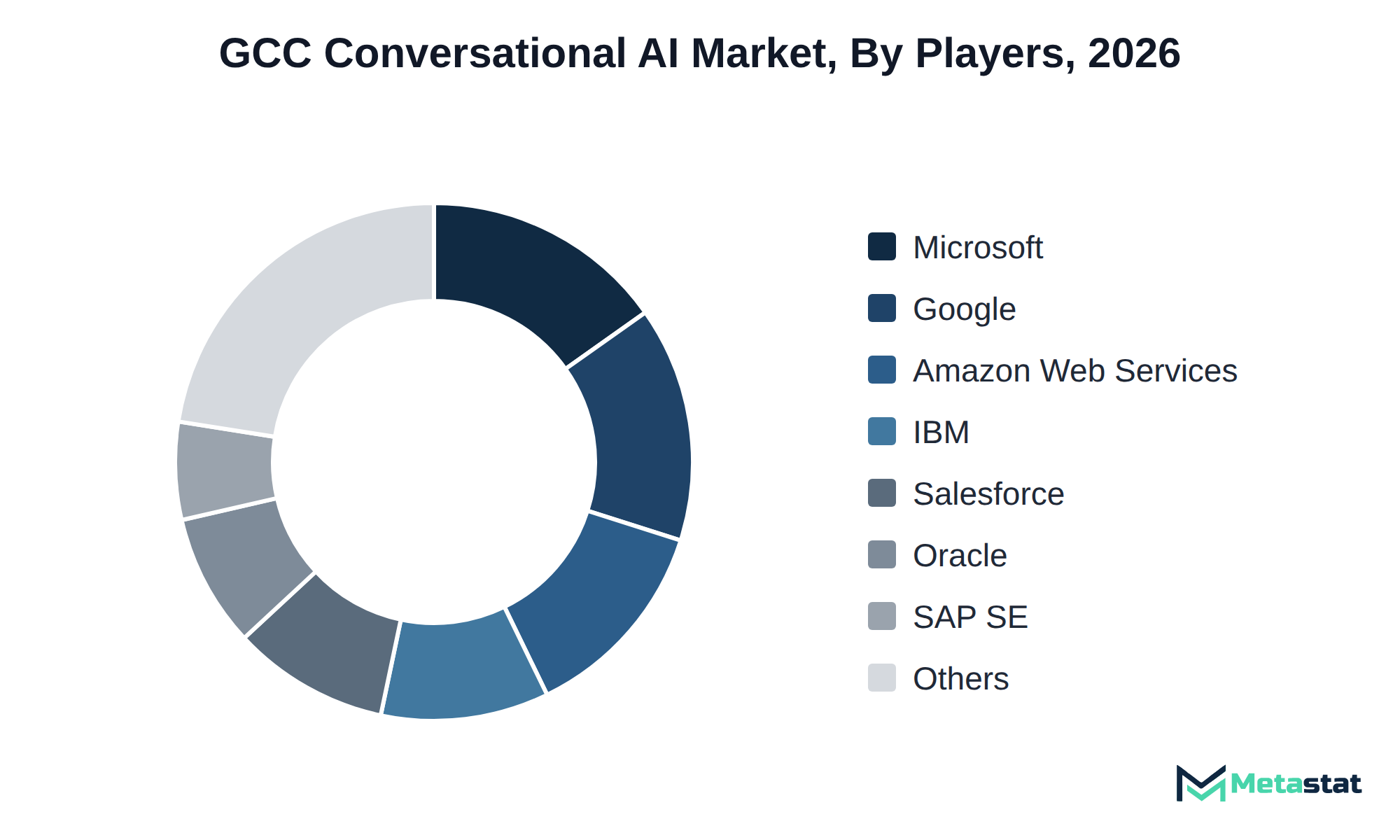
The GCC Conversational AI market features a competitive field where companies differentiate based on service type and deployment model. Key segments include intelligent virtual assistants, AI chatbots, and voice bots, each attracting different buyer preferences driven by factors including customization, pricing, and integration with existing systems.
Companies like Microsoft Corporation and Google LLC focus on cloud-based solutions, which offer scalability and flexibility, catering to businesses prioritizing operational efficiency. In contrast, IBM Corporation and Oracle Corporation have strengths in on-premises deployments, appealing to clients requiring stringent data security and control.
Buyers of conversational AI solutions consider certification and support services critical in their decision-making process. Salesforce, Inc. and SAP SE emphasize customer service and customization, facilitating tailored solutions that meet specific business needs. The market's diversity illustrates the breadth of options available for organizations seeking to enhance customer engagement through advanced AI technologies.
Several developments will drive GCC conversational AI growth. First, the adoption of cloud-based deployment models is expected to expand, enhancing scalability and accessibility for various industries. Second, the increasing demand for intelligent virtual assistants, projected to rise from USD 173.6 million in 2026 to USD 640.3 million by 2033, will significantly contribute to market expansion. Third, investments in messaging applications, anticipated to reach USD 692.8 million by 2033, will enhance customer engagement across sectors. Potential risks exist that hinder growth. Economic instability in the region could lead to reduced investments in technology, affecting adoption rates. Companies operating in the market navigate these challenges effectively to achieve the forecasted growth. The GCC Conversational AI market presents significant opportunities, driven by technological advancements and increasing consumer expectations.
By Solution Type: Intelligent Virtual Assistants, AI Chatbots, Voice Bots, Agentic Customer Service Agents, Agent Assist and Copilots, Others (Digital Humans, Avatars)
By Deployment Model: Cloud-Based, On-Premises, Hybrid
By Interaction Channel: Web and Mobile Chat, Messaging Applications, Voice and IVR, Social Media, Email and Other Asynchronous Channels, Others (Kiosks, in-Car Systems)
By End-Use Industry: Banking, Financial Services and Insurance, Retail and E-Commerce, Healthcare and Life Sciences, Travel and Hospitality, Telecom and Media, Government and Public Services, Others (Education, Utilities, Professional Services)
The report strategically identifies and profiles the key market players and analyses their core competencies in each sub-segment of the Conversational AI market.
Report Attributes | Details |
Study Period | 2021-2033 |
Base Year | 2025 |
Estimated Year | 2026 |
Forecast Period | 2026-2033 |
Historical Period | 2021-2025 |
Growth Rate | CAGR 22.1% from 2026 to 2033 |
Revenue Unit | USD million |
Segmentation | By Solution Type, Deployment Model, Interaction Channel, End-Use Industry, and Region |
Find answers to common questions about this report
The Conversational AI market size was valued at USD 501.1 million in 2025.
The market is projected to grow at a CAGR of 22.1% during the forecast period from 2026 to 2033.
Intelligent Virtual Assistants lead the Conversational AI market with a projected value of USD 640.3 million by 2033, based on the highest growth rate among the solution types.
Key drivers for the GCC Conversational AI market include significant investments in digital transformation initiatives and the demand for personalized customer interactions. The need for operational efficiency further accelerates the adoption of intelligent virtual assistants and AI chatbots across various sectors.
Operational costs present a significant barrier for organizations in the Conversational AI market. Rising expenses associated with deploying and maintaining these solutions deter firms from adoption. increasing talent costs for skilled professionals in artificial intelligence and machine learning impact profit margins and hinder expansion efforts.
The growing demand for personalized customer experiences significantly favors adoption in the GCC Conversational AI market. Organizations across various sectors, particularly banking, retail, and healthcare, prioritize intelligent virtual assistants to enhance customer interactions and streamline service processes.
The Conversational AI market is estimated to reach a valuation of USD 2,479.7 million by 2033.
Key players operating in the Conversational AI market include Microsoft Corporation, Google LLC, Amazon Web Services, Inc., IBM Corporation, Salesforce, Inc., and Oracle Corporation.
The AI chatbots segment in the GCC Conversational AI market is projected to reach USD 505.4 million by 2033, reflecting a compound annual growth rate of 19.1 percent.
Intelligent virtual assistants represent a significant growth opportunity, with a projected compound annual growth rate of 20.5%, increasing from USD 173.6 million in 2026 to USD 640.3 million by 2033.
The analysts below cover Information & Technology research at Metastat Insights.
LEAD ANALYST
Utkarsh Khirodkar is a Lead Market Research Analyst at MetaStat Insight, specializing in market intelligence, technology sector assessments, and competitive strategy.

PRINCIPAL CONSULTANT - ENTERPRISE AI & EMERGING TECHNOLOGIES
Banking & Finance · Electronics and Semiconductor · Energy and Power · Healthcare IT · Information & Technology · Professional Services
Vijay Gunti is a Principal Consultant at MetaStat Insight, bringing over two decades of experience across enterprise digital transformation, technology strategy, and intelligent systems.

LEAD CONSULTANT - COMMUNICATION, TELECOM, AND IT
Electronics and Semiconductor · Information & Technology · Machinery & Equipment · Professional Services
Ravindra Sathe Consultants for Communication, Telecom, and IT at MetaStat Insight. He leads the firm's industry research initiatives across telecommunications infrastructure, digital connectivity, enterprise networking, and emerging information technology domains.
Transitioning ultra-class mining haul trucks to alternative power requires concrete data on remote hydrogen refueling infrastructure economics. The report evaluated megawatt-scale electrolyzer installation expenses, onsite storage safety mandates, and heavy-duty fuel cell stack degradation under continuous duty cycles. That technical rigor helped our engineers benchmark realistic total operating cost horizons for off-highway fleet decarbonization.
Enterprise zero-trust network rollouts are often slowed down by multi-cloud transit latency and proprietary hardware retirement schedules. This study provided realistic total cost of ownership models comparing cloud-delivered security edge solutions against traditional hardware refreshes. The analysis of contract renewal lengths and software maintenance fees gave us clear visibility into enterprise replacement cycles over the next three to five years.
Scaling antibody-drug conjugate manufacturing hinges on contract manufacturing availability for high-potency active ingredients. The MetaStat Insight analysis looked closely at global cleanroom slot constraints, bioconjugation batch failure rates, and supply chain redundancies between the US, Europe, and India. The supplier capability matrix proved genuinely useful for our team when mapping secondary source options across our clinical pipeline.
Explore related market intelligence reports worth reading alongside this one.
Starting from
$2950