
LEAD ANALYST
Utkarsh Khirodkar is a Lead Market Research Analyst at MetaStat Insight, specializing in market intelligence, technology sector assessments, and competitive strategy.

Global Hyrox Training Equipment Market Size, Share, By Type (Sled Push Equipment, Sled Pull Equipment, Rowing Machines, SkiErg Machines, Treadmills and Air Runners, Kettlebells, Dumbbells, Functional Training Rigs, and Others), By Application (Strength Training, Endurance Training, Race Simulation Training, Functional Conditioning, Group Training, and Others), By End-User (Commercial Gyms, Boutique Fitness Studios, Cross-Training Facilities, Sports Performance Centers, Home Users, Hotels and Wellness Clubs, Schools and Universities, Corporate Fitness Centers, and Others), By Sales Channel (Direct Sales, Specialty Fitness Equipment Stores, Online Retail, Distributors and Dealers, B2B Procurement, and Others), Industry Analysis, Growth, Trends, and Forecast, 2026-2033
Report ID
MSI-4644
Published
April, 2026
Pages
313 Pages
Format
Report Details
Choose Your License
Hyrox Training Equipment Market
Global Hyrox Training Equipment market size is valued at USD 16.3 billion in 2025 and projected to grow at a CAGR of 5.8% during the forecast period, reaching USD 25.6 billion by 2033.
North America accounted for 34.3% of the global market in 2025, led by the United States.
Sled Push Equipment segment accounted for a 12.9% market share in 2025.
Key trends driving growth: Rising global popularity of functional fitness events and hybrid endurance competitions increases equipment demand, along with growing participation in organized fitness races and gym-based performance training programs propels adoption.
Opportunities include the expansion of boutique fitness studios and HYROX-affiliated training centers, creating scalable growth potential for equipment manufacturers.
Key insight: Rising participation in functional fitness racing and gym-based endurance challenges is accelerating demand for sleds, rowers, wall balls, kettlebells, and hybrid conditioning equipment in the Global Hyrox Training Equipment market.
The Global Hyrox Training Equipment market within the fitness equipment industry is evolving beyond traditional gym usage toward event-specific training ecosystems. Athletes, coaches, and fitness communities are increasingly adopting equipment that replicates race movements such as sled pushes, rowing, carries, wall balls, and interval running. Training facilities are also redesigning floor layouts to support circuit-based performance training sessions.
Over the forecast period, equipment development will focus on durability, modular storage, space efficiency, and digital training integration. The Global Hyrox Training Equipment market will benefit from rising demand for measurable training outcomes, structured group sessions, and repeat participation in competitive fitness formats.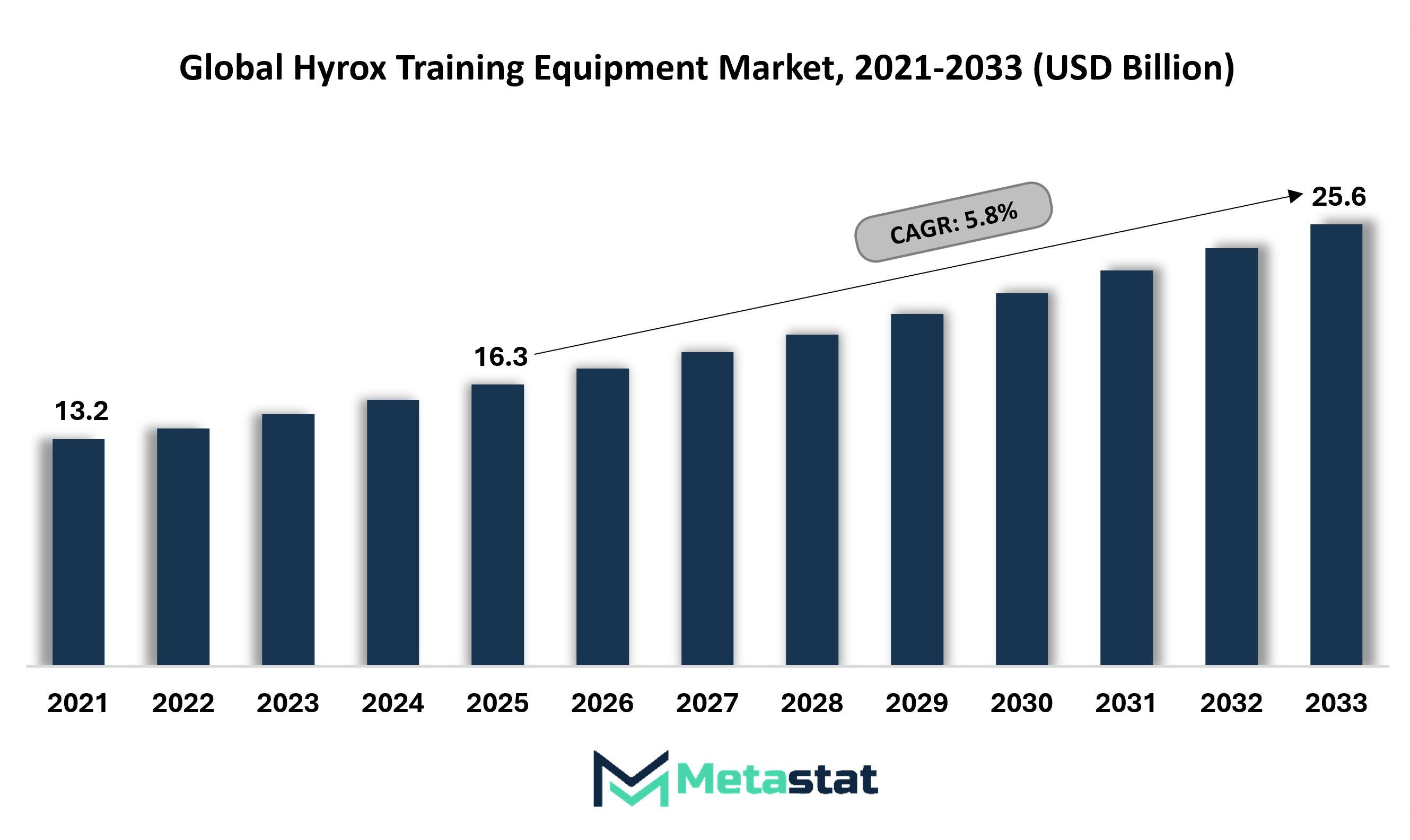
Rising global popularity of functional fitness events and hybrid endurance competitions increases equipment demand.
Rising interest in strength-endurance competitions, race-based fitness events, and measurable performance challenges is increasing purchases of sleds, rowers, ski trainers, wall balls, and turf systems. Event visibility across digital platforms is strengthening product awareness and improving commercial demand. The Global Hyrox Training Equipment market continues to gain momentum with wider adoption across fitness facilities.
Growing participation in organized fitness races and gym-based performance training programs propels adoption
Higher enrollment in structured conditioning camps, race preparation sessions, and coach-led performance classes is encouraging facility upgrades. Demand is rising for durable stations, interval training equipment, weighted carry tools, and recovery support products. Commercial gyms are seeking competitive differentiation through advanced training zones built for event preparation.
Restraints and Challenges:
High cost of specialized equipment limits accessibility for small gyms and individual users
Premium pricing of commercial sled tracks, rowing machines, ski trainers, flooring systems, and storage units creates budget pressure for smaller operators. Home users often postpone purchases owing to capital constraints. Entry barriers continue to slow market expansion across price-sensitive regions and independent training spaces.
Limited awareness in emerging markets restricts widespread adoption beyond urban fitness centers
Limited awareness of hybrid race formats across secondary cities reduces equipment inquiries and trial adoption. Premium urban fitness clubs are capturing early demand, while suburban locations remain underdeveloped. Distribution networks will move at a slower pace until stronger event marketing and coach education improve category familiarity.
Expansion of boutique fitness studios and HYROX-affiliated training centers creates scalable growth potential for equipment manufacturers
Specialized studios focused on race conditioning are opening new channels for bundled equipment sales, branded layouts, and recurring replacement cycles. Certified centers are supporting standardized product demand across regions. Manufacturers stand to benefit through partnerships, leasing models, maintenance contracts, and customized facility programs designed for rapid scaling.
The Global Hyrox Training Equipment market is segmented by Type, Application, End-User, and Sales Channel.
By Type, the market is further segmented into:
Sled Push Equipment segment is valued at USD 2.2 billion in 2026 and is projected to reach USD 3.1 billion by 2033, at a CAGR of 5% during the forecast period.
Growing demand for race-specific conditioning will support steady adoption of sled push equipment. Fitness facilities are looking for durable frames, adjustable resistance systems, smooth floor compatibility, and compact storage formats. Product innovation will include virtual load monitoring, smart sensors, and modular builds suited to different athlete levels.
Sled Pull Equipment segment is valued at USD 2 billion in 2026 and is projected to reach USD 2.8 billion by 2033, at a CAGR of 4.7% during the forecast period.
Sled pull equipment will gain traction through performance programs focused on power output, grip strength, and lower-body force development. Manufacturers will introduce stronger rope durability, variable drag systems, and foldable structures. Training venues value equipment that delivers intense sessions within limited floor space.
Rowing Machines segment is valued at USD 2.1 billion in 2026 and is projected to reach USD 3.2 billion by 2033, at a CAGR of 6.1% during the forecast period.
Rowing machines will remain essential owing to full-body conditioning benefits and measurable endurance output. Future demand will rise for connected consoles, performance analytics, quieter resistance systems, and commercial-grade frames. Multi-user training centers prefer machines that support fast transitions during circuit-based sessions.
SkiErg Machines segment is valued at USD 1.5 billion in 2026 and is projected to reach USD 2.7 billion by 2033, at a CAGR of 8.2% during the forecast period.
SkiErg machines will witness broader adoption through rising focus on upper-body endurance and race preparation needs. Market expansion will be supported by compact wall-mounted designs, advanced stroke metrics, and low-maintenance flywheel systems. Training operators prefer equipment that offers scalable intensity for both beginners and elite athletes.
Treadmills and Air Runners segment is valued at USD 2.9 billion in 2026 and is projected to reach USD 4.1 billion by 2033, at a CAGR of 5.2% during the forecast period.
Treadmills and air runners will maintain strong demand through running-focused conditioning programs. Future models will feature improved shock absorption, energy-efficient motors, self-powered options, and interval programming. Commercial buyers prefer machines built for high traffic, long training sessions, and low servicing requirements.
Kettlebells segment is valued at USD 1.7 billion in 2026 and is projected to reach USD 2.4 billion by 2033, at a CAGR of 5.2% during the forecast period.
Kettlebells will support market expansion through functional strength routines, mobility drills, and explosive movement training. Buyers will prefer coated finishes, ergonomic handles, color coding, and precise weight calibration. Compact storage remains an advantage for studios seeking versatile equipment with broad member usage.
Dumbbells segment is valued at USD 1.7 billion in 2026 and is projected to reach USD 2.5 billion by 2033, at a CAGR of 5.3% during the forecast period.
Dumbbells will maintain steady demand through their regular use across multiple training formats. Product development will include anti-roll designs, premium grip textures, smart weight recognition, and durable rubber coatings. Gyms value long product life, easy maintenance, and broad weight ranges that support progression plans.
Functional Training Rigs segment is valued at USD 1.9 billion in 2026 and is projected to reach USD 3.2 billion by 2033, at a CAGR of 7.7% during the forecast period.
Functional training rigs will attract investment through multi-station performance and group session capability. Future systems will include modular attachments, pull-up bars, storage zones, and branded layouts. Operators prefer rigs that maximize floor productivity while supporting varied movement patterns within one structure.
Others segment is valued at USD 1.2 billion in 2026 and is projected to reach USD 1.6 billion by 2033, at a CAGR of 4.9% during the forecast period.
Other equipment categories will include jump ropes, plyometric boxes, medicine balls, resistance bands, and mobility tools. Demand for these products will rise with the wider adoption of complete circuit programming. Suppliers offering bundled packages, durable materials, and coordinated branding will secure stronger commercial buying interest.
By Application, the market is divided into:
Strength Training segment is projected to reach USD 5.9 billion by 2033, at a CAGR of 5.3% during the forecast period.
Strength training applications will drive purchases of weighted tools, rigs, sled systems, and resistance accessories. Fitness programs increasingly emphasize measurable progress, structured overload, and safe technique development. Equipment manufacturers will introduce monitoring technologies that support coach feedback and performance benchmarking.
Endurance Training segment is projected to reach USD 4.7 billion by 2033, at a CAGR of 5.3% during the forecast period.
Endurance training demand will support rowing machines, air runners, treadmills, and interval-ready stations. Users are seeking longer training capacity supported by heart-rate integration and performance feedback. Facilities will prioritize durable machines capable of handling continuous use during peak hours and structured training blocks.
Race Simulation Training segment is projected to reach USD 4.8 billion by 2033, at a CAGR of 7% during the forecast period.
Race simulation training will emerge as a major growth avenue with rising event participation. Buyers are seeking equipment that mirrors competition standards, movement flow, and transition speed requirements. Facilities offering realistic practice zones will attract serious participants preparing for performance goals.
Functional Conditioning segment is projected to reach USD 5.8 billion by 2033, at a CAGR of 6.4% during the forecast period.
Functional conditioning applications will fuel demand for kettlebells, dumbbells, rigs, bands, and bodyweight stations. Market momentum will be supported by participants seeking practical fitness outcomes, mobility, balance, and stamina. Compact multi-use equipment remains attractive for efficient programming models.
Group Training segment is projected to reach USD 2.7 billion by 2033, at a CAGR of 4.5% during the forecast period.
Group training applications will encourage bulk purchases of synchronized equipment sets. Studios value quick setup, shared training formats, motivating layouts, and strong durability. Future solutions will include digital leaderboards, timer integration, and structured station sequencing suited for larger class participation.
Others segment is projected to reach USD 1.8 billion by 2033, at a CAGR of 6.1% during the forecast period.
Other applications will include rehabilitation support, youth conditioning, military readiness, and community wellness programs. Product demand will rise in settings where adaptable resistance levels and safe movement patterns remain essential. Suppliers serving these niche requirements will benefit from recurring institutional orders.
By End-User, the market is further divided into:
Commercial Gyms segment is projected to reach USD 6.8 billion by 2033.
Commercial gyms will remain the leading buyers owing to large membership bases and ongoing equipment upgrades. Operators are seeking durable assets, attractive layouts, and strong returns on floor space. Connected training zones will support member retention and premium membership conversion.
Boutique Fitness Studios segment is projected to reach USD 3.9 billion by 2033.
Boutique fitness studios will support demand through specialized class experiences focused on intensity and community engagement. Compact spaces encourage versatile equipment choices with strong visual appeal. Premium finishes, branded rigs, and digital training tools will strengthen studio differentiation.
Cross-Training Facilities segment is projected to reach USD 4.7 billion by 2033.
Cross-training facilities will require rugged equipment that supports mixed-modality sessions and competitive training environments. High repetition usage is increasing the focus on durability, safety, and easy maintenance. Vendors offering complete facility solutions will secure larger contracts across expanding performance communities.
Sports Performance Centers segment is projected to reach USD 3.3 billion by 2033.
Sports performance centers will invest in advanced systems that support athlete testing, conditioning, and recovery-linked programs. Precision metrics, coach dashboards, and progressive load options are becoming important purchase considerations. Professional and amateur athlete development programs continue to support steady demand.
Home Users segment is projected to reach USD 2.7 billion by 2033.
Home users will create growing opportunities through convenient personal training setups. Foldable machines, adjustable weights, compact sled options, and app-connected guidance will attract buyers. Space efficiency, quiet operation, and competitive pricing remain key purchase factors.
Hotels and Wellness Clubs segment is projected to reach USD 1.5 billion by 2033.
Hotels and wellness clubs are increasingly adding functional fitness zones to improve guest experience. Demand will center on premium compact equipment, low-maintenance machines, and beginner-friendly layouts. Wellness-focused travel trends continue to support gradual adoption across hospitality properties.
Schools and Universities segment is projected to reach USD 1.2 billion by 2033.
Schools and universities will invest in conditioning equipment for athletics, recreation, and wellness programs. Durable equipment with strong safety features and wide usability will remain preferred. Institutional budgeting cycles will favor phased procurement plans and service support agreements.
Corporate Fitness Centers segment is projected to reach USD 0.8 billion by 2033.
Corporate fitness centers will support demand through workplace wellness initiatives and employee engagement strategies. Compact multi-purpose equipment suits office environments with limited space. Data-linked usage monitoring will help companies measure participation and program outcomes.
Others segment is projected to reach USD 0.7 billion by 2033.
Other end users will include community centers, military sites, rehabilitation facilities, and residential clubs. Demand across these categories will depend on flexible programming, safety standards, and available budgets. Suppliers with scalable product portfolios will benefit from wider institutional demand.
By Sales Channel, the Global Hyrox Training Equipment market is divided as:
Direct Sales segment is projected to grow at a CAGR of 8.3% during the forecast period.
Direct sales channels will remain valuable for large installations that require consultation, customization, and after-sales service. Manufacturers benefit from stronger margin control and direct customer feedback. Commercial buyers prefer tailored quotations, delivery planning, and clear warranty terms.
Specialty Fitness Equipment Stores segment is projected to grow at a CAGR of 5.2% during the forecast period.
Specialty fitness equipment stores will attract buyers looking for product trials, professional guidance, and immediate product comparison. Demonstration zones can improve purchase confidence. Premium brands often benefit from curated retail environments targeted at performance-oriented customers.
Online Retail segment is projected to grow at a CAGR of 8.1% during the forecast period.
Online retail will expand rapidly through convenience, wide product visibility, and easier price comparison. Buyers increasingly value reviews, financing options, doorstep delivery, and digital support. Strong logistics networks will remain important for bulky equipment categories.
Distributors and Dealers segment is projected to grow at a CAGR of -2.4% during the forecast period.
Distributors and dealers will continue to play an important role across regional markets that require local inventory and service reach. Multi-brand portfolios help buyers compare alternatives more effectively. Reliable installation networks also strengthen long-term commercial relationships.
B2B Procurement segment is projected to grow at a CAGR of 6.8% during the forecast period.
B2B procurement channels will expand among gym chains, institutions, and corporate buyers handling bulk orders. Centralized sourcing improves pricing leverage, standardized specifications, and vendor accountability. Digital procurement platforms will streamline tendering and approval cycles.
Others segment is projected to grow at a CAGR of 7% during the forecast period.
Other channels will include leasing models, rental programs, second-hand networks, and event partnerships. Flexible ownership structures will attract budget-conscious buyers. Suppliers offering subscription-based maintenance packages will also unlock recurring revenue streams.
Based on geography, the Global Hyrox Training Equipment market is divided into North America, Europe, Asia-Pacific, South America, Middle East, and Africa.
North America is witnessing strong adoption owing to premium gym memberships and rising participation in organized fitness races.
In North America, Hyrox Training Equipment market growth gains support from connected fitness technology and rapid replacement cycles for commercial equipment.
Europe represents a strong regional market for HYROX training equipment, supported by a well-established fitness industry, rising participation in organized functional fitness formats.
Asia-Pacific presents significant opportunities for the Hyrox Training Equipment market through expanding middle-class fitness spending and rising boutique studio penetration.
Across the Middle East, Africa, and South America, the Hyrox Training Equipment market progresses through rising wellness awareness, urban gym development, and increasing demand for performance-led group training formats.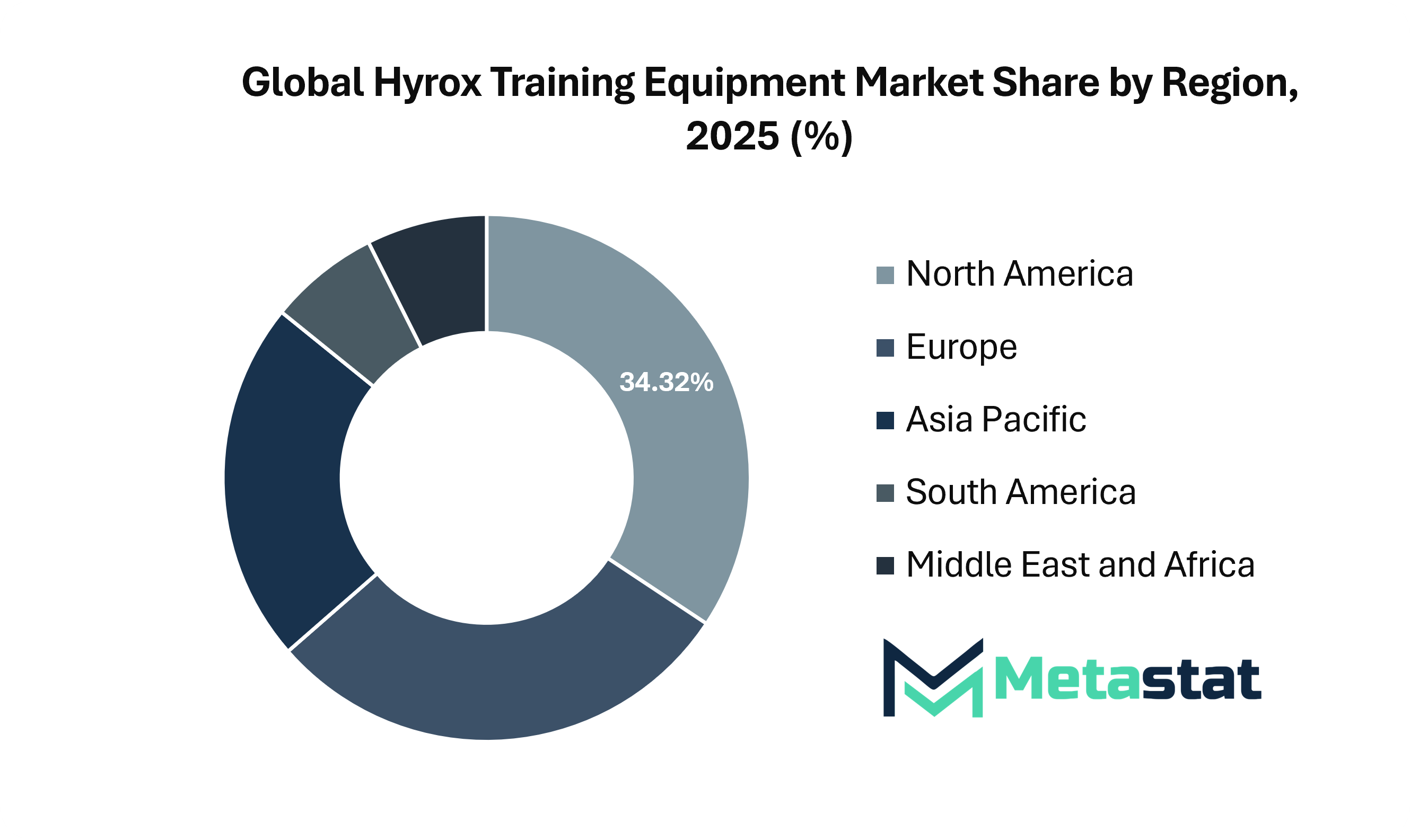
The Global Hyrox Training Equipment market is expanding with support from manufacturers that specialize in strength equipment, cardio machines, and durable commercial fitness setups. Buyers are prioritizing products that can withstand repeated use during race-style training, making established brands important across gym and studio purchasing decisions. American Barbell, Rogue Fitness, Eleiko Group AB, and REP Fitness are widely recognized for bars, plates, racks, and benches designed for high-intensity training environments. These product lines support athlete performance and help facilities build structured training zones tailored to competitive fitness preparation. Cardio-focused brands also play a central role in shaping market demand, with Concept2, Inc. maintaining strong relevance through rowing and ski training equipment.
Assault Fitness Products is widely used for air bikes and curved treadmills suited to intense interval training. Keiser Corporation offers resistance systems valued for smooth movement and reliable output across professional training environments. Functional training remains another important category within the market. Fitness Anywhere LLC (TRX), Escape Fitness, BLK BOX, Bulldog Gear, and Wolverson Fitness provide sleds, sandbags, rigs, and conditioning tools that align well with HYROX-style training circuits. These products help users improve movement efficiency and transition speed between running and workout stations. Rising home fitness participation and connected training adoption are also supporting brands such as BowFlex, Centr, LLC, iFIT Health & Fitness Inc., and NOHRD, which appeal to users seeking guided workouts and compact indoor setups. BH Fitness and Body-Solid, Inc. offer broad product portfolios that cater to homes, clubs, and commercial fitness spaces.
Regional specialists and value-driven brands also remain important to market development. Bells of Steel, Get RX’d, Mirafit, Gymleco, Jordan Fitness, Origin Fitness, BullrocK Fitness, Strengthshop GmbH, Ironcompany, Gym Concepts, Gopher Sport, Core Health & Fitness, LLC, and SDEG Ltd are helping broaden customer choice through competitive pricing, localized distribution, and targeted product offerings. Their presence strengthens product accessibility across different user groups and budget levels.
Going forward, competition will center on durability, smart monitoring, easier storage, and equipment designed for faster circuit transitions. Brands that balance pricing, product quality, and athlete requirements will strengthen demand across gyms, studios, and home users preparing for event-based fitness challenges. Buyers are also evaluating warranty terms, service support, spare-parts availability, and ease of maintenance before making purchasing decisions. Strong partnerships with events, gyms, and coaches will improve brand visibility and support repeat orders over the forecast period.
Market size is forecast to rise from USD 16.3 billion in 2025 to over USD 25.6 billion by 2033.
The Global Hyrox Training Equipment market is expected to integrate more deeply with digital coaching platforms, event qualification ecosystems, and personalized performance analytics over the forecast period. Equipment purchasing decisions are increasingly being shaped by measurable training outcomes such as race times, watt output, recovery metrics, and overall workout efficiency.
This research report categorizes the Hyrox Training Equipment market based on key segments and regions, forecasts revenue growth, and analyses trends in each submarket. The report analyses the key growth drivers, opportunities, and challenges influencing the Hyrox Training Equipment market. Recent market developments and competitive strategies such as expansion, product launch, partnership, merger, and acquisition have been included to draw the competitive landscape in the market.
|
Report Attributes |
Details |
|
Study Period |
2021-2033 |
|
Base Year |
2025 |
|
Estimated Year |
2026 |
|
Forecast Period |
2026-2033 |
|
Historical Period |
2021-2025 |
|
Growth Rate |
CAGR 5.8% from 2026 to 2033 |
|
Revenue Unit |
USD billion |
|
Sales Volume Unit |
Thousand Units |
|
Segmentation |
By Type, Application, End-User, Sales Channel, and Region |
|
By Region |
North America (By Type, Application, End-User, Sales Channel, and Country)
|
|
|
Europe (By Type, Application, End-User, Sales Channel, and Country)
|
|
|
Asia Pacific (By Type, Application, End-User, Sales Channel, and Country)
|
|
|
South America (By Type, Application, End-User, Sales Channel, and Country)
|
|
|
Middle East and Africa (By Type, Application, End-User, Sales Channel, and Country)
|
The report strategically identifies and profiles the key market players and analyses their core competencies in each sub-segment of the Hyrox Training Equipment market.
Find answers to common questions about this report
Top players operating in the Hyrox Training Equipment industry include American Barbell, LLC, Assault Fitness Products, Beistegui Hermanos S.A. (BH Fitness), Bells of Steel, BLK BOX, Body-Solid, Inc., and Gym Concepts.
Global Hyrox Training Equipment market is estimated to reach USD 25.6 billion by 2033.
High cost of specialized equipment limits accessibility for small gyms and individual users will hamper the market growth within the forecast period.
Rising global popularity of functional fitness events and hybrid endurance competitions increases equipment demand and growing participation in organized fitness races and gym-based performance training programs propels adoption are key driving factors, boosting the market.
North America region dominates the market.
The Treadmills and Air Runners is the leading type of segment in the Global market.
The Global Hyrox Training Equipment market is expected to grow at a CAGR of 5.8% over the forecast period (2026-2033).
The Metastat Insights analysis shows that the North America Hyrox Training Equipment market size is estimated to be USD 8.5 billion by 2033.
The Metastat Insights study shows that the Global Hyrox Training Equipment market size was USD 16.3 billion in 2025.
The analysts below cover Consumer Goods research at Metastat Insights.
LEAD ANALYST
Utkarsh Khirodkar is a Lead Market Research Analyst at MetaStat Insight, specializing in market intelligence, technology sector assessments, and competitive strategy.
Our team was tracking whether regional recycling infrastructure could realistically absorb the growing volume of lithium iron phosphate batteries over the next decade. The report did a solid job separating announced hydrometallurgical plant capacity from active, permitted operational throughput. That distinction made the feedstock availability projections and regional recovery rate models far more credible than standard commercial overviews.
Tracking capacity expansion in single-use bioprocessing requires dependable data on raw material availability and cleanroom-grade polymer supply chains. The competitive landscape chapter gave a grounded evaluation of secondary component suppliers across North America and Asia-Pacific rather than simply reprinting press releases. Having that level of supplier benchmarking helped clarify dual-sourcing considerations for our clinical pipeline planning.
When evaluating distributed energy resource management systems, standard research summaries tend to gloss over the operational differences between front-of-the-meter utility deployments and behind-the-meter industrial sites. The MetaStat Insight report addressed those distinctions directly, especially regarding software interoperability standards and grid interconnection backlogs. The five-year market sizing across regional transmission organizations provided actionable context for our grid modernization strategy.
Explore related market intelligence reports worth reading alongside this one.