
LEAD ANALYST
Utkarsh Khirodkar is a Lead Market Research Analyst at MetaStat Insight, specializing in market intelligence, technology sector assessments, and competitive strategy.

Global Land Planning and Development Consulting Services Market Size, Share, By Service Type (Land-Use and Master Planning, Entitlements and Permit Management, Environmental Planning and Compliance, Site Due Diligence and Feasibility, Development Project Management), By Project Type (Residential, Commercial, Industrial and Logistics, Mixed-Use, Infrastructure and Utilities, Civic and Institutional), By Client Type (Property Developers and Landowners, Government and Public Agencies, Infrastructure and Utility Operators, Corporate and Institutional Occupiers), By Engagement Model (Project-Based Assignments, Retainer Agreements, Outsourced Planning Staff), Industry Analysis, Growth, Trends, and Forecast, 2026-2033
Report ID
MSI-5636
Published
October, 2026
Pages
252 Pages
Format
Historical
Base year
Forecast
Forecast period
Report Details
Market Valuation: Valued at $37.3 Billion in 2025, projected to reach $70 Billion by 2033 at a 8.2% CAGR.
Dominant Segment: The Entitlements and Permit Management segment leads the market, driven by the increasing demand for compliance with local regulations and zoning laws. This segment is projected to reach USD 16.4 billion by 2033, reflecting a strong growth trajectory.
Geographic Lead: North America holds the largest market share at 29.2% in 2025, with the United States expected to lead in 2026. This growth is attributed to robust demand for land planning services in residential and commercial development.
What's Inside: The report provides comprehensive coverage of the competitive landscape, detailed analyses of market dynamics, and a forecast window extending from 2026 to 2033. It includes insights into various service types, project types, and client engagement models.
Growth in Residential Projects: The residential project segment is experiencing significant growth, with a projected CAGR of 7.6% through 2033. This surge is driven by urbanization and the increasing demand for new housing developments.
Enhanced Data Analytics: Technological advancements in data analytics are improving planning efficiency, enabling better decision-making and project outcomes. The adoption of AI and machine learning is becoming crucial for property developers and landowners.
Choose Your License
Global Land Planning and Development Consulting Services Market
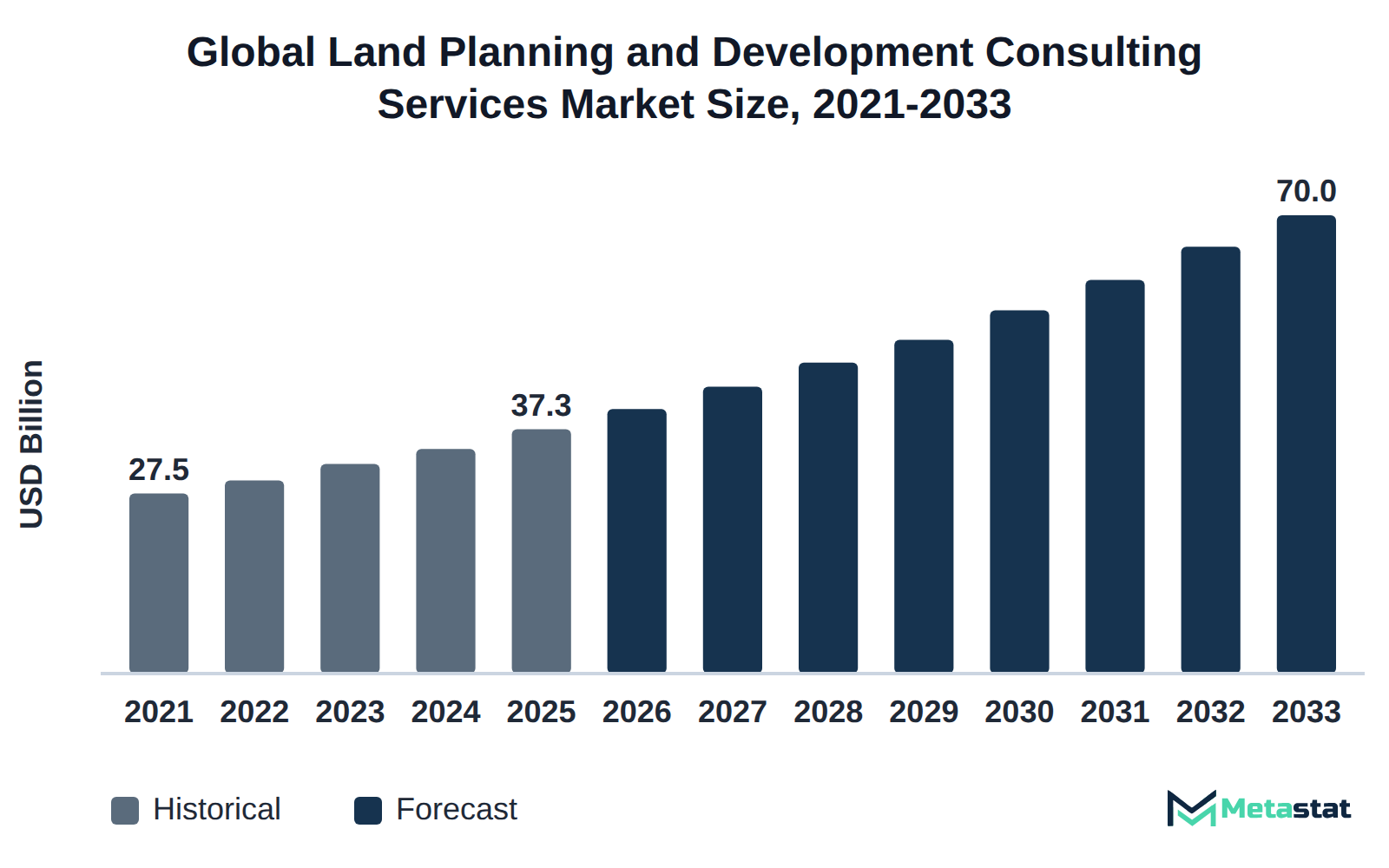
The global Land Planning and Development Consulting Services market was valued at USD 37.3 billion in 2025 and is projected to reach USD 70 billion by 2033, growing at a CAGR of 8.2% over the forecast period.
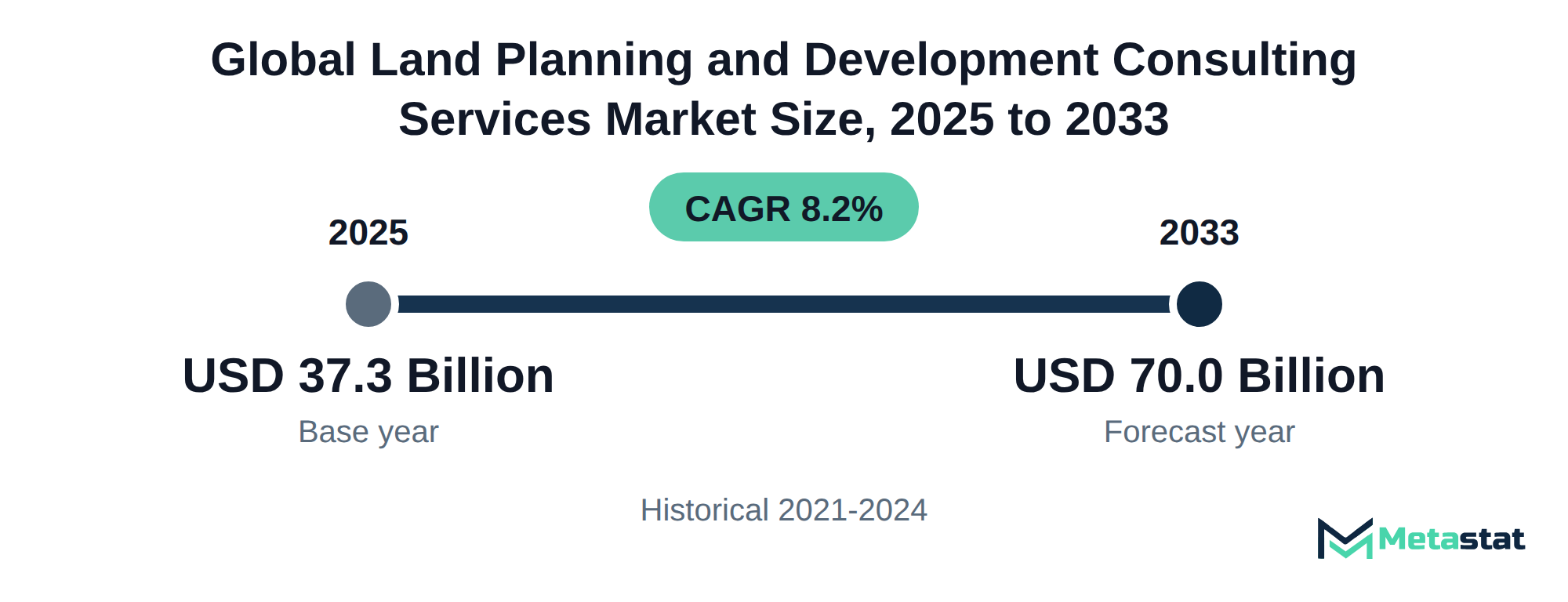
The Land Planning and Development Consulting Services market covers professional services that support the strategic development and management of land resources. Buyers invest in these services to navigate complex regulatory frameworks, ensure compliance, and optimize land-use strategies. The need for sustainable development practices drives demand across various sectors, including real estate, infrastructure, and public agencies.
Growth in the market is influenced by increasing urbanization, population growth, and a heightened focus on environmental sustainability. The segment of Entitlements and Permit Management represents the most significant revenue potential, driven by the necessity for compliance with local regulations and zoning laws. North America holds 29.2% of the market in 2025, with the US leading in 2026, reflecting robust demand in this region compared to Europe and Asia Pacific.
The market expansion is primarily fueled by investments in residential and commercial development projects. Property developers and landowners seek expert consulting services to maximize the value of their land assets while ensuring adherence to environmental standards. This focus on responsible development practices aligns with broader trends in sustainability and urban planning.
The Land Planning and Development Consulting Services market includes various sectors aimed at facilitating land use, zoning compliance, and environmental considerations for diverse projects. Buyers engage these services to navigate complex regulatory landscapes, optimize land use, and plan sustainable developments. The demand for these services is driven by a growing emphasis on urbanization and the need for efficient land utilization in both residential and commercial sectors.
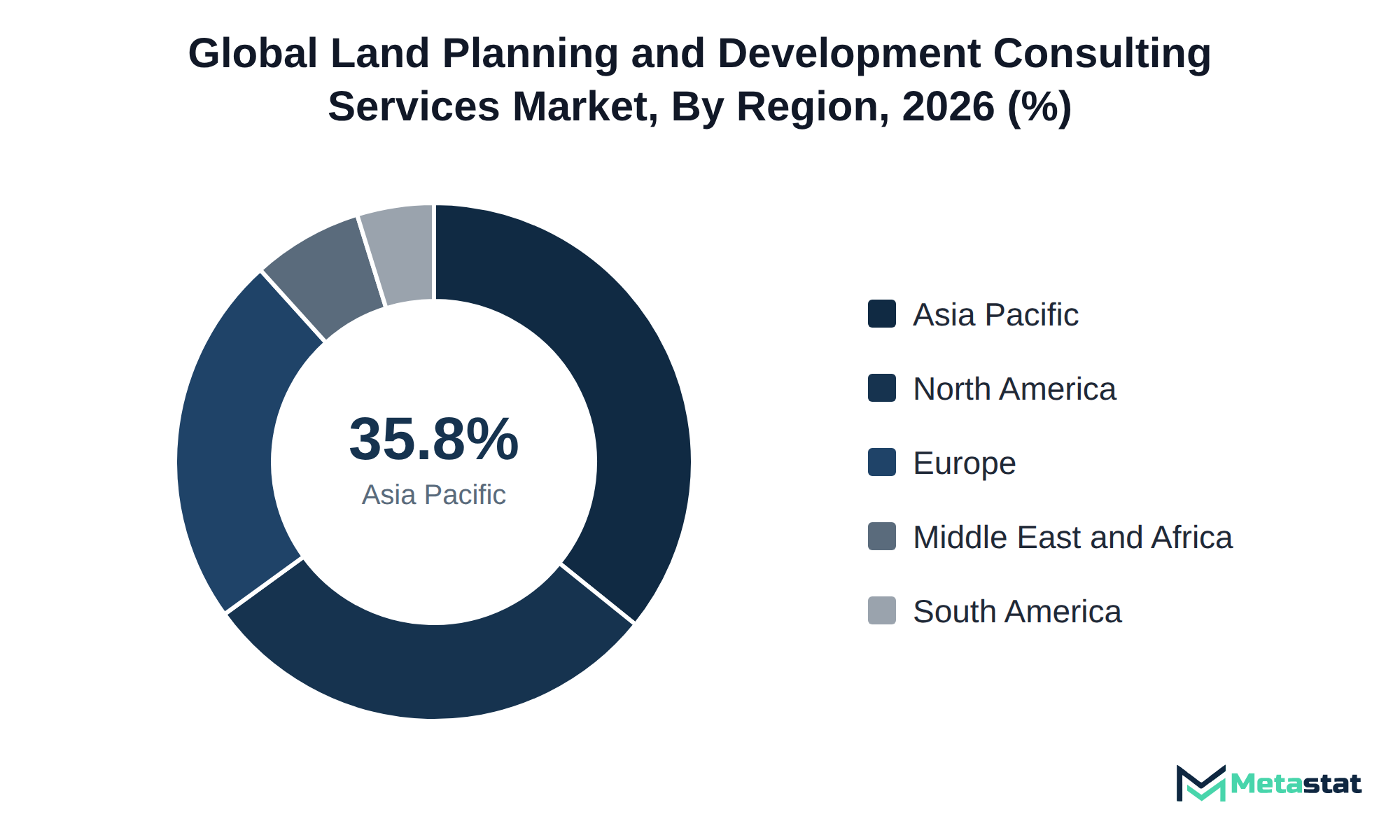
Growth in the market is propelled by increasing investment in infrastructure projects, particularly in the Asia Pacific region, which holds the largest market share at 35.8% in 2025. The segment of Land-Use and Master Planning represents the highest value within the market, reflecting a significant focus on comprehensive planning strategies to meet community needs and environmental standards.
Future developments in the market are expected to benefit from advancements in technology and big data analytics, enhancing decision-making processes and project efficiency. The integration of smart city concepts and sustainable practices into planning services further influences investment trends, ensuring that projects align with modern regulatory requirements and community expectations.
The entitlement strategy for infill housing and mixed-use development is essential in the Land Planning and Development Consulting Services market. This strategy focuses on securing necessary approvals and permits to facilitate development projects that optimize land use and address urban housing shortages. Infill projects, often located within existing urban areas, offer a sustainable approach to expansion, significantly reducing the need for new infrastructure and minimizing environmental impacts.
The segment for entitlements and permit management is projected to reach USD 16.4 billion by 2033, reflecting a compound annual growth rate of 9.3%. This growth indicates an increasing recognition of the importance of effective entitlement strategies in the successful execution of development projects. Property developers and landowners prioritize these strategies to expedite project timelines and ensure compliance with local regulations.
A clear entitlement strategy improves the feasibility and potential profitability of infill housing and mixed-use developments. The strategic approach streamlines the approval process, improves community relations, and minimizes opposition to new projects. These factors create a more efficient development cycle and support growth across the market.
Environmental permitting and mitigation services within the Land Planning and Development Consulting Services market operate on diverse pricing models tailored to client needs and project scopes. Project-based assignments represent a significant portion of engagements, generating revenue through a fee structure that aligns with the complexity and duration of individual projects. By 2033, revenue from project-based assignments is expected to reach USD 43.5 billion, indicating a clear market trend toward customized service agreements.
Retainer agreements ensure consistent service for ongoing projects. These contracts allow clients to secure a dedicated consultant or team for a specific duration, facilitating a streamlined process for environmental compliance and permitting. Revenue from retainer agreements is projected to reach USD 15 billion by 2033.
Understanding pricing models and contract structures is essential for stakeholders within the market. Clients including property developers and government agencies rely on structured payment systems to manage budgets effectively while ensuring timely project execution. Clear pricing strategies enhance competitive positioning and increase demand for consulting services that address environmental regulations.
Municipalities increasingly rely on contract planning capacity to streamline development approvals within the Land Planning and Development Consulting Services market. This reliance stems from the growing complexity of urban projects and the need for specialized expertise to navigate local regulations effectively. The market anticipates a significant increase in demand, with the segment for Property Developers and Landowners projected to expand from USD 18.5 billion in 2026 to USD 32.8 billion by 2033, reflecting a compound annual growth rate of 8.5%.
As urban areas expand, local governments face challenges in managing permits and approvals efficiently. Engaging contract planners allows municipalities to utilize external expertise in land-use practices, compliance, and community engagement. This approach alleviates the burden on public agencies while accelerating the approval process, providing immediate benefits for property developers and landowners. Improved efficiency leads to reduced project timelines and lower costs, enhancing competitiveness in a fast-evolving market.
Investing in contract planning capacity positions municipalities to meet the growing needs of urban development while building collaborative relationships with private sector stakeholders. Integrating skilled contract planners in municipal settings helps municipalities navigate complex regulatory environments and supports sustainable growth in urban development projects.
Early land-use due diligence significantly minimizes approval delays during development projects. Conducting thorough due diligence ensures compliance with local regulations and zoning laws, streamlining the permitting process. This proactive approach leads to faster approvals, enhancing the overall project timeline and reducing costs associated with delays. In the context of the Land Planning and Development Consulting Services market, the service segment focused on "Site Due Diligence and Feasibility" is projected to experience a compound annual growth rate (CAGR) of 6.9%, highlighting the increasing importance of due diligence in the development process.
Integrating early land-use due diligence into project planning influences project success. By identifying potential obstacles early, developers mitigate risks that could otherwise lead to costly delays. This strategy aligns with the growing emphasis on efficiency within the market, creating an environment where timely project execution becomes a competitive advantage. Successful navigation of regulatory environments enhances reputation and attracts potential investors who value reliability and proactive management. Effective due diligence upfront is a strategic investment in the success of land planning initiatives.
A significant shift toward residential development drives increased spending in the Land Planning and Development Consulting Services market. Property developers and landowners prioritize building projects, responding to evolving demographic trends and heightened demand for housing. Urbanization and population growth escalate the urgency for new residential units. This trend results in a substantial rise in project volume, contributing to a growth rate of 7.6% for residential project consulting services through 2033. Effective planning and compliance solutions highlight the importance of consulting services, leading to greater market activity and investment in residential developments.
The growing emphasis on sustainable and efficient land use practices fuels further demand. Developers seek expert guidance to navigate complex regulations and environmental considerations, reinforcing the role of consulting services in achieving successful project outcomes. The competitive environment drives firms to enhance their service offerings, ensuring they meet the specific needs of clients in this dynamic sector.
Technological advancements in data analytics substantially influence the effectiveness of land planning and development processes. Tools incorporating artificial intelligence and machine learning facilitate the analysis of vast datasets, allowing for more informed decision-making. These technologies enable planners to evaluate land-use patterns, potential environmental impacts, and community needs swiftly, optimizing project outcomes. Geospatial analytics supports this evaluation by tying land-use patterns and site conditions to specific locations.
Property developers and landowners increasingly adopt these data-driven approaches, resulting in improved project feasibility and reduced costs. The integration of advanced analytics into planning workflows enhances collaboration among stakeholders, leading to more streamlined communication and project execution. This aspect of technology adoption is expected to drive the growth of the market.
With the continuous evolution of these technologies, firms specializing in land planning are positioned to enhance their service offerings, catering to the complex demands of urban development and sustainability. The emphasis on data-driven strategies reflects a broader trend towards efficiency and precision within the sector.
Regulatory challenges significantly affect the pace of project approvals within the Land Planning and Development Consulting Services market. Complex permitting processes and stringent compliance requirements create delays for property developers and landowners, resulting in slower project initiation and reduced investment in new developments. The intricate nature of zoning regulations often necessitates extended negotiations with public agencies, complicating timelines and increasing project costs. This scenario discourages several developers from pursuing ambitious projects, prompting a preference for smaller or less complex undertakings. Consequently, the market experiences a contraction in the volume of new projects, limiting revenue potential for consulting firms. Over time, these regulatory hurdles hinder overall market growth, presenting a notable constraint for stakeholders engaged in land development initiatives.
Profitability challenges arise from increasing talent costs within the Land Planning and Development Consulting Services market. A shortage of skilled professionals drives salaries higher, impacting operational margins. Firms actively address this challenge by investing in employee training and adopting innovative recruitment strategies to attract new talent. Companies explore automation tools to enhance project efficiency, thereby reducing reliance on extensive personnel. This strategic focus strengthens competitive positioning and accommodates rising project demands without a proportional increase in labor costs. These initiatives improve profit margins and help firms sustain growth in a competitive market. Addressing talent costs remains essential for maintaining service quality and meeting client expectations in a changing industry.
The Entitlements and Permit Management segment within the Land Planning and Development Consulting Services market presents a substantial growth opportunity, driven by increasing demand for efficient project approvals. Factors including heightened regulatory scrutiny and the complexity of obtaining necessary approvals create a pressing demand among property developers and landowners. These entities seek expert guidance to navigate the entitlements process, ensuring compliance while minimizing delays. The growing emphasis on sustainable development further fuels the need for effective permit management strategies. Increasing investments in infrastructure and urban development contribute to the demand for specialized consulting services. Addressing these requirements enables firms to capture a larger market share while enhancing operational efficiencies within their projects.
The Global Land Planning and Development Consulting Services market is segmented based on Service Type, Project Type, Client Type, and Engagement Model.
Land-Use and Master Planning segment is valued at USD 12.8 billion in 2026 and is projected to reach USD 20.8 billion by 2033, at a CAGR of 7.2% during the forecast period. This segment focuses on creating comprehensive plans for land development that serve diverse stakeholder needs, including property developers and governmental agencies. Growth in this segment is driven by increasing urbanization and the demand for sustainable land use strategies. The emphasis on compliance with environmental regulations enhances the necessity for effective land-use planning. Compared to the Entitlements and Permit Management segment, which has a higher growth rate of 9.3%, Land-Use and Master Planning is characterized by more moderate expansion. Nonetheless, its critical role in shaping urban landscapes positions it as a key component of the market, catering to the evolving needs of communities and urban planners.
This segment focuses on obtaining necessary approvals and permits for development projects, serving property developers, government agencies, and public entities. Increasing urbanization and stricter regulatory frameworks drive demand in this segment, emphasizing the importance of compliance in development projects. Unlike other service types, which experience varied growth rates, this segment exhibits a faster growth trajectory due to heightened attention on sustainability and environmental impact assessments. The 9.3% CAGR reflects its rising significance, indicating a shift towards more regulated development processes. In comparison, other segments, including Land-Use and Master Planning, grow at a slower rate of 7.2%. The market reflects a clear trend towards prioritizing thorough entitlements and permitting to mitigate risks associated with regulatory non-compliance.
Environmental Planning and Compliance segment is expected to reach USD 15.8 billion by 2033. This segment focuses on ensuring that projects comply with environmental laws and regulations, often involving assessments, planning strategies, and mitigation measures. Environmental testing is a common input to the assessments behind these projects. Clients, including property developers, government agencies, and environmental organizations, leverage these services to address environmental impacts on projects. Demand for this segment is driven by heightened regulatory scrutiny and the increasing importance of sustainability in development projects. With a compound annual growth rate (CAGR) of 9.3%, this segment exhibits faster growth compared to other service types, reflecting its essential role in project viability. This demand contrasts with slower growth in segments like Site Due Diligence and Feasibility, which operates at a CAGR of 6.9%. The focus on compliance and sustainable practices positions this segment as a key factor in the market, influencing overall development strategies and investment decisions.
Site Due Diligence and Feasibility segment is projected to grow at a CAGR of 6.9% during the forecast period. This segment involves assessing the viability and potential of land for specific development projects, addressing factors including environmental impact, zoning regulations, and site conditions. Land surveying often provides the boundary and topographic data that informs these site condition assessments. Property developers and landowners frequently engage these services to mitigate risks and ensure project success. The increasing emphasis on sustainable development and adherence to regulatory standards drives demand for this segment, particularly in urban areas facing stringent compliance demands. Compared to other service types, including Entitlements and Permit Management, which is expected to grow at a faster rate of 9.3%, Site Due Diligence and Feasibility highlights a more cautious approach to development, focusing on thorough assessments before proceeding. This careful planning supports long-term investments and enhances project feasibility.
Development Project Management involves the coordination and oversight of various phases in land development projects, ensuring that initiatives align with strategic objectives and regulatory requirements. Engineering, procurement, and construction management is a closely related discipline that also oversees multiple project phases. This segment serves property developers and landowners, government agencies, and infrastructure operators, who rely on effective project management to navigate complex approval processes and adhere to timelines. Demand for such services is driven by increasing urbanization and the necessity for efficient resource allocation. Compared to other service types, Development Project Management typically involves higher project costs and longer engagement periods. This segment experiences steady growth, influenced by the rising complexity of projects requiring cross-disciplinary collaboration and stakeholder engagement. In contrast to quicker-growing segments like Entitlements and Permit Management, Development Project Management emphasizes long-term project viability and comprehensive execution strategies, making it a critical component of the overall market.
This segment focuses on public engagement and development economics, encompassing the processes of involving stakeholders and assessing the economic implications of land development projects. Professionals apply these services to align community interests with project goals, ensuring that developments are socially and economically viable. Clients, including government entities and private developers, prioritize this segment to enhance community acceptance and navigate regulatory landscapes. Key drivers include increasing public scrutiny of development projects and a growing emphasis on sustainable economic practices. This segment differs from others within the Service Type group, as it addresses unique stakeholder concerns and integrates economic analysis, positioning it as a crucial component in achieving long-term project success. Compared to Land-Use and Master Planning and Environmental Planning and Compliance, this segment requires a nuanced approach to stakeholder engagement and economic evaluation, resulting in distinct methodologies and client interactions.
The residential segment is valued at USD 11.4 billion in 2026 and is projected to reach USD 19 billion by 2033, at a CAGR of 7.6% during the forecast period. This segment focuses on developing housing projects, catering primarily to property developers and landowners who seek to enhance residential spaces. Increasing urbanization alongside a growing population drives demand for new housing projects. Compared to other segments, the residential sector experiences a strong growth trajectory, characterized by higher demand from private developers looking to capitalize on the expanding housing market. The need for affordable housing solutions creates additional opportunities for developers, influencing project types and engagement models. The market’s growth reflects ongoing efforts by stakeholders to balance community needs with sustainable development practices.
Commercial segment is estimated to reach USD 11.1 billion by 2033, at a CAGR of 7% during the forecast period. This segment includes planning services tailored for businesses and organizations seeking to establish or expand commercial facilities. Corporate clients, ranging from retail operations to office developers, engage these services to ensure compliance with local regulations and to optimize land use for profitability. Demand for commercial real estate development faces upward pressure due to economic growth and urbanization trends, driving investment in infrastructure and retail spaces. Compared to the residential segment, which exhibits a CAGR of 7.6%, the commercial sector shows steadier growth, driven by stable demand from property developers and landowners. Consequently, this segment presents a unique opportunity for consulting services that adapt to evolving market needs, including sustainability and technological advancements in building design. The growth trajectory in the commercial segment reinforces its significance in the broader Land Planning and Development Consulting Services market.
The Industrial and Logistics segment is expected to reach USD 9.4 billion by 2033. This segment focuses on the planning and development of infrastructure related to industrial operations and logistics services. Key clients include property developers, landowners, and logistics operators who engage consulting services for site selection, facility design, and regulatory compliance. Demand for this segment is influenced by the growth of e-commerce and the need for efficient supply chain solutions. Industrial and logistics real estate development also shapes the site selection and facility design work these clients commission. With a CAGR of 7% during the forecast period, the Industrial and Logistics segment demonstrates slower growth compared to the Residential segment, which is projected to grow at 7.6%. Strategic investments in infrastructure and adaptive reuse of existing facilities support this segment's expansion, while rising construction costs pose challenges to profit margins. The market experiences heightened competition as firms adapt to meet evolving client needs and regulatory frameworks.
Mixed-Use segment is projected to grow at a CAGR of 9% during the forecast period. This segment encompasses developments that combine residential, commercial, and recreational spaces, catering to urban environments that prioritize accessibility and community interaction. Property developers and landowners primarily apply these services to optimize land use and enhance value through diverse offerings. The rising preference for sustainable and integrated living spaces drives demand for mixed-use projects, differentiating this segment from others with slower growth rates. Increased urbanization and the need for efficient land use significantly influence market dynamics, supporting strong expansion compared to other project types, including Industrial and Logistics, which lack the same growth momentum. As urban areas evolve, the market for mixed-use developments continues to gain importance globally.
This sub-segment encompasses planning and consulting services aimed at infrastructure and utility projects, addressing essential community needs. These services find application among government bodies, utility providers, and private developers focused on enhancing public works and utility networks. Demand for these services is shaped by increasing urbanization and the necessity for sustainable infrastructure solutions, which drives investment in utility projects. Differentiating this sub-segment from others, it experiences stable demand due to its alignment with regulatory requirements and aging infrastructure across various regions. The market reflects heightened investment interest, particularly in areas focused on energy efficiency and technological integration. Such dynamics support a strong outlook for the Infrastructure and Utilities sub-segment.
Civic and Institutional development focuses on creating and enhancing public spaces, including parks, government buildings, and community facilities. This segment engages clients including government agencies and civic organizations, aiming to address community needs and improve urban functionality. A growing emphasis on sustainable design practices significantly influences this segment, leading to projects that prioritize environmental responsibility and social impact. Compared to other project types, Civic and Institutional initiatives often face unique regulatory requirements, driving up project timelines and costs. This segment's alignment with public interest creates distinct opportunities for engagement with communities, differentiating it from more profit-driven projects including commercial or industrial development. The market observes increasing demand for collaboration with local stakeholders, which enhances project relevance and community acceptance.
This sub-segment encompasses planning and consulting services focused on recreation and rural development projects. These services are employed by a variety of clients, including local governments, non-profits, and private landowners, who seek to enhance community engagement and promote sustainable land use. Key drivers for this segment include increasing public interest in outdoor spaces and the growing emphasis on sustainable practices in land development. Compared to other project types, this sub-segment experiences relatively slower growth yet plays a critical role in addressing community needs and ecological preservation. While the residential and commercial segments thrive with higher growth rates, recreation and rural development remain essential for building community connections and improving the quality of life, contributing positively to the overall dynamics of the market.
This segment focuses on services that cater to individuals and organizations involved in real estate development and land ownership, including planning for residential, commercial, and mixed-use projects. Increased urbanization and population growth drive demand, requiring effective land-use strategies and compliance with regulations. Compared to other client types, this segment experiences faster growth, fueled by ongoing investments in infrastructure and development. The projected CAGR of 8.5% highlights a robust outlook driven by the necessity for sustainable development practices and efficient land management. Competition among developers enhances the demand for comprehensive consulting services, ensuring successful project completion while adhering to environmental standards. This dynamic results in significant opportunities within the Land Planning and Development Consulting Services market.
The Government and Public Agencies segment is estimated to reach USD 23.9 billion by 2033, at a CAGR of 7.8% during the forecast period. This segment primarily serves local, regional, and federal governmental bodies, providing essential planning and consulting services for various public initiatives. Government entities frequently require assistance with land-use planning, environmental assessments, and community engagement strategies. Compared to other client types, including Property Developers and Landowners, which see a CAGR of 8.5%, the Government and Public Agencies segment experiences slightly slower growth. Focused on public interest and long-term planning, this segment shapes community development and helps ensure adherence to evolving regulations. The market reflects growing investments in infrastructure and urban planning, further enhancing the importance of this segment in the Land Planning and Development Consulting Services market.
The Infrastructure and Utility Operators segment is expected to reach USD 8.7 billion by 2033. This segment serves various stakeholders, including public entities and private utility companies, focusing on the planning and management of essential services like water supply, electricity transmission and distribution, and transport infrastructure. Demand for these services is driven by increasing urbanization and a push for modernization of existing infrastructure. Compared to other client types, this segment emphasizes compliance with regulatory frameworks, influencing project timelines and costs. Growth in this segment is anticipated due to ongoing investments in infrastructure projects aimed at enhancing community resilience and sustainability. The market reflects significant opportunities for consulting services tailored to the unique challenges faced by infrastructure and utility operators, differentiating it from segments with broader or more diverse client bases.
The Corporate and Institutional Occupiers segment is projected to grow at a CAGR of 6.2% during the forecast period. This segment primarily serves clients requiring strategic planning and development services for corporate facilities and institutional spaces. Demand for these services is driven by increasing needs for efficient and sustainable spaces that accommodate organizational growth and operational efficiency. Unlike other client segments, this group focuses on long-term investments in land and facility development, influencing project timelines and budget allocations. With a significant market presence, these clients typically engage consulting services to navigate complex regulatory environments and ensure compliance with various standards. This segment's growth trajectory is slightly slower than that of Property Developers and Landowners, whose CAGR stands at 8.5% during the same period, highlighting a distinct difference in market dynamics among client types in the Land Planning and Development Consulting Services market.
Project-Based Assignments segment is valued at USD 26.2 billion in 2026 and is projected to reach USD 43.5 billion by 2033, at a CAGR of 7.6% during the forecast period. This segment encompasses services focused on specific projects, allowing clients to engage consultants for defined tasks rather than ongoing relationships. Property developers and governmental organizations often adopt this model for its flexibility in addressing diverse project scopes. A significant driver of growth stems from increasing urbanization and infrastructure development, which heightens demand for tailored planning and consulting solutions. This segment exhibits a faster growth trajectory than its counterparts, reflecting a stronger need for specialized expertise in project execution. The market remains receptive to fluctuating project requirements, ensuring that client needs align with available consulting services.
Retainer Agreements segment is estimated to reach USD 15 billion by 2033, at a CAGR of 9.3% during the forecast period. This engagement model involves long-term contracts for consulting services, often providing clients with ongoing support and expertise. Property developers, government agencies, and private corporations engage in retainer agreements to ensure continuous access to specialized knowledge and strategic guidance. Increased complexity in regulatory requirements and the growing need for sustainable practices drive demand for this segment. Compared to Project-Based Assignments, which are projected to grow at a CAGR of 7.6%, retainer agreements exhibit a stronger growth trajectory. The Land Planning and Development Consulting Services market benefits from this trend, reflecting the heightened emphasis on ongoing advisory roles in land development and planning initiatives.
Outsourced Planning Staff segment is expected to reach USD 11.5 billion by 2033. This segment includes recruitment and staffing solutions that provide specialized skills and expertise to organizations involved in land planning and development projects. Property developers, public agencies, and corporate clients engage outsourced planning staff to augment internal capabilities and address skill shortages. Growth in this segment is driven by increasing project complexity and the need for flexible staffing solutions, allowing firms to adapt to changing demands in the marketplace. Compared to Project-Based Assignments, which are projected to grow at a CAGR of 7.6%, the Outsourced Planning Staff segment has a distinct focus on long-term staffing engagements rather than individual projects. This approach often results in different pricing structures and client relationships, creating a stable revenue stream for service providers in the Land Planning and Development Consulting Services market.
Based on geography, the Global Land Planning and Development Consulting Services market is divided into North America, Europe, Asia-Pacific, South America, Middle East, and Africa.
Demand in North America for land planning services stems from diverse sectors, with significant contributions from property developers and government agencies. The region benefits from established infrastructure and regulatory frameworks that facilitate project execution, especially in urban development. North America is projected to reach USD 19.7 billion by the end of 2033. The market experiences growth driven by increased investment in residential and commercial projects, reflecting rising urbanization trends. Buyers prioritize strategic planning and compliance, impacting the overall effectiveness of development initiatives. The anticipated expansion of the market correlates with ongoing initiatives related to environmental sustainability and urban regeneration, highlighting the region's commitment to integrating planning practices with ecological considerations.
The European market accounts for 23.3% of the global total in 2025 for the Land Planning and Development Consulting Services market. Key countries driving demand include Germany, France, the UK, Italy, Spain, and Russia, with a focus on infrastructure development and sustainability initiatives. Regulatory frameworks across these countries increasingly emphasize environmental compliance and urban planning, driving demand for consulting services that ensure projects meet stringent standards. An increasing emphasis on mixed-use developments in urban centers highlights a shift towards integrating residential, commercial, and public spaces to enhance community engagement. The market is projected to thrive, supported by rising investments in urban infrastructure and a commitment to sustainable land use practices.
Asia-Pacific accounts for 35.8% of the global Land Planning and Development Consulting Services market in 2025. Demand derives from rapid urbanization and infrastructure development across key countries. China, India, and Australia are notable contributors, driven by high levels of investment in residential and commercial projects. Regulatory frameworks in these nations often emphasize sustainability and environmental compliance, shaping project requirements. The region's diverse client base, including government agencies and property developers, influences service demand, particularly in land-use planning and project management. Growth potential remains strong, with anticipated expansions in environmental planning and compliance services. This market's dynamics reflect the evolving priorities of urban development and infrastructure enhancement in the region.
Brazil and Argentina represent significant contributors to the Land Planning and Development Consulting Services market, driven by urbanization and infrastructure investment. Local governments prioritize projects to improve public transportation and housing, aligning with national development goals. Infrastructure enhancements, particularly in urban areas, create opportunities for services related to master planning and environmental compliance. Ongoing growth is fueled by increasing investments in residential and commercial projects. Market engagement primarily involves property developers and government agencies seeking expertise in project management and compliance. This region's focus on sustainable development practices reflects a broader trend within the market, emphasizing the importance of environmental considerations in land use planning.
Growth in the Middle East and Africa region for the Land Planning and Development Consulting Services market arises from rapid urbanization and infrastructure development. Countries like Saudi Arabia and the UAE invest heavily in mega-projects and smart city initiatives, driving demand for comprehensive planning and development services. Saudi Arabia infrastructure investment is a prominent source of this regional demand. South Africa's focus on sustainable development and environmental compliance presents additional opportunities within this sector. The region accounts for 6.9% of the global market share in 2025, reflecting a strong trajectory for future growth. Client sectors including government agencies and property developers increasingly prioritize specialized consulting services to navigate complex regulations and enhance project viability. This dynamic environment positions the market for substantial expansion in the coming years, supported by strategic investments and regulatory frameworks that drive development.
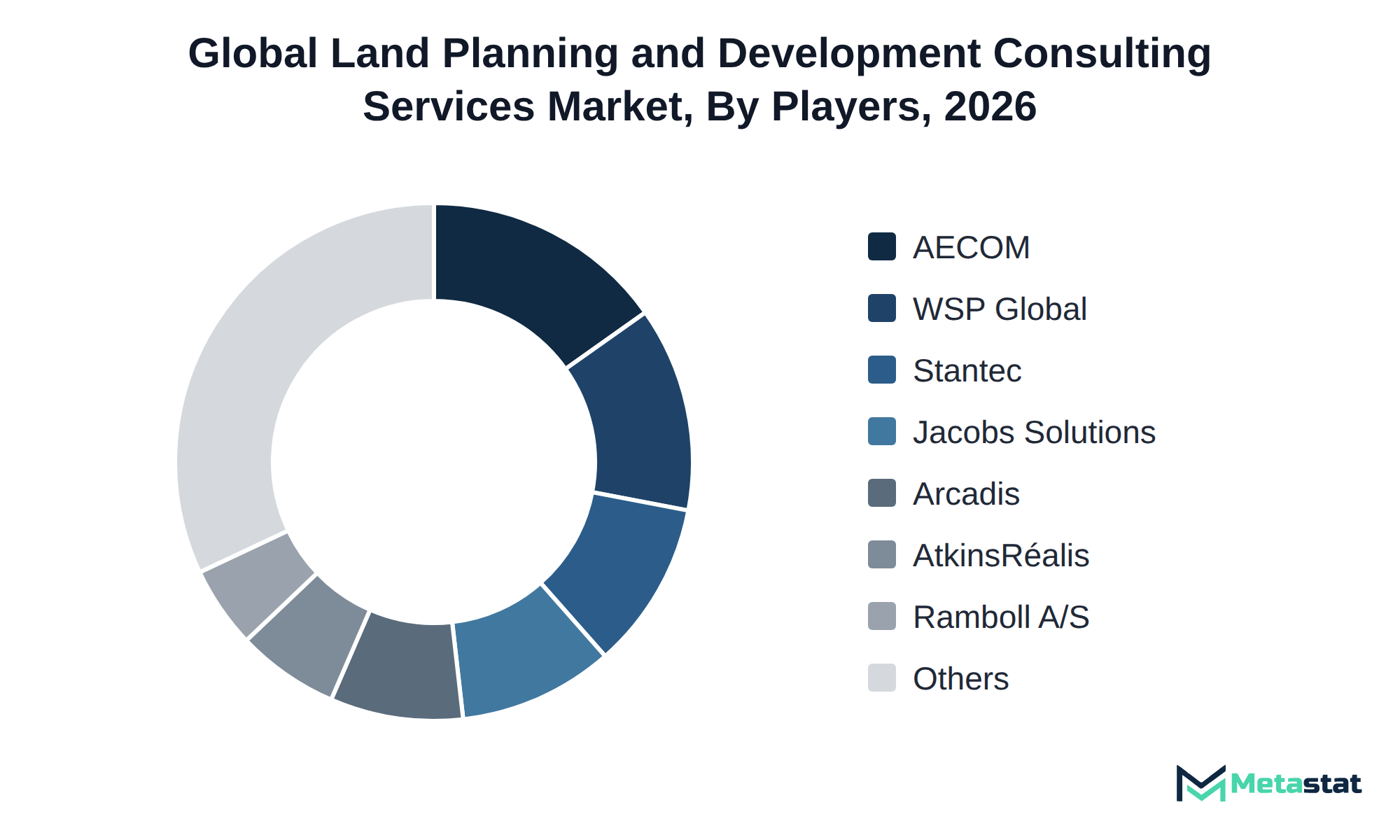
The Land Planning and Development Consulting Services market features a competitive landscape where companies differentiate through specific service offerings, engagement models, and client focus. Players emphasize strategies based on project type, including residential, commercial, and mixed-use developments, aligning their capabilities with buyer requirements for quality and timely delivery.
Key players, including AECOM and Stantec Inc., focus on land-use and master planning, providing tailored solutions to property developers and public agencies. WSP Global Inc. and Arcadis N.V. emphasize environmental planning and compliance, addressing growing regulatory demands. Buyers select firms based on factors including price, customization, and reputation for delivering compliant projects.
Engagement models, including project-based assignments and retainer agreements, characterize interactions between companies and clients. Jacobs Solutions Inc. and HDR, Inc. target property developers, while AtkinsRéalis Group Inc. and Ramboll Group A/S focus on government projects. This strategic positioning enables firms to cater to diverse client needs while ensuring competitive service delivery within the market.
The success of entitlements and permit management services, anticipated to reach USD 16.4 billion by 2033 with a CAGR of 9.3%, plays a critical role in facilitating timely project approvals, thereby supporting market expansion. Strong performance in the Asia Pacific region, which accounts for 35.8% of market share, will significantly influence overall growth. Potential risks, including regulatory challenges or economic downturns, could hinder progress. These factors specifically affect the government's role in public agencies where funding and approvals are delayed, impacting the overall landscape for the Land Planning and Development Consulting Services market. Continuous monitoring of these developments will be essential for stakeholders aiming to capitalize on the market's growth potential.
By Service Type: Land-Use and Master Planning, Entitlements and Permit Management, Environmental Planning and Compliance, Site Due Diligence and Feasibility, Development Project Management, Others (Public Engagement, Development Economics)
By Project Type: Residential, Commercial, Industrial and Logistics, Mixed-Use, Infrastructure and Utilities, Civic and Institutional, Others (Recreation, Rural Development)
By Client Type: Property Developers and Landowners, Government and Public Agencies, Infrastructure and Utility Operators, Corporate and Institutional Occupiers
By Engagement Model: Project-Based Assignments, Retainer Agreements, Outsourced Planning Staff
The report strategically identifies and profiles the key market players and analyses their core competencies in each sub-segment of the Land Planning and Development Consulting Services market.
Report Attributes | Details |
Study Period | 2021-2033 |
Base Year | 2025 |
Estimated Year | 2026 |
Forecast Period | 2026-2033 |
Historical Period | 2021-2025 |
Growth Rate | CAGR 8.2% from 2026 to 2033 |
Revenue Unit | USD billion |
Segmentation | By Service Type, Project Type, Client Type, Engagement Model, and Region |
By Region | North America (By Service Type, Project Type, Client Type, Engagement Model, and Country)
|
Europe (By Service Type, Project Type, Client Type, Engagement Model, and Country)
| |
Asia Pacific (By Service Type, Project Type, Client Type, Engagement Model, and Country)
| |
South America (By Service Type, Project Type, Client Type, Engagement Model, and Country)
| |
Middle East and Africa (By Service Type, Project Type, Client Type, Engagement Model, and Country)
|
Find answers to common questions about this report
The Land Planning and Development Consulting Services market size was valued at USD 37.3 billion in 2025.
The market is projected to grow at a CAGR of 8.2% during the forecast period from 2026 to 2033.
The North America Land Planning and Development Consulting Services market size is estimated to reach USD 19.7 billion by 2033.
Entitlements and Permit Management leads the Land Planning and Development Consulting Services market, with a projected value of USD 16.4 billion by 2033. This segment surpasses others in growth potential and revenue generation.
Increased spending in the market is driven by a significant shift toward residential development, spurred by urbanization and population growth. The growing emphasis on sustainable and efficient land use practices further fuels demand for consulting services, as developers seek expert guidance to navigate complex regulations and environmental considerations.
North America holds the dominant share of the Land Planning and Development Consulting Services market, representing 29.2 percent of the total market. This region is followed by Asia Pacific, which accounts for 35.8 percent.
Regulatory challenges significantly affect the pace of project approvals, creating delays for property developers and landowners. Increasing talent costs arise from a shortage of skilled professionals, impacting operational margins and complicating project execution.
Several factors favor adoption in the Land Planning and Development Consulting Services industry. Increasing demand for efficient project approvals drives property developers and landowners to seek expert guidance. Heightened regulatory scrutiny and the complexity of obtaining necessary approvals contribute to the growth of the Entitlements and Permit Management segment, projected at a compound annual growth rate of 9.3 percent.
The Land Planning and Development Consulting Services market is estimated to reach a valuation of USD 70 billion by 2033.
Key players operating in the Land Planning and Development Consulting Services market include AECOM, Stantec Inc., WSP Global Inc., Arcadis N.V., Jacobs Solutions Inc., HDR, Inc., Kimley-Horn and Associates, Inc., and Tetra Tech, Inc.
The analysts below cover Professional Services research at Metastat Insights.
LEAD ANALYST
Utkarsh Khirodkar is a Lead Market Research Analyst at MetaStat Insight, specializing in market intelligence, technology sector assessments, and competitive strategy.

PRINCIPAL CONSULTANT - ENTERPRISE AI & EMERGING TECHNOLOGIES
Banking & Finance · Electronics and Semiconductor · Energy and Power · Healthcare IT · Information & Technology · Professional Services
Vijay Gunti is a Principal Consultant at MetaStat Insight, bringing over two decades of experience across enterprise digital transformation, technology strategy, and intelligent systems.

PRINCIPAL CONSULTANT - QUALITY SYSTEMS & COMPLIANCE
Electronics and Semiconductor · Machinery & Equipment · Professional Services
Omkar Phadtare is an Industry Consultant at MetaStat Insight, specializing in quality systems, regulatory compliance, and standards benchmarking to drive data-driven market intelligence and strategic industry research.

LEAD CONSULTANT - COMMUNICATION, TELECOM, AND IT
Electronics and Semiconductor · Information & Technology · Machinery & Equipment · Professional Services
Ravindra Sathe Consultants for Communication, Telecom, and IT at MetaStat Insight. He leads the firm's industry research initiatives across telecommunications infrastructure, digital connectivity, enterprise networking, and emerging information technology domains.
Evaluating secondary resin quality across post-consumer packaging streams requires reliable technical segmentation. MetaStat Insight delivered an objective assessment that distinguished between extrusion-grade flake pricing and optical sorting throughput limitations across Western Europe. The competitive positioning breakdown for licensed depolymerization technology providers answered several questions during our feedstock feasibility audit. Their team clarified regional trade restrictions on mixed plastic scrap quickly when our team submitted follow-up requests.
Evaluating sovereign cloud deployments for core banking platforms demands a clear view of data residency regulations and migration exit strategies. MetaStat Insight delivered an exhaustive review of regional latency tolerances, mainframe decommission milestones, and third-party vendor concentration risk. The regulatory compliance mapping across European and Asian financial jurisdictions gave our team a dependable baseline for multi-cloud infrastructure discussions.
Replacing petrochemical surfactants with bio-based alternatives requires realistic timelines on industrial precision fermentation scaling. The market research broke down commercialization timelines, feedstock sugar price sensitivities, and regional cosmetic ingredient regulatory approvals in Europe and East Asia. That supplier readiness mapping gave our formulations team reliable context when comparing renewable chemical sourcing roadmaps.
Explore related market intelligence reports worth reading alongside this one.
Starting from
$2950
Starting from
$2950