
LEAD ANALYST
Utkarsh Khirodkar is a Lead Market Research Analyst at MetaStat Insight, specializing in market intelligence, technology sector assessments, and competitive strategy.

Global Low Cost Travel Market Size, Share, By Travel Service Type (Low-Cost Air Travel, Budget Rail Travel, Low-Cost Bus and Coach Travel, Budget Accommodation, Budget Vacation Packages), By Booking Channel (Direct Provider Websites and Apps, Online Travel Agencies, Metasearch and Comparison Platforms), By Trip Type (Domestic Travel, International Travel), By Traveler Type (Leisure Travelers, Backpackers and Solo Travelers, Students and Youth Travelers, Family Travelers, Group Travelers), Industry Analysis, Growth, Trends, and Forecast, 2026-2033
Report ID
MSI-5453
Published
October, 2026
Pages
288 Pages
Format
Historical
Base year
Forecast
Forecast period
Report Details
Market Valuation: Valued at $260.4 Billion in 2025, projected to reach $780.5 Billion by 2033 at a 14.7% CAGR.
Dominant Segment: Low-Cost Air Travel leads the market, driven by a growing preference for economical travel options and the expansion of digital booking platforms. This segment is projected to grow from USD 113.2 billion in 2026 to USD 280.5 billion by 2033.
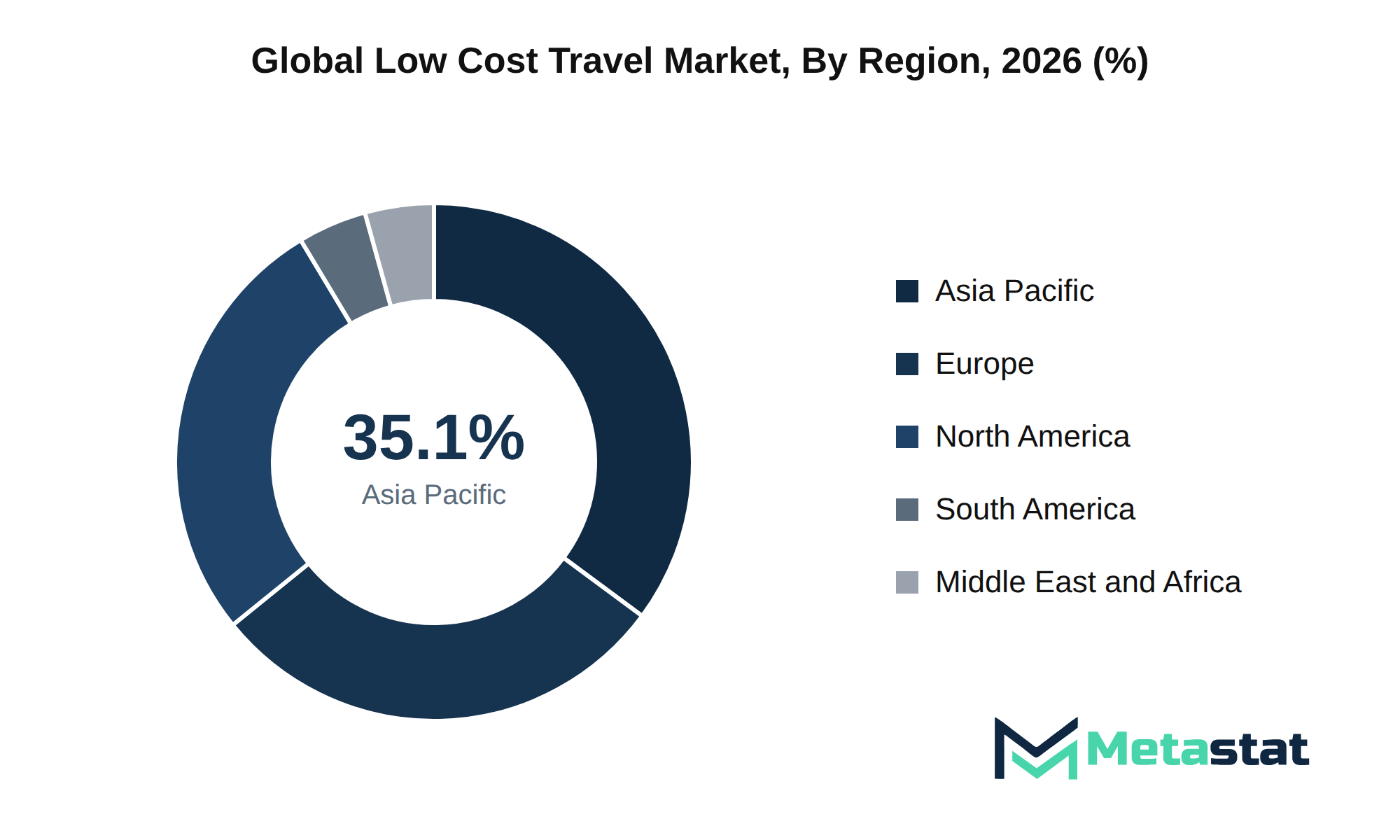
Geographic Lead: The Asia Pacific region holds the largest market share at 35.1% in 2025, with strong demand for low-cost travel services particularly in China and India. This growth is fueled by a rising number of budget-conscious travelers.
What's Inside: The report provides comprehensive coverage of the Low Cost Travel market, including detailed analyses of various travel service types, booking channels, and traveler segments, along with forecasts extending to 2033.
Emerging Trends: Digital booking platforms are reshaping consumer behavior, with direct provider websites and apps expected to grow significantly, enhancing price transparency and convenience for travelers.
Youth and Solo Travel: The segment of backpackers and solo travelers is projected to reach USD 155.8 billion by 2033, reflecting the increasing popularity of budget travel among younger generations.
Choose Your License
Global Low Cost Travel Market
The global Low Cost Travel market was valued at USD 260.4 billion in 2025 and is projected to reach USD 780.5 billion by 2033, growing at a CAGR of 14.7% over the forecast period.
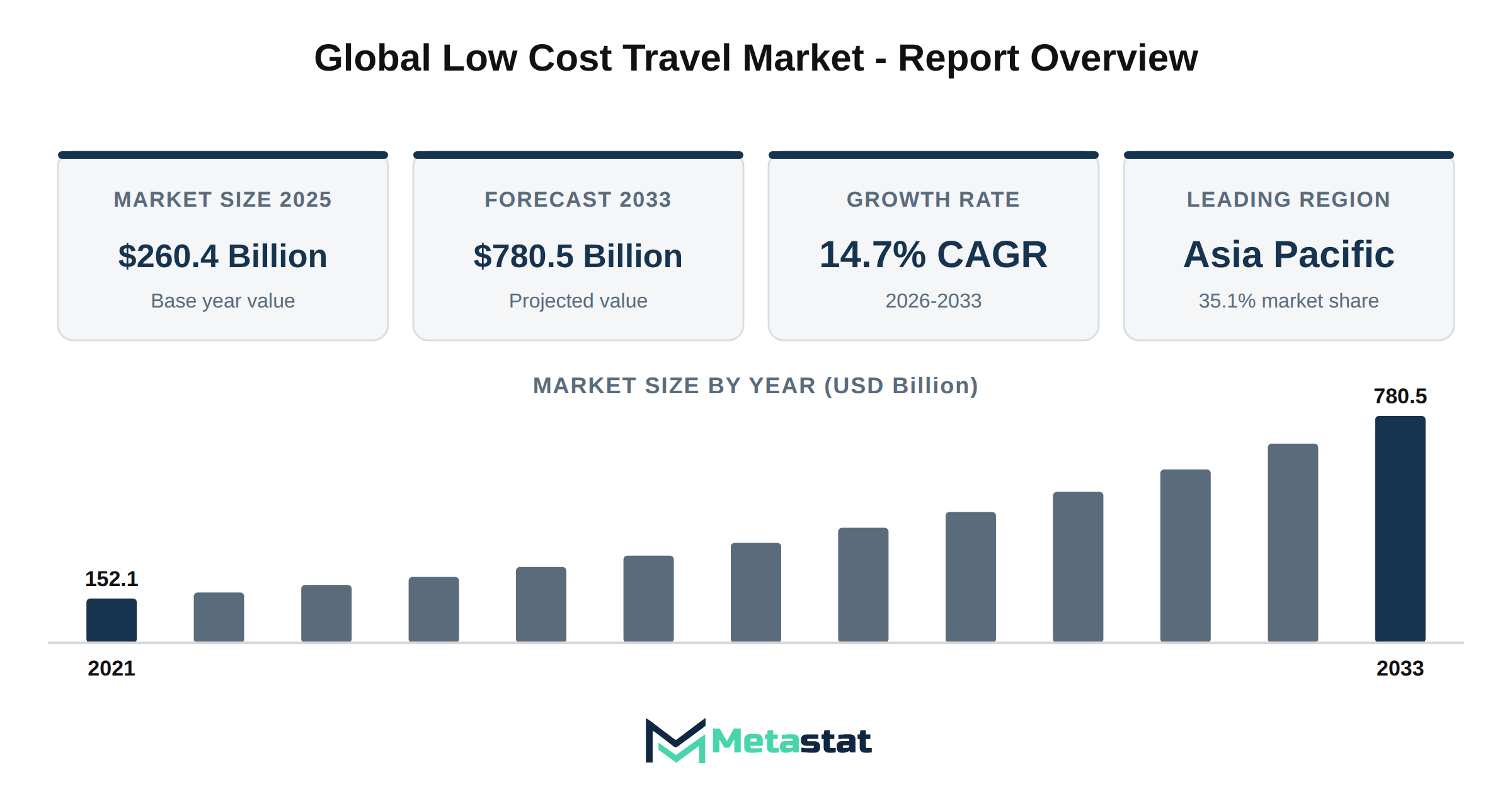
The Low Cost Travel market encompasses a variety of budget-friendly travel options, including low-cost air travel, budget rail travel, and affordable accommodations. These offerings appeal to a diverse group of consumers, particularly leisure travelers and budget-conscious individuals seeking cost-effective travel solutions. The growing trend toward economic travel has driven increased spending, with consumers prioritizing savings while still exploring new destinations. North America holds 27.2% of the market in 2025, with the US leading in 2026. Concurrently, budget-conscious travelers frequently safeguard their non-refundable itineraries through specialized coverage from the travel insurance sector.
Rapid growth in the market is fueled primarily by the rising number of leisure travelers opting for affordable travel options. Domestic travel, which constitutes a significant segment of the market, demonstrates robust demand due to increased disposable income and a desire for accessible holiday experiences. The Asia Pacific region leads with a market share of 35.1%, reflecting strong demand for low-cost travel services in countries including China and India. A considerable share of this domestic movement aligns with student mobility and academic programs analyzed in the educational tourism market.
Budget rail travel, a notable segment supported by broader infrastructure investments documented across the steel rail sector, is projected to experience substantial growth, enhancing the overall market landscape. The increasing reliance on digital platforms for booking travel services further supports this expansion, with direct provider websites and apps gaining traction among consumers. Overall, the market is positioned for significant growth, driven by evolving consumer preferences and technological advancements.
The market covers a broad range of affordable travel services that cater to various traveler segments, including leisure travelers, backpackers, and families. Buyers prioritize these options due to their cost-effectiveness, allowing them to enjoy travel experiences without overspending. The rising demand for budget travel solutions results from a shift in consumer preferences, emphasizing value for money, local culture, and accessible opportunities parallel to the wider experiential travels trend.
Growth is driven by the increasing popularity of low-cost air travel, which represents the segment with the highest value within the market. In comparison, Europe and Asia Pacific follow closely, highlighting the competitive landscape across regions. The expansion of online booking channels further supports market growth, driven by travelers seeking convenience and competitive pricing. These distribution channels rely heavily on automated systems detailed in the revenue management market to adjust fare inventory dynamically across peak and off-peak periods.
Technological advancements in travel booking platforms enhance user experiences, making travel planning more efficient. Direct provider websites and apps have gained traction, facilitating transactions for consumers. This trend reflects a broader shift in how travelers engage with travel providers, contributing to the overall expansion of the Low Cost Travel market. Similar cost-reduction priorities and self-service reservation tools are transforming business trip administration across the corporate travel management landscape.
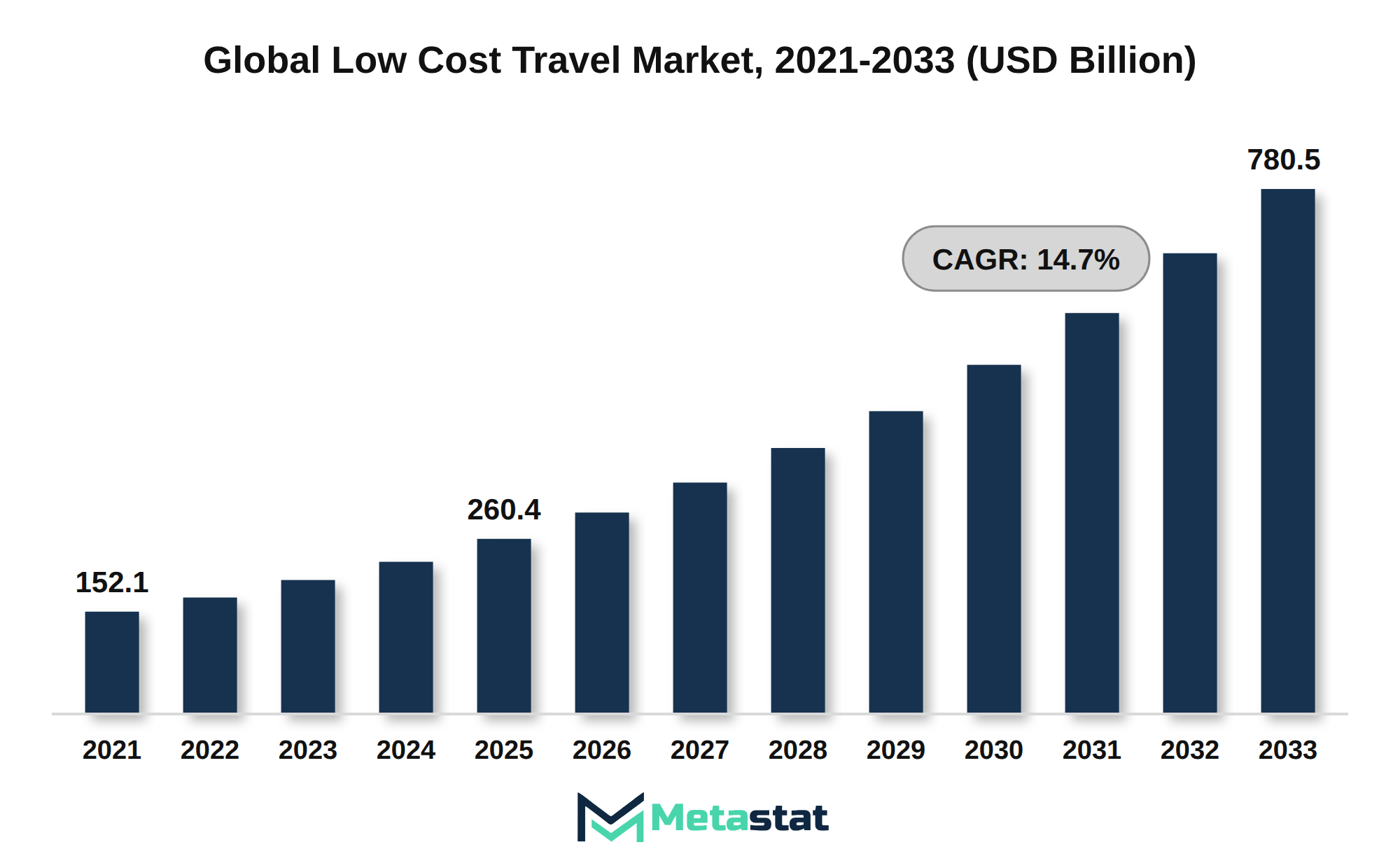
Low-cost airlines significantly reshape travel demand by providing budget-friendly options that appeal to cost-conscious travelers. This shift is evident with the segment of Low-Cost Air Travel projected to grow from USD 113.2 billion in 2026 to USD 280.5 billion by 2033, reflecting a compound annual growth rate (CAGR) of 13.8%. While these airlines expand their routes and services, they attract a diverse range of customers, including leisure travelers and backpackers, seeking economical travel solutions. Rapid aircraft turnaround times at high-density terminals also depend on efficient tarmac gates and equipment from the passenger boarding bridge sector.
The emergence of online booking platforms facilitates easier access to low-cost flight options. Direct provider websites and apps, which encompass many low-cost airline offerings, are set to soar from USD 121.6 billion in 2026 to USD 349.7 billion by 2033, marking a CAGR of 16.3%. This rapid growth highlights the importance of technology in streamlining the booking process, enhancing customer experience, and driving higher volumes of travelers. The shift toward budget airlines contributes to a more competitive landscape in the Low Cost Travel market, promoting increased travel frequency among budget-conscious individuals.
Low-cost airlines continue to thrive, and their impact on the market leads to greater price competition among traditional carriers, benefiting consumers. This trend not only fuels demand for air travel but supports growth in ancillary services, including budget accommodation options. Innovations in pricing strategies and customer engagement transform how travelers perceive and engage with affordable travel.
Digital booking platforms significantly impact purchasing behavior in the Low Cost Travel market, with users increasingly favoring price transparency and comparison features. The rise of direct provider websites and apps illustrates this shift, projected to grow from USD 121.6 billion in 2026 to USD 349.7 billion by 2033, reflecting a compound annual growth rate of 16.3%. These platforms enable travelers to easily evaluate options, leading to informed decisions based on price, convenience, and additional services offered.
The emergence of dynamic pricing models transforms how buyers engage with travel services. Customers frequently observe fluctuations in prices driven by demand, time of booking, and other factors. This strategy encourages early bookings and prompts last-minute decisions, influencing overall market dynamics. Such pricing strategies cater especially to leisure travelers, for whom value-for-money propositions define their travel choices. The Low Cost Travel market benefits from this trend, with consumers increasingly prioritizing budget-friendly options.
Payment options play a crucial role in the purchasing process, with platforms offering a variety of methods tailored to the preferences of different traveler types. Many consumers prefer payment plans, installments, or flexible cancellation policies, enhancing the appeal of budget travel options. The Low Cost Travel market thrives on this flexibility, with platforms catering to leisure travelers and budget-conscious individuals seeking accessible and affordable travel solutions. Consequently, this adaptability supports increased market penetration and growth.
Youth and solo travelers significantly contribute to the expansion of the Low Cost Travel market in the Asia Pacific region. This demographic prioritizes budget-friendly options, seeking affordable travel experiences that allow for exploration and adventure while minimizing expenses. The region's diverse cultures and destinations appeal strongly to these travelers, creating a robust market for low-cost travel services.
In 2033, the segment of backpackers and solo travelers is projected to reach USD 155.8 billion. This expected growth reflects the increasing popularity of budget travel among younger generations, who value experiences over luxury. The availability of low-cost airlines, budget accommodations, and affordable travel packages stimulates this trend, enabling greater accessibility to travel for individuals with limited budgets.
Consequently, businesses catering to this demographic find ample opportunities for growth. By offering tailored services that address the unique preferences and spending habits of youth and solo travelers, companies enhance their market presence. The focus on affordability combined with the growing trend of experiential travel positions the market for continued expansion, driven by the demands of this influential buyer group.
Travelers increasingly prioritize cost efficiency and convenience when choosing transportation options, significantly impacting the Low Cost Travel market. A shift towards budget-conscious travel arises from changing consumer preferences, particularly among leisure travelers, who seek affordable solutions. In 2026, the segment of leisure travelers is projected to generate USD 101.4 billion, expanding to USD 251.2 billion by 2033, indicating a compound annual growth rate of 13.8%. This trend reflects a broader desire for experiential travel without the burden of high costs.
The rise of digital platforms has transformed how travelers book trips. Direct provider websites and apps are expected to grow from USD 121.6 billion in 2026 to USD 349.7 billion by 2033, a robust increase driven by user-friendly interfaces and competitive pricing. The market responds to this trend by enhancing online offerings and promoting services that cater to cost-sensitive travelers. The emphasis on budget options appeals to a diverse range of consumers, ultimately supporting growth in the sector.
Growing demand for cost-effective travel options drives expansion in the Low Cost Travel market. Cost-conscious consumers increasingly seek affordable alternatives, resulting in a shift toward budget airlines, rail services, and accommodations. This shift reflects changing travel preferences, particularly among younger demographics and leisure travelers who prioritize value. The rise of digital platforms has simplified the comparison of prices, enabling travelers to make informed choices based on affordability. New offerings, including budget vacation packages and low-cost transportation, further enhance the appeal of this market. This trend increases competition among providers, ultimately benefiting consumers through lower prices and improved services. The Low Cost Travel market is expected to experience significant growth, fueled by these evolving consumer behaviors and preferences.
High prices for low-cost travel options hinder adoption among budget-conscious travelers. Many individuals prioritize affordability in their travel decisions; however, the increasing costs associated with flights, accommodations, and additional fees raise barriers to entry. This situation particularly affects leisure travelers and backpackers, who often operate within strict budgets. Higher price points lead to slower uptake of these services, resulting in smaller order volumes and decreased overall demand. In regions with intense competition, price sensitivity remains a significant driver, impacting the ability of suppliers to attract cost-conscious consumers. While the market evolves, maintaining competitive pricing while enhancing service offerings is crucial for suppliers aiming to capture these segments. The low-cost travel market faces ongoing challenges related to cost, which directly influences the purchasing behavior of key demographics and shapes the environment for affordable travel options.
Intensifying competition among service providers poses challenges for suppliers in the Low Cost Travel market. Numerous companies strive to offer competitive pricing while maintaining service quality, which pressures profit margins. This competitive environment compels suppliers to optimize operational efficiency, reduce costs, and enhance customer service. In response, companies are investing in technology to streamline booking processes and enhance user experience. This shift aids in attracting a larger customer base, thereby increasing overall volume. Suppliers are diversifying offerings, including bundling services including accommodation and transportation to create more appealing packages for budget-conscious travelers. Competition intensifies, prompting companies to focus on maintaining brand loyalty through targeted marketing strategies, reinforcing their market position. The ongoing evolution in consumer preferences toward value-driven experiences continues to influence strategies across the sector, impacting profitability and growth.
Budget rail travel stands out with a prominent growth opportunity within the Low Cost Travel market. This segment is projected to achieve a compound annual growth rate (CAGR) of 16.5%, reaching USD 80.2 billion by 2033. Travelers increasingly seek cost-effective transportation options, particularly in regions with extensive rail networks. The appeal of budget rail travel lies in its affordability and accessibility, catering primarily to leisure and family travelers who prioritize economic choices. This segment distinguishes itself from other travel modes by offering efficient connectivity while maintaining lower operational costs compared to traditional rail services. Enhanced investment in rail infrastructure and services further supports the adoption of budget rail travel. The market's focus on this segment reflects a shift toward sustainable travel practices, making it an attractive avenue for growth in the coming years. Addressing this opportunity presents potential for increased market penetration and revenue generation.
The Global Low Cost Travel market is segmented based on Travel Service Type, Booking Channel, Trip Type, and Traveler Type.
This segment serves budget-conscious travelers seeking affordable flights for leisure and business purposes. Key factors driving growth include the increasing preference for economical travel options and the rise of digital platforms that facilitate easy booking and price comparisons. Compared to other travel service types, including budget rail travel, this segment is projected to experience slightly slower growth due to varying regulatory environments and operational costs. However, the allure of low-cost air travel remains strong, particularly among leisure travelers and those seeking quick, budget-friendly options for domestic and international trips. The Low Cost Travel market adapts to evolving consumer needs, with low-cost airlines playing a central role in shaping traveler preferences.
Budget Rail Travel segment is estimated to reach USD 80.2 billion by 2033, at a CAGR of 16.5% during the forecast period. This segment caters primarily to travelers seeking affordable transportation options between cities and regions. Increasing urbanization and a growing focus on sustainable travel options drive demand for budget rail services, appealing to leisure travelers and environmentally-conscious individuals. The higher growth rate of this segment compared to segments like Low-Cost Air Travel, which has a CAGR of 13.8%, highlights its unique positioning. Budget rail travel typically offers lower prices than traditional rail services, attracting budget-minded consumers who prioritize cost-effective travel solutions. This segment’s success is grounded in its suitability for both short and medium-distance journeys, allowing it to capture a distinctive market share. The rise of digital booking platforms further enhances accessibility, enabling a more efficient purchasing experience for consumers.
Low-Cost Bus and Coach Travel segment is expected to reach USD 53.2 billion by 2033. This segment primarily serves budget-conscious travelers seeking affordable transportation options for both domestic and international journeys. The demand stems from a growing emphasis on cost-effective travel solutions, particularly among leisure travelers and younger demographics. The projected compound annual growth rate (CAGR) of 13.1% highlights a competitive advantage over other transportation segments, reflecting a strong preference for affordable bus and coach services compared to higher-priced alternatives. This segment differs from low-cost air travel and budget rail travel due to its specific appeal to price-sensitive travelers who favor ground transport options. Evolving consumer preferences and increased accessibility to bus and coach services support the growth of this segment within the Low Cost Travel market.
Budget Ferry Travel is projected to grow at a CAGR of 13.1% during the forecast period. This segment primarily caters to travelers seeking affordable maritime transportation options for shorter distances, often between islands or coastal areas. Budget ferry services are popular among leisure travelers and backpackers who prioritize cost efficiency. The rising trend of domestic tourism, particularly in regions with extensive coastlines, drives demand for budget ferry travel. Compared to other segments in the Travel Service Type, including Low-Cost Air Travel, which is expected to reach USD 280.5 billion by 2033, budget ferry travel experiences relatively slower growth. Nevertheless, the segment offers unique advantages for travelers looking to explore destinations from a different perspective, contributing to its steady expansion in the market.
Budget accommodation offers affordable lodging options for travelers seeking cost-effective alternatives to traditional hotels. This segment typically attracts budget-conscious individuals, including leisure travelers and backpackers. The rise of budget accommodation options has been propelled by increasing demand for economical travel solutions, particularly among younger demographics and those prioritizing savings. Compared to other segments, including low-cost air travel, budget accommodation often features slower growth patterns, reflecting the stable nature of lodging investments. Competition within this segment primarily focuses on price, with establishments seeking to provide essential amenities at lower costs while maintaining quality. The variety of options available, including hostels and budget hotels, caters to diverse traveler needs while remaining less volatile compared to fluctuations in airfare pricing. This segment significantly influences the overall dynamics of the Low Cost Travel market.
Budget Vacation Packages cater to travelers seeking affordable and convenient travel experiences. This segment attracts leisure travelers and families looking for all-inclusive options that simplify planning and budgeting. The popularity of packaged deals, which bundle transportation, accommodation, and activities, has surged due to a growing preference for hassle-free travel solutions. Competitive pricing and targeted marketing strategies drive demand, especially among price-sensitive customers. Compared to other segments, Budget Vacation Packages experience slower growth, influenced by economic fluctuations and changing consumer preferences. Nonetheless, unique offerings in this category appeal to those seeking value without compromising quality. The market supports diverse travel needs, ensuring that budget-conscious travelers access enjoyable and memorable experiences.
This segment focuses on budget car rental and ground mobility services, catering to travelers seeking affordable transportation options during their trips. Leisure travelers and business professionals frequently use these services for their convenience and cost-effectiveness, enhancing their travel experience. Key factors driving growth in this segment include the increasing popularity of cost-conscious travel and the demand for flexible transportation solutions. This segment generally experiences slower growth compared to the more rapidly expanding budget rail travel segment, which highlights evolving traveler preferences for diverse and affordable mobility options. Pricing dynamics and competitive offerings in the market further influence buyer decisions, promoting a shift toward these budget-friendly transportation alternatives. By addressing the specific needs of diverse traveler segments, this sub-segment contributes significantly to the overall framework of the Low Cost Travel market.
This segment facilitates direct bookings for travelers seeking budget-friendly options, eliminating intermediaries. Preferences among leisure travelers drive significant traffic to these platforms, where price transparency and ease of access become critical factors. Unlike Online Travel Agencies that rely on commission models, direct provider channels offer competitive pricing by reducing service fees, thus enabling lower overall costs for consumers. The rapid growth of mobile applications supports increasing user engagement, enhancing convenience for travelers. The projected CAGR of 16.3% signifies a faster growth trajectory compared to the Online Travel Agencies segment, which shows a CAGR of 14%. This differentiation highlights a preference shift toward direct engagement with service providers in the market.
Online Travel Agencies segment is estimated to reach USD 312.7 billion by 2033, at a CAGR of 14% during the forecast period. This segment facilitates travelers in comparing prices and booking various travel services, appealing primarily to tech-savvy consumers who prioritize convenience and cost savings. The increasing reliance on digital platforms among leisure travelers and business professionals significantly drives the growth of this segment. Unlike other segments in the Booking Channel category, including Direct Provider Websites and Apps, which focus on specific service providers, Online Travel Agencies emphasize broader offerings and competitive pricing. This segment's growth remains robust due to the rising number of users seeking price transparency and the convenience of one-stop booking experiences, resulting in a higher CAGR compared to traditional booking methods.
Metasearch and Comparison Platforms segment is expected to reach USD 71.2 billion by 2033. This segment serves travelers seeking to compare prices and services across various travel providers, including flight, hotel, and rental car options. Users include budget-conscious individuals and families who prioritize cost-effectiveness in their travel decisions. The growing trend of digital booking drives this segment, particularly among younger travelers. The segment distinguishes itself from other booking channels due to its comparative nature, which enhances price transparency and enables informed decision-making. While Online Travel Agencies exhibit a CAGR of 14%, the Metasearch and Comparison Platforms segment shows a more moderate growth outlook, driven by the performance of the listed providers. This dynamic enhances its role in the broader Low Cost Travel market, where convenience in price comparison strengthens budgeting for trips.
Offline Travel Agencies segment is projected to grow at a CAGR of 10.8% during the forecast period. This segment primarily serves travelers seeking personalized trip planning and booking assistance. Travelers rely on offline channels for their travel arrangements, especially when planning complex itineraries or group trips. The demand for tailored services and face-to-face interactions distinguishes this segment from others in the Booking Channel classification. While Direct Provider Websites and Apps segment shows a more significant growth trajectory with a projected CAGR of 16.3%, offline agencies play a critical role, particularly among older demographic groups who prefer human interaction. The market’s evolving dynamics and advancements in online technology continue to challenge offline agencies, requiring them to adapt by enhancing customer service and offering unique travel experiences to maintain relevance.
Domestic Travel segment is valued at USD 187.5 billion in 2026 and is projected to reach USD 469.7 billion by 2033, at a CAGR of 14% during the forecast period. This segment primarily serves individuals seeking affordable options for travel within their own countries, including leisure travelers and families. The increasing trend of local vacations and weekend getaways significantly drives demand. Unlike international travel, which typically incurs higher costs, domestic travel offers more accessible pricing, appealing to budget-conscious consumers. The rising availability of low-cost transportation options enhances the attractiveness of domestic travel. This segment's growth remains robust compared to others in its category, reflecting adaptability to changing consumer preferences and economic conditions. The overall expansion of the market contributes to the increasing popularity of domestic travel among various traveler types.
International Travel segment is estimated to reach USD 310.8 billion by 2033, at a CAGR of 15.7% during the forecast period. This segment caters to travelers seeking affordable options for overseas journeys, including leisure and business trips. Demand increases due to the growing globalization of travel, making international destinations more accessible. The segment differs from Domestic Travel by focusing on cross-border experiences, which often involve higher costs and regulatory considerations. Enhanced connectivity and competitive pricing among airlines fuel growth in this area, with travelers prioritizing cost-effective solutions when planning international trips. This segment exhibits strong growth compared to Domestic Travel, further highlighting the diverse needs of various traveler types in the Low Cost Travel market.
This segment serves vacationers, families, and individuals seeking budget-friendly travel options. A growing trend toward experiential travel among younger demographics drives demand, particularly among leisure travelers who prioritize cost savings. Compared to other segments, including Business and Value-Conscious Travelers, which exhibit slower growth, leisure travel demonstrates robust expansion due to its appeal to a wide audience. Enhanced access to online booking platforms further fuels this segment’s growth. The increasing availability of affordable and diverse travel experiences positions this segment as a significant contributor to overall market expansion.
Backpackers and Solo Travelers segment is estimated to reach USD 155.8 billion by 2033, at a CAGR of 16.1% during the forecast period. This segment primarily targets individuals seeking affordable travel options, emphasizing flexibility and social interaction. Travelers in this category prioritize budget-friendly experiences, leading to increased demand for low-cost accommodations and transport services. The rising trend of solo travel and the growing popularity of experiential travel experiences drive growth in this segment. Compared to Leisure Travelers, who focus on comfort and convenience, Backpackers and Solo Travelers exhibit a faster growth rate due to their inclination toward cost-saving strategies. This segment appeals to younger demographics, contributing to a distinct consumer base that actively seeks budget options, including hostels and shared accommodations. The market for Backpackers and Solo Travelers continues to expand, reflecting changing travel behaviors and preferences.
The Students and Youth Travelers segment is expected to reach USD 126.5 billion by 2033. This segment comprises travelers primarily in educational institutions or younger demographics seeking affordable travel experiences. Major driving forces include an increasing number of students participating in study abroad programs and opportunities for youth travel facilitated by budget airlines and online travel platforms. With a CAGR of 16.1%, this segment exhibits faster growth compared to others in the Traveler Type category, including Family Travelers, which experiences a CAGR of 13.5%. The affordability and accessibility of budget travel options appeal to this demographic, differentiating it from leisure travelers who prioritize different aspects, including convenience or luxury. Consequently, this segment significantly contributes to the overall growth of the market.
Family Travelers segment is projected to grow at a CAGR of 13.5% during the forecast period. This category caters to families seeking budget-friendly options for vacations and outings, focusing on affordability and convenience. Factors including increasing disposable income and a growing preference for travel experiences among families drive the demand for low-cost options. The segment specifically targets family groups, distinguishing it from leisure travelers who travel solo or in couples. Compared to other traveler types, Family Travelers emphasize value for money, often requiring family-oriented amenities and services while traveling. Demand for travel options tailored to families contributes to the growth trajectory of this segment within the Low Cost Travel market.
Group Travelers consist of individuals traveling together, often for leisure or social purposes. This segment typically includes families, friends, and organizations seeking affordable travel arrangements. The demand for this segment arises from the growing trend of group travel, driven by the desire for shared experiences and cost savings. In comparison to other traveler types, Group Travelers exhibit slower growth, influenced by price sensitivity and the need for group discounts. Budget-conscious groups prioritize affordable options, making low-cost travel services particularly appealing. Unlike Leisure Travelers, who travel alone or in smaller units, Group Travelers require tailored services to accommodate larger groups, affecting pricing dynamics and service offerings in the market. The growing interest in group travel among younger demographics significantly impacts demand, reshaping how travel services cater to this specific audience.
Business and Value-Conscious Travelers prioritize budget-friendly options without sacrificing quality. This segment attracts individuals and organizations seeking cost-effective travel solutions for work or leisure, focusing on value and practicality. A rising trend of remote work and flexible travel schedules contributes to this segment's growth, with many professionals combining business trips with leisure activities. This group often differs from Leisure Travelers in terms of travel purpose, leading to varied preferences for services and accommodations. While budget airlines and direct booking websites serve this segment effectively, competition remains intense among providers aiming to capture the attention of price-sensitive consumers. The Low Cost Travel market evolves, adapting to the unique needs of this traveler type.
Based on geography, the Global Low Cost Travel market is divided into North America, Europe, Asia-Pacific, South America, Middle East, and Africa.
Significant growth characterizes the market in North America, driven by rising consumer preferences for budget-friendly travel options. The United States, Canada, and Mexico represent the main contributors, with a growing focus on affordable travel experiences among various traveler types. North America accounts for 27.2% of the global market in 2025, reflecting strong demand for low-cost travel solutions. Factors including increased disposable income and changing travel behaviors fuel this trend, especially among leisure travelers and budget-conscious individuals. The region is projected to reach USD 199.9 billion by the end of 2033, indicating strong growth potential within the market. Enhanced digital platforms and the expansion of budget airlines further support this growth, enabling wider access to cost-effective travel alternatives.
European travelers increasingly seek budget-friendly options, driving demand within the Low Cost Travel market. Countries including Germany, France, and the UK embrace low-cost air travel and budget rail travel, enabling access to affordable transportation alternatives. Factors contributing to this trend include rising disposable incomes and a growing preference for cost-effective travel solutions. In addition, advancements in digital platforms enhance booking convenience, allowing travelers to compare options and secure the best deals efficiently. The market share for Europe stands at 29.0% in 2025, reflecting its significant role in shaping travel dynamics. Regulatory support for low-cost carriers further stimulates competition, creating an environment where affordability remains a priority for travelers across the region.
The Asia-Pacific region holds a 35.1% share of the global market in 2025. This region experiences a surge in demand driven by the increasing number of travelers from countries including China, India, and Japan. Rising disposable incomes and a growing middle class in these countries contribute to the expansion of the travel sector. Infrastructure improvements, including the development of budget airlines and enhanced rail networks, facilitate travel options across the region. In Southeast Asia, low-cost carriers gain traction, catering to both leisure and business travelers seeking affordable solutions. The Low Cost Travel market benefits from these trends, with projections indicating continued growth through 2033.
Growth in the Low Cost Travel market within South America stems from increasing demand for budget-friendly travel options among travelers in Brazil and Argentina. Economic conditions, including rising disposable incomes and a growing middle class, drive this trend. Budget air travel and accommodations gain popularity, reflecting a shift toward cost-effective solutions for leisure and business trips. The market share in this region is projected at 4.3% in 2025, indicating its potential within the global landscape. Infrastructure improvements, including expanded airports and enhanced transport networks, support market growth by facilitating easier access to low-cost travel options. In this environment, local and regional providers and international companies compete to capture the attention of value-conscious consumers, leading to a dynamic marketplace.
Growth in the Middle East and Africa stems from increasing travel infrastructure investments and a young, dynamic population seeking affordable travel options. Countries like Saudi Arabia and the UAE focus on enhancing budget travel services, attracting both leisure and business travelers. In South Africa, a growing inclination towards budget-friendly travel solutions reflects changes in consumer spending habits. The market share in this region stands at 4.3% in 2025, demonstrating potential for growth within the global context. Continued investment in low-cost travel initiatives positions the overall market for expansion, aligning with shifts in consumer preferences and travel behaviors. Unique demographic trends in the region support rising demand, particularly within the low-cost travel market.
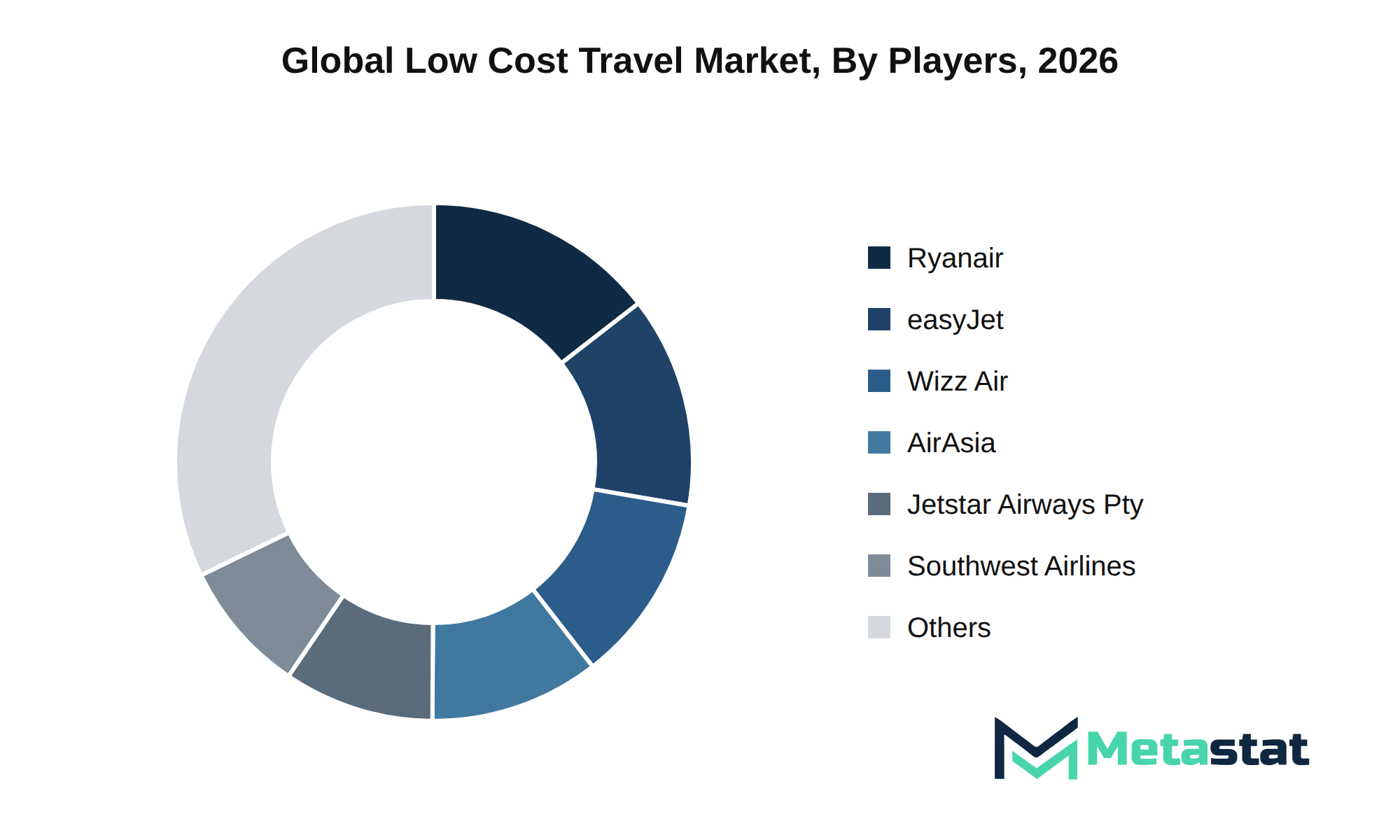
Competition within the low cost travel market occurs primarily through price differentiation and service offerings. Companies strive to enhance their value propositions by focusing on low-cost options, creating a range of budget services across air travel, rail, and accommodations. For instance, Ryanair Holdings plc emphasizes low-cost air travel, attracting price-sensitive leisure travelers. Meanwhile, easyJet plc offers a balance of affordable fares and customer service, appealing to travelers seeking both cost savings and quality.
In the area of online booking, Expedia Group, Inc. leverages technology to enhance user experience, allowing travelers to compare options easily. Online travel agencies, including Trip.com Group Limited and Agoda Company Pte. Ltd., compete by providing efficient platforms for booking diverse travel services. The availability of budget accommodation through providers like Hostelworld Group plc and MEININGER Hotels Limited caters to the specific needs of backpackers and youth travelers, ensuring broad appeal in the market.
This significant growth depends on several key developments. First, the expansion of low-cost air travel, projected to reach USD 280.5 billion by 2033, will drive overall market growth. Increasing demand from leisure travelers and the rise of budget accommodations will support this segment. Second, the growth of domestic travel, anticipated to reach USD 469.7 billion by 2033, will play a crucial role in sustaining momentum, particularly in regions like North America and Asia Pacific. However, a primary risk that could impede growth involves economic fluctuations affecting consumer spending. A downturn in global economic conditions could reduce discretionary travel budgets, particularly impacting leisure and budget-conscious travelers. The convergence of these factors will ultimately shape the trajectory of the market, influencing adoption and competition across various segments.
By Travel Service Type: Low-Cost Air Travel, Budget Rail Travel, Low-Cost Bus and Coach Travel, Budget Ferry Travel, Budget Accommodation, Budget Vacation Packages, Others (Budget Car Rental and Ground Mobility)
By Booking Channel: Direct Provider Websites and Apps, Online Travel Agencies, Metasearch and Comparison Platforms, Offline Travel Agencies
By Trip Type: Domestic Travel, International Travel
By Traveler Type: Leisure Travelers, Backpackers and Solo Travelers, Students and Youth Travelers, Family Travelers, Group Travelers, Business and Value-Conscious Travelers
The report strategically identifies and profiles the key market players and analyses their core competencies in each sub-segment of the Low Cost Travel market.
|
Report Attributes |
Details |
|
Study Period |
2021-2033 |
|
Base Year |
2025 |
|
Estimated Year |
2026 |
|
Forecast Period |
2026-2033 |
|
Historical Period |
2021-2025 |
|
Growth Rate |
CAGR 14.7% from 2026 to 2033 |
|
Revenue Unit |
USD billion |
|
Segmentation |
Travel Service Type, Booking Channel, Trip Type, Traveler Type |
|
By Region |
North America (By Travel Service Type, Booking Channel, Trip Type, Traveler Type, and Country)
|
|
Europe (By Travel Service Type, Booking Channel, Trip Type, Traveler Type, and Country)Germany
|
|
|
Asia Pacific (By Travel Service Type, Booking Channel, Trip Type, Traveler Type, and Country)
|
|
|
South America (By Travel Service Type, Booking Channel, Trip Type, Traveler Type, and Country)
|
|
|
Middle East and Africa (By Travel Service Type, Booking Channel, Trip Type, Traveler Type, and Country)
|
Find answers to common questions about this report
The Low Cost Travel market size was valued at USD 260.4 billion in 2025.
The market is projected to grow at a CAGR of 14.7% during the forecast period from 2026 to 2033.
The North America Low Cost Travel market size is estimated to reach USD 199.9 billion by 2033.
Low-Cost Air Travel leads the market with a projected value of USD 280.5 billion in 2033, reflecting the highest growth potential among the segments. This segment's growth rate of 13.8 percent highlights its dominance in the overall market.
Growing demand for cost-effective travel options drives expansion in the market. Budget rail travel stands out as a prominent growth opportunity, projected to achieve a compound annual growth rate of 16.5 percent, reaching USD 80.2 billion by 2033.
Asia Pacific holds the dominant share of the Low Cost Travel market, accounting for 35.1% in 2025. This region surpasses others, including Europe at 29% and North America at 27.2%.
Rising prices for low-cost travel options hinder adoption among budget-conscious travelers. Intense competition among service providers pressures profit margins, compelling suppliers to optimize operational efficiency while maintaining service quality.
Several factors favor adoption in the Low Cost Travel industry. The growing demand for cost-effective travel options drives interest, particularly among leisure and family travelers. Enhanced digital platforms simplify price comparisons, enabling informed choices that prioritize affordability. Budget rail travel, with a projected CAGR of 16.5 percent, exemplifies the appeal of accessible and economical transportation options.
The Low Cost Travel market is estimated to reach a valuation of USD 780.5 billion by 2033.
Key players in the Low Cost Travel industry include Ryanair Holdings plc, easyJet plc, Wizz Air Holdings Plc, AirAsia, Jetstar Airways Pty Ltd, Scoot Pte. Ltd., and Southwest Airlines Co. These companies are significant contributors to the market, providing a range of low-cost travel options to consumers.
The analysts below cover Automotive and Transportation research at Metastat Insights.
LEAD ANALYST
Utkarsh Khirodkar is a Lead Market Research Analyst at MetaStat Insight, specializing in market intelligence, technology sector assessments, and competitive strategy.

ENERGY & INFRASTRUCTURE INDUSTRY CONSULTANT
Automotive and Transportation · Electronics and Semiconductor · Energy and Power · Machinery & Equipment
Saurabh Vasant Ganvir consults for Energy & Infrastructure Industry at MetaStat Insight, specializing in renewable energy, solar EPC, and electric vehicle (EV) infrastructure markets.
Tracking capacity expansion in single-use bioprocessing requires dependable data on raw material availability and cleanroom-grade polymer supply chains. The competitive landscape chapter gave a grounded evaluation of secondary component suppliers across North America and Asia-Pacific rather than simply reprinting press releases. Having that level of supplier benchmarking helped clarify dual-sourcing considerations for our clinical pipeline planning.
When evaluating distributed energy resource management systems, standard research summaries tend to gloss over the operational differences between front-of-the-meter utility deployments and behind-the-meter industrial sites. The MetaStat Insight report addressed those distinctions directly, especially regarding software interoperability standards and grid interconnection backlogs. The five-year market sizing across regional transmission organizations provided actionable context for our grid modernization strategy.
Most industry reports on warehouse automation bundle autonomous mobile robots and fixed conveyor installations into the same top-level numbers, which complicates advisory work. This study split the market cleanly by payload tiers, navigation technology, and fleet management software layers. The regional forecast for Western Europe gave our team defensible adoption benchmarks when evaluating capital allocation for logistics clients, saving us days of secondary data scrubbing.
Explore related market intelligence reports worth reading alongside this one.