
LEAD ANALYST
Utkarsh Khirodkar is a Lead Market Research Analyst at MetaStat Insight, specializing in market intelligence, technology sector assessments, and competitive strategy.

Machine Loading Robots Market Size, Share, By Type (Cartesian Robots, Articulated Robots, SCARA Robots, Collaborative Robots, and Others), By Payload Capacity (Up to 5 Kg, 5-10 Kg, 10-20 Kg, 20-50 Kg, and Above 50 Kg), By End-User (Automotive, Electronics, Manufacturing, Food, Beverages, Logistics, Industrial, and Others), Industry Analysis, Growth, Trends, and Forecast, 2026-2033
Report ID
MSI-4612
Published
April, 2026
Pages
320 Pages
Format
Report Details
Choose Your License
Machine Loading Robots Market
The Global Machine Loading Robots market size was valued at USD 7.2 billion in 2025 and projected to grow at a CAGR of 9.2% during the forecast period, reaching USD 14.5 billion by 2033.
North America accounted for 23.7% of the global market in 2025, with the U.S. leading the regional market.
Articulated Robots segment accounted for the largest market share of 33.42% in 2025.
Key factors driving growth include rising demand for automation to improve production efficiency and reduce labor dependency, along with increasing adoption of robotics in the automotive, electronics, and metal fabrication industries.
Opportunities include growing adoption of collaborative and AI-enabled robots for flexible machine loading applications.
Key insight: Precision-driven automation and labor optimization are redefining machine loading robots from efficiency tools into core manufacturing assets.
The Global Machine Loading Robots market is entering a phase in which automation strategy is shaped less by unit replacement and more by system-wide orchestration across manufacturing ecosystems. Over the coming years, machine loading robots are expected to move beyond isolated work cells and become embedded within cyber-physical production environments where data, motion, and decision logic converge. Their role is likely to expand into dynamic scheduling, predictive task sequencing, and real-time coordination with upstream and downstream equipment, enabling factories to operate as adaptive networks rather than linear production lines.
Industrial buyers are likely to evaluate machine loading robots through a strategic lens tied to resilience and operational continuity. Deployment decisions are expected to account for how robotic systems respond to supply volatility, tooling variation, and rapid product redesign. The market is expected to emphasize modular intelligence, where software-defined capabilities enable robots to shift between machining centers, additive systems, and inspection stations without extended reconfiguration cycles. This flexibility is likely to reshape capital planning, shifting attention from fixed automation assets toward reprogrammable production capacity.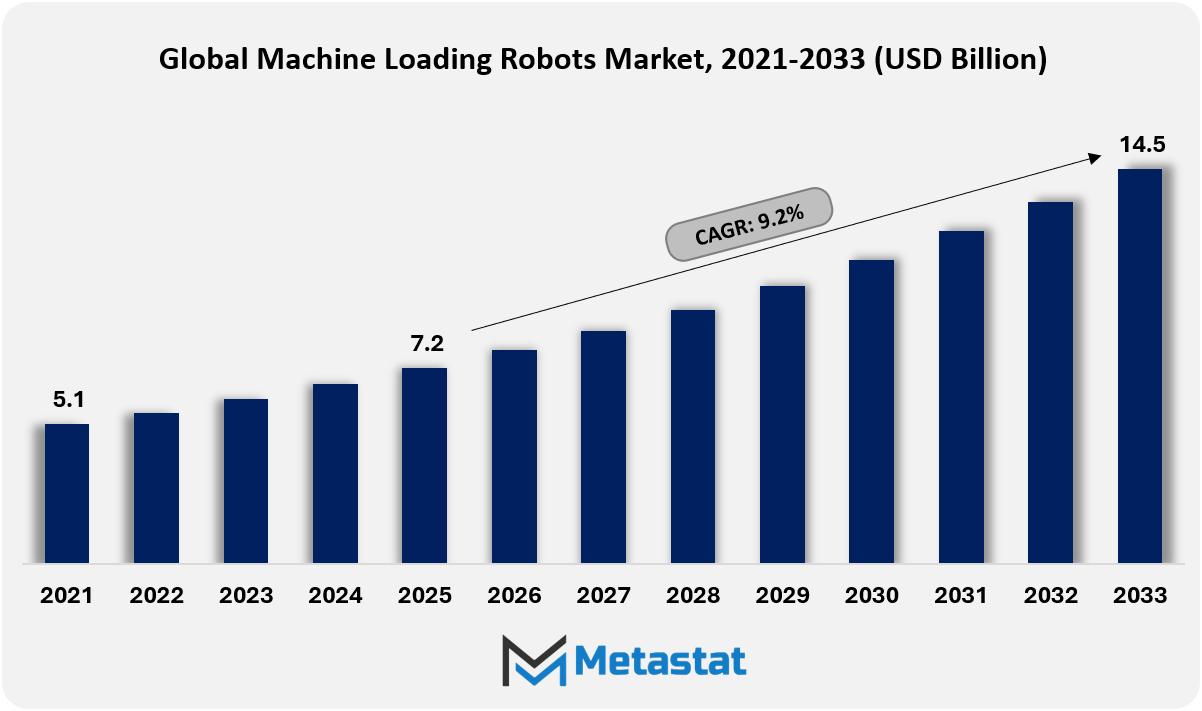
Rising demand for automation to improve production efficiency and reduce labor dependency.
Manufacturers face persistent pressure to increase output while controlling operational variability. Automated machine loading supports continuous production cycles, reduces manual handling, and stabilizes throughput. Adoption also supports workforce optimization, addresses skilled labor shortages, and improves manufacturing reliability, creating sustained demand across small, mid-sized, and large production facilities.
Increasing adoption of robotics in automotive, electronics, and metal fabrication industries.
Automotive assembly lines, electronics manufacturing facilities, and metal fabrication workshops are increasingly integrating robotic loading systems to manage high-volume repetitive tasks. Precision handling, reduced cycle time, and consistent quality standards support broader deployment. Industry-specific customization also enables alignment with complex machining requirements, encouraging deeper integration across diverse industrial environments.
High initial investment and integration costs for robotic systems.
Capital expenditure associated with robotic hardware, software, and system integration remains a major barrier. Deployment requires alignment with existing equipment, safety infrastructure, and plant layouts. Budget limitations restrict adoption among cost-sensitive manufacturers, particularly in developing regions, slowing broader penetration despite long-term operational benefits.
Complexity in programming and maintaining robots for varied production tasks.
Machine loading applications require adaptability across product variants and machining processes. Programming complexity rises with production diversity, increasing the need for specialized technical expertise. Maintenance requirements add further operational burden, while limited availability of skilled technicians can reduce uptime and create hesitation among manufacturers seeking flexible automation.
Growing adoption of collaborative and AI-enabled robots for flexible machine loading applications.
Collaborative robots and AI-enabled systems support safer human-machine interaction and more adaptive task execution. Advanced sensing, learning capabilities, and simplified programming help meet dynamic production needs. Flexible deployment models also improve suitability across a wide range of factory sizes, positioning advanced machine loading solutions for broader industrial adoption and sustained market growth.
The Global Machine Loading Robots market is classified based on Type, Payload Capacity, and End-User.
Cartesian Robots segment is estimated at USD 1.7 billion in 2026 and is projected to reach USD 2.9 billion by 2033, at a CAGR of 7.5% during the forecast period.
Cartesian robots in the global machine loading robots market will benefit greatly because of linear precision, solid load handling, and predictable motion manipulation. Future manufacturing environments will prioritize accuracy, modular design, and integration with smart production lines, positioning Cartesian structures as dependable belongings for repetitive, high-velocity loading responsibilities.
Articulated Robots segment is estimated at USD 2.6 billion in 2026 and is projected to reach USD 4.4 billion by 2033, at a CAGR of 8% during the forecast period.
Articulated robots within the global machine loading robots market will enjoy sustained push with the aid of multi-axis flexibility and prolonged reach. Advanced factories will depend on articulated designs for complex loading styles, irregular components, and space-confined layouts, helping automation desires focused on adaptability, productivity growth, and reduced guide dependency.
SCARA Robots segment is estimated at USD 1.4 billion in 2026 and is projected to reach USD 2.6 billion by 2033, at a CAGR of 9.3% during the forecast period.
SCARA robots across the global machine loading robots market will advance through demand for pace-centered automation. Lightweight construction and selective compliance will aid unique vertical loading operations. Future meeting and packaging facilities will desire SCARA gadgets for compact footprints, energy performance, and consistent overall performance under non-stop manufacturing cycles.
Collaborative Robots segment is estimated at USD 1.3 billion in 2026 and is projected to reach USD 3 billion by 2033, at a CAGR of 12.5% during the forecast period.
Collaborative robots within the global machine loading robots market will shape the destiny of work through secure human-machine interplay. Built-in sensors and adaptive controls will allow deployment without significant safety obstacles. Industrial settings will increasingly undertake collaborative models to balance automation performance with bendy project sharing and evolving manufacturing necessities.
Others segment is estimated at USD 0.8 billion in 2026 and is projected to reach USD 1.5 billion by 2033, at a CAGR of 9.8% during the forecast period.
Other robotic kinds in the global machine loading robots market will deal with the area of interest operational desires via customized configurations. Hybrid structures, cell loading devices, and alertness-precise robots will assist specialized industries. Technological experimentation will expand deployment options, encouraging tailored automation techniques aligned with future commercial diversification.
Up to 5 Kg segment is projected to reach USD 3.8 billion by 2033, at a CAGR of 8.3% during the forecast period.
Up to 5 kg payload robots within the global machine loading robots market will support precision-driven industries requiring delicate handling. Electronics, scientific devices, and micro-assembly strains will depend on lightweight robots for velocity and accuracy. Future demand will rise through miniaturization trends and high-quantity, low-weight element manufacturing.
5-10 Kg segment is projected to reach USD 3.4 billion by 2033, at a CAGR of 9% during the forecast period.
Robots with 5–10 kg payload capability within the global machine loading robots market will serve mid-range packages, balancing strength and agility. Automated workstations will undertake these systems for steady loading throughout numerous product sizes. Future manufacturing fashions will emphasise flexibility, helping frequent changeovers without productivity compromise.
10-20 Kg segment is projected to reach USD 3.3 billion by 2033, at a CAGR of 9.7% during the forecast period.
The 10–20 kg segment of the Global Machine Loading Robots Market will align with increasing commercial automation. Manufacturing flora will make use of this ability for solid handling of heavy components. Growth will follow the scalable automation capable of helping assorted product portfolios and better operational throughout.
20-50 Kg segment is projected to reach USD 2.5 billion by 2033, at a CAGR of 10% during the forecast period.
Robots coping with 20–50 kg masses in the global machine loading robots market will address heavy-duty manufacturing needs. Automotive and business system production will depend on robust systems designed for durability. Future factories will combine these robots with advanced management software programs to enhance safety, performance, and load accuracy.
Above 50 Kg segment is projected to reach USD 1.5 billion by 2033, at a CAGR of 9.2% during the forecast period.
Above 50 kg payload robots inside the global machine loading robots market will support large-scale commercial transformation. Heavy machinery, metal fabrication, and infrastructure production will require effective automation answers. Future deployment will focus on reliability, long operational cycles, and seamless integration with clever fabric coping with systems.
Automotive segment is projected to reach USD 3.1 billion by 2033.
The automobile segment of the global machine loading robots market will improve via electric vehicle manufacturing and platform standardization. Automated loading will help precision meeting, decrease cycle times, and provide consistency. Future car plant life will increasingly rely upon robotics to fulfil extent targets and design complexity.
Electronics segment is projected to reach USD 3 billion by 2033.
Electronics adoption inside the global machine loading robots market will grow owing to rising demand for compact, high-value components. Automation will allow infection management, precision alignment, and fast throughput. Future electronics manufacturing will rely on robot loading to support superior gadgets and shortened product lifecycles.
Manufacturing segment is projected to reach USD 3 billion by 2033.
General production within the global machine loading robots market will boost automation investments to enhance efficiency and fee control. Robotic loading will guide standardized techniques throughout diverse product classes. Future manufacturing techniques will emphasize resilience, facts-driven optimization, and decreased dependency on guide material coping.
Food and Beverages segment is projected to reach USD 1.2 billion by 2033.
Food and beverage participation inside the global machine loading robots market will increase through hygiene-targeted automation. Robotic structures will guide steady handling, packaging accuracy, and regulatory compliance. Future processing facilities will prioritize automation to fulfil rising consumption demands while preserving safety and operational transparency.
Logistics segment is projected to reach USD 1.8 billion by 2033.
Logistics applications within the global machine loading robots market will grow with e-trade expansion and warehouse automation. Robotic loading will guide faster order fulfillment and a blunder discount. Future logistics networks will integrate wise robots to enhance scalability, space utilization, and real-time operational responsiveness.
Industrial segment is projected to reach USD 1.8 billion by 2033.
Industrial utilization within the global machine loading robots market will continue to be a foundational driving force. Heavy manufacturing environments will undertake robot loading to enhance protection and throughput. Future business operations will combine robotics with virtual tracking structures to help with predictive maintenance and non-stop productivity improvement.
Others segment is projected to reach USD 0.7 billion by 2033.
Other give-up-person segments in the global machine loading robots market will mirror emerging automation needs across healthcare, aerospace, and research facilities. Customized robotic loading solutions will address specialised workflows. Future adoption will be driven by means of innovation, operational precision, and expanding industry automation popularity.
Based on geography, the Global Machine Loading Robots market is divided into North America, Europe, Asia-Pacific, South America, Middle East, and Africa.
North America Machine Loading Robots Market is set to expand at a CAGR of 9.2% within the forecast period, reaching a market size (TAM) of USD 3.1 billion by the end of 2033.
In North America, great adoption of clever production and chronic skilled labor shortages boost the call for device loading robots.
North America benefits from excessive automation depth throughout the car and aerospace industries, strengthening uptake of gadget loading robots.
Asia Pacific offers a sturdy possibility via increasing electronics and metal fabrication potential, searching for higher throughput and price efficiency through robotic loading.
Across the Asia Pacific, government-backed Industry packages and growing SME automation budgets open new avenues for device loading robotic deployment.
Middle East, Africa, and South America show sluggish momentum supported with the aid of commercial diversification, greenfield factories, and selective automation funding throughout mining, meals processing, and number one production.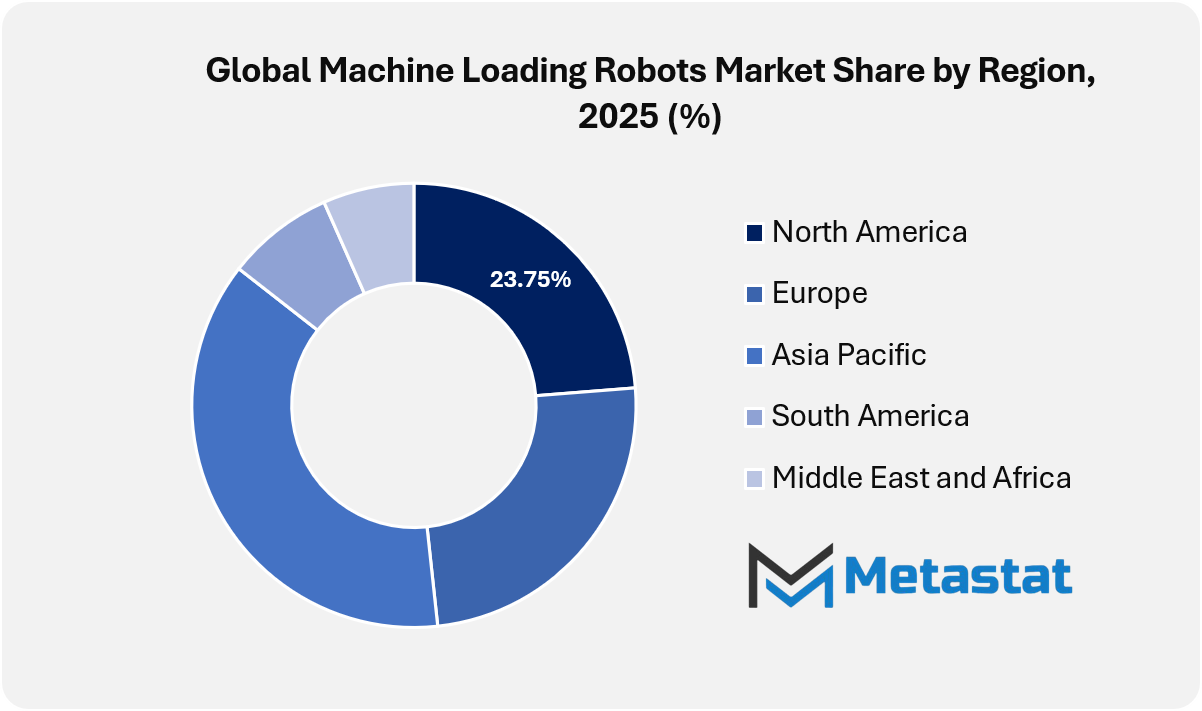
The Global Machine Loading Robots Market features a huge blend of setup automation leaders and rapidly rising robotics specialists, each shaping industrial production via precision, pace, and reliability. Companies such as FANUC Corporation, ABB Ltd., KUKA SE & Co. KGaA, and Yaskawa Electric Corporation stand at the leading edge, offering robot structures broadly followed throughout automotive, electronics, and heavy production centers. Their longstanding presence rests on deep engineering knowledge, sturdy international service networks, and constant enhancements targeted on accuracy, safety, and cycle-time discount.
Japanese producers keep maintaining a sturdy position in the market. Companies such as Kawasaki Robotics, Nachi-Fujikoshi Corp., Seiko Epson Corporation, Yamaha Motor Co., Ltd., Mitsubishi Electric Corporation, Denso Corporation, and Shibaura Machine CO., LTD make contributions to superior movement management, compact robotic designs, and excessive-velocity loading solutions. The companies focus closely on reliability and repeatability, assisting factories looking for solid output in high-volume production lines.
European firms add every other layer of electricity through flexibility and device integration capabilities. Stäubli International AG., Festo AG & Co. KG, and Agile Robotic Systems emphasize precision management, cleanroom compatibility, and collaborative automation principles. Universal Robots USA, Inc., Techman Robot Inc., JAKA Robotics Co., Ltd., AUBO Robotics, Dobot, and Elite Robots further amplify collaborative robot adoption, permitting small and mid-sized manufacturers to automate gadget loading responsibilities without complicated infrastructure.
Chinese automation carriers deliver scale and fee performance into awareness. Companies including Siasun Robot & Automation CO., Ltd., GSK CNC Equipment Co., Ltd., ESTUN AUTOMATION CO., LTD, Guangdong Huayan Robotics Co., Ltd., and Efort Robotics Srl boom home and international reach via competitive pricing and a rapidly evolving era. The presence strengthens adoption across steel processing, plastics, and trendy production sectors.
Together, the competitors create an aggressive marketplace shaped through innovation, accessibility, and performance-driven automation. Continuous funding in smarter controls, imaginative and prescient systems, and adaptive gripping solutions helps wider use of device loading robots throughout varied industrial settings, reinforcing their role in cutting-edge production environments.
Market size is forecast to rise from USD 7.2 billion in 2025 to over USD 14.5 billion by 2033.
Sustainability narratives are set to persuade design priorities. Energy-aware movement making plans, decreased idle cycles, and cloth-green handling behaviors are predicted to place machine loading robots within broader commercial decarbonization agendas. In parallel, regulatory attention is projected to move towards algorithmic responsibility, facts governance, and operational traceability, expanding the strategic verbal exchange past productiveness metrics.
By Type:
By Payload Capacity:
By End-User:
This research report categorizes the Machine Loading Robots market based on key segments and regions, forecasts revenue growth, and analyses trends in each submarket. The report analyses the key growth drivers, opportunities, and challenges influencing the Machine Loading Robots market. Recent market developments and competitive strategies such as expansion, new site development, partnership, merger, and acquisition are included to present the competitive landscape.
The report strategically identifies and profiles the key market players and analyses their core competencies in each sub-segment of the Machine Loading Robots market.
|
Report Attributes |
Details |
|
Study Period |
2021-2033 |
|
Base Year |
2025 |
|
Estimated Year |
2026 |
|
Forecast Period |
2026-2033 |
|
Historical Period |
2021-2025 |
|
Growth Rate |
CAGR 9.2% from 2026 to 2033 |
|
Revenue Unit |
USD billion |
|
Sales Volume Unit |
Thousand Units |
|
Segmentation |
By Type, Payload Capacity, End-User, and Region |
|
By Region |
North America (By Type, Payload Capacity, End-User, and Country)
|
|
Europe (By Type, Payload Capacity, End-User, and Country)
|
|
|
Asia Pacific (By Type, Payload Capacity, End-User, and Country)
|
|
|
South America (By Type, Payload Capacity, End-User, and Country)
|
|
|
Middle East and Africa (By Type, Payload Capacity, End-User, and Country)
|
Find answers to common questions about this report
Top players operating in the Machine Loading Robots industry include FANUC Corporation, KUKA SE & Co. KGaA, ABB Ltd., Yaskawa Electric Corporation, Nachi-Fujikoshi Corp., and Kawasaki Robotics.
Asia Pacific region dominates the market.
Global Machine Loading Robots market is estimated to reach USD 14.5 billion by 2033.
Rising demand for automation to improve production efficiency and reduce labor dependency. and increasing the adoption of robotics in the automotive, electronics, and metal fabrication industries. are key driving factors, boosting the market.
The Articulated Robots is the leading type segment in the Global market.
High initial investment and integration costs for robotic systems, will hamper market growth within the forecast period.
The Global Machine Loading Robots market is likely to grow at a CAGR of 9.2% over the forecast period (2026-2033).
The Metastat Insights analysis shows that the North America Machine Loading Robots market size is estimated to be USD 3.1 billion by 2033.
The Metastat Insights study shows that the Global Machine Loading Robots market size was USD 7.2 billion in 2025.
The analysts below cover Machinery & Equipment research at Metastat Insights.
LEAD ANALYST
Utkarsh Khirodkar is a Lead Market Research Analyst at MetaStat Insight, specializing in market intelligence, technology sector assessments, and competitive strategy.

INDUSTRY CONSULTANT - CHEMICALS & ADVANCED MATERIALS
Chemicals and Materials · Machinery & Equipment · Packaging
Amit Gadhekar Consultant for Chemicals and Materials at MetaStat Insight, directing sector-specific intelligence, research, and strategic consulting across global chemical and processing markets.

PRINCIPAL CONSULTANT - QUALITY SYSTEMS & COMPLIANCE
Electronics and Semiconductor · Machinery & Equipment · Professional Services
Omkar Phadtare is an Industry Consultant at MetaStat Insight, specializing in quality systems, regulatory compliance, and standards benchmarking to drive data-driven market intelligence and strategic industry research.

ENERGY & INFRASTRUCTURE INDUSTRY CONSULTANT
Automotive and Transportation · Electronics and Semiconductor · Energy and Power · Machinery & Equipment
Saurabh Vasant Ganvir consults for Energy & Infrastructure Industry at MetaStat Insight, specializing in renewable energy, solar EPC, and electric vehicle (EV) infrastructure markets.

LEAD CONSULTANT - COMMUNICATION, TELECOM, AND IT
Electronics and Semiconductor · Information & Technology · Machinery & Equipment · Professional Services
Ravindra Sathe Consultants for Communication, Telecom, and IT at MetaStat Insight. He leads the firm's industry research initiatives across telecommunications infrastructure, digital connectivity, enterprise networking, and emerging information technology domains.
Our group needed clearer visibility into out-of-autoclave processing timelines for high-temperature thermoplastic composites. MetaStat Insight delivered an objective assessment that contrasted automated fiber placement scrap rates with traditional thermoset prepreg layup cycles. The supplier landscape mapped out primary resin suppliers and tape slitting capacity across France, Germany, and Japan with solid technical accuracy. Their analyst handled our questions on precursor supply risks during an unscheduled inquiry call, providing clear, unembellished context.
Evaluating sensor fusion reliability across harsh operating environments can be tricky without field-validated data. The study on agricultural autonomous guidance systems clearly separated stereo vision setups from automotive-grade solid-state LiDAR. We appreciated the regional infrastructure analysis, specifically around RTK network density across North America and South America. During our follow-up consultation, the MetaStat Insight team walked through tier-two perception software partnerships, giving our engineering leads a practical basis for vendor shortlisting.
Analyzing the transition from natural gas to green hydrogen in iron ore reduction requires realistic infrastructure timelines. Meta stat insight supplied a detailed regional assessment of DRI plant conversion costs and scrap metal availability in North America and Western Europe. Their report carefully examined pellet quality specs and electrical grid access constraints without making oversimplified market assumptions. The research material served as a practical reference during internal technology roadmap discussions.
Explore related market intelligence reports worth reading alongside this one.
Starting from
$2950