
LEAD ANALYST
Utkarsh Khirodkar is a Lead Market Research Analyst at MetaStat Insight, specializing in market intelligence, technology sector assessments, and competitive strategy.

Global Machine Tending Robots Market Size, Share, By Robot Type (Articulated Robots, Cartesian and Gantry Robots, SCARA Robots), By Payload Capacity (Up to 10 kg, Above 10 to 20 kg, Above 20 to 50 kg, Above 50 to 100 kg, Above 100 kg), By Application (CNC Machine Tool Tending, Injection Molding Machine Tending, Press and Stamping Machine Tending, Die Casting Machine Tending), By End-Use Industry (Automotive and Transportation, Machinery and Industrial Equipment, Electrical and Electronics, Plastics and Rubber Products, Aerospace and Defense, Medical Devices), Industry Analysis, Growth, Trends, and Forecast, 2026-2033
Report ID
MSI-5599
Published
October, 2026
Pages
266 Pages
Format
Historical
Base year
Forecast
Forecast period
Report Details
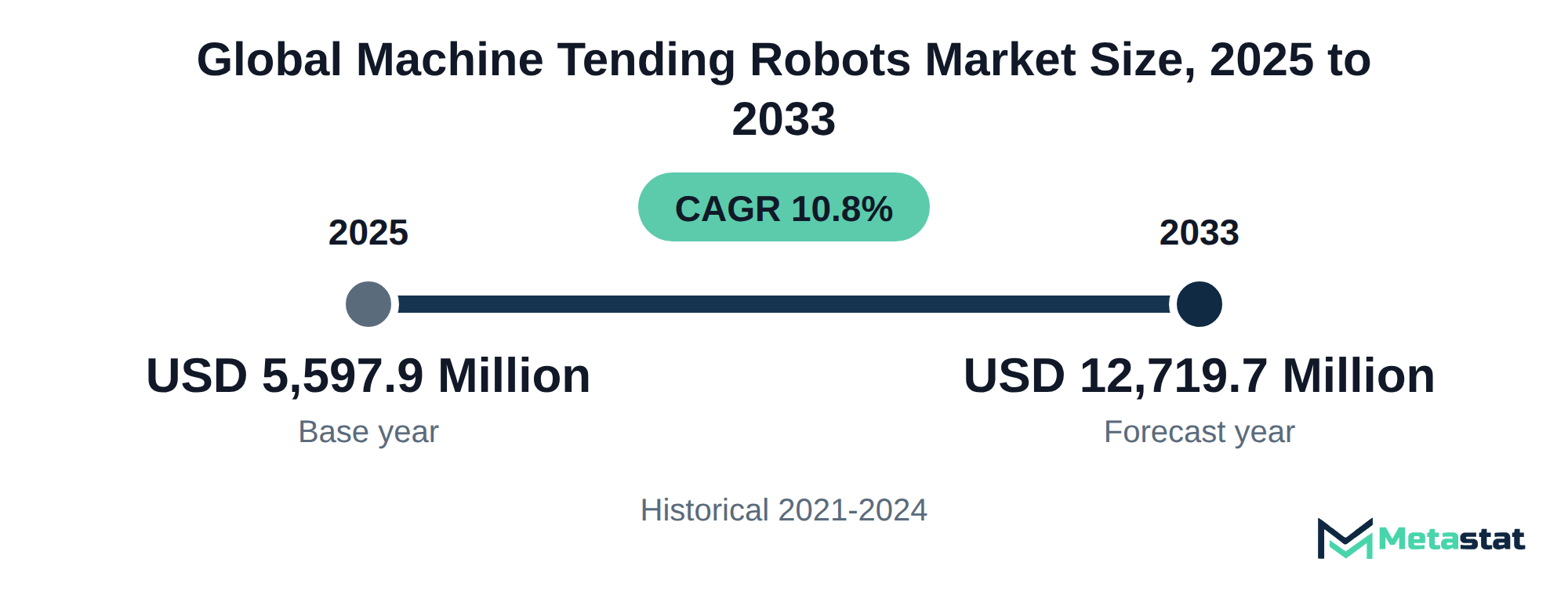
Market Valuation: Valued at $5,597.9 Million in 2025, projected to reach $12,719.7 Million by 2033 at a 10.8% CAGR.
Dominant Segment: The articulated robots segment leads the market, driven by their versatility and effectiveness in various manufacturing applications, particularly in CNC machine tool tending.
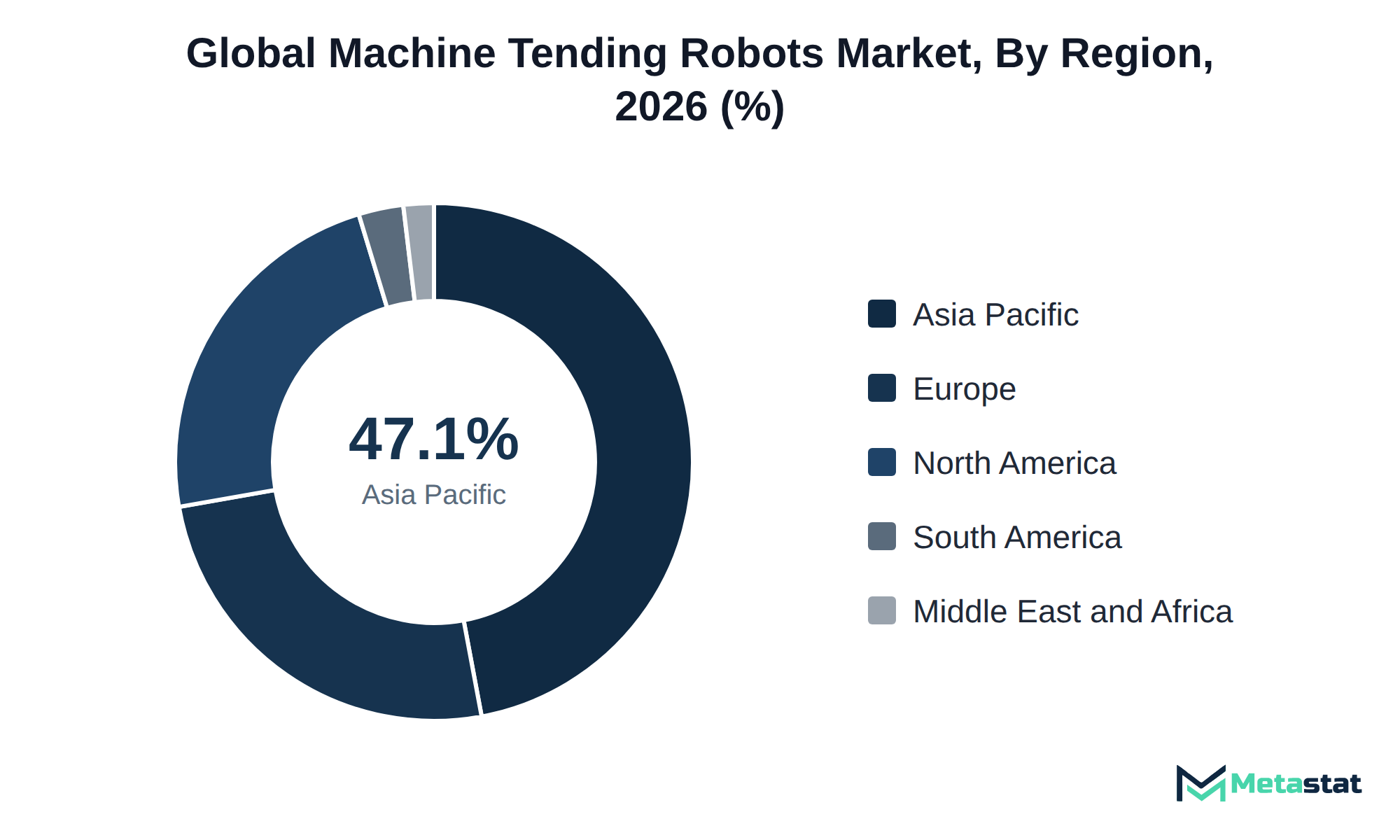
Geographic Lead: Asia Pacific dominates the market with a 47.1% share in 2025, fueled by rapid industrialization and technological advancements in automation.
What's Inside: The report provides a comprehensive analysis of the competitive landscape, market segmentation by robot type, payload capacity, application, and end-use industry, along with forecasts through 2033.
CNC Machine Tool Tending Growth: This application segment is projected to grow significantly, with an expected CAGR of 11.5% from 2026 to 2033, reflecting the increasing integration of automation in manufacturing processes.
Choose Your License
Global Machine Tending Robots Market
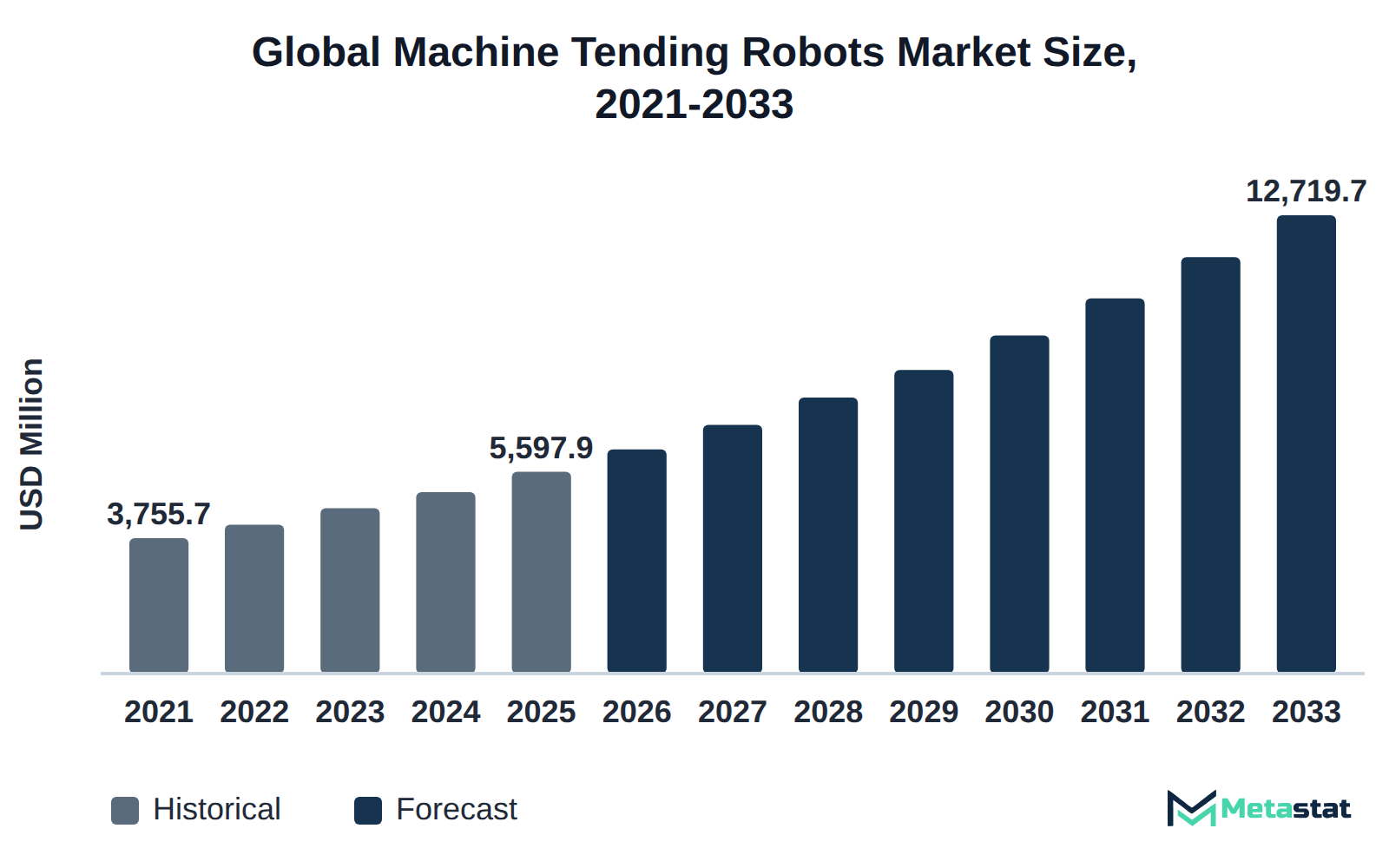
The global Machine Tending Robots market was valued at USD 5,597.9 million in 2025 and is projected to reach USD 12,719.7 million by 2033, growing at a CAGR of 10.8% over the forecast period.
The segment encompasses the use of robotics in the automation of machine tending tasks, which replace manual labor in manufacturing processes. Buyers invest in this technology to enhance operational efficiency, reduce labor costs, and improve precision in production. The growing demand for automation in various industries underpins the spending on machine tending robots, with significant applications in automotive, electronics, and industrial equipment sectors.
Growth in the market is driven by increasing adoption of automation technologies aimed at improving productivity and addressing labor shortages. The segment featuring articulated robots represents the highest value within the overall market, reflecting a strong growth trajectory. North America holds 23.1% of the market in 2025, with the US leading in 2026. The Asia Pacific region accounts for the largest share at 47.1%, highlighting its dominant role in the global market.
Advances in robotics and the growing need for operational flexibility are driving market expansion. Industries focus on enhancing their production capabilities through robotics to maintain competitiveness. This trend encourages further investment and development in automation solutions.
The market addresses automation solutions that enhance efficiency in manufacturing, focusing on tasks traditionally performed by human labor. Buyers invest in these technologies to improve productivity, reduce operational costs, and stay competitive in a changing industrial environment. The integration of machine tending robots facilitates faster production cycles and consistent quality, driving demand across various sectors.
A significant growth driver stems from the increasing adoption of automation technologies by manufacturers aiming to optimize their operations. The segment of articulated robots holds the largest value within the market, reflecting their versatility and effectiveness in diverse applications. This region is expected to see continued investment in advanced robotics, supported by a strong industrial base and favorable policies promoting technological advancement.
The ongoing transition towards smart manufacturing and Industry 4.0 concepts contributes to heightened interest in the market. Companies across various sectors seek to enhance their production capabilities and meet rising consumer demands through automation. The increasing emphasis on operational efficiency and sustainability further drives the market's trajectory, positioning machine tending robots as essential components in modern manufacturing strategies.
Collaborative robots enhance the viability of CNC loading in high-mix machine shops, enabling more efficient operations in environments with varied production demands. These robots streamline the process through rapid reconfiguration that accommodates different parts and machining requirements. The Machine Tending Robots market reflects this trend, with significant projected growth in the CNC Machine Tool Tending application segment, expected to expand from USD 2,801 million in 2026 to USD 6,007.5 million by 2033, registering a compound annual growth rate (CAGR) of 11.5%.
This growth is driven by the increasing need for flexibility in production lines, where traditional automation often falls short. Collaborative robots, designed to work alongside human operators, offer a solution that reduces downtime and enhances productivity. Because these robots can adapt to various tasks without extensive programming, they suit high-mix facilities and help manufacturers stay competitive.
Adopting collaborative robots in CNC loading improves operational efficiency and lowers overall costs, which helps companies pursue diverse market opportunities. This shift towards automation in high-mix environments signifies a significant change in the Machine Tending Robots market, emphasizing the demand for innovative solutions that drive productivity in manufacturing sectors.
Vision-guided part feeding technologies enhance unattended multi-machine production capabilities significantly within the Machine Tending Robots market. This automation leads to improved efficiency, reduced cycle times, and lower operational costs for manufacturers. The demand for such systems is driven by the need for greater flexibility and adaptability in production environments.
Pricing structures for vision-guided systems typically include upfront capital costs, ongoing maintenance fees, and software licensing models. Several suppliers offer flexible financing options, allowing buyers to align payments with the expected return on investment. These contract models often incorporate performance-based incentives, ensuring that suppliers remain accountable for the longevity and effectiveness of the deployed technology. This pricing approach strengthens partnerships between suppliers and buyers and encourages manufacturers to adopt advanced solutions that fit into existing workflows.
The result of these trends in the Machine Tending Robots market positions manufacturers to optimize productivity while minimizing costs. Such advancements drive further investment in automated solutions, as businesses seek to remain competitive in an increasingly automated environment.
Integrating gantry and take-out robots into injection-molding processes significantly reduces cycle delays. These robots enhance efficiency by automating the removal of molded parts from machines, thereby streamlining production flows. In the Machine Tending Robots market, the application of these technologies directly aligns with the increasing demand for faster production rates and reduced operational costs.
Demand is rising for automation in manufacturing processes, particularly in industries that rely heavily on injection molding. By employing integrated gantry and take-out robots, manufacturers expect to see enhanced productivity and improved quality control.
The adoption of these robotic systems translates to greater consistency in production outputs, reduction in manual labor requirements, and overall cost savings in manufacturing operations. Companies seeking to optimize their injection-molding capabilities can meet rising demand and strengthen their competitive position by investing in integrated gantry and take-out robots.
Robotic machine tending delivers a viable payback for CNC shops primarily through enhanced productivity and reduced labor costs. With rising demand for automation, businesses increasingly seek solutions that optimize operational efficiency. Such growth illustrates the speed at which CNC shops realize returns on their robotic investments.
Investment in robotic machine tending allows for continuous operation, reducing downtime and enabling shops to fulfill higher production volumes. The reduction in labor costs contributes significantly to the payback period for these systems. By integrating robotic solutions, CNC shops expect operational shifts that lead to improved margins and overall profitability. With the market evolving rapidly, timely investments in robotic machine tending often translate into competitive advantages, reinforcing the financial rationale for adoption.
Shifts in buyer behavior toward automation technologies significantly drive growth in the Machine Tending Robots market. Manufacturers increasingly prioritize efficiency and productivity, leading to higher volumes of machine tending robots in production environments. The automotive and transportation sectors demonstrate substantial investment in robotic solutions, focusing on automating tasks like CNC machine tool tending. This growth indicates a strong preference for automated processes over manual labor, enhancing overall operational efficiency and reducing production costs.
These trends support market expansion and intensify competition among suppliers. The preference for automation technologies results in heightened demand for machine tending robots, positioning them as essential assets for manufacturers aiming to optimize production capabilities.
Technological advancements enable suppliers to enhance operational efficiency, driving the evolution of machine tending solutions. Suppliers prioritize innovations that lower production costs, thereby meeting the growing demand for budget-friendly automation options. Increasing competition within the Machine Tending Robots market compels manufacturers to streamline product offerings, enhancing profitability while maintaining affordability.
The rise of modular systems enhances flexibility in operations. Suppliers increasingly offer customizable solutions that adapt to specific production requirements, contributing to the appeal of robotic automation among diverse buyer groups. This adaptability allows manufacturers to maximize utility across various applications, reinforcing the adoption of machine tending robotics in sectors including automotive, electronics, and plastics.
Ongoing investments in AI-driven technologies, including industrial AI software, facilitate enhanced precision and reliability in machine tending. These developments enhance overall productivity while reducing the likelihood of errors, providing a significant advantage for manufacturers. This technological progress supports sustained market growth as manufacturers place more emphasis on efficiency and cost-effectiveness.
Price sensitivity among small to medium-sized manufacturers presents a significant restraint in the Machine Tending Robots market. Many of these buyers face constrained budgets, making it challenging to invest in costly robotic solutions. High upfront costs and ongoing maintenance expenses often lead to slower uptake of automation technologies, resulting in smaller orders and delayed replacement of outdated machinery.
This price sensitivity particularly affects industries including automotive and transportation, where profit margins are tight. Manufacturers in these sectors require cost-effective solutions that provide a clear return on investment. Consequently, this constraint limits overall growth potential in the market, delaying advancements in automation adoption across various segments.
Suppliers of machine tending robots face significant challenges due to rising input costs, particularly for materials and components. Escalating prices of raw materials directly impact production expenses, eroding profit margins for manufacturers. Competition intensifies, prompting suppliers to seek alternative sourcing options, implement cost-reduction strategies, and invest in research and development to enhance the efficiency of their products. These strategies focus on improving the performance of robots while minimizing material usage. The automotive and industrial equipment sectors, being major buyers of these robots, feel the effects of higher costs, prompting them to demand more cost-effective solutions. The market adapts through innovations that prioritize energy efficiency and durability, ensuring that suppliers remain competitive while addressing financial pressures from rising costs. Such developments contribute to the overall growth of the machine tending robots market, with manufacturers seeking value-driven solutions during fluctuating expenses.
The CNC machine tool tending segment represents a significant growth opportunity within the Machine Tending Robots market, with an anticipated compound annual growth rate (CAGR) of 11.5% from 2026 to 2033. This acceleration in demand arises from the rising integration of automated solutions in manufacturing processes, driven by the pursuit of enhanced productivity and efficiency. Manufacturers increasingly prioritize automation to streamline operations and maintain competitiveness, particularly in sectors requiring precision and speed.
This segment's growth reflects a shift toward advanced robotic technologies that improve machine utilization and reduce downtime. The expected increase in value from USD 2,801.0 million in 2026 to USD 6,007.5 million by 2033 highlights the robust potential of this specific application. The market positions itself to cater to the increasing demand for efficient CNC operations, supporting manufacturers in achieving higher output levels while minimizing labor costs.
The Global Machine Tending Robots market is segmented based on Robot Type, Payload Capacity, Application, and End-Use Industry.
Articulated Robots segment is valued at USD 3,795.5 million in 2026 and is projected to reach USD 8,037.6 million by 2033, at a CAGR of 11.3% during the forecast period. These robots are widely used in manufacturing processes, particularly for tasks involving precision and dexterity, including CNC machine tool tending and assembly operations. The demand for articulated robots is increasingly driven by the necessity for enhanced productivity and efficiency in manufacturing environments. This segment differs from others, including Cartesian and Gantry Robots, which show a lower growth rate of 9.5%. The adaptability of articulated robots allows manufacturers to optimize workflows, responding effectively to diverse production needs. The market for articulated robots presents strong investment potential due to its growth trajectory, supporting the adoption of advanced automation solutions across various industries.
Cartesian and Gantry Robots segment is estimated to reach USD 3,265.1 million by 2033, at a CAGR of 9.5% during the forecast period. This segment finds application in automating tasks typically involving precise movement and placement, used predominantly in industries including manufacturing, where accuracy and efficiency are crucial. Linear motion system components support the accurate axis movement these robots require. Demand for these robots is driven by the increasing need for streamlined operations in production environments, particularly in sectors focusing on high precision. Compared to other robot types, Cartesian and Gantry Robots experience moderate growth, influenced by the expanding adoption of automation solutions in various industries. This segment's growth trajectory is supported by technological advancements that enhance capabilities while maintaining competitive pricing structures. Unlike articulated robots, which see a higher CAGR of 11.3%, Cartesian and Gantry Robots serve specific applications and remain a significant part of the Machine Tending Robots market.
SCARA Robots segment is expected to reach USD 1,218.5 million by 2033. This segment specializes in precise and repetitive tasks, often used for assembly, material handling, and packaging in various industries. Manufacturers in the automotive and electronics sectors frequently employ SCARA robots for their speed and accuracy, enhancing productivity while minimizing human error. The growth of this segment is driven by increasing demand for automation in manufacturing processes, particularly in high-volume production environments. Compared to other robot types, including articulated or Cartesian robots, SCARA robots exhibit a more focused application and typically lower payload capacities, making them particularly suitable for tasks requiring high precision. A CAGR of 10.5% for this segment reflects strong market potential amid ongoing advancements in robotics technology.
Others (Delta, Cylindrical Robots) segment is projected to grow at a CAGR of 8.8% during the forecast period. This segment automates complex tasks including high-speed assembly and precise material handling. Industries including electronics and automotive use these robots to perform delicate operations in confined spaces. Growth in this segment is driven by increasing demand for efficiency in production lines, where minimizing cycle times and maximizing throughput are essential. Differentiating factors include a lower growth rate compared to articulated robots, which are projected to grow at an 11.3% CAGR during the same period. The market benefits from ongoing advancements in robotic technology, which enhance precision and flexibility, positioning these robots favorably against traditional manual processes.
Valued at USD 1,549.8 million in 2026, this segment is projected to reach USD 3,270.2 million by 2033, at a CAGR of 11.3% during the forecast period. This category primarily serves manufacturers that require lightweight automation solutions for tasks involving parts weighing up to 10 kg. Demand stems from industries including electronics and small hardware manufacturing, where compact robotic solutions enhance productivity and precision. The Up to 10 kg segment distinguishes itself with a higher growth rate compared to larger payload capacities, driven by the ongoing trend toward automation in smaller-scale production environments. Adoption of these robots allows manufacturers to optimize workflows, reduce labor costs, and increase throughput without significant capital investment. Anticipated growth in this segment reflects a broader trend within the Machine Tending Robots market, focusing on flexible automation solutions tailored to meet the demands of diverse production needs.
The above 10 to 20 kg segment is estimated to reach USD 3628.9 million by 2033, at a CAGR of 11.7% during the forecast period. This segment primarily serves industries that require reliable handling of medium-weight materials and components, including automotive and electronics manufacturers. Growing automation trends within these sectors drive demand, increasing efficiency and productivity. The segment differentiates itself from others in its group through its targeted payload capacity, catering to specific operational requirements while ensuring integration into existing workflows. Higher performance capabilities in this segment attract buyers focused on maximizing throughput and reducing manual handling costs. Compared to lighter payload segments, this category enjoys a more significant growth trajectory, reflecting a stronger adoption rate in industrial applications where precision and speed are critical. Investments in advanced robotic technologies will further enhance the operational effectiveness of above 10 to 20 kg payload robots, reinforcing their role in diverse manufacturing environments within the Machine Tending Robots market.
The Above 20 to 50 kg segment is expected to reach USD 3,200.3 million by 2033. This segment is commonly used in heavy-duty applications, including automotive assembly and industrial machinery operations. Buyers in this category include large manufacturing facilities that require robust automation solutions for higher payloads. Key factors driving growth in this segment include increasing demand for automation in heavy manufacturing and advancements in robotic technology that enhance operational efficiency. Unlike lighter payload segments, this segment experiences a slower growth rate, reflecting the greater complexity and higher initial capital investment associated with integrating these robots. The compound annual growth rate is 9.5%, distinguishing it from segments including Up to 10 kg and Above 10 to 20 kg, which have markedly higher growth rates. The market continues to evolve with innovations tailored to meet the specific needs of these heavier applications.
The Above 50 to 100 kg segment is projected to grow at a CAGR of 9.5% during the forecast period. This segment finds application in heavy-duty tasks, primarily by industries including automotive and manufacturing, where robust material handling is essential. Demand for this segment is driven by increasing automation in these sectors, emphasizing efficiency and precision in operations. Compared to lighter payload segments, this category offers higher payload capacities, catering to specific applications that require enhanced strength and stability. Industries focus on optimizing production processes, and the adoption of heavier payload robots is expected to gain traction, contributing to market growth. Manufacturers investing in advanced robotics technology reflect a strategic shift toward streamlining operations and reducing labor costs, which enhances competitiveness in the market.
Payload capacities exceeding 100 kg cater to specialized applications requiring heavy lifting and precise handling of large components. Industries including automotive and aerospace frequently employ these robots for tasks including assembly, welding, and material handling. Growth within this segment is driven by increasing demand for automation solutions that enhance productivity and efficiency, particularly in sectors dealing with bulky materials. This sub-segment distinguishes itself through its potential for higher pricing strategies compared to lighter payload categories, reflecting the advanced technology and robust construction needed for these machines. While other segments like those under 10 kg experience rapid growth, the adoption of robots in the above 100 kg category is characterized by a slower but steady increase, driven primarily by the complexity of integration and the cost of the equipment involved. The market reflects a significant shift toward automation technologies that support operational excellence.
This segment serves primarily in the manufacturing sector, where it automates the loading and unloading of components in CNC machines, enhancing production efficiency. The demand is driven by the increasing need for precision machining and the growing adoption of automation in manufacturing environments. Compared to other segments, CNC Machine Tool Tending exhibits a faster growth rate, attributed to its critical role in optimizing workflows in industries including aerospace and automotive. The focus on improving productivity and reducing labor costs drives investment in this area, positioning it as a key growth driver within the market.
Injection Molding Machine Tending segment is estimated to reach USD 3,327.5 million by 2033, at a CAGR of 9.7% during the forecast period. This application primarily serves manufacturers in the plastics and rubber products industries, where precision and speed in handling molded parts are critical. Demand in this segment is driven by increasing automation of production lines, enhancing efficiency and productivity. Injection molding suppliers increasingly adopt robotic solutions to minimize manual labor and reduce cycle times, leading to heightened demand for specialized technologies. Compared to other applications, this segment experiences significant growth due to advancements in injection molding technology coupled with rising labor costs. This contrasts with segments like Press and Stamping Machine Tending, which demonstrates slower growth and a projected value of USD 1,493.3 million by 2033.
Press and Stamping Machine Tending segment is expected to reach USD 1,493.3 million by 2033. This application involves the use of machine tending robots for the automation of processes including stamping, pressing, and shaping materials in metalworking and other manufacturing settings. Industries including automotive and industrial equipment leverage this technology to enhance productivity and reduce labor costs. Increasing demand for efficiency and precision in production drives growth in this segment, which is projected to grow at a CAGR of 9.7% during the forecast period. Compared to other applications, this segment experiences slower growth rates due to the specific requirements of the machinery involved, which limits broader adoption. The market for Press and Stamping Machine Tending is characterized by more specialized robotic solutions that cater to the unique operational challenges faced by manufacturers in this field.
Die Casting Machine Tending segment is projected to grow at a CAGR of 10.5% during the forecast period. This segment involves the automation of die casting processes, primarily used in industries including automotive and machinery manufacturing. Manufacturers apply these robots to increase efficiency and enhance precision in die casting operations. The rising demand for lightweight components in automotive manufacturing drives the adoption of these robots. This demand also relates to the automotive parts aluminium die casting industry. Compared to other applications in the market, Die Casting Machine Tending involves a unique combination of high temperatures and complex molds, differentiating it from segments including CNC Machine Tool Tending. Its specific requirements for handling molten metal contribute to its growth trajectory, with expectations of reaching USD 1,493.3 million by 2033, reflecting increasing automation trends in the market.
Others (Heat Treatment, Testing Equipment) focuses on applications including heat treatment processes and testing equipment operations within various industrial settings. Industries engage these robots to enhance efficiency in tasks requiring precision and reliability. The primary drivers for this segment include rising automation in manufacturing and increasing demand for quality assurance processes. Compared to other application segments, this one typically experiences slower growth due to the specialized nature of heat treatment and testing applications, which often require customized solutions. Within the market, this segment attracts buyers seeking advanced robotic systems for specific tasks, distinguishing it from more generalized applications including CNC or injection molding. Technological advancements in robotics enhance capabilities, supporting adoption among manufacturers aiming to improve operational performance.
Valued at USD 1,866.9 million in 2026, this segment is projected to reach USD 3,581.9 million by 2033, at a CAGR of 9.8% during the forecast period. Predominantly used by automotive and transportation manufacturers, these robots facilitate various tasks, including part handling and assembly processes. The growing emphasis on automation and efficiency drives demand, with manufacturers adopting robotics to enhance productivity and reduce labor costs. Compared to other segments, this segment benefits from higher investment due to the larger scale of operations and the need for precision in automotive production. The adoption of advanced robotics technology in this sector, including machine tending robots, supports increased efficiency, resulting in significant growth opportunities. While competition remains strong, the focus on automation across the automotive industry advances the market and encourages innovation.
The Machinery and Industrial Equipment segment is estimated to reach USD 3,398.7 million by 2033, at a CAGR of 11.3% during the forecast period. This segment serves industries involved in manufacturing and processing machinery, where automation enhances productivity and operational efficiency. Demand for automation in equipment manufacturing drives growth in this segment, particularly as companies seek to improve production rates and reduce labor costs. The Machinery and Industrial Equipment segment experiences a higher growth rate compared to other segments, reflecting the increasing trend toward automated solutions in various industrial applications. The focus on innovation and technological advancements supports the adoption of machine tending robots, distinguishing this segment from others with lower growth rates and different buyer profiles. Industries including automotive and electronics contribute to demand, while the specific needs of machinery manufacturers highlight the unique characteristics of this market segment.
The Electrical and Electronics segment is expected to reach USD 2,089.8 million by 2033. This segment serves industries including consumer electronics, telecommunications, and industrial automation that require high precision and efficiency in production processes. The demand for automation solutions in manufacturing, driven by the pursuit of higher productivity and improved quality, fuels growth in this segment. Compared to others, this segment shows a more stable demand pattern due to consistent advancements in technology and the need for high-quality electronic components. With a CAGR of 11.3%, the growth rate aligns closely with that of the Up to 10 kg payload capacity segment, highlighting a competitive landscape focused on efficiency and innovation in machine tending applications. The market for machine tending robots is expected to evolve, driven by increasing investments in automation technologies across various industries.
The Plastics and Rubber Products segment is projected to grow at a CAGR of 9.2% during the forecast period. This segment serves industries involved in the manufacturing and processing of plastics and rubber, used for creating various products ranging from automotive components to consumer goods. Demand in this segment is driven by the increasing need for automation in production lines, where efficiency and precision are critical. Growth in Plastics and Rubber Products stands out due to the rising adoption of robotic solutions for injection molding and other processes. The anticipated increase in production capacities to meet consumer demand drives investment in machine tending robots, enhancing operational efficiencies across the market.
Extensively employed in high-precision applications, the Aerospace and Defense segment focuses on tasks crucial to aerospace parts manufacturing and assembly processes. Key players in this field include defense contractors and aerospace manufacturers, which rely on machine tending robots for improved efficiency and operational safety. This segment experiences growth driven by increasing demands for automation and advanced manufacturing techniques aimed at enhancing production capabilities while minimizing human error. Compared to other segments, including Automotive and Transportation, the Aerospace and Defense segment exhibits relatively slower growth due to stringent regulatory requirements and the necessity for high accuracy in operations. The adoption of advanced technologies and innovations tailored for this industry significantly influences its development. These factors contribute to a unique market dynamic that shapes the trajectory of the machine tending robots market.
This segment focuses on applications related to medical devices, which are central to healthcare and patient management. Medical device manufacturers employ machine tending robots to enhance efficiency, precision, and safety in production processes. Demand for automation in the medical sector arises from the need for increased productivity and the stringent quality demands associated with medical products. Regulations governing the production of medical devices drive the adoption of advanced technologies, including robotics. Compared to other segments, this area experiences slower growth due to higher costs and the complexity of compliance with regulatory requirements. Investment in automated solutions for medical devices reflects a commitment to improving manufacturing outcomes while addressing labor shortages in healthcare manufacturing.
This segment focuses on applications involving consumer goods and energy equipment, serving industries that require automated processes for handling products and components. Companies in retail, household goods manufacturing, and energy sectors employ machine tending robots to improve operational efficiency and reduce labor costs. Increasing demand for automation in production lines drives growth in this segment, with industries seeking to enhance productivity and ensure product quality. Compared to other segments, this segment experiences slower adoption due to the specific requirements and standards of consumer goods and energy equipment. The market presents unique challenges, including the need for customization to meet diverse application needs, which differentiates it from more standardized segments in the market.
Based on geography, the Global Machine Tending Robots market is divided into North America, Europe, Asia-Pacific, South America, Middle East, and Africa.
The demand for machine tending robots in North America stems primarily from the automotive and machinery sectors, where automation enhances efficiency and precision. Significant growth in adoption results from investments in technology that streamline manufacturing processes. The market is projected to reach USD 2,816.1 million by the end of 2033, reflecting robust interest in robotics within the region. The United States, Canada, and Mexico represent key markets, driven by modernization efforts and the push for increased productivity. North America accounted for 23.1% of the global market share in 2025, highlighting its importance in the machine tending robots landscape. This trend is expected to influence further technological advancements and competitive dynamics in the market.
The Machine Tending Robots market in Europe exhibits strong growth driven by demand from industries including automotive, machinery, and electronics. The region prioritizes automation and efficiency, enabling manufacturers to enhance productivity and reduce operational costs. Countries like Germany and France, known for their advanced manufacturing sectors, contribute significantly to the market's expansion. The favorable investment climate, alongside government initiatives for automation adoption, supports growth. With a projected market share of 25.2% in 2025, Europe remains a critical player in the global machine tending robots market. Production facilities increasingly integrate robotic systems, positioning the market for sustained growth through to 2033.
Asia-Pacific represents a significant portion of the Machine Tending Robots market, capturing 47.1% of the global share in 2025. Key drivers of demand in this region include robust manufacturing sectors, particularly in China, Japan, and India, where automation enhances efficiency and competitiveness. The region's focus on advancing technology in industries including automotive, electronics, and machinery fuels increased investment in automated solutions. Countries like South Korea and Australia actively pursue initiatives to modernize manufacturing processes, resulting in a favorable environment for machine tending solutions. The region's diverse industrial landscape supports a variety of applications, further expanding market opportunities. The market is projected to show sustained growth, driven by the rising adoption of automation technologies across various sectors.
South America contributes a modest share of 2.8% to the global market in 2025, with key demand driven by industries including automotive and machinery. Brazil and Argentina stand out as the primary markets within the region, focusing on automating processes for enhanced operational efficiency. The market faces challenges related to infrastructure development and investment in advanced technologies, impacting the pace of adoption. Companies in the region prioritize machine tending solutions to address labor shortages and improve production capabilities. The market is projected to expand steadily, reflecting growing recognition of automation's benefits across various sectors.
Growth in the Machine Tending Robots market within the Middle East and Africa relies on advancements in the automotive and manufacturing sectors. Countries including Saudi Arabia and the UAE prioritize automation to enhance productivity and efficiency in these industries. South Africa exhibits a similar trend, focusing on integrating robotics to streamline operations in various manufacturing processes. The region faces challenges related to infrastructure development, impacting the speed of technology adoption. However, regional investments in automation infrastructure are expected to support future growth. The market share in this region is estimated at 1.9% in 2025, highlighting emerging opportunities for robotics integration across various industries. Market participants are likely to explore partnerships and local collaborations to strengthen their presence and capitalize on growing demand.
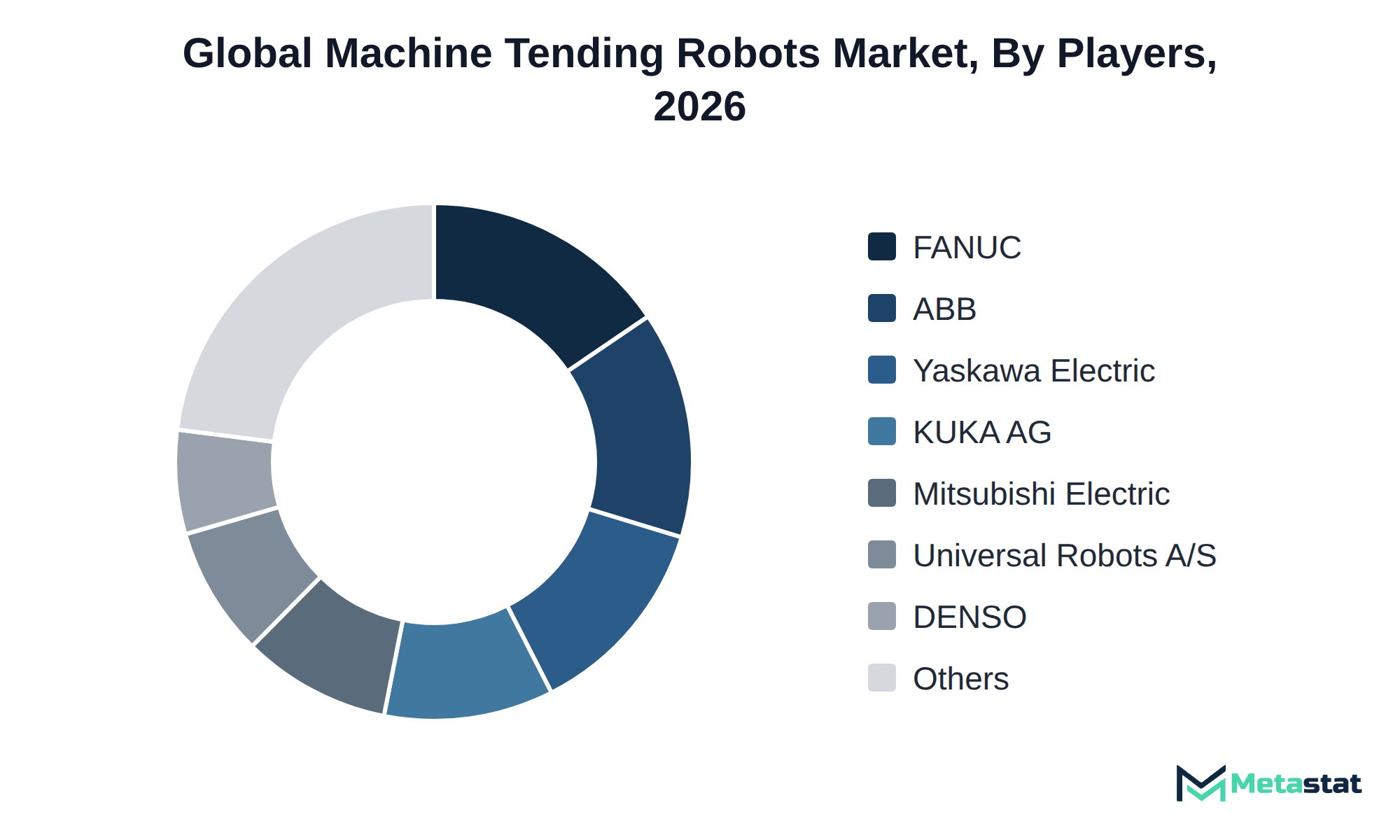
The Machine Tending Robots market exhibits a diverse competitive landscape where companies differentiate based on technology, pricing, and service offerings. Major players focus on various robot types, payload capacities, and application areas, leading to varied strategic approaches.
FANUC Corporation and Yaskawa Electric Corporation emphasize advanced robotics and automation solutions, catering to high-precision manufacturing sectors. KUKA AG and ABB Ltd. prioritize customization and integration services, allowing buyers to tailor systems to specific operational needs. In contrast, Universal Robots A/S focuses on user-friendly robots that support small and medium enterprises, enhancing accessibility to automation.
Buyers in the market prioritize factors including price, certification, support services, and the capability for customization. Companies like Mitsubishi Electric Corporation and DENSO Corporation leverage their extensive service networks to provide value-added offerings, influencing purchasing decisions among buyers seeking reliable support post-installation.
Achieving this growth relies on several key developments within the Machine Tending Robots market. Articulated robots, projected to grow from USD 3,795.5 million in 2026 to USD 8,037.6 million by 2033, are a key driver of overall market growth. However, risks including supply chain disruptions, particularly in Asia Pacific, could hinder growth. This region represents 47.1% of the market share, and any significant challenges in this area could slow the expected expansion. Ensuring a steady supply of components and maintaining operational efficiency will be essential for market participants. Overall, the combination of robust demand for advanced automation technologies and strategic responses to potential disruptions will shape the trajectory of the market through 2033.
By Robot Type: Articulated Robots, Cartesian and Gantry Robots, SCARA Robots, Others (Delta, Cylindrical Robots)
By Application: CNC Machine Tool Tending, Injection Molding Machine Tending, Press and Stamping Machine Tending, Die Casting Machine Tending, Others (Heat Treatment, Testing Equipment)
By End-Use Industry: Automotive and Transportation, Machinery and Industrial Equipment, Electrical and Electronics, Plastics and Rubber Products, Aerospace and Defense, Medical Devices, Others (Consumer Goods, Energy Equipment)
The report strategically identifies and profiles the key market players and analyses their core competencies in each sub-segment of the Machine Tending Robots market.
Report Attributes | Details |
Study Period | 2021-2033 |
Base Year | 2025 |
Estimated Year | 2026 |
Forecast Period | 2026-2033 |
Historical Period | 2021-2025 |
Growth Rate | CAGR 10.8% from 2026 to 2033 |
Revenue Unit | USD million |
Segmentation | By Robot Type, Payload Capacity, Application, End-Use Industry, and Region |
By Region | North America (By Robot Type, Payload Capacity, Application, End-Use Industry, and Country)
|
Europe (By Robot Type, Payload Capacity, Application, End-Use Industry, and Country)
| |
Asia Pacific (By Robot Type, Payload Capacity, Application, End-Use Industry, and Country)
| |
South America (By Robot Type, Payload Capacity, Application, End-Use Industry, and Country)
| |
Middle East and Africa (By Robot Type, Payload Capacity, Application, End-Use Industry, and Country)
|
Find answers to common questions about this report
The Machine Tending Robots market size was valued at USD 5,597.9 million in 2025.
The market is projected to grow at a CAGR of 10.8% during the forecast period from 2026 to 2033.
The North America Machine Tending Robots market size is estimated to reach USD 2,816.1 million by 2033.
Articulated Robots lead the Machine Tending Robots market with a projected value of USD 8,037.6 million by 2033, reflecting the highest growth compared to other robot types.
Shifts in buyer behavior toward automation technologies drive growth in the market. Increased investment in robotic solutions, particularly in the automotive and transportation sectors, emphasizes the need for enhanced efficiency and productivity.
Price sensitivity among small to medium-sized manufacturers restrains growth in the Machine Tending Robots market. High upfront costs and ongoing maintenance expenses result in slower adoption of automation technologies, particularly in the automotive and transportation sectors where profit margins remain tight.
The Machine Tending Robots market is estimated to reach a valuation of USD 12,719.7 million by 2033.
Key players operating in the Machine Tending Robots market include FANUC Corporation, ABB Ltd., Yaskawa Electric Corporation, KUKA AG, Universal Robots A/S, Mitsubishi Electric Corporation, DENSO Corporation, and Comau S.p.A.
The CNC machine tool tending segment is projected to grow at a compound annual growth rate of 11.5% from 2026 to 2033.
The Machine Tending Robots market is expected to reach USD 12,719.7 million by 2033.
The analysts below cover Machinery & Equipment research at Metastat Insights.
LEAD ANALYST
Utkarsh Khirodkar is a Lead Market Research Analyst at MetaStat Insight, specializing in market intelligence, technology sector assessments, and competitive strategy.

INDUSTRY CONSULTANT - CHEMICALS & ADVANCED MATERIALS
Chemicals and Materials · Machinery & Equipment · Packaging
Amit Gadhekar Consultant for Chemicals and Materials at MetaStat Insight, directing sector-specific intelligence, research, and strategic consulting across global chemical and processing markets.

PRINCIPAL CONSULTANT - QUALITY SYSTEMS & COMPLIANCE
Electronics and Semiconductor · Machinery & Equipment · Professional Services
Omkar Phadtare is an Industry Consultant at MetaStat Insight, specializing in quality systems, regulatory compliance, and standards benchmarking to drive data-driven market intelligence and strategic industry research.

ENERGY & INFRASTRUCTURE INDUSTRY CONSULTANT
Automotive and Transportation · Electronics and Semiconductor · Energy and Power · Machinery & Equipment
Saurabh Vasant Ganvir consults for Energy & Infrastructure Industry at MetaStat Insight, specializing in renewable energy, solar EPC, and electric vehicle (EV) infrastructure markets.

LEAD CONSULTANT - COMMUNICATION, TELECOM, AND IT
Electronics and Semiconductor · Information & Technology · Machinery & Equipment · Professional Services
Ravindra Sathe Consultants for Communication, Telecom, and IT at MetaStat Insight. He leads the firm's industry research initiatives across telecommunications infrastructure, digital connectivity, enterprise networking, and emerging information technology domains.
Most industry reports on warehouse automation bundle autonomous mobile robots and fixed conveyor installations into the same top-level numbers, which complicates advisory work. This study split the market cleanly by payload tiers, navigation technology, and fleet management software layers. The regional forecast for Western Europe gave our team defensible adoption benchmarks when evaluating capital allocation for logistics clients, saving us days of secondary data scrubbing.
Analyzing the transition from natural gas to green hydrogen in iron ore reduction requires realistic infrastructure timelines. Meta stat insight supplied a detailed regional assessment of DRI plant conversion costs and scrap metal availability in North America and Western Europe. Their report carefully examined pellet quality specs and electrical grid access constraints without making oversimplified market assumptions. The research material served as a practical reference during internal technology roadmap discussions.
Integrating zero-trust access controls across legacy electronic health record systems involves complex compliance overhead. Team produced an analysis that clearly separated identity governance and administration tools from privileged access management platforms. Their evaluation of HIPAA and GDPR compliance features across cloud native solutions gave our architecture group clear baseline criteria. The custom data request regarding biometric authentication adoption in hospital networks was returned promptly with clear documentation.
Explore related market intelligence reports worth reading alongside this one.
Starting from
$2950