
LEAD ANALYST
Utkarsh Khirodkar is a Lead Market Research Analyst at MetaStat Insight, specializing in market intelligence, technology sector assessments, and competitive strategy.

Manufacturing MRP Software Market Size, Share, By Deployment Mode (On-Premises and Cloud), By Enterprise Size (Small, Medium, and Large), Industry Analysis, Growth, Trends, and Forecast, 2026-2033
Report ID
MSI-4552
Published
February, 2026
Pages
310 Pages
Format
Report Details
Choose Your License
Manufacturing MRP Software Market
The global Manufacturing MRP Software market is valued at USD 5,070 million in 2025.
The market is projected to grow from USD 5,317.7 million in 2026 to USD 7,794.2 million by 2033, exhibiting a CAGR of 5.6% during the forecast period.
Global Manufacturing MRP Software market valued at USD 5,070 million in 2025, growing at a CAGR of 5.6% through 2033, with potential to exceed USD 7,794.2 million.
North America held 54.7% share in 2025, with US dominating the market.
On-premises deployment accounted for 39.1% share in 2025, supported by data sovereignty priorities, legacy integration requirements, and plant-level control preferences.
Key trends driving growth: Industry 4.0 push for real-time visibility and on-time delivery is accelerating adoption of digital planning and inventory optimization.
Opportunities include cloud-native, AI-enabled MRP (predictive lead-time forecasting, constraint-aware replanning, IoT/MES data feeds) tailored for mid-market manufacturers.
Key insight: The global manufacturing MRP software market is continuously gaining momentum as manufacturers are prioritizing operational efficiency, accuracy, and scalable production planning.
The global manufacturing MRP software market will redefine how production intelligence will be interpreted and applied in complex industrial environments. The market will not be limited to planning logic or physical coordination; Instead, it will transform into a strategic layer that will shape decision timing, operational accountability, and digital trust across the manufacturing ecosystem.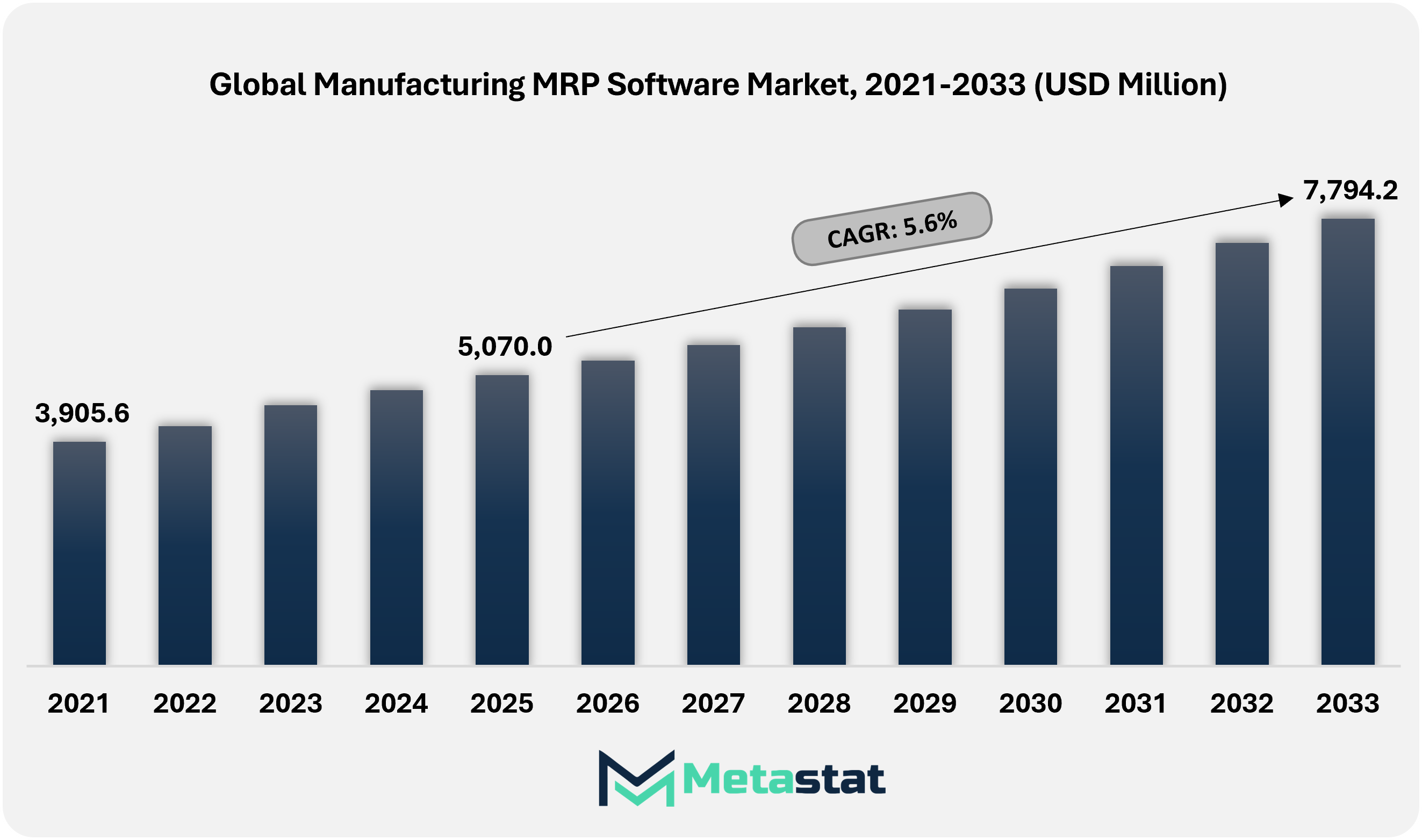
Manufacturers will increasingly regard MRP platforms as long-horizon systems of record that synchronize operational intent with execution reality. These solutions will anticipate disruption conflicts before they unfold on the factory floor, allowing organizations to simulate the consequences rather than react to disruptions. The software will act as a continuous interpreter between human decisions and machine-led execution, creating a space where planners will validate assumptions rather than manually correct outcomes.
Industry 4.0 programs are reshaping planning practices by linking machines, warehouses, and production schedules into integrated digital workflows. Real-time visibility improves schedule accuracy, coordination, and delivery reliability, strengthening customer and supplier service levels.
Supply-chain disruptions and rising input costs intensify pressure to control inventory and service levels. Time-phased material planning reduces excess stock while limiting shortages, supporting predictable cash flow and planning accuracy amid sourcing and logistics uncertainty.
Complex deployment and integration workloads, particularly among small and medium enterprises, slow adoption. Extended implementation timelines, training requirements, and organizational change costs delay realized value. Resource constraints also limit tolerance for operational disruption during rollout.
Inconsistent or outdated master data undermines planning results and reduces confidence in automated schedules. Errors in bills of materials, routings, or lead times trigger unstable plans and frequent revisions. Data quality gaps remain a major barrier to reliable planning and sustained user adoption.
Cloud-based platforms using artificial intelligence are redefining planning efficiency for modern factories. Predictive lead-time forecasting, adaptive rescheduling, and connected shop-floor data strengthen decision support. Market expansion is supported by medium-sized manufacturers adopting scalable tools designed for faster deployment, lower total cost of ownership, and continuous operational improvement.
The global manufacturing MRP software market is segmented by deployment mode and enterprise size.
On-Premises segment was valued at USD 2,079.8 Million in 2026 and is projected to reach USD 2,735.3 Million by 2033, at a CAGR of 4% during the forecast period.
On-premises deployment within the global manufacturing MRP software market will continue to attract organizations seeking direct system control and internal data handling. Future adoption will focus on sustainability, adaptation and long-term operational planning. Manufacturing facilities with fixed infrastructure will value predictable performance and tight alignment with internal production workflows.
Cloud segment was valued at USD 3,237.9 Million in 2026 and is projected to reach USD 5,058.9 Million by 2033, at a CAGR of 6.6% during the forecast period.
Accelerating digital transformation is propelling cloud deployment adoption across the global manufacturing MRP software market. The future applications of MRP software will include scalability, remote management, and cost-effectiveness. Cloud-based solutions of MRP software for manufacturing industry applications will be adopted to accommodate dispersed manufacturing operations, fast upgrades, and real-time coordination.
Small and Medium Enterprises segment is projected to reach USD 4,424.8 Million by 2033, at a CAGR of 6.3% during the forecast period.
Small and medium enterprises are increasingly adopting flexible solutions aligned with expanding production complexity and planning needs. The requirements for adoption in the coming years include affordability, simplicity, and speedy implementation. The small and medium-scale businesses would apply MRP software for optimized inventory tracking, minimizing wastage, and facilitating systematic decision-making processes with continuing expansion in operations.
Large Enterprises segment is projected to reach USD 3,369.4 Million by 2033, at a CAGR of 4.7% during the forecast period.
Large enterprises are prioritizing deep integration, multi-site planning, and governance controls to manage complex supply chains, large-scale production footprints, and global operations. MRP systems will provide functionality for planning utilization, government regulations, and ongoing improvements in large-scale manufacturing.
Based on geography, the global Manufacturing MRP Software market is divided into North America, Europe, Asia-Pacific, South America, Middle East, and Africa.
North America Manufacturing MRP Software Market is set to expand at a CAGR of 5.6% within the forecast period, reaching a market size (TAM) of USD 3,918.5 million by the end of 2033.
Widespread adoption of advanced manufacturing technologies in North America will further shape future demand for MRP software to support automation-based workflows for production.
Greater emphasis on supply chain transparency and compliance will drive faster MRP software deployment across regulated manufacturing sectors in North America.
Asia Pacific offers healthy opportunities, supported by emerging manufacturing clusters adopting digital planning systems suited to rising scale and complexity.
The increasing investment in smart factories in emerging economies in Asia Pacific will open new avenues for on-premises and cloud-based MRP software solutions.
Manufacturing enterprises across the Middle East, Africa, and South America are adopting structured materials planning to improve forecasting and resource utilization. Industrial diversification, infrastructure-led industrial growth, and procurement volatility are propelling MRP software adoption across these regions.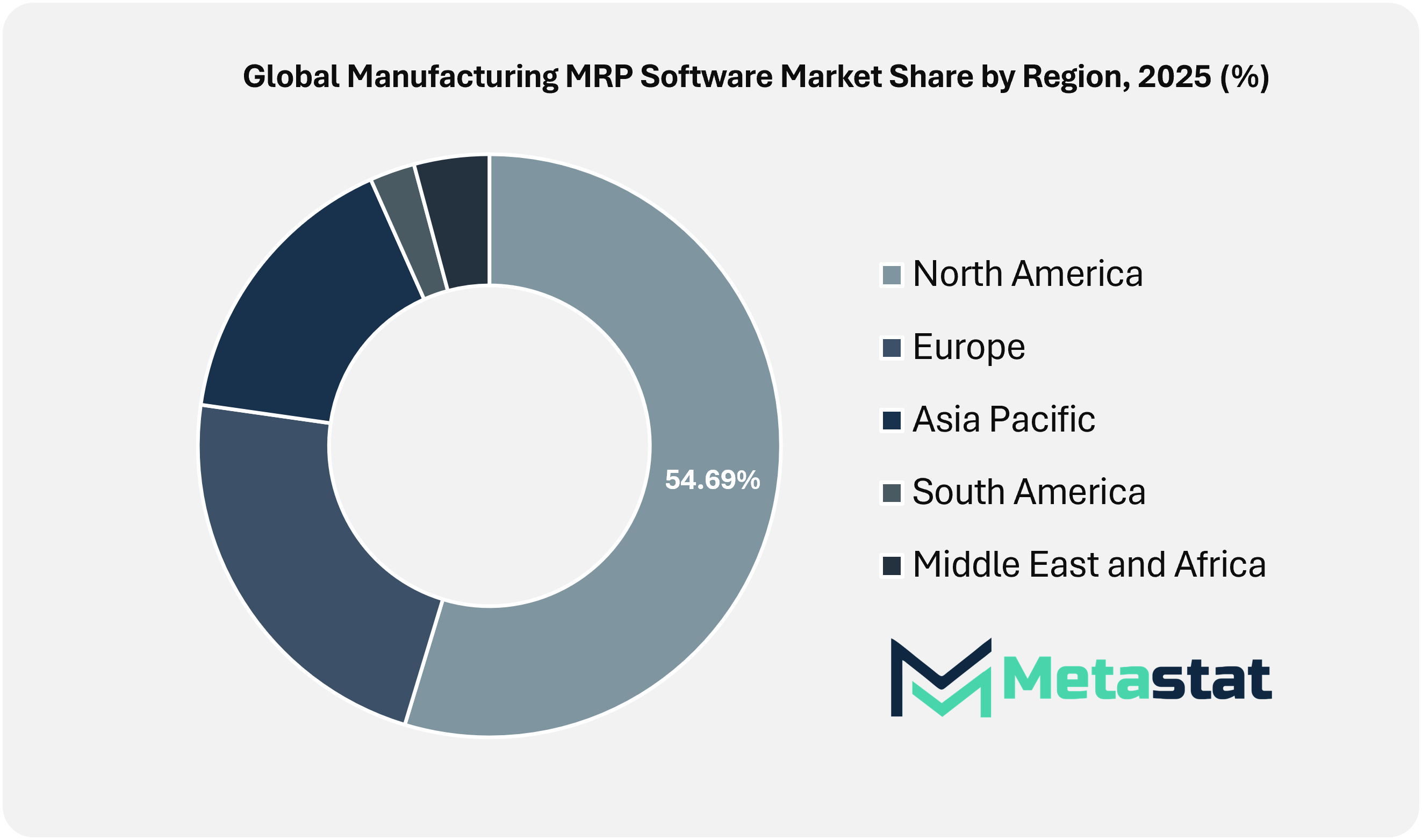
The global manufacturing MRP software market is gaining momentum, supported by manufacturer focus on planning rigor, inventory control, and coordinated execution. The MRP software will aid the manufacturing sector in planning and controlling material and workflow and will allow them to have improved control over the inventory level. With the increase in the size and complexity of manufacturing operations, the MRP software will aid the manufacturer in preventing waste and ensuring smooth and consistent production by eliminating any kind of delay.
Many established software suppliers are to continue influencing this market with solutions that are aimed at serving various needs of the manufacturing industry. Suppliers such as Syspro, Rootstock Software, and Acumatica, Inc. are recognized for solutions that are a mix of flexibility, usability, and beneficial functionality for the small to mid-sized manufacturing industry. Suppliers such as Infor and Aptean, Inc. have strengthened positioning with industry-focused suites aligned with manufacturer planning and execution objectives. Suppliers like Priority Software, Sage Group plc, further contribute to this market with solutions that use a combination of usability, usefulness, planning, and execution.
Larger enterprise-centric vendors will also have an impressive presence in the market. SAP SE, Epicor Software Corporation, and IFS AB are well-known for their combined MRP and ERP offerings that can cater to complex manufacturing requirements. Dassault Systèmes, via SOLIDWORKS, supports alignment between design data and downstream planning workflows, improving engineering-to-production handoffs. ECI Software Solutions, Inc. and ERPAG Inc will continue to provide solutions to the requirements of growing businesses that are looking for affordable planning solutions.
It is worth mentioning here that the market further comprises specialist providers, which provide operational efficiency and ease of use. Fishbowl Solutions, LLC assists with inventory-manufacturing processes, while the offerings of other players would simplify purchasing, production, and reporting processes. Competitive intensity is elevating innovation priorities related to usability, planning accuracy, and compatibility with existing manufacturing systems.
In addition, the overall manufacturing MRP software market will keep reflecting the demand for effective plans in the manufacturing industry. With greater interest in gaining more insights into materials and production plans, software solutions are likely to adapt and keep up with such working requirements. Because of diversified players such as both global and niche ones, the overall market is sure to keep responding to required changes in the manufacturing world.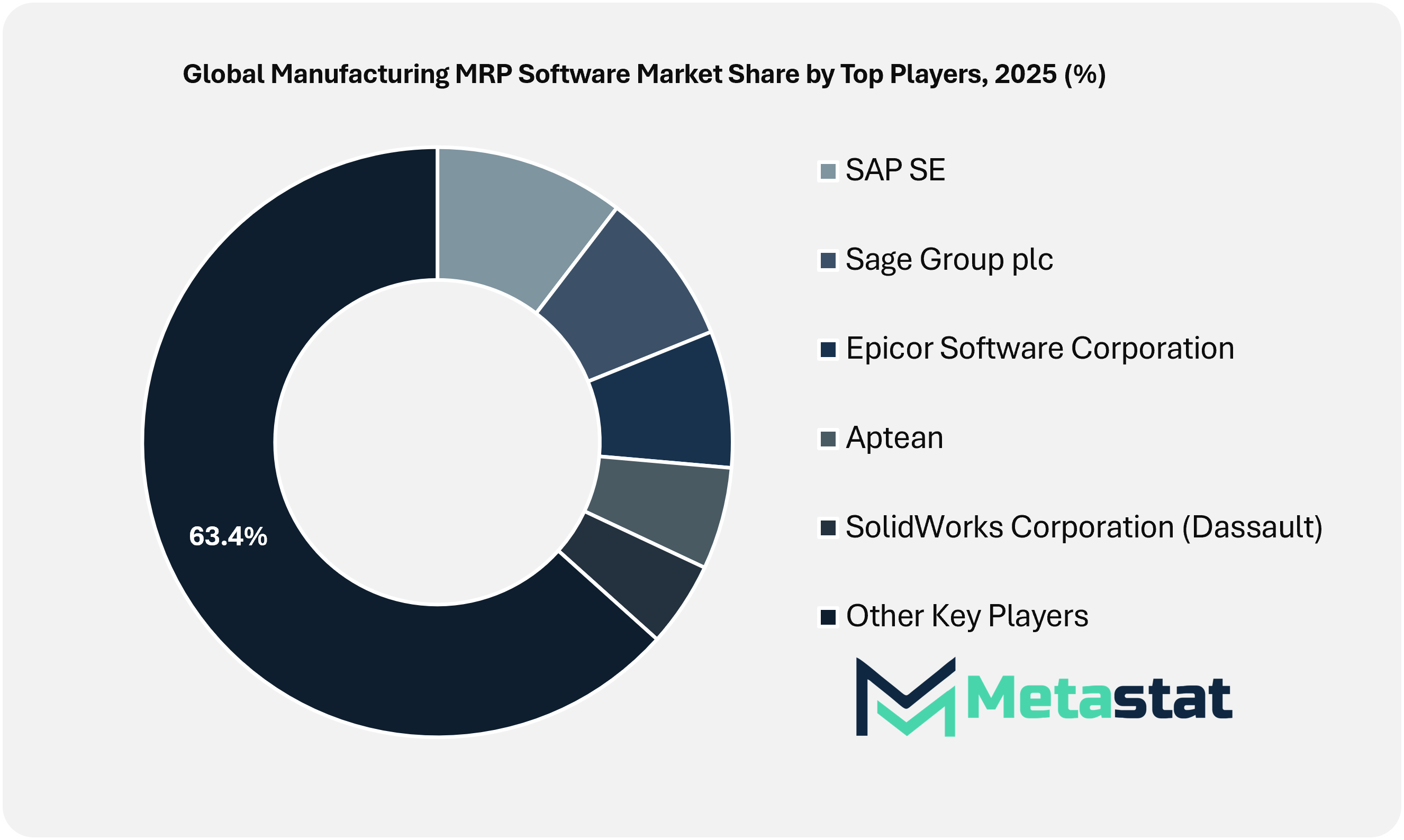
Market size is forecast to rise from USD 5,070 million in 2025 to over USD 7,794.2 million by 2033.
The global manufacturing MRP software market will also support decentralized manufacturing strategies, where facilities across regions operate under unified logic while preserving local autonomy. Cloud-native architecture and edge intelligence will allow real-time response without central bottlenecks. As a result, manufacturers will gain the ability to measure decision-making accuracy across different production models. Over time, MRP software will no longer be treated as an internal utility but as a collaborative infrastructure that will connect suppliers, manufacturers, and strategic partners through shared operational foresight. This change will position the market as the fundamental enabler of industrial sustainability rather than as a background mechanism.
This research report categorizes the Manufacturing MRP Software market based on key segments and regions, forecasts revenue growth, and analyses trends in each submarket. The report analyses the key growth drivers, opportunities, and challenges influencing the Manufacturing MRP Software market. Recent market developments and competitive strategies such as expansion, product launches, partnerships, mergers, and acquisitions are included to frame the competitive landscape.
The report strategically identifies and profiles the key market players and analyses their core competencies in each sub-segment of the Manufacturing MRP Software market.
|
Report Attributes |
Details |
|
Study Period |
2021-2033 |
|
Base Year |
2025 |
|
Estimated Year |
2026 |
|
Forecast Period |
2026-2033 |
|
Historical Period |
2021-2025 |
|
Growth Rate |
CAGR 5.6% from 2026 to 2033 |
|
Revenue Unit |
USD Million |
|
Segmentation |
By Deployment Mode, Enterprise Size, and Region |
|
By Region |
North America (By Deployment Mode, Enterprise Size, and Country)
|
|
|
Europe (By Deployment Mode, Enterprise Size, and Country)
|
|
|
Asia Pacific (By Deployment Mode, Enterprise Size, and Country)
|
|
|
South America (By Deployment Mode, Enterprise Size, and Country)
|
|
|
|
|
|
Middle East and Africa (By Deployment Mode, Enterprise Size, and Country)
|
Find answers to common questions about this report
The Metastat Insights study shows that the global Manufacturing MRP Software market size was USD 5,070 million in 2025.
The global Manufacturing MRP Software market is likely to grow at a CAGR of 5.6% over the forecast period (2026-2033).
The Metastat Insights analysis shows that the North America Manufacturing MRP Software market size is estimated to be USD 3,918.5 million by 2033.
Cloud is the leading deployment mode segment in the global market.
Industry 4.0 push for real-time visibility and on-time delivery is accelerating adoption of digital planning and inventory optimization and Supply-chain volatility and cost pressure are forcing manufacturers to reduce stockouts and carrying costs via precise, time-phased MRP are key driving factors, boosting the market.
North America region dominates the market.
Global Manufacturing MRP Software market is estimated to reach USD 7,794.2 million by 2033.
Top players operating in the Manufacturing MRP Software industry includes Syspro, Rootstock Software, Acumatica, Inc., Infor, and Aptean.
The analysts below cover Information & Technology research at Metastat Insights.
LEAD ANALYST
Utkarsh Khirodkar is a Lead Market Research Analyst at MetaStat Insight, specializing in market intelligence, technology sector assessments, and competitive strategy.

PRINCIPAL CONSULTANT - ENTERPRISE AI & EMERGING TECHNOLOGIES
Banking & Finance · Electronics and Semiconductor · Energy and Power · Healthcare IT · Information & Technology · Professional Services
Vijay Gunti is a Principal Consultant at MetaStat Insight, bringing over two decades of experience across enterprise digital transformation, technology strategy, and intelligent systems.

LEAD CONSULTANT - COMMUNICATION, TELECOM, AND IT
Electronics and Semiconductor · Information & Technology · Machinery & Equipment · Professional Services
Ravindra Sathe Consultants for Communication, Telecom, and IT at MetaStat Insight. He leads the firm's industry research initiatives across telecommunications infrastructure, digital connectivity, enterprise networking, and emerging information technology domains.
Transitioning ultra-class mining haul trucks to alternative power requires concrete data on remote hydrogen refueling infrastructure economics. The report evaluated megawatt-scale electrolyzer installation expenses, onsite storage safety mandates, and heavy-duty fuel cell stack degradation under continuous duty cycles. That technical rigor helped our engineers benchmark realistic total operating cost horizons for off-highway fleet decarbonization.
Enterprise zero-trust network rollouts are often slowed down by multi-cloud transit latency and proprietary hardware retirement schedules. This study provided realistic total cost of ownership models comparing cloud-delivered security edge solutions against traditional hardware refreshes. The analysis of contract renewal lengths and software maintenance fees gave us clear visibility into enterprise replacement cycles over the next three to five years.
Scaling antibody-drug conjugate manufacturing hinges on contract manufacturing availability for high-potency active ingredients. The MetaStat Insight analysis looked closely at global cleanroom slot constraints, bioconjugation batch failure rates, and supply chain redundancies between the US, Europe, and India. The supplier capability matrix proved genuinely useful for our team when mapping secondary source options across our clinical pipeline.
Explore related market intelligence reports worth reading alongside this one.