
LEAD ANALYST
Utkarsh Khirodkar is a Lead Market Research Analyst at MetaStat Insight, specializing in market intelligence, technology sector assessments, and competitive strategy.

Global Power Connectors Market Size, Share, By Product Type (Cable Lugs and Terminals, Cable Splice Connectors, Separable Power Connectors, PCB Power Connectors, Power Terminal Blocks), By Termination Method (Crimp and Compression, Screw and Bolted, Spring Clamp and Push-in, Solder, Press-fit, Insulation Displacement), By Rated Current (Up to 10 A, Above 10 A to 50 A, Above 50 A to 200 A, Above 200 A), By End-Use Industry (Automotive and EV Charging, Energy and Utilities, Data Centers, Telecommunications, Consumer Electronics and Appliances, Railways, Aerospace and Defense, Building and Construction), Industry Analysis, Growth, Trends, and Forecast, 2026-2033
Report ID
MSI-5598
Published
October, 2026
Pages
302 Pages
Format
Historical
Base year
Forecast
Forecast period
Report Details
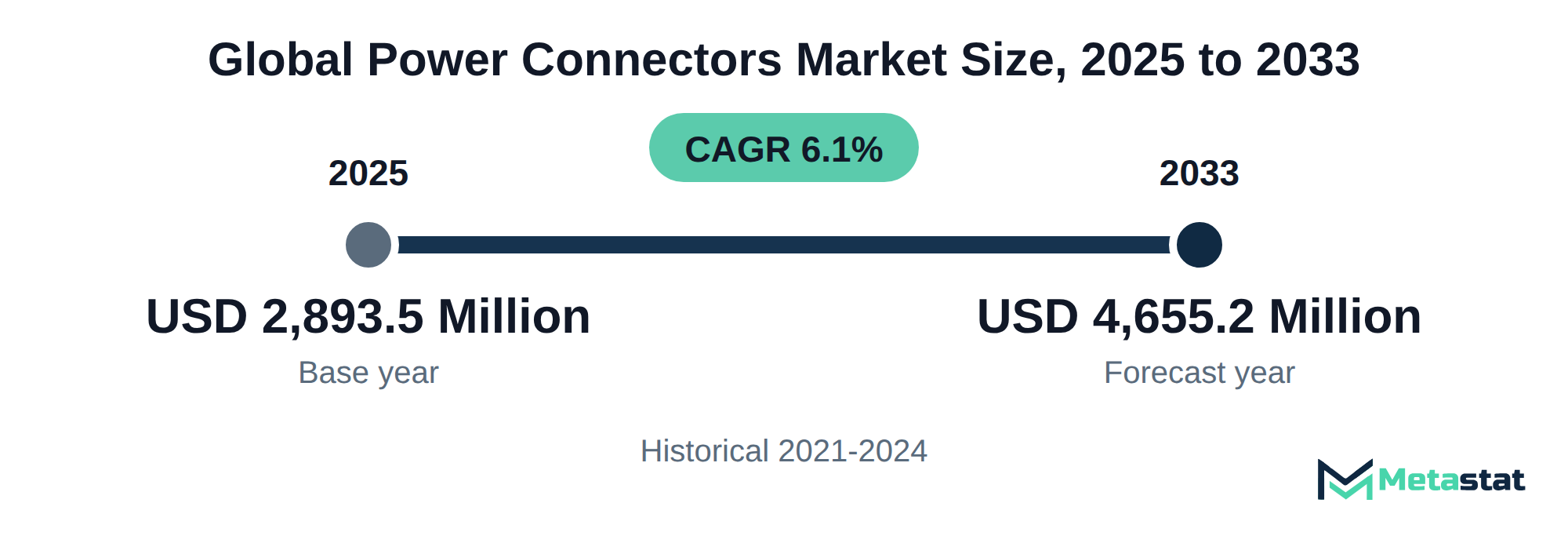
Market Valuation: Valued at $2,893.5 Million in 2025, projected to reach $4,655.2 Million by 2033 at a 6.1% CAGR.
Dominant Segment: The separable power connectors segment leads the market, driven by increasing demand for reliable power distribution systems and the expansion of renewable energy projects.
Geographic Lead: North America is projected to hold 28.5% of the market in 2025, with the US expected to lead in growth due to significant investments in electric vehicle charging infrastructure.
What's Inside: This report provides a comprehensive analysis of the competitive landscape, market segmentation by product type, termination method, rated current, and end-use industry, along with detailed forecasts through 2033.
High-Growth Area: The segment for rated current above 200 A is projected to grow at a CAGR of 7.6%, reflecting the increasing adoption of electric vehicles and the need for efficient energy transfer solutions.
Key Specifications: Power connectors rated above 10 A to 50 A are projected to reach USD 1,496.2 million by 2033, highlighting their critical role in industrial and railway applications.
Choose Your License
Global Power Connectors Market
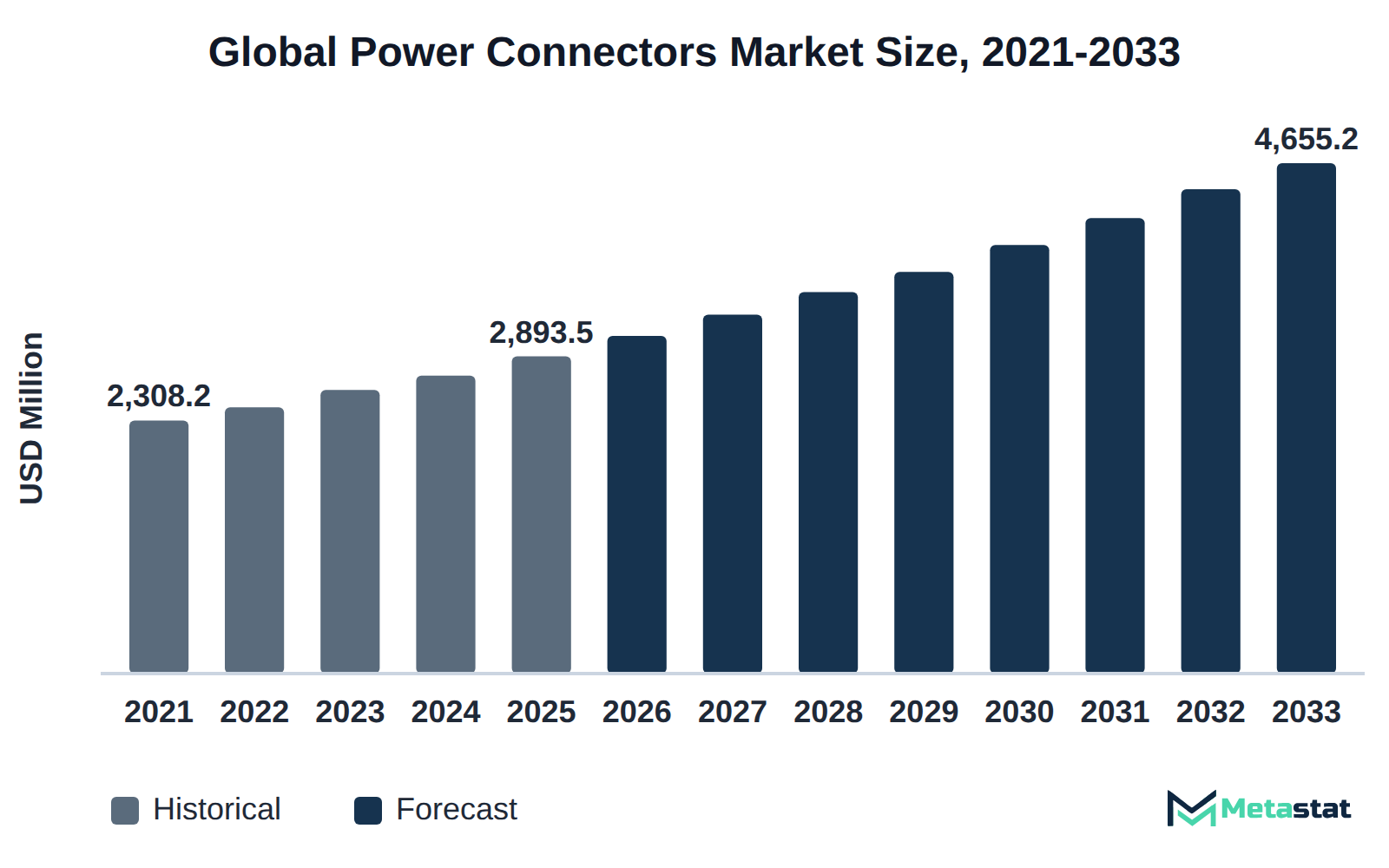
The global Power Connectors market was valued at USD 2,893.5 million in 2025 and is projected to reach USD 4,655.2 million by 2033, growing at a CAGR of 6.1% over the forecast period.
The Power Connectors market encompasses a range of products that facilitate electrical connections across various applications. Buyers invest in these solutions to ensure efficient power distribution and reliable connectivity in sectors including industrial manufacturing, automotive, and energy. Demand for durable, high-performance connectors drives expenditure, because these components help maintain operational efficiency and safety standards.
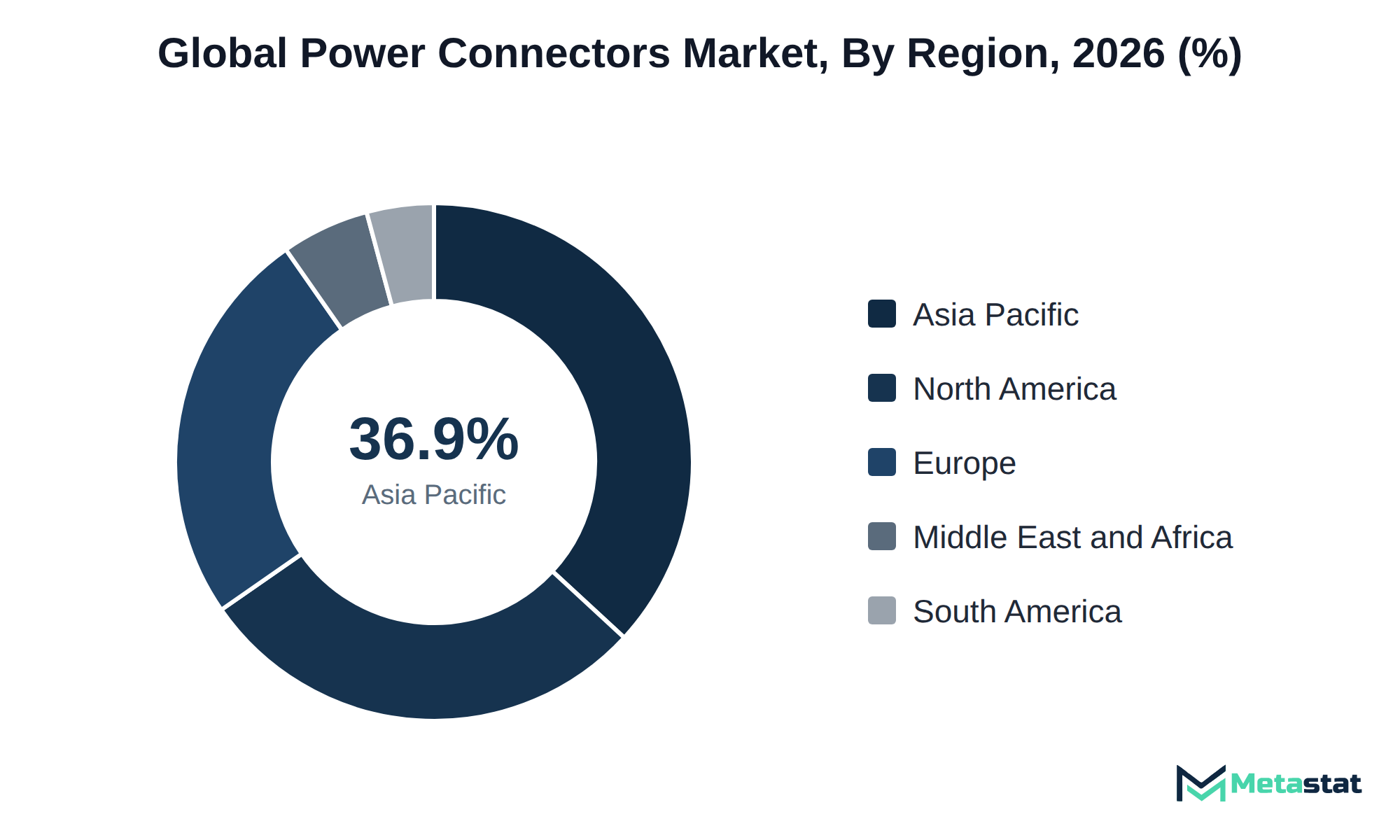
Growth in the market is primarily fueled by increased automation and electrification across industries. The separable power connectors segment represents the largest value within the industry, contributing significantly to overall market revenue. North America holds 28.5% of the market in 2025, with the US leading in 2026. In comparison, Asia Pacific follows closely, capturing 36.9% of the market share, demonstrating the region's strong demand for advanced connectivity solutions.
Technological advancements and the need for enhanced connectivity further stimulate market expansion. Industries increasingly adopt high-capacity connectors that support greater energy demands and more complex applications. These trends point to a strong outlook for the Power Connectors market, since the components are essential in modern electrical systems.
The demand for power connectors arises from their critical role in ensuring reliable electrical connections across diverse applications, including industrial manufacturing, automotive, and data centers. Buyers invest in these products to enhance operational efficiency, ensure safety, and meet the growing requirements for energy transmission and distribution. The integration of advanced technologies in power systems drives significant spending in the market, highlighting the importance of innovative connector solutions in modern electrical infrastructure.
The market experiences growth driven by the increasing adoption of renewable energy sources and electric vehicles, which necessitate efficient power distribution systems. The segment of separable power connectors stands out as the largest contributor to market value, reflecting the demand for versatile and reliable connection solutions. The region's well-established manufacturing base and ongoing investments in infrastructure support its strong position in the market.
Investments in electric vehicle charging infrastructure and renewable energy projects significantly influence market expansion. Technological advancements in connector designs, including higher current ratings and improved materials, contribute to enhanced performance and reliability. These factors give suppliers and manufacturers room to innovate and keep the power connectors market competitive and aligned with evolving industry standards.
High-current power connectors are central to the evolution of electric vehicle (EV) charging infrastructure, battery storage systems, and grid equipment. The increasing adoption of EVs drives demand for connectors capable of handling higher currents, with projections indicating that the segment experiences significant growth. For instance, the segment for rated current above 200 A is projected to grow at a CAGR of 7.6%, reflecting a strong shift toward efficient energy transfer solutions.
In the Power Connectors market, innovations in technology have led to the development of advanced connectors that enhance performance and safety while meeting the requirements of emerging applications. This shift toward high-current connectors supports the expansion of charging networks and energy storage facilities, ultimately facilitating an increase in the number of EVs on the road. The same current-handling requirements apply to EV charging cables, which carry the power delivered to a vehicle during charging. The ability of these connectors to manage high power levels ensures reliability and efficiency, which are essential for both residential and commercial users.
While the transition to renewable energy sources accelerates, the demand for high-current connections in grid equipment becomes increasingly relevant. Such grid equipment sits within the wider power transmission and distribution equipment industry. Investments in infrastructure to support renewable energy integration require connectors that handle larger power loads. The growth of this sector contributes significantly to the commercial success of manufacturers in the Power Connectors market, positioning them to benefit from the shift toward renewable energy.
The rise in power density for AI racks has intensified the demand for low-resistance connector interfaces within the Power Connectors market. These interfaces matter across data center power systems, where rack loads continue to rise. With the increasing need for high-performance computing and data processing capabilities, manufacturers prioritize connectors that withstand high thermal and electrical loads. In 2026, the market for cable lugs and terminals is projected to reach USD 651.9 million, reflecting significant growth driven by advancements in technology and the growing requirements of energy-efficient solutions.
Buyers focus on pricing models that reflect the performance capabilities and reliability of these connectors. Long-term contracts with manufacturers often include provisions for volume discounts, ensuring that companies achieve cost-effectiveness while maintaining quality. This trend highlights the importance of building strong relationships with suppliers that offer competitive pricing and technical support for integration into complex systems.
The emphasis on low-resistance interfaces enhances operational efficiency, reducing energy losses and improving overall system performance. Consequently, organizations investing in high-density power solutions benefit from greater equipment reliability and longevity, which supports their long-term strategic objectives.
Crimp and compression terminations shape the economics of panel assembly within the Power Connectors market. These terminations offer enhanced reliability and speed in installation, aligning with the increasing preference for efficient production processes. The segment for crimp and compression connections is expected to grow from USD 1,264.9 million in 2026 to USD 1,870 million by 2033, reflecting a compound annual growth rate of 5.7%.
Manufacturers in sectors including industrial manufacturing and automotive recognize the advantages of crimp and compression terminations. These buyers prioritize lower labor costs and improved electrical performance, influencing their purchasing decisions. Achieving secure connections quickly minimizes downtime during assembly, ultimately enhancing productivity levels.
The commercial consequence of adopting crimp and compression terminations leads to a stronger competitive position within the market. By optimizing assembly processes through these terminations, businesses increase output while maintaining high-quality standards. This trend contributes to growth within the power connectors sector, since efficient terminations help meet the demands of modern manufacturing environments.
Power connectors support the reliability and efficiency of industrial and railway applications. Specific specifications significantly influence the performance and overall effectiveness of these connections. Industrial manufacturing and railway systems often employ power connectors rated up to 10 A and above 10 A to 50 A, which account for a substantial portion of the market. The rated current for these connectors directly impacts their ability to handle the necessary power loads in demanding environments.
The rated current category for connectors includes those rated above 10 A to 50 A, projected to reach USD 1,496.2 million by 2033. This specification matters most for applications that need high power handling, which supports safe and efficient operation. Termination methods including crimp and compression are preferred in industrial and railway settings due to their reliability and effectiveness in connecting various components.
Choosing the right specifications impacts operational efficiency and safety. For manufacturers and operators in the power connectors market, understanding these requirements leads to better decision-making regarding connectivity solutions. Proper selection ensures integration into existing systems, reducing downtime and enhancing overall productivity.
The automotive and electric vehicle (EV) sectors drive substantial growth in the Power Connectors market. An accelerating shift towards electric mobility results in increased demand for reliable power connectors that support high-current applications. This surge in demand reflects changing consumer preferences for sustainable transportation solutions and regulatory incentives promoting EV adoption. Automotive manufacturers focus on integrating advanced technologies requiring efficient electrical connections, thus enhancing the need for robust power connectors. The automotive and EV charging segment is projected to reach USD 1,146.6 million by 2033, demonstrating a compound annual growth rate of 7.3%. This trend shows how changing consumer preferences and technological advances push suppliers to innovate and adapt to a growing market. The ongoing electrification of vehicles and infrastructure represents a significant opportunity for the market, encouraging further investment in power connector solutions.
Growing emphasis on energy efficiency significantly drives suppliers to innovate in power connector design. Emerging technologies, including advanced materials and improved manufacturing processes, enhance product performance while reducing energy losses. Industries focusing on sustainability, including industrial manufacturing and data centers, prioritize the integration of energy-efficient solutions. The implementation of these technologies results in lower operational costs and compliance with environmental regulations. Consequently, suppliers experience heightened demand for high-performance connectors, leading to increased investments in research and development. The Power Connectors market benefits from this trend, with manufacturers exploring novel designs to accommodate energy-efficient systems and meet customer expectations. The shift toward sustainable practices among end-users increases competition within the market, incentivizing suppliers to enhance product offerings and maintain market share.
Escalating material costs pose a significant restraint on the demand for power connectors. These rising costs particularly affect manufacturers in the industrial manufacturing and automotive sectors, leading to reduced profit margins and delays in production schedules. Buyers experience increased expenses, translating to slower adoption rates of new technologies. Consequently, several companies downsize their orders or postpone replacement of outdated connectors, hindering market growth.
The market reflects a direct correlation between rising input costs and purchasing decisions, with buyers prioritizing cost-effectiveness over expansive procurement. This constraint impacts the overall competitive environment, with smaller players unable to sustain operations under shifting economic conditions. In such scenarios, potential buyers remain cautious about large-scale investments, limiting engagement with the power connectors market.
Growing margin pressure arises from ongoing shortages of critical components within the power connectors market. Factors contributing to this issue include increased competition among suppliers and heightened demand across various sectors, including industrial manufacturing and automotive. Suppliers encounter difficulties in maintaining profit margins due to rising costs associated with procurement and production. In response, several organizations focus on strategic partnerships and vertical integration to enhance supply chain stability, thereby reducing reliance on external suppliers. Others invest in inventory management systems to optimize stock levels and mitigate risks associated with supply disruptions. This proactive approach aims to ensure consistent product availability, which is essential for maintaining customer satisfaction and market share. The pressure on margins continues to influence pricing strategies, prompting a reevaluation of cost structures and operational efficiencies for many firms. Suppliers actively seek innovative solutions to address these challenges and sustain their competitive positions.
Significant opportunities exist within the automotive and electric vehicle (EV) charging segment of the market. The anticipated CAGR of 7.3% highlights increasing demand for power connectors in this area. This growth stems from the rapid expansion of EV infrastructure and the need for reliable connections to support charging stations. The transition toward electrification in the automotive industry drives manufacturers to enhance connector designs to meet higher power requirements. Innovations in this segment focus on improving efficiency and reducing downtime, aligning with the demands of modern electric vehicles. Rising adoption of EV charging solutions reflects a broader commitment to sustainable transportation, influencing investment strategies in these technologies. This segment's potential directly impacts overall revenue growth projected for the Power Connectors market through 2033. Demand for power connectors in automotive applications enhances market expansion, benefiting stakeholders across the value chain.
The Global Power Connectors market is segmented based on Product Type, Termination Method, Rated Current, and End-Use Industry.
Cable Lugs and Terminals segment is valued at USD 651.9 million in 2026 and is projected to reach USD 952.5 million by 2033, at a CAGR of 5.6% during the forecast period. This segment serves critical functions in various electrical systems, allowing for secure and reliable connections in applications ranging from industrial machinery to residential wiring. Driven by increasing demand for electrical infrastructure, this segment benefits from steady growth in industrial manufacturing and construction sectors. Compared to other segments, Cable Lugs and Terminals exhibit a strong growth trajectory, supported by advancements in materials and manufacturing processes. The growth rate is higher than that of specific alternatives, including Cable Splice Connectors, which are projected to grow at a CAGR of 5.5%. These factors contribute to the escalating demand and evolving specifications within the Power Connectors market.
Cable Splice Connectors segment is estimated to reach USD 473.9 million by 2033, at a CAGR of 5.5% during the forecast period. These connectors establish reliable electrical connections and are frequently used in applications including industrial manufacturing and energy sectors. The demand for cable splice connectors primarily originates from their ability to ensure robust connections in high-performance environments, catering to industries that prioritize reliability and efficiency. Compared to other product types, this segment experiences moderate growth, with a CAGR of 5.5%, reflecting a stable demand trajectory. The segment's growth is influenced by increasing investments in infrastructure development and renewable energy projects, driving the need for efficient connectivity solutions. These factors position cable splice connectors favorably against other product types, which experience varying growth rates and different market dynamics.
Separable Power Connectors segment is expected to reach USD 1,925.4 million by 2033. These connectors serve critical functions in transferring power efficiently, particularly within heavy-duty applications in industrial manufacturing and energy sectors. Key drivers for growth include increasing demand for reliable power distribution systems and the expansion of renewable energy projects, which require robust and durable connection solutions. Compared to other segments, separable power connectors exhibit a distinct growth trajectory, supported by advancements in connector technology that enhance performance and safety. This segment is projected to experience a compound annual growth rate (CAGR) of 6.4%, differentiating it from slower-growing segments like cable splice connectors, which have a CAGR of 5.5%. The separable power connectors segment positions itself strategically to capture rising demand, driven by both infrastructure development and technological innovation within the market.
PCB Power Connectors, valued at USD 1,004.1 million in 2025, is projected to grow at a CAGR of 6.4% during the forecast period. These connectors serve critical functions in circuit boards for various electronic devices, including consumer electronics and telecommunications equipment. The segment's growth is driven by increasing demand for compact and efficient electronic systems across multiple industries. The adoption of advanced printed circuit board (PCB) technology influences this segment, attracting buyers focused on high-performance applications. Compared to other product types, including Cable Lugs and Terminals, which are projected to expand at a CAGR of 5.6%, PCB Power Connectors offer higher growth potential, appealing to manufacturers seeking innovative solutions that enhance device capabilities. This distinct growth trajectory reflects the segment's importance within the broader context of the Power Connectors market.
Power Terminal Blocks offer critical solutions for establishing electrical connections in various applications. These components serve industries including industrial manufacturing, energy, and utilities, facilitating reliable power distribution. The demand for Power Terminal Blocks reflects the increasing need for efficient wiring solutions in complex electrical systems. Innovations in design and materials enhance their performance, supporting their adoption across many sectors. This segment experiences steady growth, driven by the rising emphasis on safety and reliability in electrical installations. Compared to other product types, including Cable Lugs and Terminals, Power Terminal Blocks cater to different buyer preferences, focusing more on specific industrial applications rather than general-purpose use. The market shows strong potential for further expansion due to ongoing development in automation and smart grid technologies, which require efficient power management solutions. Continuous advancements in electrical standards and safety regulations support the demand for these components.
Crimp and compression terminations hold significant value in the Power Connectors market, estimated at USD 1,264.9 million in 2026 and projected to reach USD 1,870 million by 2033, at a CAGR of 5.7% during the forecast period. These terminations are widely used in various applications, particularly within industrial manufacturing and automotive sectors, where they ensure reliable electrical connections under demanding conditions. Demand in this segment is driven by the need for efficient and secure connections in high-power applications, contrasting with other termination methods that exhibit slower growth rates. Compared to alternatives like screw and bolted terminations, which project a CAGR of 5.2%, crimp and compression techniques offer advantages in terms of installation speed and connection integrity, appealing to manufacturers focused on maximizing efficiency. The segment's growth outlook reflects ongoing advancements in connector technology and increasing requirements for reliable power distribution in diverse applications.
Screw and Bolted segment is estimated to reach USD 1,055.8 million by 2033, at a CAGR of 5.2% during the forecast period. This segment primarily serves industries requiring secure electrical connections, commonly found in industrial manufacturing and automotive applications. The increasing focus on safety and reliability in these sectors drives demand for robust fastening methods. Compared to other termination methods, including Crimp and Compression, which experience a higher growth rate of 5.7%, Screw and Bolted offers a more conventional solution. This segment appeals particularly to users prioritizing cost-effectiveness and ease of installation, making it a preferred choice among budget-conscious buyers. The market reflects strong performance due to ongoing investments in industrial infrastructure and automotive development, supporting the growth trajectory of this segment.
Spring Clamp and Push-in segment is expected to reach USD 738.8 million by 2033. This termination method is frequently used in applications that require quick and reliable connections, particularly in industrial manufacturing and consumer electronics. Demand for Spring Clamp and Push-in connections arises from their ease of installation and efficiency in maintaining connection integrity under varying conditions. The segment experiences growth driven by rising automation and the need for efficient electrical connections in various devices. Compared to other termination methods, including Crimp and Compression, which is projected to reach USD 1,870 million by 2033, the Spring Clamp and Push-in segment exhibits a distinct appeal due to lower labor costs and reduced assembly times. This competitive advantage supports its adoption across various sectors, enhancing overall market dynamics.
Solder, projected to grow at a CAGR of 4.8% during the forecast period, plays a critical role in the connection of electrical components. Commonly used in electronics manufacturing, this termination method is favored for its ability to create strong, permanent connections that ensure electrical continuity. Industries heavily relying on solder include consumer electronics, automotive, and telecommunications. The increasing demand for compact and efficient electronic devices fuels the growth of this segment. Price sensitivity among customers drives competition against other termination methods, including crimp and compression, which exhibit a higher growth rate. In comparison, solder offers unique advantages, including lower cost and accessibility, appealing to various buyers seeking reliable and economical solutions. This differentiation contributes to the dynamics within the market, influencing purchasing decisions and adoption rates.
Press-fit connections provide a reliable method for securing electrical contacts without soldering, making them valuable in various applications. Industries including automotive, telecommunications, and industrial machinery frequently adopt this approach due to its efficiency and ability to handle high volumes of connections. The segment experiences movement driven by increasing demand for automated assembly processes, which enhance production efficiency. With such advantages, this method distinguishes itself from other termination methods, including crimp and compression or screw and bolted connections, which have differing manufacturing requirements and associated costs. The Press-fit segment appeals to manufacturers seeking to optimize production speed while maintaining connection integrity. Continuous advancements in technology further support growth within this space, compelling suppliers to innovate and keep pace with industry requirements.
Insulation Displacement refers to a termination method used in various electrical applications, known for its ability to connect wires without the need for stripping insulation. This technology finds significant use in industries including telecommunications and consumer electronics, where rapid assembly and reliability are critical. Demand for Insulation Displacement is influenced by the increasing push for automation in manufacturing processes, leading to a preference for simpler and quicker connection methods. Compared to other termination methods, this segment experiences steady growth, driven by technological advancements in connector design and efficiency. The competitive landscape features various players focusing on enhancing the performance and reliability of insulation displacement connectors, differentiating them from alternative methods like crimp and screw connections, which follow different operational protocols and consumer preferences.
Valued at USD 796 million in 2026, this segment is projected to reach USD 1,103.8 million by 2033, at a CAGR of 4.8% during the forecast period. Power connectors in this category primarily serve applications where low current is required, including consumer electronics and small appliances. Demand is driven by the increasing integration of electronic devices in various sectors, particularly in residential and commercial buildings. This sub-segment's growth trajectory remains slower compared to other rated current categories, including those exceeding 200 A, which grow at a CAGR of 7.6%. Buyers typically seek cost-effective solutions, influencing pricing strategies across the market. Innovations in design and manufacturing processes enhance the reliability and efficiency of connectors, further supporting growth in this segment.
This segment finds application in various industries, particularly in industrial manufacturing and automotive sectors, where reliable electrical connections are crucial for operational efficiency. The growing demand for energy-efficient solutions drives market growth, driven by industries seeking connectors that handle higher current loads while ensuring safety and durability. Compared to other rated current segments, this segment displays a moderate growth rate, positioned between lower and higher-rated current segments. The segment’s appeal lies in its balance of performance and affordability, attracting several buyers focused on both cost-effectiveness and quality in their power connection needs. Increased adoption of electric vehicles further supports the growth of the segment, emphasizing the importance of robust and efficient power connectors in contemporary applications within the market.
The Above 50 A to 200 A segment is expected to reach USD 1,320.2 million by 2033. This segment finds extensive application in high-power electrical systems, particularly in industrial manufacturing and energy sectors. The increasing demand for efficient power distribution systems drives growth in this segment, particularly as industries expand their capacity for electrical equipment. In comparison to other segments, this group exhibits a higher projected growth rate, reflecting a CAGR of 7.6%, which signifies a stronger uptake of robust power connectors. The market benefits from improvements in technology that enhance power management capabilities, driven by rising trends toward automation and renewable energy solutions. These developments highlight a significant shift in demand toward connectors that support higher current ratings, depicting the necessity for upgrades in existing infrastructures.
This segment addresses high-current applications, servicing industries that demand robust electrical connections, including industrial manufacturing and energy utilities. Demand for this segment arises from the increasing push for higher efficiency and enhanced power management solutions. The segment differs from others in the Rated Current category due to its higher expected growth rate, reflecting the expanding needs of industries managing substantial loads. The forecasted increase in this segment results from the growing need for reliable power distribution systems, driven by advancements in technology and infrastructure development. In contrast to segments with lower rated currents, the Above 200 A segment positions itself to offer specialized solutions for high-performance applications.
Valued at USD 746.4 million in 2026, this segment is projected to reach USD 1,077.2 million by 2033, at a CAGR of 5.4% during the forecast period. This segment serves the industrial manufacturing sector, which relies on robust electrical connections for operational efficiency and safety. The increase in automation and the push for advanced manufacturing technologies drive demand, particularly in facilities requiring reliable power distribution. This segment displays slower growth compared to the automotive and EV charging segment, which is projected to grow at a CAGR of 7.3%, indicating a more competitive pricing environment and evolving buyer preferences in the latter. The need for high-performance connectors in industrial settings, coupled with advancements in manufacturing processes, enhances the segment's appeal to industrial operators, ensuring continued investments and innovation.
This segment involves the use of power connectors in electric vehicles and their charging infrastructure, catering primarily to automotive manufacturers and charging equipment providers. The increasing adoption of electric vehicles drives demand for efficient and reliable power connectors, facilitating safe charging and optimal performance. This segment experiences higher growth compared to others, reflecting the shift toward sustainable transportation solutions. With technological advancements in electric vehicle design, the need for specialized connectors continues to rise, enhancing overall safety and efficiency in automotive applications. The market reflects a growing focus on reliable connections that support higher power demands, emphasizing its critical importance in the evolving automotive sector.
The Energy and Utilities segment is expected to reach USD 798.8 million by 2033. This segment finds applications in the generation and distribution of power, serving utilities and large-scale energy producers. Key drivers include the increasing demand for renewable energy solutions and the modernization of utility infrastructure to enhance efficiency. This segment experiences faster growth compared to others within the industry, supported by a CAGR of 8.9% in the Data Centers segment, reflecting a growing trend toward energy efficiency and sustainability. In contrast to segments like Automotive and EV Charging, which focus on consumer electrification, Energy and Utilities emphasizes large-scale applications, highlighting distinct buyer profiles centered on utility companies and large industrial users. The commitment to sustainable energy solutions and regulatory support for green initiatives significantly influence the segment's commercial prospects, positioning it for robust performance in the market.
Data Centers segment is projected to grow at a CAGR of 8.9% during the forecast period. This segment plays a critical role in supporting the infrastructure of cloud computing, data storage, and IT services for various industries. Companies operating data centers require reliable power connections to ensure uninterrupted operations. The increasing demand for cloud services and big data analytics drives significant growth in this segment. The Data Centers segment distinguishes itself from others in its group through its faster growth rate compared to segments like Industrial Manufacturing, which has a CAGR of 5.4%. The need for more efficient power connectors in data centers reflects the shift toward higher performance computing and energy efficiency, contributing to the segment's expansion in the Power Connectors market.
Telecommunications involves the transmission of information over distances for communication purposes, employing various technologies including mobile phones, internet connections, and satellite communications. This segment serves significant industries, including mobile network operators and internet service providers, who rely on efficient power connectors to ensure reliable connectivity and data transfer. A primary demand driver for this segment stems from the increasing need for high-speed internet and mobile communications, fueled by the growing adoption of smart devices and IoT technologies. Telecommunications differs from other segments due to its rapid technological advancements and evolving consumer expectations, which lead to faster growth compared to traditional sectors. This segment requires specialized power connectors that handle the demands of modern communication systems, ensuring optimal performance and reliability in a competitive market.
Consumer electronics and appliances include a wide range of devices including televisions, computers, and household appliances that require reliable power connections. These products rely on efficient power connectors to ensure optimal performance and user satisfaction. Manufacturers in this sector prioritize quality, leading to significant demand for high-quality connectors. The rise in smart home technology and energy-efficient devices drives the need for advanced power connectors that meet specific safety and performance standards. This segment experiences a distinct growth trajectory compared to others, particularly influenced by rapid technological advancements in consumer electronics. Market dynamics are shaped by evolving consumer preferences for energy efficiency and smart capabilities, which increase the demand for innovative connectors. Companies focus on developing products that align with these trends to capture market share, contributing to the overall growth in the Power Connectors market.
Railways play a vital role in global transportation, requiring reliable power connectors for various applications, including signaling, traction systems, and onboard power distribution. Key players in this sector, including government agencies and private rail operators, prioritize safety and efficiency, driving the demand for high-quality power connectors. Increasing investments in rail transportation infrastructure and electrification initiatives contribute to the growth of this segment. Unlike other segments, railways face stricter regulatory standards that affect product specifications, resulting in higher price points compared to sectors including automotive or industrial manufacturing. This segment emphasizes durability and performance under demanding conditions, distinguishing it from other applications that do not require such rigorous compliance. The market benefits from ongoing technological advancements, enhancing the performance and reliability of power connectors in railway systems.
Aerospace and Defense incorporates technologies vital for national security and aviation applications. This segment serves military and commercial aircraft manufacturers, emphasizing reliability and performance under extreme conditions. Regulatory standards significantly influence this sector, requiring compliance with stringent safety and quality benchmarks. Technological advancements drive innovation, leading to the development of connectors that withstand harsh environmental factors while ensuring optimal performance. Compared to other segments, Aerospace and Defense experiences slower growth due to these regulatory challenges and the need for extensive testing and certification. The focus on high-reliability components and specialized applications distinguishes this segment, creating a unique marketplace within the broader connectors landscape. In this market, premium pricing reflects the advanced technology required to meet the demanding requirements of aerospace and defense applications.
Building and Construction refers to a significant area involving the design and assembly of structures. This sector employs various power connectors for applications including wiring installations, power distribution, and lighting systems. Key drivers for this segment include increasing investments in infrastructure and residential projects, driving demand for reliable electrical connections. The segment exhibits unique characteristics, including potentially slower growth compared to others like Automotive and EV Charging, which experiences a higher CAGR of 7.3%. The transition toward energy-efficient construction practices further influences this segment, with buyers prioritizing sustainable materials and technologies. These factors differentiate Building and Construction from faster-growing segments, emphasizing the importance of power connectors in enhancing the safety and reliability of electrical systems. Growth in the overall Power Connectors market supports developments in this vital segment.
This segment includes applications for medical equipment and marine environments. Medical devices require reliable power connections to ensure safety and functionality. The marine sector relies on robust connectors that withstand harsh conditions, including saltwater exposure and vibration. Growing healthcare demands and increasing maritime activities drive this segment. Technological advancements in medical equipment, including portable devices and diagnostic tools, prompt greater integration of advanced power connectors. In contrast to other segments, this category experiences slower growth due to stringent regulatory requirements and the need for specialized products, resulting in higher price points. The unique challenges associated with marine applications further differentiate this segment, necessitating connectors that meet specific industry standards.
Based on geography, the Global Power Connectors market is divided into North America, Europe, Asia-Pacific, South America, Middle East, and Africa.
North America demonstrates a significant presence in the Power Connectors market, accounting for 28.5% of the global share in 2025. The strong demand in this region primarily originates from the industrial manufacturing and automotive sectors, where reliable power connections are essential for operational efficiency. Recent infrastructure initiatives support the expansion of electric vehicle (EV) charging networks, driving the investment in power connectors further. Valued at USD 1,371.4 million, the market is projected to reach this figure by the end of 2033. The focus on sustainability and energy efficiency among manufacturers facilitates advancements in product technology, enhancing the overall market growth potential. Key players in the region remain committed to innovation, positioning themselves to capitalize on emerging opportunities within the market.
Driving forces in Europe include robust industrial manufacturing and automotive sectors, particularly in countries like Germany, France, and the UK. The market benefits from a strong emphasis on renewable energy sources, influencing demand for efficient power connectors. Compliance with stringent European Union regulations encourages manufacturers to adopt advanced technologies, enhancing product reliability and safety. Investment in electric vehicle infrastructure accelerates the need for high-capacity connectors, especially in the automotive and EV charging industries. By 2025, Europe holds a market share of 25%, reflecting a competitive landscape supported by established manufacturers and innovative startups. The growing focus on data centers and telecommunications infrastructure further contributes to the market's expansion, ensuring that power connectors remain integral to various applications across the region.
Asia-Pacific holds a market share of 36.9% in 2025. The rapid growth in this region results from increasing investments in industrial manufacturing and the automotive sector, particularly in electric vehicle (EV) infrastructure. Countries including China and India exhibit robust demand driven by their extensive manufacturing bases and expanding energy needs. Infrastructure development in these countries, along with favorable government policies supporting energy efficiency, enhances market prospects. For instance, Japan's focus on innovation in electric and hybrid vehicles contributes to strong demand for power connectors. The growing emphasis on renewable energy sources further stimulates investment in power connectors across the region, leading to enhanced opportunities for various end-use industries.
South America represents a smaller segment of the Power Connectors market, contributing 4.2% of the global market share in 2025. Brazil and Argentina drive significant demand, particularly within the industrial manufacturing and automotive sectors. The region's infrastructure projects, particularly in renewable energy, encourage investments in energy-efficient systems, which increases the need for reliable power connections. Local manufacturers face challenges related to supply chain logistics and import costs, impacting overall operational efficiency. The market is projected to expand, with companies focusing on enhancing connectivity solutions to meet rising demands in emerging industry sectors.
Growth in the Power Connectors market within the Middle East and Africa is driven by increasing investments in renewable energy projects and industrial development. Countries like Saudi Arabia and the UAE focus on diversifying their economies, which emphasizes the use of advanced power connection solutions. Infrastructure development in South Africa, particularly in mining and energy sectors, contributes to demand for reliable power connections. With a market share of 5.5% in 2025, this region shows potential for significant expansion, especially given the rising emphasis on sustainable energy practices. The market is expected to benefit from government initiatives promoting cleaner technologies.
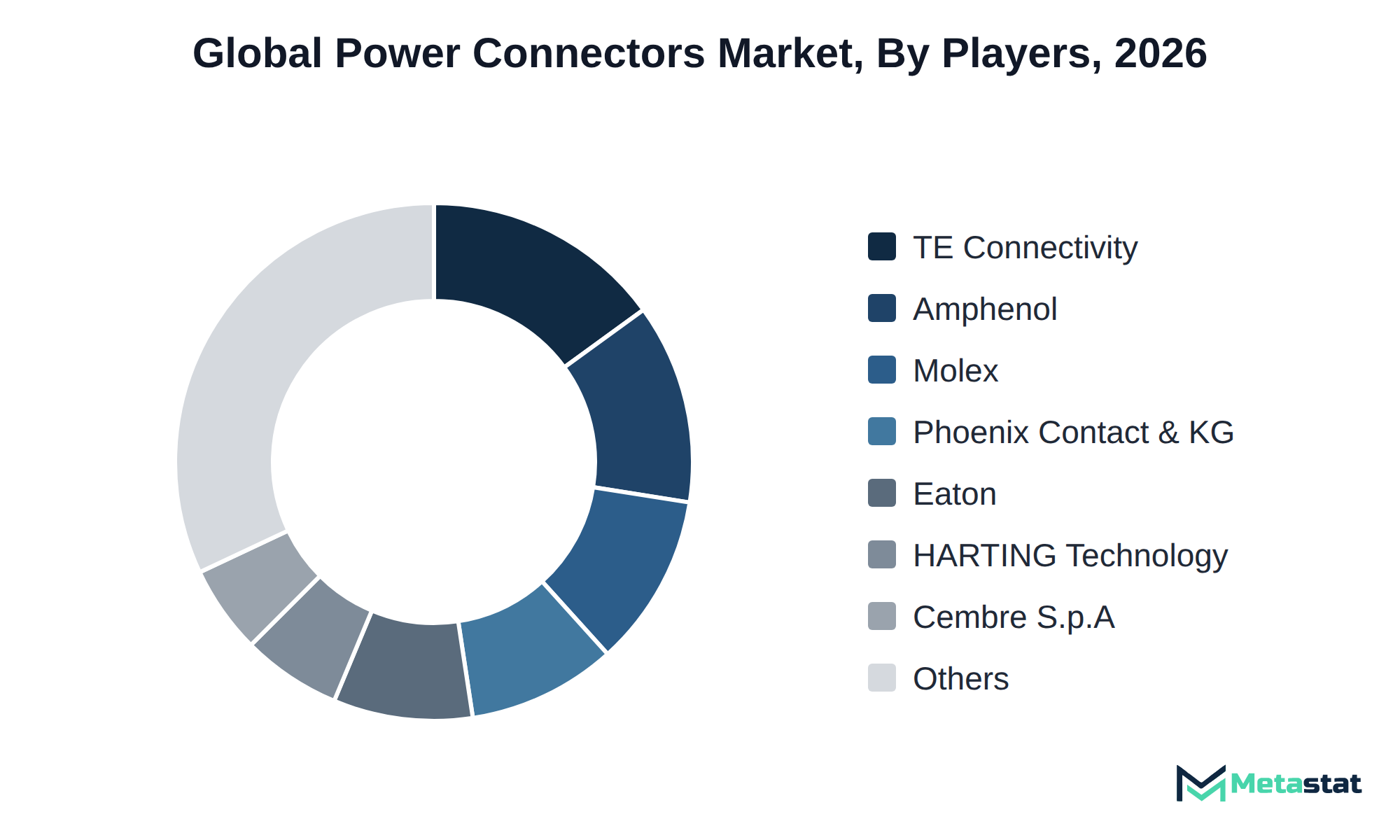
Companies in the Power Connectors market compete through multiple strategies including product innovation, pricing models, and service offerings. Key players focus on specific product types including TE Connectivity plc, which emphasizes high-quality cable lugs and terminals, while Amphenol Corporation targets cable splice connectors and PCB power connectors. Firms like Phoenix Contact GmbH & Co. KG and Weidmüller Interface GmbH & Co. KG highlight their capabilities in crimp and compression termination methods, enhancing their competitive edge in the market.
Buyers prioritize factors including price, customization, certification, and the ability to integrate within existing ecosystems. For example, Molex, LLC focuses on innovative designs that enhance compatibility, while Eaton Corporation plc emphasizes certifications for safety and performance. This competition drives companies to adapt their offerings in response to buyer expectations, significantly influencing market dynamics and shaping the competitive landscape.
Achieving this growth relies on several key developments in the Power Connectors market. First, increasing demand from the automotive and EV charging sectors is expected to drive significant revenue growth. This segment anticipates a compound annual growth rate of 7.3%, driven by the global shift toward electric vehicles. Second, the adoption of separable power connectors is projected to enhance market performance, reflecting a growing need for efficient and reliable connections across various applications. The energy and utilities sector stands to benefit significantly from this trend. Conversely, a potential risk to this growth stems from supply chain disruptions, which could hinder production capabilities and delay project timelines. Such challenges, particularly in regions like North America and Europe, could impact the market's ability to reach the forecasted figure. Addressing these risks through improved logistics and supply management remains essential to achieving the anticipated market value.
By Product Type: Cable Lugs and Terminals, Cable Splice Connectors, Separable Power Connectors, PCB Power Connectors, Power Terminal Blocks
By Termination Method: Crimp and Compression, Screw and Bolted, Spring Clamp and Push-in, Solder, Press-fit, Insulation Displacement
By End-Use Industry: Industrial Manufacturing, Automotive and EV Charging, Energy and Utilities, Data Centers, Telecommunications, Consumer Electronics and Appliances, Railways, Aerospace and Defense, Building and Construction, Others (Medical Equipment, Marine)
The report strategically identifies and profiles the key market players and analyses their core competencies in each sub-segment of the Power Connectors market.
Report Attributes | Details |
Study Period | 2021-2033 |
Base Year | 2025 |
Estimated Year | 2026 |
Forecast Period | 2026-2033 |
Historical Period | 2021-2025 |
Growth Rate | CAGR 6.1% from 2026 to 2033 |
Revenue Unit | USD million |
Segmentation | By Product Type, Termination Method, Rated Current, End-Use Industry, and Region |
By Region | North America (By Product Type, Termination Method, Rated Current, End-Use Industry, and Country)
|
Europe (By Product Type, Termination Method, Rated Current, End-Use Industry, and Country)
| |
Asia Pacific (By Product Type, Termination Method, Rated Current, End-Use Industry, and Country)
| |
South America (By Product Type, Termination Method, Rated Current, End-Use Industry, and Country)
| |
Middle East and Africa (By Product Type, Termination Method, Rated Current, End-Use Industry, and Country)
|
Find answers to common questions about this report
The Power Connectors market size was valued at USD 2,893.5 million in 2025.
The market is projected to grow at a CAGR of 6.1% during the forecast period from 2026 to 2033.
The North America Power Connectors market size is estimated to reach USD 1,371.4 million by 2033.
Separable Power Connectors lead the market with a projected value of USD 1,925.4 million by 2033, surpassing other product types.
The automotive and electric vehicle sectors drive substantial growth due to the accelerating shift towards electric mobility, resulting in increased demand for reliable power connectors. the emphasis on energy efficiency encourages suppliers to innovate in power connector design, enhancing product performance and reducing energy losses.
Escalating material costs restrain growth in the Power Connectors market, particularly affecting manufacturers in the industrial manufacturing and automotive sectors. Ongoing shortages of critical components create margin pressure, impacting profit margins and leading to cautious purchasing decisions among buyers.
Factors favoring adoption in the Power Connectors industry include the projected compound annual growth rate of 7.3% in the automotive and electric vehicle charging segment, driven by the rapid expansion of EV infrastructure and the demand for reliable power connectors that meet higher power requirements in modern electric vehicles.
The Power Connectors market is estimated to reach a valuation of USD 4,655.2 million by 2033.
Key players operating in the Power Connectors market include TE Connectivity plc, Amphenol Corporation, Molex, LLC, Phoenix Contact GmbH & Co. KG, HARTING Technology Group, Hirose Electric Co., Ltd., and Eaton Corporation plc.
The automotive and EV charging segment is projected to reach USD 1,146.6 million by 2033, demonstrating a compound annual growth rate of 7.3%.
The analysts below cover Energy and Power research at Metastat Insights.
LEAD ANALYST
Utkarsh Khirodkar is a Lead Market Research Analyst at MetaStat Insight, specializing in market intelligence, technology sector assessments, and competitive strategy.

PRINCIPAL CONSULTANT - ENTERPRISE AI & EMERGING TECHNOLOGIES
Banking & Finance · Electronics and Semiconductor · Energy and Power · Healthcare IT · Information & Technology · Professional Services
Vijay Gunti is a Principal Consultant at MetaStat Insight, bringing over two decades of experience across enterprise digital transformation, technology strategy, and intelligent systems.

ENERGY & INFRASTRUCTURE INDUSTRY CONSULTANT
Automotive and Transportation · Electronics and Semiconductor · Energy and Power · Machinery & Equipment
Saurabh Vasant Ganvir consults for Energy & Infrastructure Industry at MetaStat Insight, specializing in renewable energy, solar EPC, and electric vehicle (EV) infrastructure markets.
When evaluating distributed energy resource management systems, standard research summaries tend to gloss over the operational differences between front-of-the-meter utility deployments and behind-the-meter industrial sites. The MetaStat Insight report addressed those distinctions directly, especially regarding software interoperability standards and grid interconnection backlogs. The five-year market sizing across regional transmission organizations provided actionable context for our grid modernization strategy.
Most industry reports on warehouse automation bundle autonomous mobile robots and fixed conveyor installations into the same top-level numbers, which complicates advisory work. This study split the market cleanly by payload tiers, navigation technology, and fleet management software layers. The regional forecast for Western Europe gave our team defensible adoption benchmarks when evaluating capital allocation for logistics clients, saving us days of secondary data scrubbing.
Analyzing the transition from natural gas to green hydrogen in iron ore reduction requires realistic infrastructure timelines. Meta stat insight supplied a detailed regional assessment of DRI plant conversion costs and scrap metal availability in North America and Western Europe. Their report carefully examined pellet quality specs and electrical grid access constraints without making oversimplified market assumptions. The research material served as a practical reference during internal technology roadmap discussions.
Explore related market intelligence reports worth reading alongside this one.