
LEAD ANALYST
Utkarsh Khirodkar is a Lead Market Research Analyst at MetaStat Insight, specializing in market intelligence, technology sector assessments, and competitive strategy.

Surface Acoustic Wave (SAW) Hardware Market By Type (Filters, Oscillators and Resonators, Sensors, and Others), By Application (Consumer Electronics, Automotive, Aerospace, Defense, Telecommunications, and Others), Industry Analysis, Size, Share, Growth, Trends, and Forecast, 2024-2031
Report ID
MSI-2603
Published
February, 2026
Pages
255 Pages
Format
Report Details
Choose Your License
Surface Acoustic Wave (SAW) Hardware Market
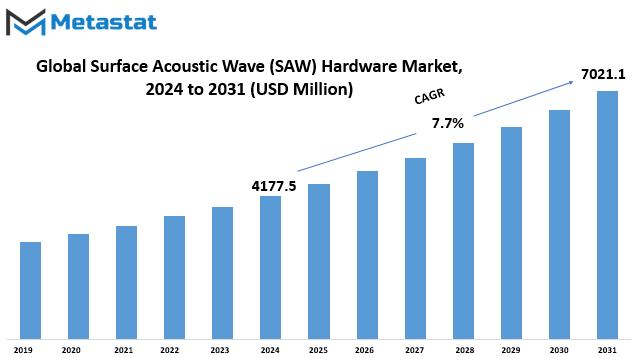
The Global Surface Acoustic Wave (SAW) Hardware market is estimated to reach $7021.1 Million by 2031; growing at a CAGR of 7.7% from 2024 to 2031.
The Global Surface Acoustic Wave (SAW) Hardware market plays a crucial role in various applications. This market encompasses a wide array of devices and components that leverage surface acoustic wave technology, contributing to the advancement of communication and sensor technologies.
The Global Surface Acoustic Wave (SAW) Hardware market lies in an intricate interplay of innovation and engineering. The industry revolves around the development and production of devices that utilize surface acoustic waves for signal processing. Unlike traditional electronic components, SAW devices exploit the mechanical vibrations traveling along the surface of a material, offering unique advantages in terms of size, efficiency, and reliability.
One of the notable applications of SAW hardware is in communication systems. SAW filters, for instance, are pivotal components in radio frequency (RF) devices, ensuring the precise filtering of signals. The market for SAW devices in communication systems has witnessed significant growth, driven by the increasing demand for efficient and compact solutions in the ever-evolving landscape of wireless communication.
Beyond communication, the Global Surface Acoustic Wave (SAW) Hardware market finds extensive utility in sensor technologies. SAW sensors are deployed in diverse sectors, ranging from industrial applications to healthcare. These sensors capitalize on the sensitivity of surface acoustic waves to detect changes in various physical parameters, making them invaluable in the development of sophisticated sensing solutions.
Furthermore, the automotive industry has become a key player in the adoption of SAW hardware. The integration of SAW filters and sensors in automotive electronics contributes to enhanced performance and reliability. As vehicles become more technologically advanced, the demand for SAW components is expected to grow, fostering innovation and collaboration within the industry.
The landscape of the Global Surface Acoustic Wave (SAW) Hardware market is characterized by a constant pursuit of excellence in design and functionality. Engineers and researchers in this field strive to push the boundaries of what is achievable, exploring new materials and fabrication techniques to optimize the performance of SAW devices. This dedication to innovation propels the industry forward, ensuring that it remains at the forefront of technological advancements.
As industries worldwide seek solutions that balance efficiency and miniaturization, the Global Surface Acoustic Wave (SAW) Hardware market continues to evolve to meet these demands. The adaptability of SAW technology to various applications positions it as a versatile player in the electronics industry, offering solutions that contribute to the seamless functioning of modern devices and systems.
The Global Surface Acoustic Wave (SAW) Hardware market stands as a testament to the power of ingenuity and engineering in shaping the future of electronics. Through its diverse applications in communication, sensing, and automotive technologies, SAW hardware plays a vital role in driving progress and innovation across industries. The continual pursuit of excellence within the industry ensures that surface acoustic wave technology will remain a key player in shaping the technological landscape for years to come.
The Surface Acoustic Wave (SAW) hardware market is on the cusp of significant transformation, driven by emerging applications, technological advancements, and evolving industry demands. One of the most promising areas for growth lies in the integration of SAW technology within the Internet of Things (IoT) and smart devices. As the number of connected devices continues to expand, the demand for compact, efficient, and reliable components is paramount. SAW devices, with their inherent advantages in size and performance, are well-suited to meet the requirements of IoT applications, ranging from smart home technologies to industrial automation. The ability of SAW sensors to detect minute changes in environmental conditions positions them as vital components in the development of intelligent systems that enhance user experience and operational efficiency.
Additionally, the automotive sector is poised for substantial growth in the adoption of SAW hardware. As vehicles evolve into more sophisticated machines equipped with advanced driver-assistance systems (ADAS), the need for high-performance sensors and filters becomes critical. SAW technology can provide the necessary precision and reliability required for applications such as radar and lidar systems, which are integral to the safe operation of autonomous vehicles. This growing integration of SAW components into automotive electronics not only enhances vehicle performance but also aligns with regulatory mandates aimed at improving safety and reducing emissions.
The integration of SAW devices into the expanding 5G networks represents another significant opportunity for market growth. The rollout of 5G infrastructure necessitates advanced RF filters capable of handling higher frequency bands with minimal interference. SAW devices are uniquely positioned to fulfill this requirement, offering high selectivity and low insertion loss, which are essential for the efficient operation of next-generation wireless communication systems. As telecom operators and equipment manufacturers invest heavily in 5G technology, the demand for specialized SAW components is expected to surge, particularly in regions actively pursuing aggressive network rollouts.
Moreover, the potential for SAW technology to penetrate new markets is vast. Applications in wearable electronics, medical devices, and flexible sensors are gaining traction, driven by the need for miniaturized and energy-efficient solutions. The adaptability of SAW devices to various substrates and form factors allows for innovative designs that cater to the unique requirements of these emerging sectors. This versatility not only opens new avenues for growth but also reinforces the strategic importance of SAW technology in the broader electronics landscape.
As the industry continues to evolve, the interplay of technological innovation, regulatory developments, and market demands will shape the future of the SAW hardware market. The continuous pursuit of excellence in design and functionality will ensure that surface acoustic wave technology remains at the forefront of advancements in communication, sensing, and automotive technologies. With the ongoing integration of SAW devices into critical applications, the market is well-positioned for sustained growth and innovation in the coming years.
The Surface Acoustic Wave (SAW) hardware market is experiencing significant transformation driven by several key dynamics that influence its growth trajectory. One of the primary drivers is the rapid proliferation of 5G networks and the increasing adoption of Internet of Things (IoT) devices. As these technologies advance, the demand for efficient and compact communication solutions intensifies, positioning SAW devices as critical components in enhancing signal processing capabilities. The ability of SAW technology to provide high-frequency performance and miniaturization aligns well with the requirements of next-generation wireless communication systems, thereby driving their adoption across various sectors.
In addition to the growth spurred by 5G and IoT, the market also faces certain restraints that could impact its expansion. Notably, competition from alternative technologies such as Bulk Acoustic Wave (BAW) presents a challenge. BAW technology, which offers similar functionalities in signal processing, may appeal to certain applications due to its distinct advantages, including higher frequency capabilities and better performance in specific conditions. This competitive pressure necessitates continuous innovation and differentiation within the SAW hardware market to maintain its relevance and market share.
Despite these challenges, there are considerable opportunities for growth, particularly in emerging markets and new applications. Regions with developing telecommunications infrastructure are increasingly recognizing the value of SAW technology for enhancing communication systems. As these markets expand, they present a fertile ground for SAW hardware manufacturers to introduce their products and solutions. Additionally, the application of SAW technology is diversifying beyond traditional communication systems. New use cases in automotive electronics, healthcare sensors, and industrial automation are emerging, showcasing the versatility of SAW devices. This diversification not only broadens the market scope but also encourages innovation in product development, targeting specific needs across different industries.
Furthermore, as industries increasingly prioritize efficiency and reliability, the demand for advanced sensing solutions is likely to rise. SAW sensors, known for their sensitivity and precision, are well-suited for applications requiring real-time monitoring and data acquisition. This trend aligns with the growing emphasis on smart technologies and automation across sectors, further solidifying the role of SAW hardware in the technological landscape.
In summary, the dynamics of the Surface Acoustic Wave (SAW) hardware market are shaped by the interplay of technological advancements, competitive pressures, and emerging opportunities. As the market evolves, stakeholders must navigate these dynamics strategically to harness the potential for growth and innovation in this vibrant sector.
The competitive dynamics within the Global Surface Acoustic Wave (SAW) Hardware market are shaped by a series of strategic mergers and acquisitions, alongside innovative competitive strategies employed by leading firms. These actions are pivotal in influencing market positioning and enhancing technological capabilities.
Mergers and acquisitions have become a prominent strategy among key players, allowing companies to consolidate resources, expand their technological portfolios, and enhance market reach. For instance, Broadcom has been actively involved in acquiring smaller firms specializing in advanced RF technologies, which aids in bolstering their product offerings in the SAW hardware segment. Similarly, Texas Instruments has pursued strategic partnerships to integrate SAW technology into their broader semiconductor solutions, thereby enhancing their competitive edge in the market.
Leading firms in the SAW hardware market are also employing various competitive strategies to differentiate their offerings. Skyworks Solutions, for example, emphasizes the development of integrated RF front-end solutions that combine SAW and Bulk Acoustic Wave (BAW) technologies. This hybrid approach not only maximizes performance but also addresses the growing demand for compact and efficient filtering solutions in 5G applications. By focusing on innovation, these companies are positioning themselves as frontrunners in the rapidly evolving landscape of wireless communication.
Emerging players are increasingly impacting market competition by introducing niche products and specialized technologies. These companies often target specific applications or frequency ranges, which allows them to carve out unique positions within the market. For example, some startups are focusing on thin-film SAW technology, which offers advantages in terms of miniaturization and energy efficiency. These innovations are likely to challenge established players, prompting them to adapt their strategies in response to this new competitive landscape.
The emergence of new technologies, such as thin-film SAW and TC-SAW, presents both opportunities and challenges. Established companies like Skyworks Solutions and Broadcom are investing in research and development to advance these technologies, ensuring they remain relevant as market demands evolve. Additionally, the increasing adoption of SAW solutions in automotive and industrial applications is driving the need for higher performance and reliability, further intensifying competition among suppliers.
Overall, the competitive landscape of the Global Surface Acoustic Wave (SAW) Hardware market is characterized by a blend of strategic mergers, innovative product development, and the rise of emerging players. As the market continues to grow, driven by advancements in communication technologies and the increasing demand for efficient filtering solutions, the interplay among these factors will shape the future dynamics of the industry.
The Surface Acoustic Wave (SAW) Hardware market can be segmented effectively by both frequency range and end-use applications, which are critical for a comprehensive understanding of the market dynamics. This segmentation not only aids in identifying market trends but also assists stakeholders in making informed decisions based on specific needs and demands within the industry.
Firstly, the frequency range is a pivotal aspect of market segmentation. The SAW devices are typically categorized into three main frequency ranges: low frequency, medium frequency, and high frequency. Low frequency SAW devices are commonly utilized in applications where larger wavelengths are acceptable, such as in certain sensor technologies. Medium frequency devices often find their use in standard communication systems, providing a balance between size and performance. High frequency SAW devices are essential for advanced applications, particularly in telecommunications, where high precision and compactness are required. Understanding these frequency segments allows manufacturers and suppliers to tailor their products to meet the specific requirements of various applications, enhancing performance and customer satisfaction.
In addition to frequency ranges, a detailed breakdown of end-use applications further enriches the market segmentation. The primary applications of SAW hardware include electronic components, radio and television broadcasting, automotive systems, and mobile phones. Each of these categories presents unique demands and challenges. For instance, in the automotive sector, the integration of SAW technology enhances the reliability and efficiency of electronic control units, while in mobile devices, the need for compact and high-performing filters is paramount. Furthermore, emerging applications in healthcare and industrial automation are gaining traction, driven by the increasing demand for precise and sensitive sensing solutions. This expansion into new sectors indicates a growing versatility of SAW technology and its potential to address diverse market needs.
Insights into market share by segment reveal that the communication applications hold a significant portion of the market, primarily due to the escalating demand for efficient wireless devices. Additionally, the automotive sector is rapidly becoming a key contributor, reflecting the industry's shift towards more technologically advanced vehicles. As different segments evolve, understanding their respective market shares allows stakeholders to identify opportunities for growth and innovation.
In summary, segmenting the Surface Acoustic Wave (SAW) Hardware market by frequency range and end-use applications is essential for a nuanced analysis. This approach not only highlights the diverse applications of SAW technology but also provides valuable insights into market dynamics, enabling stakeholders to strategize effectively in this competitive landscape.
The Global Surface Acoustic Wave (SAW) Hardware market is currently experiencing transformative trends that are reshaping its landscape. A significant trend is the rise of artificial intelligence (AI) and machine learning in the design and manufacturing processes of SAW devices. These technologies are enhancing the precision and efficiency of device development, allowing for more complex designs and improved performance metrics. By leveraging AI algorithms, manufacturers can optimize material selection and fabrication techniques, ultimately leading to higher quality products that meet the increasing demands of various applications.
Another critical trend impacting the SAW hardware market is the advent of 5G technology. The rollout of 5G networks is driving a heightened demand for advanced SAW components, as these devices are essential for managing the higher frequency signals characteristic of 5G communications. The integration of SAW filters in mobile devices and infrastructure is pivotal for ensuring efficient signal processing and maintaining communication integrity. As the telecommunications industry continues to expand its 5G offerings, the requirement for high-performance SAW hardware will correspondingly increase, presenting opportunities for manufacturers to innovate and diversify their product lines.
Furthermore, there is a marked trend towards miniaturization and energy efficiency in SAW devices. As consumer electronics evolve, the demand for smaller, more compact components that do not compromise on performance is becoming increasingly pronounced. This trend is particularly evident in sectors such as automotive and healthcare, where space constraints and energy consumption are critical considerations. Manufacturers are focusing on developing ultra-compact SAW filters and sensors that can deliver high performance while minimizing power usage. This shift not only aligns with global sustainability goals but also enhances the overall user experience by integrating advanced technology into everyday devices.
In addition to these technological advancements, the market is witnessing a growing emphasis on collaboration among industry players. Companies are forming strategic partnerships to leverage complementary strengths, share research and development costs, and accelerate the pace of innovation. This collaborative approach is essential for addressing the complex challenges presented by emerging technologies and evolving consumer preferences. As the SAW hardware market continues to adapt to these trends, it is poised for sustained growth, driven by the interplay of innovation, demand for advanced communication solutions, and the ongoing pursuit of efficiency and compactness in device design.
The global market for Surface Acoustic Wave (SAW) Hardware is influenced by various factors that shape its trajectory. One driving force is the rising demand for wireless communication devices. In an era where connectivity is paramount, the need for such devices has surged, propelling the market forward.
Another key driver is the continuous evolution of automotive electronics. As vehicles become more technologically advanced, incorporating cutting-edge electronics has become a norm. This advancement not only caters to consumers' demand for smart features but also contributes to the growth of the SAW Hardware market.
However, the industry faces certain challenges. Technological limitations in high-frequency applications pose a restraint. Despite the progress, there are still hurdles to overcome in achieving optimal performance in these applications, slowing down the overall market growth.
Moreover, there is formidable competition from alternative technologies. As the landscape of electronic solutions expands, SAW Hardware faces rivalry from other methodologies. This competition acts as a hindrance, compelling the industry to innovate and differentiate itself.
Yet, amidst challenges, opportunities arise. The advent of 5G technology is a promising prospect. With the global push towards establishing a robust 5G infrastructure, the SAW Hardware market can leverage this opportunity for growth. The increased reliance on 5G technology opens avenues for applications where SAW Hardware can play a crucial role, presenting a positive outlook for the market.
The dynamics of the global SAW Hardware market are shaped by the interplay of drivers, restraints, and opportunities. The increasing demand for wireless communication devices and advancements in automotive electronics propel the market forward. However, technological limitations and competition from alternative technologies pose challenges. On the brighter side, the growth in 5G technology infrastructure opens doors for the market's expansion, showcasing the resilience and adaptability of the SAW Hardware industry.
The global Surface Acoustic Wave (SAW) Hardware market is divided into different types, namely Filters, Oscillators and Resonators, Sensors, and Others. Each type plays a distinct role in the market, contributing to its overall dynamics. The diversity in product types caters to a wide range of applications and requirements within the industry. This segmentation provides a comprehensive understanding of the market landscape, allowing stakeholders to identify specific areas of interest or investment based on their needs.
Filters within the SAW Hardware market serve the purpose of refining signals and managing frequencies, ensuring optimal performance in various electronic devices. Oscillators and Resonators, on the other hand, contribute to the precision and stability of frequency generation, playing a crucial role in applications where accurate timing is essential. Sensors, a significant segment, enable the detection and measurement of various physical phenomena, enhancing the functionality of devices across industries. The category labeled as ‘Others’ encompasses additional components that may not fall directly into the mentioned categories but contribute uniquely to the SAW Hardware market.
This segmentation not only simplifies the understanding of the market but also facilitates targeted analysis and decision-making for businesses operating within this sector. It allows stakeholders to grasp the distinct functionalities and applications associated with each type, promoting a more nuanced comprehension of the global SAW Hardware market. Consequently, this segmentation aids in aligning strategies and resources with specific market demands, fostering efficiency and relevance in a rapidly evolving technological landscape.
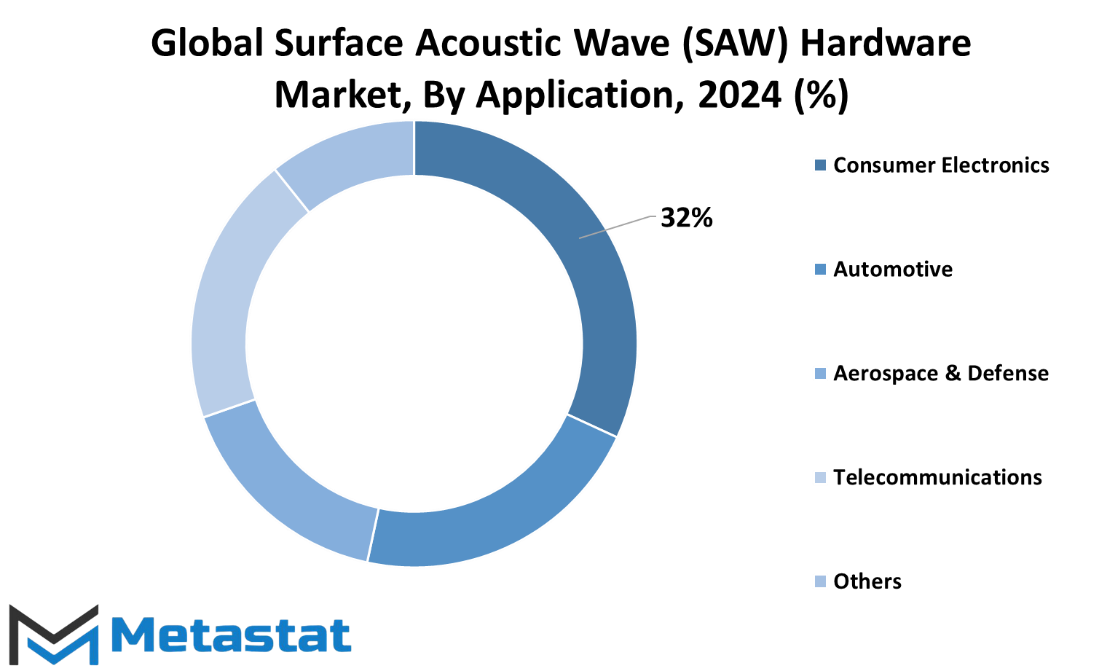
The worldwide Surface Acoustic Wave (SAW) Hardware market spans various sectors, categorized by application into Consumer Electronics, Automotive, Aerospace & Defense, Telecommunications, and Others.
In the global Surface Acoustic Wave (SAW) Hardware market, diverse applications drive its dynamics. Consumer Electronics, a pivotal domain, witnesses the integration of SAW Hardware in devices that permeate our daily lives, emphasizing the market’s significant role in enhancing user experiences.
The Automotive sector, another facet of this market, experiences the infusion of SAW Hardware to augment functionalities and connectivity within vehicles. This inclusion contributes to the evolution of automotive technology, addressing the demands of an increasingly interconnected world.
Aerospace & Defense constitute a critical segment where the incorporation of SAW Hardware plays a vital role in enhancing communication systems and ensuring robust performance in challenging environments. The reliability of SAW Hardware makes it a preferred choice in this sector.
Telecommunications, a cornerstone of modern connectivity, stands as a key application area for SAW Hardware. Its role in signal processing and communication infrastructure underscores its importance in maintaining and advancing global telecommunications networks.
The category labeled as Others encapsulates various applications beyond the specified sectors, showcasing the versatility of SAW Hardware in addressing diverse needs across different industries. This adaptability contributes to its widespread adoption and relevance in an array of contexts.
As the Surface Acoustic Wave (SAW) Hardware market continues to evolve, its influence extends across Consumer Electronics, Automotive, Aerospace & Defense, Telecommunications, and Other applications, shaping technological landscapes and meeting the ever-growing demands of an interconnected world.
The worldwide market for Surface Acoustic Wave (SAW) Hardware is analyzed with a focus on geographical segmentation. This categorization includes North America and Europe, among other regions. The examination aims to comprehend the market dynamics and trends specific to each geographic area.
In assessing the Surface Acoustic Wave (SAW) Hardware market, it is crucial to consider its regional distribution. North America and Europe serve as significant segments within this global landscape. By scrutinizing the market through a geographic lens, we gain insights into how diverse regions contribute to the overall dynamics of the industry.
In the context of the global Surface Acoustic Wave (SAW) Hardware market, North America plays a pivotal role. Its economic landscape and technological advancements significantly impact the market's trajectory. Similarly, Europe, with its distinct market characteristics, influences the overall market trends.
Understanding the geographical nuances becomes imperative when analyzing the Surface Acoustic Wave (SAW) Hardware market. It allows us to appreciate the diverse factors influencing market dynamics across different regions. As we explore the impact of North America and Europe, we unravel a more comprehensive picture of the global market landscape.
The global market for Surface Acoustic Wave (SAW) Hardware is dynamic, driven by key players who shape the industry landscape. Prominent companies in this field include Murata Manufacturing Co., Ltd., Taiyo Yuden Co., LTD., Tai Saw Technology Co. Ltd, Skyworks Solutions, Inc., Qualcomm Technologies, Inc., Spectrum Control, Abracon (Oscilent), KYOCERA Corporation, ITF Co., Ltd, Microchip Technology Inc., Nihon Dempa Kogyo Co., Ltd., Rakon Limited, Seiko Epson Corp., Crystek Corporation, Renesas Electronics Corporation, Synergy Microwave Corporation, and Q-Tech Corporation.
These competitive players play a pivotal role in the Surface Acoustic Wave (SAW) Hardware market, each contributing its unique strengths and innovations. Murata Manufacturing Co., Ltd., for instance, is known for its commitment to quality and cutting-edge technology, while companies like Skyworks Solutions, Inc. and Qualcomm Technologies, Inc. bring their expertise in developing advanced solutions.
Taiyo Yuden Co., LTD. and Tai Saw Technology Co. Ltd contribute to the competitive landscape with their proficiency in SAW Hardware, adding diversity to the market. Abracon (Oscilent) and KYOCERA Corporation, on the other hand, bring their respective strengths to the forefront, enhancing the overall competitiveness of the industry.
Microchip Technology Inc. and Renesas Electronics Corporation are key players known for their technological prowess, impacting the market with innovative hardware solutions. Seiko Epson Corp., Crystek Corporation, and Synergy Microwave Corporation further enrich the industry with their contributions, creating a vibrant and competitive environment.
Q-Tech Corporation and Nihon Dempa Kogyo Co., Ltd., among others, add depth to the Surface Acoustic Wave (SAW) Hardware market, collectively shaping its trajectory. The collaborative efforts and individual strengths of these players underscore the dynamic nature of the industry, where innovation and competition coalesce to drive advancements in SAW Hardware technology.
Find answers to common questions about this report
Global Surface Acoustic Wave (SAW) Hardware market is valued at $4177.5 million in 2024.
Global Surface Acoustic Wave (SAW) Hardware market is estimated to grow with a CAGR of 7.7% from 2024 to 2031.
Global Surface Acoustic Wave (SAW) Hardware market is estimated to reach $7021.1 million by 2031.
Top players operating in the Surface Acoustic Wave (SAW) Hardware industry includes Murata Manufacturing Co., Ltd., Taiyo Yuden Co., LTD., Tai Saw Technology Co. Ltd, and others.
The analysts below cover Electronics and Semiconductor research at Metastat Insights.
LEAD ANALYST
Utkarsh Khirodkar is a Lead Market Research Analyst at MetaStat Insight, specializing in market intelligence, technology sector assessments, and competitive strategy.

PRINCIPAL CONSULTANT - ENTERPRISE AI & EMERGING TECHNOLOGIES
Banking & Finance · Electronics and Semiconductor · Energy and Power · Healthcare IT · Information & Technology · Professional Services
Vijay Gunti is a Principal Consultant at MetaStat Insight, bringing over two decades of experience across enterprise digital transformation, technology strategy, and intelligent systems.

PRINCIPAL CONSULTANT - QUALITY SYSTEMS & COMPLIANCE
Electronics and Semiconductor · Machinery & Equipment · Professional Services
Omkar Phadtare is an Industry Consultant at MetaStat Insight, specializing in quality systems, regulatory compliance, and standards benchmarking to drive data-driven market intelligence and strategic industry research.

ENERGY & INFRASTRUCTURE INDUSTRY CONSULTANT
Automotive and Transportation · Electronics and Semiconductor · Energy and Power · Machinery & Equipment
Saurabh Vasant Ganvir consults for Energy & Infrastructure Industry at MetaStat Insight, specializing in renewable energy, solar EPC, and electric vehicle (EV) infrastructure markets.

LEAD CONSULTANT - COMMUNICATION, TELECOM, AND IT
Electronics and Semiconductor · Information & Technology · Machinery & Equipment · Professional Services
Ravindra Sathe Consultants for Communication, Telecom, and IT at MetaStat Insight. He leads the firm's industry research initiatives across telecommunications infrastructure, digital connectivity, enterprise networking, and emerging information technology domains.
Tracking capacity expansion in single-use bioprocessing requires dependable data on raw material availability and cleanroom-grade polymer supply chains. The competitive landscape chapter gave a grounded evaluation of secondary component suppliers across North America and Asia-Pacific rather than simply reprinting press releases. Having that level of supplier benchmarking helped clarify dual-sourcing considerations for our clinical pipeline planning.
When evaluating distributed energy resource management systems, standard research summaries tend to gloss over the operational differences between front-of-the-meter utility deployments and behind-the-meter industrial sites. The MetaStat Insight report addressed those distinctions directly, especially regarding software interoperability standards and grid interconnection backlogs. The five-year market sizing across regional transmission organizations provided actionable context for our grid modernization strategy.
Most industry reports on warehouse automation bundle autonomous mobile robots and fixed conveyor installations into the same top-level numbers, which complicates advisory work. This study split the market cleanly by payload tiers, navigation technology, and fleet management software layers. The regional forecast for Western Europe gave our team defensible adoption benchmarks when evaluating capital allocation for logistics clients, saving us days of secondary data scrubbing.
Explore related market intelligence reports worth reading alongside this one.
Starting from
$2950