
LEAD ANALYST
Utkarsh Khirodkar is a Lead Market Research Analyst at MetaStat Insight, specializing in market intelligence, technology sector assessments, and competitive strategy.

Telecom Outsourcing Market Size, Share, By Service Type (Managed Services, Network Management, IT Services, Billing Operations, Customer Care, Infrastructure Management, and Others), By Deployment Mode (On-Premises and Cloud-Based), By Operator Type (Mobile Network Operators, Fixed-Line Operators, and Others), By End-User (BFSI, Healthcare, Retail, IT and Telecommunications, and Others), Industry Analysis, Growth, Trends, and Forecast, 2026-2033
Report ID
MSI-4616
Published
April, 2026
Pages
320 Pages
Format
Report Details
Choose Your License
Telecom Outsourcing Market
Global Telecom Outsourcing market size is valued at USD 26.7 billion in 2025 and projected to grow at a CAGR of 9.8% during the forecast period, reaching USD 56.4 billion by 2033.
North America holds 33.0% of the global Telecom Outsourcing market in 2025, with the U.S. leading the regional market.
Managed Services segment accounts for a 26.5% market share in 2025.
Key trends driving growth: Network OPEX Optimization and Cost Efficiency, Rising Complexity of 5G, Cloud, OSS/BSS, and Multi-Vendor Operations.
Opportunities include AI-Led Autonomous Network Operations and Digital Customer Experience Transformation.
Key insight: The shift toward outsourced, technology-driven operations is redefining telecom service delivery, positioning the Global Telecom Outsourcing market for strong long-term growth.
The Global Telecom Outsourcing market continues to expand as telecom operators focus on core functions such as network expansion, service innovation, and customer acquisition while outsourcing non-core operational activities to specialized service providers. This shift supports improved efficiency, better cost control, and faster service deployment.
Service providers are strengthening their capabilities through automation, cloud platforms, and analytics-driven solutions. These advancements help telecom companies manage complex networks with greater precision and lower downtime. As network environments become more sophisticated, outsourcing partners play an important role in ensuring seamless operations. Rising demand for high-speed connectivity and digital services is further strengthening outsourcing adoption, as telecom operators manage increasing data traffic, network congestion, and customer expectations.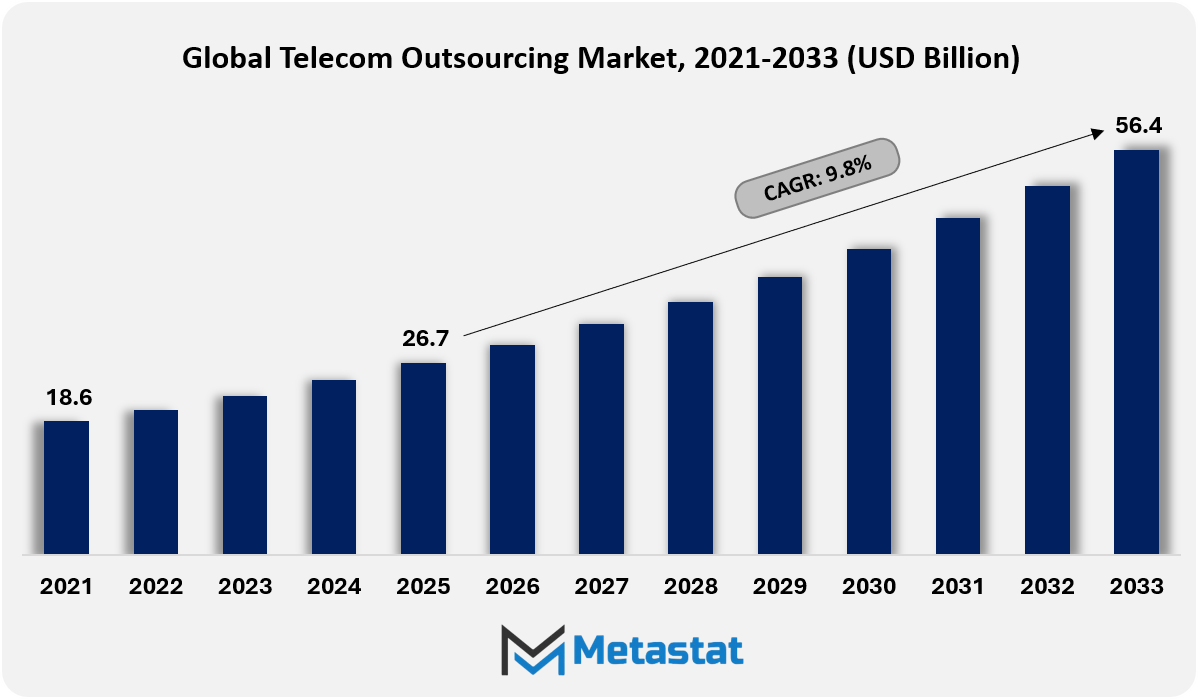
Network OPEX Optimization and Cost Efficiency.
Global Telecom Outsourcing market will witness strong momentum from continuous pressure on telecom operators to reduce operating expenditure while maintaining service quality. Outsourcing models enable structured cost management through shared resources, automation, and streamlined workflows, supporting margin stability and stronger capital allocation toward network expansion projects.
Rising Complexity of 5G, Cloud, OSS/BSS, and Multi-Vendor Operations
Global Telecom Outsourcing market will expand with increasing architectural complexity created by 5G deployment, cloud-native infrastructure, OSS/BSS transformation, and multi-vendor ecosystems. Telecom operators will rely on specialized outsourcing partners to manage integration challenges, ensure interoperability, and maintain performance consistency across highly distributed and technologically advanced network environments.
Data Security, Compliance, and Sovereignty Risks
Global Telecom Outsourcing market will face constraints related to rising concerns over data security, regulatory compliance, and cross-border data governance. Telecom operators require strict adherence to local regulations, which increases operational complexity for outsourcing providers managing sensitive customer and network data across different legal frameworks and evolving cybersecurity risk environments.
Loss of Operational Control and Vendor Dependency
Global Telecom Outsourcing market will encounter challenges from growing reliance on third-party providers, reducing direct operational visibility and control. Vendor dependency introduces risks related to service continuity, performance accountability, and strategic flexibility, while long-term contracts can limit rapid adaptation to changing technological and market conditions.
AI-Led Autonomous Network Operations and Digital Customer Experience Transformation
Global Telecom Outsourcing market will create significant opportunities through adoption of AI-driven network automation and advanced digital customer experience solutions. Outsourcing providers will leverage predictive analytics, self-healing network capabilities, and personalized engagement platforms, enabling telecom operators to improve service reliability, reduce downtime, and deliver differentiated customer experiences aligned with future digital expectations.
The Global Telecom Outsourcing market is classified based on Service Type, Deployment Mode, Operator Type, and End-User.
Managed Services segment is valued at USD 7.8 billion in 2026 and is projected to reach USD 15.5 billion by 2033, at a CAGR of 10.3% during the forecast period.
Managed services will continue gaining traction with rising demand for cost optimization and operational efficiency. Telecom operators will depend on external providers for end-to-end service management, enabling streamlined workflows, reduced capital burden, and stronger scalability aligned with future digital infrastructure expansion.
Network Management segment is valued at USD 5.3 billion in 2026 and is projected to reach USD 10.7 billion by 2033, at a CAGR of 10.7% during the forecast period.
Network management will witness steady growth supported by rising data consumption and increasingly complex network architectures. Service providers are adopting automated monitoring, predictive maintenance, and performance optimization tools to support 5G expansion, ensure uninterrupted connectivity, improve latency management, and enhance large-scale telecom operations.
IT Services segment is valued at USD 5.1 billion in 2026 and is projected to reach USD 10.6 billion by 2033, at a CAGR of 11.1% during the forecast period.
IT services will expand with ongoing digital transformation initiatives across telecom enterprises. Demand for software development, system integration, cybersecurity, cloud migration, data analytics, and AI-enabled tools is increasing, helping operators improve operational resilience and technological adaptability.
Billing Operations segment is valued at USD 3.7 billion in 2026 and is projected to reach USD 6.3 billion by 2033, at a CAGR of 8% during the forecast period.
Billing operations outsourcing will evolve with growing demand for accurate revenue management and fraud detection systems. Telecom operators are adopting advanced billing platforms to manage complex pricing structures and customer data. Automation and real-time processing improve transparency, reduce errors, and support regulatory compliance across telecom ecosystems.
Customer Care segment is valued at USD 3.4 billion in 2026 and is projected to reach USD 5.4 billion by 2033, at a CAGR of 7% during the forecast period.
Customer care services will transform through integration of AI-driven chatbots and omnichannel communication platforms. Telecom companies are outsourcing customer interaction functions to improve service quality, responsiveness, and operational efficiency. Personalization, multilingual support, and data-driven insights will strengthen customer engagement and retention across diverse markets.
Infrastructure Management segment is valued at USD 2.6 billion in 2026 and is projected to reach USD 5.2 billion by 2033, at a CAGR of 10.3% during the forecast period.
Infrastructure management will remain critical with rising investment in telecom networks, towers, and data centers. Outsourcing supports efficient maintenance, upgrades, and capacity planning, while technologies such as virtualization and edge computing improve infrastructure utilization, service continuity, and downtime reduction.
Others segment is valued at USD 1.5 billion in 2026 and is projected to reach USD 2.6 billion by 2033, at a CAGR of 8.5% during the forecast period.
Other services will include specialized outsourcing solutions such as consulting, training, compliance support, and operational advisory services. These emerging categories address niche requirements across telecom operations. Growth in this segment will reflect evolving industry needs, technological innovation, and rising demand for customized outsourcing strategies across global markets.
On-Premises segment is projected to reach USD 21.5 billion by 2033, at a CAGR of 4.3% during the forecast period.
On-premises deployment will maintain relevance among organizations requiring strict data control and security compliance. Telecom operators will prefer localized infrastructure for sensitive operations. Investments in hardware and internal systems will continue, supporting customized solutions tailored to specific operational requirements and regulatory frameworks.
Cloud-Based segment is projected to reach USD 34.9 billion by 2033, at a CAGR of 14.7% during the forecast period.
Cloud-based deployment will experience rapid adoption owing to scalability, flexibility, and cost efficiency. Telecom enterprises will shift toward cloud platforms for data storage, application management, and service delivery. Integration of advanced analytics and remote accessibility will enhance operational agility and support future-ready telecom ecosystems.
Mobile Network Operators segment is projected to reach USD 33 billion by 2033.
Mobile network operators will dominate outsourcing demand, supported by rising mobile subscriber bases and data traffic. Outsourcing partnerships help enable efficient network expansion, service innovation, and cost management. Focus remains on 5G deployment, spectrum optimization, and better user experience across mobile platforms.
Fixed-Line Operators segment is projected to reach USD 14.9 billion by 2033.
Fixed-line operators will leverage outsourcing to modernize legacy infrastructure and improve service efficiency. Growth in this segment is supported by broadband expansion and fiber network deployment. Outsourcing helps maintenance, customer support, and operational upgrades, ensuring competitive positioning in evolving telecom markets.
Others segment is projected to reach USD 8.5 billion by 2033.
Other operator types include virtual network operators and emerging telecom entities. Outsourcing supports faster market entry, operational scalability, and flexible service delivery. These models encourage innovation and efficient resource utilization across niche telecom segments.
BFSI segment is projected to grow at a CAGR of 8% during the forecast period.
BFSI will adopt telecom outsourcing to ensure secure communication networks and reliable data management. Demand is increasing for dependable connectivity, fraud prevention systems, and compliance support. Outsourcing improves operational efficiency while maintaining high standards of data protection and service reliability.
Healthcare segment is projected to grow at a CAGR of 11.5% during the forecast period.
Healthcare will rely on telecom outsourcing for telemedicine, patient data management, and real-time communication systems. Advanced network solutions support remote consultations and digital health services. Growth is supported by the increasing need for secure and efficient healthcare communication infrastructure.
Retail segment is projected to grow at a CAGR of 8.6% during the forecast period.
Retail will use telecom outsourcing to improve customer engagement and supply chain communication. Integration of digital platforms, payment systems, and data analytics strengthens operational efficiency. Outsourcing supports seamless connectivity across physical and online retail channels, enabling better customer experiences.
IT and Telecommunications segment is projected to grow at a CAGR of 11.7% during the forecast period.
IT and Telecommunications will remain a major contributor to outsourcing demand. Organizations are seeking advanced solutions for network management, cloud integration, and cybersecurity. Continuous innovation and technology upgrades will strengthen reliance on outsourcing partners for operational excellence.
Others segment is projected to grow at a CAGR of 7.9% during the forecast period.
Other end-user industries include government, education, and manufacturing. Demand is increasing for reliable communication infrastructure and digital transformation support. Outsourcing facilitates efficient operations, improved connectivity, and adoption of advanced technologies across multiple industry verticals.
Based on geography, the Global Telecom Outsourcing market is divided into North America, Europe, Asia-Pacific, South America, Middle East, and Africa.
North America leads the Telecom Outsourcing market, supported by the strong presence of major telecom operators, technology vendors, and continued investment in 5G and cloud infrastructure.
Europe records steady growth, supported by telecom modernization, regulatory compliance requirements, and greater use of managed and digital transformation services.
Asia-Pacific is emerging as a high-growth region with rapid network expansion, rising mobile penetration, and strong investment in next-generation telecom infrastructure.
South America is witnessing gradual adoption, supported by improving digital connectivity and operator focus on cost efficiency.
The Middle East and Africa present long-term opportunities with rising telecom infrastructure development and increasing demand for reliable connectivity services.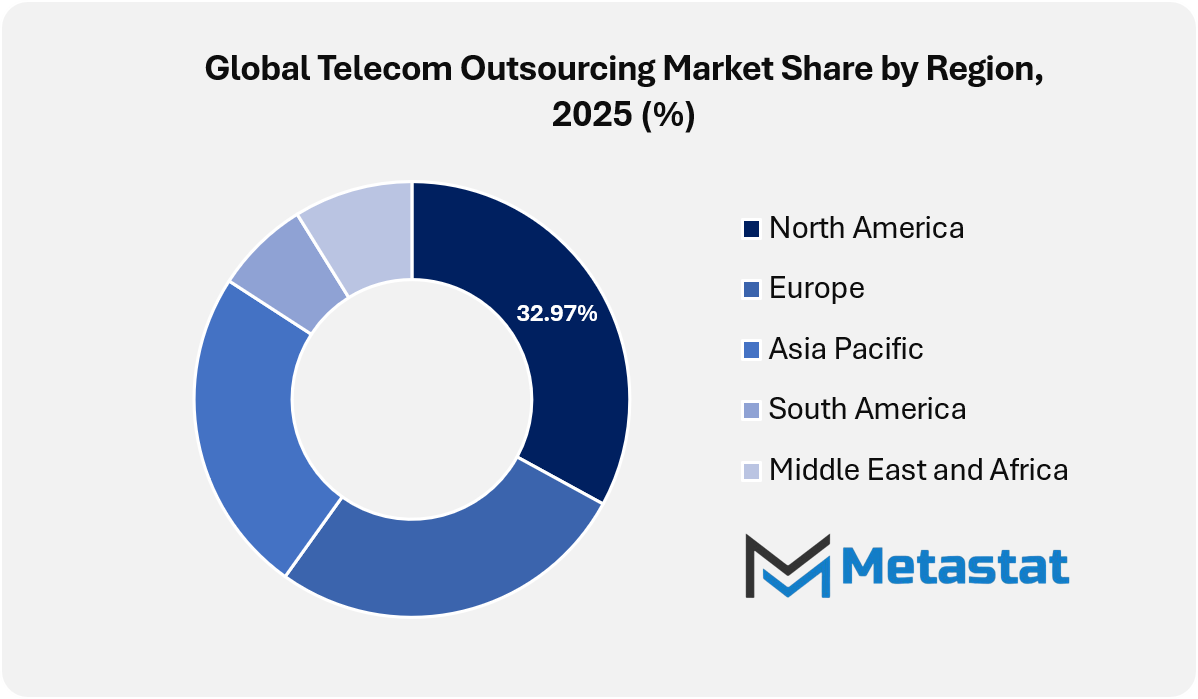
The global telecom outsourcing market continues to gain importance as telecom operators seek efficient ways to manage complex operations while maintaining cost discipline. Service providers are increasingly engaged across network management, customer support, billing systems, and IT services. Rising data consumption, 5G infrastructure expansion, and the need for faster service delivery are encouraging telecom companies to focus on core functions while outsourcing support operations. This shift helps operators remain competitive in fast-evolving digital environments without overextending internal resources.
Large technology companies and service providers play a major role in shaping the market. Companies such as IBM Corporation, Ericsson AB, and Nokia Corporation continue to provide network infrastructure and managed services that support telecom operators globally. At the same time, Huawei Technologies Co., Ltd. and ZTE Corporation are strengthening their market position through cost-effective solutions and large-scale deployment capabilities.
IT service leaders such as Accenture plc, Capgemini SE, Infosys Limited, and Wipro Limited are expanding their role by offering end-to-end digital transformation services. These companies help telecom operators modernize legacy systems, improve customer experience, and adopt cloud-based platforms. Tata Consultancy Services Limited and HCL Technologies Limited remain strong participants with large-scale delivery capabilities and skilled workforces that attract global telecom clients seeking scalable solutions.
Specialized telecom solution providers also contribute significantly to market growth. Companies such as Amdocs Limited, Netcracker Technology Corporation, and CSG Systems International, Inc. focus on billing, customer engagement, and revenue management solutions. Meanwhile, firms such as Mavenir Systems, Inc. and Prodapt Solutions Private Limited support next-generation network services and digital operations. Their specialized expertise helps telecom operators manage rising service demands with better efficiency.
As outsourcing becomes more strategic, telecom companies are increasingly prioritizing long-term partnerships rather than short-term contracts. Organizations such as NTT DATA Group Corporation, Fujitsu Limited, DXC Technology Company, and CGI Inc. are expanding their global delivery networks to meet changing customer expectations. Emerging players such as Comviva Technologies Limited and Fusion CX are also gaining traction by offering flexible and customer-focused services. The market is moving toward a model in which innovation, efficiency, and service quality define success for both telecom operators and outsourcing partners.
Market size is forecast to rise from USD 26.7 billion in 2025 to over USD 56.4 billion by 2033.
The Global Telecom Outsourcing market is projected to record strong growth, supported by increasing demand for efficient network management, cost optimization, and digital transformation support. Telecom operators will continue to rely on outsourcing partners to manage complex operations, improve service agility, and support modernization across 5G, cloud, and AI-enabled telecom environments.
By Service Type:
By Deployment Mode:
By Operator Type:
By End-User:
This research report categorizes the Telecom Outsourcing market based on key segments and regions, forecasts revenue growth, and analyses trends in each submarket. The report analyses the key growth drivers, opportunities, and challenges influencing the Telecom Outsourcing market. Recent market developments and competitive strategies such as expansion, product launch, partnership, merger, and acquisition have been included to draw the competitive landscape in the market.
The report strategically identifies and profiles the key market players and analyses their core competencies in each sub-segment of the Telecom Outsourcing market.
|
Report Attributes |
Details |
|
Study Period |
2021-2033 |
|
Base Year |
2025 |
|
Estimated Year |
2026 |
|
Forecast Period |
2026-2033 |
|
Historical Period |
2021-2025 |
|
Growth Rate |
CAGR 9.8% from 2026 to 2033 |
|
Revenue Unit |
USD billion |
|
Segmentation |
By Service Type, Deployment Mode, Operator Type, End-User, and Region |
|
By Region |
North America (By Service Type, Deployment Mode, Operator Type, End-User, and Country)
|
|
Europe (By Service Type, Deployment Mode, Operator Type, End-User, and Country)
|
|
|
Asia Pacific (By Service Type, Deployment Mode, Operator Type, End-User, and Country)
|
|
|
South America (By Service Type, Deployment Mode, Operator Type, End-User, and Country)
|
|
|
Middle East and Africa (By Service Type, Deployment Mode, Operator Type, End-User, and Country)
|
Find answers to common questions about this report
Top players operating in the Telecom Outsourcing industry include IBM Corporation, Ericsson AB, Nokia Corporation, Huawei Technologies Co., Ltd., ZTE Corporation, Tech Mahindra Limited, Accenture plc, and Capgemini SE.
Global Telecom Outsourcing market is estimated to reach USD 56.4 billion by 2033.
The Managed Services is the leading type segment in the Global market.
North America region dominates the market.
Data Security, Compliance, and Sovereignty Risks will hamper the market growth within the forecast period.
The Global Telecom Outsourcing market is expected to grow at a CAGR of 9.8% over the forecast period (2026-2033).
The Metastat Insights study shows that the Global Telecom Outsourcing market size was USD 26.7 billion in 2025.
The Metastat Insights analysis shows that the North America Telecom Outsourcing market size is estimated to be USD 17 billion by 2033.
Network OPEX Optimization and Cost Efficiency and Rising Complexity of 5G, Cloud, OSS/BSS, and Multi-Vendor Operations are key driving factors, boosting the market.
The analysts below cover Professional Services research at Metastat Insights.
LEAD ANALYST
Utkarsh Khirodkar is a Lead Market Research Analyst at MetaStat Insight, specializing in market intelligence, technology sector assessments, and competitive strategy.

PRINCIPAL CONSULTANT - ENTERPRISE AI & EMERGING TECHNOLOGIES
Banking & Finance · Electronics and Semiconductor · Energy and Power · Healthcare IT · Information & Technology · Professional Services
Vijay Gunti is a Principal Consultant at MetaStat Insight, bringing over two decades of experience across enterprise digital transformation, technology strategy, and intelligent systems.

PRINCIPAL CONSULTANT - QUALITY SYSTEMS & COMPLIANCE
Electronics and Semiconductor · Machinery & Equipment · Professional Services
Omkar Phadtare is an Industry Consultant at MetaStat Insight, specializing in quality systems, regulatory compliance, and standards benchmarking to drive data-driven market intelligence and strategic industry research.

LEAD CONSULTANT - COMMUNICATION, TELECOM, AND IT
Electronics and Semiconductor · Information & Technology · Machinery & Equipment · Professional Services
Ravindra Sathe Consultants for Communication, Telecom, and IT at MetaStat Insight. He leads the firm's industry research initiatives across telecommunications infrastructure, digital connectivity, enterprise networking, and emerging information technology domains.
Scaling antibody-drug conjugate manufacturing hinges on contract manufacturing availability for high-potency active ingredients. The MetaStat Insight analysis looked closely at global cleanroom slot constraints, bioconjugation batch failure rates, and supply chain redundancies between the US, Europe, and India. The supplier capability matrix proved genuinely useful for our team when mapping secondary source options across our clinical pipeline.
Floating offshore wind feasibility relies heavily on specialized installation vessel availability and port crane limits, which most broad renewable energy forecasts ignore. The report delivered a thorough analysis of dry dock capacity, mooring chain supply constraints, and raw material pricing trends for deepwater anchor installations. It served as a solid independent sanity check for our offshore project capital expenditure assumptions.
Assessing commercial microgrid software adoption requires looking past top-level installation numbers and examining utility interconnection queues. The research provided verifiable data on average permitting timelines, tariff structures, and battery storage integration costs across regional utility territories. That grounded perspective was valuable for our team when building five-year demand projections for industrial microgrid controllers.
Explore related market intelligence reports worth reading alongside this one.
Starting from
$2950