
LEAD ANALYST
Utkarsh Khirodkar is a Lead Market Research Analyst at MetaStat Insight, specializing in market intelligence, technology sector assessments, and competitive strategy.

Global Transformer Bushings Market Size, Share, by Insulation Technology (Oil-Impregnated Paper (OIP), Resin-Impregnated Paper (RIP), Resin-Impregnated Synthetic Nonwoven (RIS/RIN), Resin-Impregnated Fiberglass (RIF/RIG), Solid Porcelain, Cast Epoxy Resin, Thermoplastic and Others (Resin-Bonded Paper, Gas-Insulated, Hybrid Insulation)), by Bushing Construction (Condenser Bushings and Non-Condenser Bushings), by Voltage Class (Up to 36 kV, Above 36 kV to 72.5 kV, Above 72.5 kV to 145 kV, Above 145 kV to 245 kV, Above 245 kV to 550 kV and Above 550 kV), by Transformer Application (Distribution Transformers, Power Transformers, Generator Step-Up Transformers, Converter Transformers, Traction Transformers and Special-Purpose Transformers), Industry Analysis, Growth, Trends, and Forecast, 2026-2033
Report ID
MSI-5431
Published
October, 2026
Pages
267 Pages
Format
Historical
Base year
Forecast
Forecast period
Report Details
Market Valuation: Valued at $3,408.3 Million in 2025, projected to reach $5,272.2 Million by 2033 at a 5.6% CAGR.
Dominant Segment: Condenser bushings comprise the segment with the most value, driven by their extensive use in high-voltage and critical power applications requiring reliable insulation and advanced dielectric properties.
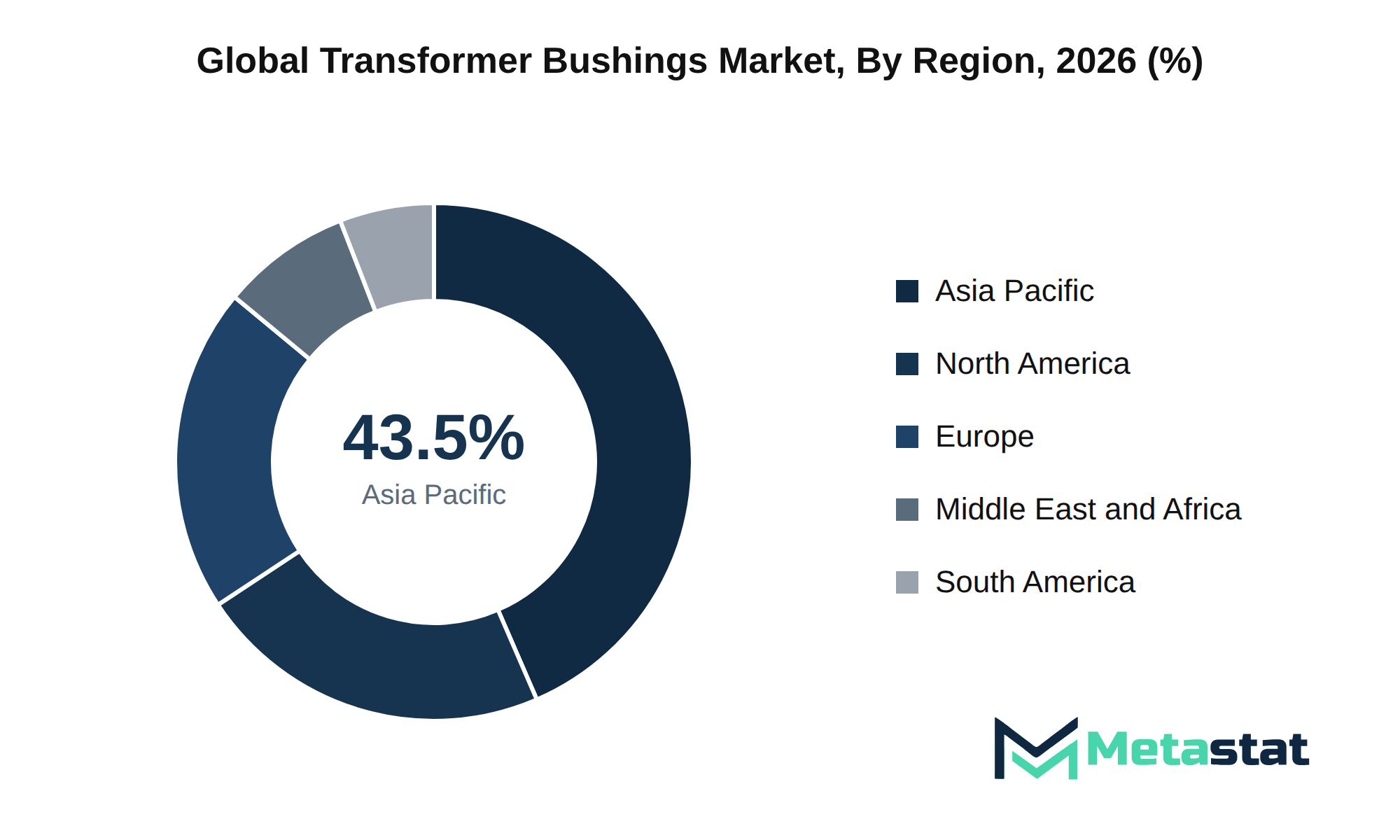
Geographic Lead: Asia Pacific holds the largest regional share at 43.5%, supported by rapid urbanization, industrialization, and sustained investment in transmission and distribution infrastructure, particularly in China and India.
Fastest-Growing Segment: Converter transformers are projected to register the highest CAGR of 8.7% by 2033 among transformer applications, while Resin-Impregnated Fiberglass (RIF/RIG) bushings lead insulation technologies with an 8.4% CAGR.
What's Inside: The report provides detailed segmentation by insulation technology, bushing construction, voltage class, and transformer application, with regional market analysis, competitive landscape, and forecasts from 2026 to 2033.
Choose Your License
Global Transformer Bushings Market
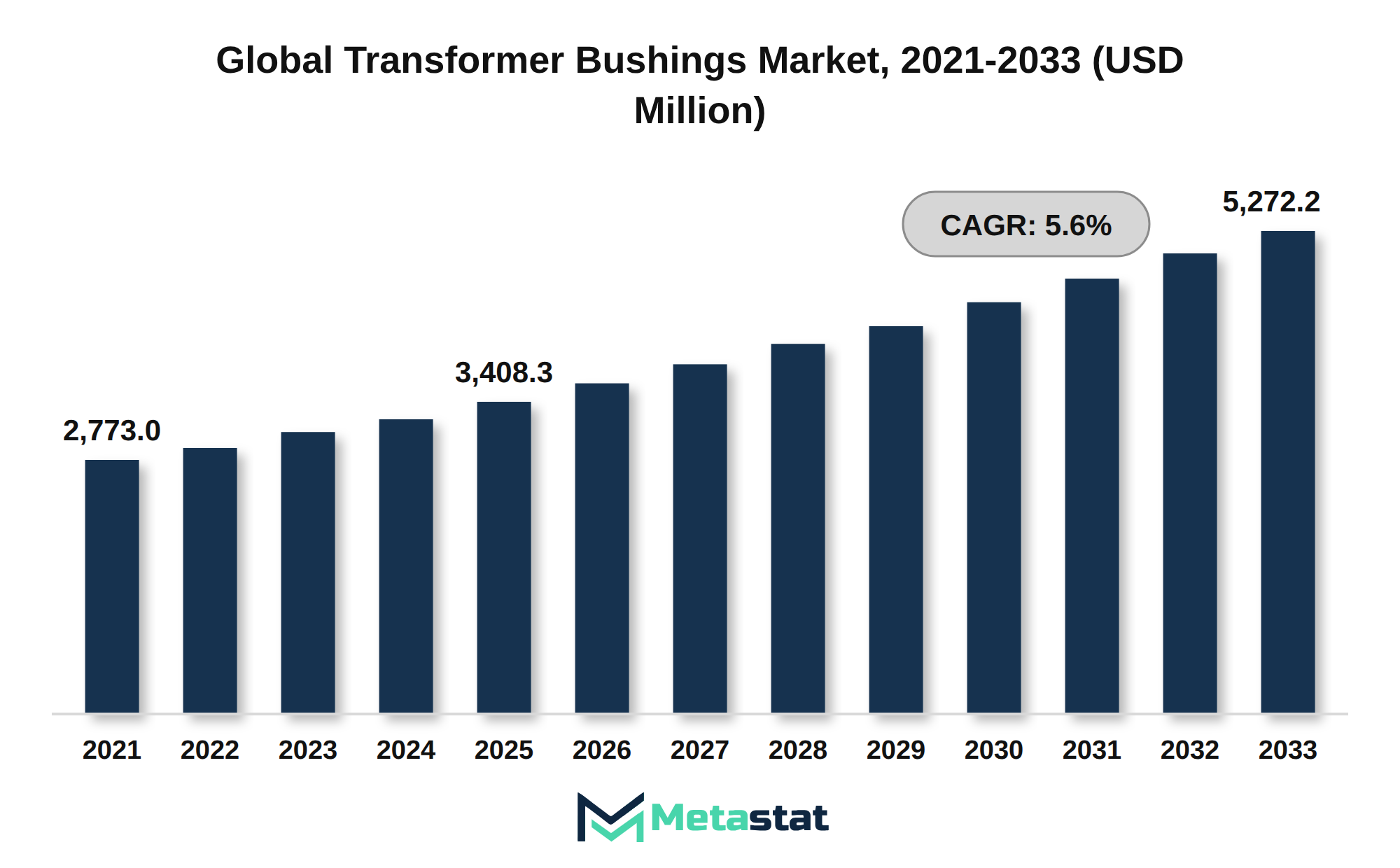
The global Transformer Bushings market was valued at USD 3,408.3 million in 2025 and is projected to reach USD 5,272.2 million by 2033, growing at a CAGR of 5.6% over the forecast period.
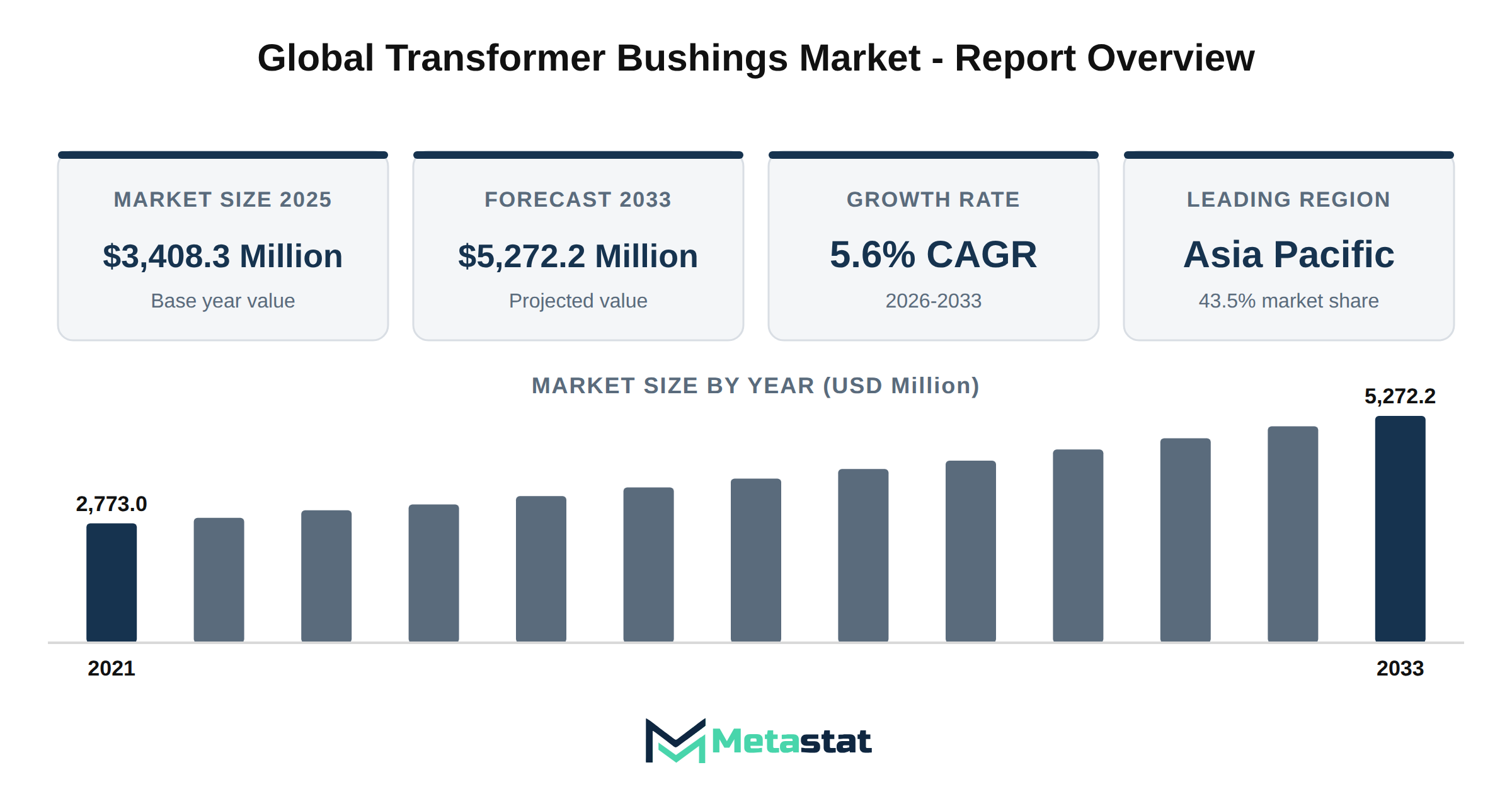
The Transformer Bushings market covers electrical components that insulate and support conductors passing through grounded transformer tanks, replacing older, less reliable insulating solutions. Utilities, industrial facilities, and renewable energy developers are the top buyer groups. Purchases are triggered by grid modernization, capacity upgrades, and the integration of new generation assets alongside utility-scale battery energy storage systems. Reliability and safety remain priorities, driving investments in advanced bushing designs that minimize maintenance and extend transformer lifespans.
Growth in the Transformer Bushings market is driven primarily by surging investment in power T&D equipment and broader electrical infrastructure, particularly in emerging economies. Asia Pacific holds the largest regional share at 43.5%. Rapid urbanization and industrialization in countries including China and India support this position. North America holds 22.2% of the market in 2025. The US leads the region in 2026. Adoption of higher voltage transformers and expansion of transmission networks further increase demand for advanced bushing technologies.
Within the market, condenser bushings comprise the segment with the most value, reflecting their extensive use in high-voltage and critical power applications. Utilities and independent power producers invest in these bushings to improve grid reliability and accommodate higher loads. Operators frequently pair these high-voltage transformer installations with substation capacitor banks to manage reactive power and stabilize network voltage levels. Improved performance and operational safety in power delivery continue to underpin market expansion.
Buyers in the Transformer Bushings market focus on products that deliver high reliability under demanding grid conditions and support expanding power infrastructure. Utilities, industrial facilities, and power generation firms account for the largest share of purchases. Their priorities include enhanced safety, system uptime, and long-term asset protection. The market covers a broad range of insulation technologies and construction types. Each is tailored for specific voltage classes and transformer applications. These buyers invest in advanced bushings to extend the service life of transformers and reduce maintenance frequency. This approach lowers operational costs and minimizes the risk of unplanned outages.
Condenser bushings represent the segment with the most value, reflecting their widespread adoption across medium and high voltage transformers. Their engineered dielectric properties enable efficient management of electrical stress, which is critical for large-scale transmission and industrial installations. Asia Pacific leads in regional share at 43.5%, reflecting sustained investment in transmission and distribution infrastructure, urbanization, and a high rate of industrialization. North America holds 22.2% of the market in 2025. The US leads in 2026.
The main growth driver for the Transformer Bushings market is the accelerating upgrade and replacement cycle of aging grid assets. Several countries are investing in grid modernization to improve reliability and integrate large-scale renewable energy generation into national power systems. This increases demand for advanced bushings with higher performance standards and longer service intervals. Product innovation in insulation materials and bushing design supports this transition by addressing stricter safety requirements and enhancing system resilience. In renewable-heavy portfolios, equipment condition data is increasingly integrated into renewable energy asset management software to coordinate substation inspection intervals and monitor health metrics across remote sites.
Adoption of dry-type transformer bushings based on Resin-Impregnated Paper (RIP), Resin-Impregnated Synthetic Nonwoven (RIS/RIN), and Resin-Impregnated Fiberglass (RIF/RIG) technologies is accelerating, with utilities and industrial operators seeking improved safety and reliability under demanding conditions. The market is shifting away from oil-impregnated insulating technologies, driven by operational requirements for fire resistance, minimal maintenance, and environmental safety. In this market, RIP bushings are projected to reach USD 2,100.4 million by 2033, reflecting robust demand among buyers aiming to reduce fluid leak risks and extend service intervals. RIS/RIN bushings, which enhance mechanical strength and moisture resistance, are expected to account for USD 915.3 million by 2033, attracted by users in industrial environments exposed to high humidity or chemical pollution. RIF/RIG bushings, recognized for their superior thermal stability and lightweight construction, support deployment in compact substation designs and mobile transformer units, where space and weight constraints are critical.
This transition is most pronounced in regions with strict fire protection requirements or where environmental regulations restrict oil-containing equipment. Manufacturers respond by expanding their dry-type product portfolios and investing in advanced impregnation technologies. For buyers, shifting to dry-type solutions reduces maintenance costs, improves operational safety, and aligns asset fleets with evolving compliance obligations. This sustained trend supports long-term growth in dry-type bushing adoption and intensifies competition among suppliers focused on innovation in insulation materials and process engineering.
Buyers in the Transformer Bushings market have shifted procurement practices for high-voltage applications, with HVDC converter projects driving demand for advanced bushing technologies and larger contract values. Utilities and grid infrastructure developers increasingly bundle large-scale orders for resin-impregnated fiberglass and resin-impregnated paper bushings to support extended HVDC converter station rollouts. This shift results from the rising adoption of converter transformers, which are projected to register the highest CAGR of 8.7% by 2033 among transformer applications. Multi-year framework contracts and volume-based pricing models are now favored by project developers seeking price stability and supply continuity for technically demanding projects. These agreements lock in favorable pricing for bulk purchases, reduce administrative bidding cycles, and enable suppliers to optimize production scheduling for high-specification bushings.
Pricing for high-voltage bushings in HVDC projects reflects the technical complexity and the customization required for each installation. Power transmission project owners select suppliers based on proven performance in delivering bushings rated above 145 kV, often awarding contracts through prequalification and negotiated tendering rather than spot purchases. For ultra-high-capacity power corridors and fault-current-limiting systems, these high-voltage links often interface with installations utilizing high-temperature superconducting tape to minimize electrical losses. In this market structure, suppliers that demonstrate capability in resin-impregnated synthetic nonwoven and fiberglass technologies are prioritized for large-scale HVDC converter deployments. Similar specialized converter and insulation topologies are also extending into regional distribution architectures through the deployment of MVDC grids. Higher average selling prices for suppliers active in the high-voltage segment result from technical differentiation and contractual reliability in HVDC converter projects.
Utilities and industrial operators prioritizing replacement transformer bushings face procurement cycles driven by system reliability requirements and asset aging. Retrofit compatibility remains a critical factor, particularly in large transformer fleets where older transformer designs differ in mounting standards, insulation technologies, and voltage classes. Operators with legacy systems frequently specify retrofit-compatible bushings to avoid costly transformer modifications and extended outages. In the Transformer Bushings market, distribution transformer operators are a distinct buyer group with recurring replacement needs. Segment data shows distribution transformer applications are projected to reach USD 1,222.1 million by 2033, reflecting the scale of ongoing replacement and retrofit activity within this group.
Compatibility concerns impact both technical and commercial procurement decisions. Buyers seek bushings that match legacy dimensions, insulation characteristics, and performance ratings, ensuring rapid installation and reducing downtime. Suppliers in the Transformer Bushings market differentiate by offering modular designs, flexible mounting kits, and tailored insulation technologies, including resin-impregnated paper or synthetic nonwoven variants. This focus streamlines procurement for distribution utilities and industrial sites operating diverse transformer fleets, supporting uninterrupted network operations. Lifecycle cost and network reliability now drive asset owners, increasing demand for suppliers able to verify retrofit compatibility through technical support and comprehensive documentation, strengthening long-term purchasing relationships and recurring revenue streams. This focus on extending fleet operational longevity aligns with broader utility reliance on industrial electronics repair and refurbishment services to maintain auxiliary monitoring, relay, and control assemblies.
Resin-Impregnated Paper (RIP) transformer bushings deliver a lower lifecycle cost than Oil-Impregnated Paper (OIP) bushings, driven by both extended service intervals and reduced maintenance requirements. RIP bushings, with their solid insulation and sealed construction, eliminate oil leakage risks and limit the frequency of inspections. This contrasts with OIP bushings, which often require regular oil level monitoring and periodic refurbishment to address aging and moisture ingress. In the Transformer Bushings market, RIP bushings are projected to reach USD 2,100.4 million in revenue by 2033, reflecting strong demand from operators looking to reduce total ownership costs.
For buyers in the Transformer Bushings market, the shift toward RIP technology offers financial and operational advantages over the bushing’s full lifespan. While OIP bushings have a longer track record and lower upfront costs, recurring expenses for oil management, insulation drying, and environmental risk mitigation add to the lifetime spend. RIP bushings support reliability strategies by lowering the risk of catastrophic failure, and their adoption reduces the indirect costs associated with transformer downtime. Utilities and industrial power users, especially those in regions with strict environmental standards or limited maintenance resources, increasingly specify RIP bushings to improve asset reliability and stabilize operational budgets.
Utilities and transmission operators are driving a broad replacement cycle driven by grid modernization efforts that accelerate investment in higher-efficiency, longer-life components. In the Transformer Bushings market, replacement demand is rising with networks transitioning from legacy bushings to advanced insulation technologies that better withstand higher voltages and increased thermal loads. This trend is especially prominent in regions working to upgrade substation infrastructure and deploy digital monitoring capabilities. The installed base of aging bushings creates a steady stream of retrofit projects, pushing volume growth in both medium- and high-voltage classes. Suppliers are seeing increased orders for Resin-Impregnated Paper (RIP) and Resin-Impregnated Synthetic Nonwoven (RIS/RIN) bushings, supporting the market’s forecasted expansion from USD 3,408.3 million in 2025 to USD 5,272.2 million by 2033. The shift to technology-driven replacements is expected to sustain higher average selling prices and promote long-term revenue visibility for manufacturers participating in the Transformer Bushings market.
Procurement of advanced bushing technologies faces price pressures that slow uptake among utility buyers and industrial operators with limited capital budgets. The cost premium attached to resin-impregnated and high-performance synthetic bushings discourages rapid replacement of legacy oil-impregnated designs, especially in regions where infrastructure investment remains constrained. For lower-voltage and distribution applications, cost sensitivity leads to prolonged equipment life cycles and delayed upgrades, which in turn reduces near-term order volumes for next-generation products. The effect is concentrated in markets outside Asia Pacific, where infrastructure spending is less aggressive and price competition is pronounced. Suppliers experience extended sales cycles and limited penetration for higher-margin product lines, softening growth potential in price-driven segments.
Volatile input costs, especially for key materials including specialty insulating papers, resins, and metals, increase pricing risk for suppliers in the Transformer Bushings market. Shifts in global commodity prices and supply disruptions drive unpredictable swings in procurement expenses, making it difficult for manufacturers to maintain stable margins. Suppliers aim to reduce exposure by diversifying sourcing strategies and negotiating longer-term contracts, but frequent price fluctuations still challenge profitability, particularly in competitive bidding scenarios for utility and industrial projects. The push for advanced bushing designs that use engineered materials for improved performance adds complexity to cost management, since these inputs often command premium pricing. In response, several manufacturers are investing in supply chain integration and process efficiencies to buffer against raw material volatility, yet sustained margin pressure remains a defining challenge for the Transformer Bushings market.
Converter transformers stand out for their rapid expansion potential, demonstrated by the 8.7% compound annual growth rate projected for this segment through 2033. Paired with this, Resin-Impregnated Fiberglass (RIF/RIG) bushings deliver the highest growth among insulation technologies, at 8.4% CAGR. Together, these segments support a structural shift in large-scale power transmission projects, where higher-voltage, more demanding operational environments require advanced bushing solutions. Suppliers that prioritize RIF/RIG technology and tailor offerings for converter transformer integration address an under-served need in projects involving HVDC and renewable energy integration. The market is expected to see new entrants and established players increase investment in these fast-rising segments, with the potential to capture outsized revenue growth when high-performance bushings become standard in critical grid expansion initiatives. Buyers in this category recognize the operational value of robust insulation and high thermal tolerance, reinforcing demand for these next-generation products in upcoming infrastructure deployments.
The Global Transformer Bushings market is segmented based on Insulation Technology, Bushing Construction, Voltage Class, and Transformer Application.
Oil-Impregnated Paper (OIP) segment is valued at USD 1,018.3 million in 2026 and is projected to reach USD 1,221.6 million by 2033, at a CAGR of 2.6% during the forecast period. OIP bushings serve in medium- and high-voltage transformers, favored by utilities and industrial operators seeking proven reliability for large installed bases and long-established grid assets. This segment's demand is primarily sustained by retrofit and replacement cycles rather than new installations, reflecting the ongoing use of legacy technology by cost-sensitive buyers with mature infrastructure. Compared with alternatives in the Insulation Technology segment, OIP posts a noticeably slower growth rate than Resin-Impregnated Paper (RIP), which achieves a 6.4% CAGR. Pricing for OIP bushings is generally lower, making them attractive for projects with strict budget constraints, yet the segment is experiencing gradual displacement by dry-type technologies where enhanced safety and reduced maintenance are prioritized. Buyers weigh the trade-off between established reliability and evolving regulatory pressures favoring modern insulation materials. Suppliers offering OIP products address buyers prioritizing cost and compatibility with existing equipment.
Estimated to reach USD 2,100.4 million by 2033 with a CAGR of 6.4%, Resin-Impregnated Paper (RIP) insulation technology is favored for installations requiring advanced safety and reduced fire risk. Utilities and industrial buyers select RIP bushings to comply with stricter environmental and operational standards, where the superior thermal stability and partial discharge resistance of RIP outperform traditional oil-impregnated options. This segment's growth outpaces Oil-Impregnated Paper (OIP) bushings, which post a 2.6% CAGR, indicating a marked shift in buyer preference toward dry-type solutions during power network modernization. Utilities and industrial buyers invest in RIP bushings to address increasing grid reliability expectations and regulatory requirements for non-flammable materials. Compared to RIS/RIN and RIF/RIG technologies, RIP bushings offer a balanced combination of price, performance, and established qualification with major utilities, supporting adoption in both new builds and retrofits. The rising adoption of RIP insulation reflects its role in enabling advanced transformer designs and strengthens the premium end of the market.
Resin-Impregnated Synthetic Nonwoven (RIS/RIN) segment is expected to reach USD 915.3 million by 2033. This technology is selected by utilities and industrial buyers that require enhanced moisture resistance and mechanical robustness in environments where service conditions challenge traditional insulation methods. Adoption is driven by projects demanding bushings that perform reliably in variable climates and installations with exposure to voltage surges, supporting grid reliability objectives. Compared to Oil-Impregnated Paper (OIP) and Resin-Impregnated Paper (RIP) technologies, RIS/RIN solutions differentiate themselves through improved operational stability and lower susceptibility to partial discharge under severe loading. RIS/RIN is a preferred option in new installations where advanced insulation properties reduce planned maintenance cycles and support regulatory compliance for safety-critical assets. Unlike segments with slower growth or those more sensitive to oil leaks, RIS/RIN appeals to operators seeking long-term performance with minimal interruption, particularly in regions where weather extremes and environmental regulation influence procurement decisions. While the segment expands, buyers weigh up-front cost against durability, reflecting a balance often sought in this segment.
Projected to grow at a CAGR of 8.4% during the forecast period, Resin-Impregnated Fiberglass (RIF/RIG) insulation technology stands out for its rapid momentum in the Transformer Bushings market. This segment is widely adopted in switchyards and substations requiring robust moisture resistance, mechanical strength, and extended service life. Utility operators and original equipment manufacturers select RIF/RIG bushings for demanding environments where frequent replacements disrupt operations or where high humidity shortens the lifespan of conventional insulation materials. Demand growth outpaces that of Oil-Impregnated Paper (OIP), which is projected at a 2.6% CAGR, and Resin-Impregnated Paper (RIP), set at 6.4%, reflecting a shift toward advanced material solutions. Market expansion for RIF/RIG is driven by the need for longer maintenance intervals and improved reliability, especially in fast-developing grid regions and renewable-heavy installations. Compared to other insulation technologies in the Transformer Bushings market, RIF/RIG solutions command a premium due to their performance characteristics, attracting buyers prioritizing lifetime value over initial capital expenditure.
Solid porcelain insulation is selected for transformer bushings in applications where mechanical durability and proven performance outweigh requirements for advanced dielectric strength or compact form factors. Industrial buyers and utilities with legacy fleets favor this segment in bulk transmission, distribution substations, and transformer installations where environmental stability and ease of inspection are valued. Within the market, solid porcelain options often carry lower upfront pricing than resin-impregnated alternatives, attracting operators with constrained capital budgets or replacement cycles focused on reliability over innovation. Adoption is limited by the comparatively heavier weight and bulk of solid porcelain bushings, which restricts their use in high-density installations and applications where space and handling constraints drive a preference for newer composite insulations. The market for solid porcelain bushings is influenced by the continued presence of installed legacy assets and a user base prioritizing proven, serviceable designs over the performance advantages offered by advanced insulation technologies. In this segment, a slower pace of technology change and a user profile oriented toward traditional operating models distinguish it from other insulation technologies.
Cast Epoxy Resin insulation technology is engineered to deliver high electrical strength and moisture resistance, making it a preferred solution in environments where contamination, humidity, or chemical exposure present significant operational risks. This segment is adopted by operators of distribution and medium-voltage power transformers in industrial facilities and urban substations requiring a compact, maintenance-friendly bushing design. Demand for Cast Epoxy Resin bushings rises where safety and fire performance take priority over the oil-filled alternatives. Compared to Oil-Impregnated Paper (OIP) and Resin-Impregnated Paper (RIP) segments, Cast Epoxy Resin products often attract buyers focused on simplified installation and lower risk of fluid leakage. Buyers select this technology for its cost advantages, durability, and environmental safety, particularly in geographies enforcing stricter containment or fire protection standards. Adoption tends to be strongest among sectors seeking to standardize on dry-type, non-flammable solutions, reinforcing the role of Cast Epoxy Resin in broadening the market’s appeal beyond traditional utility buyers. The segment’s suitability in retrofit applications and constrained installation footprints supports its expanding use across diverse settings.
Thermoplastic insulation technology is specified where end users prioritize lightweight construction, simplified installation, and strong resistance to surface contamination. This segment supports applications in compact transformers and environments where rapid deployment and reduced handling risk are valued, including in urban substations or constrained indoor installations. Utilities and OEMs with cost-sensitive or modular deployment plans often select thermoplastics to reduce maintenance and streamline logistics. Compared to segments including Oil-Impregnated Paper (OIP) or Resin-Impregnated Paper (RIP), thermoplastic insulation typically competes on its lower initial cost and flexibility in design, not on long-term dielectric or thermal performance. Buyers evaluating thermoplastic solutions frequently aim to offset higher lifecycle requirements by controlling upfront expenditure. Suppliers differentiate thermoplastic offerings through proprietary formulations and compatibility with emerging regulations on sustainable or recyclable materials, which influences both product selection and procurement cycles for infrastructure projects.
Hybrid insulation approaches, including resin-bonded paper, gas-insulated, and mixed-technology designs, serve projects with atypical or highly demanding installation requirements. Utility procurement teams and specialized transformer OEMs rely on these bushing types when operating conditions exceed standard performance specifications. Demand in this segment is influenced by applications requiring customized dielectric properties, installation flexibility, or non-traditional geometries that conventional oil-impregnated or resin-impregnated technologies do not address. Buyers pursuing grid modernization, urban substation upgrades, or compact infrastructure projects frequently specify these hybrid insulation solutions to address unique risk profiles or regulatory mandates. Compared with higher-volume insulation types, hybrid and gas-insulated bushings typically command a price premium and attract buyers focused on project-specific reliability. Adoption is shaped less by cost sensitivity and more by technical or compliance-driven selection criteria, setting this segment apart from the volume-driven behavior observed in the broader market.
Valued at USD 3,112.6 million in 2026 and projected to reach USD 4,672.7 million by 2033, condenser bushings segment is forecast to grow at a CAGR of 6%. These bushings operate in high-voltage applications spanning transmission networks and large substations, where utility operators and power producers require reliable insulation and controlled electric field distribution. The segment secures its position as the primary choice for medium- and high-voltage transformer installations, driven by increasing grid capacity additions and infrastructure upgrades across Asia Pacific, North America, and Europe. Condenser bushings support higher voltages and offer more advanced dielectric properties than non-condenser bushings, making them more attractive for buyers operating in environments with stringent reliability and performance requirements. With a 6% CAGR, this segment grows faster than non-condenser bushings, which are forecast at 2.7% through 2033. Technology changes in insulation materials and a focus on reduced partial discharge risk continue to influence supplier differentiation and pricing in this segment.
Non-Condenser Bushings segment is estimated to reach USD 599.4 million by 2033, at a CAGR of 2.7% during the forecast period. These bushings are specified primarily for cost-sensitive or legacy installations, where grid operators and certain industrial users prioritize basic insulation performance or seek direct replacements for older transformer assets. In contrast to condenser bushings, which are projected to grow at a CAGR of 6%, the non-condenser bushings segment trails in both growth rate and scale. Slower adoption results from limited advancements in insulation technology and a focus on short-term capital expenditure rather than lifecycle optimization. Demand in this segment is influenced by buyers who balance upfront equipment costs with established maintenance routines, often in regions or facilities where advanced grid reliability requirements are less pronounced. Price competition remains a distinguishing factor, with non-condenser bushings often selected where budget constraints outweigh the benefits of higher-performing alternatives.
Valued at USD 580.2 million in 2026 and projected to reach USD 786.6 million by 2033, this segment addresses transformer applications rated up to 36 kV. Utilities, distribution network operators, and industrial facilities prioritize these bushings for medium-voltage installations supporting commercial campuses, urban grids, and light manufacturing. Urbanization and electrification drive grid expansion in densely populated and emerging regions, increasing demand in the Up to 36 kV segment. Compared to higher voltage classes, this segment delivers a moderate growth trajectory with a CAGR of 4.4%, reflecting stable infrastructure investments and established replacement cycles. Buyers in this segment often focus on reliability and cost-efficiency, distinguishing it from segments above 36 kV that target higher-performance requirements and faster growth rates. With widespread grid modernization, the Up to 36 kV segment remains attractive to suppliers that deliver durable, serviceable products at scale. Regulatory pressures for safer, more sustainable electrical components reinforce adoption and support sustained order volumes for the segment.
Estimated to reach USD 534.1 million by 2033, this voltage class segment addresses the requirements of medium-voltage networks operating above 36 kV up to 72.5 kV. Utilities and industrial facility operators specify bushings in this range to support substation upgrades, regional grid enhancements, and industrial plant expansions that demand reliable insulation at moderate voltage levels. Growth in this segment is set at a 4.8% CAGR, reflecting steady infrastructure investments from electric utilities and process industries. Compared to the "Up to 36 kV" segment, which has a CAGR of 4.4%, the "Above 36 kV to 72.5 kV" class is expanding at a faster pace, highlighting a shift in demand toward higher voltage resilience and equipment longevity. Rising grid reliability standards and the modernization of legacy assets are driving demand in this segment. Equipment buyers in this segment focus on balancing capital expenditure with operational efficiency, supporting manufacturers that offer both technical reliability and lifecycle value.
Above 72.5 kV to 145 kV segment is expected to reach USD 1,014.4 million by 2033. This voltage class is integral for high-voltage transmission infrastructure, with utility-scale transmission operators and large industrial facilities identified to be its primary buyers. Demand intensifies where grid expansion projects focus on interconnecting substations, integrating renewable energy, or upgrading aging infrastructure to handle larger capacity. Distinct from the Up to 36 kV and Above 36 kV to 72.5 kV segments, this class addresses installations with significantly higher performance, safety, and reliability requirements, resulting in more stringent product specifications and higher unit costs. Regulatory requirements for insulation coordination and grid safety further influence adoption patterns. While this segment does not display the fastest growth rate, it occupies a critical position based on installed value due to large-scale deployments in national power grids and heavy industry. Project planners often select this class when prioritizing operational security and long-term asset life.
Above 145 kV to 245 kV segment is projected to grow at a CAGR of 5.3% during the forecast period. This range is specified for high-voltage transmission and substation infrastructure, where reliability and insulation performance are prioritized. Utilities and grid operators select bushings in this class for step-up transformers, bulk power transmission assets, and critical substations interfacing with regional or interregional grids. In the market, this segment stands out for addressing the technical and regulatory demands of expanding high-voltage grids, especially in regions investing in grid modernization and interconnection. Compared to sub-segments including Up to 36 kV (4.4% CAGR) or Above 36 kV to 72.5 kV (4.8% CAGR), demand for Above 145 kV to 245 kV bushings grows at a faster rate, reflecting rising transmission capacities and grid reinforcement projects. Buyers face higher pricing and qualification requirements due to the stringent operational, safety, and performance standards applied to equipment in this voltage class, setting it apart from lower-voltage categories in the market.
Large-scale utility and transmission projects specify the Above 245 kV to 550 kV segment for application in high-capacity substations and interregional grid connections. Utilities and infrastructure developers adopt these bushings to manage the increased electrical and mechanical stresses encountered at these voltage levels, commonly in extra-high voltage (EHV) and ultra-high voltage (UHV) installations. Demand arises from organizations involved in bulk power transfer, cross-country interconnections, and grid reinforcement programs where reliability and extended service life are critical investment criteria. Across the Voltage Class segmentation, this segment typically commands a higher price point than lower voltage categories due to its technical complexity and stringent performance requirements. Adoption is influenced by the expansion of long-distance transmission corridors and integration of renewable power sources into national grids, reinforcing the importance of durability and safety certifications. These specifications distinguish the segment from medium- and high-voltage alternatives, where buyer priorities focus more on cost and footprint than on EHV resilience.
Ultra-high voltage ratings above 550 kV are specified for transformer bushings in cross-border transmission corridors and bulk interconnection points linking national or regional grids. Engineering firms, grid operators, and utilities select this voltage class for new projects involving ultra-high voltage alternating current (UHVAC) or direct current (UHVDC) lines, particularly in countries investing in large-scale renewable generation and long-distance power transfer. The technical and regulatory requirements at this level drive adoption of bushings with enhanced dielectric strength, advanced insulation systems, and robust monitoring features, differentiating them from segments including Above 245 kV to 550 kV, which serve conventional high-voltage substations. Product qualification cycles are longer and upfront costs are higher, reflecting the criticality and complexity of the assets. In this segment, demand is influenced by public investment in grid modernization and transnational energy exchange projects, while buyer concentration remains high among transmission system operators and engineering-procurement-construction contractors. Innovation in this segment focuses on reliability and reduced maintenance intervals to support grid stability.
Distribution Transformers segment is valued at USD 872.7 million in 2026 and is projected to reach USD 1,222.1 million by 2033, at a CAGR of 4.9% during the forecast period. Utilities and municipal grid operators drive demand in this segment, specifying transformer bushings for medium- and low-voltage distribution infrastructure in urban, suburban, and rural networks. Rising investments in grid modernization and electrification, particularly in emerging economies, have supported steady replacement cycles and upgrades to existing transformer fleets. This segment differs from Power Transformers, which target higher capacity and transmission-scale installations and hold a higher forecast value of USD 2,191.7 million by 2033. Distribution transformer applications typically require bushings that balance cost and robust operational reliability, reflecting budget constraints of public utilities and distributed energy projects. In this segment, Distribution Transformers serve a wide base of end users, supporting volume growth while average unit prices remain below those of transmission or generator step-up applications. Expansion of decentralized renewable energy and rural electrification programs sustains demand in both developed and developing regions, reinforcing the long-term outlook for this segment.
Power Transformers segment is estimated to reach USD 2,191.7 million by 2033, at a CAGR of 4.9% during the forecast period. These high-capacity units are critical in transmission substations and industrial grids, with buyers concentrated among utilities, heavy industry, and large infrastructure projects. Growth in this segment is influenced by grid expansion and increasing demand for reliable long-distance power transfer, particularly in regions upgrading networks for renewable and distributed generation integration. Power transformers require bushings rated for higher voltages and currents, setting this segment apart from distribution transformers, which serve lower capacity and localized networks. Compared to generator step-up transformers, which fulfill specialized generation-side functions, power transformers are specified for broader system interconnections and load management. The CAGR for power transformers matches that of distribution transformers, reflecting stable investment in grid reinforcement and modernization. Demand in this segment is more sensitive to regulatory standards and tender-driven procurement cycles, which shape supplier competition and product specification.
Generator Step-Up Transformers segment is expected to reach USD 815.1 million by 2033. These transformers are deployed at power generation sites to raise generator output voltage for grid transmission, primarily serving utilities and large-scale independent power producers. Upgrades and new installations in renewable and conventional power plants drive demand, with grid operators prioritizing generator step-up equipment for higher capacity and reliability. In the Transformer Bushings market, this segment is distinct from Distribution Transformers and Power Transformers. Generator step-up applications require bushings engineered for high mechanical and electrical stresses present during generator start-up and grid synchronization. Product selection differs significantly, with generator step-up bushings specified for robust dielectric performance and thermal endurance. Demand in this segment rises with investments targeting power generation expansion, particularly in regions with aging plant infrastructure or grid modernization programs. The Transformer Bushings market sees project-driven procurement cycles for these applications, contributing to stable but project-dependent revenue patterns for suppliers.
Converter transformers segment is projected to grow at a CAGR of 8.7% during the forecast period, the fastest rate among transformer application categories in the Transformer Bushings market. These units serve high-voltage direct current (HVDC) transmission schemes, enabling long-distance power transfer between asynchronous grids or across geographies with weak interconnection. Utilities and grid operators drive most of the demand, prioritizing reliability and advanced performance to support large-scale renewable integration. The rapid buildout of HVDC corridors, particularly in Asia Pacific and Europe, accelerates investment in this segment. Growth outpaces both power transformers and distribution transformers, each with a CAGR of 4.9%, reflecting the distinctive infrastructure priorities and technology sophistication required in HVDC environments. Adoption faces higher barriers related to complex engineering, stricter standards, and specialized procurement cycles, giving the segment higher average value per unit in the Transformer Bushings market and a more concentrated buyer profile than conventional AC transformer applications.
Traction transformers serve rolling stock and railway infrastructure, providing voltage conversion and insulation for electric locomotives and trainsets operating on mainline and urban transit networks. Rail operators, infrastructure builders, and rolling stock manufacturers are the primary buyers, selecting transformer bushings engineered for vibration resistance and compact integration within stringent rail vehicle designs. In the Transformer Bushings market, traction transformer applications are influenced by electrification drives in passenger and freight corridors, particularly in Asia Pacific and Europe, where network expansion and modernization projects are prioritized. This segment faces different adoption dynamics than power or distribution transformers, with procurement tied closely to rail project cycles and fleet renewal rather than routine utility demand. The need for high mechanical robustness and lower installed footprint distinguishes traction transformer bushings from those specified for stationary or high-capacity substation environments. Shorter replacement intervals and more variable operating conditions further differentiate procurement approaches within this buyer group in the Transformer Bushings market.
Special-purpose transformers deliver tailored solutions for niche industrial operations, research facilities, and custom infrastructure where standard transformer types do not align with technical or operational requirements. Buyers include process industries, scientific laboratories, and specialized utilities that demand unique voltage ratings, insulation schemes, or compact footprints to serve highly specific applications. In the Transformer Bushings market, growth in this segment is driven by the rise in bespoke engineering projects and the expansion of advanced manufacturing sectors adopting equipment with non-standard electrical configurations. Unlike distribution or power transformers, purchases in the special-purpose category are project-driven and infrequent, with buyers placing a premium on custom performance rather than unit price or volume. This leads to higher per-unit costs and longer procurement cycles, distinguishing the segment from faster-moving, high-volume applications. For suppliers in the Transformer Bushings market, success in this segment requires technical agility and the ability to collaborate closely with end users during design and commissioning stages.
Based on geography, the Global Transformer Bushings market is divided into North America, Europe, Asia-Pacific, South America, Middle East, and Africa.
Utilities and industrial operators in North America are increasing investments in transformer bushing upgrades to strengthen grid reliability and support renewable energy integration. Regulatory pressure on grid resilience and the ongoing replacement cycle for aging infrastructure continue to influence purchase decisions, especially in the United States and Canada. The region’s advanced transmission network and focus on modernization drive consistent demand for higher-specification bushings. North America is projected to reach USD 1,114 million by 2033. Buyers in the region favor solutions that offer extended service life and enhanced resistance to environmental stresses common in both urban and remote installations. The market benefits from proactive grid hardening initiatives and a prioritization of operational reliability in an environment facing increasingly complex electrical loads.
Utilities and grid operators in Europe drive demand through sustained investment in network modernization and reliability upgrades, reflecting the region’s focus on renewable integration and decarbonization targets. Germany, France, and the UK have accelerated replacement cycles for aging transformer fleets, prompting higher procurement of advanced insulation technologies and bushings with improved performance characteristics. European buyers emphasize compliance with evolving technical standards and prioritize products that address safety and efficiency requirements across complex power grids. The region’s adoption of smart grid initiatives increases the demand for bushings compatible with digital monitoring systems, supporting predictive maintenance strategies and reduced downtime. Industrial manufacturing, urban infrastructure, and renewables expansion collectively shape purchasing patterns, making demand in Europe especially responsive to technology upgrades and regulatory compliance pressures.
Utility investments across China, India, and Southeast Asia drive regional demand, supported by large-scale power grid modernization and electrification initiatives. Asia-Pacific holds a 43.5% share of the global Transformer Bushings market in 2025, reflecting fast-growing transmission and distribution infrastructure and a high rate of new transformer installations. Industrial and commercial users in China and India account for a significant portion of specification activity, particularly in urban expansion zones and manufacturing hubs. Growth in renewable energy deployment and grid integration projects pushes requirements for advanced bushing technologies, supporting a steady shift from legacy oil-impregnated designs to resin-based insulation. Increased procurement from state utilities and private infrastructure developers strengthens vendor pipelines and accelerates technology adoption cycles, reinforcing the region’s leadership position.
Brazil and Argentina anchor demand in South America, reflecting utility-led investment in grid expansion to reach underserved metropolitan and rural regions. The market in this region responds to rising electricity consumption and the modernisation of generation assets. In Brazil, state-driven electrification programs and upgrades to existing transmission infrastructure have led utilities to specify advanced bushing technologies, particularly in new hydropower and renewables integration projects. Argentina’s grid renewal initiatives focus on improving transmission efficiency and reliability, driving adoption of bushings engineered for higher performance and extended service life. Utility investment and grid modernization in both countries sustain demand from original equipment manufacturers and aftermarket service providers. In Rest of South America, power sector investments support incremental volume growth, yet budget constraints often direct buyers to proven, robust bushing designs. Regional supply chains and local assembly contribute to a competitive cost structure, shaping both specification practices and supplier selection within the Transformer Bushings market.
Saudi Arabia and UAE are experiencing accelerated growth in the Transformer Bushings market, driven by investments in large-scale power generation and transmission projects. Grid expansion in both Gulf states focuses on integrating new gas-fired and renewable power sources, which increases demand for high-voltage bushings. South Africa’s utilities invest in grid stability and substation upgrades to address aging infrastructure, while regional buyers emphasize reliability and long operational lifespans under harsh climatic conditions. Middle East and Africa’s share of global demand reflects the influence of government-backed electrification and urbanization programs. Suppliers serving these countries respond by offering solutions tailored for high ambient temperatures and dust-prone environments, supporting ongoing infrastructure renewal and capacity expansion initiatives.
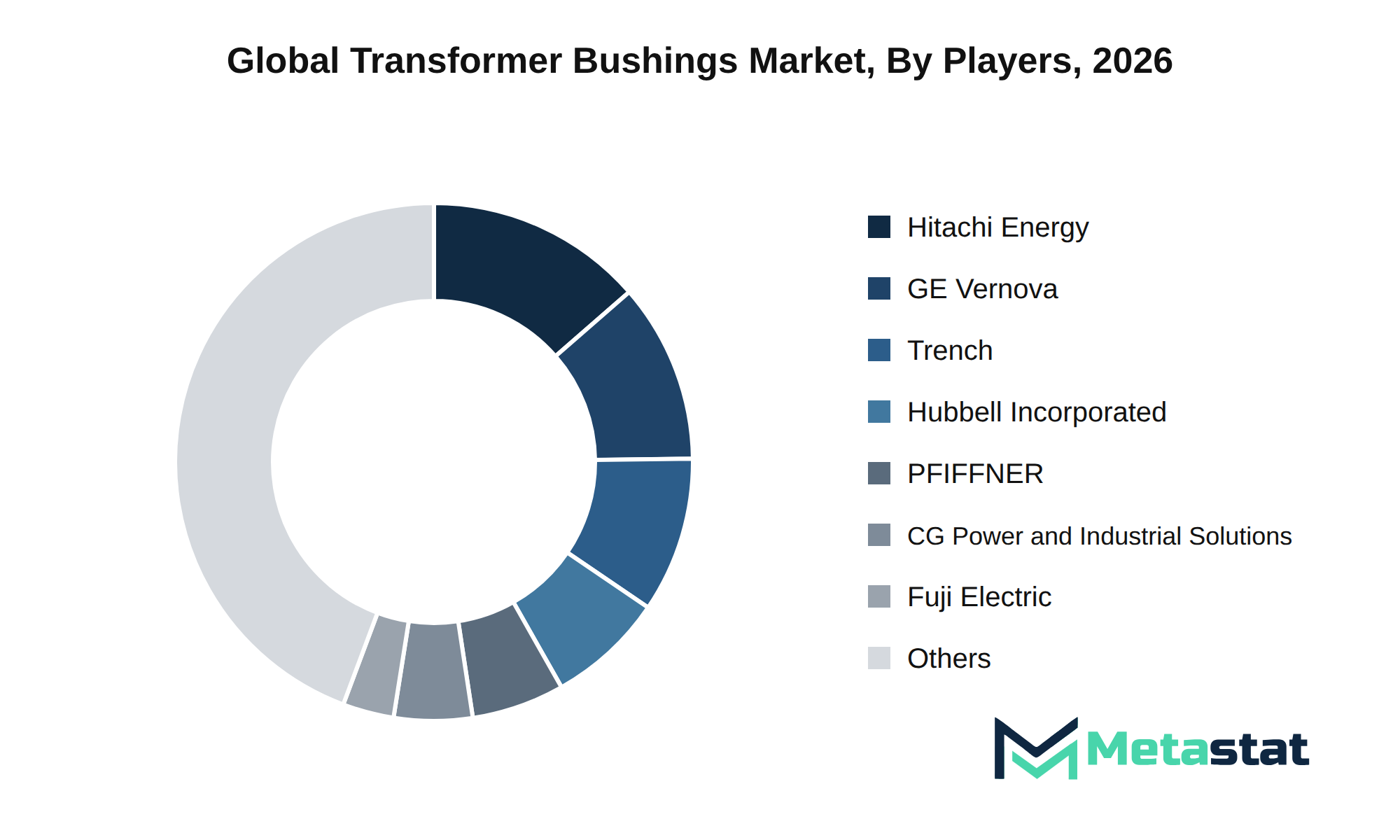
The Transformer Bushings market features a diverse supplier field, with companies offering a wide portfolio of insulation technologies and bushing constructions to address varied voltage classes and transformer applications. Buyers prioritize reliability, voltage performance, compatibility with specific transformer designs, and cost efficiency when selecting products. Certification standards and the ability to customize bushing specifications for demanding grid or industrial applications influence purchasing decisions. Suppliers differentiate through technology integration, breadth of segment coverage, and responsiveness to end-user requirements.
Several companies in the Transformer Bushings market focus on expanding their insulation technology portfolios to address shifting demand toward resin-impregnated designs. Hitachi Energy Ltd. emphasizes comprehensive offerings across both condenser and non-condenser bushings, while GE Vernova Inc. strengthens its presence by supporting multiple voltage classes and transformer types. CG Power and Industrial Solutions Limited targets growth in high-efficiency bushings for power transformers, responding to rising grid infrastructure investments. Maschinenfabrik Reinhausen GmbH and Trench Group enhance their portfolios to address evolving technical standards and performance needs in advanced industrial and utility networks. This competitive dynamic drives continuous innovation and operational improvements among suppliers, supporting both established and emerging application segments.
Realizing this growth depends on continued investment in power infrastructure, especially in Asia Pacific, which is projected to account for 43.5% of global value. Government-led grid modernization in China and India, along with the expansion of renewable energy projects, drives procurement of power and distribution transformers equipped with advanced bushings. A shift toward Resin-Impregnated Paper (RIP) insulation technology, with a 6.4% CAGR through 2033, reflects end users prioritizing safety, reliability, and reduced maintenance, especially for urban and utility-scale installations. Meanwhile, the largest revenue gains are projected in condenser bushing construction, which is expected to reach USD 4,672.7 million by 2033, driven by demand for high-voltage applications and improved dielectric performance.
The central risk to this outlook is volatility in raw material prices, particularly for advanced resins and specialty metals, which could narrow supplier margins and delay project timelines. Supply disruptions would affect regions that depend on imported components, especially Europe and parts of South America, slowing replacement cycles and capital investment in transmission networks.
By Insulation Technology: Oil-Impregnated Paper (OIP), Resin-Impregnated Paper (RIP), Resin-Impregnated Synthetic Nonwoven (RIS/RIN), Resin-Impregnated Fiberglass (RIF/RIG), Solid Porcelain, Cast Epoxy Resin, Thermoplastic, Others (Resin-Bonded Paper, Gas-Insulated, Hybrid Insulation)
By Bushing Construction: Condenser Bushings, Non-Condenser Bushings
By Transformer Application: Distribution Transformers, Power Transformers, Generator Step-Up Transformers, Converter Transformers, Traction Transformers, Special-Purpose Transformers
The report strategically identifies and profiles the key market players and analyses their core competencies in each sub-segment of the Transformer Bushings market.
|
Report Attributes |
Details |
|
Study Period |
2021-2033 |
|
Base Year |
2025 |
|
Estimated Year |
2026 |
|
Forecast Period |
2026-2033 |
|
Historical Period |
2021-2025 |
|
Growth Rate |
CAGR 5.6% from 2026 to 2033 |
|
Revenue Unit |
USD million |
|
Segmentation |
|
|
By Region |
North America (By Insulation Technology, Bushing Construction, Voltage Class, Transformer Application, and Country)
|
|
|
|
Asia Pacific (By Insulation Technology, Bushing Construction, Voltage Class, Transformer Application, and Country)
|
|
|
|
|
Middle East and Africa (By Insulation Technology, Bushing Construction, Voltage Class, Transformer Application, and Country)
|
Find answers to common questions about this report
The Transformer Bushings market size was valued at USD 3,408.3 million in 2025.
The projected CAGR is 5.6% for the forecast period from 2026 to 2033.
The North America Transformer Bushings market size is estimated to reach USD 1,114 million by 2033.
Condenser Bushings lead by construction type, reaching USD 4,672.7 million in 2033, the highest among all type segments.
Utilities and transmission operators are accelerating replacement cycles as grid modernization and higher-efficiency requirements drive demand for advanced insulation technologies. Rapid expansion of converter transformers and the adoption of high-performance bushings for HVDC and renewable integration projects further support growth.
Asia Pacific holds the dominant share with 43.5 percent of the total, the highest among all regions. North America follows with 22.2 percent.
Procurement of advanced bushing technologies faces price pressures that slow uptake among utility buyers and industrial operators with limited capital budgets. Volatile input costs for specialty insulating materials and metals increase pricing risk for suppliers, challenging profitability and creating uncertainty in competitive bidding.
Converter transformers and Resin-Impregnated Fiberglass (RIF/RIG) bushings are supporting adoption through their rapid growth in large-scale power transmission projects and HVDC integration. Suppliers focusing on these advanced technologies address an under-served need for robust insulation and high thermal tolerance in demanding grid expansion initiatives.
The Transformer Bushings market is estimated to reach a valuation of USD 5,272.2 million by 2033.
Companies active in this sector include Hitachi Energy Ltd., Trench Group, GE Vernova Inc., Hubbell Incorporated, PFIFFNER Group, CG Power and Industrial Solutions Limited, and Fuji Electric.
The analysts below cover Energy and Power research at Metastat Insights.
LEAD ANALYST
Utkarsh Khirodkar is a Lead Market Research Analyst at MetaStat Insight, specializing in market intelligence, technology sector assessments, and competitive strategy.

PRINCIPAL CONSULTANT - ENTERPRISE AI & EMERGING TECHNOLOGIES
Banking & Finance · Electronics and Semiconductor · Energy and Power · Healthcare IT · Information & Technology · Professional Services
Vijay Gunti is a Principal Consultant at MetaStat Insight, bringing over two decades of experience across enterprise digital transformation, technology strategy, and intelligent systems.

ENERGY & INFRASTRUCTURE INDUSTRY CONSULTANT
Automotive and Transportation · Electronics and Semiconductor · Energy and Power · Machinery & Equipment
Saurabh Vasant Ganvir consults for Energy & Infrastructure Industry at MetaStat Insight, specializing in renewable energy, solar EPC, and electric vehicle (EV) infrastructure markets.
Most industry reports on warehouse automation bundle autonomous mobile robots and fixed conveyor installations into the same top-level numbers, which complicates advisory work. This study split the market cleanly by payload tiers, navigation technology, and fleet management software layers. The regional forecast for Western Europe gave our team defensible adoption benchmarks when evaluating capital allocation for logistics clients, saving us days of secondary data scrubbing.
Standard industry briefs frequently blur the operational distinctions between isobaric pressure exchangers and centrifugal turbines. In this study, MetaStat Insight categorized mega-scale desalination tenders across the GCC and Mediterranean basins by membrane replacement frequencies and salinity tolerances. Their primary research helped us evaluate local content requirements in Saudi Arabia and the UAE without relying on marketing literature. We found the segment-level equipment replacement estimates grounded and well-reasoned throughout.
The technical breakdown of ISO 20022 migration readiness across correspondent banking corridors was remarkably thorough. Rather than treating cross-border corporate payments as a single block, the report drew a useful distinction between multilateral netting platforms and domestic instant payment rails across ASEAN economies. MetaStat Insight highlighted regulatory constraints on foreign exchange liquidity management that many publications gloss over. The research material offered practical clarity for our platform development roadmap.
Explore related market intelligence reports worth reading alongside this one.
Starting from
$2950