
LEAD ANALYST
Utkarsh Khirodkar is a Lead Market Research Analyst at MetaStat Insight, specializing in market intelligence, technology sector assessments, and competitive strategy.

Global E-Banking Market Size, Share, By Banking Channel (Internet Banking, Mobile Banking Applications, Mobile Web Banking, Telephone and Interactive Voice Response (IVR) Banking and Others (Email Banking, Social Media-Based Banking)), By Banking Service (Account Management and Information Services, Electronic Fund Transfers and Remittances, Online Bill Payments, Digital Deposits and Account Opening, Online Lending and Credit Services, Digital Investment and Wealth Management, Card Management and Digital Wallet Services, Trade Finance and Cash Management and Others (Cheque Services, Digital Foreign Exchange Services)), By Customer Type (Individual Customers, Micro, Small, and Medium Enterprises, Large Enterprises, Financial Institutions, Government and Public-Sector Organizations and Others (Nonprofit Organizations, Trusts)), Industry Analysis, Growth, Trends, and Forecast, 2026-2033
Report ID
MSI-5506
Published
October, 2026
Pages
269 Pages
Format
Historical
Base year
Forecast
Forecast period
Report Details
Market Valuation: Valued at $17.3 Billion in 2025, projected to reach $48.5 Billion by 2033 at a 13.8% CAGR.
Dominant Segment: Mobile Banking Applications lead the E-Banking market, driven by changing consumer preferences for mobile-first solutions and projected to reach USD 28.3 billion by 2033.
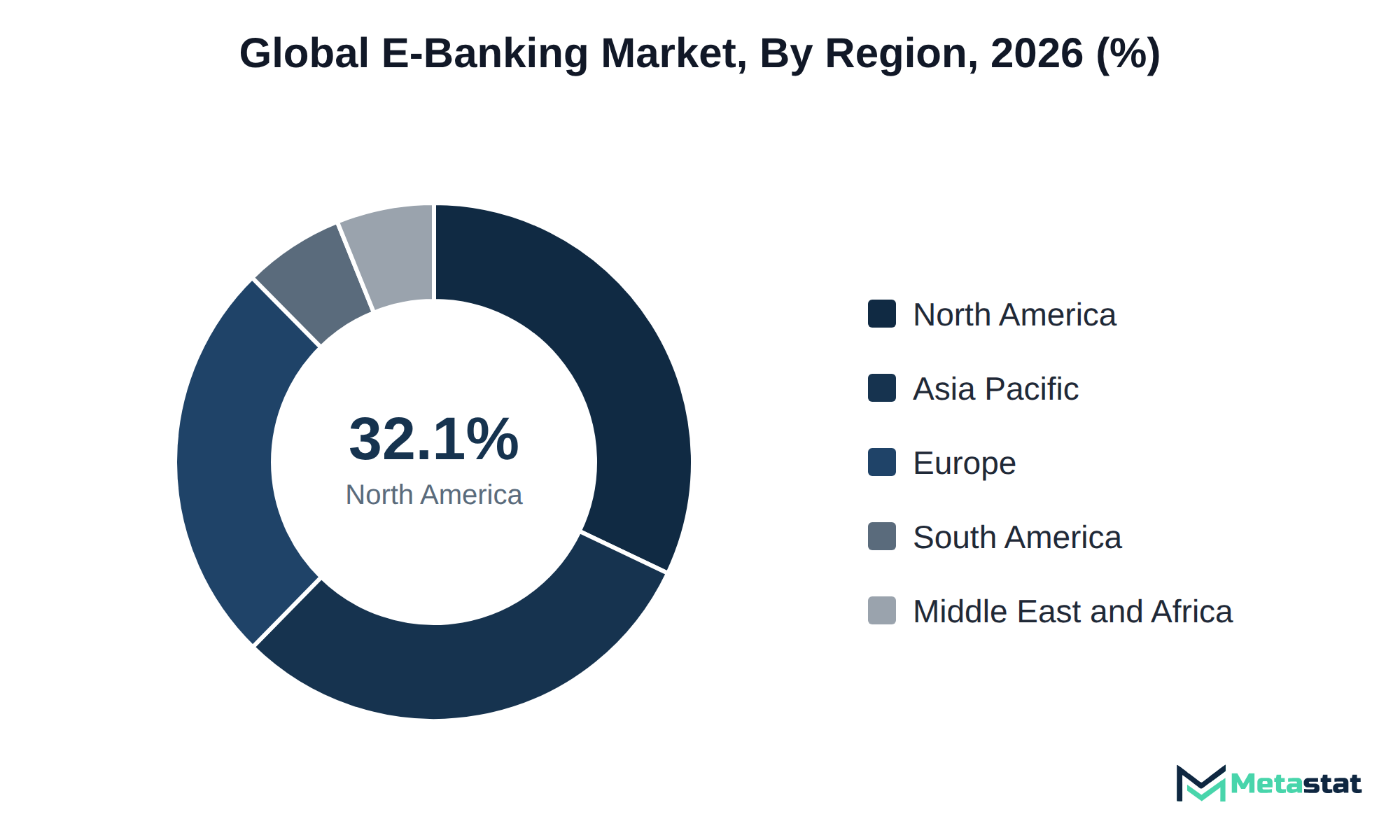
Geographic Lead: North America is the leading region in the E-Banking market, capturing 32.1% of the market in 2025, with the US expected to continue its dominance into 2026.
What's Inside: This report provides a comprehensive analysis of the E-Banking market, including competitive coverage, detailed segment breakdowns, and forecasts from 2026 to 2033.
Market Growth Drivers: The market is fueled by increasing smartphone penetration and the rising demand for secure online transactions, prompting financial institutions to enhance their digital offerings.
Customer Type Trends: Individual customers are a key growth driver, with their adoption of mobile banking solutions expected to significantly increase, reflecting a broader shift towards digital financial management.
Choose Your License
Global E-Banking Market
The global E-Banking market was valued at USD 17.3 billion in 2025 and is projected to reach USD 48.5 billion by 2033, growing at a CAGR of 13.8% over the forecast period.
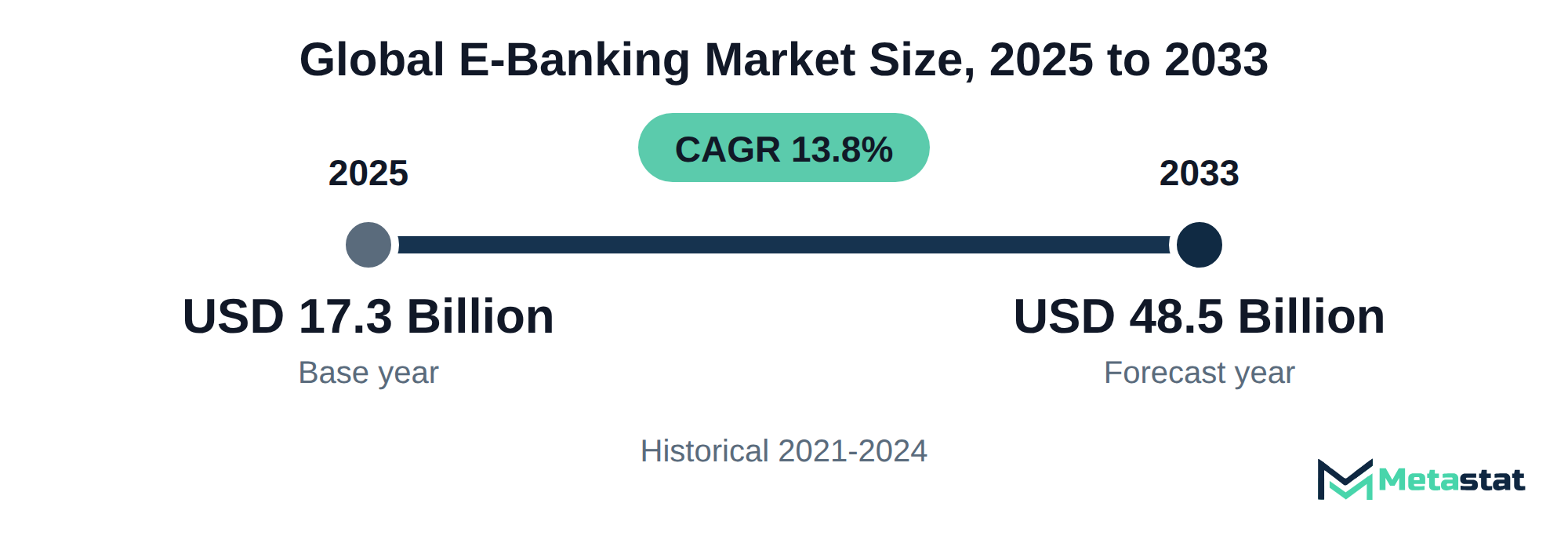
The E-Banking market encompasses a range of financial services provided through digital platforms, enabling users to conduct banking activities online. These services include account management, fund transfers, and bill payments. Buyers invest in these solutions to enhance convenience, improve operational efficiency, and reduce costs associated with traditional banking methods.
Growth in the market is driven by increasing smartphone penetration and the rising adoption of digital banking services. Among the various segments, Mobile Banking Applications hold the most significant value, reflecting changing consumer preferences toward mobile-first solutions. North America holds 32.1% of the market in 2025, with the US leading in 2026. The Asia Pacific region closely follows, capturing 30.3% of the overall market share.
A primary growth driver stems from the rising demand for secure and efficient online transactions, prompting financial institutions to enhance their digital offerings. This shift toward digital banking accommodates consumer preferences and aligns with ongoing advancements in technology and infrastructure, positioning the market for expansion.
The E-Banking market covers various services that allow individuals and businesses to manage their financial transactions online. Buyers invest in these services due to the convenience and efficiency they provide, enabling quick access to account management, fund transfers, and payment processing. The increasing digitization of financial services drives the demand, with customers seeking effective experiences and enhanced security features in their banking activities.
Growth in the market is fueled by the rapid adoption of mobile banking applications, which have gained significant traction among users. Mobile banking applications are projected to reach a value of USD 28.3 billion by the end of the forecast period. This region benefits from higher internet penetration and a strong emphasis on technological innovation within the banking sector.
The surge in individual customers adopting these digital banking solutions highlights a broader shift towards online financial management. The E-Banking market reflects a growing preference for digital interactions, driven by the need for speed and efficiency in financial transactions. Financial institutions continuously enhance their offerings to meet customer expectations, further strengthening their positions in this evolving environment.
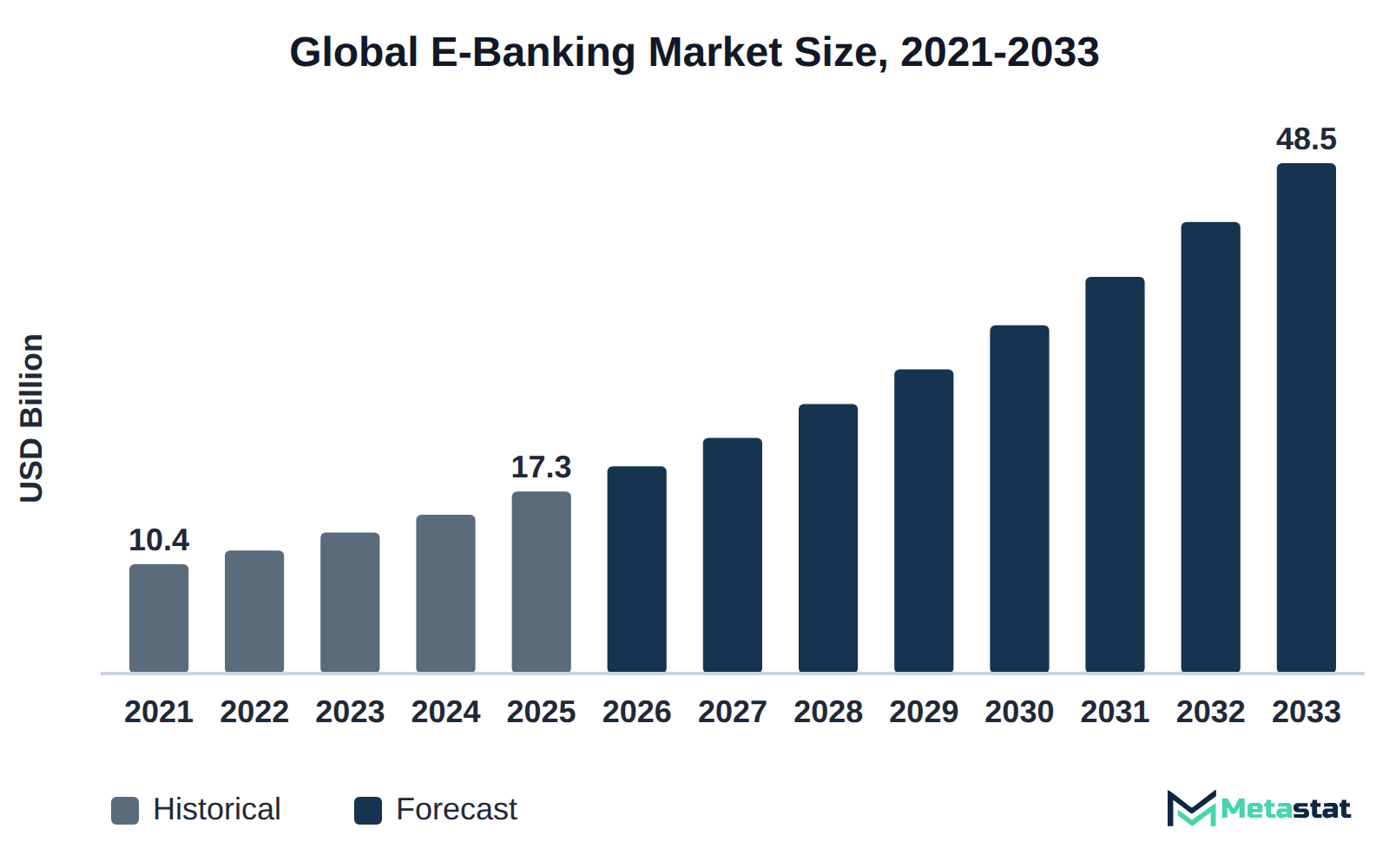
Mobile E-Banking adoption experiences significant growth, driven by consumer preference for app-based account management. By 2033, mobile banking applications are projected to reach USD 28.3 billion, reflecting a compound annual growth rate of 16.1%. This shift towards mobile solutions aligns with changing customer behaviors, where individuals increasingly favor convenience and accessibility in financial transactions. The integration of advanced security features, including mobile biometric authentication, enhances user confidence in app-based banking.
Individual customers emerge as a key segment in this trend, with their usage expected to grow from USD 9.5 billion in 2026 to USD 22.8 billion by 2033, representing a CAGR of 13.4%. This growth highlights the increasing reliance on mobile solutions for both personal finance management and everyday transactions. Financial institutions recognize the necessity of prioritizing mobile app development to capture this expanding customer base. Institutions investing in user-friendly interfaces and innovative functionalities experience competitive advantages, positioning themselves favorably within the market.
The integration of open banking APIs and real-time B2B payments significantly transforms corporate cash management. With these technologies, businesses experience enhanced transaction speed and improved visibility over their cash flows. This expansion emphasizes the increasing reliance on digital solutions, particularly in financial operations.
Corporate buyers seek pricing models that align with their cash management strategies. Many organizations prefer subscription-based pricing for open banking services, allowing them to manage expenses effectively. Such models provide access to a suite of financial services, including electronic fund transfers and remittances, which are crucial for efficient cash flow management. The anticipated value for electronic fund transfers and remittances in the E-Banking market reaches USD 11.5 billion by 2033, highlighting a clear demand for real-time transaction capabilities.
Incorporating these technologies allows corporations to optimize liquidity management and streamline operations. The shift towards real-time payments enables businesses to settle transactions promptly, reducing the time spent on cash management activities. Organizations realize improved operational efficiency and enhanced financial control, resulting in greater competitiveness in the market.
Digital onboarding has transformed credit access for small businesses, streamlining the process of account opening and loan applications. In the E-Banking market, small enterprises increasingly prefer to conduct financial transactions online. This shift is evident since the segment for Digital Deposits and Account Opening is projected to experience significant growth, driven by evolving customer expectations and technological advancements. Financial institutions face pressure to provide efficient and effective digital services that cater to the unique needs of small businesses.
In 2025, the market for Individual Customers is set at USD 17.3 billion, highlighting the considerable potential for financial institutions to expand their offerings tailored to small businesses. Effective digital onboarding processes enhance the customer experience, encourage retention, and ultimately improve loyalty. By investing in user-friendly interfaces and robust security measures, banks establish trust, thus improving credit access for small enterprises. This focus on small business needs enhances market competitiveness and cultivates long-term relationships within the E-Banking market.
Digital payment fraud poses significant risks within the E-Banking market, prompting providers to implement robust security measures. A substantial portion of the market revenues, estimated at USD 48.5 billion by 2033, reflects the urgency for security enhancements to build customer trust and protect financial assets. Providers deploy multi-factor authentication, encryption protocols, and real-time transaction monitoring to mitigate these risks effectively.
For instance, in the segment of Electronic Fund Transfers and Remittances, which is projected to reach USD 11.5 billion by 2033, security measures are critical for safe transactions. Effective fraud detection systems analyze transaction patterns, alerting users and institutions to suspicious activities immediately. These strategies safeguard customers and strengthen the overall integrity of the market.
Compliance with regulations including the Payment Card Industry Data Security Standard (PCI DSS) ensures that providers adhere to stringent security requirements, enhancing consumer confidence. This commitment to security drives increased adoption of E-Banking solutions, resulting in sustained growth and competitive advantages.
Consumer preference for mobile banking applications drives significant growth in the industry. Individual customers increasingly adopt mobile banking due to the convenience and flexibility offered by these platforms. Enhanced user experiences and advanced features encourage higher transaction volumes and increased frequency of use. This preference leads to higher engagement and loyalty among users, resulting in increased revenues for financial institutions. The E-Banking market benefits from this trend, with a substantial rise in the number of active mobile banking users boosting overall market performance.
Technological advancements and a growing focus on digital financial services further support this trend. Increasing smartphone penetration and improved internet connectivity facilitate access to mobile banking, appealing to a broader customer base. The desire for quick and efficient banking services shapes consumer behavior, prompting a notable increase in demand. This shift shows the importance of mobile banking and positions it as a key growth driver within the market.
Mobile banking applications significantly enhance the accessibility and efficiency of financial services. Providers invest heavily in innovative technologies aimed at improving user experience and functionality. Features including biometric authentication and personalized financial management tools drive user engagement and build loyalty among individual consumers and businesses alike. The convenience offered by mobile platforms aligns with rapid digital transformation trends, prompting a shift in consumer behavior towards online banking services. This transition provides unique opportunities for financial institutions to capture new customer segments, particularly among younger demographics. The E-Banking market benefits from this demand, with mobile banking applications projected to experience substantial growth through 2033. This growth supports broader financial inclusion, enabling underserved populations to access essential banking services. Financial institutions enhance their competitive positioning by leveraging these technologies, which positively impacts overall market expansion.
Cybersecurity threats present a significant barrier to growth in the E-Banking market, particularly affecting individual customers and small enterprises. Increasing incidents of data breaches and online fraud create hesitation among potential users regarding digital banking adoption. Concerns regarding the safety of personal and financial information deter many customers from transitioning to online banking channels. This reluctance results in slower uptake of digital banking solutions and smaller order sizes, particularly from micro, small, and medium enterprises that lack robust cybersecurity measures. Enhanced security protocols and investment in protective technologies raise operational costs for service providers, ultimately contributing to delayed service adoption. Ensuring customer trust becomes essential in driving future growth, with confidence in cybersecurity measures influencing consumer willingness to embrace digital banking services.
Margin pressure challenges suppliers within the E-Banking market, driven by increasing competition and customer demands for lower fees and enhanced services. This pressure arises from the need to maintain profitability while investing in advanced technologies to improve service delivery and security. Suppliers face heightened operational costs, particularly related to technology upgrades and cybersecurity measures, which impact their ability to sustain profit margins. In response, many providers focus on streamlining operations and adopting innovative technologies to enhance efficiency. Several are exploring partnerships with fintech companies to draw on their expertise in cost-effective solutions. This strategic approach enables suppliers to better manage expenses while meeting evolving customer expectations, strengthening resilience in a competitive landscape. Adapting to these margin dynamics will influence long-term growth and sustainability in the market.
Opportunities within the E-Banking market arise from the increasing demand for mobile banking applications, particularly among individual customers. The broad adoption of smartphones and the enhancement of mobile banking features contribute significantly to this trend, facilitating easier access to banking services for consumers. Individual customers prefer applications that offer efficient transactions and innovative features, resulting in increased competition among financial institutions. The market's growth trajectory highlights the importance of investing in mobile platform capabilities, leading to improved customer satisfaction and engagement. This focus on mobile banking is expected to strengthen the market position of companies that prioritize user-friendly applications equipped with advanced functionalities. The competitive landscape is evolving to accommodate these preferences, positioning the market for sustained growth through the forecast period.
The Global E-Banking market is segmented based on Banking Channel, Banking Service, and Customer Type.
Internet Banking segment is valued at USD 6.5 billion in 2026 and is projected to reach USD 13.5 billion by 2033, at a CAGR of 11% during the forecast period. Online banking services provide individuals and businesses with the ability to manage their financial activities remotely, including account management, fund transfers, and bill payments. The demand for internet banking is driven by the increasing preference for convenience and transparency, particularly among individual customers and micro, small, and medium enterprises. Compared to other segments, internet banking experiences slower growth, influenced by factors including regulatory compliance and the need for robust cybersecurity measures. Ongoing digital transformation pushes banks to enhance their internet banking platforms, ensuring they meet customer expectations while maintaining security and reliability. This segment's growth trajectory significantly contributes to the overall expansion of the E-Banking market.
Mobile banking applications let users perform transactions, manage accounts, and access financial information from mobile devices. Individual customers and Micro, Small, and Medium Enterprises (MSMEs) primarily engage with this segment to streamline banking processes. The driving force fueling growth in this segment is the increasing smartphone penetration, which allows users to engage in banking activities on-the-go. Compared to other segments, Mobile Banking Applications experience faster growth, with a significant CAGR of 16.1%, contrasting with the 11% CAGR projected for Internet Banking. This shift demonstrates a distinct preference for mobile solutions, positioning this segment as a key driver in the E-Banking market.
Mobile Web Banking segment is expected to reach USD 4.7 billion by 2033. This segment facilitates banking activities through mobile web browsers, enabling users to perform transactions without dedicated applications. Individual customers access these services to view their accounts, make payments, and transfer funds conveniently. The demand for mobile web banking experiences growth driven by increased smartphone penetration and the desire for convenient banking solutions. This slower growth results from the preference for dedicated applications, which often provide enhanced features and user experiences, while mobile web banking serves those prioritizing ease of access without additional downloads.
Telephone and Interactive Voice Response (IVR) Banking segment is projected to grow at a CAGR of 8.7% during the forecast period. This segment serves customers who prefer accessing banking services through telephonic communications, enabling transactions and inquiries without the need for internet connectivity. It appeals to a demographic that does not adopt digital banking channels fully, including older individuals and those in regions with limited internet access. The segment's growth is driven by enhancements in speech recognition technology, allowing for smoother interactions. Compared to mobile banking applications, which project a CAGR of 16.1%, IVR banking experiences slower growth due to increasing consumer orientation toward mobile and internet-based services. However, it remains essential for maintaining customer engagement and providing support, particularly for those valuing convenience. In this context, the E-Banking market adapts to diverse customer preferences, ensuring that various banking channels remain viable and accessible.
Others (Email Banking, Social Media-Based Banking) encompasses digital banking services that engage email and social media platforms for transactions and account management. These services appeal to individual customers and small enterprises seeking convenient access and communication with financial institutions. The rise of mobile device usage and social media's popularity facilitates the adoption of these channels. Growth within this sub-segment hinges on user familiarity with social media, creating a preference for informal communication with banks. This segment differs from traditional Internet and Mobile Banking segments, which focus on more structured services, resulting in slower growth projections compared to mobile banking applications, where rapid consumer adoption drives significant market expansion. The increasing integration of social media into banking services enhances customer engagement and provides opportunities for personalized marketing strategies, contributing to evolving customer expectations in the market.
Account Management and Information Services segment is valued at USD 3.2 billion in 2026 and is projected to reach USD 6.8 billion by 2033, at a CAGR of 11.2% during the forecast period. This segment provides essential services for individuals and businesses to manage their accounts efficiently, including tracking balances, transaction history, and account information. The growing demand for easy access to account management tools drives this segment, particularly among individual customers and small to medium enterprises. Differentiating itself from other segments, Account Management and Information Services experiences moderate growth compared to Electronic Fund Transfers and Remittances, which displays a CAGR of 14.4%. The rising emphasis on digital banking solutions enhances the profitability of this segment while ensuring that traditional banking institutions remain competitive in the evolving market.
Electronic Fund Transfers and Remittances segment is estimated to reach USD 11.5 billion by 2033, at a CAGR of 14.4% during the forecast period. This segment facilitates the electronic movement of funds, supporting both individual customers and businesses in various financial transactions. Increasing globalization and the rise of e-commerce drive demand for efficient and cost-effective transfer solutions. Financial institutions and service providers increasingly adopt innovative technologies to enhance transaction speed and streamline processes. This segment experiences higher growth due to the growing preference for digital payment solutions, with a notable CAGR of 14.4%. The market's focus on security and reliability remains critical, with users requiring confidence in their financial transactions.
Online Bill Payments segment is expected to reach USD 5.1 billion by 2033. This service facilitates the convenient payment of bills for consumers and businesses, allowing users to pay utilities, loans, and other recurring expenses electronically. Individual customers and micro, small, and medium enterprises frequently use this service to streamline their payment processes. The growing reliance on digital transactions significantly drives this segment, propelled by consumer preference for faster and more efficient payment methods. Compared to other segments within Banking Services, Online Bill Payments exhibits a slower growth trajectory, influenced by the established nature of traditional bill payment methods. The segment's growth is further supported by advancements in security features and user-friendly interfaces, enhancing trust and usability among users. The market is expected to evolve, adapting to changing consumer needs and technological advancements.
Digital Deposits and Account Opening segment is projected to grow at a CAGR of 15.4% during the forecast period. This segment facilitates the online opening of bank accounts and the deposit of funds, primarily targeting individual customers and small to medium enterprises seeking convenient banking solutions. The increasing preference for digital services fuels growth in this segment, reflecting a broader trend toward enhanced customer experiences through technology. Compared to other banking services, this segment experiences faster growth due to its alignment with the shift toward online banking practices. Financial institutions invest in digital platforms to streamline account management and improve customer engagement. Initiatives driven by user-friendly interfaces and promotional offers significantly influence adoption rates, differentiating this segment from more traditional banking services.
Online Lending and Credit Services involves providing financial solutions through digital platforms, enabling users to access loans and credit facilities. This segment attracts individual customers and small to medium enterprises seeking quick and convenient lending options. Factors driving this segment include the rising need for instant credit access and the growing acceptance of digital financial services. Compared to other segments within the banking services, this segment exhibits rapid growth due to increasing consumer preference for online solutions. The demand for faster processing times and lower interest rates enhances its appeal, particularly among younger customers who favor digital interactions over traditional methods. Innovations in technology further enable broader access to credit, differentiating this segment from slower-growing areas including traditional banking services. The E-Banking market continues to evolve, reflecting these shifts in consumer behavior and technological advancements.
Digital Investment and Wealth Management focuses on providing clients with tools and platforms for managing investments and financial assets. This segment serves individual customers, micro, small, and medium enterprises, and large enterprises, supporting a range of investment strategies and wealth-building options. Growing interest in sustainable investing and the integration of artificial intelligence into financial advisory and wealth management services drive this segment. Clients increasingly seek personalized investment solutions tailored to their unique financial goals.
Compared to other segments, Digital Investment and Wealth Management typically offers higher price points due to the complexity of services provided. Demand from affluent customers for sophisticated investment options influences growth rates, distinguishing this segment from others in the banking services group. Increased competition drives innovation, pushing firms to enhance service offerings while ensuring compliance with evolving regulatory standards. The market adapts in response to changing consumer preferences and technological advancements.
Card Management and Digital Wallet Services encompasses digital platforms that facilitate management of payment cards and electronic wallets for consumers. This segment is widely used by individual customers and small to medium enterprises seeking efficient transaction methods and streamlined payment processes. Growing adoption of mobile devices significantly influences this segment, with more consumers favoring contactless and remote payment solutions. Compared to other banking service segments, this sub-segment experiences rapid growth driven by technological advancements and consumer preferences for convenience. Unlike traditional services that rely on physical interactions, digital wallet services provide enhanced efficiency and security, appealing to a broader range of users seeking modern banking solutions. The expansion of the E-Banking market is expected to hinge on innovations in this space, addressing the evolving expectations of tech-savvy consumers.
Trade Finance and Cash Management involves services that facilitate the management of cash flow, optimize liquidity, and improve transactions for businesses. Financial institutions and corporations typically use these services to improve operational efficiency and reduce risk. Demand for these services is driven by the growing need for efficient cash management solutions and global trade expansion, which necessitates effective financial transactions across borders. This segment differs from others in the Banking Service category by focusing on strategic financial processes that support businesses rather than individual consumers. Segments like Electronic Fund Transfers and Remittances exhibit strong growth trajectories. The Trade Finance and Cash Management segment instead emphasizes relationship management and service customization, aligning closely with corporate clients who require tailored solutions for unique needs. The market continues to adapt to technological advancements, enhancing the effectiveness of cash management strategies.
Cheque Services and Digital Foreign Exchange Services encompass specific financial transaction capabilities that facilitate secure and efficient transactions for businesses and consumers. These services cater to individual customers and businesses seeking reliable methods to manage payments and currency exchanges. Demand for these services stems from the increasing need for effective cross-border transactions and the growth of international trade. Unlike other segments, this sub-segment experiences slower growth, driven by regulatory challenges and varying acceptance rates across different regions. While other services, including electronic fund transfers, exhibit significant growth, Cheque Services and Digital Foreign Exchange Services encounter barriers related to evolving digital preferences among consumers. The E-Banking market continues to adapt to these trends, ensuring that these services meet the emerging needs of their users.
Individual customers engage with E-Banking services for various purposes, including online transactions, account management, and financial planning. A significant driver for this segment is the increasing adoption of mobile banking applications, which cater to a tech-savvy customer base seeking convenience and efficiency in managing their finances. Compared to other segments, this group demonstrates strong growth, with a higher CAGR than large enterprises, indicating a shift toward digital solutions among individuals. The rising demand for personalized banking experiences further enhances the segment's appeal, distinguishing it from the offerings targeted at businesses or financial institutions. Through 2033, growth in this segment is expected to continue influencing the overall dynamics of the market.
Micro, Small, and Medium Enterprises segment is estimated to reach USD 12.3 billion by 2033, at a CAGR of 15.8% during the forecast period. This segment primarily serves smaller businesses that require efficient banking solutions for daily operations, including payment processing, fund transfers, and account management. Accelerated digital transformation contributes to its growth, with businesses increasingly adopting e-banking solutions to enhance operational efficiency and customer experience. Compared to individual customers, this segment shows a faster growth trajectory, reflecting the rising demand for accessible and flexible banking services tailored to the unique needs of smaller enterprises. Competitive pricing of e-banking solutions drives more businesses to transition from traditional banking methods.
Large Enterprises segment is expected to reach USD 7.4 billion by 2033. This segment primarily serves large corporations requiring advanced banking services that include extensive transaction handling, risk management, and financial analytics. A significant demand driver for this segment stems from the increasing complexity of financial operations within large organizations, necessitating robust e-banking solutions. In contrast to other segments, this segment experiences a slower growth rate, with a projected CAGR of 12.7% during the forecast period. The higher transaction volumes and more sophisticated requirements of large enterprises contribute to its distinct operational dynamics compared to segments including Individual Customers, which is projected to grow at a CAGR of 13.4%. The E-Banking market increasingly aligns with digital transformation trends, enabling large enterprises to optimize their banking operations through advanced technology and integrated platforms.
Financial Institutions segment is projected to grow at a CAGR of 12.7% during the forecast period. This segment serves banks, insurance companies, and investment firms, providing them with digital solutions for transactions, account management, and financial services. The rising demand for digital transformation in financial services drives growth, with institutions increasingly adopting e-banking solutions to enhance efficiency and customer experience. Compared to other segments, including Individual Customers, this segment experiences a different trajectory of growth, focusing on larger transaction volumes and more complex service requirements. Financial Institutions benefit from adopting advanced technologies, including artificial intelligence and blockchain, which enhance security and streamline operations. With a projected value reaching USD 7.4 billion by 2033, the segment influences the overall dynamics of the market.
Government and Public-Sector Organizations use digital platforms to enhance service delivery, improve communication, and streamline administrative processes. These entities use e-banking solutions for transaction management, compliance with financial regulations, and efficient management of budgets. Factors driving the adoption of e-banking among government and public-sector organizations include the increasing demand for digital services and the push for greater transparency in public financial management. Unlike individual customers and enterprises, this segment engages with e-banking solutions at a slower growth rate, focusing on compliance and security features that cater to regulatory requirements. The emphasis on robust cybersecurity measures influences procurement decisions, highlighting the unique needs of this segment compared to others in the customer type classification.
Nonprofit organizations and trusts employ various digital banking solutions to streamline financial operations, manage donations, and facilitate transactions. Increasing adoption of e-banking solutions within this segment results from the necessity to enhance operational efficiency and improve transparency in financial reporting. Organizations in this segment seek to optimize their financial management while adhering to regulatory requirements related to fund allocation. Compared to other customer types, this segment experiences slower growth due to reliance on donor funding and limited budgets for technology investments. However, the push for digital transformation among these entities highlights a significant opportunity for growth within the E-Banking market, driven by increasing demand for cost-effective and user-friendly banking solutions tailored to unique requirements.
This segment encompasses various financial services tailored to meet the needs of diverse customer types, including government and public-sector organizations, along with nonprofit organizations and trusts. The rise in digital financial solutions drives growth in this segment, largely fueled by increasing adoption among underserved consumers and organizations seeking efficient banking options. Compared to other segments, this area experiences robust demand due to the expanding emphasis on digital transformation across various sectors. This focus on digitization enhances user experience and streamlines operations, setting this segment apart with its higher growth potential relative to traditional banking services. The E-Banking market benefits from the segment's adaptability, reflecting changing consumer preferences and technological advancements.
Based on geography, the Global E-Banking market is divided into North America, Europe, Asia-Pacific, South America, Middle East, and Africa.
In the E-Banking market, North American demand is driven by a strong emphasis on technological adoption, particularly among individual customers and small to medium enterprises. The region benefits from a well-established digital infrastructure, enabling efficient transactions and connectivity. Compliance with regulatory frameworks, including the Payment Card Industry Data Security Standard (PCI DSS), enhances consumer trust in online banking services. Innovations in mobile banking applications reshape how consumers interact with their financial institutions, contributing to increased market penetration. North America is projected to reach USD 14.2 billion by the end of 2033, accounting for 32.1% of the global market in 2025. This substantial growth highlights the region's important role in the overall expansion of the market.
Significant growth in the E-Banking market within Europe is driven by increased adoption of digital banking solutions among individual customers and enterprises seeking efficiency and convenience. Countries including Germany, France, and the UK lead in the deployment of innovative financial technologies, supported by robust regulatory frameworks focused on enhancing consumer protection and data security. The EU's PSD2 regulation encourages competition and innovation in the financial services sector, promoting the integration of new banking applications and services. The market in Europe accounted for a share of 25.3% in 2025, reflecting strong consumer demand for online banking and mobile applications. Italy and Spain contribute to this growth, driven by a rising number of mobile banking users and increased transaction volumes. With total market value projected to reach USD 48.5 billion by 2033, advancements in technology and changing consumer preferences are expected to shape the E-Banking landscape across the region.
In the Asia-Pacific region, the E-Banking market experiences significant growth driven by increasing digitalization and a rising preference for online financial services among consumers and businesses. Countries like China, Japan, and India actively enhance their digital banking infrastructure, leading to higher adoption rates of mobile and internet banking solutions. The expanding smartphone penetration in South Korea and Australia supports the surge in mobile banking applications. In addition, Southeast Asia experiences a growing number of startups focusing on innovative financial technology solutions, further stimulating demand. The regional market share in 2025 stands at 30.3%, reflecting its important role in the global E-Banking market.
Brazil and Argentina serve as key players in the E-Banking market, with financial institutions increasingly adopting digital solutions to meet consumer preferences. Growing internet penetration and smartphone usage enhance accessibility for users, leading to a surge in demand for mobile banking applications and online services. The market experiences strong adoption rates driven by cost-saving opportunities and improved service delivery for consumers and businesses. Infrastructure investments in digital payment systems and government initiatives focused on financial inclusion contribute to expanding market potential. In 2025, South America represents 6.3% of the global market share, reflecting its significance in the broader landscape of e-banking solutions.
Demand for digital banking solutions in the Middle East and Africa receives strong support from a growing number of users transitioning to online platforms. Countries including Saudi Arabia and the UAE lead in technological adoption, driven by government initiatives promoting digital transformation within banking. South Africa's banking sector focuses on enhancing financial inclusion through mobile banking applications, targeting the unbanked population. This region's unique blend of emerging economies fuels the E-Banking market, reflecting the demand for efficient, accessible financial services.
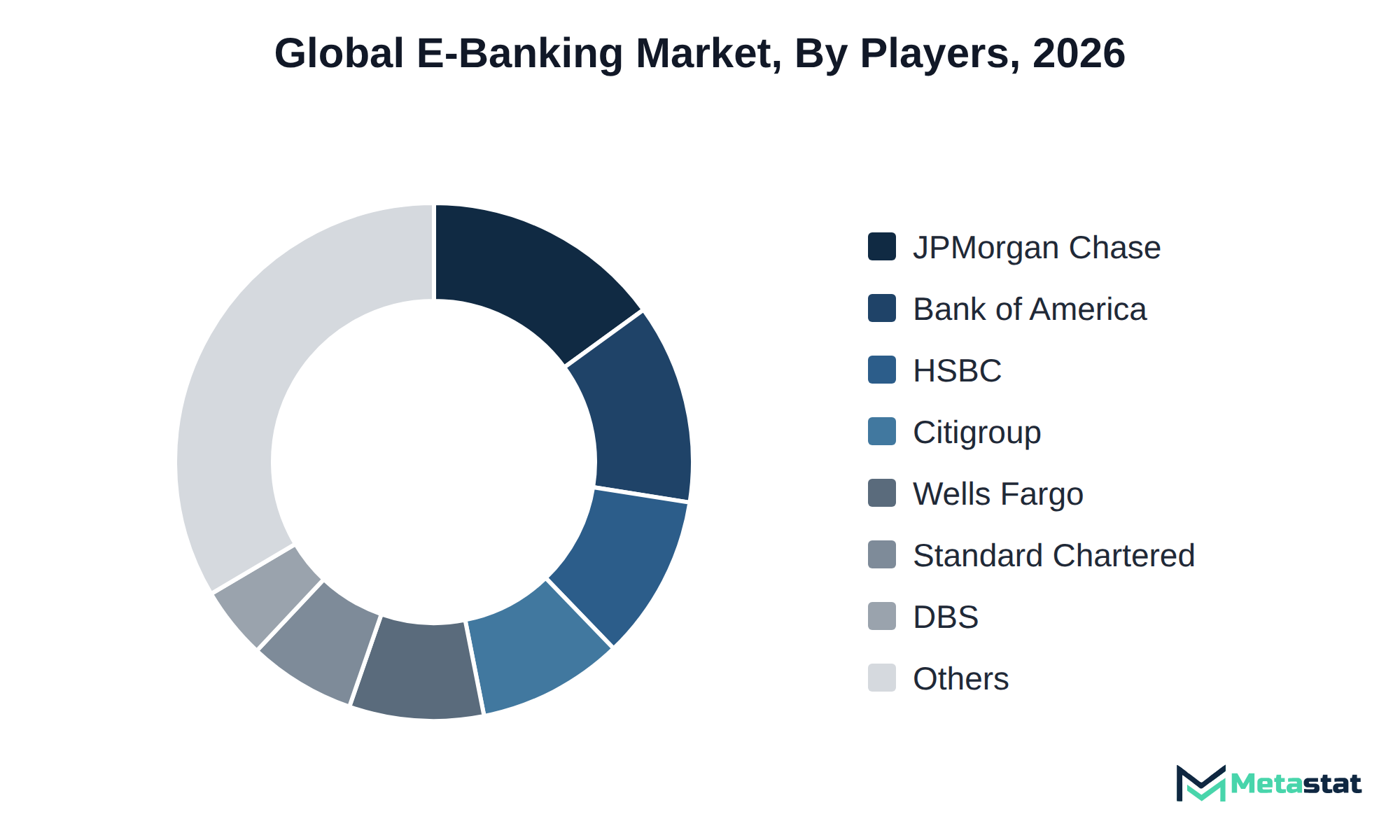
Companies in the E-Banking market compete primarily on service types, customer experience, and technology integration. Key areas influencing buyer choice include price, customization, and the robustness of the service ecosystem. For instance, JPMorgan Chase & Co. emphasizes a comprehensive range of banking services, focusing on mobile banking applications that cater to the growing demand for convenient banking solutions. In contrast, Citigroup Inc. focuses on electronic fund transfers and remittances, addressing the increasing need for efficient cross-border payments. HSBC Holdings plc invests heavily in digital deposits and account opening services, enhancing the overall customer onboarding experience.
Players position themselves based on their operational strengths and targeted customer segments. Bank of America Corporation prioritizes individual customers with tailored account management and information services, while Standard Chartered PLC emphasizes offerings for micro, small, and medium enterprises. Competition intensifies with the emergence of fintech solutions, with companies like Revolut Bank UAB and N26 Bank SE positioning themselves as disruptive forces, attracting tech-savvy customers with user-friendly mobile interfaces. This landscape requires continuous innovation among traditional banks to retain market share in the E-Banking market.
Achieving this growth relies on several critical developments within the E-Banking market. First, the widespread adoption of mobile banking applications is essential, with projections showing significant demand growth in this segment. This trend is driven by increasing smartphone penetration and consumer preference for convenient banking solutions, particularly in regions including Asia Pacific and North America. Second, advancements in account management and information services will enhance customer experiences and streamline banking processes, further encouraging user engagement. The European market plays a key role in this area, where digital transformation strategies are actively pursued by financial institutions. However, the forecast faces risks, particularly from cybersecurity threats that could undermine consumer trust and slow down adoption rates. Significant breaches deter users from accessing digital banking platforms, impacting overall growth. Addressing these challenges while promoting innovation and enhancing security measures will determine the market's ability to reach USD 48.5 billion by 2033.
By Banking Channel: Internet Banking, Mobile Banking Applications, Mobile Web Banking, Telephone and Interactive Voice Response (IVR) Banking, Others (Email Banking, Social Media-Based Banking)
By Banking Service: Account Management and Information Services, Electronic Fund Transfers and Remittances, Online Bill Payments, Digital Deposits and Account Opening, Online Lending and Credit Services, Digital Investment and Wealth Management, Card Management and Digital Wallet Services, Trade Finance and Cash Management, Others (Cheque Services, Digital Foreign Exchange Services)
By Customer Type: Individual Customers, Micro, Small, and Medium Enterprises, Large Enterprises, Financial Institutions, Government and Public-Sector Organizations, Others (Nonprofit Organizations, Trusts), By
The report strategically identifies and profiles the key market players and analyses their core competencies in each sub-segment of the E-Banking market.
Report Attributes | Details |
Study Period | 2021-2033 |
Base Year | 2025 |
Estimated Year | 2026 |
Forecast Period | 2026-2033 |
Historical Period | 2021-2025 |
Growth Rate | CAGR 13.8% from 2026 to 2033 |
Revenue Unit | USD billion |
Segmentation | By Banking Channel, Banking Service, Customer Type, and Region |
By Region | North America (By Banking Channel, Banking Service, Customer Type, and Country)
|
Europe (By Banking Channel, Banking Service, Customer Type, and Country)
| |
Asia Pacific (By Banking Channel, Banking Service, Customer Type, and Country)
| |
South America (By Banking Channel, Banking Service, Customer Type, and Country)
| |
Middle East and Africa (By Banking Channel, Banking Service, Customer Type, and Country)
|
Find answers to common questions about this report
The E-Banking market size was valued at USD 17.3 billion in 2025.
The market is projected to grow at a CAGR of 13.8% during the forecast period from 2026 to 2033.
The North America E-Banking market size is estimated to reach USD 14.2 billion by 2033.
Mobile Banking Applications lead the E-Banking market, with a projected value of USD 28.3 billion by 2033. This segment demonstrates the highest growth potential compared to other segments.
Consumer preference for mobile banking applications drives significant growth in the industry. Technological advancements and a growing focus on digital financial services further support this trend.
North America holds the dominant share of the E-Banking market, with a value of USD 14.2 billion projected for 2033, representing 32.1 percent of the total market.
Cybersecurity threats present a significant barrier to growth, creating hesitation among potential users regarding digital banking adoption. Concerns about the safety of personal and financial information deter customers from transitioning to online banking channels, resulting in slower uptake of digital solutions.
Increasing demand for mobile banking applications among individual customers drives adoption in the E-Banking market. The expansion of this segment, projected to grow from USD 9.5 billion in 2026 to USD 22.8 billion by 2033, highlights the importance of efficient transactions and innovative features in attracting users.
The E-Banking market is estimated to reach a valuation of USD 48.5 billion by 2033.
Key players operating in the E-Banking industry include JPMorgan Chase & Co., Bank of America Corporation, HSBC Holdings plc, Citigroup Inc., Wells Fargo & Company, and Standard Chartered PLC.
The analysts below cover Banking & Finance research at Metastat Insights.
LEAD ANALYST
Utkarsh Khirodkar is a Lead Market Research Analyst at MetaStat Insight, specializing in market intelligence, technology sector assessments, and competitive strategy.

PRINCIPAL CONSULTANT - ENTERPRISE AI & EMERGING TECHNOLOGIES
Banking & Finance · Electronics and Semiconductor · Energy and Power · Healthcare IT · Information & Technology · Professional Services
Vijay Gunti is a Principal Consultant at MetaStat Insight, bringing over two decades of experience across enterprise digital transformation, technology strategy, and intelligent systems.
When evaluating distributed energy resource management systems, standard research summaries tend to gloss over the operational differences between front-of-the-meter utility deployments and behind-the-meter industrial sites. The MetaStat Insight report addressed those distinctions directly, especially regarding software interoperability standards and grid interconnection backlogs. The five-year market sizing across regional transmission organizations provided actionable context for our grid modernization strategy.
Most industry reports on warehouse automation bundle autonomous mobile robots and fixed conveyor installations into the same top-level numbers, which complicates advisory work. This study split the market cleanly by payload tiers, navigation technology, and fleet management software layers. The regional forecast for Western Europe gave our team defensible adoption benchmarks when evaluating capital allocation for logistics clients, saving us days of secondary data scrubbing.
Analyzing the transition from natural gas to green hydrogen in iron ore reduction requires realistic infrastructure timelines. Meta stat insight supplied a detailed regional assessment of DRI plant conversion costs and scrap metal availability in North America and Western Europe. Their report carefully examined pellet quality specs and electrical grid access constraints without making oversimplified market assumptions. The research material served as a practical reference during internal technology roadmap discussions.
Explore related market intelligence reports worth reading alongside this one.