
LEAD ANALYST
Utkarsh Khirodkar is a Lead Market Research Analyst at MetaStat Insight, specializing in market intelligence, technology sector assessments, and competitive strategy.

Europe Automotive Dealer Management System (DMS) Market Size, Share, By Deployment (Cloud-based and On-premise), By Application (Customer Relationship Management, Dealer Tracking, Inventory Management, Finance, Sales, and Others), By End-User (Large Dealership Groups, Medium-Sized Dealerships, and Small Dealerships), By Region (UK, Germany, France, Italy, and Rest of Europe), Industry Analysis, Growth, Trends, and Forecast, 2026-2033
Report ID
MSI-2632
Published
October, 2026
Pages
309 Pages
Format
Historical
Base year
Forecast
Forecast period
Report Details
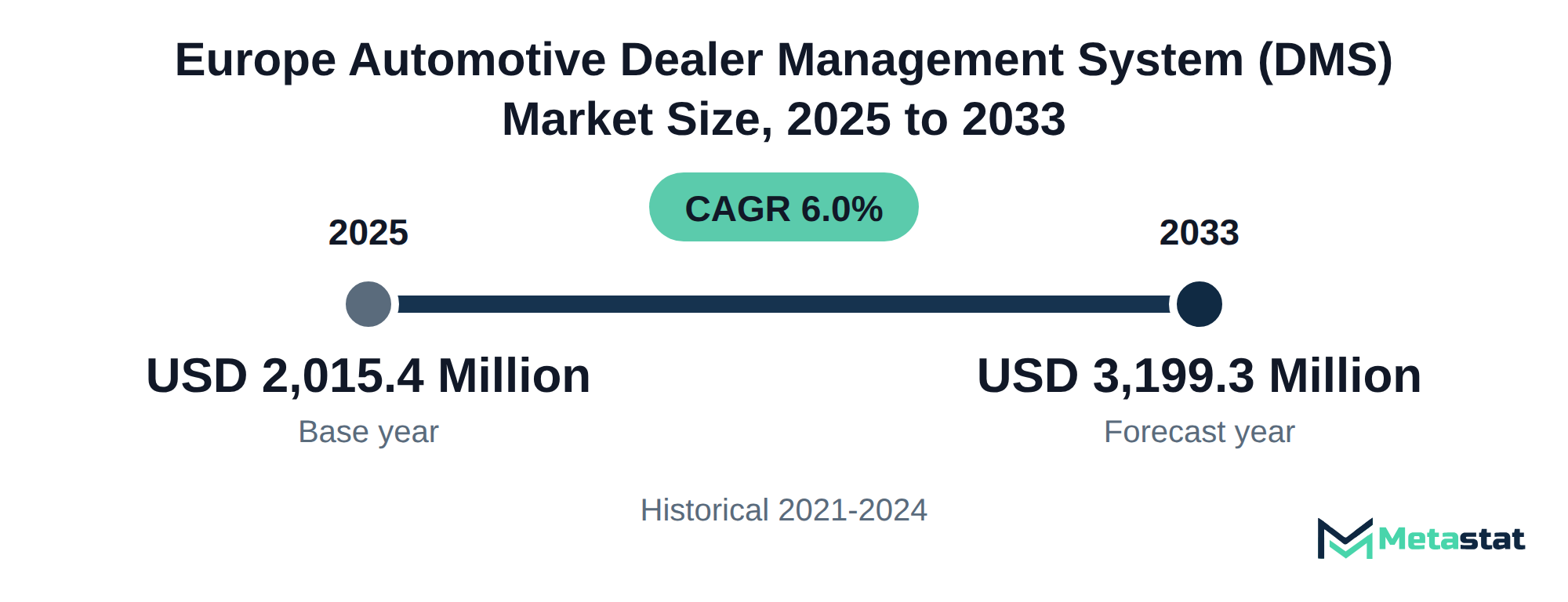
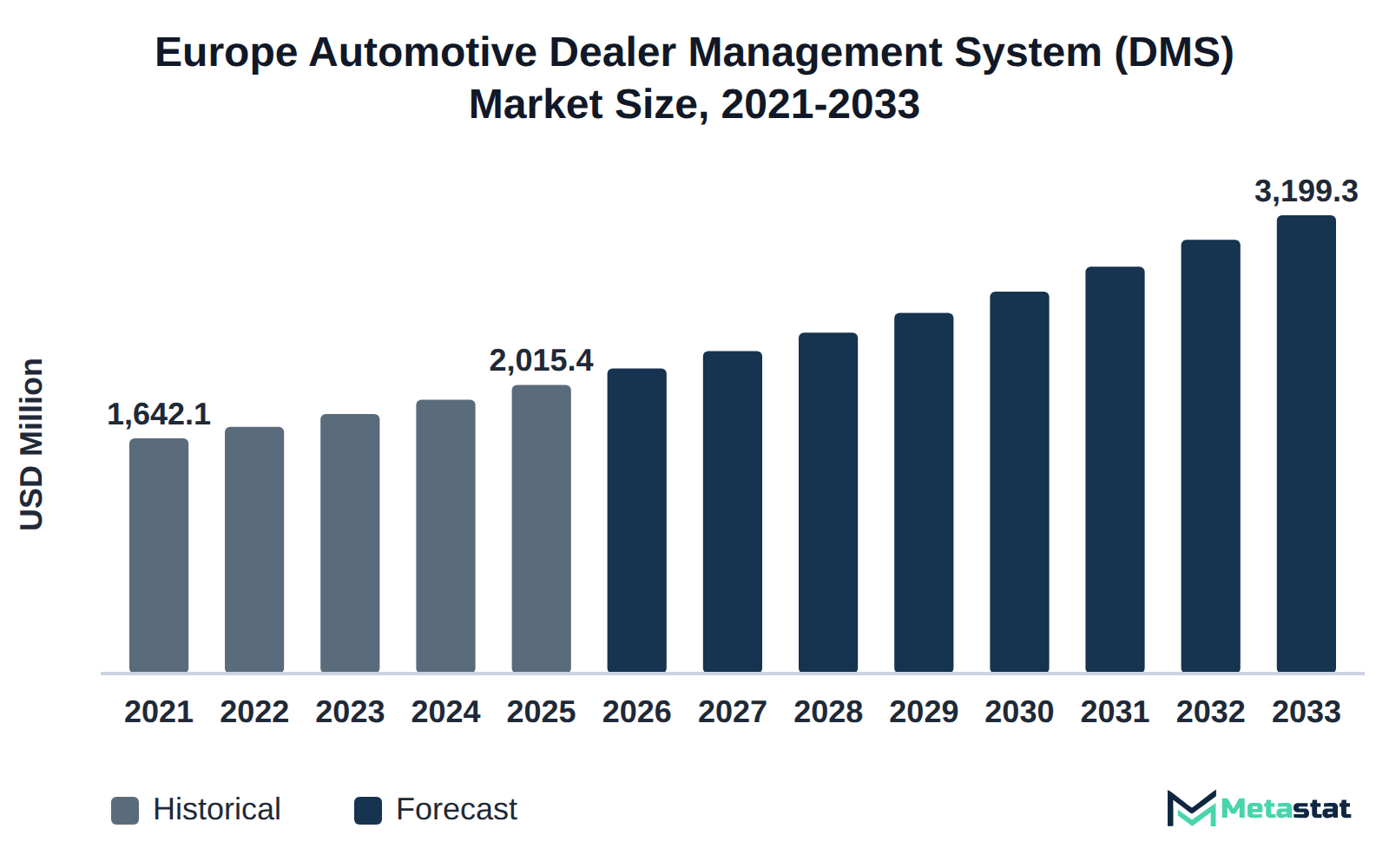
Market Valuation: Valued at $2,015.4 Million in 2025, projected to reach $3,199.3 Million by 2033 at a 6.0% CAGR.
Dominant Segment: Customer Relationship Management holds the largest value in the Europe Automotive Dealer Management System market, driven by its critical role in enhancing customer loyalty and driving repeat business.
Geographic Lead: The UK leads the market, benefiting from a robust automotive industry and a growing emphasis on digital transformation, which fuels demand for advanced DMS solutions.
What's Inside: The report provides a comprehensive analysis of the market, including competitive coverage, segment performance by deployment and application, and a detailed forecast window from 2026 to 2033.
Cloud-Based DMS Growth: Cloud-based DMS solutions are projected to grow significantly, from USD 784.7 million in 2026 to USD 1,252.6 million by 2033, reflecting a strong preference for flexible and scalable systems among dealerships.
Investment Drivers: Large dealership groups are driving the market's growth, with a projected increase from USD 1,046.7 million in 2026 to USD 1,658.2 million by 2033, emphasizing the need for advanced management systems.
Choose Your License
Europe Automotive Dealer Management System (DMS) Market
The Europe Automotive Dealer Management System (DMS) market was valued at USD 2,015.4 million in 2025 and is projected to reach USD 3,199.3 million by 2033, growing at a CAGR of 6.0% over the forecast period.
The Europe Automotive Dealer Management System (DMS) market encompasses software solutions that streamline operations for automotive dealerships. This technology addresses various functions, including customer relationship management, inventory management, and finance. Buyers invest in these systems to enhance efficiency, improve customer engagement, and drive sales performance within their operations. Rising complexity in automotive sales and service processes increases the need for management tools that support dealership growth.
Growth in the market is fueled by several factors, particularly the increasing adoption of cloud-based solutions. Cloud technology offers flexibility, scalability, and reduced operational costs, prompting dealerships to transition from traditional on-premise systems. Among the segments, customer relationship management holds the largest value, reflecting its critical role in enhancing customer loyalty and driving repeat business. Customer loyalty and retention software is a related category that also supports repeat business. The UK emerges as the region with the largest market share, benefiting from a robust automotive industry and a growing emphasis on digital transformation.
Investment in innovative technologies continues to shape the competitive landscape of the market. Dealerships prioritize solutions that enhance operational efficiency and customer satisfaction. The integration of advanced analytics and automation within DMS platforms supports data-driven decision-making, further driving market expansion. With a projected compound annual growth rate (CAGR) of 6% through the forecast period, the market is expected to keep growing, influenced by evolving consumer preferences and technological advancements.
Buyers invest in the Europe Automotive Dealer Management System (DMS) market to enhance dealership efficiency and improve customer satisfaction. The solutions offered by this market facilitate better inventory management, finance tracking, and customer relationship management. Dealerships face increasing competition, making the need for advanced software solutions that streamline operations critical for maintaining profitability and competitive advantage.
Growth in the market is primarily driven by the increasing adoption of cloud-based solutions, enabling dealerships to access real-time data and analytics. Among the segments, the cloud-based deployment option holds the largest value, reflecting a strong preference among buyers for flexible and scalable solutions. The UK holds the largest regional share, demonstrating strong demand for DMS solutions tailored to local dealership needs.
This market experiences a compound annual growth rate of 6%, with potential for further expansion driven by digital transformation initiatives within the automotive sector. The integration of advanced technologies, including artificial intelligence and machine learning, further supports the development of innovative solutions that enhance operational efficiency. Such advancements position the market for sustained growth in the coming years.
Cloud-based Dealer Management Systems (DMS) represent a significant shift in the Europe Automotive Dealer Management System (DMS) market. With the increasing adoption of cloud-based solutions, dealerships realize numerous operational efficiencies and cost savings. For instance, the market anticipates a growth from USD 784.7 million in 2026 to USD 1,252.6 million by 2033, reflecting a compound annual growth rate (CAGR) of 6.9%. This transition facilitates improved access to real-time data, enabling dealerships to streamline operations and enhance customer service.
The integration of cloud-based DMS involves initial setup costs and ongoing subscription fees, which vary based on the specific needs of each dealership. While the upfront investment appears substantial, the long-term benefits often outweigh these costs. By reducing the need for extensive on-premise infrastructure and associated IT maintenance, dealerships benefit from a more adaptive and scalable solution. The trend shows that larger dealership groups are particularly inclined toward adopting cloud solutions for their flexibility and efficiency, contributing to their projected growth within the market.
This strong shift toward cloud-based DMS reflects changing dealership preferences and influences competitive dynamics in the market. Companies that offer strong cloud solutions stand to gain a significant competitive advantage and a favorable position in an evolving landscape. While initial costs for cloud-based DMS adoption remain a consideration, the strategic benefits ensure that dealerships remain competitive and efficient in an increasingly digital environment.
Multi-brand dealer groups prioritize centralized inventory management to optimize operations and meet diverse consumer demands. The reliance on a singular inventory system enhances visibility across multiple brands, improving decision-making and resource allocation. This transition allows dealer groups to streamline processes, reduce redundancy, and improve overall efficiency.
The pricing models associated with these centralized systems vary, often including subscription-based contracts that align with usage and service levels. Such models appeal to multi-brand groups seeking flexibility in costs and the ability to scale operations when required. By adopting these pricing strategies, organizations achieve better financial management while ensuring competitiveness within the market. The emphasis on centralized inventory management enhances operational efficiency and positions multi-brand dealer groups to respond swiftly to market changes and customer preferences.
The integration of agency sales models within the Europe Automotive Dealer Management System (DMS) market reflects a significant shift in how automotive manufacturers engage with consumers. These models prioritize direct relationships between automakers and customers, enabling more streamlined sales processes. Demand for customer relationship management solutions continues to escalate. For instance, the Customer Relationship Management application segment is projected to grow from USD 553.4 million in 2026 to USD 842.1 million by 2033, indicating a compound annual growth rate of 6.2%.
This growth highlights the increasing need for dealerships to adopt sophisticated DMS solutions that align with the agency model framework. Large dealership groups, which are expected to see growth from USD 1,046.7 million in 2026 to USD 1,658.2 million by 2033, often seek advanced DMS functionality to maintain competitive advantages. The integration of these systems allows for enhanced customer interactions, improved inventory management, and streamlined financial processes. Meeting the distinct needs of this buyer group improves customer retention and drives revenue growth within the automotive sector.
Evaluating pricing and total ownership costs for Dealer Management Systems (DMS) in the Europe Automotive Dealer Management System (DMS) market involves understanding both upfront and ongoing expenses. Dealerships often overlook the full scope of total ownership costs, which cover initial licensing fees, maintenance, training, and potential upgrades.
Cloud solutions are gaining preference because of their lower upfront costs and flexible payment structures. Ongoing costs associated with cloud hosting, data security, and compliance factor into the total cost evaluation.
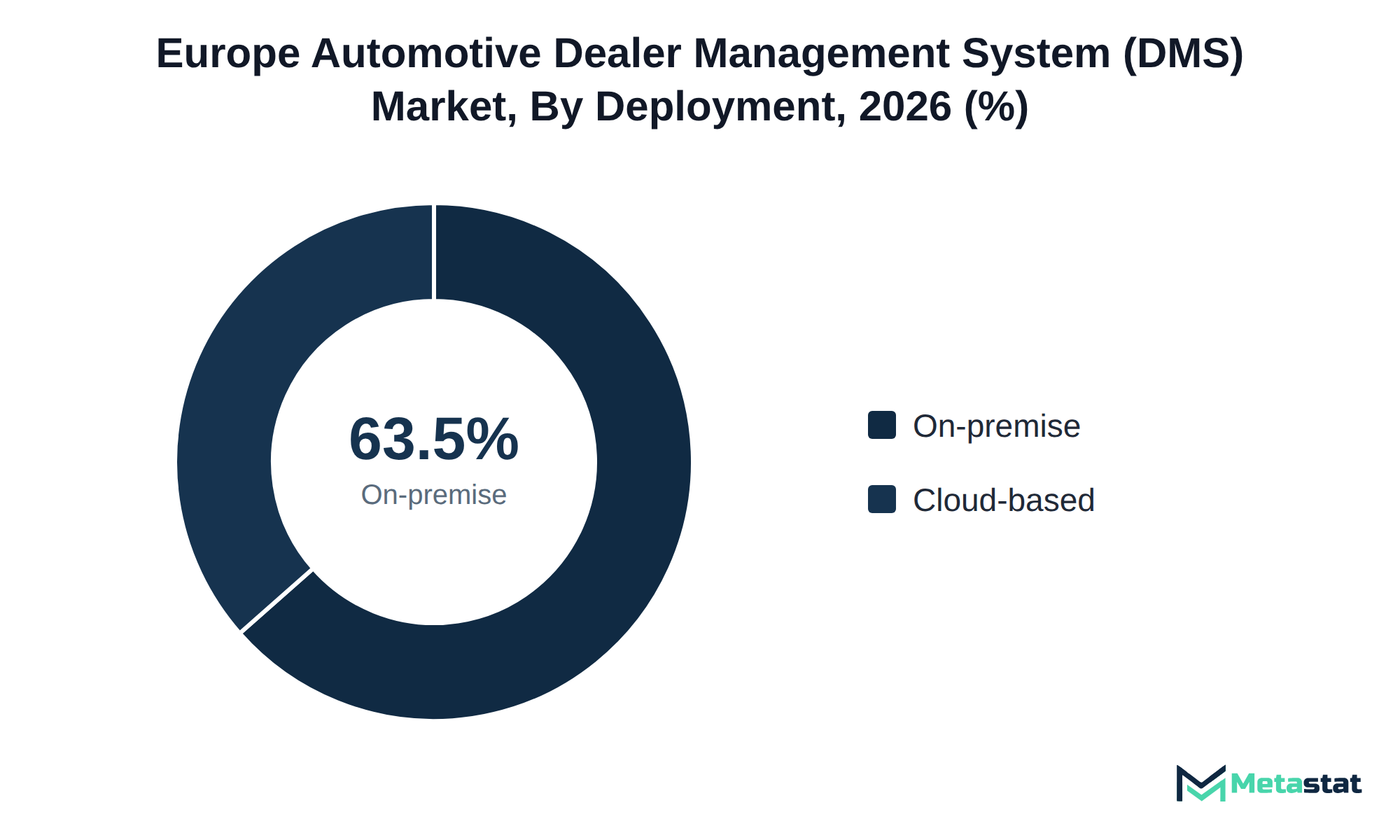
Understanding these costs allows dealerships to make informed decisions that align with their financial strategies. Opting for a cloud-based solution provides better scalability and lower upfront investment, ultimately leading to enhanced profitability. In contrast, traditional on-premise systems incur higher initial costs, yet provide long-term stability and control. Strategic evaluation of pricing and total ownership costs influences the overall financial health of dealerships within the market.
Large dealership groups represent a primary buyer group for the Europe Automotive Dealer Management System (DMS) market. Recent shifts toward digital transformation drive these groups to invest significantly in advanced management systems. Enhanced operational efficiency and improved customer interactions emerge as critical objectives. The anticipated growth rate for this segment stands at 6.8% through 2033, reflecting strong demand for comprehensive solutions. Dealerships focus on cloud-based systems that facilitate better data management and streamline processes. This transition supports increased sales volume and enhances profitability, resulting in a competitive advantage within the market. The evolving landscape of consumer expectations further increases demand for innovative DMS solutions among these large dealership groups.
As dealerships adopt more sophisticated applications, the market is projected to reach USD 3,199.3 million by 2033, reflecting how these investments are shaping automotive retail.
The shift toward cloud-based solutions significantly impacts the Europe Automotive Dealer Management System (DMS) market. Providers increasingly enhance their offerings by integrating advanced technologies, ensuring access to critical data for dealerships. Enhanced data analytics capabilities allow dealerships to refine their decision-making processes, resulting in improved operational performance.
Dealerships benefit from reduced IT infrastructure costs associated with cloud deployment, which eliminates the need for extensive on-premise systems. This financial advantage enables several smaller dealerships to access technologies once limited to larger competitors, promoting a more competitive landscape. The scalability of cloud solutions allows dealerships to adapt their systems dynamically in response to evolving market demands.
Cloud adoption accelerates, driving a surge in investment focused on software development and infrastructure. Providers benefit from ongoing software-as-a-service subscription models, which offer steady revenue streams. In such an environment, competition intensifies, prompting continuous innovation and improvements across the market.
High costs associated with the implementation and maintenance of Automotive Dealer Management Systems (DMS) restrict adoption among small and medium-sized dealerships. Many of these buyers face budget constraints that result in delayed procurement or reduced investment in comprehensive systems. The financial burden arising from software licensing, hardware requirements, and ongoing support fees significantly influences decision-making. In the context of the Europe Automotive Dealer Management System (DMS) market, this constraint manifests through slower uptake and smaller order sizes, particularly for robust solutions that integrate multiple applications. Medium-sized dealerships show particular sensitivity to high initial investments, leading to an inclination toward more basic systems that do not fully meet operational needs. When dealerships opt for less expensive solutions, overall growth potential within the market diminishes, which affects long-term competitiveness and operational efficiency.
Compliance costs present a significant challenge for suppliers operating within the Europe Automotive Dealer Management System (DMS) market. Increasing regulatory requirements surrounding data security, consumer privacy, and operational standards demand substantial investment to ensure adherence. Suppliers face rising expenses related to technology upgrades and staff training, which erodes profit margins. In response, many suppliers focus on optimizing operational efficiencies and using regulatory technology to automate compliance processes. By investing in advanced software solutions, firms streamline compliance management, reducing manual effort and minimizing potential penalties related to non-compliance. This strategic adjustment supports maintaining competitiveness while addressing compliance obligations within the market.
Large dealership groups represent a rapidly expanding segment within the Europe Automotive Dealer Management System (DMS) market. This segment is projected to reach USD 1,658.2 million by 2033, reflecting a compound annual growth rate (CAGR) of 6.8% from USD 1,046.7 million in 2026. The push for enhanced operational efficiency and improved customer relationship management drives this growth, with larger groups increasingly adopting cloud-based solutions. Cloud-based DMS offers scalability and integration capabilities that address the complex needs of extensive dealership networks. This adoption trend signals a shift toward more flexible and efficient management systems, positioning large dealership groups to use advanced data analytics and streamlined processes. The market stands to benefit significantly as these groups invest in technologies that enhance customer engagement and operational performance, creating a competitive edge. The transition to cloud-based DMS solutions meets demand from large dealership groups and fosters broader market innovation.
The Europe Automotive Dealer Management System (DMS) market is segmented based on Deployment, Application, End-User, and Region.
Cloud-based solutions for dealer management systems are valued at USD 784.7 million in 2026 and are projected to reach USD 1,252.6 million by 2033, at a CAGR of 6.9% during the forecast period. This segment primarily serves large dealership groups and medium-sized dealerships, facilitating centralized operations, customer relationship management, and inventory control. Demand for cloud-based DMS is driven by the increasing need for scalable and flexible solutions, allowing dealerships to adapt to market changes efficiently. Compared to on-premise systems, which are anticipated to grow at a CAGR of 5.4%, cloud-based systems offer enhanced accessibility and reduced upfront costs. The rising focus on digital transformation in the automotive sector accelerates the adoption of cloud-based platforms, positioning them favorably against traditional systems. Overall, the cloud-based segment experiences significant growth due to its alignment with modern dealership needs.
On-premise deployment is estimated to reach USD 1,946.7 million by 2033, at a CAGR of 5.4% during the forecast period. This deployment method remains popular among large dealership groups and medium-sized dealerships, which require robust control over their IT environments. Demand for on-premise systems often stems from the need for data security and regulatory compliance, driving investment in this segment. Compared to cloud-based solutions, which are projected to grow at a higher CAGR of 6.9%, on-premise systems typically involve higher upfront costs, appealing to buyers valuing long-term ownership and control. The growth trajectory of this segment indicates a stable yet gradual shift in preference among dealerships, favoring a more traditional approach to management systems.
This segment focuses on managing interactions with customers, which is essential for dealerships seeking to enhance customer retention and satisfaction. Large dealership groups primarily employ this segment to streamline operations and build stronger relationships with their clientele. The demand for improved customer service drives growth in this segment, distinguishing it from other applications including Inventory Management, which has a different focus and market dynamics. Customer Relationship Management exhibits a growth rate that is slightly higher than the overall market growth, reflecting its increasing importance in a competitive automotive landscape. Continuous advancements in technology and data analytics further support its expansion, enabling dealerships to customize their services and enhance customer experiences.
Dealer Tracking segment is estimated to reach USD 713.1 million by 2033, at a CAGR of 6.1% during the forecast period. This segment facilitates the monitoring and management of vehicle sales and services, providing dealerships with insights into inventory turnover and customer behavior. Large dealership groups employ Dealer Tracking solutions to optimize their sales processes and enhance customer interactions. The continued growth of e-commerce and digital sales channels drives demand for effective tracking systems, allowing dealerships to respond swiftly to market changes. Compared to other segments, including Customer Relationship Management, which has a CAGR of 6.2%, Dealer Tracking experiences slightly slower growth. However, its critical role in managing inventory effectively ensures sustained interest and investment from automotive dealerships throughout Europe.
Inventory Management segment is expected to reach USD 597.7 million by 2033. This segment serves dealerships by allowing for the efficient tracking and control of vehicle inventory, ensuring optimal stock levels and reducing holding costs. Demand for effective inventory management solutions is propelled by the growing complexities of managing vehicle stocks across multiple platforms and locations. Large dealership groups employ sophisticated inventory management systems to enhance operational efficiency and align with market demand. This sub-segment experiences steady growth, but at a slower rate than solutions focused on Customer Relationship Management, which has a CAGR of 6.2%. The focus on inventory management differentiates it from other applications, reflecting the logistical challenges faced by dealerships in maintaining competitive inventory turnover ratios.
Finance solutions represent a crucial element in the Europe Automotive Dealer Management System (DMS) market, projected to grow at a CAGR of 5.5% during the forecast period. This segment serves dealership operations by managing financial transactions, including vehicle financing and lease management. Primarily used by large and medium-sized dealerships, these systems streamline financial processes and enhance revenue tracking. The increased complexity of automotive financing options drives growth in this segment. Unlike the Customer Relationship Management segment, which shows a higher growth rate at 6.2%, the Finance segment focuses on specific financial functionalities, presenting a more stable but slower growth profile. This distinct positioning highlights the vital role finance plays in dealership profitability and operational efficiency.
Sales solutions function to streamline the sales process for automotive dealerships, enhancing customer engagement and optimizing revenue generation. Large dealership groups employ these solutions to improve their sales operations and maximize profitability. The market experiences growth due to increasing digital transformation efforts among dealerships, driving demand for innovative sales tools. Competition among dealerships intensifies, prompting the adoption of advanced sales technologies to differentiate from rivals. This segment's growth trajectory aligns closely with trends in customer expectations for enhanced service and experience, distinguishing it from other applications including inventory management and finance, which lag in technological adoption. In the Europe Automotive Dealer Management System (DMS) market, the integration of sales solutions reflects a vital shift toward data-driven decision-making and personalized customer interactions.
This segment includes large automotive dealerships that typically operate multiple franchises and require robust dealer management solutions to optimize operations, customer engagement, and inventory control. A primary force driving growth in this segment is the increasing demand for advanced technology solutions that enhance operational efficiency and customer experience. Compared to medium-sized and small dealerships, large groups experience faster growth due to higher budgets and greater capacity for investment in comprehensive software solutions. The focus on cloud-based systems among large dealership groups signifies a shift toward scalability and flexibility, facilitating integration with various applications, unlike smaller counterparts that often depend on on-premise solutions.
Medium-Sized Dealerships segment is estimated to reach USD 1,001.1 million by 2033, at a CAGR of 5.6% during the forecast period. This segment primarily comprises dealerships with moderate inventory and service capabilities, often leveraging dealer management systems to enhance operational efficiency and customer relationships. The growing emphasis on customer service drives demand for advanced solutions, while the ongoing digital transformation in the automotive sector further increases the adoption of DMS among these dealerships. Compared to Large Dealership Groups, this segment experiences slower growth due to resource constraints and limited technological investments. While Large Dealerships target comprehensive, high-end systems, Medium-Sized Dealerships prioritize cost-effective solutions that streamline operations and improve customer interactions. This positioning results in a unique set of challenges and opportunities within the Europe Automotive Dealer Management System (DMS) market.
Small Dealerships segment is expected to reach USD 540 million by 2033. These dealerships employ Automotive Dealer Management Systems (DMS) to streamline operations, manage inventory, and enhance customer relationships. The primary force driving this segment includes the increasing demand for cost-effective solutions tailored to the specific needs of smaller operations. Compared to larger dealership groups, which experience a projected CAGR of 6.8%, this sub-segment expands at a slower rate, reflecting the unique challenges faced by smaller entities in adopting advanced technologies. Cost constraints and concerns about return on investment play a significant role in shaping purchasing decisions within this segment. In contrast to medium-sized dealerships, which are anticipated to reach USD 1,001.1 million by 2033, small dealerships require more affordable options, influencing both market dynamics and competitive strategies.
Valued at USD 296.3 million in 2026, the UK segment is projected to reach USD 456 million by 2033, at a CAGR of 6.4% during the forecast period. This segment serves large and medium-sized dealerships that seek to enhance operational efficiency through advanced management systems. Demand in this market benefits from the increasing emphasis on customer experience and the need for streamlined operations. This reflects a growing trend among UK dealerships to adopt technology-driven solutions for improved performance. Compared to other regions, the UK segment exhibits a moderate growth rate, influenced by a competitive landscape that encourages innovation and investment. Distinctly, the UK market's focus on comprehensive customer support differs from other segments that prioritize cost savings or simplified management processes. This alignment with customer-centric strategies strengthens the position of the segment in the broader Europe Automotive Dealer Management System (DMS) market.
Germany's segment is estimated to reach USD 783.4 million by 2033, at a CAGR of 6.6% during the forecast period. This segment serves large dealership groups, medium-sized dealerships, and small dealerships, focusing on enhancing operational efficiency and customer engagement. The increasing demand for integrated systems drives adoption among these dealerships, enabling access to real-time data and improved customer relationship management. Compared to other regions, Germany demonstrates a strong commitment to technological advancement in automotive dealer management, driving competition among providers. This commitment allows for a more extensive deployment of innovative solutions, distinguishing Germany from other markets, particularly in terms of its growth rate and adoption of cloud-based technologies. The market is expected to see continued investment in DMS solutions, reflecting the evolving landscape of the automotive industry.
France segment is expected to reach USD 423.7 million by 2033. This segment is primarily used by automotive dealerships to enhance operational efficiency and customer engagement through effective management solutions. The increasing focus on customer experience drives demand within this market, influencing dealerships to adopt advanced Dealer Management Systems. Compared to other segments, the France segment experiences a moderate growth trajectory, distinguished by its unique market characteristics and buyer preferences. The forecasted growth rate for this segment reflects a steady adoption pattern, differing from the more rapid expansion observed in the Large Dealership Groups segment. The Europe Automotive Dealer Management System (DMS) market benefits from technology advancements that facilitate integration and improve data management, contributing to the evolving needs of dealerships in France.
Italy's segment is projected to grow at a CAGR of 6.1% during the forecast period. This segment finds usage among various dealership sizes, primarily facilitating effective management and operational efficiency. Adoption of advanced dealer management systems in Italy is driven by increasing digitalization and the demand for improved customer engagement. The market’s growth is supported by larger dealership groups that recognize the value of integrated management solutions. Compared to other regions, Italy presents unique characteristics, focusing on smaller dealerships that require tailored solutions. While larger dealership groups leverage economies of scale, medium and small dealerships often face challenges related to budget constraints, leading to slower adoption of advanced systems. The Europe Automotive Dealer Management System (DMS) market continues to evolve, responding to these varying needs and market dynamics.
The segment encompasses various countries across Europe that do not fall under the major markets of the UK, Germany, France, or Italy. This area serves a diverse array of dealerships and automotive businesses, including small and medium-sized enterprises that require effective management solutions. Demand within this segment is influenced by the gradual digital transformation of automotive operations, pushing dealerships to adopt comprehensive management systems. The relatively lower adoption rates compared to larger markets suggest that growth in the Rest of Europe segment progresses at a more measured pace, driven by growing recognition of the benefits of efficient operations and customer relationship management. This segment highlights the opportunity for software providers to tailor solutions specifically for regional needs, differentiating it from the larger segments that focus on advanced features and technologies.
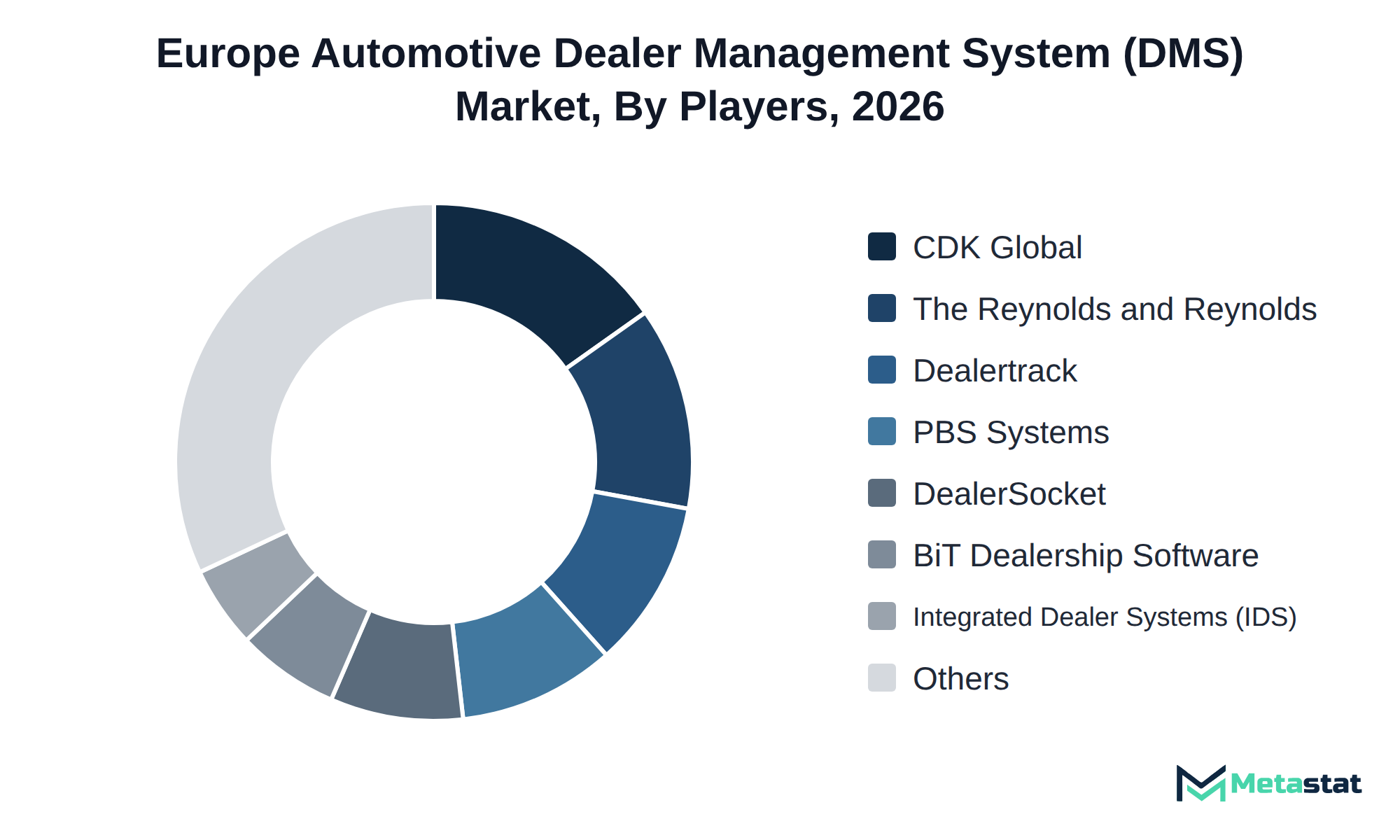
Competition within the Europe Automotive Dealer Management System (DMS) market occurs primarily through differentiation in service offerings and pricing strategies. Companies focus on various aspects, including customer relationship management capabilities, inventory management solutions, and finance functionalities. Buyers select solutions based on criteria including price, service quality, customization options, and the overall software ecosystem.
PBS Systems emphasizes integrated solutions that enhance dealer operations, while CDK Global LLC positions itself with a strong focus on customer relationship management. Dealertrack Inc. specializes in streamlining finance processes, providing a robust platform for dealerships to manage financial transactions effectively. Each company targets specific buyer needs, shaping its offerings to address particular market segments.
With various players operating in the market, competition intensifies as companies seek to capture larger shares. The involvement of firms including Integrated Dealer Systems (IDS) and The Reynolds and Reynolds Company illustrates the diverse approaches within the market, reflecting their tailored solutions to meet the demands of large dealership groups and medium-sized dealerships. This strategic diversity drives innovation and responsiveness to evolving buyer expectations.
Several key developments will help the Europe Automotive Dealer Management System (DMS) market reach its projected value of USD 3,199.3 million by 2033. The growth of cloud-based solutions is projected to significantly enhance market penetration, with an expected CAGR of 6.9% from 2026 to 2033. The increasing need for Customer Relationship Management applications, anticipated to grow at a CAGR of 6.2%, will drive adoption among dealerships. However, potential economic downturns or fluctuations in consumer spending pose risks, potentially slowing down investments in DMS solutions. This dynamic highlights the importance of maintaining effective growth strategies within the sectors served by the market.
By Deployment: Cloud-based, On-premise
By Application: Customer Relationship Management, Dealer Tracking, Inventory Management, Finance, Sales, Others (Service and Repair Management, Warranty and Claims Management, Human Resources and Payroll Management, Document Management)
By End-User: Large Dealership Groups, Medium-Sized Dealerships, Small Dealerships
By Region: UK, Germany, France, Italy, Rest of Europe
The report strategically identifies and profiles the key market players and analyses their core competencies in each sub-segment of the Automotive Dealer Management System (DMS) market.
|
Report Attributes |
Details |
|
Study Period |
2021-2033 |
|
Base Year |
2025 |
|
Estimated Year |
2026 |
|
Forecast Period |
2026-2033 |
|
Historical Period |
2021-2025 |
|
Growth Rate |
CAGR 6.0% from 2026 to 2033 |
|
Revenue Unit |
USD million |
|
Segmentation |
By Deployment, Application, End-User, Region, and Region |
Find answers to common questions about this report
The Automotive Dealer Management System (DMS) market size was valued at USD 2,015.4 million in 2025.
The market is projected to grow at a CAGR of 6.0% during the forecast period from 2026 to 2033.
The leading segment in the Automotive Dealer Management System (DMS) market is On-premise, with a projected value of USD 1,946.7 million by 2033. This segment surpasses others in terms of total value.
Enhanced operational efficiency and improved customer relationship management drive growth in the market. Large dealership groups increasingly adopt cloud-based solutions to meet their complex needs and leverage advanced data analytics.
High costs associated with the implementation and maintenance of Automotive Dealer Management Systems restrict adoption among small and medium-sized dealerships. Compliance costs related to increasing regulatory requirements surrounding data security and operational standards present a significant challenge for suppliers.
Enhanced operational efficiency and improved customer relationship management drive adoption among large dealership groups in the Europe Automotive Dealer Management System (DMS) market. The transition to cloud-based solutions supports scalability and integration, addressing the complex needs of extensive dealership networks.
The Automotive Dealer Management System (DMS) market is estimated to reach a valuation of USD 3,199.3 million by 2033.
Key players operating in the Automotive Dealer Management System (DMS) market include PBS Systems, Information Systems Ltd., BiT Dealership Software, Inc., Blue Skies Business Solutions Inc., CDK Global LLC, DealerSocket, Dealertrack Inc., and The Reynolds and Reynolds Company.
Cloud-based DMS solutions are expected to grow at a compound annual growth rate of 6.9% through 2033, reflecting the increasing demand for scalable and efficient management systems.
Large dealership groups are projected to reach USD 1,658.2 million by 2033, showcasing a compound annual growth rate of 6.8% from USD 1,046.7 million in 2026.
The analysts below cover Automotive and Transportation research at Metastat Insights.
LEAD ANALYST
Utkarsh Khirodkar is a Lead Market Research Analyst at MetaStat Insight, specializing in market intelligence, technology sector assessments, and competitive strategy.

ENERGY & INFRASTRUCTURE INDUSTRY CONSULTANT
Automotive and Transportation · Electronics and Semiconductor · Energy and Power · Machinery & Equipment
Saurabh Vasant Ganvir consults for Energy & Infrastructure Industry at MetaStat Insight, specializing in renewable energy, solar EPC, and electric vehicle (EV) infrastructure markets.
Tracking ceramic matrix composite adoption in high-bypass aero engines requires strict attention to material qualification cycles and FAA airworthiness testing milestones. The MetaStat Insight team provided a detailed timeline of silicon carbide fiber manufacturing capacity and commercial foundry lead times. Having clear visibility into upstream thermal barrier coating supply helped us stress-test our long-term component procurement strategy.
Transitioning ultra-class mining haul trucks to alternative power requires concrete data on remote hydrogen refueling infrastructure economics. The report evaluated megawatt-scale electrolyzer installation expenses, onsite storage safety mandates, and heavy-duty fuel cell stack degradation under continuous duty cycles. That technical rigor helped our engineers benchmark realistic total operating cost horizons for off-highway fleet decarbonization.
Enterprise zero-trust network rollouts are often slowed down by multi-cloud transit latency and proprietary hardware retirement schedules. This study provided realistic total cost of ownership models comparing cloud-delivered security edge solutions against traditional hardware refreshes. The analysis of contract renewal lengths and software maintenance fees gave us clear visibility into enterprise replacement cycles over the next three to five years.
Explore related market intelligence reports worth reading alongside this one.
Starting from
$2950