
LEAD ANALYST
Utkarsh Khirodkar is a Lead Market Research Analyst at MetaStat Insight, specializing in market intelligence, technology sector assessments, and competitive strategy.

South Africa Iron and Steel Market Size, Share, By Product Type (Flat Steel Products, Long Steel Products, Steel Tubes and Pipes, Semi-Finished Iron and Steel Products, Iron and Steel Castings and Others), By Iron Production Technology (Blast Furnace Process, DRI Process and Other Production Technologies), By Steel Production Technology (Basic Oxygen Furnace, Electric Arc Furnace and Other Production Technologies), By End-Use Industry (Construction and Infrastructure, Manufacturing and Engineering, Mining and Mineral Processing, Automotive and Transport Equipment, Energy and Power Generation, Oil and Gas, Agriculture and Farm Equipment, Packaging and Consumer Goods and Others), Industry Analysis, Growth, Trends, and Forecast, 2026-2033
Report ID
MSI-5492
Published
October, 2026
Pages
266 Pages
Format
Historical
Base year
Forecast
Forecast period
Report Details
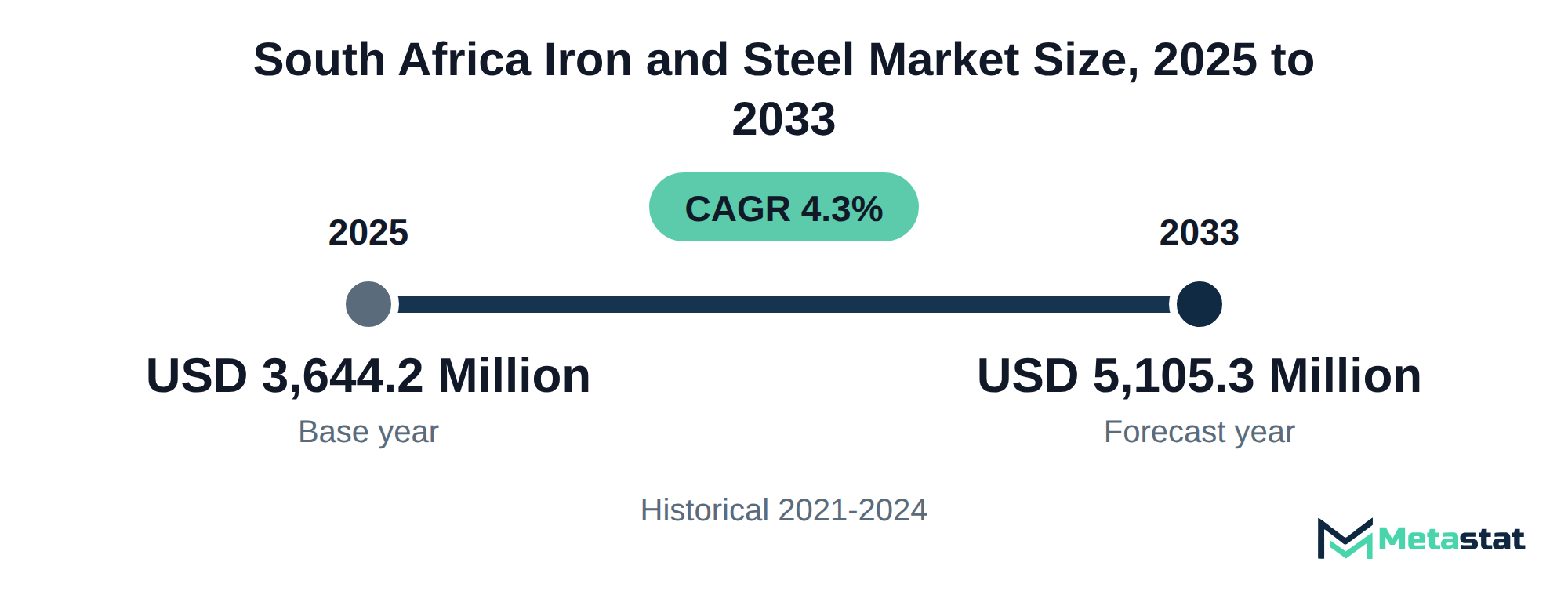
Market Valuation: Valued at $3,644.2 Million in 2025, projected to reach $5,105.3 Million by 2033 at a 4.3% CAGR.
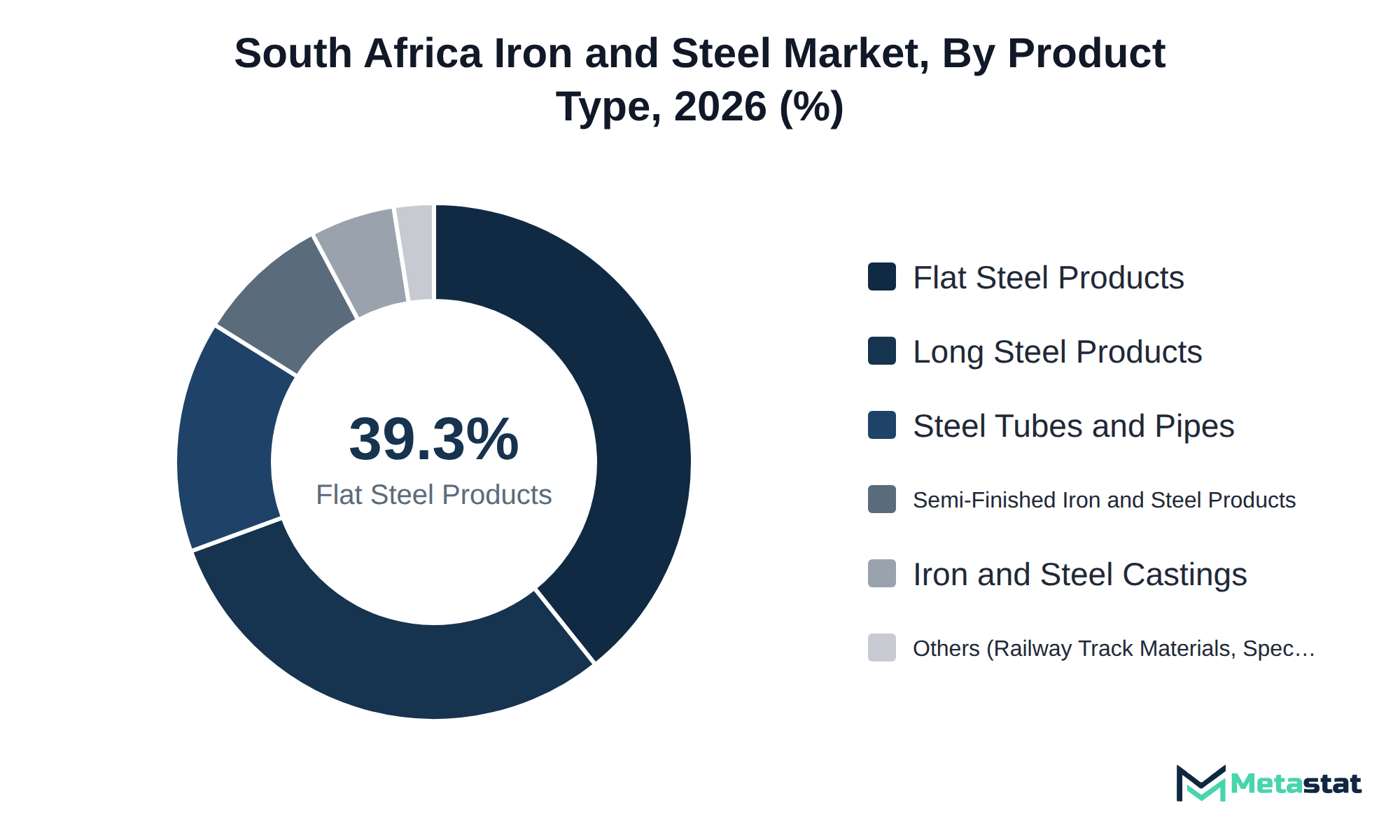
Dominant Segment: Flat steel products lead the South Africa Iron and Steel market, driven by their essential role in construction and manufacturing applications. This segment's growth is fueled by ongoing infrastructure projects and increased demand for high-quality materials.
Geographic Lead: South Africa is the primary market for iron and steel, benefiting from local production capabilities and strategic investments in infrastructure. This environment attracts both domestic and international buyers, enhancing market dynamics.
What's Inside: The report includes a comprehensive analysis of market segmentation by product type, production technology, and end-use industries, along with competitive insights and a forecast window extending to 2033.
Rising Electric Arc Furnace Adoption: The Electric Arc Furnace segment is set to grow significantly, reaching USD 2,130.4 million by 2033, driven by a shift towards sustainable production methods and reduced carbon emissions.
Infrastructure Development Demand: Infrastructure development and mining activities are key drivers for long and flat steel products, with the construction and infrastructure segment projected to grow from USD 1,207.3 million in 2026 to USD 1,666.4 million by 2033.
Choose Your License
South Africa Iron and Steel Market
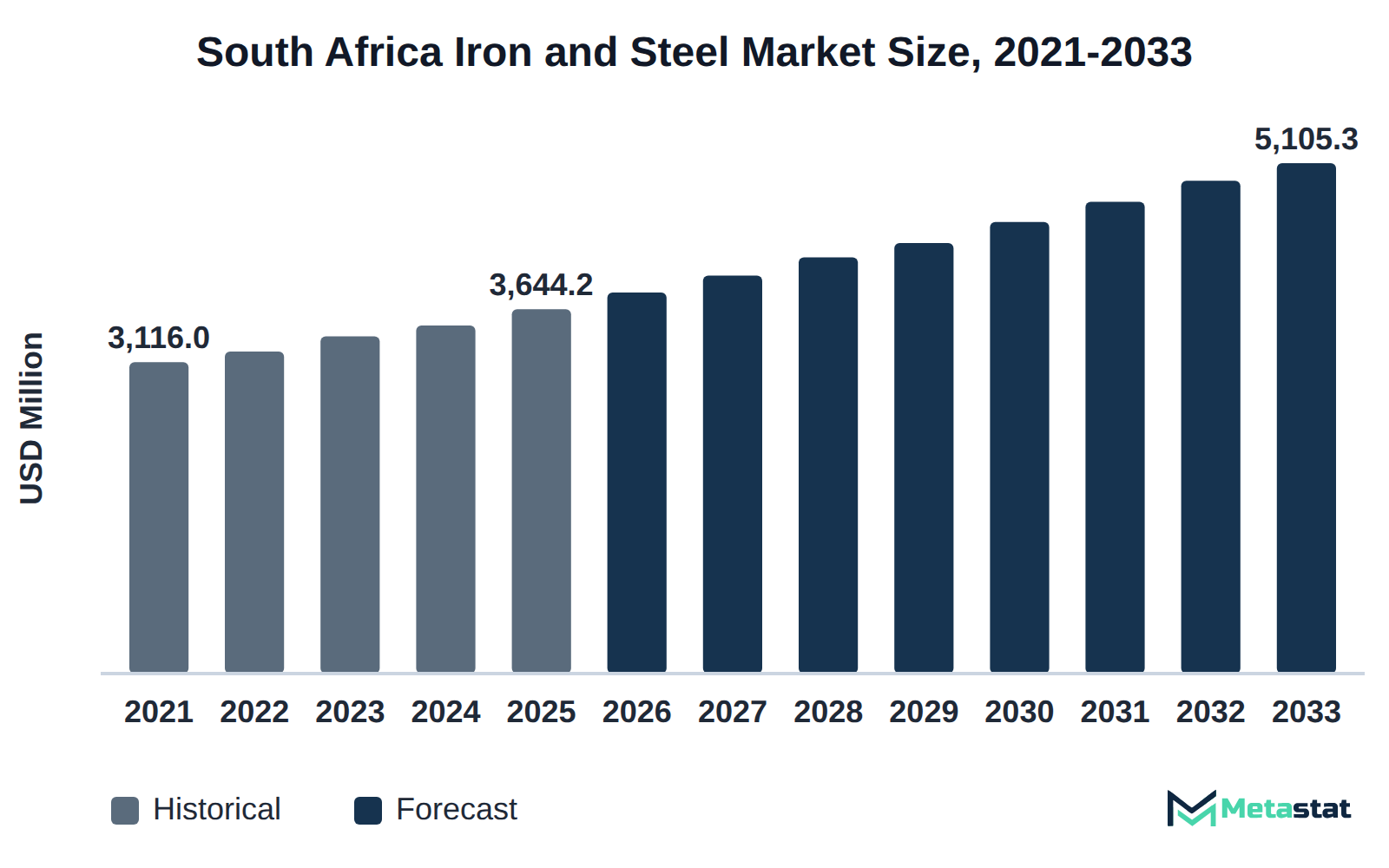
The South Africa Iron and Steel market was valued at USD 3,644.2 million in 2025 and is projected to reach USD 5,105.3 million by 2033, growing at a CAGR of 4.3% over the forecast period.
The South Africa Iron and Steel market encompasses the production and distribution of various iron and steel products, serving essential industries including construction, manufacturing, and automotive. Buyers invest in this market to secure high-quality materials that meet specific requirements for durability and structural integrity. Demand for these products is driven by ongoing infrastructure projects and the need for robust construction materials, which significantly influences purchasing decisions.
Growth in the market is primarily attributed to increasing investments in construction and infrastructure development. The flat steel products segment holds the largest value, reflecting its critical role in various applications across different industries. While the market experiences growth across various regions, South Africa stands out due to a combination of local production capabilities and strategic investments in infrastructure, attracting significant interest from both domestic and international buyers.
One key driver of expansion in the market is the rise in construction activities fueled by government initiatives and private sector investments. These developments create robust demand for iron and steel products, ensuring a steady market trajectory. The market's growth reflects an overall positive outlook, supported by ongoing trends in urbanization and industrialization.
The market serves a wide range of sectors, with significant spending driven by the need for high-quality materials in construction and manufacturing. Flat steel products represent the largest segment in terms of value, reflecting the increased demand for versatile applications across various industries. Buyers prioritize durability and performance, leading to investments in advanced steel production technologies that enhance product quality and meet stringent industry standards.
Growth in the South Africa Iron and Steel market is influenced by several factors, including rising urbanization and infrastructure development. The construction and infrastructure sector stands out as a primary driver, reflecting ongoing demand for residential, commercial, and industrial projects. The availability of innovative steel products supports this trend, reinforcing the market's function in facilitating large-scale projects and contributing to economic development.
Investment in sustainable production methods and green steel technologies, including the Direct Reduced Iron (DRI) process, supports the market's expansion. This process offers improved energy efficiency and lower emissions, aligning with global efforts towards sustainability. While regulations around environmental impact tighten, the adoption of cleaner technologies positions the market for future growth, ensuring it remains competitive in an evolving landscape.
The Electric Arc Furnace (EAF) technology, which relies on EAF transformers, is gaining traction in the South Africa Iron and Steel market, driven by an increasing focus on sustainable production methods. The EAF process employs scrap steel as the primary raw material, resulting in a reduction of carbon emissions compared to traditional blast furnace methods. This shift aligns with global trends towards greener production technologies and supports growing regulatory pressures for environmental responsibility.
By 2033, the Electric Arc Furnace segment is expected to reach a value of USD 2,130.4 million, reflecting a compound annual growth rate (CAGR) of 5.9%. This rapid growth highlights the industry's ongoing transformation, catering to evolving consumer preferences for sustainable products. The EAF technology offers flexibility for steelmakers to respond to fluctuating scrap prices, allowing for improved operational efficiency.
Producers adopting EAF technology position themselves competitively in a market that increasingly prioritizes environmental stewardship. This technology enhances production efficiency and demonstrates commitment to sustainable practices, making companies more attractive to environmentally conscious consumers and investors.
Steel imports significantly influence domestic manufacturing dynamics within the South Africa Iron and Steel market. The presence of lower-priced steel from international suppliers exerts pressure on local manufacturers, forcing them to adjust pricing strategies to remain competitive. For instance, the projected CAGR for Flat Steel Products stands at 4.7% from 2026 to 2033, indicating robust demand; however, this growth occurs against a backdrop of increasing import volumes.
Import competition often results in contracted margins for domestic producers, especially those relying heavily on traditional pricing models. Ongoing volatility in global steel prices presents challenges for local manufacturers in sustaining profitability without sacrificing quality or service levels. Buyers seeking cost-effective solutions leverage this competitive landscape to negotiate favorable terms with suppliers.
Consequently, the emphasis on flexible pricing contracts and dynamic payment structures gains importance. Manufacturers increasingly adopt innovative pricing strategies, including fixed contracts with price review clauses and flexible payment options, to attract buyers in a cost-sensitive environment. This shift to adaptable pricing models aims to balance competitive pressures while ensuring profitability and long-term sustainability within the market.
Infrastructure development and mining sector activities drive substantial demand for long and flat steel products in the South Africa Iron and Steel market. The construction and infrastructure segment is projected to grow from USD 1,207.3 million in 2026 to USD 1,666.4 million by 2033, reflecting a compound annual growth rate of 4.7%. This growth stems from increased government investments and private sector initiatives focused on improving transportation networks, housing projects, and mining infrastructure.
Mining companies require significant quantities of long and flat steel products for the construction of processing plants, machinery, and transport systems. The evolving landscape in the mining sector, driven by expansion projects and the need for upgraded facilities, contributes to the rising demand for these steel products. Consequently, suppliers and manufacturers are positioned to benefit from this trend, enhancing their market presence and revenue streams.
Continued investments in infrastructure and mining not only boost demand for long and flat steel products but signal robust opportunities for stakeholders within the South Africa Iron and Steel market. Industry participants focused on these segments stand to gain from increasing order volumes and the potential for strategic partnerships with construction and mining firms.
The rising costs of energy and the urgent need for decarbonization significantly affect the South Africa Iron and Steel market. The DRI Process, which is expected to reach a value of USD 748.9 million by 2033, offers a more sustainable method of iron production compared to traditional methods. This technology reduces greenhouse gas emissions, aligning production with global environmental standards while responding to the growing demand for cleaner manufacturing processes.
Producers adopting the DRI Process enhance their competitive position while addressing regulatory requirements. The market's shift towards more sustainable technologies is driven by government policies and consumer preferences for environmentally friendly products. Companies investing in innovative production technologies position themselves favorably for future growth.
In this context, the South Africa Iron and Steel market presents opportunities for firms to invest in advanced production methods that optimize energy use and comply with decarbonization goals. With an expected CAGR of 7.4% for the DRI Process, businesses that embrace these changes anticipate operational efficiency and a favorable reception in an evolving market driven by sustainability.
Construction and infrastructure development significantly boost demand for steel products. Current trends indicate a growing emphasis on infrastructure projects, with buyers from the construction sector increasing their spending on steel, which is essential for structural integrity and durability. The demand for flat steel products is projected to expand from USD 1,506.1 million in 2026 to USD 2,074.3 million by 2033, reflecting a compound annual growth rate of 4.7%. This uptick in expenditure results from a heightened focus on urbanization and housing projects, which directly influences the volume of steel products consumed. Buyers increasingly prioritize high-quality materials to meet construction standards, leading to upward pressure on both volume and pricing. The South Africa Iron and Steel market stands to benefit from this robust demand trajectory, with construction activities leading to increased investments in steel production and supply chains.
The adoption of the Direct Reduced Iron (DRI) Process influences production efficiency within the South Africa Iron and Steel market. This technology, which emphasizes the reduction of iron ore in a solid state, provides significant advantages in terms of lower energy consumption and reduced carbon emissions compared to traditional methods. The rising focus on sustainability within the manufacturing sector drives interest in the DRI Process due to its ability to produce higher-quality iron with fewer impurities.
Producers leveraging this advanced technology gain a competitive edge in the marketplace, responding to the increasing demand for environmentally friendly practices. The anticipated growth in DRI Process adoption aligns with a broader industry trend toward innovative solutions that enhance both operational performance and environmental responsibility. Overall, the evolution of iron production technologies, including DRI, is expected to support continued expansion in the market, meeting the needs of various end-use industries.
Escalating energy costs present a significant constraint on the South Africa Iron and Steel market. Energy-intensive production processes, including the Blast Furnace and Electric Arc Furnace methods, experience increasing operational expenses, which limit profit margins. The manufacturing and engineering sectors, reliant on steel products, face rising prices that impact their purchasing decisions. Higher costs result in smaller order volumes and delayed projects, affecting overall market demand. These factors contribute to slower growth within the market, with buyers seeking to mitigate expenses by exploring alternative materials or suppliers. For many in the construction and infrastructure sectors, the increased cost of steel impacts project budgets, prompting reconsideration of material choices and timelines. Efficient energy use technologies are critical in maintaining competitiveness and ensuring sustained operations in the face of rising costs.
Rising input costs present a significant challenge for suppliers within the South Africa Iron and Steel market. Factors including increased prices for raw materials, including iron ore and scrap steel, contribute to higher production expenses. Suppliers face pressure to maintain profit margins while navigating these rising costs, which restrict operational flexibility and investment in growth initiatives. In response, several suppliers adopt advanced production technologies to enhance efficiency and reduce waste, aiming to offset rising input costs. Investment in process improvements focuses on optimizing resource utilization and driving down long-term operational expenses. Negotiating long-term contracts with suppliers of raw materials and exploring alternative sourcing strategies serves to stabilize input costs, providing a competitive edge. Adaptive strategies remain critical for suppliers seeking to sustain profitability in a challenging cost environment.
The Direct Reduced Iron (DRI) Process segment presents a significant opportunity within the South Africa Iron and Steel market. With a projected compound annual growth rate (CAGR) of 7.4%, this segment is expected to reach a value of USD 748.9 million by 2033. Growing demand for cleaner production methods aligns with the global shift towards sustainability and lower carbon emissions. Industries focusing on steel production benefit from increased efficiency and reduced environmental impact through DRI technology. The transition towards this method appeals to buyers in manufacturing and construction who prioritize sustainable practices. Companies adopting this technology strengthen their competitive position and enhance overall profitability. The DRI Process meets evolving market demands and supports the broader vision of decarbonization within the industry. This shift influences investment strategies and market dynamics across various sectors.
The South Africa Iron and Steel market is segmented based on Product Type, Iron Production Technology, Steel Production Technology, and End-Use Industry.
This segment serves industries including construction, automotive, and manufacturing, providing essential materials for structural applications, vehicle production, and machinery components. Key drivers for demand include ongoing infrastructure projects and the expansion of manufacturing capabilities. This segment demonstrates a faster growth trajectory compared to Long Steel Products, which has a CAGR of 3.7%. The need for lightweight and high-strength materials in automotive applications further enhances the flat steel sector. Competitive pricing and innovative production technologies play crucial roles in maintaining market relevance and capturing additional demand within the South Africa Iron and Steel market.
Long Steel Products segment is estimated to reach USD 1,465.7 million by 2033, at a CAGR of 3.7% during the forecast period. This segment finds usage primarily in construction and infrastructure projects, with buyers ranging from general contractors to specialized engineering firms. Demand is driven by ongoing infrastructure projects across various sectors, reflecting significant investment in public and private developments. The growth of this segment remains steady, positioned between Flat Steel Products, which achieve a higher growth rate of 4.7%, and Steel Tubes and Pipes. Price fluctuations in raw materials impact the profitability of long steel products, affecting supplier margins. Demand for long steel products is anticipated to remain stable, supported by the expansion of the construction industry and investment in infrastructure development in the South Africa Iron and Steel market.
Steel Tubes and Pipes segment is expected to reach USD 784.7 million by 2033. This segment primarily serves industries including construction, manufacturing, and automotive, offering essential products for various applications, including fluid transport and structural support. Demand is driven by infrastructure projects and a growing automotive sector that require durable and high-performance materials. With a CAGR of 3.7%, growth within this segment remains steady compared to Flat Steel Products, which has a higher CAGR of 4.7%. The competitive pricing of steel tubes and pipes differentiates this segment from others, presenting opportunities for manufacturers to capitalize on emerging markets. Efficient production methods and innovations in design contribute to maintaining relevant supply levels in the market while adapting to changing buyer preferences.
Semi-Finished Iron and Steel Products is projected to grow at a CAGR of 3.2% during the forecast period. This segment provides raw material for various manufacturing processes, particularly for construction and engineering applications. Industries including manufacturing and automotive rely on semi-finished products for their structural integrity and reliability. Demand is driven by ongoing infrastructure development and the continuous need for durable materials in construction projects. Compared to other product types, this segment experiences slower growth, evidenced by its CAGR of 3.2%, in contrast to Flat Steel Products, which shows stronger growth at a CAGR of 4.7%. This differentiates semi-finished products from segments with higher growth potential, influencing pricing dynamics and buyer preferences within the South Africa Iron and Steel market.
Iron and Steel Castings serve critical roles in various industries, providing components essential for manufacturing processes and construction applications. Commonly used in the automotive and machinery sectors, these castings are produced using iron and steel, meeting the requirements for strength and durability. Demand for this segment is influenced by factors including the growth of the manufacturing sector and ongoing investments in infrastructure projects. Compared to other product types, Iron and Steel Castings experience varied growth dynamics. This segment typically requires specialized production techniques, often resulting in higher costs. While Flat Steel Products and Long Steel Products dominate in volume and market size, Iron and Steel Castings target niche applications, appealing to specific buyer segments that prioritize quality and performance over cost. The South Africa Iron and Steel market adapts to address these diverse needs across its sub-segments.
Others (Railway Track Materials, Specialty Steel Products) encompasses specific steel items used primarily in transportation and infrastructure projects. These products find applications in railway construction, such as steel rail installation and maintenance, serving industries including transportation and logistics. Demand for this segment sees growth driven by infrastructure investments aimed at enhancing rail networks. Unique requirements for durability and safety in railway applications result in a different pricing structure compared to general steel products. This segment experiences slower growth relative to others, influenced by the pace of infrastructure development policies. The specialized nature of these products limits the buyer base to companies focused on rail and heavy-duty construction projects. Overall, the distinct characteristics and applications of this segment set it apart from more generic steel offerings.
Blast Furnace Process segment is valued at USD 2,643.6 million in 2026 and is projected to reach USD 3,327.6 million by 2033, at a CAGR of 3.3% during the forecast period. This process is essential for producing pig iron and is widely used in various industries, including construction and automotive. Demand for this segment is primarily driven by the increasing need for high-quality steel products, which find applications in infrastructure projects and vehicle manufacturing. Compared to other iron production technologies, the Blast Furnace Process exhibits slower growth, reflecting a more mature operational model. In contrast, the Direct Reduced Iron (DRI) Process, with a CAGR of 7.4%, highlights a shift towards more efficient and environmentally friendly production methods. Competitive pricing and the established nature of the Blast Furnace Process continue to attract investment, contributing to the overall growth in the South Africa Iron and Steel market.
This process is primarily employed in the production of direct reduced iron, which acts as a key input material for steel manufacturing. Industries including construction and automotive heavily apply DRI in their operations due to its efficiency and reduced carbon footprint compared to traditional methods. The increasing emphasis on sustainable production methods drives adoption, positioning this segment for significant growth. Compared to other iron production technologies, the DRI Process demonstrates a higher growth rate, reflecting a shift toward greener alternatives, while the Blast Furnace Process is projected to grow at a CAGR of 3.3%. This difference highlights the market's evolving preferences toward environmentally friendly production technologies.
Other Production Technologies segment is expected to reach USD 1,028.7 million by 2033. This segment encompasses various alternative methods for iron production that do not fall within conventional categories like the Blast Furnace or Direct Reduced Iron processes. Industries including manufacturing and engineering apply these technologies for specific applications, particularly where unique material properties are required. Demand for these technologies is driven by the growing emphasis on flexible production processes and sustainability. Compared to the Blast Furnace Process, which shows a CAGR of 3.3%, Other Production Technologies exhibit a slower growth rate, aligning with niche market needs rather than mainstream applications. Buyers often seek differentiated products and lower energy consumption, positioning this segment favorably for targeted customer bases. The South Africa Iron and Steel market reflects increasing investments toward diverse production methodologies, creating a favorable environment for innovation and adaptation in the manufacturing landscape.
Basic Oxygen Furnace segment is valued at USD 2,174.9 million in 2026 and is projected to reach USD 2,661.9 million by 2033, at a CAGR of 2.9% during the forecast period. This technology primarily serves the manufacturing of steel products for various industries, including construction, automotive, and heavy machinery. Demand from the construction and infrastructure sectors drives the adoption of this technology, with companies seeking high-quality steel for structural applications. The Basic Oxygen Furnace segment experiences a slower growth rate compared to the Electric Arc Furnace segment, which offers higher adaptability and lower operational costs, reflecting a shift in market preferences. Price sensitivity remains a critical factor, influencing buyer decisions across the market. Consequently, the Basic Oxygen Furnace segment's projected growth highlights its sustained relevance despite competitive pressures from alternative steel production technologies.
This production technology primarily serves industries focused on manufacturing high-quality steel products, including automotive and construction. The increasing emphasis on sustainability and energy efficiency drives the adoption of Electric Arc Furnaces, which recycle scrap metal and are less energy-intensive compared to traditional methods. This segment experiences faster growth compared to the Basic Oxygen Furnace, which demonstrates a CAGR of 2.9%, highlighting the shift towards more environmentally friendly production processes. Demand for Electric Arc Furnace technology arises from buyers seeking flexibility in production and a reduced carbon footprint. The market's evolution towards advanced steel production methods positions the Electric Arc Furnace as an essential technology in the South Africa Iron and Steel market.
This segment includes various innovative methods for steel production, typically employed by manufacturers seeking alternative processes that enhance efficiency. Demand for these technologies derives from the need for lower emissions and reduced energy consumption, aligning with sustainability goals within the industry. Compared to the Basic Oxygen Furnace and Electric Arc Furnace segments, Other Production Technologies exhibit slower growth, influenced by limited adoption among traditional manufacturers. This segment's CAGR of 4.3% reflects the gradual shift towards more sustainable production methods, while the market's overall growth trajectory is projected to remain robust.
This segment supplies vital building materials for construction projects, infrastructure development, and civil engineering applications. Typically, construction firms, property developers, and public agencies use steel and iron products for structural integrity and durability. A primary driver of growth involves increased investment in infrastructure projects across South Africa, reflecting government initiatives aimed at enhancing public services. Compared to other segments, this one experiences relatively strong growth, outperforming segments including Manufacturing and Engineering, which is projected to grow at a CAGR of 3.9%. The demand for reliable and high-quality materials significantly influences the market, promoting the exploration of innovative production technologies to meet evolving industry requirements.
Manufacturing and Engineering segment is estimated to reach USD 1,093 million by 2033, at a CAGR of 3.9% during the forecast period. This segment encompasses a range of applications vital for producing various goods and machinery used in multiple sectors, including consumer products, industrial equipment, and machinery components. Growth in this segment aligns with increased activity in manufacturing, driven by rising consumer demand for durable goods and investments in industrial capacity. This segment reflects slower growth compared to others, largely due to market maturity and competitive pricing pressures. While the Flat Steel Products segment shows a higher CAGR of 4.7%, the Manufacturing and Engineering segment maintains its importance due to its diverse applications and consistent need for steel materials, positioning it strategically within the South Africa Iron and Steel market.
The Mining and Mineral Processing segment is expected to reach USD 690.7 million by 2033. This segment focuses on providing essential iron and steel products used in the extraction and processing of minerals. Key players in this sector include mining companies and operators of mineral processing plants that use steel for machinery, infrastructure, and transportation needs. The demand for iron and steel in this segment is driven by ongoing developments in mining operations and the need for robust materials to withstand harsh environments. Compared to other segments, including Construction and Infrastructure, which is projected to grow at a CAGR of 4.7%, the Mining and Mineral Processing segment exhibits a slower growth trajectory, reflecting a more stable market influenced by global commodity prices and mining regulations. The market continues to adjust to fluctuations in demand, ensuring that suppliers remain competitive while addressing the specific requirements of mining operations.
Automotive and Transport Equipment is projected to grow at a CAGR of 4.9% during the forecast period. This segment is essential in the production of vehicles and transportation systems, serving manufacturers of cars, trucks, and public transport vehicles. Demand for high-strength steel in automotive applications drives growth within this segment, aligning with increasing automotive production in South Africa. The necessity for lightweight materials that enhance fuel efficiency further fuels adoption among manufacturers. Compared to other segments, Automotive and Transport Equipment exhibits stronger growth potential, driven by trends in environmentally friendly vehicles and technological advancements in production processes. The market benefits from innovations in materials and manufacturing techniques, improving product quality while reducing costs.
Energy and Power Generation involves using steel products for constructing and maintaining energy infrastructure, including power plants and renewable energy installations. Utilities and energy companies rely on this segment to support their operations, ensuring efficient energy generation and distribution. Increased focus on sustainable energy initiatives drives demand for advanced steel solutions that meet regulatory standards. This segment stands out due to its higher growth potential compared to other segments within the End-Use Industry, reflecting a shift towards renewable sources and energy efficiency. Demand is fueled by government policies promoting clean energy, while fluctuations in raw material costs impact pricing strategies. The South Africa Iron and Steel market recognizes this segment's crucial role in transitioning towards more sustainable energy practices, positioning it distinctively among industrial applications.
Oil and Gas represents a vital sector relying on steel products for infrastructure development and equipment manufacturing. This segment primarily serves companies involved in exploration, extraction, and transportation of oil and gas resources. Demand drivers include increasing global energy requirements and ongoing investments in energy infrastructure. Heightened focus on renewable energy sources impacts traditional oil and gas operations, leading to evolving dynamics in supplier relationships. Compared to other segments, this sector features distinctive pricing pressures linked to fluctuating commodity prices. The South Africa Iron and Steel market continues to adapt to these changes, reflecting the evolving landscape of energy production and consumption.
Agriculture and Farm Equipment comprises essential agricultural machinery and tools used in farming operations, enabling increased productivity and efficiency in agricultural activities. This segment caters to farmers, agricultural businesses, and equipment manufacturers. Demand is driven by the ongoing need for advanced machinery that enhances productivity and reduces labor costs in the sector. Rising agricultural output requires robust equipment to keep pace with production. Compared to other segments, this segment experiences a unique dynamic, with specific buyers focusing on technology that supports sustainable practices and efficiency improvements. The Agriculture and Farm Equipment segment stands out due to its connection to agricultural innovations that influence equipment design and functionality. The South Africa Iron and Steel market benefits from this segment's developments, with enhanced agricultural practices creating a consistent demand for high-quality steel products that are essential for equipment manufacturing.
Packaging and Consumer Goods involves the use of steel products for various applications, including packaging materials and containers, such as tinplate cans. Industries including food and beverage, pharmaceuticals, and consumer electronics rely on durable and lightweight materials to enhance product safety and shelf life. Demand for innovative packaging solutions influences this segment significantly, driven by consumer preferences for sustainable and eco-friendly alternatives. Compared to other segments, Packaging and Consumer Goods experiences distinct dynamics, with an emphasis on customization and flexibility. This sector requires adaptability to shifts in consumer behavior, setting it apart from more traditional steel applications. The growth potential in this segment aligns with broader sustainability goals, promoting the use of recyclable materials, which continues to attract investment across the South Africa Iron and Steel market.
Railway equipment and industrial machinery represent a specialized category that requires high-quality steel products for durability and performance. Several industries use these materials to construct essential components, including locomotives and other rolling stock, rail tracks, and machinery used in heavy industries. Demand for this segment is driven by increasing investments in infrastructure development and modernization projects across the region. Ongoing advancements in manufacturing technology enhance production efficiency, further supporting demand. Compared to other segments, this category often experiences slower growth due to the specific requirements of machinery and equipment manufacturing, which necessitate higher material quality and specialized production techniques. The South Africa Iron and Steel market continues to evolve, focusing on meeting the unique needs of this niche sector.
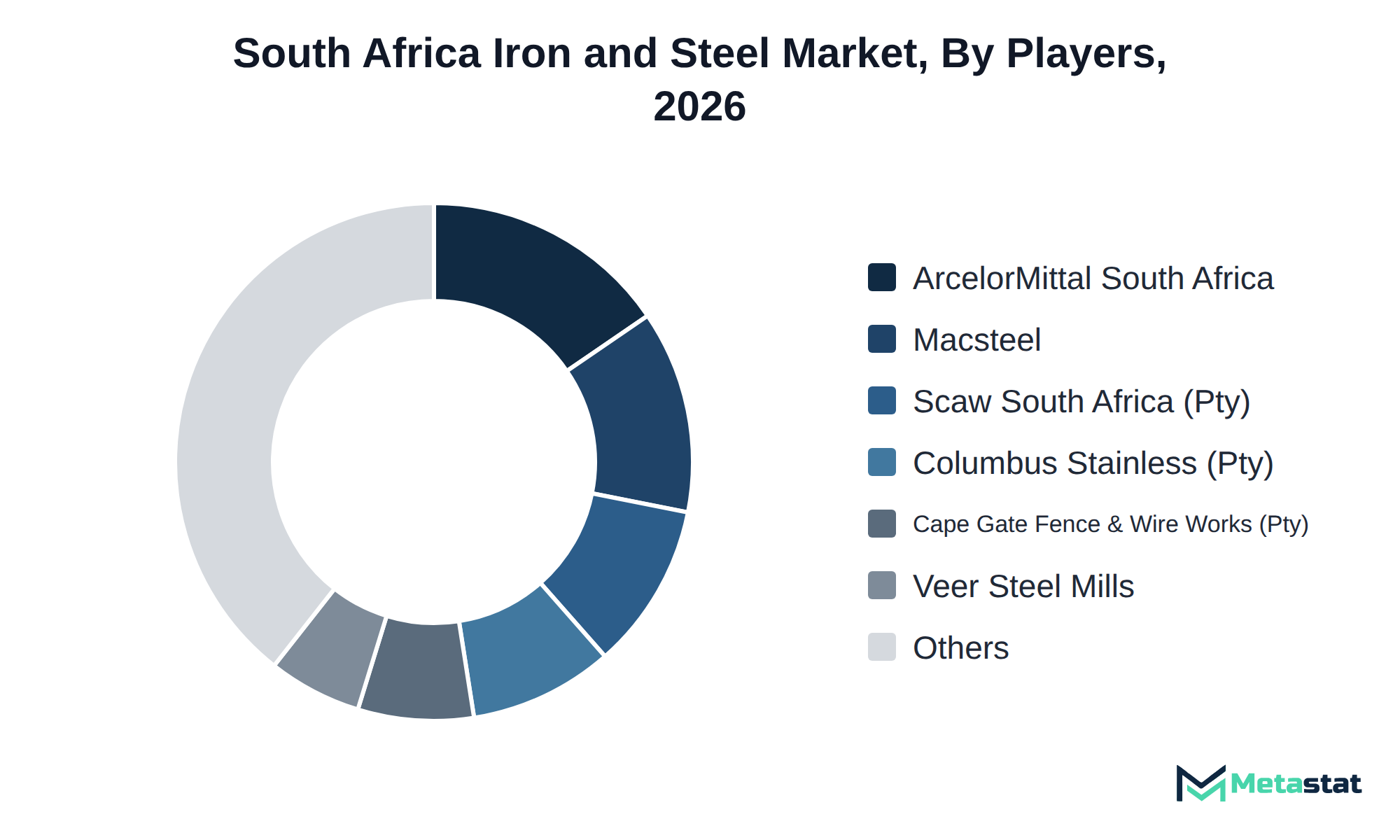
Competition within the South Africa Iron and Steel market occurs across several dimensions, including product type, pricing strategies, and customer service. Companies focus on establishing strong supply chains and enhancing the quality of their offerings to differentiate themselves, while buyers prioritize factors including price, certification, customization, and service levels.
ArcelorMittal South Africa Limited operates in flat and long steel product offerings, leveraging its extensive production capabilities and established market presence. Scaw South Africa (Pty) Ltd emphasizes its diverse product range, particularly in semi-finished steel products, catering to various industries. Columbus Stainless (Pty) Ltd specializes in stainless steel products, addressing niche markets that demand high-quality materials.
Key developments essential for reaching this figure include advancements in Steel Tubes and Pipes production, which is expected to capture significant demand from the automotive and transport equipment sector. The increasing focus on infrastructure projects will drive demand for Flat Steel Products, contributing to overall market growth. The adoption of Electric Arc Furnace technology presents an opportunity for efficiency improvements in production processes, further enhancing competitiveness in the South Africa Iron and Steel market.
However, risks including fluctuating raw material prices and geopolitical factors could hinder progress. Economic stability, particularly in the manufacturing and engineering industries, influences demand for various steel products. A downturn in these sectors could impede the anticipated growth trajectory. Overall, achieving the forecasted market size will depend on leveraging technological advancements, maintaining competitive pricing, and ensuring stability within key end-use industries.
By Product Type: Flat Steel Products, Long Steel Products, Steel Tubes and Pipes, Semi-Finished Iron and Steel Products, Iron and Steel Castings, Others (Railway Track Materials, Specialty Steel Products)
By Steel Production Technology: Basic Oxygen Furnace, Electric Arc Furnace, Other Production Technologies
By End-Use Industry: Construction and Infrastructure, Manufacturing and Engineering, Mining and Mineral Processing, Automotive and Transport Equipment, Energy and Power Generation, Oil and Gas, Agriculture and Farm Equipment, Packaging and Consumer Goods, Others (Railway Equipment and Industrial Machinery)
The report strategically identifies and profiles the key market players and analyses their core competencies in each sub-segment of the Iron and Steel market.
Report Attributes | Details |
Study Period | 2021-2033 |
Base Year | 2025 |
Estimated Year | 2026 |
Forecast Period | 2026-2033 |
Historical Period | 2021-2025 |
Growth Rate | CAGR 4.3% from 2026 to 2033 |
Revenue Unit | USD million |
Segmentation | By Product Type, Iron Production Technology, Steel Production Technology, End-Use Industry, and Region |
Find answers to common questions about this report
The Iron and Steel market size was valued at USD 3,644.2 million in 2025.
The market is projected to grow at a CAGR of 4.3% during the forecast period from 2026 to 2033.
Flat Steel Products leads the Iron and Steel market with a projected value of USD 2,074.3 million by 2033, reflecting the highest growth among the product segments.
Construction and infrastructure development significantly boosts demand for steel products, driven by increased spending on urbanization and housing projects. The adoption of the Direct Reduced Iron (DRI) Process enhances production efficiency and aligns with the growing focus on sustainability within the manufacturing sector.
Escalating energy costs and rising input costs significantly restrain growth in the South Africa Iron and Steel market. Energy-intensive production processes face increasing operational expenses that limit profit margins, while higher prices for raw materials challenge suppliers, restricting operational flexibility and investment in growth initiatives.
The adoption of the Direct Reduced Iron (DRI) Process in the South Africa Iron and Steel market is favored by its projected compound annual growth rate of 7.4% and the increasing demand for cleaner production methods. This technology enhances production efficiency while aligning with global sustainability trends, appealing to industries focused on reducing carbon emissions.
The Iron and Steel market is estimated to reach a valuation of USD 5,105.3 million by 2033.
Key players operating in the Iron and Steel industry include ArcelorMittal South Africa Limited, Scaw South Africa (Pty) Ltd, Columbus Stainless (Pty) Ltd, Cape Gate Fence & Wire Works (Pty) Ltd, Veer Steel Mills, Unica Iron and Steel, and Safal Steel.
The projected value of flat steel products is USD 2,074.3 million by 2033, reflecting a compound annual growth rate of 4.7 percent.
The Direct Reduced Iron Process is expected to grow at a compound annual growth rate of 7.4 percent, reaching a value of USD 748.9 million by 2033.
The analysts below cover Chemicals and Materials research at Metastat Insights.
LEAD ANALYST
Utkarsh Khirodkar is a Lead Market Research Analyst at MetaStat Insight, specializing in market intelligence, technology sector assessments, and competitive strategy.

INDUSTRY CONSULTANT - CHEMICALS & ADVANCED MATERIALS
Chemicals and Materials · Machinery & Equipment · Packaging
Amit Gadhekar Consultant for Chemicals and Materials at MetaStat Insight, directing sector-specific intelligence, research, and strategic consulting across global chemical and processing markets.
Decarbonizing industrial thermal processes hinges on refrigerant regulations and compressor efficiency limits. Metastat Insights delivered a thorough market analysis that evaluated natural refrigerants like CO2 and hydrocarbons against synthetic low-GWP alternatives. The breakdown of utility incentives and grid capacity constraints across key European manufacturing hubs offered valuable perspective. The follow-up conversation with their sector analysts addressed our specific questions on mechanical vapor recompression systems efficiently.
Assessing 200mm wafer transition schedules and substrate supply bottlenecks requires precise technical intelligence. MetaStat Insight supplied an actionable breakdown comparing planar and trench MOSFET architectures across automotive and industrial drive markets. The regional capacity estimates for Asia-Pacific foundries helped clarify lead-time uncertainties during our strategic planning session. When we needed additional clarification on high-purity raw material sourcing, their analyst team responded with helpful context within twenty-four hours.
Tracking maintenance cycle demand for secondary flight display units and terrain collision avoidance systems across regional jet fleets involves complex aftermarket dynamics. MetaStat Insight provided practical analysis separating airline retrofit programs from OEM forward-fit production schedules in North America and Southeast Asia. The supplier matrix highlighted component obsolescence timelines without resorting to vague generalizations. The dataset served as a dependable reference during our annual program review meetings.
Explore related market intelligence reports worth reading alongside this one.