
LEAD ANALYST
Utkarsh Khirodkar is a Lead Market Research Analyst at MetaStat Insight, specializing in market intelligence, technology sector assessments, and competitive strategy.

Global Cocoa Market Size, Share, By Product Type (Cocoa Beans and Nibs, Cocoa Butter, Cocoa Powder and Cake, Cocoa Liquor and Mass), By Cocoa Type (Conventional Cocoa and Certified Organic Cocoa), By Application (Chocolate and Confectionery, Bakery Products, Beverages, Dairy and Frozen Desserts, Cosmetics and Personal Care), By Sales Channel (Direct Sales, Distributors and Wholesalers, Online and Retail Sales), Industry Analysis, Growth, Trends, and Forecast, 2026-2033
Report ID
MSI-5708
Published
November, 2026
Pages
267 Pages
Format
Historical
Base year
Forecast
Forecast period
Report Details
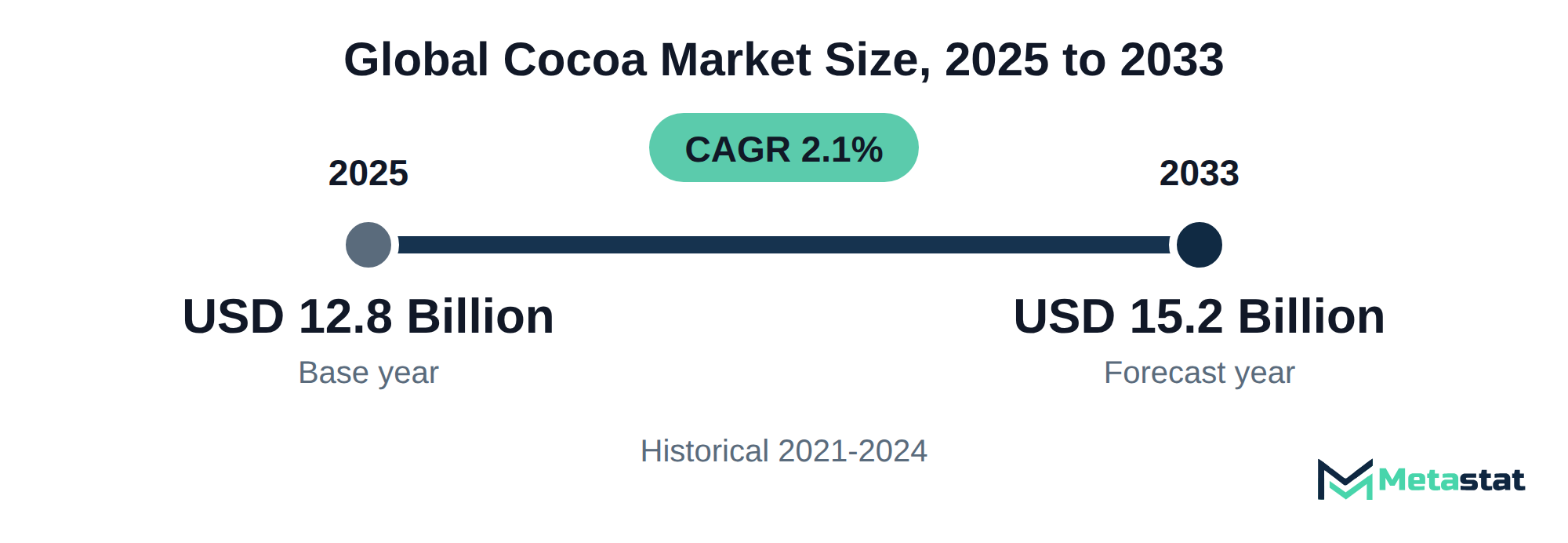
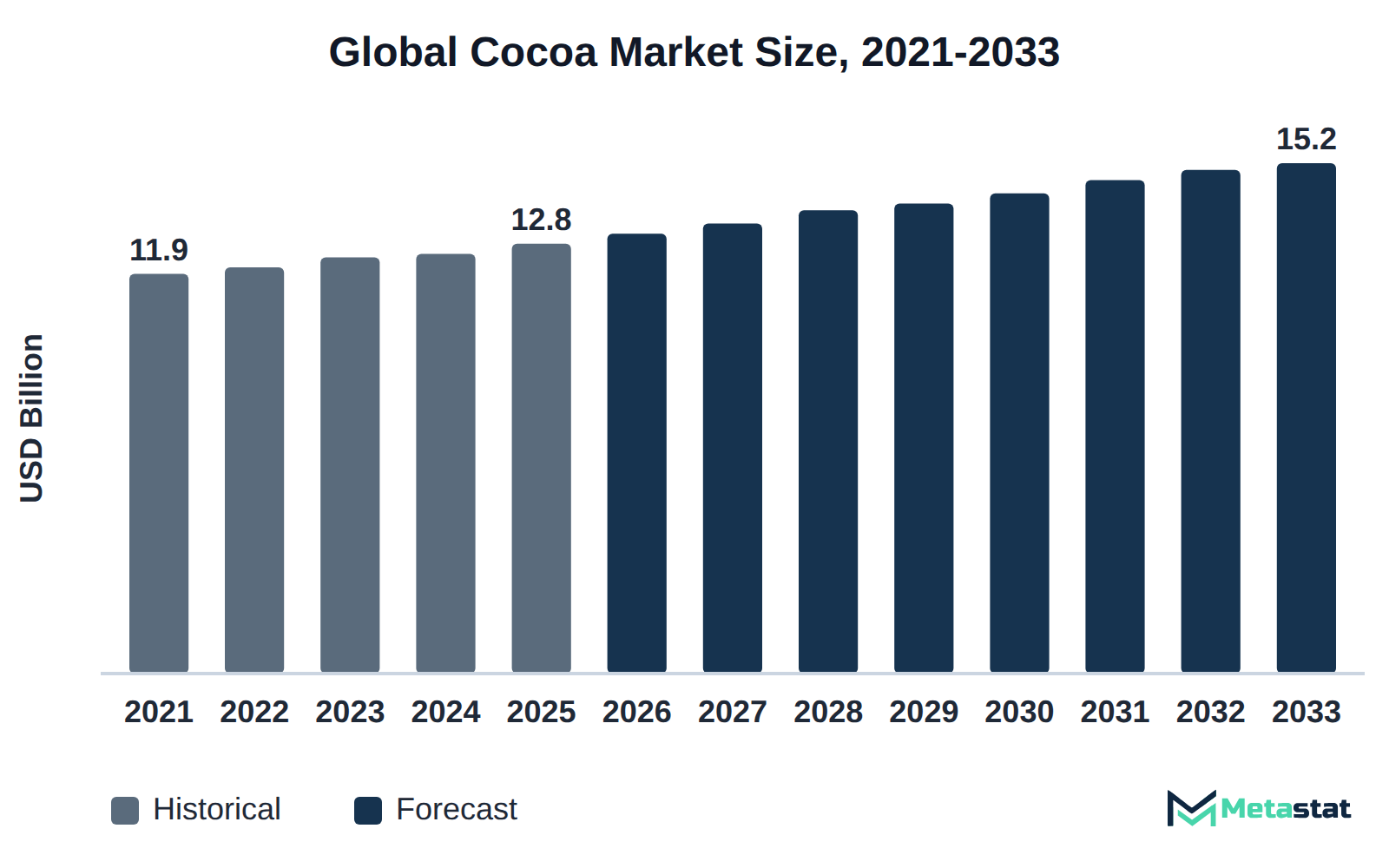
Market Valuation: Valued at $12.8 Billion in 2025, projected to reach $15.2 Billion by 2033 at a 2.1% CAGR.
Dominant Segment: The chocolate and confectionery segment leads the market, driven by increasing consumer demand for premium cocoa products and innovative flavor profiles.
Geographic Lead: North America is the leading region, holding 22.3% of the market share in 2025, with the U.S. projected to maintain its dominance due to strong consumer preferences for cocoa-based products.
What's Inside: The report provides comprehensive competitive coverage, detailed analyses of market dynamics, and forecasts extending to 2033, enabling informed decision-making for stakeholders.
Cocoa Butter Growth Opportunity: Cocoa butter is projected to reach USD 5.3 billion by 2033, reflecting strong demand in both food and cosmetic applications, particularly among consumers seeking natural ingredients.
Emerging Plant-Based Cocoa Alternatives: The rise of plant-based cocoa alternatives is reshaping consumer preferences, appealing to health-conscious buyers and driving innovation within the market.
Choose Your License
Global Cocoa Market
The global Cocoa market was valued at USD 12.8 billion in 2025 and is projected to reach USD 15.2 billion by 2033, growing at a CAGR of 2.1% over the forecast period.
The Cocoa market encompasses a wide range of products derived from cocoa beans, catering to various applications, including chocolate and confectionery, bakery products, and beverages. Buyers invest in this market primarily due to increasing consumer demand for cocoa-based products, which serve essential ingredients in many food and beverage categories. The rising trend toward premium and organic cocoa products further drives expenditure in this sector, reflecting changing consumer preferences toward quality and sustainability.
Growth within the market is propelled by several factors, with the chocolate and confectionery segment representing the largest share of value. North America holds 22.3% of the market in 2025, with the US leading in 2026. The Asia Pacific region follows closely, capturing 27.5% of the market share. The increasing popularity of cocoa in diverse applications, including beverages and health-oriented products, fuels this growth, aligning with global health and wellness trends.
In addition to regional dynamics, the rise in premium cocoa products contributes significantly to market expansion. Certified organic cocoa demonstrates a strong growth trajectory, driven by heightened consumer awareness surrounding health and environmental impact. The overall market is projected to grow steadily, supported by evolving consumer behaviors and preferences.
The cocoa market includes many products, and investment is driven by consumer preferences for high-quality chocolate and confectionery items. Buyers prioritize cocoa ingredients due to their versatility in various applications, enhancing flavor and texture in baked goods and beverages. The growing trend towards organic and sustainable sourcing further influences purchasing decisions, with consumers increasingly seeking out ethically produced cocoa products.
Growth within the market is primarily fueled by the rising demand for chocolate and confectionery products, especially in the Asia Pacific region, which accounts for 27.5% of the market share. The segment of cocoa butter represents the highest value among product types, experiencing robust demand due to its essential role in chocolate production and cosmetic applications.
Increasing consumer awareness of health benefits associated with cocoa consumption supports market expansion. Product formulation innovation contributes to new offerings that meet evolving consumer preferences. Ongoing research and development by key players supports sustained growth throughout the forecast period.
Cocoa bean supply faces significant challenges due to changing climate conditions and agricultural practices. Fluctuations in weather patterns directly impact yield, with cocoa production in West Africa, which accounts for 70% of global production, particularly vulnerable. Adverse weather events including droughts or excessive rainfall lead to lower output and increased costs for consumers in the cocoa market.
In response to these challenges, farmers increasingly adopt precision agriculture technologies. This shift enables better management of soil health and crop monitoring, which enhances overall productivity. Cocoa butter is projected to reach USD 5.3 billion by 2033, reflecting the importance of maintaining supply levels to meet growing demand. Investments in technology by producers improve operational efficiency and mitigate risks associated with supply volatility.
The ongoing price volatility in the cocoa market requires buyers to stay informed about production trends. Fluctuations in supply could lead to unpredictable pricing, impacting profit margins across various applications, including chocolate and confectionery. Stakeholders need to understand the dynamics of cocoa bean supply and price volatility.
Price transparency significantly influences purchasing behavior in the Cocoa market, particularly for cocoa butter, powder, and liquor in food manufacturing. Current pricing trends indicate that cocoa butter is expected to reach USD 5.3 billion by 2033, reflecting a compound annual growth rate of 2.3%. This growth prompts buyers to engage in strategic contract negotiations to secure favorable terms.
Typically, food manufacturers opt for long-term contracts that provide price stability and predictability. These contracts often incorporate fixed pricing agreements, allowing companies to manage costs effectively while minimizing exposure to market volatility. Buyers increasingly seek multi-year agreements that include clauses for periodic price adjustments linked to global cocoa prices. This approach mitigates risk and aligns procurement strategies with market dynamics.
Spot purchasing represents an alternative for manufacturers aiming to capitalize on short-term market fluctuations. This option often entails higher prices, making it less appealing for high-volume producers. The balance between long-term contracts and spot purchases directly impacts operational margins and financial planning. Understanding the pricing framework and contract models is essential for stakeholders in the food manufacturing sector, influencing overall market growth and competitiveness.
Traceability in cocoa supply chains has emerged as a critical concern among manufacturers and consumers alike, reflecting heightened awareness regarding ethical sourcing practices. With an increasing number of consumers prioritizing sustainability, cocoa producers face pressure to adopt transparent sourcing methodologies that ensure ethical cultivation. The cocoa market offers potential in certified organic cocoa, projected to reach USD 1.5 billion by 2033, growing at a compound annual growth rate (CAGR) of 4.6%. This trend highlights an opportunity for suppliers to differentiate themselves by demonstrating compliance with sustainable practices.
Sustainable sourcing strategies enhance brand value and build consumer loyalty. Manufacturers that implement robust traceability systems strengthen their market position by establishing trust with consumers increasingly scrutinizing the origins of cocoa products. The focus on sustainable practices facilitates access to premium markets, often resulting in higher profit margins. A commitment to ethical sourcing positions companies advantageously in the competitive landscape, driving demand for responsibly sourced cocoa and ultimately influencing overall market growth.
Cocoa processing significantly influences the supply and pricing of key ingredients in the industry. For instance, in the segment of cocoa butter, the anticipated market value reaches USD 5.3 billion by 2033, driven by increasing demand in food applications. Cocoa butter is essential in chocolate production, acting as a primary fat source that impacts the texture and melting point of the final product. This ingredient's pricing is closely linked to its availability, which is contingent on the efficiency of cocoa processing methods. Enhanced processing techniques improve yield rates, allowing suppliers to offer more competitively priced products in the cocoa market.
The processing of cocoa liquor and mass plays a critical role in determining overall ingredient costs. This segment exhibits a compound annual growth rate (CAGR) of 1.8%, indicating steady demand for cocoa liquor, primarily in chocolate production. Fluctuations in cocoa bean prices directly influence the costs of cocoa liquor, thereby impacting the profit margins for manufacturers. Efficient processing techniques, including fermentation and roasting, enhance flavor and quality, supporting higher retail prices. Processors who adapt to market trends through innovation in processing benefit from improved supply chain management and pricing strategies.
Demand for chocolate products has surged among consumers, driven by evolving dietary preferences and the growing popularity of premium offerings. This shift has led to increased purchases from manufacturers focused on chocolate and confectionery applications. Consumers seek high-quality ingredients and innovative flavor profiles; manufacturers respond by enhancing their product offerings to align with these trends. In 2025, revenue from chocolate and confectionery applications accounted for USD 7.5 billion, with projections indicating growth to USD 8.5 billion by 2033. This demand affects pricing, production strategies, and investment in cocoa sourcing. Manufacturers are investing in sustainable practices to meet consumer expectations, which further reinforces the demand dynamics in the cocoa market.
Increased consumer interest in health-conscious alternatives has contributed to the growing demand for chocolate products. Chocolate has become a favored ingredient in various applications; manufacturers are adapting their strategies to capitalize on this trend, ensuring a stable growth trajectory for the market.
Innovation in plant-based alternatives to traditional cocoa products drives a notable shift in consumer preferences, with significant implications for the Cocoa market. The growing interest in health-conscious and environmentally sustainable options prompts manufacturers to explore substitutes that replicate flavor and texture. These alternatives appeal to vegan consumers and attract health-focused buyers seeking lower-calorie or allergen-free options. The rise in plant-based ingredients reflects a broader trend toward diversification in food products, compelling suppliers to adapt their offerings to maintain competitive edges.
This transition supports market expansion by engaging a wider audience, particularly among younger demographics prioritizing health and sustainability. Suppliers investing in research and development of these alternatives position themselves favorably within the evolving competitive landscape. With increasing acceptance of plant-based diets, the demand for these innovative cocoa substitutes is projected to strengthen, influencing traditional cocoa production and pricing structures. Existing players must adapt to changing consumer expectations.
Fluctuations in cocoa prices create uncertainty for manufacturers and retailers, particularly those in the chocolate and confectionery sector. This price volatility results in hesitancy when committing to larger orders, influencing procurement strategies and delaying potential investments in new product lines. Manufacturers often opt for smaller, more frequent purchases to mitigate risk, which restricts overall market growth. Price instability impacts budgeting and financial forecasting, leading many companies to exercise caution in purchasing decisions.
Retailers face similar challenges; fluctuating prices affect their ability to maintain competitive pricing for consumers. The Cocoa market experiences slower adoption of new products and innovations due to these financial constraints. Retailers prioritize stability in supply chains, which leads to a preference for established suppliers who offer consistent pricing and reliable delivery schedules. This environment hampers expansion opportunities for newer entrants in the market.
Input cost pressures stemming from fluctuating prices of raw materials impact profitability for suppliers in the Cocoa market. The demand for high-quality ingredients, particularly in the chocolate and confectionery segments, increases pressure on suppliers to secure cost-effective sources. Fluctuations in global cocoa prices and increasing costs associated with sustainable sourcing strategies strain margins further. In response, many suppliers focus on optimizing their supply chains and enhancing operational efficiencies to maintain competitive pricing. Investments in technology and innovation enable suppliers to reduce production costs and improve processing capabilities. Collaborative efforts within the supply chain, including partnerships with farmers, support these objectives while ensuring quality standards are met. Anticipated growth in the market relies on the ability of suppliers to navigate these challenges while adapting to evolving consumer preferences for premium and sustainable cocoa products.
The market presents significant growth potential in the cocoa butter segment, driven by increasing demand in both food and cosmetic applications. The rising popularity of natural ingredients in personal care products, alongside a surge in premium chocolate offerings, fuels this demand. Consumers prefer cocoa butter for its moisturizing properties and its role in enhancing product quality.
Manufacturers focusing on this segment leverage the growing trend toward clean label and organic products. This shift aligns with the market's movement toward certified organic cocoa, projected to achieve a CAGR of 4.6% through 2033. Companies that invest in sustainable sourcing and transparent supply chains improve their competitive advantage. The cocoa butter segment remains an essential area for strategic growth within the cocoa market, reflecting broader consumer trends and preferences.
The Global Cocoa market is segmented based on Product Type, Cocoa Type, Application, and Sales Channel.
Cocoa Beans and Nibs segment is valued at USD 2.4 billion in 2026 and is projected to reach USD 2.6 billion by 2033, at a CAGR of 1.4% during the forecast period. This segment is essential in the production of chocolate and confectionery products. Manufacturers in these sectors rely on cocoa beans and nibs for their flavor, texture, and nutritional properties. Increasing consumer awareness of health benefits associated with cocoa products drives demand for this segment. Compared to other segments, including Cocoa Butter, which has a CAGR of 2.3%, Cocoa Beans and Nibs exhibit slower growth. This slower trajectory reflects a more stable pricing environment, while other components experience greater price volatility, leading to different buyer behavior across the segments. Sustainable sourcing trends also shape buying patterns among socially conscious consumers.
This segment finds extensive use in both food products and cosmetics, catering primarily to manufacturers of chocolate and confectionery items, and personal care products. The rising demand for high-quality and natural ingredients drives the growth of cocoa butter, particularly among consumers who prioritize clean-label products. Compared to other segments, cocoa butter experiences moderate growth; however, its pricing is higher due to quality considerations and sourcing challenges. The increasing trend toward healthier and organic formulations significantly influences this segment, positioning it well against alternatives that do not offer the same sensory and functional properties. The cocoa market benefits from new applications of cocoa butter that track consumer preferences.
Cocoa Powder and Cake is projected to reach USD 4.5 billion by 2033. This segment serves various applications, particularly within chocolate and confectionery products, appealing to manufacturers requiring high-quality ingredients for flavor enhancement. Demand for this segment experiences growth driven by increasing consumer interest in healthier and premium options. The CAGR for Cocoa Powder and Cake aligns with trends in sweet treats, differing from Cocoa Butter, which has a faster CAGR of 2.3%. Consumer preferences for lower-calorie chocolate options push manufacturers to innovate, thereby supporting sustained growth in this segment. The Cocoa Powder and Cake segment meets diverse food industry demand and supports overall growth in the Cocoa market.
Cocoa Liquor and Mass is projected to grow at a CAGR of 1.8% during the forecast period. This segment primarily serves the chocolate and confectionery industry, providing essential ingredients for manufacturing various products. Increasing demand for premium chocolate and the surge in health-conscious consumers favoring darker chocolate varieties drive growth in this sub-segment. Compared to Cocoa Butter and Cocoa Powder segments, Cocoa Liquor and Mass presents slower growth, evidenced by its 1.8% CAGR, contrasting with Cocoa Butter's 2.3% growth rate. While the premiumization trend influences all cocoa products, Cocoa Liquor and Mass appeals predominantly to a niche market focused on high-quality chocolate, resulting in varying price points and consumer preferences. The market continues to evolve, reflecting changing dietary habits and preferences.
Conventional Cocoa segment is valued at USD 12.1 billion in 2026 and is projected to reach USD 13.8 billion by 2033, at a CAGR of 1.9% during the forecast period. This cocoa type finds extensive use in the production of chocolate and confectionery products, favored by manufacturers due to its cost-effectiveness and widespread availability. Demand for conventional cocoa is primarily driven by sustained growth in the chocolate industry, where affordability and bulk supply play crucial roles. Unlike certified organic cocoa, which experiences a higher growth rate of 4.6%, conventional cocoa presents a more stable supply chain, appealing to larger producers focused on mass production. The conventional cocoa segment's growth reflects the market's balance between premium offerings and accessibility, allowing it to cater to diverse consumer preferences.
This segment serves primarily in the production of premium chocolate and confectionery items, attracting health-conscious consumers and those seeking sustainable sourcing options. Increasing awareness regarding the benefits of organic products enhances demand, particularly among manufacturers focused on sustainability. Compared to its counterparts, Certified Organic Cocoa exhibits a faster growth trajectory, driven by rising consumer preference for organic ingredients and ethical sourcing practices. The commitment to organic certification often results in higher pricing compared to conventional cocoa, reflecting the increased costs associated with organic farming practices. This pricing structure appeals to a specific demographic willing to pay a premium for perceived higher quality and environmental friendliness, differentiating it from other segments.
Chocolate and Confectionery segment is valued at USD 7.5 billion in 2026 and is projected to reach USD 8.5 billion by 2033, at a CAGR of 1.8% during the forecast period. This segment serves various applications, primarily in the production of chocolate products and confections consumed by a wide range of consumers. The demand for chocolate products experiences growth, driven by evolving dietary preferences, particularly towards premium offerings. This segment demonstrates slower growth compared to others, including Certified Organic Cocoa, which has a CAGR of 4.6%. Pricing fluctuations for raw materials pose challenges, impacting profit margins for manufacturers. In contrast to segments like Bakery Products, which are expected to achieve a CAGR of 2.4%, Chocolate and Confectionery shows stable demand characteristics that reflect consistent consumer interest in confectionery items.
Bakery Products segment is estimated to reach USD 2.4 billion by 2033, at a CAGR of 2.4% during the forecast period. This segment primarily serves the food industry, particularly manufacturers of baked goods, pastries, and snack items that incorporate cocoa for flavor and texture. Consumer trends toward indulgent treats and the increasing popularity of artisanal and premium baked goods drive demand for cocoa in this category. Compared to other segments, Bakery Products experiences slower growth, influenced by the competitive nature of the baked goods market and the availability of substitutes including fruit flavorings. The rising focus on health-conscious options, including lower-sugar and gluten-free products, presents opportunities for innovation within this segment. The Cocoa market reflects a diverse landscape where Bakery Products continue to hold significant relevance while adapting to evolving consumer preferences.
The Beverages segment is expected to reach USD 1.8 billion by 2033. This segment finds extensive applications in the beverage industry, particularly in the production of chocolate-flavored drinks, cocoa-infused beverages, and dairy alternatives. Increasing consumer interest in specialty and artisanal beverages drives demand within this segment. The rapid growth of the health and wellness trend influences product development, pushing manufacturers to innovate with healthier options that integrate cocoa. Compared to other segments, including Chocolate and Confectionery, which is projected to grow at a CAGR of 1.8%, the Beverages segment has distinct characteristics, with varying growth rates driven by consumer preferences and emerging market trends. In contrast with Bakery Products, where the segment is expected to reach USD 2.4 billion by 2033 with a CAGR of 2.4%, Beverages stands out with a unique focus on enhancing flavor profiles and nutritional benefits in drink formulations, appealing to health-conscious consumers.
Dairy and Frozen Desserts segment is projected to grow at a CAGR of 2.5% during the forecast period. This segment serves various applications including ice creams, yogurts, and other frozen treats, appealing to consumers who prioritize indulgence and convenience. The growing trend toward premiumization in dairy products drives demand for high-quality cocoa ingredients that enhance flavor and texture. In contrast to other segments, including Bakery Products, which targets a broader consumer base, Dairy and Frozen Desserts focuses on specific demographics seeking rich and flavorful experiences. Increasingly health-conscious consumers influencing formulation changes support the segment's growth, with manufacturers incorporating natural and organic cocoa options to cater to evolving preferences. This strategic shift aligns with trends observed in the Cocoa market, where premium offerings generate higher revenue potential.
Cosmetics and Personal Care applications incorporate cocoa for its moisturizing and antioxidant properties, appealing to manufacturers seeking natural ingredients for skincare and beauty products. This segment attracts health-conscious consumers and those preferring organic formulations. The rising demand for certified organic cocoa drives this segment, reflecting a broader trend towards sustainability and wellness in personal care. Compared to other applications, the Cosmetics and Personal Care segment often commands higher prices due to the premium nature of the products and the sourcing of organic ingredients. This segment exhibits a relatively faster growth trajectory, influenced by shifting consumer preferences towards natural and organic cosmetics, contrasting with traditional applications that focus more on food products. The ongoing shift in consumer behavior towards eco-friendly products enhances opportunities for growth in this segment, contributing positively to the overall dynamics of the cocoa market.
This sub-segment encompasses applications in pharmaceuticals and nutraceuticals, employing cocoa for its antioxidant properties and potential health benefits. Manufacturers in the health sector incorporate cocoa into products aimed at enhancing wellness and promoting healthy lifestyles. Growing consumer awareness of health and wellness significantly influences this segment, driving demand for cocoa-based ingredients perceived as beneficial. Compared to other applications, this segment typically exhibits slower growth, focusing on quality and efficacy rather than price alone. While chocolate and confectionery applications target indulgence, the pharmaceuticals and nutraceuticals segment attracts a different buyer demographic emphasizing health benefits, leading to distinct market dynamics. These factors collectively shape the market's trajectory, highlighting the importance of quality and health perceptions in driving demand.
Direct Sales segment is valued at USD 8.2 billion in 2026 and is projected to reach USD 9.6 billion by 2033, at a CAGR of 2.2% during the forecast period. This segment primarily serves manufacturers and retailers who require a direct supply of cocoa products for various applications, including chocolate production and bakery goods. Strong consumer demand for products featuring high-quality cocoa contributes to growth in this segment. Compared to other sales channels, Direct Sales offers the benefit of reduced costs associated with intermediaries, allowing for competitive pricing. The focus on product authenticity and quality has shifted several buyers toward direct purchasing, influencing market dynamics. The growth rate in Direct Sales is slower than Online and Retail Sales, which are projected to scale due to increasing e-commerce trends.
Distributors and Wholesalers segment is estimated to reach USD 4.6 billion by 2033, at a CAGR of 1.7% during the forecast period. This segment facilitates the distribution of cocoa products to various industries, including food and beverage manufacturers, bakers, and retailers. Key factors influencing this segment include rising demand for cocoa in chocolate production and expansion of retail channels, which enable broader access to end consumers. Compared to other sales channels, this segment experiences slower growth, with a CAGR of 1.7%, reflecting a more stable pricing environment. The presence of established distribution networks strengthens relationships with buyers, ensuring a reliable supply chain for cocoa products. The market relies on distributors and wholesalers to maintain consistency in product availability, supporting overall market growth.
Online and Retail Sales segment is expected to reach USD 1.1 billion by 2033. This segment serves various consumer markets, providing convenient access to cocoa products through online platforms and physical retail locations. Growth is driven by rising consumer preference for online shopping, influenced by the increasing penetration of e-commerce in different regions. Compared to other segments, growth in this category ranks higher, supported by shifting consumer behaviors and a growing inclination toward personalized shopping experiences. This segment differs from traditional sales channels, which experience more gradual growth patterns. The Cocoa market benefits from the dynamics of the Online and Retail Sales segment, reflecting broader trends in consumer purchasing habits.
Based on geography, the Global Cocoa market is divided into North America, Europe, Asia-Pacific, South America, Middle East, and Africa.
Demand in North America is supported by a strong chocolate and confectionery sector, with significant consumer interest in premium and specialty products. The region is characterized by a strong preference for high-quality cocoa, particularly in the United States, Canada, and Mexico. Sustainability initiatives play a vital role in shaping purchasing decisions, leading to increased demand for certified organic cocoa, projected to grow at a CAGR of 4.6% through 2033. North America is projected to reach USD 3.3 billion by the end of 2033, reflecting the market's focus on quality and ethical sourcing. The cocoa market in this region sees strong distribution channels, including direct sales and distributors, further enhancing accessibility for consumers. Overall growth is supported by evolving consumer preferences emphasizing health, sustainability, and taste.
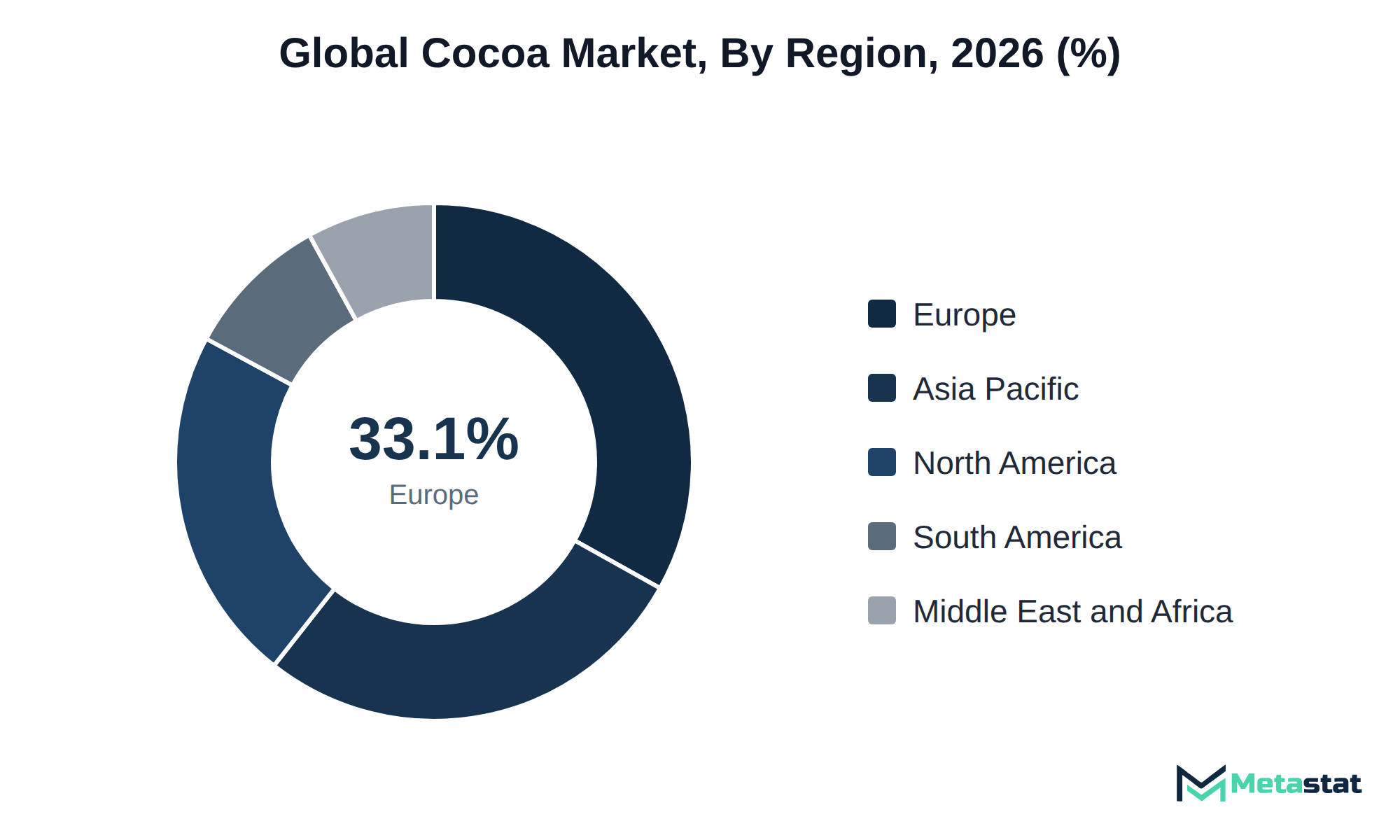
Strong demand in the Cocoa market arises from countries like Germany, France, and the UK, where chocolate and confectionery applications dominate consumption. The market benefits from a well-established infrastructure for production and distribution, facilitating access to high-quality cocoa products. A significant portion of the region's market share, 33.1% in 2025, reflects robust processing capabilities and consumer preferences for premium cocoa offerings. Regulations promoting sustainability drive the growth of certified organic cocoa, appealing to health-conscious consumers. The increasing popularity of artisanal and high-end confectionery products further drives demand for cocoa, especially in France and the UK. With a strong emphasis on quality, the market is expected to experience consistent growth through innovative product offerings and evolving consumer preferences.
Demand in the Asia-Pacific market for cocoa is driven by the growing chocolate and confectionery industries, particularly in countries including China and India. Increasing consumer preference for premium chocolate products enhances the segment's growth prospects. Infrastructure improvements in supply chain logistics and processing capabilities further improve market potential. With a market share of 27.5% in 2025, Asia-Pacific stands out for its diverse buyer base, including both large manufacturers and artisanal producers. Regulatory support for sustainable cocoa production encourages investment in certified organic cocoa, driving demand from health-conscious consumers. The cocoa market continues to evolve, reflecting regional trends in health and wellness, which significantly shape purchasing behavior.
In South America, the market experiences distinct demand driven by both Brazil and Argentina. Brazil represents a significant portion of cocoa consumption, particularly in the chocolate and confectionery sectors. The region's climate supports cocoa cultivation, enhancing production capabilities. Argentina's growing interest in gourmet and artisanal chocolate products reflects a shift in consumer preferences toward quality offerings. The region holds a notable position within the global cocoa market. Local manufacturers adapt to consumer trends by incorporating premium ingredients, influencing purchasing decisions. Infrastructure developments in transportation and logistics facilitate the distribution of cocoa products, contributing to market accessibility.
Growth in the Cocoa market within the Middle East and Africa region is fueled by increasing consumer demand for chocolate products in countries like South Africa and the UAE. The region's share of the global market is projected at 8.0% in 2025, reflecting its expanding confectionery sector. Rising awareness of health benefits associated with cocoa, particularly in organic forms, drives new product development and consumption. Significant investments in local manufacturing infrastructure enhance supply chain efficiency, contributing to market accessibility. The diverse culinary applications of cocoa across various segments, including beverages and baked goods, support overall market expansion. Industry players actively seek opportunities within this region, responding to shifting consumer preferences for quality and sustainability.
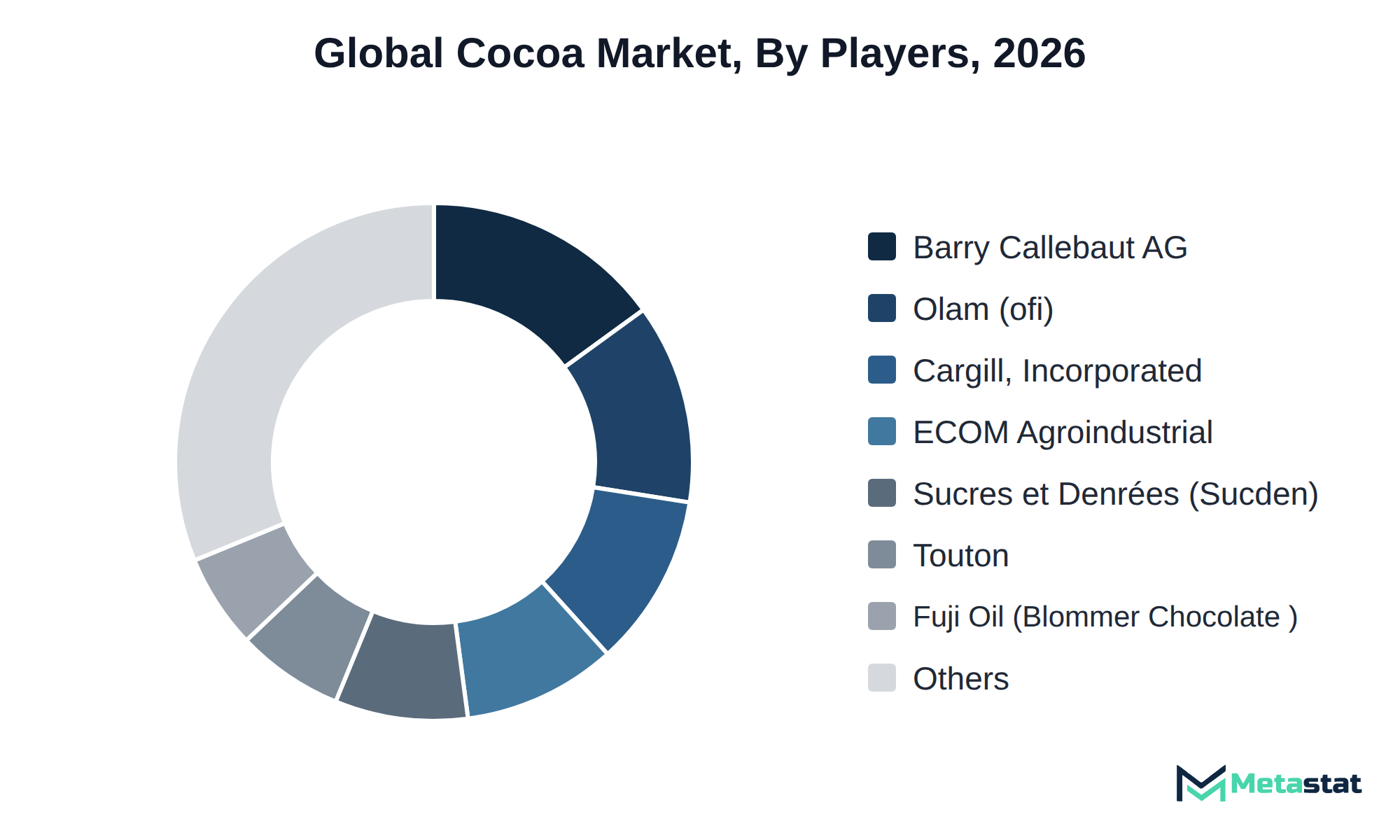
Companies in the cocoa market compete through product differentiation and pricing models. Buyers typically select suppliers based on several factors, including price, certification, customization, and overall service quality.
Olam Group Limited (ofi) emphasizes sustainability and traceability in sourcing, appealing to buyers prioritizing certified organic products. Barry Callebaut AG focuses on innovation in product formulations, offering customized solutions for the chocolate and confectionery segment. Cargill, Incorporated provides a broad range of cocoa products while leveraging economies of scale to maintain competitive pricing.
Achieving this growth relies on several key developments. First, the increasing demand for Cocoa Butter, projected to reach USD 5.3 billion by 2033, will significantly support market expansion. This demand is driven by the growing use of Cocoa Butter in various applications, particularly in chocolate and confectionery products. Second, the rise of Certified Organic Cocoa, anticipated to reach USD 1.5 billion by 2033, reflects a shift in consumer preferences toward organic and sustainable products, particularly in regions like North America and Europe. Third, growth in the Direct Sales channel, expected to increase to USD 9.6 billion by 2033, will enhance market accessibility and reach. However, risks including fluctuating cocoa prices and supply chain disruptions hinder optimal growth. These factors could impact production costs and availability, particularly in regions heavily reliant on cocoa farming.
By Product Type: Cocoa Beans and Nibs, Cocoa Butter, Cocoa Powder and Cake, Cocoa Liquor and Mass
By Cocoa Type: Conventional Cocoa, Certified Organic Cocoa
By Application: Chocolate and Confectionery, Bakery Products, Beverages, Dairy and Frozen Desserts, Cosmetics and Personal Care, Others (Pharmaceuticals, Nutraceuticals)
By Sales Channel: Direct Sales, Distributors and Wholesalers, Online and Retail Sales
The report strategically identifies and profiles the key market players and analyses their core competencies in each sub-segment of the Cocoa market.
Report Attributes | Details |
Study Period | 2021-2033 |
Base Year | 2025 |
Estimated Year | 2026 |
Forecast Period | 2026-2033 |
Historical Period | 2021-2025 |
Growth Rate | CAGR 2.1% from 2026 to 2033 |
Revenue Unit | USD billion |
Segmentation | By Product Type, Cocoa Type, Application, Sales Channel, and Region |
By Region | North America (By Product Type, Cocoa Type, Application, Sales Channel, and Country)
|
Europe (By Product Type, Cocoa Type, Application, Sales Channel, and Country)
| |
Asia Pacific (By Product Type, Cocoa Type, Application, Sales Channel, and Country)
| |
South America (By Product Type, Cocoa Type, Application, Sales Channel, and Country)
| |
Middle East and Africa (By Product Type, Cocoa Type, Application, Sales Channel, and Country)
|
Find answers to common questions about this report
The Cocoa market size was valued at USD 12.8 billion in 2025.
The market is projected to grow at a CAGR of 2.1% during the forecast period from 2026 to 2033.
The North America Cocoa market size is estimated to reach USD 3.3 billion by 2033.
Cocoa Butter leads the market with a projected value of USD 5.3 billion by 2033, distinguishing itself from other segments in terms of revenue potential.
Increasing consumer interest in health-conscious alternatives drives demand for chocolate products. Manufacturers are investing in sustainable practices to meet evolving consumer expectations, reinforcing demand dynamics in the cocoa market.
Europe holds the dominant share of the Cocoa market, accounting for 33.1 percent in 2025. This figure surpasses the shares of other regions, establishing Europe as the leading market.
Fluctuations in cocoa prices create uncertainty for manufacturers and retailers, influencing procurement strategies and delaying investments in new product lines. Input cost pressures from these price fluctuations impact profitability for suppliers, increasing the need for cost-effective sourcing and operational efficiencies.
Growing consumer interest in health-conscious alternatives and sustainable options drives the adoption of innovative cocoa substitutes. Suppliers focusing on research and development to offer plant-based ingredients position themselves advantageously in the evolving market.
The Cocoa market is estimated to reach a valuation of USD 15.2 billion by 2033.
Key players operating in the Cocoa market include Olam Group Limited (ofi), Barry Callebaut AG, Cargill, Incorporated, ECOM Agroindustrial Corp. Limited, Sucres et Denrées S.A. (Sucden), and Kokoa Kamili.
The analysts below cover Food and Beverages research at Metastat Insights.
LEAD ANALYST
Utkarsh Khirodkar is a Lead Market Research Analyst at MetaStat Insight, specializing in market intelligence, technology sector assessments, and competitive strategy.

LEAD PRINCIPAL ANALYST, PHARMA AND HEALTHCARE
Food and Beverages · Healthcare · Healthcare IT · Medical Devices
Ajay Devgire is the Lead Healthcare Analyst at MetaStat Insight, leading strategic research and market intelligence initiatives across the global healthcare domain.

SENIOR RESEARCH ANALYST
Biotechnology · Food and Beverages · Medical Devices · Packaging
Snehal Pasalkar is a Research Analyst at MetaStat Insight, operating at the intersection of life sciences research, competitive strategy, and market intelligence.
Our team was tracking whether regional recycling infrastructure could realistically absorb the growing volume of lithium iron phosphate batteries over the next decade. The report did a solid job separating announced hydrometallurgical plant capacity from active, permitted operational throughput. That distinction made the feedstock availability projections and regional recovery rate models far more credible than standard commercial overviews.
Tracking capacity expansion in single-use bioprocessing requires dependable data on raw material availability and cleanroom-grade polymer supply chains. The competitive landscape chapter gave a grounded evaluation of secondary component suppliers across North America and Asia-Pacific rather than simply reprinting press releases. Having that level of supplier benchmarking helped clarify dual-sourcing considerations for our clinical pipeline planning.
When evaluating distributed energy resource management systems, standard research summaries tend to gloss over the operational differences between front-of-the-meter utility deployments and behind-the-meter industrial sites. The MetaStat Insight report addressed those distinctions directly, especially regarding software interoperability standards and grid interconnection backlogs. The five-year market sizing across regional transmission organizations provided actionable context for our grid modernization strategy.
Explore related market intelligence reports worth reading alongside this one.