
LEAD ANALYST
Utkarsh Khirodkar is a Lead Market Research Analyst at MetaStat Insight, specializing in market intelligence, technology sector assessments, and competitive strategy.

Global Industrial Outdoor Storage (IOS) Market Size, Share, By Type (Storage Containers, Open Yards, Racks and Shelving Systems), By Industry (Logistics and Transportation, Construction, E-commerce, Automotive, Municipal Services), By Revenue Source (Sale and Rent), Industry Analysis, Growth, Trends, and Forecast, 2026-2033
Report ID
MSI-3482
Published
October, 2026
Pages
259 Pages
Format
Historical
Base year
Forecast
Forecast period
Report Details
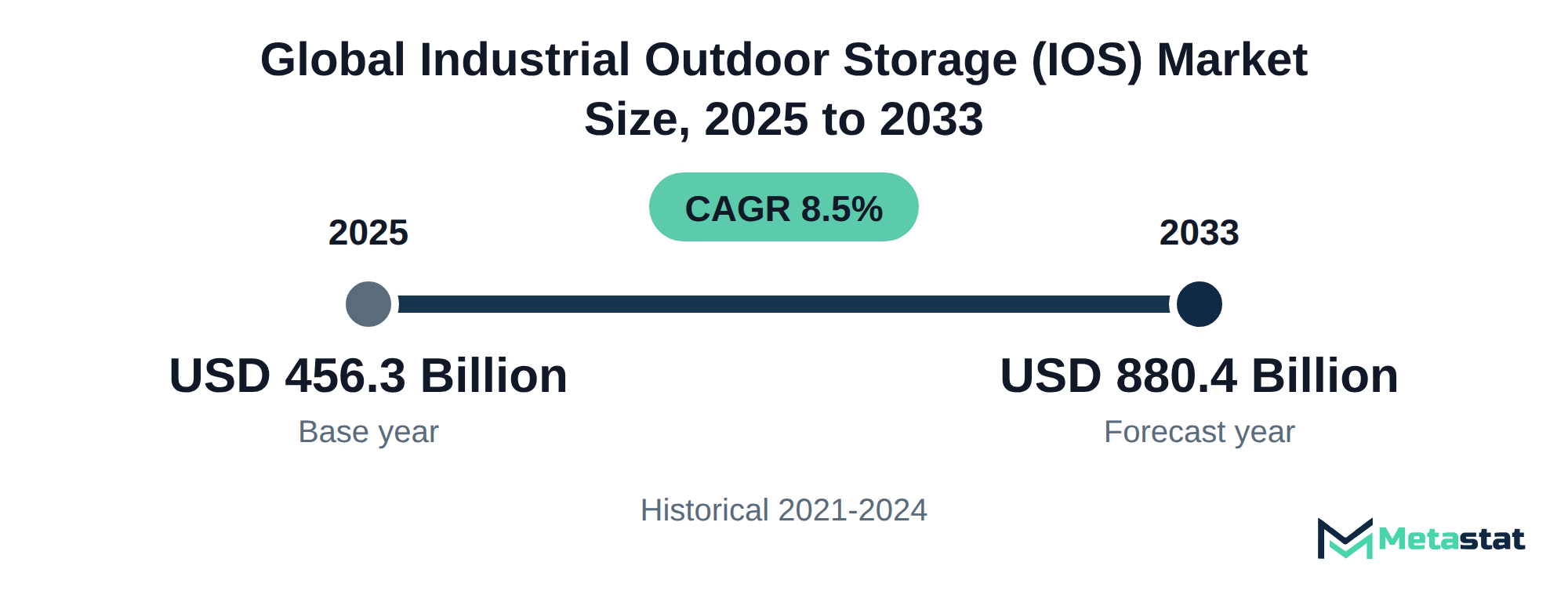
Market Valuation: Valued at $456.3 Billion in 2025, projected to reach $880.4 Billion by 2033 at a 8.5% CAGR.
Dominant Segment: Open yards lead the Industrial Outdoor Storage market, driven by their flexibility and scalability for various industries. This segment's value is enhanced by the growing demand for efficient storage solutions in logistics and transportation.
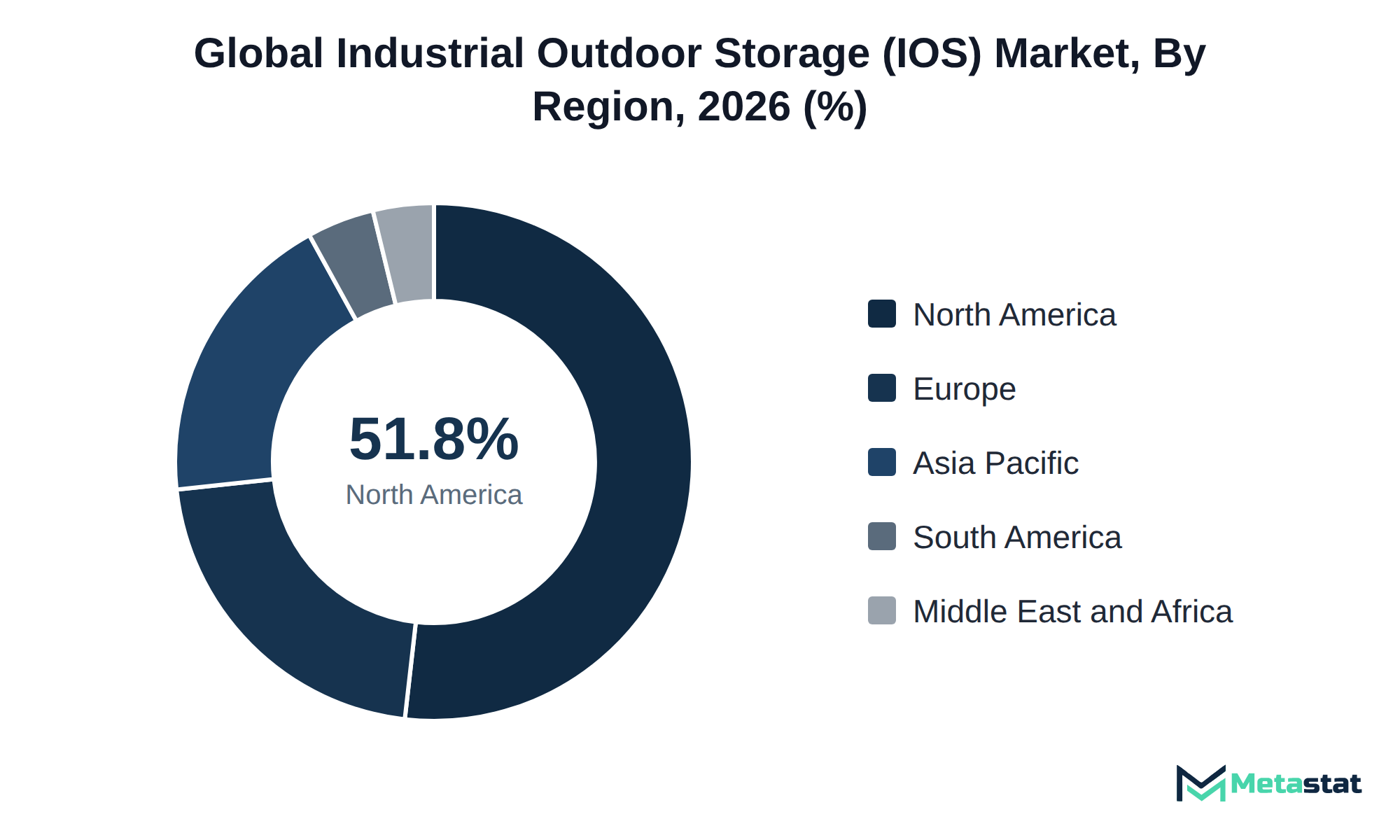
Geographic Lead: North America dominates the market with a 51.8% share in 2025, primarily due to significant investments in infrastructure and a robust logistics network. The U.S. is expected to continue leading growth through 2026.
What's Inside: The report provides comprehensive coverage of market dynamics, competitive landscape, and detailed segment analysis. It includes forecasts for various types of storage solutions and revenue sources from 2026 to 2033.
Growth in Storage Container Segment: The storage container segment is projected to grow significantly, with a CAGR of 10% from 2026 to 2033, driven by increasing demand for secure and efficient inventory management across multiple industries.
Institutional Investment Impact: Institutional investment is accelerating consolidation in the IOS market, particularly in urban areas, as investors seek high-demand locations that enhance logistics and supply chain operations.
Choose Your License
Global Industrial Outdoor Storage (IOS) Market
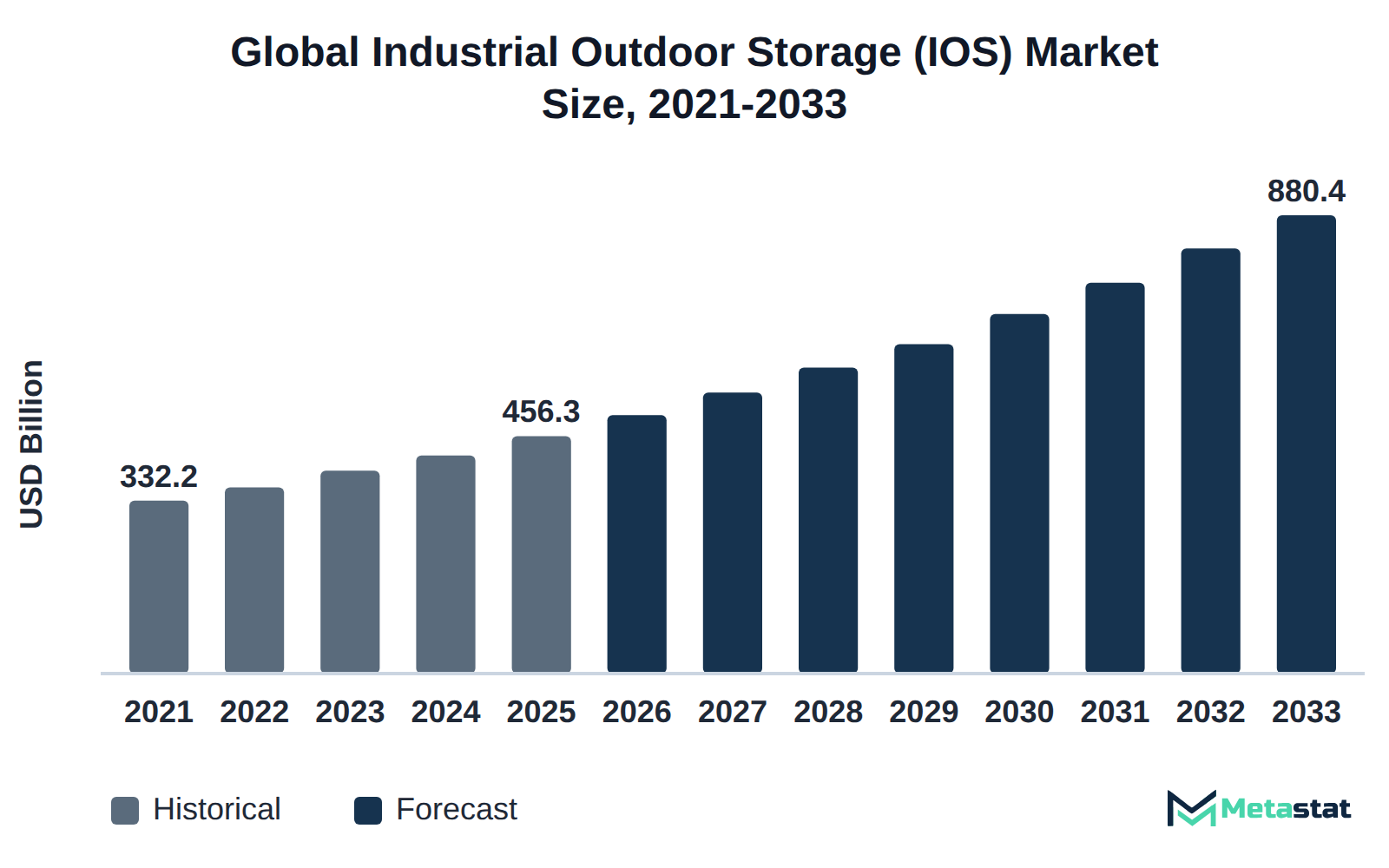
The global Industrial Outdoor Storage (IOS) market was valued at USD 456.3 billion in 2025 and is projected to reach USD 880.4 billion by 2033, growing at a CAGR of 8.5% over the forecast period.
The Industrial Outdoor Storage (IOS) market encompasses a range of outdoor storage solutions, including storage containers, open yards, and racks and shelving systems. Buyers invest in these solutions to enhance their operational efficiency, manage inventory, and accommodate the increasing demand for space in various industries. The market is particularly relevant for sectors including logistics and transportation, construction, and e-commerce, where streamlined storage capabilities have become essential for maintaining competitive advantage.
Growth in the market is driven by rising demand for efficient storage solutions, primarily due to the expansion of e-commerce and logistics operations. Open yards represent the segment with the most value, catering to a variety of industries requiring flexible and scalable storage options. North America holds 51.8% of the market in 2025, with the US leading in 2026. This regional dominance is attributed to significant investments in infrastructure and a robust logistics network that supports outdoor storage facilities.
The market is projected to experience continued growth, with increasing investments in both rental and sale revenue sources. The rent segment stands out, projected to reach USD 667.6 billion by the end of the forecast period in 2033. This trend highlights the shift towards flexible leasing options, allowing businesses to adapt to fluctuating storage needs without incurring substantial capital expenditures. The Industrial Outdoor Storage (IOS) market positions itself as a crucial component for companies seeking to optimize supply chain operations.
The market features essential outdoor storage solutions designed for various applications across industries. Buyers invest in these solutions to enhance operational efficiency, manage inventory effectively, and ensure the safe storage of goods. The IOS market caters to sectors including logistics, construction, and e-commerce, where the need for secure and accessible storage has become critical for maintaining competitiveness and meeting customer demands.
Growth in the market is driven by increasing demand for efficient supply chain management solutions. Open yards represent the segment with the highest value, providing flexible storage options to accommodate a wide range of goods. This strong regional presence stems from the well-established logistics and transportation infrastructure, which supports widespread adoption of industrial outdoor storage solutions.
With a projected compound annual growth rate (CAGR) of 8.5%, the market is poised for significant expansion. Key factors include the rising e-commerce sector, which necessitates increased storage capabilities to meet the demands of rapid order fulfillment. Companies invest in innovative storage technologies, further propelling market growth and enhancing operational efficiencies within various industries.
Port-adjacent storage yards play a critical role in optimizing container and trailer logistics, reflecting a significant shift in the Industrial Outdoor Storage (IOS) market. This trend stems from the increasing demand for efficient intermodal shipment solutions, driven by the rise of global trade and e-commerce activities. A robust network of port-adjacent storage facilities enhances operational efficiency by facilitating quicker turnaround times for trailers and containers, thereby reducing congestion at ports.
Investments in such facilities have grown, with the market for open yards projected to reach USD 529 billion by 2033, reflecting a compound annual growth rate of 7.7%. This growth highlights the strategic importance of these storage yards, which serve as essential hubs for logistics companies in managing cargo flows. The proximity to shipping lanes and freight hubs enables companies to streamline operations, reducing transportation costs and improving service delivery.
Logistics and transportation industries significantly benefit from this trend, as companies seek to optimize their supply chains. The importance of port-adjacent storage yards within the Industrial Outdoor Storage (IOS) market illustrates their value in enhancing logistics efficiency and supporting the continuation of growth in the sector.
Zoning restrictions play a significant role in determining rental pricing within the Industrial Outdoor Storage (IOS) market. An analysis of these restrictions highlights the impact on available storage land, particularly in urban areas where infill land scarcity escalates costs. In areas where zoning regulations limit the development of new storage facilities, existing properties experience heightened demand, leading to increased rental prices. For instance, the forecast for the IOS market indicates that rental income from the rent segment is projected to reach USD 667.6 billion by 2033, emphasizing the financial implications of land scarcity on rental strategies. These land dynamics also link outdoor storage to the wider industrial and logistics real estate sector.
Buyers navigating this landscape adapt their purchasing strategies to align with geographic zoning laws, influencing contract terms and rental agreements. Long-term leases become prevalent as buyers secure favorable terms during rising costs driven by limited availability. This trend stabilizes income for suppliers and reflects a shift in buyer behavior, prioritizing long-term commitments to mitigate uncertainties associated with fluctuating rental prices. The evolving dynamics of zoning restrictions and infill land availability shape the overall operational landscape, emphasizing the importance of strategic planning within the Industrial Outdoor Storage (IOS) market.
Institutional investment plays a critical role in the consolidation of portfolios within the Industrial Outdoor Storage (IOS) market. Increased interest from institutional investors has driven demand for strategically located storage facilities, particularly in urban areas. This trend reflects a broader shift toward optimizing logistics and supply chain operations among businesses aiming to enhance efficiency.
In 2025, the market recorded a base value of USD 456.3 billion, indicating strong financial backing and interest from large-scale investors, which further supports market growth. The Logistics and Transportation sector, projected to reach USD 274.5 billion by 2033, significantly benefits from this consolidation trend. Institutions recognize the potential returns on investment that arise from high-demand locations, which subsequently influences real estate investment management strategies for IOS facilities.
This consolidation enables companies to leverage economies of scale, enhancing service offerings and operational efficiency. A more consolidated portfolio strengthens the competitive positioning of firms within the market, leading to improved profitability and sustained growth opportunities.
The growing reliance on data centers and infrastructure projects significantly influences the demand for outdoor storage facilities. These projects require large amounts of equipment and materials that necessitate secure storage solutions. For instance, the Industrial Outdoor Storage (IOS) market sees a projected growth in storage containers, rising from USD 124.7 billion in 2026 to USD 242.8 billion by 2033, reflecting a compound annual growth rate of 10%. This increase correlates with the expansion of data centers and infrastructure developments, which require substantial space for staging, storing, and managing equipment.
Investment in infrastructure, particularly in telecommunications and energy, drives the need for organized outdoor storage solutions that facilitate project efficiency. Data centers, which house critical IT infrastructure, rely on outdoor storage for essential components, including backup generators and cooling systems. While these industries grow, the need for high-capacity outdoor storage facilities becomes imperative, leading to increased revenue opportunities within the market. Companies providing such storage solutions are well positioned to capitalize on this trend, ensuring operational efficiency and security for their clients engaged in rapid infrastructure development.
Logistics and transportation companies increasingly invest in outdoor storage solutions due to growing supply chain complexities and the need for efficient inventory management. The rise in e-commerce activities intensifies this trend, prompting businesses to seek reliable storage options that accommodate fluctuating inventory levels. For instance, the logistics and transportation sector is projected to expand from USD 164.2 billion in 2026 to USD 274.5 billion by 2033, reflecting a compound annual growth rate of 7.6%. This investment boosts the volume of outdoor storage, resulting in higher demand for various storage types, including open yards and storage containers. The shift towards greater efficiency drives pricing dynamics in the market, ensuring attractive returns for businesses investing in outdoor storage infrastructure.
Emerging trends in consumer behavior further support this demand, with companies aiming to adapt to rapid changes in market conditions. The Industrial Outdoor Storage market benefits from these developments, encouraging suppliers to innovate and enhance their service offerings. Greater operational flexibility and improved logistical efficiency remain key benefits for businesses leveraging outdoor storage solutions.
Technological advancements in supply chain optimization significantly influence the Industrial Outdoor Storage (IOS) market. Enhanced tracking and inventory management systems allow for more efficient use of storage spaces, compelling companies to adopt innovative storage solutions. These technologies streamline operations, reduce overheads, and improve asset utilization, appealing particularly to the logistics, e-commerce, and manufacturing sectors.
The transition towards automated storage and retrieval systems and smart inventory management creates demand for advanced outdoor storage solutions. Many companies invest in integrated platforms that facilitate real-time data access and analytics, enhancing decision-making processes. This digital transformation supports organizations in reducing excess inventory and lowering holding costs associated with traditional storage methods.
Investment in technology enhances operational efficiency and drives competitive advantages throughout the market. By optimizing storage practices, companies respond quickly to market fluctuations and evolving consumer preferences, ultimately reinforcing their positions within the Industrial Outdoor Storage (IOS) market.
Fluctuations in prices for construction materials and real estate hinder investment in outdoor storage solutions. Companies in the construction and logistics sectors experience budget constraints due to rising costs, resulting in delayed orders for Industrial Outdoor Storage (IOS) facilities. This situation particularly affects buyers seeking to expand their storage capacities or upgrade existing infrastructures. Uncertainty in pricing impacts procurement strategies, leading to smaller orders or extended decision-making processes. In a competitive market environment, these constraints slow the overall adoption of outdoor storage solutions. The market's growth trajectory faces challenges from these economic pressures, which restrict the ability of companies to secure necessary storage resources.
Suppliers in the Industrial Outdoor Storage (IOS) market face significant challenges in maintaining profit margins due to rising input costs. Increasing prices for essential materials and labor strain profitability across various segments, including storage containers and open yards. These pressures result from global supply chain disruptions and heightened demand for raw materials, contributing to inflated operational costs. Suppliers respond by implementing cost-control measures, enhancing operational efficiency, and exploring alternative sourcing strategies. Investments in automation and technology help mitigate cost increases while improving service delivery. Adopting innovative pricing models, including flexible rental agreements, allows suppliers to remain competitive in a market defined by fluctuating demand. These adaptations enhance the ability to attract and retain customers while navigating the evolving dynamics of the IOS market.
The storage container segment within the Industrial Outdoor Storage (IOS) market presents a significant opportunity for expansion, driven by increasing demand from various industries. Businesses engaged in logistics, construction, and e-commerce sectors prioritize storage solutions that enhance operational efficiency and adaptability to fluctuating inventory needs. Investment in storage containers allows companies to optimize space utilization while maintaining inventory accessibility. The anticipated growth in this segment highlights the increasing reliance on flexible outdoor storage solutions that cater to diverse operational requirements. Organizations seeking to enhance their storage capabilities will drive greater adoption of storage containers, positioning their operations for improved efficiency and cost-effectiveness.
The Global Industrial Outdoor Storage (IOS) market is segmented based on Type, Industry, and Revenue Source.
These containers serve various industries, including logistics, construction, and e-commerce, providing secure storage solutions for materials and equipment. Increasing demand for efficient inventory management within the logistics and transportation sectors significantly drives growth for this segment. Compared to open yards and racks and shelving systems, storage containers exhibit a higher growth rate due to their versatility and adaptability across different applications. The rising trend of urbanization further enhances the appeal of storage containers, with urban areas often facing space constraints, leading to a greater need for compact and efficient storage solutions. Such dynamics position this segment favorably within the market.
This segment provides substantial outdoor space for various industries, allowing for the storage of equipment, vehicles, and materials. Logistics and transportation, construction, and e-commerce industries frequently use open yard storage to optimize operational efficiency and reduce space constraints. Demand for this segment rises primarily due to increasing logistics complexities and the growing requirement for flexible storage solutions. Compared to other segments, open yards exhibit a slower growth rate than storage containers, which are projected to experience a CAGR of 10% during the same period. The price point for open yards typically remains lower than that of storage containers, attracting several budget-conscious buyers seeking practical outdoor storage options. This distinction further emphasizes the varied strategies buyers employ to meet their storage needs in the Industrial Outdoor Storage (IOS) market.
Racks and Shelving Systems segment is expected to reach USD 108.6 billion by 2033. This segment supports the organization and accessibility of stored goods, particularly for industries including logistics and e-commerce. Businesses leverage racks and shelving systems to enhance efficiency and maximize storage capacity. A key driver of this segment stems from the increasing demand for optimized space utilization in warehouses, where operational efficiency is critical. This difference highlights the ongoing shift toward more flexible and scalable outdoor storage solutions that align with the evolving needs of various buyers in the market.
This segment primarily serves logistics providers and transportation companies, focusing on efficient inventory management and storage solutions. The rising demand for rapid and reliable delivery of goods significantly drives growth, reflecting the increasing complexity of global supply chains. Compared to other segments, this segment experiences a moderate growth rate, influenced by the steady increase in e-commerce and the expansion of logistics networks. The focus on optimizing logistics operations distinguishes this segment, while factors including regulatory compliance and the need for adaptable storage solutions present challenges and opportunities for investment. The market continues to evolve, driven by advancements in technology and changing consumer expectations.
Construction is estimated to reach USD 200.4 billion by 2033, at a CAGR of 7.7% during the forecast period. The construction sector employs outdoor storage solutions for the safe and efficient handling of materials and construction equipment, essential for ongoing projects. Demand in this segment is driven by increasing construction activities, particularly in urban development and infrastructure projects. Unlike other segments, including logistics and transportation, which report a CAGR of 7.6%, construction prioritizes immediate accessibility and organization of resources on-site. This focus leads to specific requirements, including the need for versatile storage options that adapt to fluctuating project demands. Reliance on outdoor storage solutions contributes to maintaining project timelines and reducing delays caused by material shortages.
The E-commerce segment is expected to reach USD 189.2 billion by 2033. This segment serves online retail and distribution companies seeking efficient storage solutions to manage inventory effectively. Growing consumer demand for online shopping fuels investment in outdoor storage spaces. Companies face increasing pressure to enhance logistics efficiency and speed of delivery, driving the adoption of such solutions. Compared to other segments, the E-commerce sector shows a dynamic growth pattern, supported by technological advancements and a shift towards integrated inventory management systems. This segment's growth rate aligns with a compound annual growth rate (CAGR) of 7.6%, reflecting a strategic response to the fast-evolving needs of the retail landscape. In contrast to slower-growing segments, the E-commerce segment presents unique opportunities for investment, highlighting the necessity for tailored storage solutions to meet specific industry demands.
Automotive segment is projected to grow at a CAGR of 7.6% during the forecast period. This segment primarily serves automotive manufacturers and suppliers who use outdoor storage solutions for vehicle parts and finished vehicle logistics. Increasing vehicle production and a growing emphasis on efficient inventory management drive demand within this segment. The automotive industry requires specific storage solutions that accommodate larger items and maintain accessibility. In comparison to other segments, the automotive segment experiences steady growth, benefiting from consistent demand for automobiles. This stability contrasts with sectors including construction, which face fluctuations based on economic conditions. The market's focus on automotive storage solutions highlights the industry's unique requirements and strategic investments in outdoor storage facilities.
Municipal services encompass a range of outdoor storage solutions primarily by government agencies, waste management services, and public utilities. This segment is essential in the organization and management of public assets, including equipment storage, waste collection, and maintenance operations. Demand for outdoor storage in this area escalates due to increasing urbanization and the corresponding growth in municipal programs aimed at improving community services. Unlike other segments including logistics and transportation, which experience rapid expansion driven by e-commerce, the municipal services segment exhibits steadiness, focusing on compliance with regulations. These specific requirements differentiate it from faster-growing sectors, ensuring stable yet moderate demand for outdoor storage solutions tailored to municipal needs.
Others in the industry segmentation incorporates various sectors not classified under the primary categories. This segment serves multiple purposes across different sectors, including municipal services and specialized industrial applications. Demand for outdoor storage solutions in these areas experiences growth driven by urbanization and the expansion of infrastructure projects. This segment differs from the logistics and transportation segment, which focuses more on streamlined supply chains and inventory management. Pricing strategies for the Others segment tend to be more flexible, accommodating specific local needs and varying project requirements. Overall, this segment meets diverse storage requirements within the market.
Sale segment is valued at USD 136.8 billion in 2026 and is projected to reach USD 212.9 billion by 2033, at a CAGR of 6.5% during the forecast period. This segment serves primarily businesses seeking permanent outdoor storage options for various goods and materials, including logistics firms and construction companies. Demand for these solutions arises from the need for efficient space management and inventory control. The growth of e-commerce significantly contributes to this segment, with companies requiring increased storage capacity to accommodate rising online sales. Compared to the Rent segment, which is projected to reach USD 667.6 billion by 2033 at a CAGR of 9.2%, the Sale segment demonstrates relatively slower growth. Nevertheless, it remains a critical part of the Industrial Outdoor Storage market, responding to ongoing developments in supply chain efficiency and logistics organization.
This segment serves businesses that require flexible storage solutions without the commitment of ownership, providing cost-effective options for various industries. Demand stems from sectors like logistics, e-commerce, and commercial enterprises that prioritize operational efficiency and adaptability. Growing urbanization and the increasing need for space optimization significantly influence this segment's performance. Compared to other segments, the rent segment experiences a faster growth rate, driven by the rising preference for rental solutions over outright purchase. In contrast, the sale segment reflects a more static approach to storage, appealing to businesses that require long-term investments in outdoor storage assets. The market evolves, responding to changing consumer preferences and economic conditions.
Based on geography, the Global Industrial Outdoor Storage (IOS) market is divided into North America, Europe, Asia-Pacific, South America, Middle East, and Africa.
North America holds a 51.8% share of the Industrial Outdoor Storage (IOS) market, accounting for USD 426 billion by the end of 2033. The region features robust demand driven by industries including logistics and transportation, construction, and e-commerce. Infrastructure improvements and technological advancements within these sectors further enhance operational efficiency, adding to the growth potential. The focus on optimizing supply chains heightens the need for effective outdoor storage solutions. Major players in this region actively invest in expanding their warehouse capabilities and enhancing customer service, contributing to the overall market dynamics.
Demand for industrial outdoor storage solutions in Europe stems from key industries, particularly logistics and transportation, construction, and e-commerce. The region benefits from established infrastructure and an increasing focus on efficient storage solutions to manage inventory and streamline operations. Countries including Germany, France, and the UK contribute significantly to the market due to robust industrial activities and growing consumer demand for rapid courier, express, and parcel delivery services. The market forecasts a share of 21.5% in 2025, reflecting strong adoption trends. Regulations focused on sustainability and efficiency reinforce the necessity for innovative storage solutions. The Industrial Outdoor Storage (IOS) market in Europe is expected to grow driven by investments in technology and infrastructure that enhance storage capabilities.
Strong demand for outdoor storage solutions in the Asia-Pacific region arises from the rapid growth of industries including logistics and transportation, e-commerce, and construction. A significant increase in online retail activities in countries like China and India drives investments in industrial outdoor storage facilities. Infrastructure development remains crucial for enhancing connectivity and accessibility, resulting in a need for effective storage solutions that accommodate varying logistical requirements. With a market share of 18.7% in 2025, the Asia-Pacific region reflects strong growth potential for the Industrial Outdoor Storage (IOS) market, driven by rising urbanization rates and increasing construction activities. The evolving landscape in Southeast Asia, characterized by emerging economies, complements the demand for innovative storage solutions. Continuous advancements in technology and infrastructure improvements further support the market trajectory, creating opportunities for various stakeholders.
In South America, the Industrial Outdoor Storage (IOS) market experiences growth driven by increasing industrial activities within Brazil and Argentina. The logistics and transportation sectors play a crucial role in stimulating demand, particularly within urban areas where storage solutions address space constraints. Infrastructure development, particularly in transportation networks, enhances accessibility to outdoor storage facilities, facilitating operations across various industries. Regulatory frameworks focused on safety and environmental standards influence operational procedures within the market, impacting cost structures. This region demonstrates considerable potential for growth through enhanced service offerings and strategic investments, particularly in the rental segment, presenting opportunities for market expansion.
In the Middle East and Africa, demand for the Industrial Outdoor Storage (IOS) market relies heavily on industries including construction and logistics. Countries like Saudi Arabia and UAE experience significant growth driven by infrastructure development and urbanization efforts. South Africa presents opportunities due to its expanding industrial base and increasing logistics needs. The region's market share reflects a gradual increase in outdoor storage solutions. Infrastructure improvements and investments drive higher adoption rates among buyers. The focus on efficient space utilization and cost-effective storage options supports market growth.
Regional challenges include varying regulatory environments and economic conditions that impact investment. Increased competition among local and international players shapes pricing strategies and service offerings. The IOS market in this region positions itself to serve rising demand for organized storage solutions across various sectors.
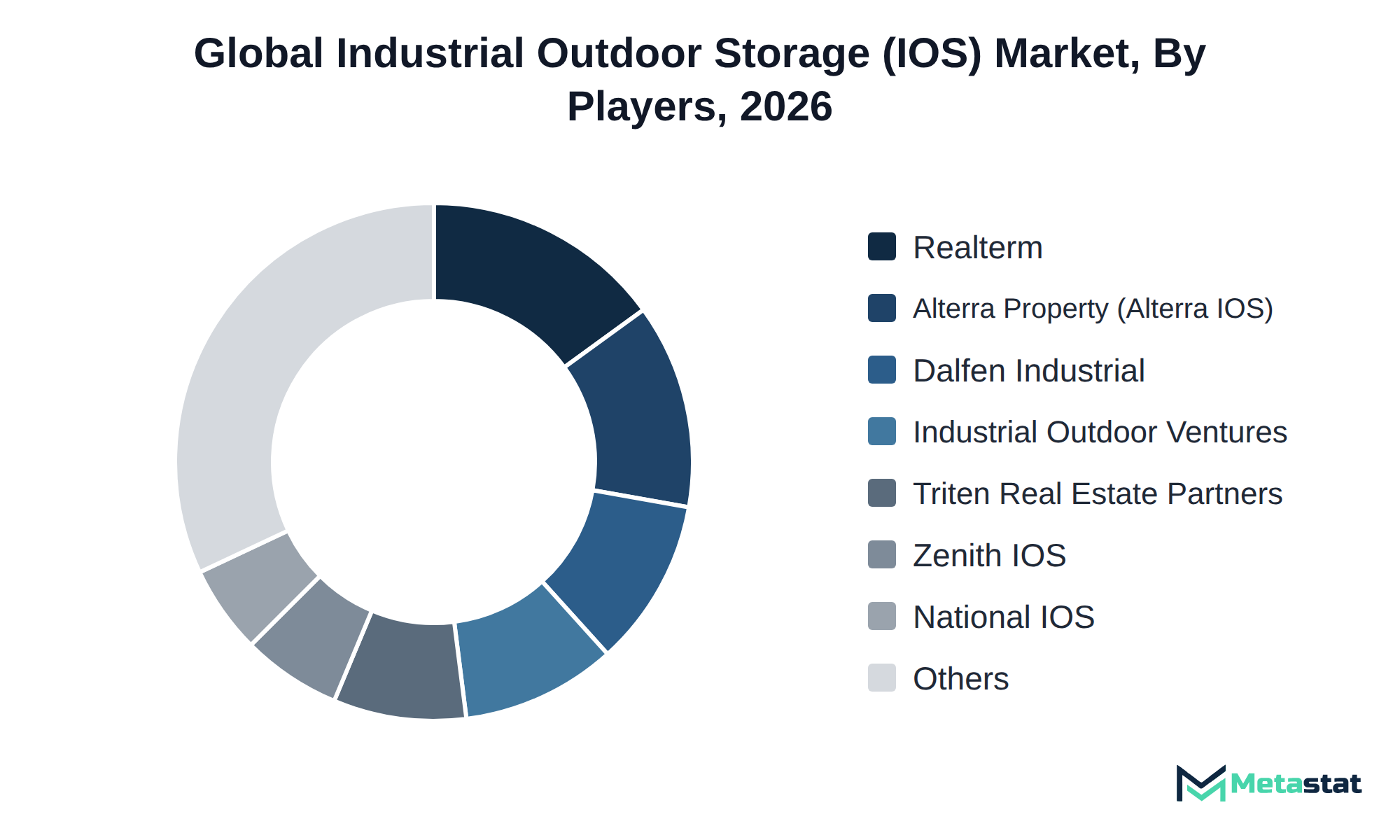
Competition within the Industrial Outdoor Storage (IOS) market demonstrates diversity in strategic approaches among key players. Companies differentiate themselves through various business models, focusing on different segments including storage containers, open yards, and racks and shelving systems.
Buyers prioritize factors including price, service quality, and customization when selecting providers. For example, Alterra Property Group (Alterra IOS) emphasizes its extensive portfolio, appealing to clients seeking versatile storage solutions. In contrast, Industrial Outdoor Ventures, LLC focuses on rental offerings, catering to businesses that prefer flexibility in storage arrangements. Realterm highlights its expertise in logistics infrastructure, targeting clients in the logistics and transportation sectors.
Achieving this growth relies on several key developments. First, the expansion of the logistics and transportation industry is projected to contribute significantly to the market, especially as companies seek efficient outdoor storage solutions. Second, the increasing demand for storage containers is anticipated to rise from USD 124.7 billion to USD 242.8 billion during the same period at a CAGR of 10%, driving overall market growth. Third, the revenue source from rentals is projected to reach USD 667.6 billion by 2033, reflecting a strong preference for flexible storage solutions. A primary risk that could hinder this growth includes economic downturns, which affect investment in outdoor storage facilities. The Industrial Outdoor Storage (IOS) market requires sustained demand from key segments and regions to achieve its projected value.
By Industry: Logistics and Transportation, Construction, E-commerce, Automotive, Municipal Services, Others
By Revenue Source: Sale, Rent
The report strategically identifies and profiles the key market players and analyses their core competencies in each sub-segment of the Industrial Outdoor Storage (IOS) market.
|
Report Attributes |
Details |
|
Study Period |
2021-2033 |
|
Base Year |
2025 |
|
Estimated Year |
2026 |
|
Forecast Period |
2026-2033 |
|
Historical Period |
2021-2025 |
|
Growth Rate |
CAGR 8.5% from 2026 to 2033 |
|
Revenue Unit |
USD billion |
|
Segmentation |
By Type, Industry, Revenue Source, and Region |
|
By Region |
North America (By Type, Industry, Revenue Source, and Country)
|
|
Europe (By Type, Industry, Revenue Source, and Country)
|
|
|
Asia Pacific (By Type, Industry, Revenue Source, and Country)
|
|
|
South America (By Type, Industry, Revenue Source, and Country)
|
|
|
Middle East and Africa (By Type, Industry, Revenue Source, and Country)
|
Find answers to common questions about this report
The Industrial Outdoor Storage (IOS) market size was valued at USD 456.3 billion in 2025.
The market is projected to grow at a CAGR of 8.5% during the forecast period from 2026 to 2033.
The North America Industrial Outdoor Storage (IOS) market size is estimated to reach USD 426 billion by 2033.
Storage Containers lead the Industrial Outdoor Storage market with a projected value of USD 242.8 billion by 2033, reflecting the highest growth potential among the segments.
Logistics and transportation companies increasingly invest in outdoor storage solutions due to growing supply chain complexities and the rise in e-commerce activities. Technological advancements in supply chain optimization significantly influence the market, enhancing tracking and inventory management systems that improve operational efficiency.
North America holds the dominant share of the Industrial Outdoor Storage market, with a projected value of USD 426 billion in 2033, representing 51.8 percent of the total market. This region significantly outpaces others in terms of market share.
Fluctuations in prices for construction materials and real estate hinder investment in outdoor storage solutions. Rising input costs strain profitability across various segments, resulting in challenges for suppliers to maintain profit margins.
The storage container segment within the Industrial Outdoor Storage (IOS) market is experiencing significant growth due to increasing demand from logistics, construction, and e-commerce sectors. Companies prioritize storage solutions that enhance operational efficiency and adaptability to fluctuating inventory needs, driving greater adoption of storage containers.
The Industrial Outdoor Storage (IOS) market is estimated to reach a valuation of USD 880.4 billion by 2033.
Key players operating in the Industrial Outdoor Storage (IOS) market include Alterra Property Group (Alterra IOS), Industrial Outdoor Ventures, LLC, Peakstone Realty Trust, Realterm, JIOS (Jadian Capital), Triten Real Estate Partners, Dalfen Industrial LLC, and Zenith IOS.
The analysts below cover Packaging research at Metastat Insights.
LEAD ANALYST
Utkarsh Khirodkar is a Lead Market Research Analyst at MetaStat Insight, specializing in market intelligence, technology sector assessments, and competitive strategy.

SENIOR RESEARCH ANALYST
Biotechnology · Food and Beverages · Medical Devices · Packaging
Snehal Pasalkar is a Research Analyst at MetaStat Insight, operating at the intersection of life sciences research, competitive strategy, and market intelligence.

INDUSTRY CONSULTANT - CHEMICALS & ADVANCED MATERIALS
Chemicals and Materials · Machinery & Equipment · Packaging
Amit Gadhekar Consultant for Chemicals and Materials at MetaStat Insight, directing sector-specific intelligence, research, and strategic consulting across global chemical and processing markets.
When planning edge sensor rollouts across refinery environments, generic IoT reports typically miss the harsh-environment certification bottlenecks. MetaStat Insight gave an objective evaluation of ATEX and Class 1 Division 2 hardware availability, along with realistic five-year maintenance cycle cost projections. The comparison of wireless mesh versus private cellular backhaul helped our team pressure-test network reliability models for remote processing facilities.
In the biological seed treatment space, registration timelines vary drastically between the European Union, Brazil, and North America. The MetaStat Insight research handled these cross-border regulatory barriers with genuine nuance, mapping commercialization pathways alongside historical field adoption rates. The segmentation between microbial strains and biochemical active ingredients was particularly well structured.
Our team was tracking whether regional recycling infrastructure could realistically absorb the growing volume of lithium iron phosphate batteries over the next decade. The report did a solid job separating announced hydrometallurgical plant capacity from active, permitted operational throughput. That distinction made the feedstock availability projections and regional recovery rate models far more credible than standard commercial overviews.
Explore related market intelligence reports worth reading alongside this one.