
LEAD ANALYST
Utkarsh Khirodkar is a Lead Market Research Analyst at MetaStat Insight, specializing in market intelligence, technology sector assessments, and competitive strategy.

Nordic Enterprise Agentic AI Market Size, Share, By Deployment Model (Cloud-Based, On-Premises, Hybrid), By Application (Customer Service and Virtual Assistants, Robotics and Automation, Financial Services, Security and Surveillance, Gaming and Entertainment, Marketing and Sales, Others), By End-Use Industry (Banking, Financial Services and Insurance, Manufacturing, Retail and Wholesale Trade, Healthcare and Life Sciences, Information Technology and Telecommunications, Professional and Business Services, Transportation and Logistics, Energy and Utilities, Public Administration, Others), By Country (Sweden, Denmark, Norway, Finland, Iceland), Industry Analysis, Growth, Trends, and Forecast, 2026-2033
Report ID
MSI-5503
Published
October, 2026
Pages
292 Pages
Format
Historical
Base year
Forecast
Forecast period
Report Details
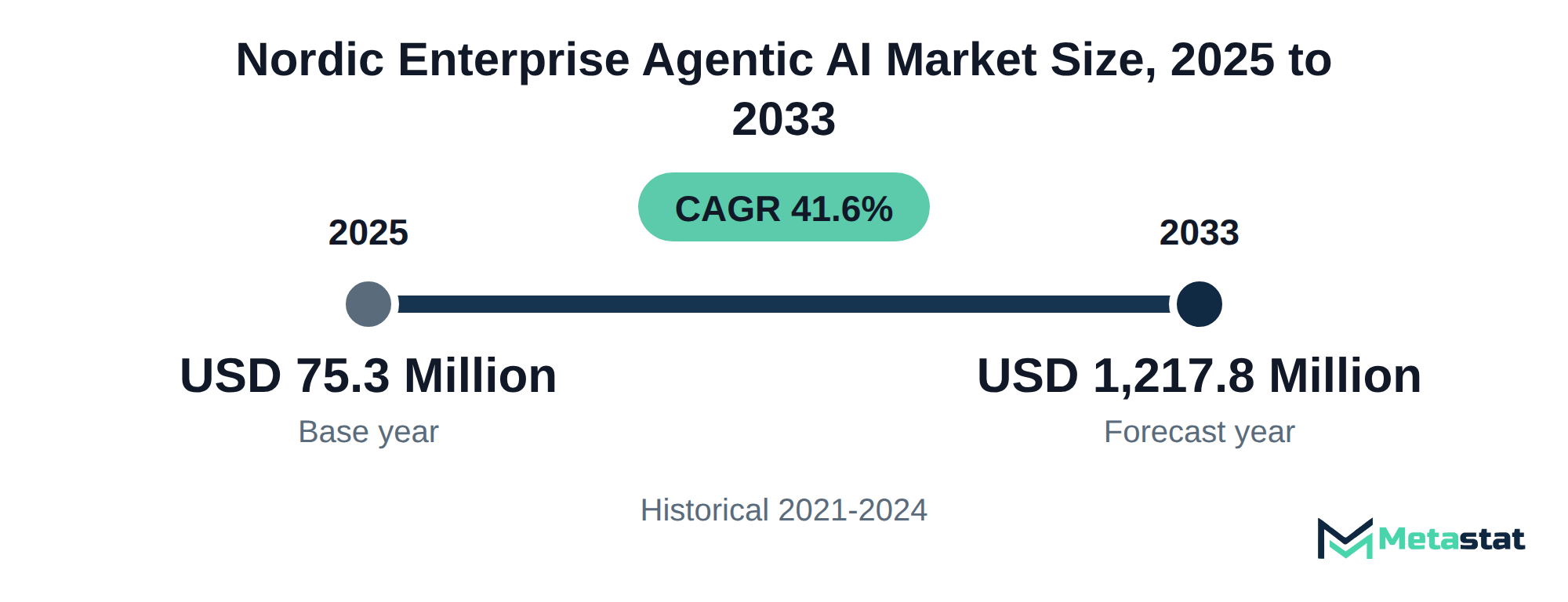
Market Valuation: Valued at $75.3 Million in 2025, projected to reach $1,217.8 Million by 2033 at a 41.6% CAGR.
Dominant Segment: The cloud-based deployment model leads the Nordic Enterprise Agentic AI market, driven by its scalability and flexibility, which are essential for businesses undergoing digital transformation.
Geographic Lead: Sweden holds the largest market share, reflecting robust demand for AI solutions that enhance operational capabilities and customer engagement across various sectors.
What's Inside: This report provides a comprehensive analysis of the Nordic Enterprise Agentic AI market, including competitive coverage, detailed segmentations by deployment model, application, end-use industry, and a forecast window from 2026 to 2033.
Market Opportunity: The robotics and automation segment is projected to grow at a CAGR of 43.5%, highlighting significant investment potential driven by the need for efficient process automation in industries like manufacturing and logistics.
Choose Your License
Nordic Enterprise Agentic AI Market
The Nordic Enterprise Agentic AI market was valued at USD 75.3 million in 2025 and is projected to reach USD 1,217.8 million by 2033, growing at a CAGR of 41.6% over the forecast period.
The Nordic Enterprise Agentic AI market encompasses a range of technologies designed to enhance business operations through intelligent automation and data analysis. Organizations invest in these solutions to improve efficiency, reduce operational costs, and enhance customer experiences. The market comprises various applications, including customer service, financial services, and robotics, which cater to diverse industry needs and address specific pain points, prompting significant spending by businesses across sectors.
Strong growth in the market results from increasing adoption driven by advancements in cloud-based technologies. Among the various segments, the cloud-based deployment model represents the largest share, facilitating integration and accessibility for businesses. Sweden stands out with the most substantial market share, reflecting robust demand for AI-driven solutions that enhance operational capabilities and customer engagement.
Investment in the Nordic Enterprise Agentic AI market is primarily fueled by ongoing digital transformation across industries. Companies recognize the potential of AI to streamline processes and enable data-driven decision-making, leading to improved outcomes. This trend positions the market for significant expansion, with stakeholders actively seeking innovative solutions to address evolving business challenges.
The demand for intelligent automation solutions significantly influences spending in the Nordic Enterprise Agentic AI market. Organizations prioritize these technologies to improve operational efficiency, enhance customer experiences, and drive innovation. The increasing emphasis on data-driven decision-making further drives investment in these solutions, particularly among enterprises aiming to maintain a competitive edge.
Cloud-based deployment models account for the largest share of the market, reflecting a strong preference among businesses for scalable solutions that support remote accessibility and flexibility. Sweden emerges as the region with the most substantial market presence, outpacing other countries in the Nordic region. The market is expected to experience rapid growth, driven by rising adoption of automation technologies across various industries, including manufacturing and financial services.
One significant growth driver involves the increasing integration of AI and machine learning into enterprise applications. This trend drives the development of sophisticated virtual assistants and enhanced customer service tools, thereby attracting substantial investments. The Nordic Enterprise Agentic AI market stands to benefit from this momentum, aligning with evolving business requirements and technological advancements.
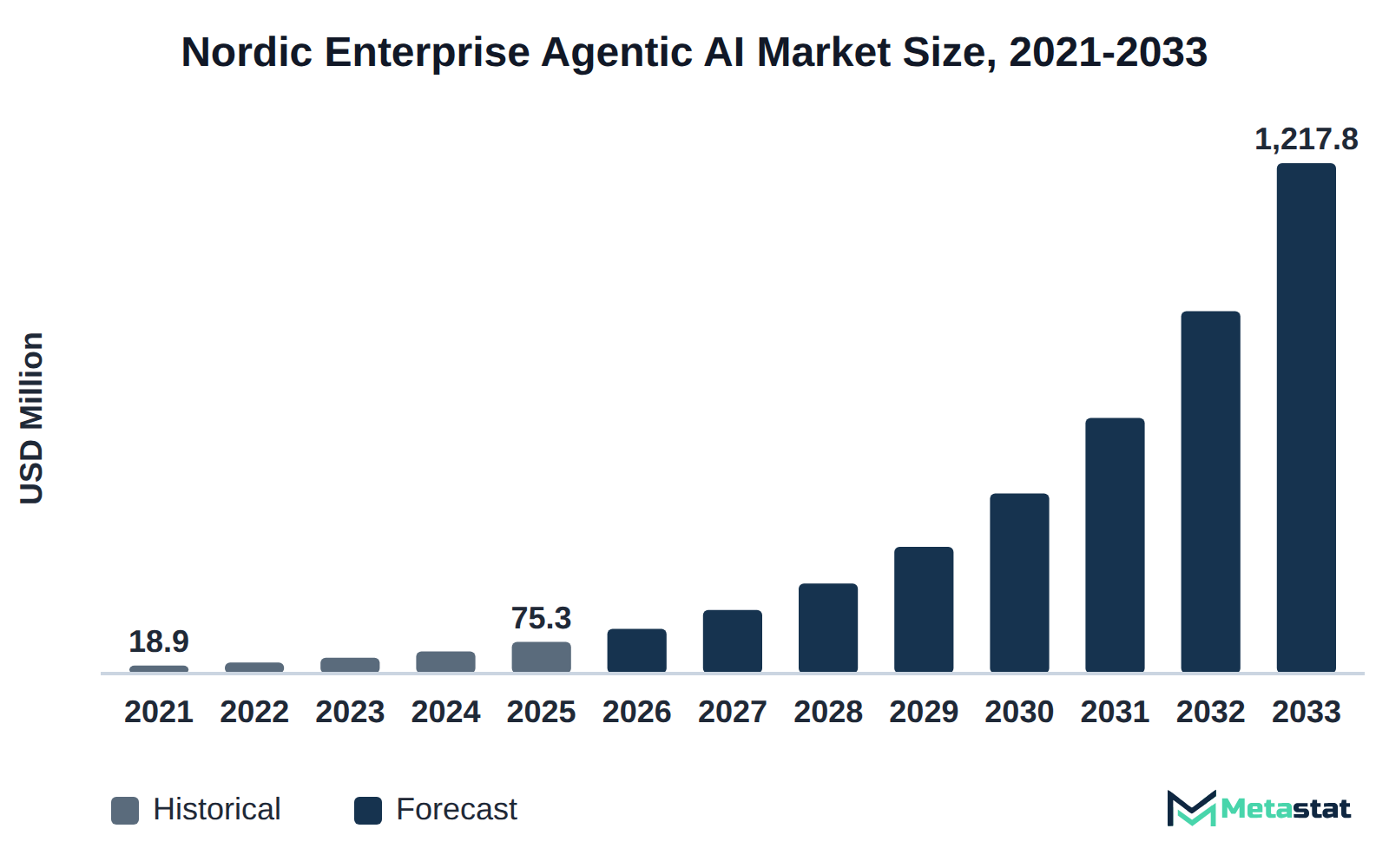
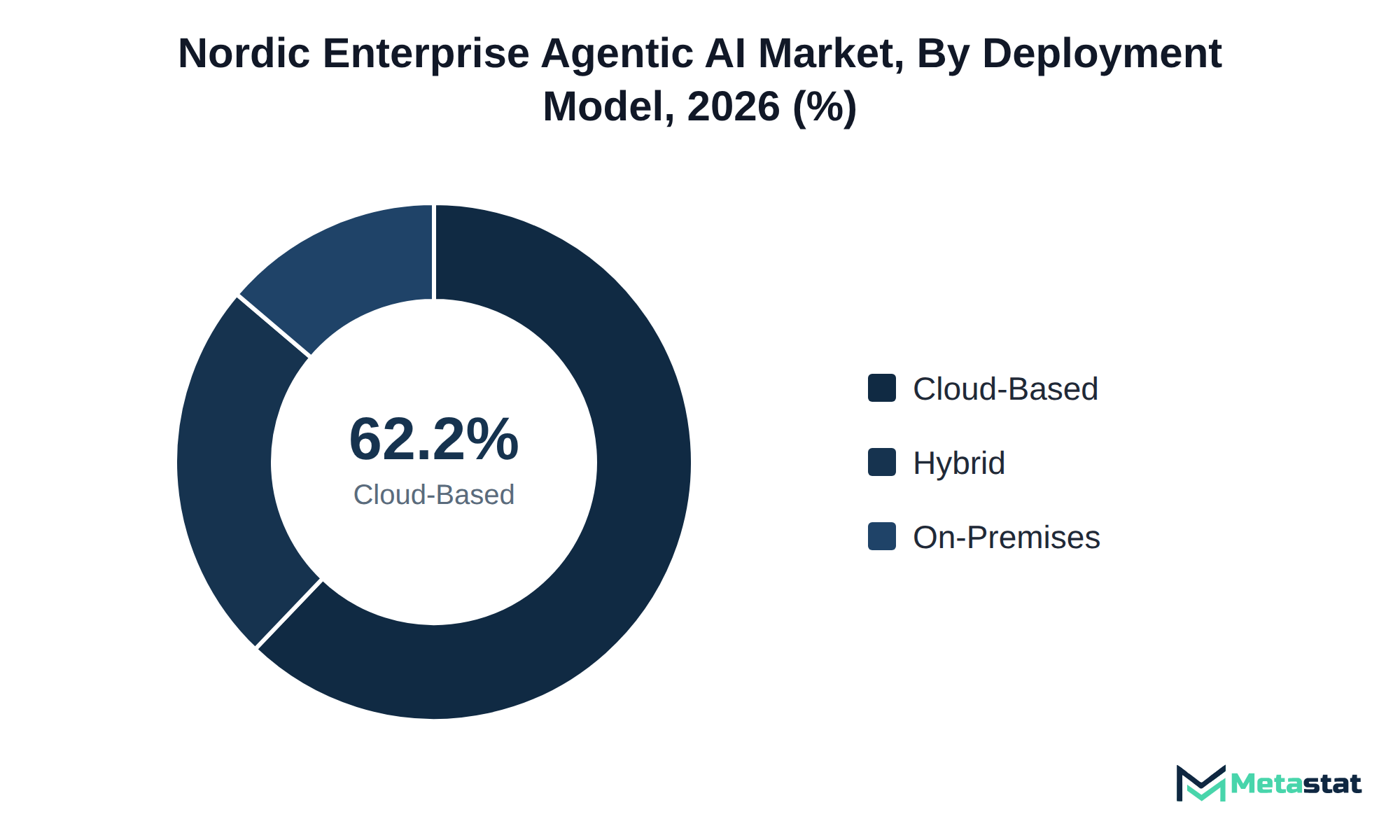
The adoption of cloud-based solutions in the Nordic Enterprise Agentic AI market specifically impacts the banking and manufacturing sectors. By 2033, the cloud-based deployment model is projected to reach USD 720.7 million, reflecting a compound annual growth rate (CAGR) of 40.6%. This rapid growth stems from increased demand for scalable and flexible solutions that enhance operational efficiency and reduce costs across these industries.
In banking, financial institutions leverage cloud-based agentic AI technologies to improve customer service and streamline operations. The segment focusing on customer service and virtual assistants is expected to grow from USD 29.9 million in 2026 to USD 314.7 million by 2033, driven by the need for personalized interactions and improved customer experiences. This shift represents a strategic opportunity for banks to enhance their service offerings and respond to competitive pressures effectively.
Manufacturing firms embrace cloud technologies, particularly for robotics and automation applications. The robotics and automation segment is anticipated to grow significantly, reaching USD 282.2 million by 2033, with a CAGR of 43.5%. This trend highlights the market’s shift towards more integrated and automated processes, allowing manufacturers to increase productivity and maintain quality standards. Overall, the adoption of cloud-based solutions in these sectors transforms operational capabilities and positions organizations for sustained growth in the Nordic Enterprise Agentic AI market.
Hybrid deployment of AI solutions offers flexibility that attracts buyers within the Nordic Enterprise Agentic AI market. Organizations increasingly prefer hybrid models due to their ability to combine on-premises and cloud-based resources, allowing for tailored solutions that meet specific operational needs. In 2026, the hybrid deployment segment is projected to reach USD 370.6 million by 2033, reflecting strong investment in versatile AI applications.
Pricing structures in this market vary significantly depending on deployment models and service offerings. Many providers adopt subscription-based pricing for cloud services, aligning costs with usage and providing predictable expenses. This model appeals to businesses aiming to control budget allocations while accessing advanced technology. On-premises deployments involve upfront costs for hardware and software licenses, leading to a different financial commitment. Companies evaluate these models based on operational requirements and long-term strategies.
While demand for hybrid solutions increases, service providers in the Nordic Enterprise Agentic AI market are adjusting their pricing strategies to enhance competitiveness. Flexible contract terms and tiered pricing structures facilitate wider adoption among organizations looking to optimize AI investments. This shift in purchasing behavior highlights the growing emphasis on scalability and adaptability in AI technologies.
In the Nordic Enterprise Agentic AI market, organizations in the banking, financial services and insurance (BFSI) sector prioritize compliance and security when selecting AI solutions. The unique regulatory landscape and the sensitive nature of financial data necessitate rigorous standards for technology adoption. With a projected value of USD 275.7 million by 2033, the BFSI segment reflects significant investment in AI capabilities that protect customer information while enhancing service delivery.
Banks and financial institutions focus heavily on vendor reliability and the ability to provide robust security features. The increasing prevalence of cyber threats reinforces the demand for solutions that integrate advanced security protocols. In this context, AI technologies that demonstrate compliance with stringent regulations and streamline operations represent critical assets. The ability to effectively mitigate risks while delivering personalized services presents a competitive advantage, enhancing customer trust and loyalty.
The importance of compliance and security in the BFSI segment directly influences purchasing decisions, shaping the overall trajectory of the Nordic Enterprise Agentic AI market. Investments in AI solutions that prioritize these factors enhance operational efficiency and align with the evolving regulatory requirements across the region.
Investment in customer service and virtual assistants provides substantial returns on investment for businesses in the Nordic Enterprise Agentic AI market. This application segment is projected to grow from USD 29.9 million in 2026 to USD 314.7 million by 2033, reflecting a compound annual growth rate of 40%. Companies leveraging these technologies enhance customer engagement and streamline operations.
Efficient handling of customer inquiries and support requests not only improves customer satisfaction but reduces operational costs associated with traditional service models. The financial impact of adopting virtual assistants demonstrates clear advantages for businesses striving for competitive positioning in the market. The resulting increase in efficiency supports ongoing growth and builds customer loyalty.
The implementation of robotics and automation in business workflows presents another avenue for significant ROI. Expected to reach USD 282.2 million by 2033, this segment exhibits a compound annual growth rate of 43.5%. By integrating robotic solutions, organizations achieve higher productivity levels, ultimately translating to increased profitability.
Investing in these workflows highlights the importance of technology in transforming customer interactions and operational effectiveness. Organizations within the Nordic Enterprise Agentic AI market continue to embrace these innovations, and the potential for expanded market share and enhanced revenue streams becomes increasingly evident.
The rise in digital transformation initiatives drives increased spending on virtual assistants in the Nordic enterprise sector. Organizations across industries, particularly in customer service, prioritize solutions that enhance user experience and operational efficiency. The shift towards remote work and digital engagement channels prompts companies to seek AI-driven technologies that streamline interactions and improve service levels. A notable growth of 40% in customer service and virtual assistants is projected, reaching USD 314.7 million by 2033. This significant increase in demand reflects changing consumer expectations and the need for businesses to adopt advanced tools to remain competitive. The market's expansion aligns with the growing focus on automating routine tasks, allowing personnel to concentrate on more complex, value-added activities. This transformation in operational strategies leads to heightened adoption rates of agentic AI solutions, further fueling investment in the market.
Increased automation technologies significantly impact operational efficiency within enterprises. Suppliers of Agentic AI solutions focus on enhancing their offerings, integrating advanced machine learning and natural language processing capabilities. Innovations in these areas improve systems for handling customer interactions, data analysis, and operational workflows.
Organizations investing in automation report enhanced productivity and reduced operational costs. The drive towards automation stems from a competitive landscape, where companies strive to optimize resources and enhance service delivery. Buyers across various sectors, particularly in banking, healthcare, and retail, prioritize these technologies to streamline operations and improve customer experiences.
The Nordic Enterprise Agentic AI market experiences accelerated growth fueled by these advancements. Organizations adopt automation to remain competitive, and this trend is expected to continue influencing investments and driving demand for sophisticated AI solutions.
The implementation costs associated with Nordic Enterprise Agentic AI solutions pose a significant challenge for several buyer groups, particularly small to medium-sized enterprises (SMEs). High initial investments required for hardware, software, and integration deter these businesses from adopting agentic AI technologies. This reluctance often results in slower uptake and smaller orders, impacting overall market growth. While larger organizations have the necessary resources to invest in advanced solutions, SMEs frequently lack the budget to transition from traditional systems to more sophisticated AI-driven processes.
This trend hinders the market's potential, limiting the pool of customers willing to invest in innovative AI solutions. Consequently, the higher costs associated with the deployment and maintenance of agentic AI technologies result in delayed replacement cycles for existing systems. Organizations in sectors including manufacturing and retail experience pressure to balance costs with the competitive advantages that AI offers, complicating the decision-making process surrounding new technology adoption.
Talent costs represent a significant challenge for suppliers within the Nordic Enterprise Agentic AI market. The demand for skilled professionals in AI development and implementation continues to outpace the availability of talent, leading to increased labor costs. Suppliers confronting these pressures have implemented several strategies, including investment in training programs to upskill existing employees and partnerships with educational institutions to cultivate a new workforce. These initiatives aim to mitigate the impact of rising talent costs while enhancing operational capabilities.
Organizations are exploring automation tools to streamline internal processes, reducing dependency on high-cost talent for routine tasks. By automating certain functions, suppliers enhance efficiency and lower operational costs. This shift enables suppliers to maintain competitive pricing while addressing the challenges associated with talent acquisition and retention.
The robotics and automation application within the Nordic Enterprise Agentic AI market presents significant growth potential, driven by a projected compound annual growth rate (CAGR) of 43.5% through 2033. This segment addresses the increasing demand for efficient process automation across various industries, particularly manufacturing and logistics. Investment in robotics and automation solutions enhances productivity, reduces operational costs, and optimizes workflows for organizations seeking competitive advantages.
The anticipated revenue for this segment is projected to reach USD 282.2 million by 2033, highlighting the lucrative opportunities for suppliers and developers focusing on advanced robotics technologies. Organizations across sectors are prioritizing automation to streamline operations, thereby enabling considerable market expansion. This trend reflects a broader shift toward integrating intelligent systems into traditional workflows, positioning robotics and automation as a crucial area for investment and development in the Nordic region.
The Nordic Enterprise Agentic AI market is segmented based on Deployment Model, Application, End-Use Industry, and Country.
Cloud-Based solutions in the Nordic Enterprise Agentic AI market are valued at USD 66.2 million in 2026 and are projected to reach USD 720.7 million by 2033, at a CAGR of 40.6% during the forecast period. Organizations widely adopt these solutions for customer service applications and virtual assistants, contributing to enhanced operational efficiency and user engagement. The driving force behind this segment relates to the increasing demand for scalable, flexible solutions that adapt to varied business needs, thus supporting digital transformation efforts across industries. Compared to alternative deployment models, the Cloud-Based segment exhibits faster growth, supported by its ability to meet diverse organizational requirements at a competitive price. This contrasts with the On-Premises and Hybrid segments, which, while valuable, face different constraints including higher upfront costs and integration challenges that limit their overall growth potential in the market.
On-Premises segment is estimated to reach USD 126.5 million by 2033, at a CAGR of 36.7% during the forecast period. This segment is adopted by businesses seeking control over their AI infrastructure and data security, particularly in sectors including banking, manufacturing, and healthcare, where sensitive information is prevalent. A demand driver includes the need for enhanced data governance and compliance with local regulations, influencing enterprises to adopt on-premises solutions. The segment experiences slower growth compared to the cloud-based segment, which has a CAGR of 40.6%, due to higher initial investment and maintenance costs associated with on-premises deployments. However, organizations prioritizing data privacy and customizability gravitate towards this model, setting it apart within the broader market dynamics.
This model allows organizations to combine both on-premises and cloud-based solutions, providing flexibility and scalability. Typically used by enterprises looking to balance security with innovation, Hybrid deployment enables companies to maintain sensitive data locally while benefiting from cloud advancements. Demand for this model arises from the necessity for organizations to adapt quickly to emerging technologies while managing compliance and data residency concerns. Compared to other deployment models, Hybrid exhibits a moderate growth trajectory, with a compound annual growth rate of 36.7%. The ability to integrate existing systems with new advancements positions Hybrid as a competitive choice, particularly for industries requiring stringent data governance, including healthcare and finance. This adaptability differentiates it from purely cloud-based or on-premises models within the Nordic Enterprise Agentic AI market.
Intelligent virtual assistants enhance customer engagement through automated interactions, streamlining service delivery for businesses across various sectors. The demand for efficient customer service solutions drives growth in this segment, with companies increasingly adopting AI-driven technologies to improve user experiences. In particular, businesses in retail and healthcare benefit significantly from these solutions, resulting in rapid value creation. Compared to other segments, the Customer Service and Virtual Assistants segment experiences a faster growth trajectory, outperforming sectors including Financial Services, which has a lower CAGR. Organizations are expected to invest heavily in virtual assistant technologies to leverage their potential in customer interactions, reflecting the growing importance of automation in enhancing operational efficiency and customer satisfaction.
This segment focuses on automating various tasks within enterprises, enabling organizations to improve efficiency and reduce operational costs. Industries including manufacturing and logistics leverage robotics and automation solutions to streamline processes and enhance productivity. The increasing demand for advanced automation technologies drives growth within this segment, significantly outpacing other applications, including Customer Service and Virtual Assistants, which has a CAGR of 40%. Organizations adopting these solutions experience improved performance and higher output, contributing to a competitive advantage in the market. Enhanced capabilities in robotics and automation enable businesses to implement sophisticated systems that cater to evolving market demands.
Financial Services segment is expected to reach USD 224.8 million by 2033. Financial institutions leverage agentic AI applications primarily for enhancing customer interactions and improving operational efficiency. Demand for personalized financial services drives adoption among banks and insurance companies, responding to heightened consumer expectations for tailored experiences. Competitive pressure, with firms seeking innovative solutions to differentiate themselves, accelerates investment in agentic AI technologies. This segment benefits from a compound annual growth rate of 42.4%, positioning it among the faster-growing segments within the application category. The implementation of advanced analytics and automation tools in financial services sets this segment apart, with technology advancements catering specifically to the complex demands of the finance sector.
Valued at USD 37.8 million in 2023, the Security and Surveillance segment is projected to grow at a CAGR of 42.4% during the forecast period. This segment focuses on enhancing safety and security protocols through advanced AI technologies, serving industries including public administration, healthcare, and financial services. Increased demand for real-time monitoring and threat detection drives growth, with organizations seeking to enhance safety measures. The technology's ability to integrate with existing systems differentiates it from other applications in the market. While the Robotics and Automation segment experiences a faster growth rate at 43.5%, the Security and Surveillance segment remains vital due to its critical role in safeguarding assets and information. Investments in cybersecurity and regulatory compliance further increase interest, indicating sustained expansion in this area.
This segment focuses on gaming and entertainment applications that enhance user experience and engagement through enterprise agentic AI technologies. Industries including video game development, content creation, and interactive media apply these capabilities to create immersive environments and personalized experiences for end-users. Demand for innovative gaming experiences drives growth, with developers seeking to integrate advanced AI functionalities into their products. Rising expectations for high-quality graphics and responsive gameplay significantly influence this segment. Compared to other applications, gaming and entertainment exhibit unique dynamics, emphasizing creativity and user interaction over traditional operational efficiencies. This segment does not benefit from the same growth rate as robotics and automation, which demonstrates a higher CAGR of 43.5%. Players in the gaming industry integrating these technologies intensify competition, leading to increased investment in AI-driven solutions.
This segment focuses on advancing AI technologies for enhancing marketing and sales processes. Organizations apply these solutions to improve customer engagement, streamline sales workflows, and enhance data-driven marketing strategies. A notable demand driver for this segment is the growing emphasis on personalized customer experiences, which requires sophisticated analytics capabilities and automation tools. In contrast to other applications, this segment experiences a distinct environment due to the competitive landscape that prioritizes rapid adoption and innovation. Organizations in various industries, including retail and e-commerce, prioritize these technologies to gain a competitive edge. The market benefits from the increasing integration of AI-driven insights into marketing strategies while facing challenges related to data privacy and compliance. The Nordic Enterprise Agentic AI market presents opportunities for providers equipped to navigate these complexities while delivering tailored solutions to their clients.
This sub-segment encompasses applications related to Human Resources, Legal, and Compliance, focusing on automating and enhancing processes within these fields. Enterprises leverage agentic AI technologies to streamline HR functions, manage legal documentation, and ensure compliance with regulations. Ongoing digital transformation in various sectors drives interest in these applications, particularly among large corporations that require efficient solutions to handle complex HR and legal frameworks. Demand in this sub-segment is characterized by improved operational efficiency and mitigation of risks associated with non-compliance. Compared to other applications, including Customer Service and Virtual Assistants, this sub-segment experiences slower growth due to its specialized nature and the complexity of integration into existing systems. However, increasing emphasis on regulatory compliance and efficient HR management ensures a steady demand flow, aligning with broader trends in the Nordic Enterprise Agentic AI market.
Valued at USD 23.2 million in 2026, the Banking, Financial Services and Insurance segment is projected to reach USD 275.7 million by 2033, at a CAGR of 42.4% during the forecast period. This segment focuses on delivering innovative solutions for customer engagement, risk assessment, fraud detection, and regulatory compliance for financial institutions. Adoption of AI technologies enhances operational efficiency and reduces costs within banks and insurance companies. Strong demand for enhanced security measures and personalized customer experiences drives growth in this segment. Compared to other segments, the Banking, Financial Services and Insurance segment shows faster growth, driven by a robust increase in digital services and the urgency to meet evolving consumer expectations. The projected CAGR of 42.4% positions this segment as a key area of focus in the Nordic Enterprise Agentic AI market, reflecting increasing investment in digital transformation initiatives by financial institutions.
Manufacturing segment is estimated to reach USD 206.2 million by 2033, at a CAGR of 42.8% during the forecast period. This segment finds application among manufacturers looking to optimize production processes and minimize operational costs. A significant force driving growth involves the ongoing adoption of smart manufacturing practices, leveraging AI to enhance efficiency and reduce waste. Companies in this sector increasingly invest in AI technologies to improve supply chain management and predictive maintenance. This segment outpaces others, including retail and wholesale trade, due to its higher compound annual growth rate, reflecting strong market demand for innovative automation solutions and advanced analytics. The focus on integrating AI into manufacturing workflows positions this segment for accelerated growth compared to slower-growing areas including healthcare and life sciences within the market.
Retail and Wholesale Trade segment is expected to reach USD 125.1 million by 2033. Companies within this segment leverage agentic AI for enhancing inventory management, personalizing customer experiences, and optimizing supply chains. Key drivers for growth include increasing demand for personalized shopping experiences and the need for operational efficiency. This segment exhibits a higher growth rate compared to others in the End-Use Industry category, supported by a projected compound annual growth rate of 42.5%. Retailers invest in AI-driven solutions to remain competitive, focusing on strategies that improve customer engagement and streamline operations. With significant emphasis on data analytics and machine learning, businesses in this segment respond quickly to market shifts and consumer preferences, ensuring they stay relevant in a changing environment. The Nordic Enterprise Agentic AI market reflects this dynamic trend, highlighting the critical role of technology in retail transformation.
Valued at USD 75.3 million in 2025, the Healthcare and Life Sciences segment is projected to grow at a CAGR of 44.1% during the forecast period. This segment encompasses applications that support patient care, diagnostics, and operational efficiency in healthcare settings. Demand is driven by the continuous need for improved patient outcomes and the automation of administrative tasks among healthcare providers. Unlike other segments, Healthcare and Life Sciences experiences faster growth, reflecting increasing investments in technology to enhance healthcare delivery. Regulatory pressures for data privacy and security influence this segment, with compliance to standards becoming essential for technology adoption. The market presents opportunities for suppliers to develop solutions tailored to the specific needs of healthcare organizations.
This sub-segment addresses applications in the Information Technology and Telecommunications sector, focusing on enhancing operational efficiency and customer engagement. Enterprises in this field apply agentic AI to streamline operations, automate customer interactions, and improve service delivery. A significant demand driver stems from the increasing need for businesses to adopt advanced technologies that enhance productivity and reduce operational costs. Increased reliance on AI solutions by major telecommunications operators differentiates this sub-segment from others, reflecting a faster pace of technological adoption. The growing complexity of IT infrastructures necessitates innovative solutions, which fuels investment in agentic AI technologies, contributing to the broader dynamics of the Nordic Enterprise Agentic AI market.
This sub-segment focuses on applications related to Professional and Business Services, which encompass a range of solutions aimed at improving operational efficiency and client engagement through advanced technologies. Businesses within this sector apply enterprise agentic AI for tasks including data analysis, customer relationship management, and process automation, enhancing overall productivity. Demand is driven by organizations seeking competitive advantages through innovation and efficiency improvements. Compared to other sub-segments, Professional and Business Services experiences moderate growth, influenced by the increasing reliance on technology in service-based industries. This contrasts with more dynamic segments, including Robotics and Automation, which demonstrate a higher growth trajectory. Adoption barriers include initial investment costs and integration challenges, impacting the speed at which entities implement these technologies. The Nordic Enterprise Agentic AI market shows strong potential for development in this sub-segment, reflecting the broader trend of digital transformation across various sectors.
This sub-segment focuses on applications within the transportation and logistics sector, leveraging advanced agentic AI technologies to optimize operations and enhance decision-making processes. Companies in this space apply these solutions to automate workflows, improve supply chain visibility, and enhance customer service through real-time data analysis. Demand for agentic AI solutions is driven by the increasing need for operational efficiency and cost reduction in logistics, particularly due to growing pressures to meet customer expectations for faster delivery times. Compared to other segments, including healthcare and manufacturing, this sub-segment experiences distinct challenges, including regulatory compliance and integration with existing systems. The Nordic Enterprise Agentic AI market anticipates ongoing advancements in AI technologies and their applications in this sector, leading to greater adoption among logistics providers and transportation companies. This segment exhibits potential for significant growth, reflecting broader trends in digital transformation across industries.
This sub-segment focuses on applications within the energy and utilities sector, leveraging advanced technologies to optimize operations and improve service delivery. Energy companies employ agentic AI for predictive maintenance, demand forecasting, and smart grid management, enhancing efficiency and reducing operational costs. The increasing emphasis on sustainability and regulatory compliance drives demand for innovative solutions in this area. Compared to other segments, the energy and utilities sub-segment experiences robust interest due to its critical role in supporting infrastructure and public services, positioning it uniquely for significant investments in technology. While growth in this sub-segment aligns with key trends in the Nordic Enterprise Agentic AI market, it faces distinct challenges related to regulatory constraints and the need for integration with existing legacy systems, impacting the adoption rate compared to faster-growing segments including robotics and automation.
This sub-segment encompasses applications related to public administration, addressing the need for efficient governance and citizen engagement. Public administration leverages advanced AI technologies to enhance service delivery, streamline processes, and improve decision-making for government agencies and public institutions. Demand for enterprise agentic AI in this sector is driven by the increasing emphasis on digital transformation and the desire for data-driven insights. This area experiences slower growth due to budgetary constraints and regulatory challenges impacting public sector investments. However, ongoing technological advancements provide opportunities for enhancing operational capabilities, leading to greater adoption rates in the future. The Nordic Enterprise Agentic AI market sees a variety of players targeting public administration, focusing on solutions that improve transparency and enhance public service delivery.
This sub-segment encompasses applications related to Construction, Hospitality, and Education sectors, focusing on enhancing operational efficiency, customer engagement, and service delivery through advanced AI technologies. These applications find utility among various stakeholders, including project management teams in construction, service providers in hospitality, and educational institutions seeking to improve learning experiences. Demand for enterprise agentic AI technologies in this sub-segment reflects an increasing emphasis on automation and data-driven decision-making across industries. Factors including the growing trend of digital transformation drive adoption, while challenges including initial implementation costs hinder several organizations. Compared to other segments, this sub-segment experiences slower growth due to varying levels of awareness and investment across the different sectors it serves. Overall, the Nordic Enterprise Agentic AI market sees a diverse range of applications, with each segment responding to distinct industry requirements and technological advancements.
Valued at USD 38.6 million in 2026, this segment is projected to reach USD 424 million by 2033, at a CAGR of 40.8% during the forecast period. Applications in Sweden primarily focus on enhancing customer interactions and automating processes across various sectors. Key drivers include increased adoption of AI technologies among businesses seeking to improve efficiency and customer satisfaction. Compared to other regions, Sweden exhibits strong growth due to its robust technology infrastructure and a high concentration of innovative enterprises. The market's emphasis on customer service and virtual assistants distinguishes it from segments in other countries, which prioritize different applications. This focus is supported by growing demand from industries including retail and healthcare, where enhancing user experience represents a significant competitive advantage.
Denmark is estimated to reach USD 306.4 million by 2033, at a CAGR of 42.5% during the forecast period. This segment serves various industries, including financial services and retail, leveraging AI technologies to enhance customer interactions and operational efficiencies. Growing demand for automation and advanced analytics drives this segment, prompting businesses to adopt innovative solutions. Demand for AI applications in Denmark is stronger than in other regions, reflecting the country’s focus on technological advancement and digital transformation. The high CAGR indicates a favorable environment for investment in AI solutions, differentiating this segment through rapid growth and unique buyer needs, particularly in the banking and financial services sector. Denmark's significant positioning supports its robust expansion trajectory through 2033 in the Nordic Enterprise Agentic AI market.
Valued at USD 240.4 million by 2033, this segment focuses on applications that leverage agentic AI technologies to enhance operational efficiency across various sectors. Organizations in Norway employ these technologies for purposes including automating customer service functions, improving financial analysis, and optimizing supply chain logistics. Growth in Norway draws momentum from increasing investments in digital transformation initiatives, reflecting a broader trend across the Nordic Enterprise Agentic AI market. Comparative analysis indicates that the growth rate for this segment stands at 42.1%, positioning it favorably among its peers, particularly in relation to the higher growth rates seen in neighboring markets. Factors influencing this growth include rising demand for advanced analytics and automated solutions that enhance decision-making processes, vital for maintaining competitive advantage in a dynamic economic environment.
Valued at USD 53.1 million in 2024, this segment is projected to grow at a CAGR of 42.1% during the forecast period. Finland's market primarily serves businesses looking to enhance operational efficiency through automated solutions and advanced AI technologies. Demand in this segment is driven by the increasing adoption of automated customer service and virtual assistant applications across various industries, including banking and healthcare. The growth trajectory in Finland stands out due to a robust technology infrastructure and a strong focus on innovation, differentiating it from other Nordic countries. In comparison to Sweden and Denmark, which exhibit CAGRs of 40.8% and 42.5%, respectively, Finland's growth remains competitive while highlighting unique local adoption patterns. This segment's emphasis on advanced AI applications positions it favorably within the Nordic Enterprise Agentic AI market, appealing to diverse end-users seeking to leverage technology for enhanced performance.
Iceland represents a unique focus on applications that enhance agentic AI technologies, improving various sectors through innovative solutions. Demand stems from the need for improved operational efficiency and enhanced customer interactions, particularly in niche markets. Buyers in Iceland include specific industries that value tailored solutions capable of addressing local challenges. Unlike other Nordic countries, the Icelandic segment experiences a distinct pace of growth, influenced by a smaller market size and growing adoption of advanced technologies. Factors including the availability of technical skills and local business investment drive the segment's development, positioning Iceland as a specialized player in the broader Nordic Enterprise Agentic AI market.
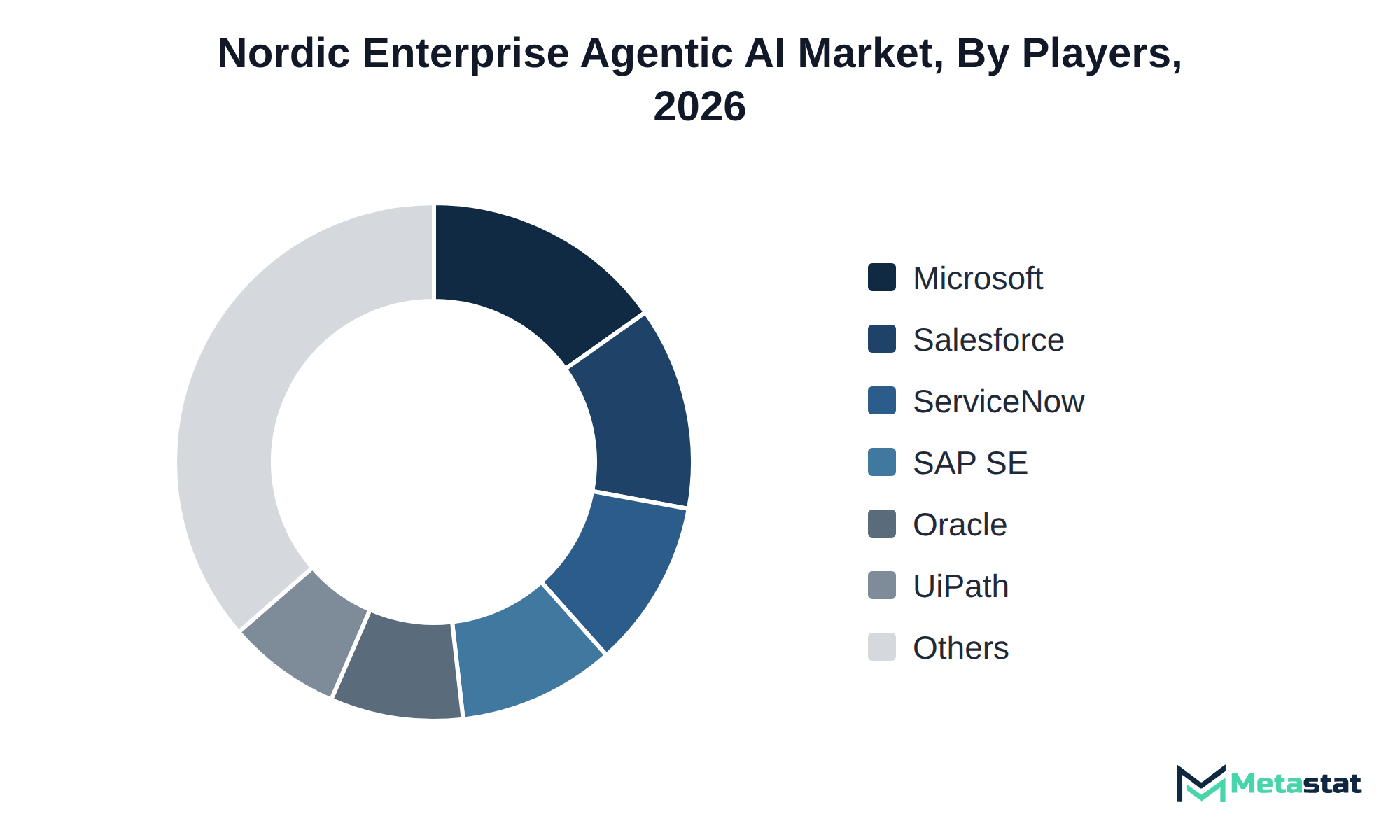
In the Nordic Enterprise Agentic AI market, companies adopt various strategies to differentiate their offerings. Key players focus on distinct deployment models, including cloud-based solutions and on-premises systems. Cloud-based options attract buyers seeking scalability and reduced upfront costs, while on-premises solutions appeal to clients prioritizing data security and customization.
Buyers emphasize factors including pricing, customization, and the overall service ecosystem when selecting vendors. For instance, Microsoft Corporation focuses on integration with its existing software solutions, enhancing its appeal to enterprises already within its ecosystem. UiPath, Inc. emphasizes automation capabilities, attracting clients looking to streamline operations. Similarly, Salesforce, Inc. champions customer relationship management features, addressing the specific needs of businesses aiming to enhance customer interactions. These strategic focuses shape the competitive dynamics within the Nordic Enterprise Agentic AI market.
Achieving this growth requires several key developments within the Nordic Enterprise Agentic AI market. First, the expansion of cloud-based deployment models will drive significant adoption, with expected growth from USD 66.2 million in 2026 to USD 720.7 million by 2033. This transition enhances operational efficiency and accessibility for businesses across various sectors. Second, advancements in applications, particularly in customer service and virtual assistants, will boost revenue from USD 29.9 million in 2026 to USD 314.7 million by 2033, responding to rising consumer expectations for immediate service. Lastly, the banking, financial services, and insurance sector will play a crucial role, with growth anticipated from USD 23.2 million in 2026 to USD 275.7 million by 2033, driven by increasing reliance on AI for risk management and fraud detection.
However, potential risks could hinder progress. Economic downturns or regulatory changes restrict investments in technology, impacting the market's ability to reach its full potential. The interaction of these factors will ultimately shape the trajectory of the Nordic Enterprise Agentic AI market.
By Deployment Model: Cloud-Based, On-Premises, Hybrid
By Application: Customer Service and Virtual Assistants, Robotics and Automation, Financial Services, Security and Surveillance, Gaming and Entertainment, Marketing and Sales, Others (Human Resources, Legal and Compliance)
By End-Use Industry: Banking, Financial Services and Insurance, Manufacturing, Retail and Wholesale Trade, Healthcare and Life Sciences, Information Technology and Telecommunications, Professional and Business Services, Transportation and Logistics, Energy and Utilities, Public Administration, Others (Construction, Hospitality, Education)
By Country: Sweden, Denmark, Norway, Finland, Iceland
The report strategically identifies and profiles the key market players and analyses their core competencies in each sub-segment of the Enterprise Agentic AI market.
Report Attributes | Details |
Study Period | 2021-2033 |
Base Year | 2025 |
Estimated Year | 2026 |
Forecast Period | 2026-2033 |
Historical Period | 2021-2025 |
Growth Rate | CAGR 41.6% from 2026 to 2033 |
Revenue Unit | USD million |
Segmentation | By Deployment Model, Application, End-Use Industry, Country, and Region |
Find answers to common questions about this report
The Enterprise Agentic AI market size was valued at USD 75.3 million in 2025.
The market is projected to grow at a CAGR of 41.6% during the forecast period from 2026 to 2033.
The leading segment in the Enterprise Agentic AI market is Cloud-Based deployment, projected to reach USD 720.7 million by 2033. This segment outpaces others in growth, driven by increasing demand for scalable solutions.
Key drivers for the Nordic Enterprise Agentic AI market include increased investment in virtual assistants due to digital transformation initiatives and the rising demand for automation technologies that enhance operational efficiency. These factors significantly contribute to market growth across various sectors, particularly in customer service, banking, and healthcare.
High implementation costs associated with hardware, software, and integration deter small to medium-sized enterprises from adopting agentic AI technologies. rising talent costs in AI development and implementation challenge suppliers, leading to increased labor expenses and complicating operational capabilities.
The increasing focus on automating routine tasks enhances operational efficiency and allows personnel to concentrate on complex activities, driving adoption of agentic AI solutions. organizations across sectors, particularly banking, healthcare, and retail, prioritize these technologies to streamline operations and improve customer experiences.
The Enterprise Agentic AI market is estimated to reach a valuation of USD 1,217.8 million by 2033.
Key players operating in the Enterprise Agentic AI market include Microsoft Corporation, Salesforce, Inc., ServiceNow, Inc., SAP SE, Oracle Corporation, International Business Machines Corporation, UiPath, Inc., and Automation Anywhere, Inc.
The revenue for customer service and virtual assistants is projected to reach USD 314.7 million by 2033, reflecting a significant growth of 40 percent.
The robotics and automation segment is expected to generate USD 282.2 million by 2033, driven by a compound annual growth rate of 43.5 percent.
The analysts below cover Information & Technology research at Metastat Insights.
LEAD ANALYST
Utkarsh Khirodkar is a Lead Market Research Analyst at MetaStat Insight, specializing in market intelligence, technology sector assessments, and competitive strategy.

PRINCIPAL CONSULTANT - ENTERPRISE AI & EMERGING TECHNOLOGIES
Banking & Finance · Electronics and Semiconductor · Energy and Power · Healthcare IT · Information & Technology · Professional Services
Vijay Gunti is a Principal Consultant at MetaStat Insight, bringing over two decades of experience across enterprise digital transformation, technology strategy, and intelligent systems.

LEAD CONSULTANT - COMMUNICATION, TELECOM, AND IT
Electronics and Semiconductor · Information & Technology · Machinery & Equipment · Professional Services
Ravindra Sathe Consultants for Communication, Telecom, and IT at MetaStat Insight. He leads the firm's industry research initiatives across telecommunications infrastructure, digital connectivity, enterprise networking, and emerging information technology domains.
In the biological seed treatment space, registration timelines vary drastically between the European Union, Brazil, and North America. The MetaStat Insight research handled these cross-border regulatory barriers with genuine nuance, mapping commercialization pathways alongside historical field adoption rates. The segmentation between microbial strains and biochemical active ingredients was particularly well structured.
Our team was tracking whether regional recycling infrastructure could realistically absorb the growing volume of lithium iron phosphate batteries over the next decade. The report did a solid job separating announced hydrometallurgical plant capacity from active, permitted operational throughput. That distinction made the feedstock availability projections and regional recovery rate models far more credible than standard commercial overviews.
Tracking capacity expansion in single-use bioprocessing requires dependable data on raw material availability and cleanroom-grade polymer supply chains. The competitive landscape chapter gave a grounded evaluation of secondary component suppliers across North America and Asia-Pacific rather than simply reprinting press releases. Having that level of supplier benchmarking helped clarify dual-sourcing considerations for our clinical pipeline planning.
Explore related market intelligence reports worth reading alongside this one.