
LEAD ANALYST
Utkarsh Khirodkar is a Lead Market Research Analyst at MetaStat Insight, specializing in market intelligence, technology sector assessments, and competitive strategy.

Global RFID Market Size, Share, By Offering (Tags, Inlays & Labels, Readers & Reader Modules, RFID Antennas, RFID Printers & Encoders, RFID Software and RFID Services), By System Type (Passive RFID Systems Including Battery-Assisted Passive and Active RFID Systems), By Frequency Band (Low Frequency LF, High Frequency HF Including NFC and Ultra-High Frequency UHF), By End-Use Industry (Retail & Consumer Goods, Transportation, Logistics & Warehousing, Healthcare & Pharmaceuticals, Industrial Manufacturing & Automotive, Food, Beverages & Foodservice, Banking & Financial Services, Agriculture & Livestock, Hospitality, Events & Entertainment, Government & Defense and Others Including IT & Telecom, Energy & Utilities, Education & Libraries and Construction), Industry Analysis, Growth, Trends, and Forecast, 2026-2033
Report ID
MSI-5613
Published
October, 2026
Pages
292 Pages
Format
Historical
Base year
Forecast
Forecast period
Report Details
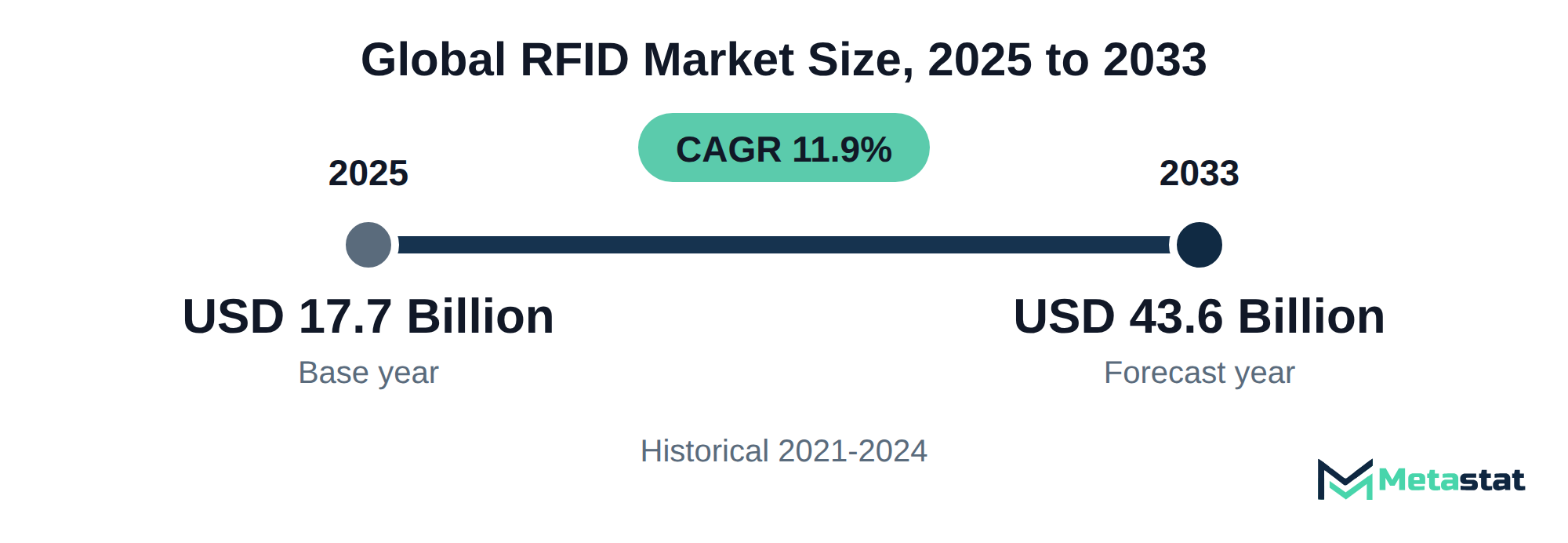
Market Valuation: Valued at $17.7 Billion in 2025, projected to reach $43.6 Billion by 2033 at a 11.9% CAGR.
Dominant Segment: Tags, Inlays & Labels lead the RFID market, driven by increasing demand for enhanced inventory management and asset tracking capabilities across various industries.
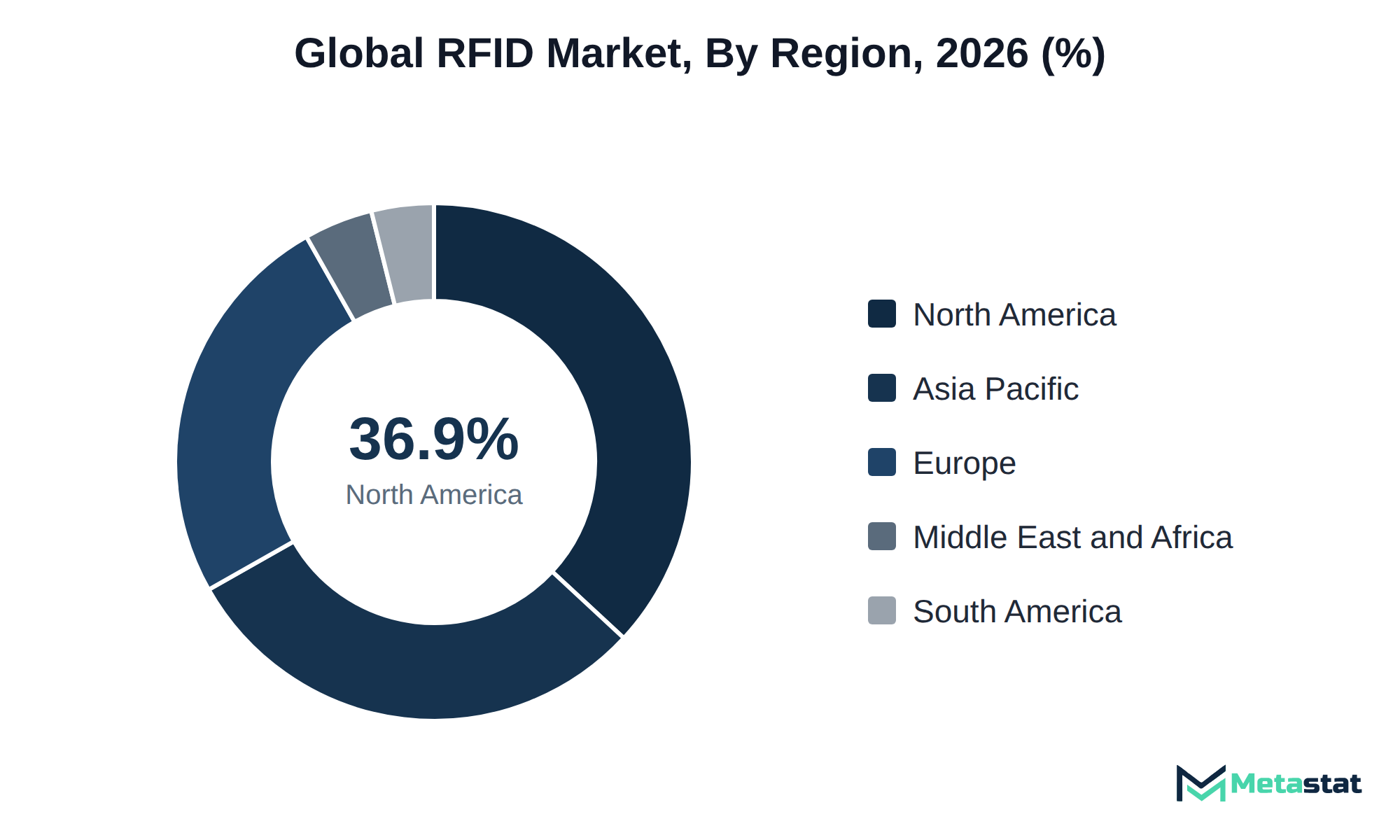
Geographic Lead: North America is the leading region, accounting for 36.9% of the market in 2025, supported by robust infrastructure and technological advancements.
What's Inside: The report provides comprehensive coverage of market segmentation by offering, system type, frequency band, and end-use industry, along with detailed competitive analysis and growth forecasts.
Growing Opportunities: The retail and consumer goods sector is projected to experience significant growth, reaching USD 15.3 billion by 2033, highlighting the increasing necessity for advanced tracking solutions.
Technological Advancements: Investments in RFID software and hardware are driving market expansion, with a focus on automation and real-time data access enhancing operational efficiency.
Choose Your License
Global RFID Market
The global RFID market was valued at USD 17.7 billion in 2025 and is projected to reach USD 43.6 billion by 2033, growing at a CAGR of 11.9% over the forecast period.
The RFID market encompasses various technologies and applications that track and manage assets across different sectors using radio-frequency identification. As an automatic identification and data capture technology, RFID replaces traditional methods of identification and inventory management, offering enhanced efficiency and accuracy. Buyers invest in RFID solutions to streamline operations, improve supply chain visibility, and reduce labor costs, leading to substantial long-term savings.
Growth in the market is driven by the increasing adoption of automation and the demand for real-time data. Among the various segments, Tags, Inlays & Labels represent the highest value, with considerable investment directed toward enhancing their capabilities. North America holds 36.9% of the market in 2025, with the US leading in 2026. The region's well-developed infrastructure and technological advancement support strong demand for RFID solutions across industries.
One significant growth driver is the rising need for efficient inventory management systems in retail and logistics. Companies strive to enhance operational efficiency and customer satisfaction through improved inventory accuracy. Asia Pacific follows closely, contributing 29.9% of the market share, reflecting its growing industrial base and increasing technology adoption in emerging economies.
The RFID market includes products and systems designed for identifying, tracking, and managing objects through radio-frequency technology. Buyers invest in this market to enhance operational efficiency, decrease errors, and improve inventory management. The growing emphasis on automation and real-time data access drives spending across various industries, including retail, healthcare, and logistics.
Active RFID Systems generate the most value within the market, while North America holds 36.9% of the market in 2025, with the US leading in 2026. The significant growth in the retail and consumer goods sector contributes to this trend, driven by increasing demand for inventory accuracy and supply chain transparency. The expansion of electronic commerce further accelerates the adoption of RFID solutions.
Technological advancements in RFID, including the development of more efficient and cost-effective tags and readers, support market growth. The need for effective asset tracking and management solutions across various industries reinforces this trend. Continuous investment in RFID technology positions businesses to improve their processes and respond to market demands effectively.
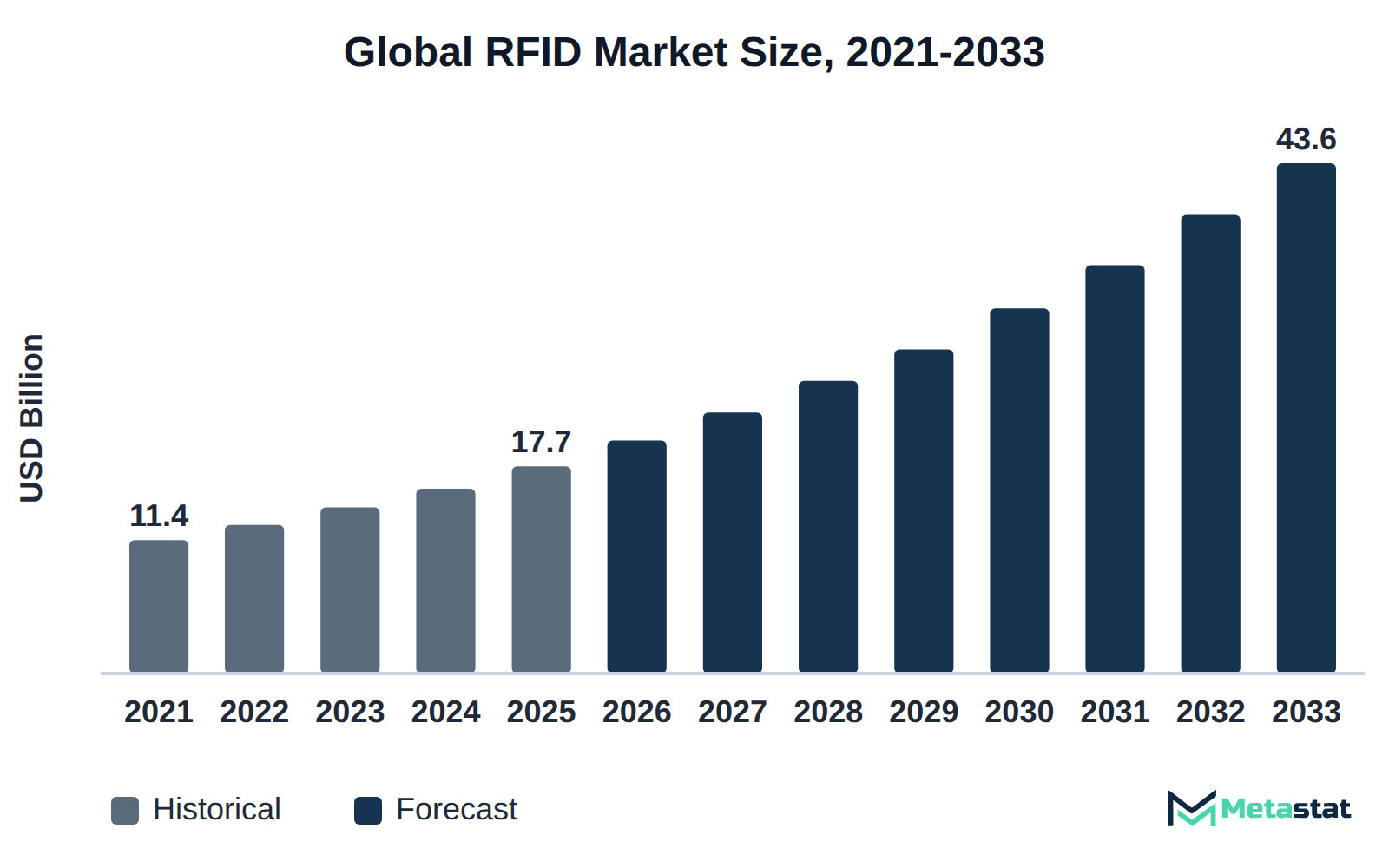
Retail compliance tagging is driving the expansion of item-level RFID beyond traditional apparel applications. This shift reflects changing consumer expectations and retailer demands for greater visibility and accountability across diverse product categories. The retail and consumer goods segment is projected to grow significantly, reaching USD 15.3 billion by 2033, highlighting the increasing necessity for advanced tracking solutions.
Adoption of RFID technology enables retailers to efficiently manage inventory, reduce shrinkage, and enhance the overall shopping experience. Item-level tagging therefore fits within the broader smart retail industry. The integration of item-level tagging across sectors including electronics, cosmetics, and home goods illustrates the versatility of RFID systems, moving beyond mere apparel identification. This technology facilitates effective inventory management, enabling precise stock levels and timely replenishment, ultimately driving sales performance.
The RFID market is expected to thrive as more retailers recognize the benefits of compliance tagging. Enhancements in operational efficiency, increased customer satisfaction, and improved supply chain management result from this technological transformation. By investing in RFID systems, retailers strengthen their competitive position and meet evolving consumer demands while optimizing their operations.
Pricing strategies for printable UHF labels influence the overall economics of suppliers in the RFID market. The projected value for UHF labels is USD 21.4 billion by 2033, reflecting substantial market potential and prompting suppliers to adopt innovative pricing models. These models often include tiered pricing based on volume, which encourages bulk purchases from large clients, enhancing supplier revenue while providing cost savings for buyers.
Contracts in this segment frequently incorporate long-term agreements that secure stable prices for buyers while allowing suppliers to forecast revenues more accurately. Buyers in industries including retail and logistics favor these arrangements, seeking predictability in budgeting and inventory management. Successful negotiations hinge on the quality and reliability of the labels, and suppliers use advanced encoding technologies to add value that justifies premium pricing.
Competition intensifies in the RFID market, and suppliers that effectively communicate the benefits of their encoding technologies position themselves favorably against others. The shift toward digital integration and automation within supply chains further increases the importance of efficient labeling systems. Consequently, the approach to pricing and contract models significantly impacts growth trajectories and profitability across the industry.
RFID traceability has become essential for industries focused on managing food cold chains, healthcare assets, and tire lifecycles. The global RFID market is projected to reach USD 43.6 billion by 2033, demonstrating significant growth potential. In the food industry, accurate tracking of temperature-sensitive products ensures compliance with safety regulations and enhances inventory management. This traceability facilitates timely responses to potential spoilage, ultimately reducing waste and increasing customer trust.
In healthcare, RFID technology helps manage assets including medical devices, pharmaceuticals, and supplies. The technology enables real-time tracking and helps prevent loss or misplacement of valuable equipment, which leads to delayed patient care. The RFID market for healthcare assets is expected to generate substantial revenue as hospitals seek efficient solutions to improve operational efficiency. By implementing RFID systems, healthcare providers enhance patient safety and optimize resource use. Better visibility of medical supplies also strengthens healthcare supply chain management.
Tire manufacturers and distributors employ RFID traceability to monitor the lifecycle of tires, from production to disposal. This technology enables accurate tracking of warranty information and helps ensure proper maintenance throughout the product's life. With a growing emphasis on sustainability, tracking tire usage contributes to environmental initiatives by promoting tire recycling and responsible disposal. By using RFID solutions, these manufacturers and distributors improve customer satisfaction while complying with regulatory standards.
The retail and consumer goods sector presents significant opportunities for RFID labels and tagging services. Increased emphasis on inventory management and supply chain efficiency drives demand in this industry. Projections indicate that the retail and consumer goods segment will grow from USD 6.9 billion in 2026 to USD 15.3 billion by 2033, reflecting a compound annual growth rate (CAGR) of 12%. This growth stems from the need for enhanced tracking of products throughout the supply chain and improved customer experience through expedited checkout processes.
Healthcare and pharmaceuticals present promising avenues for RFID technology. With the healthcare industry focusing on patient safety and medication accuracy, the role of RFID labels and tagging services becomes crucial. The healthcare segment is projected to reach USD 5.6 billion by 2033. Adoption of RFID solutions allows for precise tracking of medical supplies and equipment, reducing the risk of errors and enhancing operational efficiency. The same accuracy requirements apply to pharmaceutical logistics, where medication handling must be tracked reliably.
Industries that integrate RFID technology experience improved operational performance, translating to cost savings and higher revenue potential. The RFID market continues to expand in various sectors, driven by organizations recognizing the commercial advantages of implementing RFID labels and tagging services.
Retailers increasingly adopt RFID technology to enhance inventory management and improve operational efficiency. This transition results from rising consumer expectations for accurate stock availability and streamlined shopping experiences. Significant investment in tracking capabilities drives this shift, enabling retailers to minimize stockouts and reduce excess inventory. The retail and consumer goods segment is anticipated to experience a compound annual growth rate (CAGR) of 12% from 2026 to 2033, reflecting the growing importance of RFID in optimizing operations. The RFID market experiences heightened demand due to these evolving buyer needs, leading to increased spending on RFID solutions across the industry.
Expansion continues in various retail applications, including apparel, electronics, and food sectors. Enhanced visibility throughout the supply chain improves overall efficiency and traceability, driving an increase in adoption rates. Retailers invest in RFID to meet consumer demands for transparency and real-time information, which makes the technology central to modern retail operations.
Technological advancements in RFID software drive growth across various sectors. Enhanced big data analytics capabilities allow businesses to leverage real-time information for improved decision-making and inventory management. The emphasis on automation and integration of RFID systems into existing enterprise resource planning (ERP) solutions supports operational efficiency. Retailers, manufacturers, and logistics providers adopt these software solutions to optimize tracking and monitoring processes. Integration with Internet of Things (IoT) devices further enhances the capabilities of RFID systems, resulting in better asset visibility and management. This trend contributes significantly to the RFID market expansion, with software solutions projected to complement traditional hardware offerings. Continuous investments in research and development by leading suppliers reinforce the demand for advanced software solutions, generating new opportunities for growth in the market. Industry players recognize that enhancing software capabilities improves user experience and drives competitive advantage through increased operational effectiveness.
Pricing pressures significantly impact the adoption of RFID technology, particularly among small and medium-sized enterprises (SMEs) operating in sectors including retail and healthcare. The initial investment required for RFID systems, including tags, readers, and software, influences decision-making processes. Many SMEs face budget constraints, resulting in slower uptake of this technology. Delayed replacement of existing systems often occurs due to high costs associated with transitioning to RFID solutions, reducing the market's overall growth potential.
In the healthcare sector, strict budgets further exacerbate the challenge, affecting financial allocations for innovative solutions. Reluctance to invest in new technology leads to smaller orders, limiting economies of scale and keeping prices high. Consequently, the RFID market experiences slower growth, especially in segments reliant on smaller businesses, where the cost-to-benefit ratio remains a significant barrier to entry.
Input cost pressures impact market profitability. Increased material costs challenge suppliers in the RFID market, straining profit margins. Rising prices for critical components, including tags and readers, lead to heightened operational expenses. Suppliers face the challenge of balancing quality and affordability while maintaining competitive pricing.
In response, many suppliers invest in optimizing production processes and supply chain efficiencies. Collaborations with component manufacturers aim to secure long-term contracts that stabilize pricing. Investments in research and development focus on creating more cost-effective RFID solutions, enhancing value propositions for clients across industries. Strategic partnerships with technology firms facilitate access to innovative materials and processes, lowering overall input costs. Suppliers increasingly explore alternative materials for RFID tags, seeking to reduce reliance on more expensive components. This approach supports sustained growth despite the financial challenges in the RFID market and builds resilience amid fluctuating costs.This growth stems from increasing demand for efficient inventory management and enhanced product tracking capabilities, aligning with the industry's shift toward digital transformation. Retailers adopt RFID tags to streamline operations and improve customer experiences, providing a competitive edge in a changing market. The emphasis on accuracy and transparency in supply chains drives investment in RFID technology, facilitating real-time data access and inventory control. This segment's growth is supported by advancements in RFID systems, particularly in tag, inlay, and label offerings, which address specific retail challenges. The RFID market appeal continues to expand, driven by innovations that enhance operational efficiency and customer satisfaction.
The Global RFID market is segmented based on Offering, System Type, Frequency Band, and End-Use Industry.
Tags, Inlays & Labels segment is valued at USD 9.8 billion in 2026 and is projected to reach USD 21.1 billion by 2033, at a CAGR of 11.5% during the forecast period. This segment finds extensive application in retail, logistics, and healthcare, facilitating inventory management, asset tracking, and patient identification. Rapid adoption of RFID technology among retailers enhances operational efficiency and reduces shrinkage, driving growth in this segment. Compared to other offerings in the market, Tags, Inlays & Labels exhibit a stronger growth trajectory due to increased demand for item-level visibility. The ongoing trend toward automation and digital transformation across various industries supports this growth, with businesses seeking more efficient ways to manage their assets through RFID solutions. In contrast, other segments like RFID Antennas and Printers & Encoders experience slower growth, highlighting the unique position of Tags, Inlays & Labels in the RFID market.
Readers & Reader Modules segment is estimated to reach USD 9.3 billion by 2033, at a CAGR of 10.7% during the forecast period. These modules facilitate communication between RFID tags and host systems, enabling essential functions including inventory management and asset tracking. This segment is widely used in retail, logistics, and healthcare sectors, where real-time data access is critical. Growing demand for operational efficiency drives investments in readers and reader modules, including industrial RFID readers, particularly in industries requiring precise tracking capabilities. Compared to other segments, this sub-segment experiences a higher growth rate, driven by rapid technological advancements and increasing adoption rates. Unlike Tags, Inlays & Labels, which focus on the physical tagging of items, Readers & Reader Modules emphasize the infrastructure necessary for reading those tags efficiently, supporting broader market expansion.
RFID Antennas segment is expected to reach USD 1.5 billion by 2033. This segment enables communication between RFID tags and readers, serving various industries including retail, logistics, and healthcare. The demand for RFID antennas is driven by the increasing need for efficient inventory management and asset tracking solutions. Adoption of these antennas supports enhanced operational efficiency and accuracy in data collection. Compared to other segments, including Tags, Inlays & Labels which show a projected CAGR of 11.5%, RFID antennas exhibit steady growth, reflecting the market's overall trajectory. The competitive landscape emphasizes the importance of technological advancements in antenna design to improve range and performance, impacting both production costs and application versatility.
RFID Printers & Encoders segment is projected to grow at a CAGR of 9.9% during the forecast period. These printers and encoders serve as essential tools for producing RFID labels and tags, used extensively in various industries including retail, healthcare, and logistics for tracking and managing inventory. The demand for efficient and reliable printing solutions drives growth in this segment, with retailers investing in technology for better inventory accuracy and loss prevention. Unlike other segments, this segment experiences moderate growth rates compared to Tags, Inlays & Labels, which has a higher CAGR of 11.5%. The increasing focus on automation and supply chain efficiency drives investments in RFID Printers & Encoders, distinguishing it in pricing and application across the market.
RFID Software encompasses applications designed to manage and analyze data collected from RFID systems. Various industries employ this software to optimize inventory management, enhance supply chain visibility, and improve operational efficiency. A strong demand driver for this segment is the increasing need for data analytics and reporting capabilities, which businesses use to gain insights from RFID technology. This segment differs from others within the offering category, particularly in its focus on software solutions rather than hardware components. Hardware segments like Tags, Inlays & Labels and Readers & Reader Modules experience significant growth. RFID Software instead emphasizes the functionality and usability of RFID data, making it integral for companies striving to improve operational strategies. Industries prioritize data-driven decision-making, leading to escalating demand for RFID Software, reflecting broader trends in technology adoption across sectors.
RFID Services encompass a range of support and management solutions designed to enhance the implementation and utilization of RFID technologies across various sectors. Organizations leverage these services for system integration, maintenance, and training, particularly in industries including retail, logistics, and healthcare. Increasing demand for efficient supply chain management drives growth in this segment, with companies seeking to optimize operations and reduce errors in inventory tracking. The complexity of RFID technology necessitates professional services, leading to higher expenditures compared to other segments like Tags or Readers. This segment provides a unique opportunity for service providers to differentiate themselves by offering tailored solutions that meet the specific needs of clients, ensuring a competitive edge in the expanding market.
Passive RFID Systems (Including Battery-Assisted Passive) segment is valued at USD 16.6 billion in 2026 and is projected to reach USD 36 billion by 2033, at a CAGR of 11.7% during the forecast period. This technology finds extensive application in supply chain management, inventory tracking, and asset management, serving industries including retail, healthcare, and logistics. The rising demand for real-time visibility and operational efficiency drives growth in this segment. Compared to Active RFID Systems, which experience a higher CAGR of 13%, Passive RFID Systems attract several users seeking cost-effective solutions for asset tracking. This sub-segment's growth is further fueled by technological advancements in tag design and reader capabilities, enabling greater integration into existing systems. Innovations in battery-assisted passive systems enhance functionality, expanding their application scope beyond traditional uses.
Active RFID Systems segment is estimated to reach USD 7.6 billion by 2033, at a CAGR of 13% during the forecast period. This segment finds applications in asset tracking, personnel identification, and inventory management, primarily serving industries including transportation, healthcare, and logistics. The increasing demand for real-time visibility of assets drives growth, highlighting the segment's role in operational efficiency. Investment in technology upgrades contributes to market expansion. Compared to Passive RFID Systems, Active RFID Systems experience faster growth due to their capacity for longer read ranges and real-time data transmission. This capability enhances their attractiveness to buyers seeking immediate access to critical information. The market environment supports a shift towards Active RFID Systems, driven by rising operational demands across various sectors.
Low Frequency (LF) segment is valued at USD 1.7 billion in 2026 and is projected to reach USD 3.3 billion by 2033, at a CAGR of 9.5% during the forecast period. This segment primarily serves applications in access control, asset tracking, and animal identification, appealing to industries including healthcare, agriculture, and transportation. Demand for LF RFID technology is driven by a growing emphasis on tracking and managing inventory in environments where electromagnetic interference affects higher frequency systems. Compared to other frequency bands, LF technology exhibits slower growth, characterized by its longer read ranges and ability to penetrate materials effectively, which offers distinct advantages for specific use cases. The segment's adoption faces challenges from increasing competition from higher frequency systems, which provide faster data transfer rates and greater read ranges.
High Frequency (HF), Including NFC segment is estimated to reach USD 18 billion by 2033, at a CAGR of 10.7% during the forecast period. Utilization of HF RFID technology is prevalent in sectors including retail and healthcare, where it enhances data transfer rates and improves tracking accuracy. Demand for this segment reflects the increasing implementation of contactless payment systems and improved inventory visibility. The growth of the HF segment is fueled by advancements in Near Field Communication (NFC) technology, driving adoption among consumers and businesses alike. Compared to other frequency bands, the HF segment displays a balanced growth trajectory, influenced by user preferences for faster data exchange and lower-cost solutions, highlighting its competitive positioning within the RFID market.
Ultra-High Frequency (UHF) segment is expected to reach USD 21.4 billion by 2033. This segment primarily serves applications that require long-range communication and rapid data transfer, making it essential for industries including transportation, logistics, and retail. Demand for UHF technology is driven by the increasing need for efficient inventory management and real-time tracking solutions. Compared to other frequency bands, including Low Frequency and High Frequency, UHF systems offer a longer range and faster data transfer rates, appealing to businesses seeking to streamline operations. With a projected CAGR of 10.7%, this segment demonstrates significant growth potential, reflecting strong market demand for advanced tracking and identification solutions across various sectors.
The Microwave segment is projected to grow at a CAGR of 10.7% during the forecast period. This segment serves applications requiring high-frequency identification solutions, including asset tracking and real-time monitoring in sectors including healthcare and transportation. Increasing demand for efficiency and accuracy drives adoption in industries where swift data processing enhances operational capabilities. Compared to other frequency bands, including Ultra-High Frequency (UHF), the Microwave segment differentiates itself through its unique application in specialized areas, often commanding higher prices due to the advanced technology involved. The market for Microwave solutions reflects a targeted approach to specific use cases, allowing users to capture precise data in environments demanding immediate feedback.
This segment includes RFID applications such as inventory management, product tracking, and customer experience enhancements, employed by retailers and consumer goods manufacturers. Increasing demand for real-time data and efficient supply chain operations drives growth in this segment. The need for improved inventory accuracy and loss prevention strategies influences adoption among retailers. Compared to other segments, the Retail & Consumer Goods segment experiences faster growth, with a higher CAGR than components like Transportation, Logistics & Warehousing, which has a CAGR of 12.1%. This dynamic environment positions the segment as a key driver of the RFID market, reflecting the ongoing transformation in retail technologies.
Transportation, Logistics & Warehousing segment is estimated to reach USD 7.2 billion by 2033, at a CAGR of 12.1% during the forecast period. This segment serves industries that manage the movement of goods and storage, including shipping companies, freight carriers, and warehouse operators. Increased demand for efficiency and transparency in supply chains drives the adoption of RFID technology in this sector, including warehouse management. The industry relies on real-time tracking and inventory management to optimize operations, distinguishing it from other segments that focus more on retail applications. Enhanced visibility and accuracy are crucial for logistics providers, leading to higher investment and integration of RFID systems to improve service delivery and reduce operational costs. The growth rate of this segment stands out compared to others, reflecting a strong response to evolving market requirements in logistics and warehousing.
The Healthcare & Pharmaceuticals segment is expected to reach USD 5.6 billion by 2033. This segment involves the application of RFID technology to track and manage medical supplies, pharmaceuticals, and patient identification. Hospitals and pharmaceutical companies use RFID systems to enhance inventory management and ensure patient safety. The demand for improved operational efficiency and accuracy drives the growth of this segment, with technology advancements enabling more effective applications. Compared to other segments, this area exhibits a higher growth rate, reflecting a CAGR of 12.1%, driven by the increasing adoption of automation and data analytics in healthcare settings. These factors significantly differentiate it from other segments, contributing to a strong position in the RFID market.
Industrial Manufacturing & Automotive segment is projected to grow at a CAGR of 11.9% during the forecast period. This segment primarily serves manufacturers and automotive companies that apply RFID technology to enhance inventory management, production processes, and asset tracking. The demand for improved efficiency and accuracy in manufacturing operations drives growth in this area. Companies increasingly adopt RFID systems to streamline production lines, reduce operational costs, and minimize human error. Compared to other segments, this segment experiences significant growth due to the increasing focus on automation and smart manufacturing practices. Higher investment in advanced technologies is essential for companies to maintain competitive advantages, contributing to the anticipated growth in the RFID market. The integration of RFID solutions facilitates better inventory control and enhances overall supply chain visibility, making it a crucial tool for industrial and automotive players.
This segment focuses on the Food, Beverages & Foodservice industry, which plays a critical role in tracking inventory, ensuring food safety, and enhancing supply chain efficiency. Implementing RFID technology allows businesses to automate processes, reduce human error, and improve traceability. Retailers, manufacturers, and foodservice operators apply RFID to manage perishable goods, ensuring freshness and compliance with health regulations. Demand growth in this segment derives from increasing consumer expectations for food safety and transparency. This sector experiences faster growth compared to others due to stringent regulatory requirements and the escalating need for efficient inventory management. The integration of RFID technology in foodservice enhances operational efficiency, differentiating this segment from others with varying regulatory pressures and customer expectations. The RFID market sees expansive opportunities in the food, beverages, and foodservice segment, driven by rising demand for efficient tracking and management solutions.
Banking & Financial Services involve the use of RFID technology to enhance security and streamline operations, particularly in transaction processing and asset tracking. Financial institutions use RFID for secure identification and access control, minimizing fraud risks and improving customer service. Increasing security concerns drive demand within this segment, with organizations prioritizing safeguarding sensitive data and assets. Compared to other segments, Banking & Financial Services typically experience slower growth, influenced by stringent regulatory requirements and the complexity of financial infrastructures. The need for higher security standards leads to a cautious approach in technology adoption, distinguishing this segment from faster-growing areas including Retail & Consumer Goods. Increased investment in cybersecurity measures presents both a challenge and an opportunity, affecting operational costs and technology implementation timelines in this sector. The RFID market continues to evolve, integrating more sophisticated security features to meet emerging demands in the financial landscape.
In the Agriculture & Livestock sub-segment, RFID technology is essential for tracking livestock, managing feed inventory, and ensuring compliance with health regulations. Farmers and ranchers employ RFID systems to enhance productivity and streamline operations, enabling real-time monitoring of animal health and behavior. The increasing emphasis on food safety and traceability drives demand for RFID solutions in this sector. Adoption often faces challenges, including initial investment costs and integration with existing management systems. Compared to segments including Healthcare & Pharmaceuticals, the growth trajectory for Agriculture & Livestock appears slower due to varying investment priorities among agricultural stakeholders. Nonetheless, the market remains crucial for improving efficiency and sustainability in food production.
This segment targets the Hospitality, Events & Entertainment sectors, focusing on enhancing visitor experiences and improving operational efficiency. This sub-segment integrates RFID technology for applications including access control, ticketing, and asset tracking, streamlining processes for event organizers and venue managers. Increasing demand for efficient crowd management and personalized services drives growth in this area. Adoption of RFID solutions in hospitality allows for enhanced customer engagement through real-time data collection and analysis of visitor preferences. Compared to other segments, growth in this sub-segment experiences fluctuations driven by seasonal events and economic conditions affecting travel and leisure activities. However, the emphasis on improving guest experiences and operational efficiency continues to fuel interest and investment in RFID technology in the market.
This segment addresses various applications within government and defense sectors, including asset tracking, personnel monitoring, and supply chain management. Government agencies employ RFID technology for enhanced security, logistics optimization, and real-time data collection. Demand for this segment is driven by the increasing emphasis on secure identification systems and efficient inventory management practices. The need for advanced tracking solutions results from heightened security concerns and regulatory requirements. Compared to other segments, this area features distinct requirements, often leading to higher complexity in deployment and integration. This segment's growth trajectory and dynamics differ from others, emphasizing specialized applications and compliance with stringent standards, which supports the overall expansion of the RFID market.
This segment includes applications in IT and Telecom, Energy and Utilities, Education and Libraries, and Construction. Organizations in these sectors employ RFID technology for asset tracking, inventory management, and process automation. Increased efficiency and reduced operational costs drive demand in this segment, with companies seeking to enhance productivity and streamline workflows. Adoption barriers often include initial setup costs and the need for integration with existing systems. Compared to other segments, this one experiences slower growth due to varying levels of technological adoption and investment priorities among different industries. Education and Libraries focus on tracking resources and materials, while Energy and Utilities emphasize monitoring equipment and ensuring compliance with regulations. Participants in the RFID market observe significant opportunities for expansion through tailored solutions that address specific industry challenges, enhancing the overall effectiveness of RFID applications.
Based on geography, the Global RFID market is divided into North America, Europe, Asia-Pacific, South America, Middle East, and Africa.
Demand in North America is driven primarily by the retail and healthcare sectors. The presence of major players in the United States, Canada, and Mexico enhances the adoption of RFID technology across various applications. The market benefits from well-developed infrastructure and increasing investments in automation to streamline operations. Regulatory requirements focusing on inventory management and traceability in the healthcare and food industries contribute to the market's growth. North America is projected to reach USD 15.1 billion by the end of 2033. This region remains an important player in the RFID market, supporting diverse applications that enhance operational efficiency.
The European RFID market thrives due to significant demand in the retail and healthcare sectors. Major players in Germany, France, and the UK employ RFID technology to enhance inventory management and patient tracking, respectively. Regulatory initiatives focused on improving supply chain transparency drive investments in this technology across the region. Economic conditions, including fluctuations in manufacturing costs and labor availability, influence purchasing decisions. By 2025, Europe is projected to capture a 25% share of the global market. This region is set to adopt advancements in RFID systems, particularly in logistics and consumer goods, to optimize operations and reduce inefficiencies. Continued growth in the market reflects the increasing integration of RFID solutions into various industries, supporting improved accuracy and operational effectiveness.
In Asia-Pacific, the RFID market experiences significant growth, driven by increasing demand across various industries, including retail, healthcare, and logistics. Countries including China and India lead in adoption, influenced by government initiatives promoting digital transformation and supply chain improvements. The region's vast population and rising e-commerce activities significantly enhance the demand for RFID technology. Japan's advanced technological infrastructure enables rapid implementation of RFID systems, while Australia focuses on enhancing traceability in supply chains. Southeast Asia presents unique opportunities due to expanding manufacturing and logistics sectors. The market share for this region highlights its importance in the global RFID market.
The RFID market in South America experiences unique dynamics, primarily influenced by the retail and logistics sectors, which drive demand for tracking solutions. Brazil and Argentina represent the leading markets, where enterprises increasingly adopt RFID technology to enhance inventory management and operational efficiency. Specific challenges including infrastructure limitations in various regions hinder growth, necessitating strategic investments to improve connectivity. The market share in South America is projected at 3.9% in 2025, reflecting growing interest in innovative solutions across multiple industries. Major players in the RFID market recognize the region's potential, resulting in heightened competition and collaboration among suppliers aiming to capture market share.
In the Middle East and Africa, demand for RFID solutions stems from sectors including retail and logistics. The region's growing infrastructure, particularly in supply chain management, contributes to increased adoption of RFID solutions. Countries including Saudi Arabia and the UAE invest heavily in retail technology, enhancing customer experience and inventory management through RFID systems. South Africa's focus on improving technological capabilities further supports market growth, driven by the needs of various industries. With a share of 4.3% of the global market in 2025, the market is expected to expand, driven by innovation and evolving consumer expectations.
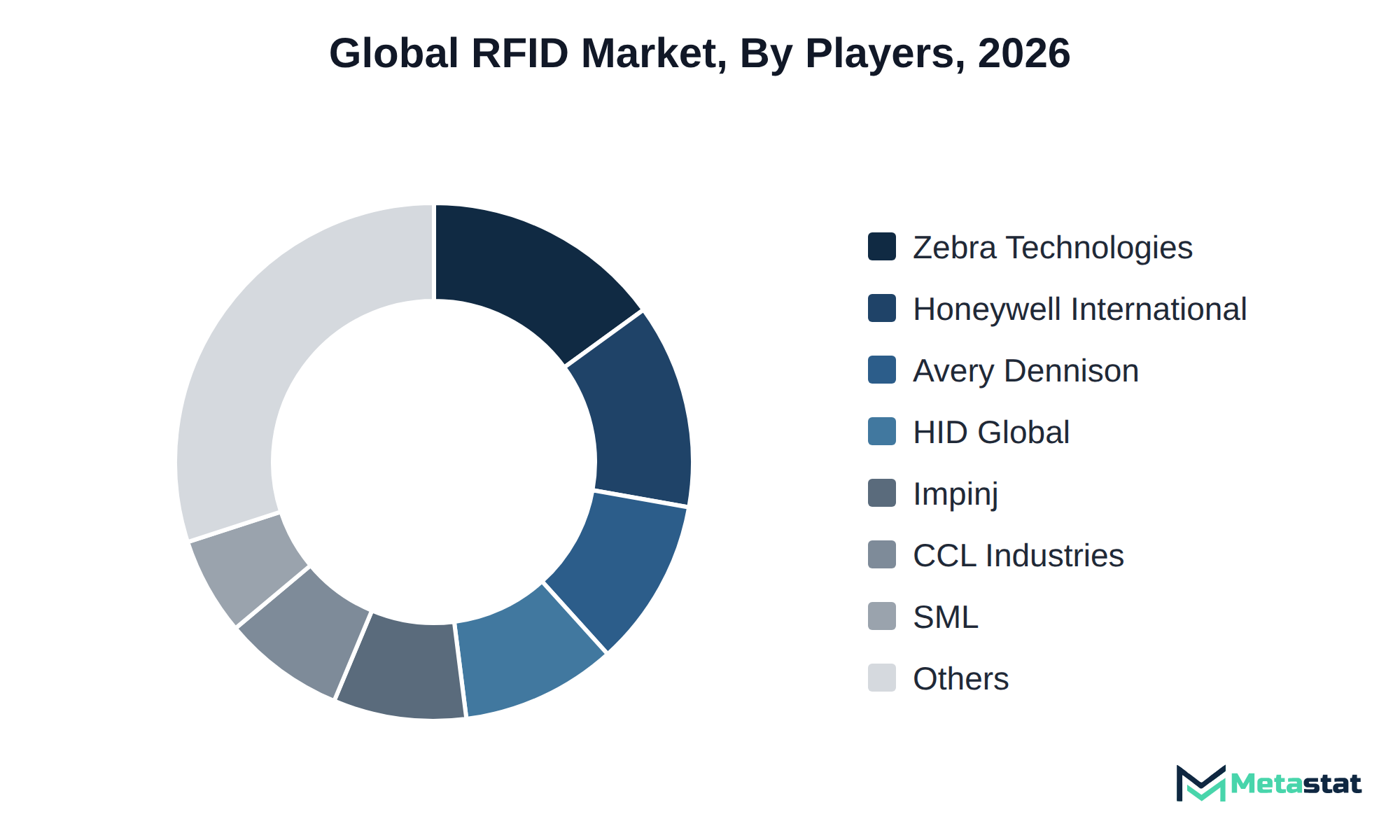
The RFID market features significant competition among various players, divided primarily by offering types and system capabilities. Companies differentiate themselves through pricing strategies, product certifications, customization options, and comprehensive service ecosystems that enhance the end-user experience. Buyers increasingly favor providers that deliver reliable performance and robust service solutions, impacting purchasing decisions across industries.
Zebra Technologies Corporation and Honeywell International Inc. focus on providing comprehensive RFID solutions, catering to diverse end-use industries, while Impinj, Inc. emphasizes specialized products for high-frequency applications. Avery Dennison Corporation stands out through its extensive range of RFID tags and labels designed for retail and consumer goods, reflecting its commitment to innovation and market responsiveness.
The RFID market sees fierce competition driven by technological advancements and evolving customer expectations. Players including SML Group Limited and Datalogic S.p.A. focus on enhancing product functionalities and integrations, ensuring their offerings meet the increasing demand for efficiency and traceability in logistics and supply chain management.
Achieving this growth depends on several key developments within the market. This segment's growth is essential for enhancing operational efficiencies across industries. This growth highlights the demand for improved inventory management and customer experience. However, potential risks exist that could impede reaching USD 43.6 billion. Economic downturns affect investment in RFID technologies, particularly in regions like South America, where the market share remains relatively low at 3.9%. Addressing these risks while capitalizing on the growth opportunities within dominant segments, including Passive RFID Systems and Retail, is essential for the market to fulfill its forecast potential.
By Offering: Tags, Inlays & Labels, Readers & Reader Modules, RFID Antennas, RFID Printers & Encoders, RFID Software, RFID Services
By System Type: Passive RFID Systems (Including Battery-Assisted Passive), Active RFID Systems
By Frequency Band: Low Frequency (LF), High Frequency (HF), Including NFC, Ultra-High Frequency (UHF), Microwave
By End-Use Industry: Retail & Consumer Goods, Transportation, Logistics & Warehousing, Healthcare & Pharmaceuticals, Industrial Manufacturing & Automotive, Food, Beverages & Foodservice, Banking & Financial Services, Agriculture & Livestock, Hospitality, Events & Entertainment, Government & Defense, Others (IT & Telecom, Energy & Utilities, Education & Libraries, Construction)
The report strategically identifies and profiles the key market players and analyses their core competencies in each sub-segment of the RFID market.
Report Attributes | Details |
Study Period | 2021-2033 |
Base Year | 2025 |
Estimated Year | 2026 |
Forecast Period | 2026-2033 |
Historical Period | 2021-2025 |
Growth Rate | CAGR 11.9% from 2026 to 2033 |
Revenue Unit | USD billion |
Segmentation | By Offering, System Type, Frequency Band, End-Use Industry, and Region |
By Region | North America (By Offering, System Type, Frequency Band, End-Use Industry, and Country)
|
Europe (By Offering, System Type, Frequency Band, End-Use Industry, and Country)
| |
Asia Pacific (By Offering, System Type, Frequency Band, End-Use Industry, and Country)
| |
South America (By Offering, System Type, Frequency Band, End-Use Industry, and Country)
| |
Middle East and Africa (By Offering, System Type, Frequency Band, End-Use Industry, and Country)
|
Find answers to common questions about this report
The RFID market size was valued at USD 17.7 billion in 2025.
The market is projected to grow at a CAGR of 11.9% during the forecast period from 2026 to 2033.
The North America RFID market size is estimated to reach USD 15.1 billion by 2033.
Tags, Inlays & Labels lead the RFID market with a projected value of USD 21.1 billion by 2033, reflecting the highest growth among the segments.
Rising consumer expectations for accurate stock availability and streamlined shopping experiences drive demand for RFID technology. Significant investments in tracking capabilities enable retailers to minimize stockouts and reduce excess inventory, enhancing operational efficiency.
North America holds the dominant share of the RFID market, with a projected value of USD 15.1 billion in 2033, representing 36.9 percent of the total market. This figure surpasses the shares of other regions, including Europe at 25 percent and Asia Pacific at 29.9 percent.
Pricing pressures significantly impact the adoption of RFID technology, particularly among small and medium-sized enterprises. Many SMEs face budget constraints, resulting in slower uptake of this technology and delayed replacement of existing systems.
Technological advancements in RFID software support adoption by enhancing data analytics capabilities, enabling businesses to leverage real-time information for improved decision-making. Integration with Internet of Things (IoT) devices further enhances asset visibility and management, driving increased investment in RFID solutions across various sectors.
The RFID market is estimated to reach a valuation of USD 43.6 billion by 2033.
Key players operating in the RFID market include Zebra Technologies Corporation, Avery Dennison Corporation, Honeywell International Inc., HID Global Corporation, Impinj, Inc., and RF Code, Inc.
The analysts below cover Information & Technology research at Metastat Insights.
LEAD ANALYST
Utkarsh Khirodkar is a Lead Market Research Analyst at MetaStat Insight, specializing in market intelligence, technology sector assessments, and competitive strategy.

PRINCIPAL CONSULTANT - ENTERPRISE AI & EMERGING TECHNOLOGIES
Banking & Finance · Electronics and Semiconductor · Energy and Power · Healthcare IT · Information & Technology · Professional Services
Vijay Gunti is a Principal Consultant at MetaStat Insight, bringing over two decades of experience across enterprise digital transformation, technology strategy, and intelligent systems.

LEAD CONSULTANT - COMMUNICATION, TELECOM, AND IT
Electronics and Semiconductor · Information & Technology · Machinery & Equipment · Professional Services
Ravindra Sathe Consultants for Communication, Telecom, and IT at MetaStat Insight. He leads the firm's industry research initiatives across telecommunications infrastructure, digital connectivity, enterprise networking, and emerging information technology domains.
Tracking maintenance cycle demand for secondary flight display units and terrain collision avoidance systems across regional jet fleets involves complex aftermarket dynamics. MetaStat Insight provided practical analysis separating airline retrofit programs from OEM forward-fit production schedules in North America and Southeast Asia. The supplier matrix highlighted component obsolescence timelines without resorting to vague generalizations. The dataset served as a dependable reference during our annual program review meetings.
Evaluating secondary resin quality across post-consumer packaging streams requires reliable technical segmentation. MetaStat Insight delivered an objective assessment that distinguished between extrusion-grade flake pricing and optical sorting throughput limitations across Western Europe. The competitive positioning breakdown for licensed depolymerization technology providers answered several questions during our feedstock feasibility audit. Their team clarified regional trade restrictions on mixed plastic scrap quickly when our team submitted follow-up requests.
Evaluating sovereign cloud deployments for core banking platforms demands a clear view of data residency regulations and migration exit strategies. MetaStat Insight delivered an exhaustive review of regional latency tolerances, mainframe decommission milestones, and third-party vendor concentration risk. The regulatory compliance mapping across European and Asian financial jurisdictions gave our team a dependable baseline for multi-cloud infrastructure discussions.
Explore related market intelligence reports worth reading alongside this one.