
LEAD ANALYST
Utkarsh Khirodkar is a Lead Market Research Analyst at MetaStat Insight, specializing in market intelligence, technology sector assessments, and competitive strategy.

Global Smart Energy Market Size, Share, By Solution Type (Smart grid and advanced metering, Digital oilfield, Smart solar and renewable integration, Building and home energy management, Smart storage and microgrid systems, Smart EV charging), By Component (Hardware, Software, Services), By End User (Energy utilities, Industrial enterprises, Commercial and institutional facilities, Residential households, Transport and fleet operators), By Sales Channel (Direct enterprise sales, System integrators and EPC contractors, OEM and embedded supply agreements, Distributors and installers, Digital and self-service sales), Industry Analysis, Growth, Trends, and Forecast, 2026-2033
Report ID
MSI-4114
Published
October, 2026
Pages
269 Pages
Format
Historical
Base year
Forecast
Forecast period
Report Details
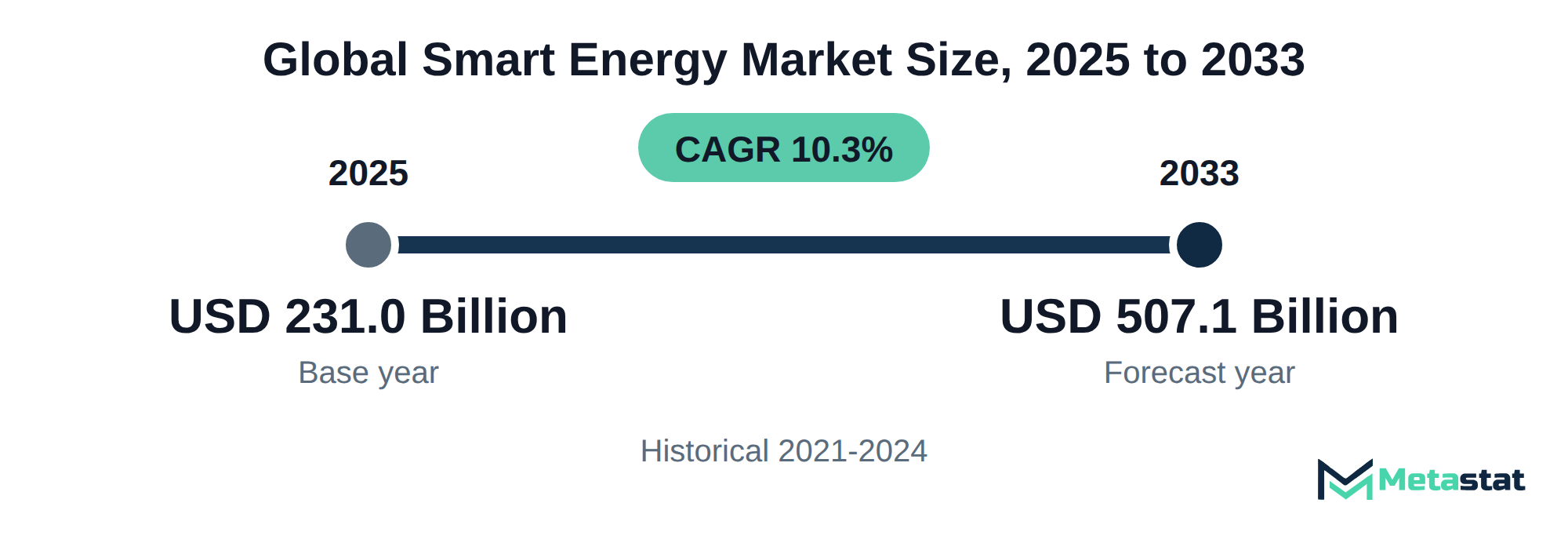
Market Valuation: Valued at $231 Billion in 2025, projected to reach $507.1 Billion by 2033 at a 10.3% CAGR.
Dominant Segment: The smart grid and advanced metering segment leads the market, driven by the increasing demand for enhanced energy distribution and management solutions.
Geographic Lead: North America is the leading region, with the US expected to dominate due to significant infrastructure investments and government initiatives promoting smart energy technologies.
What's Inside: The report provides a comprehensive analysis of market dynamics, competitive landscape, and detailed forecasts from 2026 to 2033 across various segments and components.
Emerging Trends: The integration of smart solar and renewable technologies is gaining traction, with a projected market value of USD 80.3 billion by 2033, reflecting a shift towards sustainable energy solutions.
Market Challenges: High initial capital expenditures and rising operational costs are significant barriers to adoption for energy utilities and industrial enterprises, potentially slowing market growth.
Choose Your License
Global Smart Energy Market
The global Smart Energy market was valued at USD 231 billion in 2025 and is projected to reach USD 507.1 billion by 2033, growing at a CAGR of 10.3% over the forecast period.
The Smart Energy market encompasses various solutions and technologies that enhance energy efficiency, management, and integration of renewable sources. Buyers invest in this market due to increasing demand for sustainable energy practices, reducing operational costs, and meeting regulatory requirements. This investment is vital for energy utilities, industrial enterprises, and residential households seeking to optimize energy consumption and minimize environmental impact.
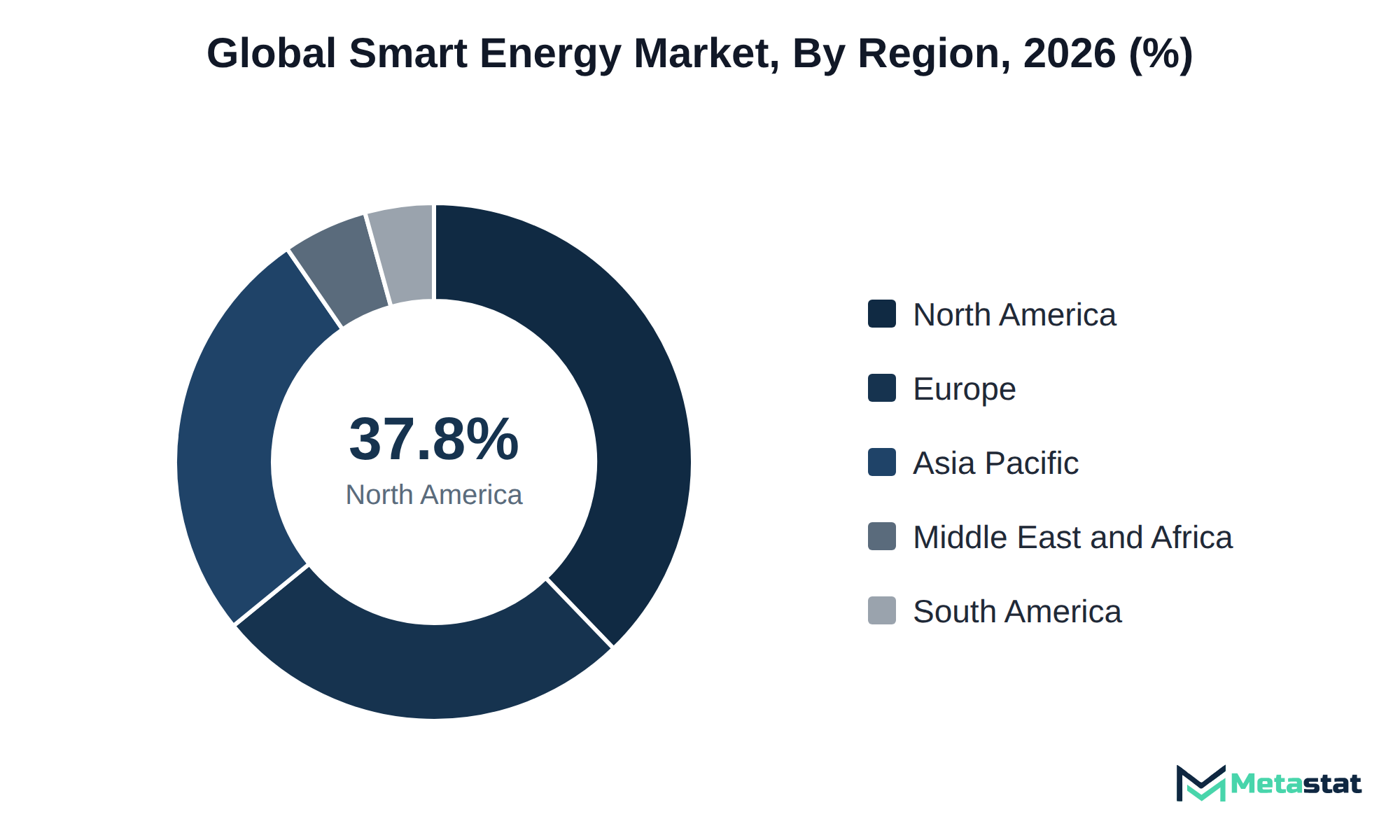
Growth in the market is driven by the transition toward smarter and more interconnected energy systems. The segment of smart grid and advanced metering represents the largest value in this market, highlighting its significance in enhancing energy distribution and consumption. North America holds 37.8% of the market in 2025, with the US leading in 2026. This regional dominance reflects strong infrastructure investment and government initiatives that promote the adoption of smart energy technologies.
Technological advancements shape the Smart Energy market. Innovations in hardware and software components facilitate the implementation of smart solutions, enabling better data analytics and energy management. The ongoing development of renewable energy integration further supports market expansion, attracting investments and driving competitive dynamics among key players.
The Smart Energy market provides essential solutions for optimizing energy consumption, integrating renewable energy sources, and enhancing overall energy management capabilities. Buyers invest in this market primarily to improve operational efficiency, reduce energy costs, and meet regulatory requirements. The continuous push towards sustainability and the transition to greener energy sources drive investments in smart energy technologies across various sectors.
Growth in the market is fueled by technological advancements and a heightened focus on energy efficiency. Among the segments, smart grid and advanced metering solutions represent the most substantial value, reflecting the increasing demand for enhanced energy distribution and management systems. This region benefits from significant investments in energy infrastructure and innovative technologies, creating a favorable environment for market expansion.
The need for reliable energy management systems continues to drive adoption across several industries, including utilities and industrial enterprises. Organizations seek to modernize their energy frameworks, and the market demonstrates strong potential for growth. The ongoing shift towards digitalization and the integration of renewable energy sources positions the Smart Energy market for significant advancements in the coming years.
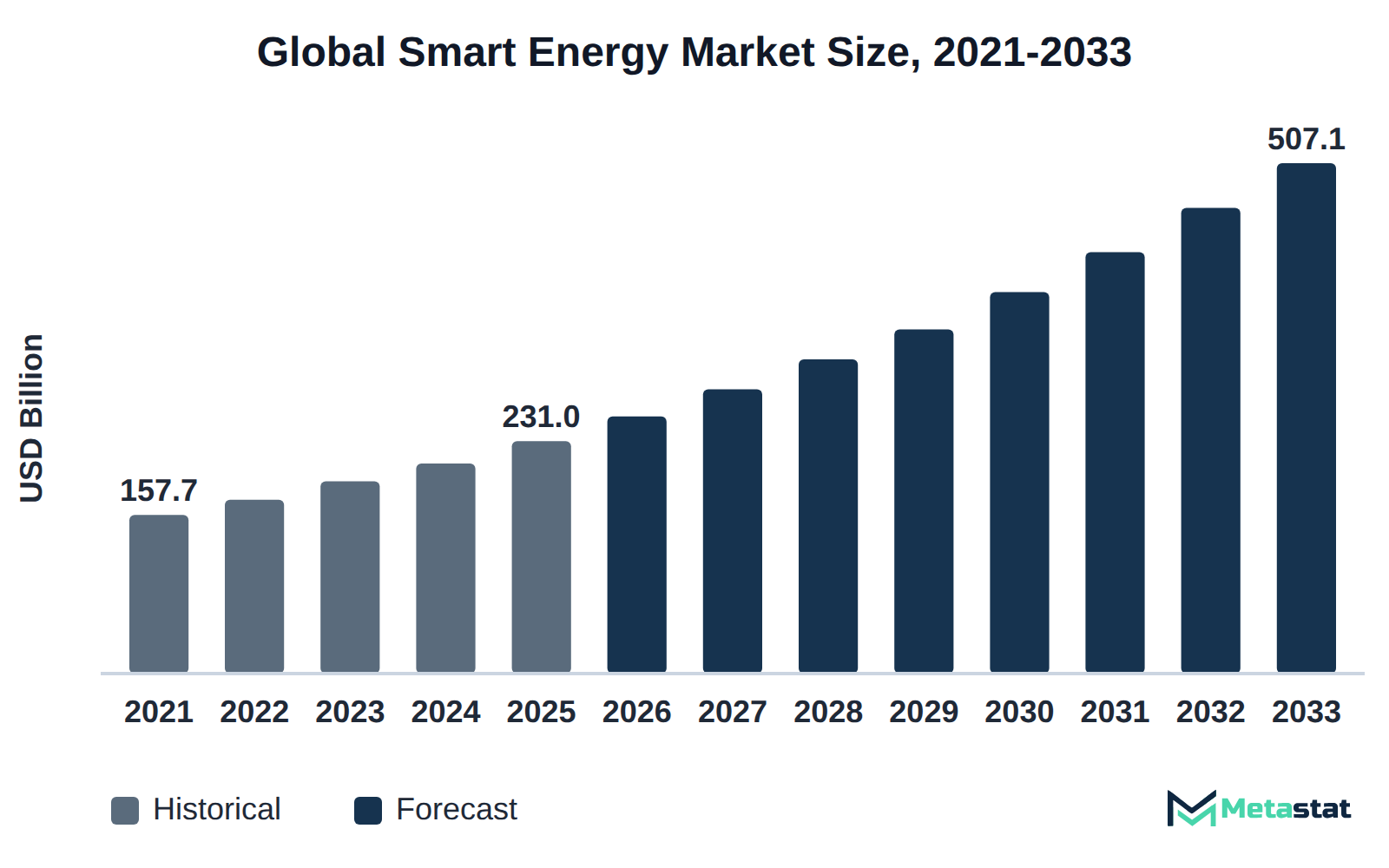
Smart charging technology optimizes electric vehicle (EV) demand alongside household solar and battery storage systems. This integration enhances energy efficiency and minimizes reliance on the grid during peak hours. EV charging management software handles the coordination between vehicle charging, household solar generation, and battery storage. The Smart Energy market experiences a substantial shift towards this integration, driven by advancements in smart grid technologies. The smart grid and advanced metering segment is projected to grow from USD 102.7 billion in 2026 to USD 189.1 billion by 2033, reflecting a compound annual growth rate (CAGR) of 9.1%. This growth highlights the increasing importance of smart charging solutions in managing energy flow between EVs and home energy systems.
By coordinating EV charging times with solar energy production, households utilize excess energy generated during the day, thereby reducing electricity costs and enhancing energy independence. This approach benefits consumers by lowering their energy bills and supports grid stability by offloading demand during peak periods. Adoption of smart charging technologies is expected to drive significant investments in both residential and commercial sectors, promoting growth within the Smart Energy market. As more consumers embrace these solutions, market penetration and sustained demand for energy management systems have room to grow.
Virtual power plants (VPPs) facilitate the integration of distributed energy resources, enhancing grid flexibility and resilience. This integration enables operators to optimize energy production and consumption patterns, effectively managing demand response and renewable generation. The Smart Energy market experiences increasing interest in VPPs due to their capability to aggregate diverse energy assets, including solar panels, energy storage systems, and demand-side resources, which collectively contribute to grid stability.
The pricing models for VPPs typically involve performance-based contracts, where payments are linked to the actual energy savings or capacity contributions realized. This approach aligns the interests of energy providers and consumers, encouraging investments in energy efficiency and demand-side management. In 2033, the expected revenue for Smart grid and advanced metering solutions within the market is USD 189.1 billion, reflecting the significant role that VPPs play in enhancing overall system performance.
The adoption of VPPs helps utility companies reduce operational costs while providing consumers with more control over their energy usage. Several stakeholders recognize the financial and environmental benefits of distributed resource orchestration, and innovation in energy management solutions is expected to drive substantial market growth.
Industrial energy management enhances factory efficiency while aligning operations with renewable power procurement strategies. The integration of advanced energy management practices enables industrial enterprises to optimize energy usage and reduce operational costs. In the Smart Energy market, the segment focusing on industrial energy management is projected to reach USD 154.2 billion by 2033, reflecting a compound annual growth rate (CAGR) of 9.7%. This significant growth highlights the increasing emphasis on sustainability and efficiency in industrial operations.
Energy utilities, primary players in this segment, drive demand for smarter energy solutions that facilitate better control over energy consumption and enhance responsiveness to market fluctuations. By investing in smart energy technologies and services, businesses achieve substantial reductions in their energy expenditures while meeting regulatory requirements for sustainability. The operational benefits extend beyond cost savings, leading to improved productivity and a competitive edge in the marketplace.
Industrial enterprises increasingly prioritize renewable energy sources, resulting in continued upward demand for integrated energy management solutions. The Smart Energy market thus presents substantial opportunities for companies offering innovative products and services aimed at optimizing energy efficiency and promoting renewable energy usage.
Smart energy solutions reduce electric vehicle (EV) charging costs and manage peak electricity demand. The implementation of smart grid and advanced metering technologies significantly enhances energy efficiency, allowing users to optimize their energy consumption patterns. Users increasingly rely on these solutions to manage energy usage effectively.
Smart grids facilitate real-time monitoring and control of electricity distribution, enabling utilities to balance supply and demand dynamically. By integrating energy storage systems and renewable energy sources, these solutions reduce reliance on traditional energy sources during peak hours. Resulting benefits for EV owners include lower charging costs due to reduced demand charges and enhanced grid stability. The growing adoption of smart energy solutions contributes to a more sustainable energy future while simultaneously lowering operational costs for energy utilities and consumers alike, driving demand in the market.
Growing environmental awareness drives consumers toward energy-efficient solutions, significantly affecting energy utilities and industrial enterprises. These buyers prioritize investments in carbon footprint management technologies that reduce emissions and enhance sustainability efforts. The shift in consumer behavior toward greener practices has heightened demand for smart grid systems and advanced metering solutions. This increased adoption contributes to a projected market value of USD 507.1 billion by 2033, reflecting a strong compound annual growth rate of 10.3%. The emphasis on sustainable practices pushes buyers to seek innovative solutions that enhance energy efficiency and reliability, influencing overall market dynamics. Aligning energy consumption strategies with environmental goals has a positive impact on both volume and pricing in the market.
Advancements in digital technologies significantly influence energy systems, enhancing efficiency and integration across various sectors. Smart grid technologies facilitate real-time data analytics, enabling precise energy management and improving operational flexibility. This digitization trend impacts energy utilities and industrial enterprises, driving investments in innovative solutions that optimize resource allocation. Enhanced data capabilities lead to better forecasting and demand response strategies, enabling stakeholders to adapt to changing energy landscapes effectively.
The Smart Energy market benefits from increased reliance on digital solutions, supporting the transition toward decentralized energy systems. Integrating digital oilfield technologies allows energy producers to improve efficiency and streamline operations. Trends in smart solar and renewable integration demonstrate how digitization transforms energy generation and consumption patterns, promoting greater transparency and accountability. These developments create opportunities for investment and growth in the market, aligning with the global push for enhanced energy performance and sustainability.
High initial capital expenditure limits adoption among energy utilities and industrial enterprises within the market. The transition to smart energy solutions requires substantial investment in infrastructure, including advanced metering systems and smart grid technologies. Many companies face difficulty justifying these expenditures, resulting in slower uptake and smaller order sizes. Infrastructure development requires long-term planning and funding, which often delays project execution and replacement cycles for existing energy systems. This dynamic restricts market growth, with companies hesitating to invest in technologies that do not promise immediate returns. Consequently, reduced momentum impacts the overall adoption of innovative energy solutions. Addressing these financial barriers will be essential for enhancing market penetration and facilitating the widespread implementation of smart energy technologies.
Rising operational costs represent a significant challenge for suppliers within the Smart Energy market. Increased expenses related to labor, materials, and compliance contribute to margin pressure. Each supplier faces pressure to maintain profitability while delivering high-quality solutions. The complexity of integrating advanced technologies and services into existing infrastructures further exacerbates these challenges. Suppliers respond by optimizing their operational processes and investing in training to enhance workforce efficiency. Collaborations with technology partners to streamline supply chains help suppliers manage costs. This strategic alignment allows suppliers to reduce overhead while ensuring competitive pricing for clients. The focus on operational efficiency directly influences the competitive landscape, driving suppliers to innovate and enhance their offerings. Addressing these operational challenges remains essential to sustain growth within the market.
The segment of smart solar and renewable integration presents a significant opportunity within the market, driven by increasing investments in clean energy technologies. By 2033, this segment is expected to reach USD 80.3 billion, reflecting a growing emphasis on integrating solar solutions into energy systems. Energy utilities and residential households prioritize sustainable practices, leading to increased demand for innovative solar integration products. Adoption of smart solar technologies enhances energy management, supports reduced reliance on fossil fuels, and addresses regulatory pressures for cleaner energy. The embrace of solar solutions aligns with global efforts to transition toward renewable energy, ultimately impacting energy consumption patterns. Growth in this sector is expected to improve the overall market landscape, presenting avenues for suppliers to offer solutions that meet evolving consumer preferences. This development enhances competitive positioning for companies specializing in solar photovoltaic technologies and integration systems.
The Global Smart Energy market is segmented based on Solution Type, Component, End User, and Sales Channel.
This segment enables efficient electricity distribution and monitoring, used primarily by energy utilities and industrial enterprises to enhance grid reliability and operational efficiency. The growing demand for energy efficiency initiatives drives investment in smart grid technologies, reflecting a shift toward sustainable energy practices. Compared to other segments like digital oilfield, which has a slower growth rate of 6.6%, the smart grid and advanced metering segment stands out with a higher CAGR of 9.1%. This distinction indicates strong market interest in upgrading existing infrastructure to accommodate renewable energy sources and support modern energy management systems.
Digital oilfield segment is estimated to reach USD 68.5 billion by 2033, at a CAGR of 6.6% during the forecast period. This segment focuses on integrating advanced technologies in the oil and gas sector, enhancing operational efficiency and reducing costs. Primarily employed by energy utilities and industrial enterprises, the digital oilfield enables real-time monitoring, data analytics, and improved decision-making processes. Demand for this segment is driven by ongoing digital transformation in the energy sector and increasing emphasis on operational efficiency. Compared to other segments, including smart grid and advanced metering, which have a CAGR of 9.1%, the digital oilfield exhibits slower growth. However, its specific applications in enhancing productivity and safety within oil and gas operations distinguish it from the more broadly applicable solutions in the market.
Smart solar and renewable integration segment is expected to reach USD 80.3 billion by 2033. This segment focuses on enhancing the integration of renewable energy sources, including solar power, into existing energy systems. Energy utilities and industrial enterprises apply this technology to improve efficiency and reduce dependence on fossil fuels. Growing demand for sustainable energy solutions drives adoption, supported by increasing government policies favoring renewable energy. With a compound annual growth rate (CAGR) of 6.6%, this segment experiences slower growth compared to others in the market, including building and home energy management, which has a CAGR of 11.2%. The emphasis on sustainability and energy transition enhances investment opportunities, increasing the segment's significance in the evolving energy landscape.
The building and home energy management segment is projected to grow at a CAGR of 11.2% during the forecast period. This segment focuses on optimizing energy consumption within residential and commercial buildings, using technologies that enhance energy efficiency and integrate renewable sources. Property owners and facilities management teams increasingly employ these solutions to minimize energy costs and improve sustainability practices. The push toward energy efficiency, driven by rising energy prices and regulatory incentives, significantly supports this segment's growth. Compared to other segments in the market, including smart grid and advanced metering, which grow at a CAGR of 9.1%, building and home energy management stands out with its faster growth trajectory. This rapid expansion aligns with the increasing emphasis on smart technologies, making it a vital component in energy management strategies.
Smart storage and microgrid systems employ advanced technologies to optimize energy storage and distribution within localized energy networks. These systems enable energy utilities, commercial facilities, and residential households to enhance energy reliability and efficiency, particularly in regions with variable energy supply or demand. Key drivers for this segment include the increasing adoption of renewable energy sources and the rising demand for resilient energy infrastructures. The ability to store energy generated from intermittent sources, including solar and wind, supports grid stability and energy management. Compared to other segments, this segment focuses on integrating energy storage solutions, which differentiates it from solutions including smart grid and advanced metering. The market experiences unique challenges, including regulatory constraints and the need for standardization in technology, which slow adoption rates in certain areas.
Smart EV charging provides infrastructure for the growing number of electric vehicles and enables efficient energy supply during charging. This segment serves energy utilities, commercial facilities, and residential households seeking to optimize charging solutions. Demand for smart EV charging is driven by the increasing adoption of electric vehicles, supported by government incentives promoting greener transportation options. Differentiating itself from other segments, this sub-segment is positioned for faster growth due to rapidly expanding EV adoption rates. Advancements in charging technology enhance user convenience and reduce charging times, appealing to a broader consumer base. This segment's focus on sustainability aligns with the market's overall objectives, facilitating the transition to a more energy-efficient system.
Hardware is valued at USD 104 billion in 2026 and is projected to reach USD 189 billion by 2033, at a CAGR of 8.9% during the forecast period. This component segment is central to implementing smart energy solutions, offering physical devices that enhance energy efficiency and grid management. Energy utilities and industrial enterprises primarily use hardware for optimized energy distribution and consumption. Growing investments in renewable energy infrastructure and the increasing need for energy-efficient technologies drive demand for hardware. Compared to software and services, which exhibit higher growth rates at CAGRs of 11.4% and 10%, respectively, hardware growth remains steady, focusing on foundational technologies essential for effective operations. The market benefits from technological advancements that enhance the performance and integration of hardware within the broader smart energy ecosystem.
Software segment is estimated to reach USD 184.6 billion by 2033, at a CAGR of 11.4% during the forecast period. This segment optimizes energy management, facilitates data analysis, and enhances operational efficiency for various stakeholders, including energy utilities, industrial enterprises, and commercial facilities. Rising demand for advanced analytics and real-time monitoring drives growth, ensuring effective resource utilization. The software segment stands out with its accelerated growth rate compared to hardware components, which are projected to grow at a CAGR of 8.9%. This differentiation highlights the increasing focus on digital solutions in the market. The integration of software solutions with hardware systems creates opportunities for enhanced interoperability and improved performance across energy management applications.
Services segment is expected to reach USD 133.5 billion by 2033. This segment encompasses various offerings that support the implementation and maintenance of smart energy solutions, catering primarily to energy utilities, industrial enterprises, and commercial entities. Increasing demand for efficient energy management systems drives growth in this segment, with a notable focus on integrating advanced technologies to optimize performance. The services segment is characterized by a higher growth rate compared to hardware, with a projected CAGR of 11.4%. This growth reflects the increasing reliance on software-based solutions and consultancy services to enhance energy efficiency and sustainability. These developments signal a shift toward service-oriented models that provide continuous support, ensuring that clients maximize their investments in smart energy technologies. Such dynamics position the services segment as a vital element in the broader market, helping entities manage the energy transition.
Energy utilities segment is valued at USD 95.1 billion in 2026 and is projected to reach USD 183.4 billion by 2033, at a CAGR of 9.8% during the forecast period. This segment consists of companies responsible for the generation, transmission, and distribution of electricity and gas. Energy utilities employ smart energy solutions to enhance operational efficiency, reduce outages, and integrate renewable energy sources into their grids. An increasing focus on sustainability drives energy utilities to invest in advanced metering infrastructure and smart grid technologies, improving service delivery and customer engagement. This segment expands at a moderate pace compared to commercial and institutional facilities, which benefit from a higher CAGR of 11.1%. Energy utilities face unique challenges, including regulatory requirements and aging infrastructure, compelling them to adopt innovative solutions to maintain reliability and reduce costs. Investment in technology that facilitates real-time data monitoring and management remains crucial in meeting demand in the Smart Energy market.
This segment primarily serves manufacturing, processing, and production facilities, focusing on enhancing operational efficiency and sustainability in energy consumption. Increasing regulatory pressures for emissions reduction significantly influence this segment, compelling enterprises to adopt advanced energy management solutions. Compared to other segments, including commercial and institutional facilities, the industrial enterprises segment demonstrates higher growth potential due to the pressing need for modernization and energy optimization in large-scale operations. Adoption of smart technologies in energy management enhances productivity while contributing to cost savings over time. The market for industrial enterprises thus represents a key area of investment for technology providers aiming to meet evolving demands for sustainable and efficient energy solutions.
The commercial and institutional facilities segment is expected to reach USD 91.8 billion by 2033. This segment encompasses a range of users including office buildings, educational institutions, and healthcare facilities that require efficient energy management solutions. A primary driver of growth in this segment involves the increasing focus on energy efficiency and sustainability. These facilities strive to reduce operational costs while meeting regulatory requirements. Growth in this segment is projected at a CAGR of 11.1%, distinguishing it with a more rapid expansion rate compared to other end users, including energy utilities and industrial enterprises. Competitive pricing and technological advancements in energy management systems support the adoption of smart technologies within commercial and institutional facilities, enhancing overall energy performance while contributing to the broader objectives of the market.
Residential households segment is projected to grow at a CAGR of 11.1% during the forecast period. This segment focuses on implementing smart energy solutions tailored for individual homes, addressing energy efficiency and management. Homeowners increasingly adopt technologies including smart meters and integrated energy management systems to reduce consumption and enhance convenience. Rising awareness of energy conservation and growing demand for sustainable living drive this segment's growth. Compared to other segments like energy utilities, which grow at a CAGR of 9.8%, residential households display a faster rate due to increasing emphasis on smart home technologies and government incentives promoting energy efficiency. This segment targets individual consumers rather than larger enterprises, creating distinct market dynamics that influence product offerings and pricing strategies.
Transport and fleet operators employ smart energy solutions to enhance the efficiency of logistics and reduce environmental impact. This segment caters to businesses focused on optimizing transportation routes and minimizing fuel consumption, thus supporting sustainability initiatives. The demand for advanced energy management systems in this area is driven by regulatory pressures and the growing emphasis on reducing carbon footprints. Unique challenges arise from the rapid adoption of electric and hybrid vehicles, which requires substantial investment in infrastructure. The market's evolution will strongly influence how companies manage their energy use and adapt to emerging technologies, distinguishing them from traditional energy consumers.
Direct enterprise sales segment is valued at USD 116.6 billion in 2026 and is projected to reach USD 226.7 billion by 2033, at a CAGR of 10% during the forecast period. This segment involves transactions made directly to large organizations that require energy solutions, typically including energy utilities and industrial enterprises. Strong demand for integrated energy management solutions drives growth within this segment, supported by an increasing emphasis on energy efficiency and sustainability initiatives. Compared to other sales channels, direct enterprise sales differentiates itself through its focus on larger contracts and long-term partnerships, resulting in a more stable revenue stream. In contrast, segments including system integrators and EPC contractors exhibit different growth trajectories due to varying customer bases and engagement levels. The Smart Energy market reflects a shift toward more customized and scalable solutions, addressing the unique needs of diverse buyers.
System integrators and EPC contractors segment is estimated to reach USD 136.1 billion by 2033, at a CAGR of 10% during the forecast period. This segment focuses on providing integrated solutions and power EPC services that construct energy systems for various applications, primarily for energy utilities and industrial enterprises. A growing emphasis on renewable energy integration and energy efficiency drives demand for these services. This sub-segment distinguishes itself from alternatives like direct enterprise sales by targeting complex energy projects requiring specialized expertise, resulting in higher pricing structures. The integration of new technologies, including automation and advanced data analytics, further supports the segment's growth, enhancing project execution and operational efficiency. Overall, the segment contributes significantly to the market, facilitating the transition to more sustainable energy practices.
OEM and embedded supply agreements segment is expected to reach USD 77 billion by 2033. This segment facilitates partnerships between manufacturers and suppliers, enabling the integration of smart energy solutions into various products. Companies in sectors including energy utilities and industrial enterprises engage in these agreements to enhance product offerings and streamline operations. The demand for integrated solutions drives this segment, supported by advancements in technology and an increased focus on energy efficiency. Compared to direct enterprise sales, this segment experiences slower growth, reflecting a more niche approach with specific customer requirements. The transition toward renewable energy sources and regulatory pressures further influence the dynamics of this segment, highlighting its importance within the Smart Energy market.
The distributors and installers segment is projected to grow at a CAGR of 8.8% during the forecast period. This segment provides essential services for the deployment of smart energy solutions, connecting manufacturers and end users through a network that ensures efficient energy management. Energy utilities and industrial enterprises use these services to enhance energy efficiency and integrate advanced technologies. The increasing demand for smart meters and renewable energy solutions drives growth in this segment, particularly as businesses and consumers seek to optimize energy consumption. Compared to other sales channels, this segment exhibits moderate growth, primarily due to reliance on skilled labor and local expertise. The market reflects a shift toward more integrated solutions, with distributors and installers playing a crucial role in supporting the transition to smarter energy systems. In this context, the segment's expanding capabilities align with broader trends in the Smart Energy market.
Digital and self-service sales encompass innovative methods allowing consumers and businesses to access smart energy solutions through online platforms. This segment attracts buyers seeking convenience and efficiency in managing their energy consumption, including residential households and commercial facilities. The growing emphasis on sustainability drives demand for digital solutions, with users looking for ways to reduce their carbon footprint while optimizing energy use. Unlike traditional sales channels, which involve in-person interactions, this segment offers a streamlined purchasing process. Digital and self-service sales leverage advancements in technology to enhance customer engagement and satisfaction. This approach positions the segment uniquely compared to others, facilitating a more adaptive market response to evolving consumer preferences and contributing significantly to the overall market.
Based on geography, the Global Smart Energy market is divided into North America, Europe, Asia-Pacific, South America, Middle East, and Africa.
Driven by advancements in technology and increasing investments from energy utilities, the Smart Energy market in North America is projected to reach USD 176.6 billion by the end of 2033. The emphasis on renewable energy sources and smart grid technologies fuels demand, particularly in the United States, Canada, and Mexico. Regulatory support and initiatives aimed at reducing greenhouse gas emissions encourage stakeholders to adopt smart energy solutions. The push for energy efficiency in industrial and commercial sectors strengthens the market. The region's share of the global market accounts for 37.8% in 2025, reflecting significant opportunities for growth and innovation within the sector.
In Europe, the Smart Energy market experiences significant demand driven by energy utilities and industrial enterprises that prioritize efficiency and sustainability. The regulatory environment encourages investments in smart grid technologies and renewable energy integration. Countries including Germany and France lead in adopting advanced metering infrastructure, enhancing energy management capabilities. The market share for this region is projected at 26.3% in 2025, reflecting the commitment of stakeholders to transition toward a low-carbon economy. Ongoing infrastructure developments support the deployment of smart energy solutions across various applications, further strengthening Europe's position as a key player in the global market.
Asia-Pacific holds a significant 26.3% share of the global market in 2025, driven by rapid urbanization and industrialization in countries including China and India. These nations invest heavily in smart grid technologies and renewable energy solutions, enhancing energy efficiency and sustainability. Infrastructure developments, particularly in India and Southeast Asia, support increased adoption of smart energy systems, with government initiatives promoting renewable integration. In Japan, technological advancements in energy management further stimulate demand, particularly among energy utilities and industrial enterprises. The region's diverse energy needs necessitate innovative solutions, positioning the smart energy market for strong growth. Smart solar and renewable integration, along with digital oilfield solutions, serve as vital components advancing energy transformation in this region.
Brazil and Argentina exhibit increasing investment in renewable energy initiatives, reflecting a growing awareness of sustainability. The market benefits significantly from government incentives aimed at enhancing energy efficiency and reducing dependence on fossil fuels. Infrastructure improvements, including the expansion of smart grid technologies, drive demand among energy utilities seeking to modernize operations. This focus on integration and efficiency positions South America as a region with a unique approach to energy management. With a projected market share of 4.3% of the global market in 2025, the region demonstrates potential for steady growth in smart energy applications.
Growth in the Smart Energy market within the Middle East and Africa region is supported by increasing investments in renewable energy and energy efficiency initiatives. Countries like Saudi Arabia and the UAE are implementing ambitious plans to diversify their energy sources, focusing on solar and wind projects. South Africa has made strides in integrating smart grid technologies to enhance electricity distribution and management. The region's share of the global market is forecasted at 5.3% in 2025. This development creates opportunities for technological innovation and collaboration within the sector while addressing rising demand for sustainable energy solutions in urban areas. The market dynamics reflect a strong push towards modernization, influencing the strategies of both energy providers and consumers.
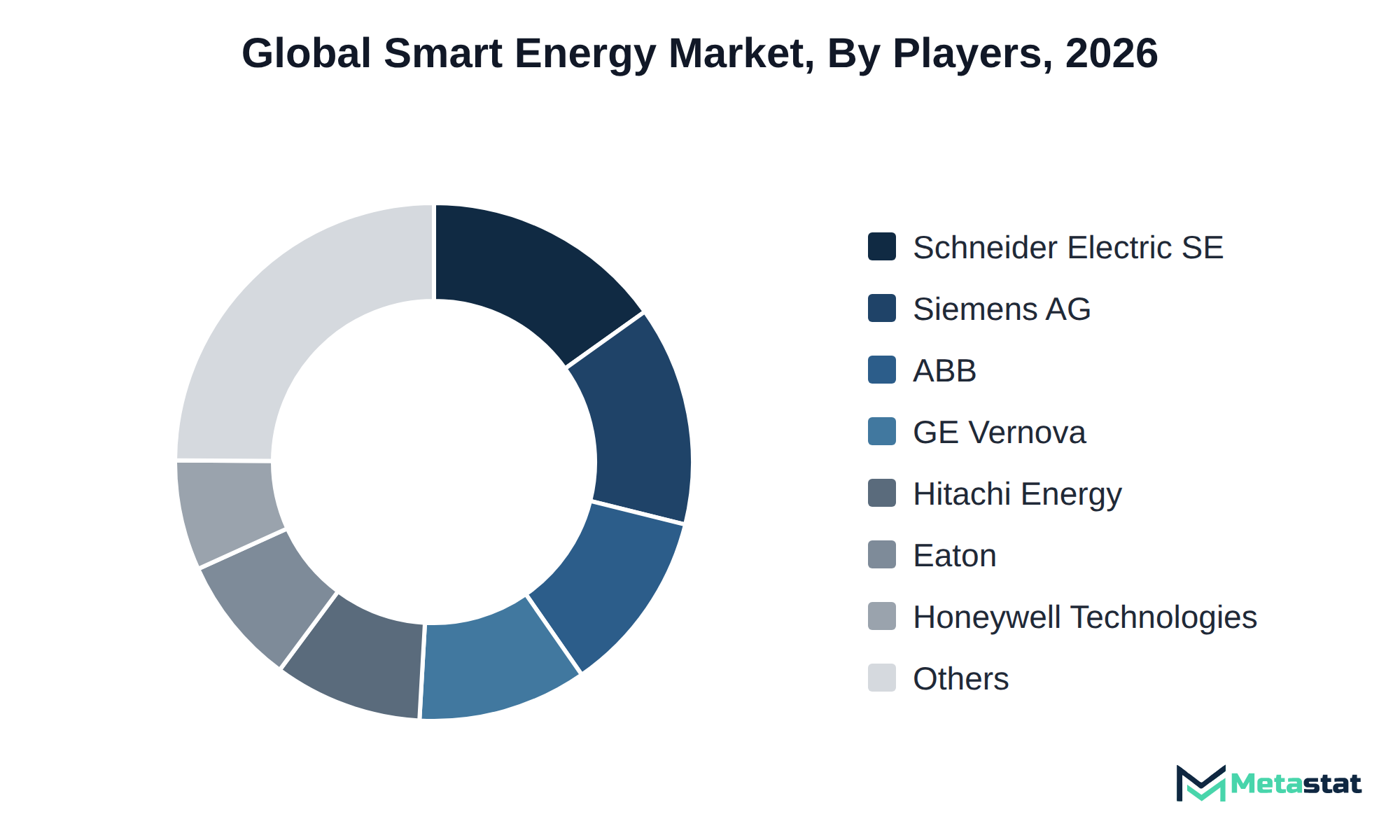
Competition within the Smart Energy market encompasses a diverse array of companies focusing on various segments. Companies including Schneider Electric SE, Siemens AG, and ABB Ltd primarily emphasize smart grid technologies and advanced metering solutions. In contrast, GE Vernova Inc. and Hitachi Energy Ltd concentrate on digital oilfield applications, targeting energy utilities seeking to enhance operational efficiency.
Buyers select solutions based on factors including price, certification, customization, and service. For instance, Honeywell Technologies Inc. and Itron, Inc. provide customized energy management systems tailored to commercial and industrial users, enhancing their value propositions. Companies like Tesla, Inc. and Enphase Energy, Inc. focus on integrating smart solar and renewable solutions, appealing to environmentally conscious consumers and residential households.
Smart solar and renewable energy integration will be a key driver of the Smart Energy market, supported by anticipated demand. Key risks to this forecast involve potential regulatory setbacks and technological challenges in the deployment of innovative solutions, particularly in the Asia Pacific region, where infrastructure varies significantly. These factors could hinder the market's ability to achieve the projected value by 2033. Overall, the Smart Energy market is positioned for substantial growth, driven by advancements in technology and regulatory frameworks that support innovation.
By Solution Type: Smart grid and advanced metering, Digital oilfield, Smart solar and renewable integration, Building and home energy management, Smart storage and microgrid systems, Smart EV charging
By Component: Hardware, Software, Services
By End User: Energy utilities, Industrial enterprises, Commercial and institutional facilities, Residential households, Transport and fleet operators
By Sales Channel: Direct enterprise sales, System integrators and EPC contractors, OEM and embedded supply agreements, Distributors and installers, Digital and self-service sales
The report strategically identifies and profiles the key market players and analyses their core competencies in each sub-segment of the Smart Energy market.
|
Report Attributes |
Details |
|
Study Period |
2021-2033 |
|
Base Year |
2025 |
|
Estimated Year |
2026 |
|
Forecast Period |
2026-2033 |
|
Historical Period |
2021-2025 |
|
Growth Rate |
CAGR 10.3% from 2026 to 2033 |
|
Revenue Unit |
USD billion |
|
Segmentation |
By Solution Type, Component, End User, Sales Channel, and Region |
|
By Region |
North America (By Solution Type, Component, End User, Sales Channel, and Country)
|
|
Europe (By Solution Type, Component, End User, Sales Channel, and Country)
|
|
|
Asia Pacific (By Solution Type, Component, End User, Sales Channel, and Country)
|
|
|
South America (By Solution Type, Component, End User, Sales Channel, and Country)
|
|
|
Middle East and Africa (By Solution Type, Component, End User, Sales Channel, and Country)
|
Find answers to common questions about this report
The Smart Energy market size was valued at USD 231 billion in 2025.
The market is projected to grow at a CAGR of 10.3% during the forecast period from 2026 to 2033.
The North America Smart Energy market size is estimated to reach USD 176.6 billion by 2033.
The leading segment in the Smart Energy market is Smart grid and advanced metering, with a projected value of USD 189.1 billion by 2033. This segment demonstrates significant growth potential, driven by increasing demand for advanced energy management solutions.
Growing environmental awareness drives consumers toward energy-efficient solutions, significantly affecting energy utilities and industrial enterprises. High initial capital expenditure limits adoption among energy utilities and industrial enterprises within the market.
North America holds the dominant share of the Smart Energy market, with a projected value of USD 176.6 billion in 2033, representing 37.8 percent of the total market.
High initial capital expenditure limits adoption among energy utilities and industrial enterprises. Rising operational costs represent a significant challenge for suppliers, contributing to margin pressure and complicating the integration of advanced technologies into existing infrastructures.
Growing investments in clean energy technologies favor the adoption of smart solar and renewable integration solutions. By 2033, this segment is projected to reach USD 80.3 billion, driven by the demand for innovative solar integration products that enhance energy management and support sustainability efforts.
The Smart Energy market is estimated to reach a valuation of USD 507.1 billion by 2033.
Key players operating in the Smart Energy market include Schneider Electric SE, Siemens AG, ABB Ltd, GE Vernova Inc., Hitachi Energy Ltd, Eaton Corporation plc, Honeywell Technologies Inc., and Tesla, Inc.
The analysts below cover Energy and Power research at Metastat Insights.
LEAD ANALYST
Utkarsh Khirodkar is a Lead Market Research Analyst at MetaStat Insight, specializing in market intelligence, technology sector assessments, and competitive strategy.

PRINCIPAL CONSULTANT - ENTERPRISE AI & EMERGING TECHNOLOGIES
Banking & Finance · Electronics and Semiconductor · Energy and Power · Healthcare IT · Information & Technology · Professional Services
Vijay Gunti is a Principal Consultant at MetaStat Insight, bringing over two decades of experience across enterprise digital transformation, technology strategy, and intelligent systems.

ENERGY & INFRASTRUCTURE INDUSTRY CONSULTANT
Automotive and Transportation · Electronics and Semiconductor · Energy and Power · Machinery & Equipment
Saurabh Vasant Ganvir consults for Energy & Infrastructure Industry at MetaStat Insight, specializing in renewable energy, solar EPC, and electric vehicle (EV) infrastructure markets.
Floating offshore wind feasibility relies heavily on specialized installation vessel availability and port crane limits, which most broad renewable energy forecasts ignore. The report delivered a thorough analysis of dry dock capacity, mooring chain supply constraints, and raw material pricing trends for deepwater anchor installations. It served as a solid independent sanity check for our offshore project capital expenditure assumptions.
Assessing commercial microgrid software adoption requires looking past top-level installation numbers and examining utility interconnection queues. The research provided verifiable data on average permitting timelines, tariff structures, and battery storage integration costs across regional utility territories. That grounded perspective was valuable for our team when building five-year demand projections for industrial microgrid controllers.
Ambulatory surgical centers have very different purchasing cycles for robotic-assisted surgery platforms than major hospital networks. The MetaStat Insight study focused squarely on capital expenditure depreciation, procedural reimbursement pathways, and surgeon training overhead. That operational clarity made it much simpler to validate multi-year procedure growth forecasts against actual ambulatory center adoption patterns.
Explore related market intelligence reports worth reading alongside this one.