
LEAD ANALYST
Utkarsh Khirodkar is a Lead Market Research Analyst at MetaStat Insight, specializing in market intelligence, technology sector assessments, and competitive strategy.

Global Chargeback Management Software Market Size, Share, By Deployment Model (Cloud-Based and On-Premises), By Type (Chargeback Prevention and Alert Management Software, Dispute Management and Case Tracking Software, Chargeback Representment and Evidence Management Software, Chargeback Analytics and Reporting Software, Integrated Chargeback Management Platforms and Others (Automated Refund and Resolution Tools)), By Organization Size (Small and Medium-Sized Enterprises and Large Enterprises), By End-Use Industry (Retail and E-Commerce, Travel and Hospitality, Financial Services, Digital Goods and Subscription Services, Gaming and Online Entertainment, Telecommunications and Others (Healthcare, Education, Professional Services)), Industry Analysis, Growth, Trends, and Forecast, 2026-2033
Report ID
MSI-5802
Published
November, 2026
Pages
285 Pages
Format
Historical
Base year
Forecast
Forecast period
Report Details
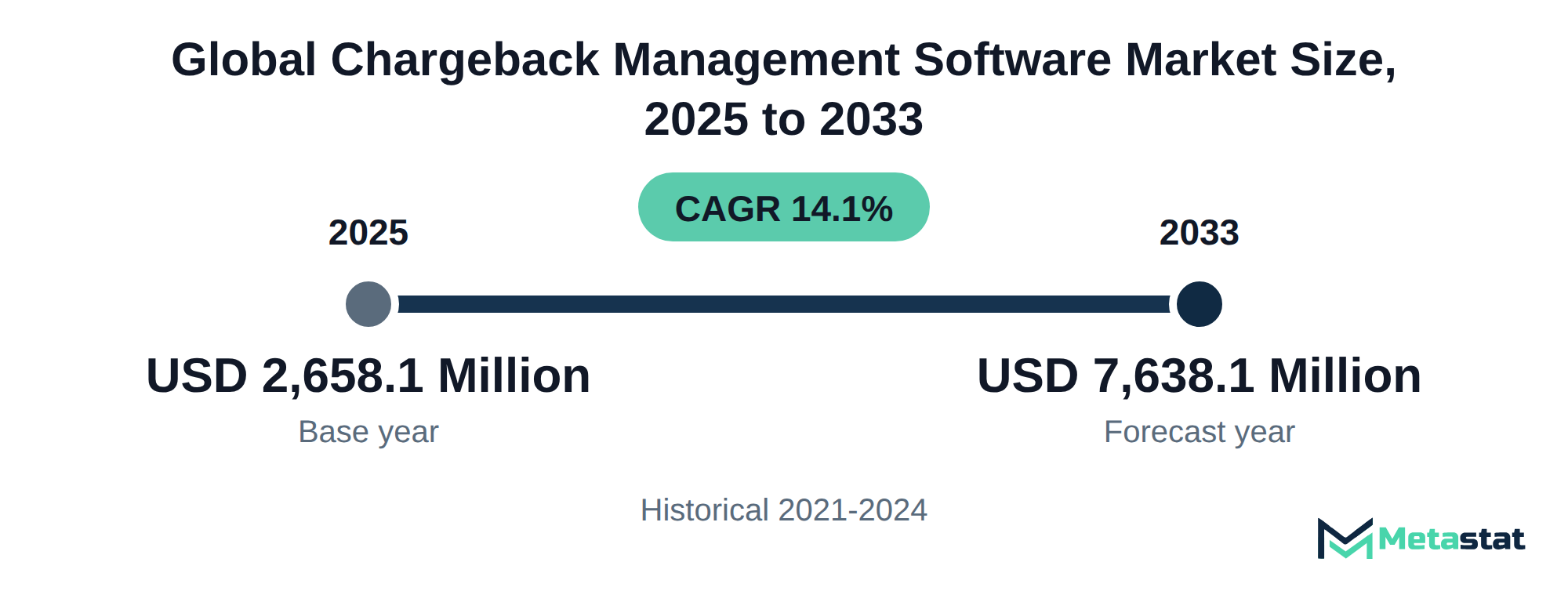
Market Valuation: Valued at $2,658.1 Million in 2025, projected to reach $7,638.1 Million by 2033 at a 14.1% CAGR.
Dominant Segment: The Chargeback Prevention and Alert Management Software segment leads the market, driven by the increasing necessity for businesses to protect against rising chargeback incidents, particularly in retail and e-commerce.
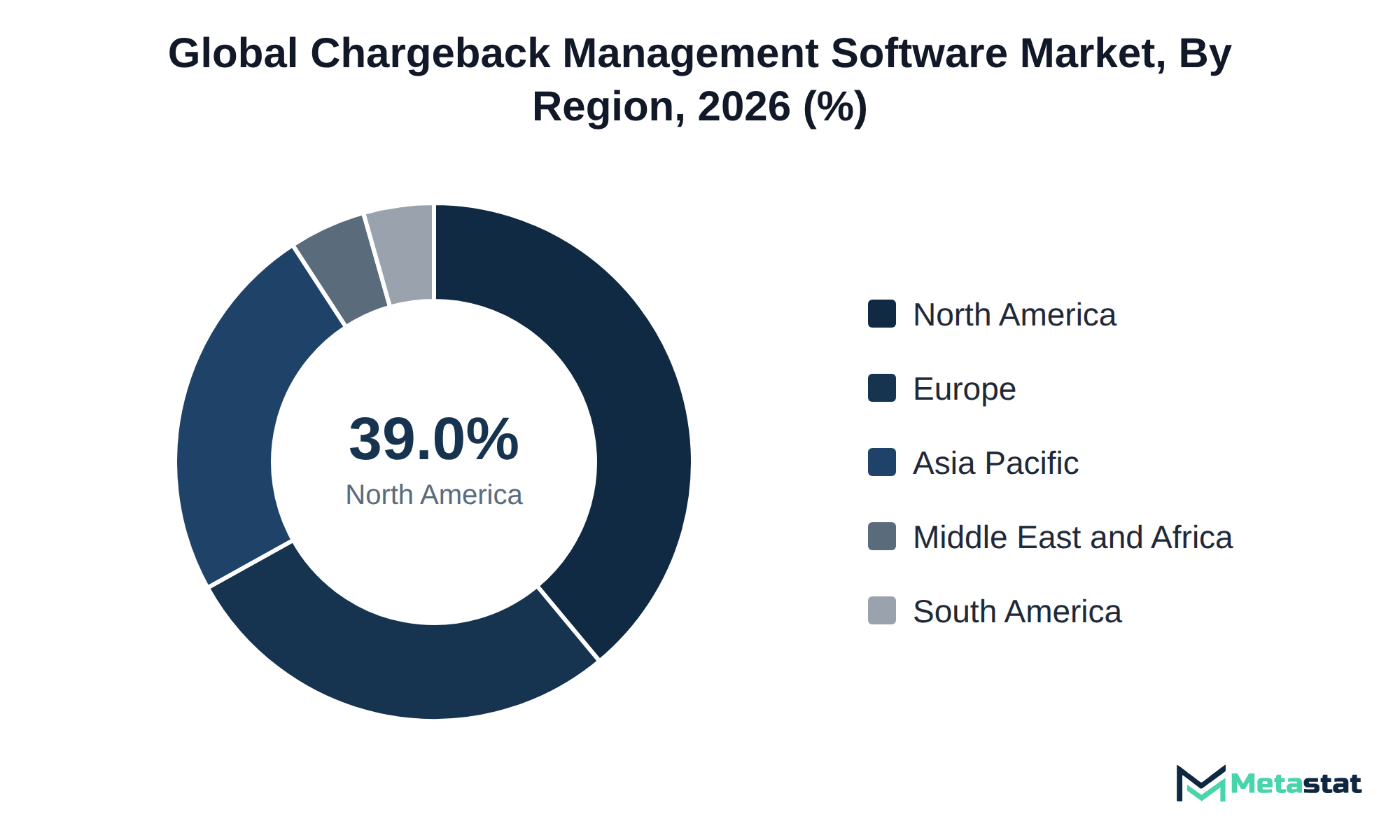
Geographic Lead: North America dominates the market, holding 39.0% in 2025, with the US leading due to its robust infrastructure and high consumer spending.
What's Inside: The report provides a comprehensive analysis of market dynamics, competitive landscape, and detailed forecasts from 2026 to 2033, covering various deployment models and end-use industries.
Growth in Cloud-Based Solutions: The cloud-based deployment model is projected to grow at a CAGR of 15.3%, reflecting increasing demand for flexible and scalable chargeback management solutions.
Enhanced Chargeback Analytics: The demand for advanced chargeback analytics tools is rising, enabling businesses to gain insights into chargeback trends and improve their prevention strategies.
Choose Your License
Global Chargeback Management Software Market
The global Chargeback Management Software market was valued at USD 2,658.1 million in 2025 and is projected to reach USD 7,638.1 million by 2033, growing at a CAGR of 14.1% over the forecast period.
The Chargeback Management Software market encompasses tools and systems designed to help businesses manage and mitigate chargebacks effectively. Organizations invest in these solutions to enhance transaction integrity, reduce financial losses, and improve customer satisfaction. The rising prevalence of online transactions and digital payments drives the adoption of such software, with businesses striving to protect revenue from fraudulent activities and disputes.
Growth in the market is fueled by increasing transaction volumes, particularly in the retail and e-commerce sector, which represents the most significant value segment. North America holds 39.0% of the market in 2025, with the US leading in 2026. This region's robust infrastructure, high consumer spending, and advanced technological landscape contribute to its dominance, while other regions including Europe and Asia Pacific follow with shares of 28.0% and 23.9%, respectively.
The market experiences expansion due to the increasing need for automated solutions that streamline chargeback processes and enhance operational efficiency. Businesses aim to minimize the impact of chargebacks on their bottom line while maintaining a positive customer experience. The growing focus on data analytics and reporting supports demand for sophisticated chargeback management tools.
The Chargeback Management Software market includes solutions that assist businesses in managing chargeback processes, thus protecting revenue and enhancing operational efficiency. Buyers invest in this software to address the increasing complexity of online transactions and improve their financial performance. Organizations across various sectors, including retail, travel, and financial services, seek these solutions to streamline dispute resolution and minimize losses related to chargebacks.
Growth in the market is driven by the rising adoption of digital payment methods, leading to an increase in transaction volumes and, consequently, chargeback occurrences. Among the different segments, Cloud-Based deployment emerges as the most valuable, offering flexibility and scalability to businesses. North America's dominance results from a well-established e-commerce infrastructure and high online transaction activity.
The need for effective chargeback management tools intensifies, given the competitive nature of the market. Organizations prioritize investments in advanced analytics and reporting capabilities within chargeback solutions. This strategic focus on enhanced functionalities supports sustained demand and the projected 14.1% CAGR of the Chargeback Management Software market.
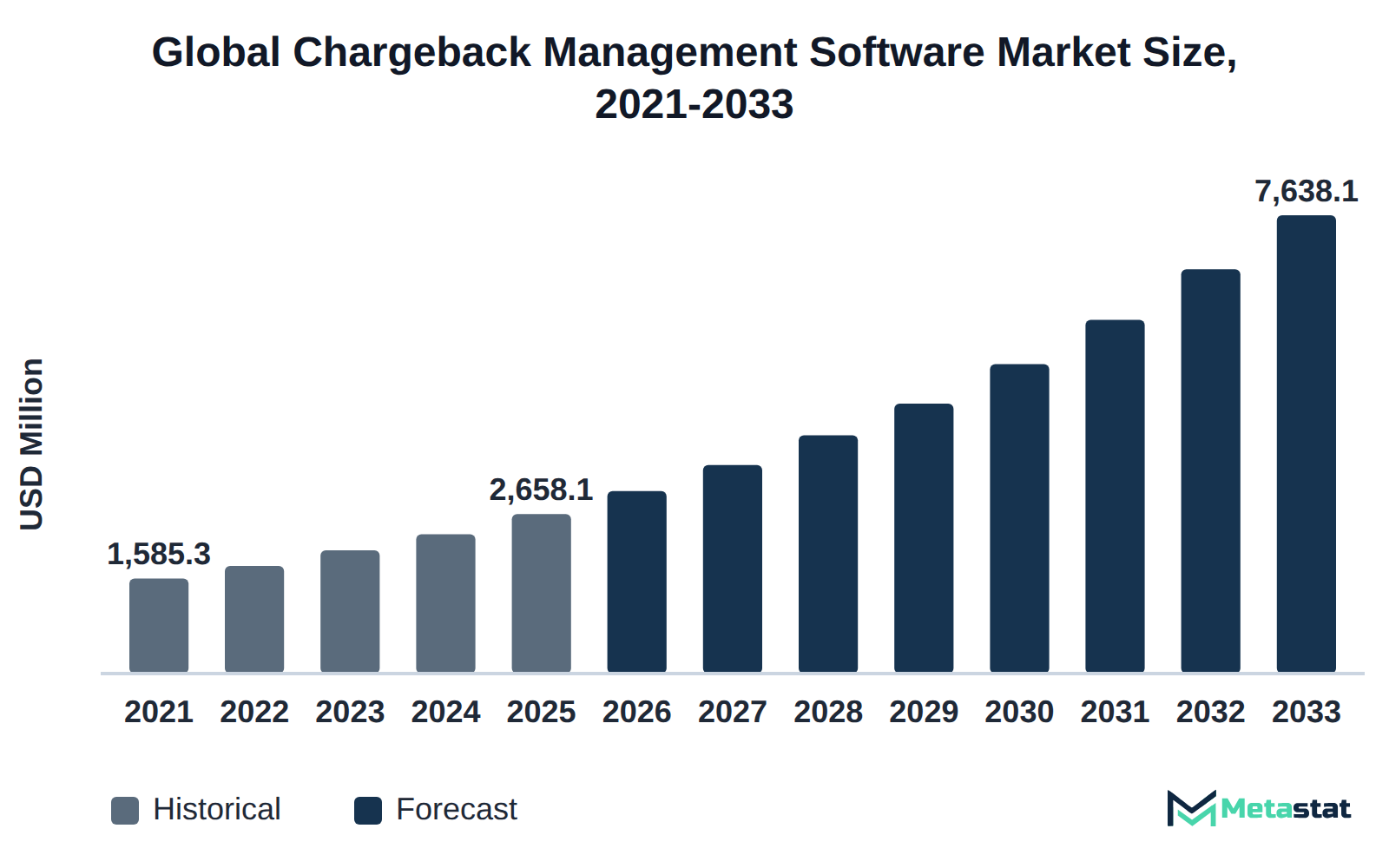
AI-driven chargeback prevention technologies transform the Chargeback Management Software market by enhancing the efficiency of fraud detection and resolution processes. These technologies use machine learning algorithms to analyze transaction data in real-time, identifying patterns and anomalies that indicate potential fraud. For instance, the market is projected to achieve a compound annual growth rate (CAGR) of 14.1% from 2026 to 2033, driven by advancements in AI capabilities.
In particular, the Chargeback Prevention and Alert Management Software segment is expected to grow from USD 638.3 million in 2026 to USD 1,483.3 million by 2033, reflecting a CAGR of 12.8%. This growth stems from the increasing necessity for businesses to protect themselves against rising chargeback incidents, particularly in sectors including retail and e-commerce, which remain vulnerable to fraudulent activities.
Organizations adopting AI-driven solutions benefit from reduced operational costs and improved customer satisfaction due to faster resolution times. The integration of these technologies allows for more precise fraud alerts, minimizing false positives and enabling businesses to focus on legitimate transactions, ultimately leading to sustained growth in the market.
Pricing structures in the Chargeback Management Software market reflect the increasing complexity of chargeback processes, with buyers seeking solutions that align with their specific operational needs. Various vendors deploy subscription-based models or tiered pricing strategies, enabling organizations to select packages suited to their transaction volumes and features required. This flexibility supports buyers from small and medium-sized enterprises to large corporations.
The subscription-based model, particularly prevalent among cloud-based solutions, allows for predictable budgeting and scalability. Costs under this model are projected to increase from USD 2,131.4 million in 2026 to USD 5,760.7 million by 2033, representing a CAGR of 15.3%. Many organizations view tiered pricing as a strategic advantage, permitting the adoption of essential functionalities without incurring unnecessary expenses. This approach enhances customer satisfaction and improves retention rates.
In this competitive environment, understanding contract terms becomes vital for buyers, ensuring clarity in service levels and performance metrics. Vendors that provide transparent pricing and flexible contracts typically forge stronger relationships with clients, driving market growth and encouraging further investment in chargeback management solutions. Selecting the right pricing and contract model affects operational efficiency and financial outcomes across multiple industries.
The surge in e-commerce and digital payment platforms drives the adoption of chargeback automation solutions. Retail and e-commerce, a crucial end-use industry in the Chargeback Management Software market, is projected to grow from USD 785 million in 2026 to USD 2,048.5 million by 2033, reflecting a compound annual growth rate (CAGR) of 14.7%. This growth results from an increasing number of online transactions, raising the incidence of chargebacks.
Businesses operating in the e-commerce sector face unique challenges, including a higher risk of fraudulent transactions and chargebacks compared to traditional retail. Chargeback automation helps these companies streamline operations, reduce financial losses, and improve customer service by providing timely responses to disputes. Implementing effective chargeback prevention and alert management systems enables businesses to mitigate risks associated with online payments and enhance overall profitability.
Investing in chargeback automation solutions becomes essential for e-commerce companies aiming to thrive in a competitive landscape. The Chargeback Management Software market presents opportunities for suppliers to meet the growing demand for tailored solutions that address specific needs within the e-commerce segment.
Regulatory changes and evolving payment networks significantly influence the chargeback management software market. New regulations impose stricter compliance requirements, compelling businesses to adapt their chargeback management processes to mitigate risks associated with non-compliance. The increasing emphasis on consumer protection and fraud prevention measures drives organizations to invest in advanced chargeback management solutions that enhance operational efficiency.
Market growth results from businesses seeking solutions that address chargeback disputes while adhering to regulatory standards. Payment networks, including Visa Inc. and Mastercard Incorporated, actively develop new frameworks to streamline dispute resolution processes, enhancing the capabilities of chargeback management software.
As payment networks evolve, companies that adopt these innovations improve their competitive positioning and capture a larger share of the growing demand for chargeback management solutions. The relationship between regulatory changes and payment networks reinforces the necessity for organizations to adopt comprehensive software solutions, ensuring compliance while optimizing chargeback management strategies.
Retail and e-commerce businesses experience a notable increase in chargeback incidents, prompting investment in management solutions. The shift towards online shopping has led to a surge in payment disputes, resulting from higher transaction volumes and digital payment adoption. In response, organizations actively seek Chargeback Management Software to mitigate risks and streamline dispute resolution processes. This increased focus on chargeback prevention aligns with the industry's growth, reflected in the projected market value of USD 7,638.1 million by 2033. Retail and e-commerce sectors demonstrate a compounded annual growth rate (CAGR) of 14.7% during the forecast period, highlighting the importance of effective chargeback management in maintaining profitability. Demand for these solutions reflects the role of chargeback management software in supporting operational efficiency and revenue protection.
Increased emphasis on advanced chargeback analytics significantly influences the Chargeback Management Software market. Enhanced analytics tools provide businesses with critical insights into chargeback patterns and trends, enabling more effective prevention strategies. These tools allow organizations to identify vulnerabilities, adjust their operational processes, and develop targeted strategies to mitigate chargebacks. The rising complexity of transaction data drives demand for sophisticated big data analytics solutions capable of processing large volumes of information efficiently.
Retail and e-commerce sectors particularly benefit from these analytics tools, facing higher transaction volumes and corresponding chargeback incidents. The integration of data-driven analytics into chargeback management strategies enhances decision-making capabilities, resulting in improved financial performance. Firms that invest in chargeback analytics report lower chargeback rates and improved customer satisfaction due to better dispute resolution processes. Consequently, strong demand for analytics-driven chargeback solutions supports growth in the market, reflecting a shift towards data-centric approaches in chargeback management.
Pricing pressures significantly affect adoption rates among small and medium-sized enterprises (SMEs) in the Chargeback Management Software market. High software costs deter these buyers from investing in comprehensive solutions, resulting in slower uptake and smaller orders. SMEs operate with tighter budgets, leading to delays in software implementation and replacement. These enterprises prioritize cost-effective solutions that fit their financial constraints, which limits their ability to adopt advanced chargeback management technologies. Consequently, this financial limitation inhibits overall market growth and restricts the potential customer base for premium offerings. A more affordable pricing strategy could enable wider adoption across all buyer segments and enhance the competitive environment.
Suppliers in the Chargeback Management Software market experience significant challenges related to talent acquisition, impacting operational efficiency and profitability. Competition for skilled professionals drives up recruitment costs and limits access to essential expertise. This situation affects the timely delivery of solutions and the quality of customer support, leading to dissatisfaction among clients. In response, suppliers implement various strategies to enhance workforce retention, including offering competitive compensation packages and investing in employee training programs. Companies increasingly focus on automating processes to mitigate the impact of talent shortages, ensuring higher efficiency and reducing reliance on manual labor. Several suppliers explore partnerships with educational institutions to cultivate a pipeline of skilled workers, aiming to address the skills gap within the industry. These efforts enable suppliers to maintain competitiveness despite ongoing talent challenges in the market.
The cloud-based deployment model stands out within the Chargeback Management Software market, exhibiting a compound annual growth rate (CAGR) of 15.3% from 2026 to 2033. This segment's growth results from increasing demand for flexible, scalable, and cost-effective solutions that enhance operational efficiency. Small and medium-sized enterprises (SMEs) increasingly adopt cloud-based solutions to effectively manage chargeback processes while minimizing IT infrastructure costs. Larger organizations transition toward cloud-based platforms, recognizing the advantages of streamlined integrations and real-time data access.
This shift reflects a broader trend among businesses prioritizing digital transformation and cloud computing for their operations. By adopting cloud-based chargeback management solutions, companies improve customer experience through faster dispute resolution and proactive fraud prevention. This segment's anticipated growth aligns with the overall market expansion, projected to reach USD 7,638.1 million by 2033, driven by the rising digital payment landscape and the need for robust chargeback management solutions.
The Global Chargeback Management Software market is segmented based on Deployment Model, Type, Organization Size, and End-Use Industry.
This segment is used predominantly by retail and e-commerce businesses that require efficient chargeback management solutions to enhance revenue protection and optimize operational processes. The growing trend of digital transactions significantly drives the demand for cloud-based systems, ensuring scalability and flexibility in managing chargebacks. This segment distinguishes itself with a higher growth rate compared to on-premises solutions, which exhibit a CAGR of 10.9%. Cloud-based software facilitates real-time data access and collaboration, appealing particularly to small and medium-sized enterprises seeking cost-effective solutions that adapt to evolving market demands. The market shows a marked preference for cloud-based offerings, reflecting increasing reliance on technology in financial management.
On-Premises segment is estimated to reach USD 1,877.4 million by 2033, at a CAGR of 10.9% during the forecast period. Organizations deploy this model to maintain direct control over software and data, often preferred by businesses requiring high levels of security and compliance. Industries with stringent regulatory requirements, including financial services and healthcare, frequently adopt on-premises systems. The segment experiences growth driven by the increasing need for data privacy and customization, factors critical for large enterprises managing sensitive customer information. Compared to cloud-based solutions, the on-premises segment exhibits slower growth, reflecting a more cautious approach to technology adoption among certain buyers. Unlike cloud-based alternatives, which are becoming increasingly popular due to their scalability and lower upfront costs, on-premises systems involve higher initial investments and ongoing maintenance expenses.
Chargeback prevention and alert management software focuses on identifying and preventing fraudulent chargebacks before they occur, serving primarily retailers and e-commerce platforms that face high rates of chargeback disputes. Growing online transactions contribute to an increase in chargeback incidents, driving demand for efficient management solutions. In contrast to other types, this segment exhibits a stronger growth rate due to the rising emphasis on fraud prevention strategies and real-time alerts. Demand for enhanced security measures influences the software's development, positioning it as a vital tool for businesses aiming to protect revenue streams effectively. The integration of advanced analytics further differentiates this segment, enabling businesses to proactively address potential chargeback issues.
Dispute Management and Case Tracking Software segment is estimated to reach USD 1,310.7 million by 2033, at a CAGR of 13.6% during the forecast period. This segment provides tools that support the management of disputes related to chargebacks, enabling businesses to track and resolve cases more efficiently. Retailers and financial service providers primarily use this software to handle the increasing volume of dispute cases driven by the expansion of online transactions. The growth in e-commerce fuels demand for such solutions, enhancing operational efficiency and minimizing losses. Compared to other types, this segment experiences a moderate growth rate, influenced by the ongoing need for effective case tracking capabilities. In contrast to Chargeback Prevention and Alert Management Software, which grows at a CAGR of 12.8%, this segment's growth reflects its essential role in addressing disputes rather than preventing chargebacks upfront.
Chargeback Representment and Evidence Management Software segment is expected to reach USD 1,174.7 million by 2033. This software type manages disputes and evidence collection for chargebacks, specifically appealing to retailers and financial institutions focused on reducing revenue loss. Increased fraud cases and heightened consumer protection regulations drive demand for effective representment solutions. Growth in this segment is slower compared to Chargeback Prevention and Alert Management Software due to higher complexities and costs associated with dispute management processes. While the market experiences a CAGR of 13.6%, the representment segment faces challenges from evolving technology and heightened competition. Differentiation is key. Companies seek solutions that streamline processes while maintaining evidence integrity, ensuring a competitive edge in the market.
Chargeback Analytics and Reporting Software is projected to grow at a CAGR of 14.6% during the forecast period. This segment focuses on providing businesses with insights and reporting capabilities to analyze chargeback trends and identify areas for improvement. Retail and e-commerce sectors increasingly adopt this software to better understand chargeback reasons and reduce financial losses. The demand for data-driven analytics drives growth in this segment, owing to organizations seeking to enhance their chargeback mitigation strategies. Compared to other types, including Chargeback Prevention and Alert Management Software, this segment offers a unique emphasis on analytics, appealing to organizations looking to optimize their overall performance. The ability to leverage data effectively distinguishes this segment, positioning it for growth in the evolving market.
Integrated Chargeback Management Platforms help businesses manage chargebacks efficiently. These platforms cater to businesses seeking to streamline their chargeback processes by offering integrated tools for tracking, resolving, and analyzing disputes. Retailers and financial institutions use these platforms to enhance operational efficiency and minimize losses associated with chargebacks. Demand for such platforms is driven by the increasing complexity of payment disputes, where traditional methods fall short. This segment differs from others by providing a more comprehensive approach, resulting in faster resolution times and better resource allocation. In contrast to Chargeback Prevention and Alert Management Software, which focuses primarily on preemptive measures, Integrated Chargeback Management Platforms address the entire lifecycle of a chargeback situation, positioning them as a vital resource in the chargeback management software market.
Automated Refund and Resolution Tools address the complexities involved in processing refunds and resolving disputes in various transactions. Retailers, e-commerce platforms, and service providers that experience frequent chargebacks use these tools to streamline their refund processes and enhance customer satisfaction. The increasing prevalence of online transactions fuels demand for efficient resolution systems, driving investments in this segment. Unlike other types of chargeback management software, Automated Refund and Resolution Tools focus specifically on simplifying the refund process rather than dispute management or analytics. The market for these tools remains distinct due to ongoing advancements in technology, which enhance operational efficiency and reduce the time required for resolution. This segment's emphasis on automation aligns with broader trends toward digital transformation in various industries, supporting its relevance in today’s market. Demand for such solutions continues to grow, reflecting the changing needs of organizations striving for improved customer relations and reduced operational burdens.
Small and Medium-Sized Enterprises segment is valued at USD 1,203.2 million in 2026 and is projected to reach USD 3,304.2 million by 2033, at a CAGR of 15.5% during the forecast period. This segment primarily serves businesses with fewer resources compared to large enterprises, focusing on efficient chargeback management to minimize losses associated with fraudulent transactions and disputes. The rapid growth of e-commerce and digital payment platforms drives adoption within this segment, while SMEs increasingly face chargeback challenges in an expanding online marketplace. Unlike large enterprises, which benefit from economies of scale and have dedicated resources for chargeback management, SMEs often seek cost-effective and streamlined solutions. The increasing emphasis on chargeback prevention and analytics among smaller businesses highlights a distinct demand for user-friendly software tailored to their operational scale, differentiating it from larger segments in terms of growth dynamics and pricing strategies.
Large Enterprises segment is estimated to reach USD 4,333.9 million by 2033, at a CAGR of 13% during the forecast period. This segment primarily serves large companies that require robust chargeback management solutions to handle complex transactions and high transaction volumes effectively. A significant demand driver for this segment stems from the increasing incidences of chargebacks affecting larger businesses, prompting them to seek comprehensive solutions for dispute resolution. Compared to the Small and Medium-Sized Enterprises segment, which is projected to grow at a CAGR of 15.5%, growth in Large Enterprises reflects a more stable but substantial demand for sophisticated chargeback management systems. These enterprises often face higher stakes due to their larger financial exposures, influencing their investment strategies in chargeback management software. The Chargeback Management Software market adapts to these evolving needs, ensuring that large enterprises maintain operational efficiency and protect revenue.
Chargeback management software for retail and e-commerce serves retailers and online merchants, focusing on minimizing financial losses due to chargebacks. Growth in this sector is driven by the increasing volume of e-commerce transactions, prompting businesses to invest in efficient chargeback management solutions. Compared to other segments, the Retail and E-Commerce segment demonstrates a faster growth trajectory, with a higher CAGR than other industries, illustrating the urgent need for effective chargeback strategies among retailers. The significant rise in online shopping has heightened the risk of chargebacks, urging businesses to adopt advanced software solutions to manage disputes and enhance customer satisfaction. This segment's expansion reflects broader trends influencing the Chargeback Management Software market.
Travel and Hospitality segment is estimated to reach USD 1,062.5 million by 2033, at a CAGR of 13.4% during the forecast period. This segment caters to hotels, airlines, and online travel agencies, focusing on managing chargebacks arising from bookings and transactions. Increased travel activity post-pandemic drives demand for effective chargeback management solutions, prompting significant investments in software that streamlines dispute resolution. Unique challenges faced in this sector include high transaction volumes and the complexity of customer interactions, differentiating it from other segments with slower growth rates. Compared to Retail and E-Commerce, which has a CAGR of 14.7%, Travel and Hospitality experiences a steadier growth trajectory due to dependence on seasonal demand and fluctuating travel trends. The market requires specialized solutions that address the nuances of travel-related disputes, enhancing operational efficiency and customer satisfaction.
Financial Services segment is expected to reach USD 1,364.2 million by 2033. This segment primarily serves banks, credit unions, and insurance companies, focusing on managing chargeback processes effectively to reduce financial losses. The increasing reliance on digital banking and other digital transactions within the financial sector drives demand for robust solutions tailored to mitigate chargeback risks. Compared to other segments, Financial Services exhibits a lower growth trajectory, influenced by a compound annual growth rate (CAGR) of 13%. Challenges related to regulatory compliance and evolving fraud tactics create barriers to adoption, prompting financial institutions to seek advanced software solutions that ensure adherence to industry standards while protecting revenue streams. The need for specialized capabilities differentiates this segment, highlighting the importance of targeted solutions in a competitive environment. Investment in innovative technologies remains crucial for financial service providers aiming to enhance operational efficiency and safeguard their interests.
The Digital Goods and Subscription Services segment is projected to grow at a CAGR of 15.9% during the forecast period. This segment caters to businesses providing digital products and subscription-based services, appealing to consumers who prefer immediate access to content and services. Increasing acceptance of such models drives demand, with companies seeking robust chargeback management solutions to mitigate revenue loss from disputes. Unlike other segments, this area demonstrates faster growth, supported by a shift in consumer behavior toward digital consumption. The unique challenges of subscription models, including recurring billing and fraud, highlight the importance of effective chargeback management. This focus on minimizing chargebacks while enhancing customer experience creates distinct competitive advantages for suppliers in the Chargeback Management Software market.
The gaming and online entertainment sector relies on advanced chargeback management solutions to tackle the unique challenges associated with digital transactions. This segment serves businesses that face high volumes of customer transactions, requiring robust systems to manage disputes and prevent chargebacks effectively. Growth in this sector is influenced by increasing consumer demand for online gaming and entertainment options, coupled with the potential for fraudulent activities, which drives the need for sophisticated software solutions. Compared to other segments, the gaming and online entertainment sector experiences a different buying pattern, focusing on technology that maximizes user engagement while minimizing financial risks. This sector's responsiveness to rapid technological innovations sets it apart, necessitating ongoing adaptations to combat emerging threats and enhance customer satisfaction. Chargeback Management Software market participants prioritize features tailored to this niche to capture the evolving demands of this dynamic industry.
Telecommunications encompasses various services and systems that enable communication over distances, including mobile networks, broadband, and VoIP services. This segment serves enterprises and service providers who manage chargeback management software to handle disputes arising from customer transactions and service-related charges. A significant force driving this segment involves the expansion of digital services, which increases the volume of transactions requiring robust chargeback management. Unlike the retail and e-commerce sector, the telecommunications segment faces unique challenges due to diverse service offerings and regulatory pressures. The distinct nature of telecommunications transactions necessitates tailored chargeback solutions, contributing to different pricing models and adoption rates compared to other segments. The Chargeback Management Software market reflects these dynamics, supporting ongoing development to address the specific needs of telecommunications providers.
Healthcare, education, and professional services represent a diverse sub-segment of the Chargeback Management Software market. Institutions within these areas apply chargeback management solutions to efficiently handle disputes related to transactions, ensuring compliance and mitigating potential losses. The demand for such software arises from the increasing reliance on digital payment systems, which have heightened the frequency of chargebacks. Unlike segments including retail and e-commerce, which focus on high-volume transactions, this sub-segment typically experiences slower growth due to the sporadic nature of chargebacks in service-based industries. While retail and e-commerce adopt strategies for proactive chargeback prevention, healthcare and education platforms prioritize streamlined dispute resolution and compliance with regulatory standards. The Chargeback Management Software market continues to evolve, reflecting the unique needs of each industry it serves.
Based on geography, the Global Chargeback Management Software market is divided into North America, Europe, Asia-Pacific, South America, Middle East, and Africa.
Demand for chargeback management solutions in North America is driven by a robust retail and e-commerce sector, which requires effective tools to manage disputes and reduce chargebacks. The region benefits from a mature digital payments infrastructure supporting various payment processing channels, enhancing the adoption of chargeback management software. In particular, the United States, Canada, and Mexico play significant roles in driving market growth, with the share of the global market projected at 39.00% in 2025. North America is projected to reach USD 2,763.5 million by the end of 2033. The financial services industry in this region actively seeks advanced chargeback management solutions to protect revenue and maintain customer trust. The market is characterized by a competitive landscape featuring established players focused on innovation and integration of new technologies.
Demand for the Chargeback Management Software market in Europe draws from several key industries, particularly retail and financial services, where transaction volumes and chargeback incidents are significant. Countries including Germany, France, and the UK exhibit a strong focus on implementing robust chargeback management systems to safeguard revenue and enhance customer experience. Increasing digital transactions across various sectors exert pressure on retailers and service providers to adopt advanced chargeback solutions. By 2025, Europe holds a 28.0% share of the global market. The region's emphasis on compliance and consumer protection regulations further influences the market, driving local firms to invest in sophisticated software that aligns with evolving standards.
The Asia-Pacific region, representing 23.9% of the global Chargeback Management Software market in 2025, features a varied environment driven by the growth of e-commerce and digital payment platforms. Countries including China and India experience rapid digital transformation, fueling demand for software solutions that enhance transaction security and streamline dispute management processes. Australia and South Korea increasingly adopt chargeback management tools to optimize customer experience and minimize revenue loss. The presence of a robust fintech ecosystem across Southeast Asia drives innovation in chargeback prevention and alert management solutions. Regional players focus on integrating artificial intelligence and machine learning technologies to improve fraud detection and response times. Businesses expand their online operations, and the market is projected to reach USD 7,638.1 million by 2033, reflecting significant growth.
Brazil and Argentina represent key markets for chargeback management solutions, driven by the increasing reliance on digital transactions and e-commerce. The need for effective chargeback management strategies has surged due to rising transaction volumes in retail and e-commerce sectors. Companies operating in these markets face challenges related to fraud and disputes, necessitating advanced software solutions for managing chargebacks effectively. In 2025, South America accounts for 4.4% of the global market, highlighting the region's potential for growth. Continuous investment in technology infrastructure will support the expansion of the market, enabling businesses to adopt more sophisticated solutions to combat chargeback issues.
The Middle East and Africa represent a developing market for chargeback management solutions, with a share of 4.8% of the global market in 2025. Growth in the region is primarily driven by the increasing adoption of digital payment systems, particularly in Saudi Arabia and the UAE. Companies operating in these markets face unique challenges, including varying regulations and consumer protection laws that influence chargeback processes. South Africa's expanding e-commerce sector further contributes to the demand for software solutions that enhance transaction security and reduce disputes. The chargeback management software market is expected to benefit from the rising focus on fraud prevention and improved customer experience across various industries.
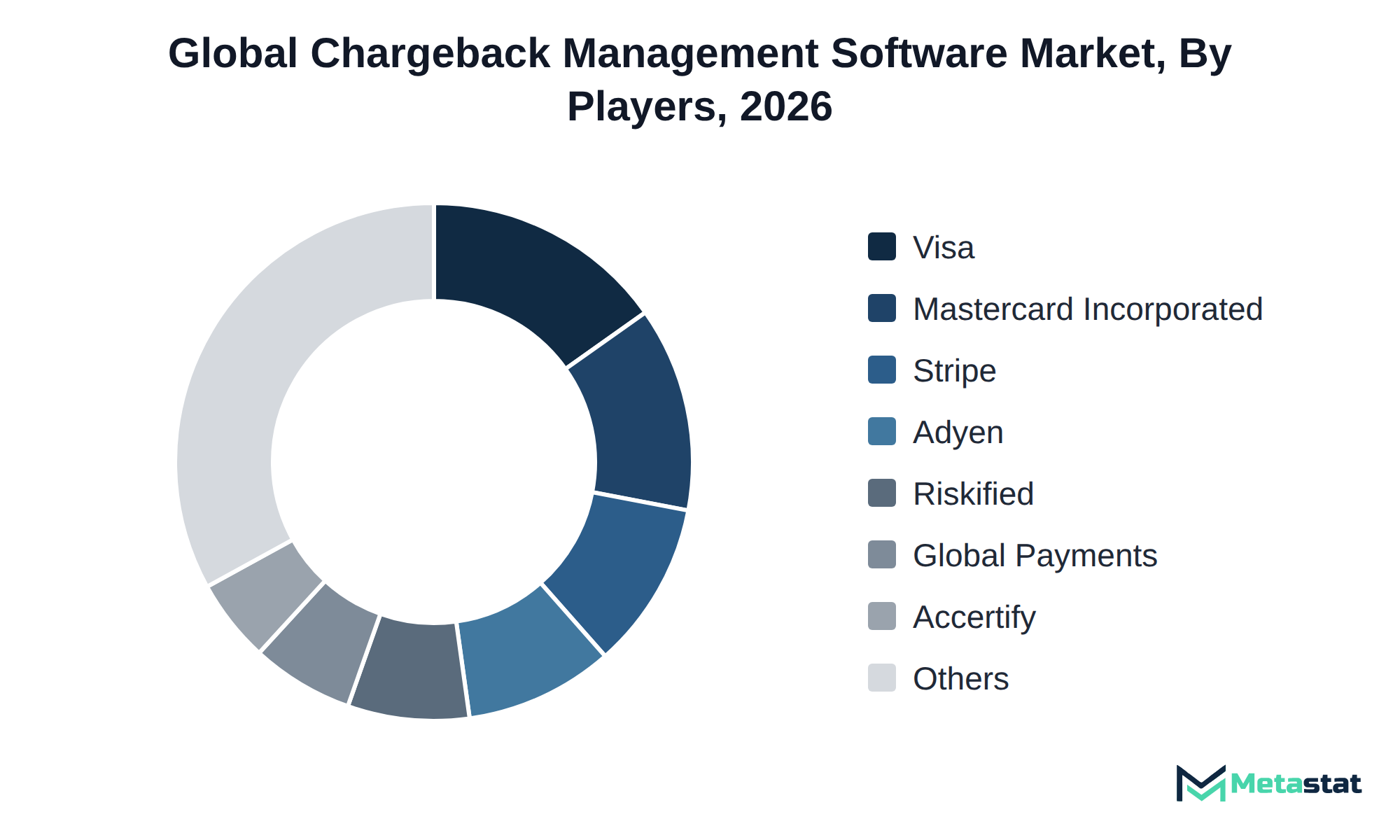
The competitive landscape within the Chargeback Management Software market features various strategic behaviors among leading companies. Organizations differentiate themselves through deployment models, service types, and pricing strategies. Cloud-based solutions dominate the market, reflecting a significant trend toward flexibility and scalability in software offerings.
Buyers prioritize various factors when selecting chargeback management solutions, including price, customization, ecosystem integration, and service quality. For instance, Visa Inc. focuses on robust payment processing capabilities, enhancing its chargeback prevention tools. Stripe, Inc. emphasizes ease of integration and user-friendly interfaces, appealing to several small and medium-sized enterprises. Riskified Inc. highlights its advanced fraud detection algorithms, catering to businesses requiring enhanced security measures.
Mastercard Incorporated and Adyen N.V. use their extensive global payment networks to offer solutions that address diverse customer needs. Companies like Chargebacks911 and Chargeback Gurus specialize in tailored services to assist clients in dispute management, reflecting a growing demand for personalized support in the market.
This growth relies on several key developments within the Chargeback Management Software market. This shift reflects a preference for scalability and flexibility among organizations, particularly in North America, which holds a significant market share of 39%. Growth in online transactions within this segment drives the need for effective chargeback management.
Potential risks could hinder this trajectory. Economic uncertainties and regulatory changes could impact investment decisions across industries, particularly within large enterprises, which contribute significantly to the market. Such challenges could slow growth and affect the projected market size. Achieving the forecasted USD 7,638.1 million will depend on addressing these developments and risks effectively.
By Deployment Model: Cloud-Based, On-Premises
By Type: Chargeback Prevention and Alert Management Software, Dispute Management and Case Tracking Software, Chargeback Representment and Evidence Management Software, Chargeback Analytics and Reporting Software, Integrated Chargeback Management Platforms, Others (Automated Refund and Resolution Tools)
By Organization Size: Small and Medium-Sized Enterprises, Large Enterprises
By End-Use Industry: Retail and E-Commerce, Travel and Hospitality, Financial Services, Digital Goods and Subscription Services, Gaming and Online Entertainment, Telecommunications, Others (Healthcare, Education, Professional Services)
The report strategically identifies and profiles the key market players and analyses their core competencies in each sub-segment of the Chargeback Management Software market.
Report Attributes | Details |
Study Period | 2021-2033 |
Base Year | 2025 |
Estimated Year | 2026 |
Forecast Period | 2026-2033 |
Historical Period | 2021-2025 |
Growth Rate | CAGR 14.1% from 2026 to 2033 |
Revenue Unit | USD million |
Segmentation | By Deployment Model, Type, Organization Size, End-Use Industry, and Region |
By Region | North America (By Deployment Model, Type, Organization Size, End-Use Industry, and Country)
|
Europe (By Deployment Model, Type, Organization Size, End-Use Industry, and Country)
| |
Asia Pacific (By Deployment Model, Type, Organization Size, End-Use Industry, and Country)
| |
South America (By Deployment Model, Type, Organization Size, End-Use Industry, and Country)
| |
Middle East and Africa (By Deployment Model, Type, Organization Size, End-Use Industry, and Country)
|
Find answers to common questions about this report
The Chargeback Management Software market size was valued at USD 2,658.1 million in 2025.
The market is projected to grow at a CAGR of 14.1% during the forecast period from 2026 to 2033.
The North America Chargeback Management Software market size is estimated to reach USD 2,763.5 million by 2033.
Chargeback Prevention and Alert Management Software leads the market with a projected value of USD 1,483.3 million by 2033. This segment surpasses others in terms of revenue generation within the Chargeback Management Software market.
Increased chargeback incidents in retail and e-commerce drive investment in management solutions. The rising complexity of transaction data increases the demand for sophisticated analytics solutions capable of processing large volumes of information efficiently.
North America holds the dominant share of the Chargeback Management Software market, with a value of USD 2,763.5 million projected for 2033. This region accounts for 39 percent of the overall market.
Pricing pressures significantly affect adoption rates among small and medium-sized enterprises, deterring investment in comprehensive chargeback management solutions. suppliers face challenges related to talent acquisition, driving up recruitment costs and impacting operational efficiency.
The increasing demand for flexible, scalable, and cost-effective cloud-based solutions enhances operational efficiency, favoring adoption among small and medium-sized enterprises. the integration of advanced chargeback analytics tools provides critical insights, allowing organizations to develop more effective prevention strategies and improve financial performance.
The Chargeback Management Software market is estimated to reach a valuation of USD 7,638.1 million by 2033.
Key players operating in the Chargeback Management Software market include Visa Inc., Mastercard Incorporated, Stripe, Inc., Adyen N.V., Riskified Inc., Global Payments Inc., and Accertify, Inc.
The analysts below cover Banking & Finance research at Metastat Insights.
LEAD ANALYST
Utkarsh Khirodkar is a Lead Market Research Analyst at MetaStat Insight, specializing in market intelligence, technology sector assessments, and competitive strategy.

PRINCIPAL CONSULTANT - ENTERPRISE AI & EMERGING TECHNOLOGIES
Banking & Finance · Electronics and Semiconductor · Energy and Power · Healthcare IT · Information & Technology · Professional Services
Vijay Gunti is a Principal Consultant at MetaStat Insight, bringing over two decades of experience across enterprise digital transformation, technology strategy, and intelligent systems.
Evaluating sensor fusion reliability across harsh operating environments can be tricky without field-validated data. The study on agricultural autonomous guidance systems clearly separated stereo vision setups from automotive-grade solid-state LiDAR. We appreciated the regional infrastructure analysis, specifically around RTK network density across North America and South America. During our follow-up consultation, the MetaStat Insight team walked through tier-two perception software partnerships, giving our engineering leads a practical basis for vendor shortlisting.
Analyzing the transition from natural gas to green hydrogen in iron ore reduction requires realistic infrastructure timelines. Meta stat insight supplied a detailed regional assessment of DRI plant conversion costs and scrap metal availability in North America and Western Europe. Their report carefully examined pellet quality specs and electrical grid access constraints without making oversimplified market assumptions. The research material served as a practical reference during internal technology roadmap discussions.
Integrating zero-trust access controls across legacy electronic health record systems involves complex compliance overhead. Team produced an analysis that clearly separated identity governance and administration tools from privileged access management platforms. Their evaluation of HIPAA and GDPR compliance features across cloud native solutions gave our architecture group clear baseline criteria. The custom data request regarding biometric authentication adoption in hospital networks was returned promptly with clear documentation.
Explore related market intelligence reports worth reading alongside this one.