
LEAD ANALYST
Utkarsh Khirodkar is a Lead Market Research Analyst at MetaStat Insight, specializing in market intelligence, technology sector assessments, and competitive strategy.

Global Payments Market Size, Share, By Payment Instrument (Credit and Charge Cards, Debit Cards, Prepaid Cards, Credit Transfers, Direct Debits, E-money and Mobile Money, Checks, Cash), By Transaction Type (Consumer-to-Business (C2B), Business-to-Business (B2B), Business-to-Consumer (B2C), Consumer-to-Consumer (C2C)), By Payment Flow (Domestic Payments, Cross-border Payments), By Revenue Type (Fee Income, Net Interest Income), Industry Analysis, Growth, Trends, and Forecast, 2026-2033
Report ID
MSI-5586
Published
October, 2026
Pages
274 Pages
Format
Historical
Base year
Forecast
Forecast period
Report Details
Market Valuation: Valued at $2,162.4 Billion in 2025, projected to reach $3,052.7 Billion by 2033 at a 4.4% CAGR.
Dominant Segment: Credit and Charge Cards lead the Payments market, driven by strong consumer demand for flexible payment options and rewards programs.
Geographic Lead: North America is the leading region, holding 33.7% of the market in 2025, supported by a robust financial infrastructure and high consumer spending.
What's Inside: The report provides in-depth competitive coverage, segment analyses, and a forecast window from 2026 to 2033, detailing various payment instruments and transaction types.
Consumer Adoption Trends: The Payments market is experiencing significant growth due to increased consumer adoption of digital payments, particularly among younger demographics favoring contactless methods.
Technological Advancements: Innovations such as blockchain and AI are enhancing payment processing, driving operational efficiencies and customer satisfaction across sectors.
Choose Your License
Global Payments Market
The global Payments market was valued at USD 2,162.4 billion in 2025 and is projected to reach USD 3,052.7 billion by 2033, growing at a CAGR of 4.4% over the forecast period.
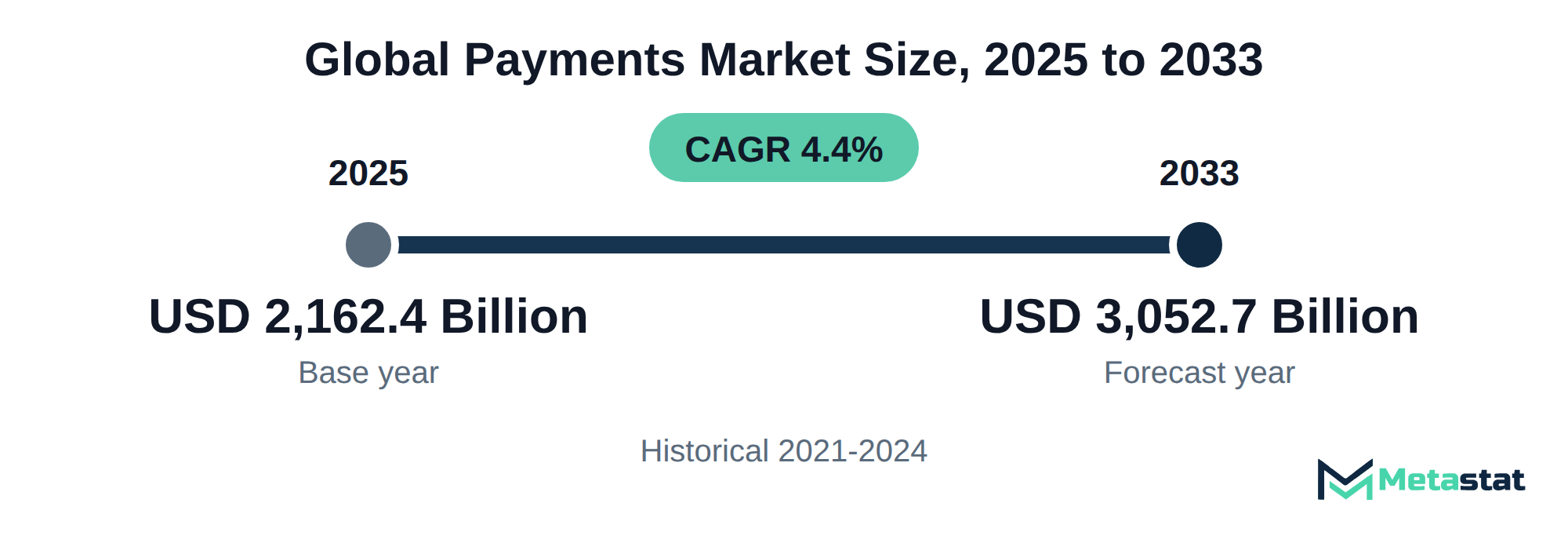
The Payments market encompasses various payment instruments, transaction types, payment flows, and revenue types. Buyers invest in this market to facilitate efficient and secure financial transactions across different sectors. The growth in digital transactions and the increasing adoption of electronic payment methods drive spending in this sector. The diverse applications of payment solutions across industries highlight their significance in modern commerce.
Growth in this market is influenced by several factors, including advancements in technology and the rising preference for cashless transactions. Among the segments, Credit and Charge Cards represent the highest value, reflecting strong consumer demand for convenient payment options. North America holds 33.7% of the market in 2025, with the US leading in 2026. The region's strong financial infrastructure and high consumer spending support its dominant position.
One key growth driver stems from the increasing shift towards e-commerce, which has escalated the demand for effective payment solutions. Rising internet penetration and smartphone usage further support this trend, enabling consumers to engage in online shopping and digital services. The Payments market is projected to experience sustained expansion, driven by these evolving consumer behaviors and technological innovations.
The Payments market includes a diverse range of financial transactions facilitated through various instruments and channels. Buyers invest in this market to enhance payment efficiency, security, and customer experience. The growing demand for efficient and secure payment solutions drives businesses to adopt advanced payment technologies, thereby increasing overall spending in the sector.
Growth in the market is propelled by the increasing adoption of digital payment methods. Among the segments, Consumer-to-Business (C2B) transactions represent the highest value, reflecting significant consumer engagement in digital payments. This regional dominance results from a strong technological infrastructure and a high level of consumer acceptance of digital payment solutions.
Technological advancements and the rise of e-commerce create substantial opportunities for market expansion. The integration of mobile wallet solutions and contactless payment options enhances convenience for consumers and encourages businesses to invest in innovative electronic payment systems. These developments support the market's positive trajectory and sustained growth in the coming years.
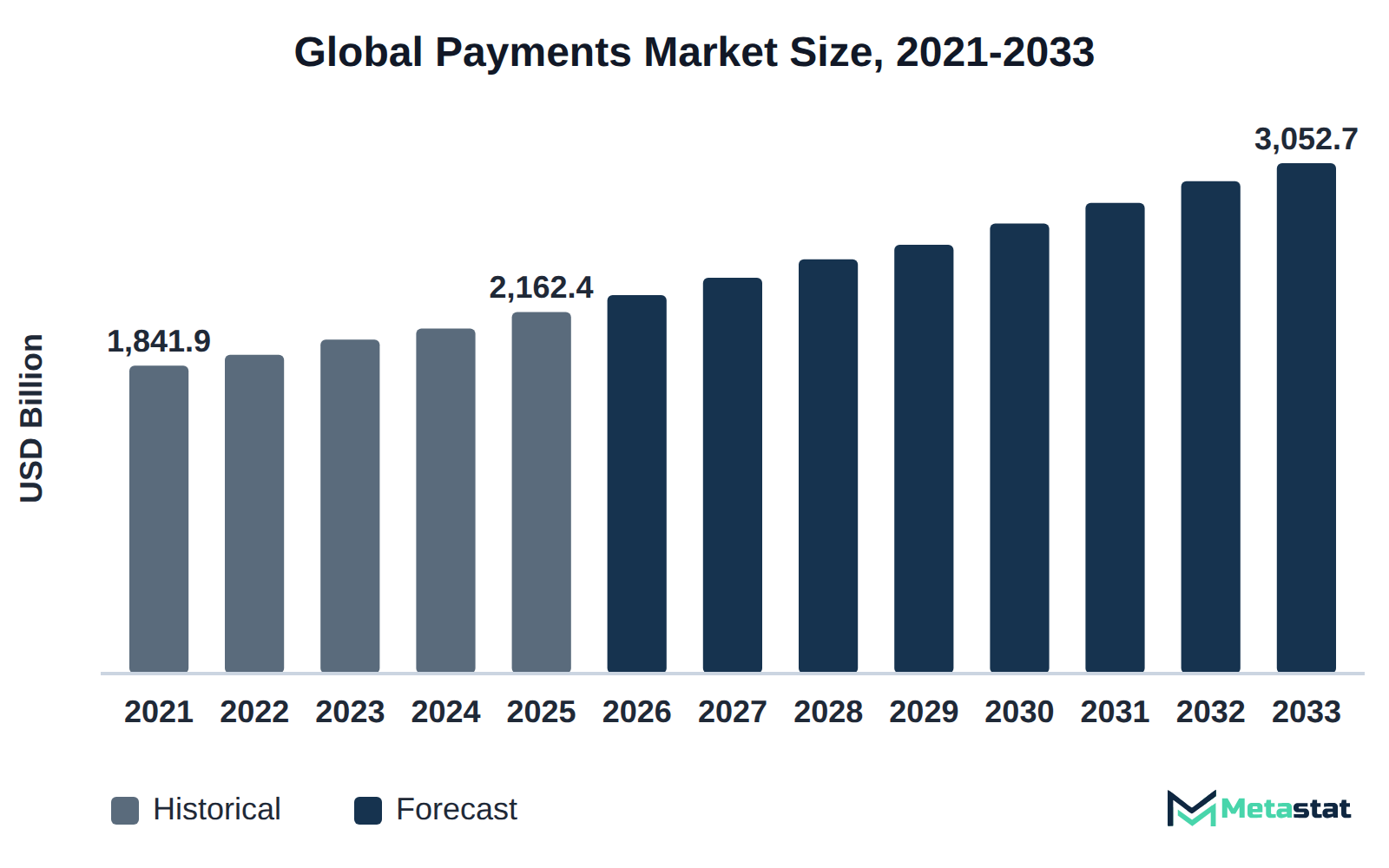
Instant account-to-account payments represent a significant shift within the Payments market, enabling rapid transactions between bank accounts without traditional intermediary processes. This technology delivers a straightforward user experience and reduces transaction times, positioning it as a preferred option for both consumers and businesses. The segment of domestic payments is expected to grow from USD 1,956.1 billion in 2026 to USD 2,600.6 billion by 2033, reflecting a compound annual growth rate (CAGR) of 4.2%. This growth highlights the increasing preference for immediate payment solutions, which eliminate the delays associated with traditional payment methods.
The economics of cash displacement further support the rise of instant payments by minimizing reliance on cash and check transactions. Financial institutions and payment service providers invest in technology that enhances transaction speed and security, making account-to-account transfers more attractive. With cash withdrawals and checks declining, businesses and consumers increasingly seek efficient alternatives, driving demand within the market. The transition towards instant payments streamlines financial operations and creates an opportunity for enhanced revenue streams through fee income. Fee income is projected to rise from USD 1,241 billion in 2026 to USD 1,744 billion by 2033, a CAGR of 5%. This evolving landscape illustrates the substantial commercial potential of instant account-to-account payments in the Payments market.
The integration of embedded payments into Software as a Service (SaaS) platforms significantly transforms how users engage with services. Embedded payments are one part of the broader category of embedded finance solutions. This approach allows providers to monetize transactions within their own ecosystem, improving user experience and raising revenue. In the Payments market, embedded payments contribute to a notable increase in transaction volumes, driven by the convenience they offer to end users.
With a forecast value of USD 3,052.7 billion by 2033, the market reflects a strong trend toward monetization strategies that align with user behavior. SaaS companies adopt flexible pricing models, including subscription-based fees and transaction-based charges, to optimize revenue streams. By implementing tiered pricing structures, businesses cater to varying customer segments, maximizing both uptake and profitability.
SaaS platforms evolve through effective contract models that incorporate embedded payments, allowing for predictable cash flow. Establishing clear terms regarding transaction fees enhances transparency between service providers and users. This strategy ultimately supports long-term customer retention and increases lifetime value, positioning SaaS companies to capitalize on growth opportunities within the Payments market.
Cross-border treasury payments represent a critical need for multinational corporations managing foreign exchange (FX) operations. These entities face challenges in achieving favorable FX margins while ensuring timely transactions across borders. The market for cross-border payments is projected to reach USD 452.1 billion by 2033, reflecting significant growth driven by increasing international trade and investment activities.
Companies involved in treasury management require efficient methods to minimize costs associated with currency exchange. Utilizing stablecoin settlements offers a promising solution, enabling quicker transactions and reduced volatility compared to traditional fiat currencies. By integrating stablecoins into their payment systems, corporations enhance cash flow management and optimize treasury operations.
The Payments market presents substantial opportunities for businesses aiming to streamline cross-border payments. Adopting technologies that facilitate stablecoin transactions leads to lower transaction fees and enhances operational efficiency. Organizations expect improved profitability and stronger competitive positioning within their industries.
Banks face pressure on traditional revenue streams, particularly while deposit margins continue to normalize. In this environment, focusing on payment fee income presents a viable strategy for growth.
This increase highlights the potential for banks to earn transaction fees from payment services. Banks enhance their offerings by integrating advanced technology solutions for processing payments, enhancing customer experience, and expanding their service portfolios. Emphasizing customer engagement through digital channels drives payment transactions, which directly contribute to fee income.
The competitive landscape supports this shift, as banks seek to differentiate themselves in a saturated market. Maintaining a focus on innovative payment solutions, including mobile wallets and contactless payments, enables banks to better capture fee income opportunities. Overall, adapting to the changing financial environment by prioritizing payment fee income positions banks for sustained growth.
Recent shifts in consumer preferences toward digital payments drive significant growth in transaction volumes. With the rise of e-commerce and mobile banking, consumers increasingly favor efficient transactions, leading to higher spending in the Payments market. Younger demographics, particularly millennials and Generation Z, exhibit a strong inclination toward contactless payment methods, further accelerating this trend. The transition away from cash transactions influences businesses to adopt digital payment solutions to meet customer expectations. In 2026, consumer-to-business (C2B) transactions are projected to reach USD 1,021.4 billion, growing to USD 1,322.4 billion by 2033, reflecting an annual growth rate of 3.8%. This surge in digital payment adoption enhances operational efficiency for businesses and increases overall market spending, contributing to the strong growth trajectory of the market.
Shifts in demographic behavior drive the market's expansion. Businesses increasingly align their payment offerings to cater to tech-savvy consumers who prefer digital solutions. This adjustment boosts transaction volumes and enhances customer satisfaction, which increases loyalty and repeat business.
The technological advancement of payment processing systems drives significant enhancements within the Payments market. Innovations including blockchain technology and artificial intelligence facilitate faster, more secure transaction methods. These developments enhance customer experience, leading to increased transaction volumes and improved operational efficiencies across various sectors. Industries adopting these technologies benefit from reduced transaction times and lower processing costs, allowing for greater scalability and reach. Enhanced security measures, including biometric authentication and encryption, further build consumer trust in digital payment options. Such transformations are expected to attract more businesses and consumers into the market, creating a competitive environment. The expansion of digital payment solutions satisfies existing consumer demand and enables new market entrants and innovative offerings, which drives growth in transaction volumes and revenue streams.
Investments in technology infrastructure and development will shape the future of the Payments market, helping stakeholders capture emerging opportunities and meet changing consumer needs. This momentum reflects a shift toward digital-first strategies, highlighting the critical need for continuous innovation in payment solutions.
Insufficient infrastructure presents a significant restraint on adoption among businesses in the Payments market. Many regions lack the necessary technological framework to support advanced payment systems, delaying the implementation of efficient payment solutions. This limitation impacts several small to medium-sized enterprises (SMEs), which struggle to secure the resources required for updated infrastructure. Consequently, slower uptake of digital payment solutions occurs, adversely affecting transaction volumes and operational efficiency. The absence of adequate infrastructure leads to smaller order sizes, with businesses remaining hesitant to commit to large-scale digital transformations without reliable technological support. Overall, these challenges result in restrained growth potential within the market, limiting the ability of SMEs to compete effectively in an increasingly digitized economy.
Compliance costs present a significant challenge in the Payments market, affecting suppliers' ability to maintain profit margins. Increasing regulatory requirements demand investment in technology and personnel to ensure adherence. This challenge impacts smaller players, who face difficulties in allocating sufficient resources for compliance measures. Larger firms, including Visa Inc. and Mastercard Incorporated, use their scale to absorb these costs more effectively, allowing them to maintain competitive pricing structures.
To mitigate compliance costs, suppliers invest in advanced technology solutions that streamline regulatory reporting and enhance risk management capabilities. Automation of compliance processes reduces the manual workload and minimizes the likelihood of costly errors. This shift supports operational efficiency and enables firms to focus on core business strategies while addressing regulatory requirements. These adaptations help suppliers keep pace with changing requirements while pursuing profitability in the competitive Payments market.
The Credit and Charge Cards segment presents a strong opportunity within the Payments market. This segment is projected to expand from USD 826.2 billion in 2026 to USD 1,041.6 billion by 2033, reflecting a compound annual growth rate (CAGR) of 3.4%. Factors driving this growth include increasing consumer preference for flexible payment options and rewards programs associated with credit cards. Financial institutions and card issuers benefit from enhanced fee income and improved customer loyalty through this segment. The ongoing digital transformation supports the adoption of contactless and mobile payment capabilities, optimizing the user experience. This trend aligns with broader market dynamics, positioning credit and charge cards as critical instruments that capitalize on evolving payment behaviors.
The Global Payments market is segmented based on Payment Instrument, Transaction Type, Payment Flow, and Revenue Type.
These instruments facilitate consumer spending by allowing users to borrow funds for purchases, which they repay later, often with interest. This segment appeals primarily to consumers seeking flexibility in their payment options, particularly in retail and online transactions. A notable factor influencing this segment is the rising trend toward credit usage driven by consumer confidence and increased disposable income. Compared to Debit Cards, which exhibit a CAGR of 3.9%, the slower growth rate of Credit and Charge Cards reflects a more mature market, with higher interest rates impacting buyer decisions and adoption rates. Overall, the dynamics of this segment highlight a distinct consumer preference for credit flexibility over immediate payment solutions.
Debit Cards segment is estimated to reach USD 446 billion by 2033, at a CAGR of 3.9% during the forecast period. This payment instrument serves consumers by facilitating transactions directly from their bank accounts. Users primarily include individuals making everyday purchases or managing expenses without carrying cash. Growing consumer preference for cashless transactions drives demand for debit cards, while the convenience of instant access to funds without incurring debt appeals to many users. Compared to other payment instruments, including Credit and Charge Cards, which have a CAGR of 3.4%, debit cards exhibit faster growth rates. Lower fees associated with debit transactions attract budget-conscious consumers, further differentiating it from credit products. Increased digital banking adoption enhances the utility of debit cards, positioning them as a reliable choice for consumers in the evolving payments environment.
Prepaid Cards segment is expected to reach USD 102.9 billion by 2033. This payment instrument allows consumers to load funds onto a card that is used for various transactions, appealing to individuals seeking budget control or those without access to traditional banking services. Demand for prepaid cards is driven by the increasing preference for digital wallets and contactless payments, enhancing their attractiveness for online shopping and travel. Compared to other segments like Credit and Charge Cards, which have a projected CAGR of 3.4%, prepaid cards exhibit slower growth due to limited acceptance at certain merchants. The unique characteristics of prepaid cards, including their ease of use and reloadable nature, differentiate them from debit and credit options, catering primarily to a cost-sensitive demographic.
Credit Transfers segment is projected to grow at a CAGR of 5.4% during the forecast period. This segment facilitates the transfer of funds directly from one bank account to another, making it popular among consumers and businesses for its efficiency. Account-to-account transactions drive significant adoption among businesses seeking to streamline payment processes and reduce transaction costs. Financial institutions and payment service providers play crucial roles in this segment by offering effective solutions. Compared to other payment instruments, Credit Transfers exhibit faster growth, benefiting from the increasing shift towards digital transactions. The demand for real-time payments enhances its appeal, distinguishing it from traditional methods. With consumers and businesses prioritizing speed and convenience, strong expansion is expected in this segment.
Direct debits facilitate automatic withdrawals from customers' bank accounts, commonly used for recurring payments including utility bills and subscription services. Businesses and service providers rely on this payment method for its efficiency and reliability, ensuring timely payments without requiring manual intervention from consumers. The increasing preference for convenience among consumers drives growth in this segment. Compared to other payment instruments, direct debits often feature lower transaction costs, appealing to businesses that process high volumes of similar transactions. However, challenges arise from strict regulatory requirements surrounding authorization processes and consumer protection, impacting adoption rates in certain markets. The market, through its various segments, adapts to evolving consumer preferences and regulatory landscapes, emphasizing efficiency and security.
E-money and Mobile Money encompass digital financial transactions conducted electronically, often via mobile devices. This segment serves individuals and businesses seeking convenient, instant payment solutions, facilitating both personal and commercial transactions. The growing adoption of smartphones and mobile applications accelerates the use of this segment, appealing to consumers prioritizing speed and ease of access in their financial interactions. In the Payments market, this segment distinguishes itself by targeting tech-savvy consumers and businesses that favor mobile solutions, contrasting with traditional payment methods. Regulatory advancements and increasing smartphone penetration significantly influence growth, while competition from other digital payment solutions poses challenges. The focus on convenience and accessibility positions this segment favorably against others, particularly in emerging markets where mobile infrastructure continues to expand.
Checks represent a traditional payment method that enables individuals and businesses to transfer funds through written orders on bank accounts. This payment instrument remains popular among certain demographics for transactions where electronic payments are less favorable. The usage of checks often arises in specific sectors including real estate and legal services, where large sums are transferred securely. Factors influencing this segment include a growing demand for traceable transactions among businesses and a cultural preference for physical payment methods in specific regions. Compared to other segments, checks experience slower growth due to the increasing shift toward digital alternatives, which offer enhanced efficiency and convenience. This segment faces challenges including declining consumer preference and rising costs associated with check processing, impacting its competitive position in the payments market.
Cash functions as a traditional payment method, facilitating transactions through physical currency. It serves various consumers and businesses across numerous sectors, particularly in regions where digital payment adoption lags. The ongoing demand for cash stems from its universal acceptance and the anonymity it provides, appealing to certain buyer preferences. Despite the rise of digital alternatives, cash remains a preferred option for consumers prioritizing simplicity and privacy during transactions. The broader trend toward digital payments presents ongoing challenges for cash use, limiting its growth compared to segments like Credit Cards and Debit Cards, which experience faster adoption rates driven by technological advancements and consumer preferences for convenience. This dynamic interaction between cash and digital payments continues to shape the market overall, dictating shifts in consumer behavior and payment preferences.
Digital asset payments and money orders encompass various non-traditional payment methods, gaining traction in both consumer and business transactions. These methods appeal to tech-savvy consumers and businesses seeking alternatives to conventional banking systems. Factors driving adoption include increasing acceptance of cryptocurrencies and the desire for more efficient cross-border transactions. Unlike traditional payment instruments, this segment caters to a niche market with distinct buyer characteristics prioritizing flexibility and innovation. While conventional payment methods, including credit and debit cards, dominate the market, digital asset payments attract attention due to their unique features and the growing trend toward decentralized finance. Such dynamics contribute to the ongoing evolution of the payments market.
This segment primarily facilitates transactions where consumers make payments to businesses for goods and services. Increasing consumer reliance on e-commerce platforms drives demand for C2B transactions, enhancing convenience and efficiency in purchasing processes. Compared to other transaction types, C2B transactions exhibit steady growth, positioned between the faster-growing Business-to-Business (B2B) sector at a CAGR of 4.8% and the slower-growing Business-to-Consumer (B2C) sector. Ongoing advancements in payment technology, including digital wallets and mobile payment solutions, support the expansion of the C2B segment, providing businesses with improved methods for transaction processing and consumer engagement. The Payments market evolves with these enhancements, reflecting broader trends in consumer behavior and technology adoption.
Business-to-Business (B2B) segment is estimated to reach USD 1,165.2 billion by 2033, at a CAGR of 4.8% during the forecast period. This segment primarily serves companies that transact with other businesses, facilitating B2B payments for goods and services. The increasing demand for efficient supply chain management and the need for streamlined invoicing processes significantly drive this segment's growth. In comparison to other transaction types, B2B transactions tend to involve higher amounts and longer payment cycles, contributing to its robust financial performance. The growth of e-commerce platforms and the shift towards digital invoicing further support this segment's expansion. While Consumer-to-Business (C2B) transactions experience faster growth, the B2B segment maintains a steady rise due to its established infrastructure and consistent buyer relationships. This segment's focus on large transaction volumes distinguishes it from the other segments in this group.
Business-to-Consumer (B2C) segment is expected to reach USD 268.3 billion by 2033. This segment involves transactions where businesses sell products or services directly to consumers. Increasing consumer spending on e-commerce drives demand in this segment, reflecting a shift towards digital purchasing behaviors. Unlike other transaction types, B2C transactions typically feature higher average transaction values, appealing to a broad range of consumers. The B2C segment experiences a compound annual growth rate (CAGR) of 3.8%, influenced by the ongoing digital transformation. Innovations in payment technologies support efficient transactional experiences, positively impacting consumer adoption. This segment, while growing steadily, does not match the faster growth of Business-to-Business (B2B) transactions, which benefit from larger ticket sizes and ongoing enterprise investments. The Payments market adapts to these trends, shaping how consumers interact with businesses.
Consumer-to-Consumer (C2C) segment is projected to grow at a CAGR of 3.8% during the forecast period. This segment facilitates peer-to-peer transactions, allowing individuals to transfer funds directly to one another. Users primarily include consumers engaging in online marketplaces, social networks, and personal financial exchanges. The rise of mobile payment applications and digital wallets drives growth in this segment, enhancing convenience and accessibility for users. Unlike other transaction types, C2C transactions typically involve lower fees, making them appealing for casual users. The Payments market adapts to evolving consumer preferences, reflecting increasing demand for simplified, user-friendly transaction methods.
Government-related Payments encompass transactions that fulfill public sector obligations, including tax payments, fines, and other government fees. These payments are primarily used by individuals and businesses to comply with regulations and fulfill legal requirements. Key demand drivers for this segment include increasing government revenue needs and the push for digital transformation in public services. Regulatory initiatives aimed at enhancing payment efficiency and transparency in government dealings influence the segment's growth. Compared to other transaction types, including Consumer-to-Business (C2B) payments, Government-related Payments experience distinct dynamics, often characterized by slower adoption rates driven by bureaucratic processes and the traditional nature of government operations. This segment's reliance on established payment methods and its regulatory framework differentiate it from other transaction types in the market.
This segment encompasses financial transactions made within a country's borders, primarily used by consumers and businesses for everyday transactions including bill payments and retail purchases. Growth in this segment is driven by the increasing adoption of digital payment solutions and the shift toward cashless transactions. Compared to cross-border payments, which achieve a higher CAGR of 5.6%, domestic payments experience steadier growth, reflecting the more established infrastructure and broader acceptance among users. The Payments market sees robust engagement in this segment due to the necessity of efficient and secure payment methods for routine transactions.
Cross-border Payments segment is estimated to reach USD 452.1 billion by 2033, at a CAGR of 5.6% during the forecast period. This segment facilitates financial transactions that occur between different countries, enabling businesses and consumers to transact across borders efficiently. Cross-border payments primarily serve multinational corporations, online retailers, and consumers engaging in international trade. The increasing globalization of commerce drives demand for these payment solutions, with businesses seeking more efficient transaction methods. Improved technology and regulatory harmonization across regions enhance the efficiency of cross-border payments, distinguishing this segment from others including Domestic Payments, which exhibit a lower growth rate at a CAGR of 4.2%. The market benefits from advancements in digital payment systems and the rise of fintech solutions, which streamline cross-border transactions, thereby encouraging increased competition and innovation.
This segment generates revenue for financial institutions, primarily through transaction fees, service charges, and merchant fees. Institutions including banks and payment processors use fee income to enhance profitability amid competitive pricing pressures. The growth of digital transactions significantly drives this segment, with consumers increasingly preferring cashless payments, leading to higher transaction volumes. Compared to other sub-segments, fee income exhibits strong growth, outpacing certain segments due to the increasing acceptance of electronic payments. The Payments market continues to evolve, influenced by advancements in technology and consumer preferences, ensuring that fee income remains a key revenue stream for market participants.
Net Interest Income segment is estimated to reach USD 1,308.7 billion by 2033, at a CAGR of 3.6% during the forecast period. Financial institutions generate earnings through interest charged on loans and credit products. The demand for net interest income is driven by the increasing reliance on credit products, with borrowers seeking financing solutions for consumer and business needs. This segment experiences a slower growth rate compared to others in the Revenue Type category, including Fee Income, which is projected to grow at a CAGR of 5% during the same period. Institutions operating in this market face challenges related to interest rate fluctuations that directly impact profitability. The Payments market continues to evolve, with net interest income remaining a vital component for lenders aiming to sustain competitive advantage while managing risk effectively.
Based on geography, the Global Payments market is divided into North America, Europe, Asia-Pacific, South America, Middle East, and Africa.
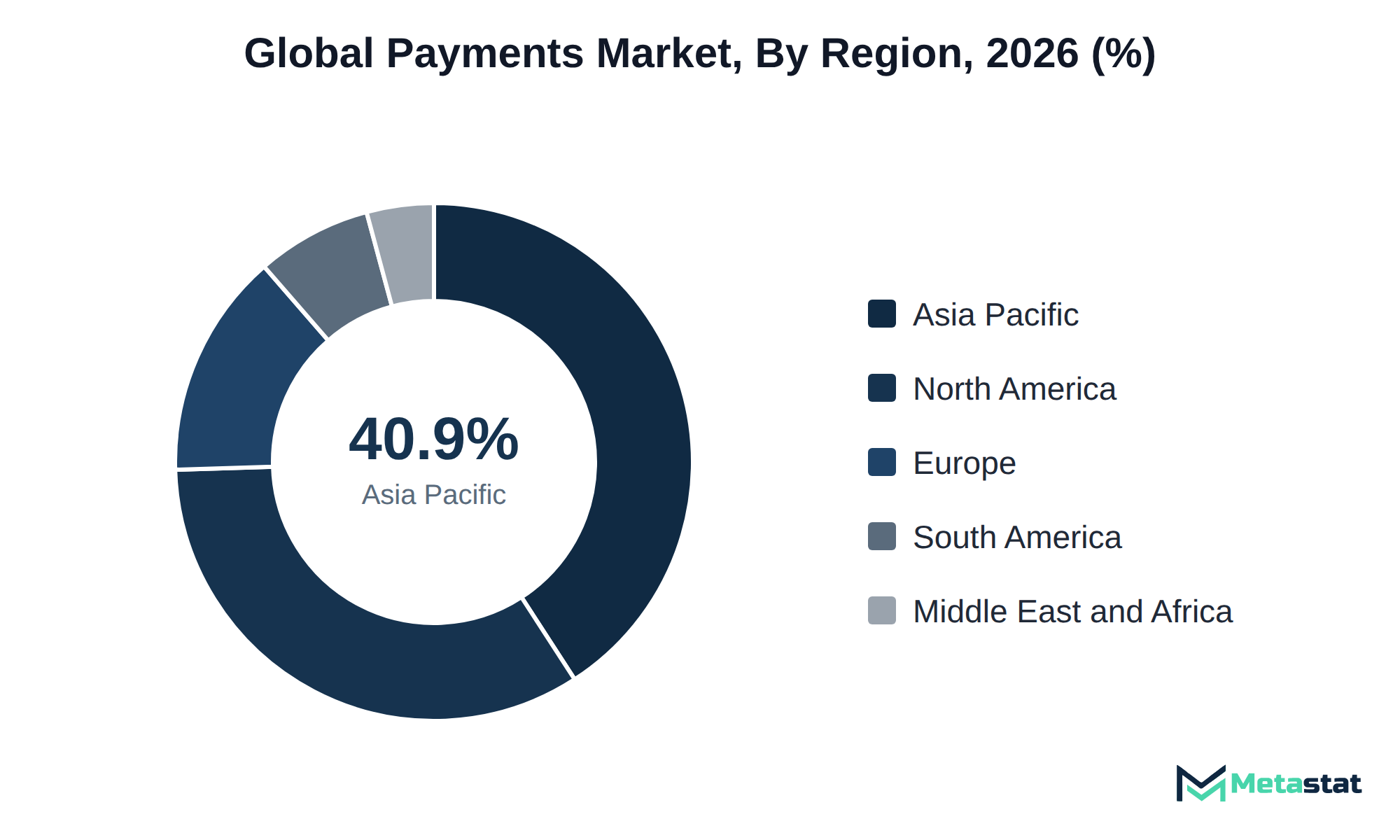
Demand within North America drives significant growth in the Payments market, where technology adoption continues to evolve rapidly. The United States, Canada, and Mexico represent the primary countries contributing to this demand. A strong digital infrastructure supports the increasing use of credit and charge cards, which are projected to reach USD 1,041.6 billion by 2033, expanding at a CAGR of 3.4%. Regulatory frameworks in this region facilitate smoother transaction processes, promoting consumer confidence in digital payments. North America is projected to reach USD 1,072.1 billion by the end of 2033, accounting for 33.7% of the global market share in 2025. The rising preference for secure and efficient transaction methods fuels further growth potential in the sector.
Europe's Payments market, characterized by its diverse financial infrastructure, encompasses a considerable share of the global market. Germany, France, the UK, Italy, Spain, and Russia play essential roles in driving demand across various sectors. The region benefits from advanced banking systems and a growing inclination toward digital payment solutions. The rise in e-commerce continues to fuel consumer spending, further stimulating market growth. The regulatory environment in Europe encourages innovation in payment technologies, enhancing competition among financial service providers. This dynamic promotes the adoption of more efficient payment methods, contributing to the overall expansion of the Payments market.
The Asia-Pacific region accounts for 40.9% of the global Payments market in 2025. Rapid digitalization and the proliferation of mobile payment technologies drive increased adoption among consumers in China, India, and Southeast Asia. The region's robust economic growth, coupled with a large population of unbanked and underbanked individuals, enhances the demand for innovative payment solutions. Regulatory frameworks supporting digital payments facilitate this shift towards cashless transactions. Countries like Japan and South Korea emphasize advanced fintech solutions, which reshape the payment landscape, attracting substantial investments. Projections indicate ongoing growth in this dynamic market, with opportunities arising from the increasing demand for efficient payment experiences across various industries.
Brazil and Argentina play crucial roles in driving demand within the Payments market, with a growing emphasis on digital payment solutions. The increased penetration of mobile banking and e-commerce platforms significantly influences consumer behavior and transaction preferences in these countries. Ongoing investments in payment infrastructure, including enhancements to online payment security and efficiency, promote higher adoption rates. The expansion of financial inclusion initiatives addresses underserved populations, creating a more robust payment ecosystem. With a share of 7.2% in 2025, the region demonstrates potential for growth, particularly in adapting to evolving consumer expectations and technological advancements. The market in South America is projected to expand, guided by these trends and developments.
The Payments market in the Middle East and Africa reflects unique characteristics driven by rapid technological advancements and increasing financial inclusion initiatives. Countries including Saudi Arabia and the UAE exhibit significant investments in digital payment infrastructure, facilitating a shift toward cashless transactions. The adoption of mobile payment solutions and digital wallets is prominent among consumers and businesses, enhancing transaction efficiency. In South Africa, a growing focus on financial literacy and access to banking services contributes to expanding market participation. The region's share of the global market in 2025 stands at 4.2%. Innovations in payment technologies, alongside government support for fintech development, create a favorable environment for growth in this segment.
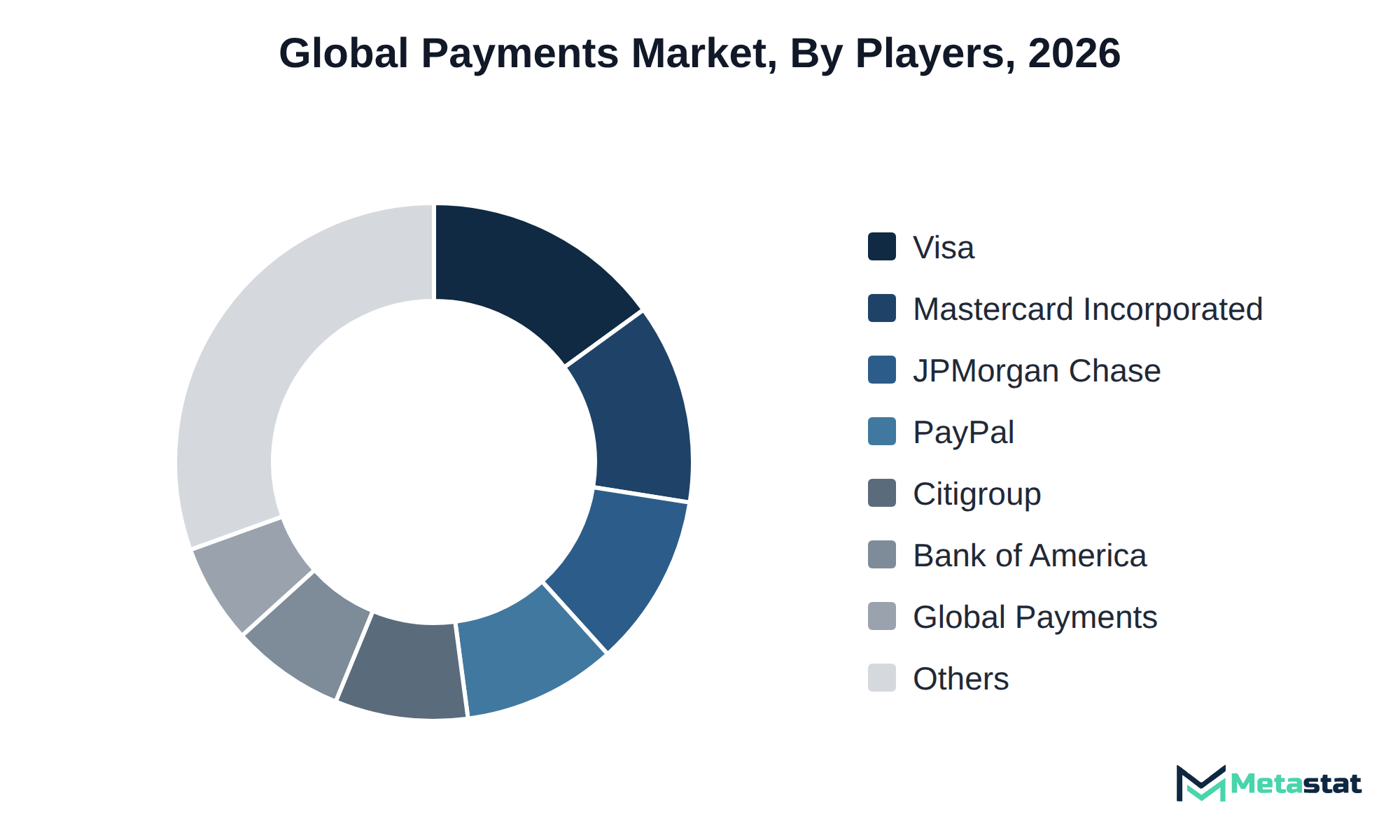
Companies in the payments market employ various strategies to differentiate themselves and attract customers. Major players focus on factors including price, service quality, and ecosystem integration. Buyers often choose providers based on the perceived value of transaction fees, security certifications, and the ability to customize services to fit specific requirements.
Visa Inc. and Mastercard Incorporated operate in the credit and charge card segment, leveraging their extensive networks and partnerships to offer competitive pricing and efficient services. PayPal Holdings, Inc. emphasizes convenience and user experience, appealing to consumers through its widely recognized platform for online transactions. Companies like Stripe, Inc. and Adyen N.V. focus on providing integrated payment solutions tailored for e-commerce, addressing the increasing demand for effective online payment processes across various industries.
Achieving this target relies on several key developments within the Payments market. This trend reflects an increase in digital commerce and the adoption of electronic payment solutions by consumers. Second, the expansion of cross-border payment services, anticipated to grow at a CAGR of 5.6%, represents a significant opportunity for the market. More businesses seek international exposure, necessitating efficient payment solutions across borders. However, the main risk that could impede market growth stems from regulatory constraints in various regions, particularly in Europe and the Asia Pacific, where compliance with strict regulations slows the adoption of new payment technologies. These dynamics show why adaptability and innovation matter in the Payments market for capturing emerging opportunities and handling potential challenges.
By Payment Instrument: Credit and Charge Cards, Debit Cards, Prepaid Cards, Credit Transfers, Direct Debits, E-money and Mobile Money, Checks, Cash, Others (Digital Asset Payments, Money Orders)
By Payment Flow: Domestic Payments, Cross-border Payments
By Revenue Type: Fee Income, Net Interest Income
The report strategically identifies and profiles the key market players and analyses their core competencies in each sub-segment of the Payments market.
Report Attributes | Details |
Study Period | 2021-2033 |
Base Year | 2025 |
Estimated Year | 2026 |
Forecast Period | 2026-2033 |
Historical Period | 2021-2025 |
Growth Rate | CAGR 4.4% from 2026 to 2033 |
Revenue Unit | USD billion |
Segmentation | By Payment Instrument, Transaction Type, Payment Flow, Revenue Type, and Region |
By Region | North America (By Payment Instrument, Transaction Type, Payment Flow, Revenue Type, and Country)
|
Europe (By Payment Instrument, Transaction Type, Payment Flow, Revenue Type, and Country)
| |
Asia Pacific (By Payment Instrument, Transaction Type, Payment Flow, Revenue Type, and Country)
| |
South America (By Payment Instrument, Transaction Type, Payment Flow, Revenue Type, and Country)
| |
Middle East and Africa (By Payment Instrument, Transaction Type, Payment Flow, Revenue Type, and Country)
|
Find answers to common questions about this report
The Payments market size was valued at USD 2,162.4 billion in 2025.
The market is projected to grow at a CAGR of 4.4% during the forecast period from 2026 to 2033.
The North America Payments market size is estimated to reach USD 1,072.1 billion by 2033.
Credit and Charge Cards lead the Payments market with a projected value of USD 1,041.6 billion in 2033, based on the highest forecast figure among the segments.
Recent shifts in consumer preferences toward digital payments drive significant growth in transaction volumes. The technological advancement of payment processing systems enhances customer experience, leading to increased transaction volumes and improved operational efficiencies across various sectors.
Asia Pacific holds the dominant share of the Payments market, accounting for 40.9 percent in 2025. This region surpasses others, including North America at 33.7 percent.
Insufficient infrastructure and high compliance costs restrain Payments market growth. Many small to medium-sized enterprises struggle to secure resources for updated systems, while increasing regulatory requirements challenge suppliers' profit margins. These factors limit the adoption of efficient payment solutions and hinder overall market expansion.
Several factors favor adoption in the Payments industry, including increasing consumer demand for digital payment solutions and the rise of e-commerce. The growing preference for flexible payment options, particularly in the Credit and Charge Cards segment, enhances transaction volumes and revenue streams.
The Payments market is estimated to reach a valuation of USD 3,052.7 billion by 2033.
Key players operating in the Payments industry include Visa Inc., Mastercard Incorporated, JPMorgan Chase & Co., Citigroup Inc., PayPal Holdings, Inc., Stripe, Inc., and Apple Inc.
The analysts below cover Banking & Finance research at Metastat Insights.
LEAD ANALYST
Utkarsh Khirodkar is a Lead Market Research Analyst at MetaStat Insight, specializing in market intelligence, technology sector assessments, and competitive strategy.

PRINCIPAL CONSULTANT - ENTERPRISE AI & EMERGING TECHNOLOGIES
Banking & Finance · Electronics and Semiconductor · Energy and Power · Healthcare IT · Information & Technology · Professional Services
Vijay Gunti is a Principal Consultant at MetaStat Insight, bringing over two decades of experience across enterprise digital transformation, technology strategy, and intelligent systems.
Replacing petrochemical surfactants with bio-based alternatives requires realistic timelines on industrial precision fermentation scaling. The market research broke down commercialization timelines, feedstock sugar price sensitivities, and regional cosmetic ingredient regulatory approvals in Europe and East Asia. That supplier readiness mapping gave our formulations team reliable context when comparing renewable chemical sourcing roadmaps.
Tracking ceramic matrix composite adoption in high-bypass aero engines requires strict attention to material qualification cycles and FAA airworthiness testing milestones. The MetaStat Insight team provided a detailed timeline of silicon carbide fiber manufacturing capacity and commercial foundry lead times. Having clear visibility into upstream thermal barrier coating supply helped us stress-test our long-term component procurement strategy.
Transitioning ultra-class mining haul trucks to alternative power requires concrete data on remote hydrogen refueling infrastructure economics. The report evaluated megawatt-scale electrolyzer installation expenses, onsite storage safety mandates, and heavy-duty fuel cell stack degradation under continuous duty cycles. That technical rigor helped our engineers benchmark realistic total operating cost horizons for off-highway fleet decarbonization.
Explore related market intelligence reports worth reading alongside this one.